Showing posts with label Rule 7.02. Show all posts

Monday, August 29, 2022

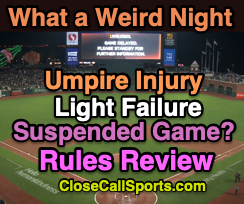
After Marvin Hudson Gets Hurt, the Lights Fail

San Diego defeated San Francisco Monday night, but not after two delays due to an injury to original HP Umpire Marvin Hudson, followed by a light failure at Oracle Park in the 3rd inning. What are the rules for called, paused and suspended games, anyway?

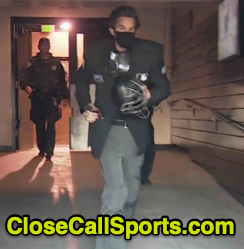
Injury: With none out and none on in the bottom of the 1st inning, HP Umpire Hudson slipped on the infield grass behind home plate on a first-pitch pop fly from Giants batter Tommy La Stella that fell to the ground in foul territory. Crew Chief Hudson was replaced behind home plate by 2B Umpire John Tumpane, while 1B Umpire Ryan Blakney remained at first base and 3B Umpire Adrian Johnson remained at third, additionally assuming acting crew chief duties, which would come into play when...

...Light Failure: At the conclusion of the 2nd inning, as California and the Pacific Time Zone bid adieu to sunlight, Oracle Park became darker and a reportedly pre-existing problem with the stadium lights became hazardous to continued play. 

As a result, the umpires called "Time" (well, it was an inning break anyway) pursuant to Official Baseball Rule 5.12 (a combination of provision (b)(1): "darkness...makes immediate further play impossible" and (b)(2): "light failure makes it difficult or impossible for umpires to follow the play").

As operations staff worked on the light malfunction issue, the umpires pondered whether it would be possible to resume play. Although play did eventually resume after a lengthy delay, the umpires considered Rule 7.02(a) for how to proceed if play were to be impossible for the remainder of the night: "A game shall become a suspended game that must be completed at a future date if the game is terminated for any of the following reasons...(3) light failure."

Although OBR 7.02(a) lists several different possibilities for suspending play—curfew, time limit, darkness unrelated to light failure, inclement weather (rain)—only light failures, equipment malfunctions (e.g., tarp failures), and non-light failure darkness result in a suspended game no matter when they occur. Whether a game gets called due to light failure in the 1st inning or the 8th, it becomes a suspended game to be made up at a future date.

This is different than inclement weather (rain) or a curfew/time limit, which either become a suspended game if it has not yet reached regulation game status (e.g., five innings completed or four-and-a-half innings if the home team is ahead; this rule was changed in 2020 due to COVID-19 health and safety protocols [prior to 2020, non-regulation terminated games were wiped off the books and started from scratch at a later date]), or become a called game in which case the score is final (e.g., 4-3, F/7, signifying the game is final but only seven innings were played).

Finally, because the rulebook is always simple, MLB has decreed that the suspended game rule/decision tree does not apply to postseason games. The Commissioner's Office makes all decisions relative to postseason games and, if worst comes to worst, will suspend even a rain-stopped game, so as to ensure all games are played to the full nine innings (or extra innings if tied).

Video as follows:

Tuesday, May 4, 2021

Light Failure - An Ump's Play On vs Suspension Call

When lights went out at Busch Stadium during Monday's #Mets-#Cardinals game, HP Umpire Mark Carlson immediately called time before pitcher Alex Reyes' delivery. What is MLB's light failure rule and at what point does a power outage turn into a suspended game? Seeing as a manager filed a protest regarding a light failure situation in the past, it's important to know the rules to determine when to play vs when to call both teams in; even if protests are no longer permitted in MLB, it is important to get the call right the first time.

The protested game occurred on June 22, 2015, when Joe Maddon's Chicago Cubs hosted Don Mattingly's Los Angeles Dodgers. With Clayton Kershaw on the mound in the 6th inning of a one-run game (Cubs leading 2-1), several banks of lights unexpected shut off.

After Maddon left his dugout to question the lighting situation, HP Umpire Jordan Baker met with his Crew Chief Jerry Meals and the umpires ultimately opted to keep playing. Maddon, perhaps in a ploy to ice Kershaw, then argued with Meals before again pleading with Baker to stop playing, even as full power appeared to be restored to Wrigley Field.

Mattingly yelled at Maddon, Maddon yelled at someone on the Dodgers, Kershaw yelled over Andy Fletcher at Maddon, and, ultimately, Maddon filed a protest that the umpires had failed to stop the game due to light failure. Although the Cubs ultimately defeated Los Angeles 4-2 (thus the protest was dropped), we follow the rules to determine that even had LA won the game, the protest would have failed.

Official Baseball Rule 5.12(b)(2) states that "The ball becomes dead when an umpire calls “Time.” The umpire-in-chief shall call “Time"—When light failure makes it difficult or impossible for the umpires to follow the play...Except in the cases stated in paragraphs (2) and (3)(A) of this rule, no umpire shall call “Time” while a play is in progress."

As light failure is 5.12(b)(2), umpires can call "Time" while play is in progress if the light failure criterion applies.

Finally, OBR 7.02(a)(3) states that a game becomes a suspended game (meaning it is preserved at the moment of suspension and must be completed at a future date) if the following occurs: "Light failure, malfunction of, or unintentional operator error in employing, a mechanical or field device or equipment under the control of the home club."

MLB cited this rule 7.02(a)(3) (then known as 4.12(a)) as its basis for upholding a protest for the first time in 28 years when the San Francisco Giants protested in 2014 that the Cubs' ground crew erred in deploying the tarp during a rain delay.

However, for light failure, notice 5.12(b)(2)"s statement, "When light failure makes it difficult or impossible for the umpires to follow the play": not the players, not the managers or coaches, not even the fans...the umpires. Thus, the rule regarding light failure concerns the rare umpire judgment call not based on reading anyone else's mind or intent nor factoring in player safety or anyone else's concerns, but reading one's own ability to see a baseball and follow play; the purest judgment call there is.

Video as follows:

Friday, May 18, 2018

Ask the UEFL - Trades During a Suspended Game

A rain delay turned Tuesday's Yankees-Nationals contest into a suspended game. With the game not set to resume for another month, Ask the UEFL considers what would occur if New York or Washington added a player to the roster via trade or other transaction during that span. Eligible players ordinarily include those on the active roster, but what of those who weren't with a team when a game first began?

Video: Do the rules address a mid-game trade?
Could a player conceivably wind up playing for both teams during the same suspended game, or, rather, do the rules prohibit a player from appearing on both sides during the same game?

Question: Are such new players—acquired via trade, call-up, coming off the Disabled List, or otherwise—eligible to participate in the second half of the suspended game or is the roster limited to only those who started play on Tuesday when the game was originally suspended? What if a player were serving a disciplinary-related punishment, such as a 50-day PED suspension, when the game first began?

Answer: First, we find that the Yankees-Nats game is suspended because it was a regulation game (5+ innings) called with the score tied (3-3), as in Rule 7.02(a)(6).

With that established, we find our answer in Rule 7.02(c), which states:
A player who was not with the club when the game was suspended may be used as a substitute, even if he has taken the place of a player no longer with the club who would not have been eligible because he had been removed from the lineup before the game was suspended.
This player "not with the club" specifically refers to a player who did not appear on the 25-man active roster (or 40- in September), meaning that in addition to traded players, a club can use a player who has returned from the Disabled List, been called up from the minor leagues, or been moved from the 40- to the 25- active roster—as long as the team carries no more than 25 players (40 in September) on the roster in use for the resumption portion of the suspended game. A suspended player, likewise, was "not with the club" in the sense that he was not in the clubhouse or eligible to participate when the game was suspended, even if he were still on the Major League squad serving his penalty.

This ensures that a team which trades heavily or is subject to a Restocking Draft (pursuant to ML Rule 29, Major League Disaster Plan) is not placed at an unfair disadvantage upon resumption of a suspended game; for instance if a team had traded away half of its roster between the first and second halves of a suspended game, it will not lose the eligible-to-play roster spots that had been occupied by traded-away players.

Picture This: A player who was taken out in the 3rd inning of what will eventually become a suspended game because that player had been traded to another team is then traded back to his original team months later. Can this player re-enter the game because he "was not with the club when the game was suspended" in a later inning?

2015: NYM's Wilmer Flores thought he was
traded mid-game, but eBIS never verified it.
Answer: Simply put, no. Rule 5.10(d) states that "a player once removed from a game shall not re-enter that game." A mid-game trade won't change that.

A longer explanation is that if the transaction was entered into the Electronic Baseball Information System (eBIS)—the same system through which other transactions such as drafts, minor league assignments, and Disabled List placements are effected—prior to the suspension of the game, then the player is said not to be with the club. The realistic nature of each transactions' detailed subtleties indicates that it simply takes time to dot the i's and cross the t's, and additional time for the League to cross-check certain eligibility criteria (no-trade clause? bonus? do the teams actually agree to the trade's terms?). Thus, the trade will not be official before the game becomes suspended, meaning, in addition to 5.10(d), this player will not be eligible to re-enter the game under 7.02(c).

History: According to SABR archives, no player has appeared for both the winning and losing teams in a suspended game separated by a period of time, but it could have happened on several occasions.

Tuesday, March 27, 2018

Broken Sewer Pipe Ends Angels-Dodgers Game in 5th

Tuesday's Spring Training finale at Dodger Stadium came to an abrupt halt in the bottom of the 5th inning, when a third-base side water main burst and flooded the left field warning track, purportedly with sewage, along foul territory. Enter the unconventional plumbing delay.

Pipe bursts, making the field unfit for play.
After further delay and consultation with the grounds crew and both clubs, Crew Chief Gerry Davis opted to call the game pursuant to Official Baseball Rule 7.01 and 4.08(g).

First, OBR 4.08(g) states that, "Between games of a doubleheader, or whenever a game is suspended because of the unfitness of the playing field, the umpire-in-chief shall have control of ground-keepers and assistants for the purpose of making the playing field fit for play.
PENALTY: For violation, the umpire-in-chief may forfeit the game to the visiting team."

Because the home team was leading at the time Davis called the game after the visiting team had already batted five times (e.g., the bottom of the 5th inning), it became a regulation game (Rule 7.01[c][2]) that, had this occurred during the regular season, may well have become a suspended game to be completed at a future date (Rule 7.02[a][3]); because of the Spring Training nature of the game, naturally, the game became final with the home team the victor.

It was Rule 7.02(a)(3) (then known as Rule 4.12(a)) that served as basis for a Giants protest in August 2014, resulting in MLB's first upheld protest in nearly three decades and an order to continue the suspended game.
Related Post: Protest Upheld for 1st Time in 28 Yrs in SF-CHC Rainout (8/20/14).
Related Post: Forgoing "Time" to Power Through Light Failure (4/14/17).

As we recently reviewed, the home team determines whether or not to start the game, but, once started, the umpire has sole authority to call or suspend the game, in accordance with the official rules.
Related Post: Ask the UEFL - Testing for Fog and Other Perils of Play (3/17/18).

For what it's worth, the third and final Replay Review of the 2018 preseason was also the third call to go against the Dodgers following a manager's challenge. In the 2nd, Angels center fielder Mike Trout's relay to shortstop Andrelton Simmons to catcher Martin Maldonado was just in time to nab Dodgers baserunner Enrique Hernandez trying to score from first base. HP Umpire John Libka's out call stood following a challenge by Dodgers Manager Dave Roberts.

Wrap: Los Angeles Angels of Anaheim vs. Los Angeles Dodgers, 3/27/18 | Videos as follows:

Wednesday, March 7, 2018

Declaring a Tie - NCAA Game Ends After Ump Hurt

Tuesday's Florida Southern vs Mount Olive NCAA Division II baseball game ended in a scoreless tie after the home plate umpire left due to injury in the game's 7th inning.

Jim Joyce umpires from behind the mound.
Having sustained a foul ball injury in the 5th inning, Tuesday's home plate umpire persevered through the 6th and into the 7th, until a rotation play forced the issue as the afflicted plate umpire ran to cover a baserunner advancing to third base on a single to right field; the umpire ended up at a local hospital due to the game-related injury.

With a two-person officiating crew assigned to this inter-conference matchup, both head coaches agreed to end the game in a 7th inning tie rather than continue with one umpire. It was the finale of a brief two-game series.

College Rule: NCAA baseball rules allow for tie games: "Any regulation game called by the umpire with the score tied shall be declared a 'tie' game. Note: All individual and team averages from a tie game shall be incorporated into the official playing record" (5-10-b). Because the game was called in the 7th inning, it was a regulation ballgame (having gone at least five innings). Meanwhile, Rule 3-6-h states, "No umpire may be replaced in a game unless the individual becomes ill or injured." So while the umpire technically could have been replaced, with an out of conference Division II matchup (announced attendance: 25), it would have been highly unlikely for a replacement to be nearby.

Professional Rule: In professional baseball, a regulation game called with the score tied becomes a suspended game that must be completed at a future date (OBR 7.02(a)). If this same regulation suspended game is subsequently not completed prior to the last scheduled regular season game between the two teams, it becomes a "tie game" pursuant to Rule 7.02(b)(4)(B), unless either of the two teams involved would need to play the game in order to determine postseason eligibility or seeding, in which case the game must be completed prior to the playoffs. OBR 10.03(e)(1) instructs the official scorer to "record all individual and team actions up to the moment the game ends," with the exception of winning and losing pitchers.

OBR's replacement rule 8.02(d) states, "No umpire may be replaced during a game unless he is injured or becomes ill." Generally speaking, an umpire injured in a four-person game causes the crew to assume three-person mechanics, three umps beget two, etc.
Related Post: Dale Scott Exits with Injury, Joyce Umps Behind Mound (3/5/15).

Retrosheet maintains a repository of umpire changes during games dating back to 1871 (reason: "catch train"). According to the database, the last MLB umpire replacement occurred on July 14, 2011, when Cory Blaser entered the Brewers-Rockies game in its 4th inning to replace 2B Umpire Brian O'Nora, who had left shortly after the game began due to back pain.

From tmac:
Blaser umpired the AAA All-Star game in Salt Lake [on Wednesday, July 13] and was not scheduled to work another game until Friday [July 15] so he WAS sitting at home. When O'Nora got to the locker room [during the game on Thursday, July 14] and was deemed unfit to return, MLB execs called Blaser who must be able to drive very quickly (or was at the game having a beer (JOKE!)). This is a very unusual situation, as the ONLY time an umpire would be home (unless home is a city he works) would be during an all star break. I must start looking at a calender (or at least buy one).
Cubs-Pirates game ends in a tie.
Historical Note: The last tie in Major League Baseball occurred on September 30, 2016, when the evening's Cubs-Pirates game was called due to rain in the top of the 6th inning with a 2-2 score. Because that game was the last scheduled contest between the two teams for the 2016 regular season, and because the Cubs had already clinched home field advantage through the League Championship Series (best National League record...home field advantage for the 2016 World Series was decided by whichever league won the All-Star Game, the final year of MLB's 14-year "this time it counts" experiment), whereas Pittsburgh had already been eliminated from postseason contention, the game was declared final pursuant to OBR 7.02(b)(4)(B).
Related Post: Anatomy of a Tie as Cubs-Pirates Game Ends in 1-1 Draw (9/30/16).

High School Rule: Under NFHS Rule 4-2-2, any game called at the end of five+ innings with the score tied shall be recorded as a "tie game," unless the state association has instituted a specific policy to address ties. As in the other codes, all individual and team statistics count for seasonal totals, but the game doesn't factor into a team's win-loss record. The NFHS umpire replacement rule is 10-1-6 ("No umpire may be replaced during a game unless he becomes ill or is injured").

Tuesday's was the final game of the Mocs-Trojans series and game time had been moved up in the day due to forecasted inclement weather later in the evening.

Wrap: Florida Southern Moccasins vs Mount Olive Trojans, 3/6/18

Thursday, August 31, 2017

NPB Game Suspended After Flock-of-Birds Delay

8/30's NPB (Japan) Eagles-Lions game at Kobo Park Miyagi in Sendai was suspended due to rain and a flock of birds that refused to leave the stadium, ultimately leading to a call of animal abandonment.

Birds encircle players at Kobo Park Miyagi.
With the Saitama Seibu Lions leading 8-4 heading into the bottom of the 8th inning, the Tohuku Rakuten Golden Eagles, who call Kobo Park Miyagi home and play alongside Saitama Seibu in the NBP's Pacific League, scored four times before rain put a halt to play.

As the delay concluded and umpires Kimihiro Akimura,  Masuda Shohei, Tetsuo Yamaji, and Argana Shoji prepared to resume play, a flock of birds descended on the stadium—perhaps under the impression, during the rain delay, that the game had ended—flying in circles and disrupting the defensive players. After pulling players off the field, stadium personnel attempted to chase the birds into the outfield before shutting off the lights in an attempt to get the flock to leave.

Kobo shut off its lights to coax the birds away.
By that time, however, the attempted bird removal delay—which at one point involved a drone dispatched to patrol the outfield sky—had spanned past the 40-minute mark and hadn't yet proven successful, resulting in an ultimate decision to call off the game, leading to its suspension or, what in OBR, would be Rule 7.02(a):
A game shall become a suspended game that must be completed at a future date if the game is terminated for any of the following reasons:
Kobo's scoreboard says: The Game is Over.
Before we leave this one to the birds, which is a situation not explicitly addressed in the rulebook, note that OBR 7.02(a)(6) mandates the game shall become suspended if play is terminated with the score tied: "It is a regulation game that is called with the score tied."

Finally, let's review what happens if a ball were to strike a bird during play. In sum, a batted or thrown ball remains live and in play, while a pitched ball becomes dead ("no pitch"):
If a batted or thrown ball strikes a bird in flight or other animal on the playing field, the ball is considered alive and in play, the same as if had not touched the bird or animal.
If a pitched ball strikes a bird in flight or other animal on the playing field, the pitch is nullified and play shall be resumed with the previous count. 
Seagulls show up late in San Francisco.
Examples: In 2009, a group of Cleveland-area gulls helped give the home team a walk-off victory by distracting Royals outfielder Coco Crisp on a line drive to center field. One seagull was struck by the batted ball as it attempted to fly away; the batted ball was kept alive and in play. Meanwhile, Randy Johnson in 2001 threw a pitch that struck a bird flying by. Both the ball and bird were declared dead, and the circumstance of a pitched ball striking a bird was added to the MLB Umpire Manual shortly thereafter.

The Japanese phalarope (link is to the North American Audubon Field Guide, although red and red-necked phalaropes are two phalarope species that inhabit the Japanese Empire's coastal region; Sendai is a coastal city in Japan's Miyagi Prefecture) is known to engage in circling behavior as displayed in Sendai on Wendesday: "In courtship, female flies in wide circle, calling."

Gulls eat popcorn at Oakland's Coliseum.
In Major League Baseball, perhaps the bird with greatest invasion potential is the San Francisco Bay Area seagull, which has been feasting on the discarded peanuts and Cracker Jack of AT&T Park ever since the formal dedication of McCovey Cove. The gulls' usual MO is make an appearance late in a Giants game, usually the 9th inning when fans are filing out, leaving behind food and other treats for the eastern Pacific Coast's scavenging fowl. Seagulls have also been spotted in other ballparks near the water, including in Oakland, San Diego, Seattle, and at Chicago's Wrigley Field.

Wrap: Tohoku Raketten Golden Eagles vs. Saitama Seibu Lions, 8/30/17 | Video as follows:

Friday, April 14, 2017

Forgoing "Time" to Power Through Light Failure

A bank of lights failed just prior to a pitch during Wednesday's Braves-Marlins game, bringing baseball's rules concerning power outages and other emergency procedures to the forefront.

Umpires wait out the light outage delay.
With one out and none on in the top of the 4th inning, Marlins pitcher Tom Koehler began his delivery to Braves batter Brandon Phillips as a series of field lights in Miami shut off, noticeably dimming lighting conditions throughout the ballpark and field of play. Koehler completed his delivery and Phillips hit the ensuing knuckle-curve on the ground to third baseman Miguel Rojas, who threw to first baseman Tyler Moore for the inning's second out.

After the conclusion of that play, HP Umpire and Crew Chief Ted Barrett called "Time" to consult with his crew and the game experienced a delay as Marlins Park facilities staff restored power to the affected light bulbs.

Umpires made the proper call in allowing play to continue until the out was recorded.

Official Baseball Rule 5.12(b) delineates when an umpire may call "Time," and specifically names light failure (partial or complete) as one of these instances, albeit with an important qualification:
(2) The ball becomes dead when an umpire calls 'Time.' The umpire-in-chief shall call 'Time'...When light failure makes it difficult or impossible for the umpires to follow the play.
>> For the additional six reasons "Time" may be called, refer to our review from 2012, "Are Umpires Calling 'Time' to Argue?" <<

A number of lights failed during play in MIA.
The consideration for calling "Time" in a partial or complete light failure situation is not simply whether or not a requisite number or percentage of field lights have shut off, it is whether the light failure has made it "difficult or impossible" for the umpires—not the players, coaches, or managers—to follow the play.

Rule 5.12(b)(8) states, "Except in the cases stated in paragraphs (2) and (3)(A) of this rule, no umpire shall call 'Time' while a play is in progress."

Accordingly, as Miami's partial light failure did not make it difficult or impossible for umpire Ted Barrett or his crew to follow the play, he properly kept the ball alive until such time as the play's completion allowed the ball to become dead in a natural fashion, after which he wisely held the game until such time as the lighting situation could be resolved.

Hypothetical: Had Marlins staff been unable to remedy the problem, and this forced the game to be called, Rule 7.02(a) (formerly 4.12) holds that the game would become suspended—regardless of innings completed or the score: "A game shall become a suspended game that must be completed at a future date if the game is terminated for any of the following reasons...Light failure, malfunction of, or unintentional operator error in employing, a mechanical or field device or equipment under the control of the home club (e.g., a retractable roof, a tarpaulin, or other water removal equipment)."

Wendelstedt observes Chicago's rain chaos.
Rule 7.02(a)(3) (formerly 4.12(a)) was the rule involved in Major League Baseball's most recently upheld protest in August 2014, when the San Francisco Giants protested HP Umpire and Acting Crew Chief Hunter Wendelstedt's decision to call and make final the result of a 2-0 Cubs win in five innings, caused by Chicago grounds crew's inability to properly place Wrigley Field's tarp during a rain delay, which in turn resulted in flooding to the infield when umpires attempted to resume play.

At the time, then-Rule 4.12(a) simply stated, "Light failure or malfunction of a mechanical field device under control of the home club. (Mechanical field device shall include automatic tarpaulin or water removal equipment)." In terminating the game and making it final, Wendelstedt explained, "by the baseball rulebook, there was nothing to put our hat on to suspend the game."

MLB VP Joe Torre's office ruled the play a field device malfunction, but also agreed with Wendelstedt about the rule's deficiency, and the following season, the MLB Rules Committee voted to add "unintentional operator error in employing [the device]" to the rulebook.

Miami light outage video via "Read More"

Friday, September 30, 2016

Anatomy of a Tie as Cubs-Pirates Game Ends in 1-1 Draw

Thursday's Cubs-Pirates game ended in a tie for the first time in MLB since 2005, when the Astros and Reds finished their game even at 2-2. Rules discussion: Is a tie ever an acceptable outcome in Major League Baseball?
PNC Park's final game of 2016 ended in a tie. 

Thursday's game in Pittsburgh ended as a tie in the 6th inning due to persistently poor weather at PNC Park. HP Umpire and Crew Chief Brian Gorman had called for the tarp just one hour and fifteen minutes into the game, but after waiting out another hour decided to formally suspend the game in the top of the 6th inning with a 1-1 score when the weather forecast began to look exceedingly bleak.

Whereas Official Baseball Rule 4.04 concerns Weather and Field Conditions prior to the game's first pitch (and states that the home club shall determine whether such a game is to be played [unless the game is the second game of a double header, in which case the umpire shall decide]), OBR 7.02 addresses already-begun games terminated prematurely, with 7.02(a)(5) and (6) used most frequently when a rain delay occurs: "A game shall become a suspended game that must be completed at a future date if the game is terminated for any of the following reasons...(5) Weather, if a regulation game is called while an inning is in progress and before the inning is completed, and the visiting team has scored one or more runs to take the lead, and the home team has not retaken the lead; or (6) It is a regulation game that is called with the score tied."

Thus, Rule 7.02(a)(6) states Thursday's Cubs-Pirates game was suspended at the time Gorman opted to terminate the game due to weather...So how could a suspended game "that must be completed at a future date" result in a tie and a called game?

A rain delay turned into a called game at PNC.
Rule 7.02(b)(4)(B) states how a suspended game that has progressed far enough to become a regulation game AND is the last scheduled game between the two clubs during that season (Thursday's was the final game between Chicago and Pittsburgh in 2016) shall be treated: "If the score is tied, the game shall be declared a 'tie game'" BUT that the game "must be played [to completion]...if the League President determines that not playing such game might affect post-season play, including eligibility for the post-season and/or home-field advantage for any post-season game."

Because the Cubs had already clinched home field advantage by virtue of clinching the best record in the National League, and because the Pirates had already been eliminated from playoff contention, Thursday's Cubs-Pirates game qualified as a meaningless game, as far as post-season implications are concerned: A Chicago win or loss would not change anything about the playoffs, and, thus, Thursday's game, as the last scheduled game between the two clubs, was properly declared a tie.

Wrap: Chicago Cubs vs. Pittsburgh Pirates, 9/29/16 | Video of Tie Game available via "Read More"

Friday, June 7, 2013

The Retouch Rule 7.08(d): A Game of Acting and Knowing

When the umpires suffered a week of bad press earlier this season, Vin Scully provided a much-needed reprieve, so we thought we'd see what Scully had to offer tonight after some hotly contested ejections by Clint Fagan, Dan Iassogna and the controversial gum-throwing Jordan Baker. Fortunately, Vinny didn't disappoint.

Scully—the man that UEFL'ers in 2011 voted baseball's best broadcaster—paired up with the ever-affable CB Bucknor and colleague Rick Monday to educate fans about the finer points of the "retouch rule."

Rule 2.00 specifies a retouch is the "act of a runner in returning to a base as legally required."
Rule 7.02, which establishes that a runner shall run the bases in order, also orders runners to retouch all bases in reverse order if forced to return to a base.
Finally, Rule 7.08(d) requires a runner to "retouch his base after a fair or foul ball is legally caught before he, or his base, is tagged by a fielder." If he fails to do so, the defensive team may appeal for an out.

Bucknor praised after call at 2nd.
With none out and one on in the top of the 8th inning of the Braves-Dodgers game, Braves batter Andrelton Simmons hit a fly ball to Dodgers center fielder Andre Ethier as baserunner R1 Jordan Schafer ran with the pitch before returning to first base. Unfortunately for Schafer, the adept CB Bucknor and Dodgers second baseman Skip Schumaker saw a violation of Rules 2.00 RETOUCH, 7.02 and 7.08(d) and, after appeal, Schafer was called out to complete the double play.

Replays indicate Schafer slid headfirst into second base, rounded and took two steps beyond second base towards third and then, realizing Ethier was about to catch the baseball, retreated to first base without first retouching second base, the out call on appeal was correct.

And so was Scully, who said:
Let's take a look and see. There's Schafer going into second, the Dodgers trying to double team him... Oh, he rounded second, you see that? He went in and actually took two steps beyond second base and then didn't touch second base going back to first, so that was a great call by the umpires, indeed.
Unfortunately, the video ends before Scully's recap of the play following the mid-inning commercial break:
Schafer lost where the ball was and forgot to retouch second on his way back to first... He said "I touched the bag," but he only touched it once; he should have touched it twice. Heads up play by Punto, Schumaker and the Dodgers. Plus, a very, very good call by CB Bucknor, the umpire at second base. They always get boo'd at, but boy that was a great call by the umpire to spot it. 
Meanwhile, Braves broadcaster Chip Caray had a different take: "They're going to say he didn't retag. They're going to call Schafer out for not retagging, you see he touched it, he slid and stood back up and stepped right back on the bag and came back to first. Now Dale Scott saying, 'you overslid and didn't retouch. You have to retouch the bag.'"

After viewing the tape, Caray admitted there was no retouch, crediting Punto-Schumaker with a "great play."

Dodgers radio analyst Rick Monday spotted it immediately: "The Dodgers need to make the appeal to second base, he went past the bag and didn't retouch it on the way back—he's out!"

In closing, Monday said what we all are constantly thinking: "I'm still amazed at how many players play this game and do not know the rules—and I'm talking about basic rules... Both Schumaker and Punto should get an award for supporting cast...I'm sorry, this is the major leagues—that's basic. I'm amazed. Again, Schafer did not know where the ball was. Once he got up, he turned and looked at his third base coach but took a step toward third base—well, that's in the interpretation, an 'advance,' but even if you overslide the bag, you have to come back and hit it on the way back." Added Charlie Steiner, "you have to retouch."

Video: Schafer fails to retouch 2nd while running in reverse order, LA appeals and CB bangs the out (LAD)
[Context: On Monday, the Dodgers middle infield deked Padres R1 Chris Denorfia on a fly ball to deep right field in the 9th, allowing RF Yasiel Puig to complete a game-ending double play, as called by HP Umpire Mark Wegner after making sure U2 Tim Timmons was not also making a call]

Monday, April 22, 2013

Solution for Case Play 2013-03: Segura as R2 Steals First

Group Case Play 2013-03 (R2 Segura stealing first base) is now final. Answer appears below.

To refresh: With R1 and R2, F1 sniffed out R2's stolen base attempt and trapped him in a rundown between second and third as R1 advanced to second base. With R1 standing on second, R2 slid safely into second base, ballcarrier F5 tagging both R1 and R2 while both occupied second before again tagging R2 as R2 retreated towards first base before assuming a position on first. "Time" was called and R2 became R1; R1 was (formerly R2) subsequently was thrown out trying to steal second base.
Click the above pic to watch the baserunning chaos unfold.

Answer, Group Case Play 2013-03:
The group noticed F5 Valbuena tagged R2 Segura while R2 was not in contact with any base. As such, R2 could have been declared out for this "simple" reason (7.08[c]). That said...

Rule 7.08(i) was the most cited rule in our group discussion. It states, in part, that a runner is out when he "runs the bases in reverse order for the purpose of confusing the defense or making a travesty of the game." However, as R2 did not appear to be motivated in this fashion (he was confused himself), Rule 7.08(i) Comment, which addresses the case of a decoyed or confused runner, references the case of a runner touching an unoccupied base and then returning to the base he last touched. The unoccupied base referred to here would have been third and the base he last touched would be second, not first. Accordingly, 7.08(i) does not directly apply and R2 is not out pursuant to its terms.

Abandonment 7.08(a)(2) made an appearance as well, though on face value alone, it only directly applies to a runner at first base after an overrun, as allotted by rule. 7.08(a)(2) Comment: PLAY addresses a runner at third base as well, indicating abandonment may be used at other bases ("Runner believing he is called out on a tag at first or third base starts for the dugout and progresses a reasonable distance still indicating by his actions that he is out, shall be declared out for abandoning the bases") Had this been NCAA College ball, R2 would be out because he was heading for his dugout. This unique phrasing regarding the dugout does not explicitly exist in either NFHS or OBR, though such an interpretation is equally valid (9.01[c]).

However, Jim Evans has interpreted it as such, "A player who leaves the infield area abandoning the base paths between 1st base and 3rd base may be declared out once he leaves fair territory. If a play is being made on him, however, he is subject to the guidelines established in 7.08(a.1)...he must be advancing toward a base and cannot go more than three feet out of his direct line to avoid a tag."

R2, though, never left fair territory. However, a play was being made on R2 as F6 chased R2 towards first base. Pursuant to Rule 2.00, the defense could have claimed R2's violation of the rules (appeal) for a violation of Rule 7.01, "If a runner legally acquires title to a base, and the pitcher assumes his pitching position, the runner may not return to a previously occupied base."

However, after assuming his pitching position, F1 disengaged the rubber and "unassumed" his pitching position. Only while F1 was an infielder (as opposed to a pitcher) did R2 return to a previously occupied base. Right?

Well... Rule 7.02 authorizes a runner to both advance and to return to first, second, third and home bases, in order, though 7.02 is subservient to 7.01 and 7.08(a)(1) - assumption and abandonment.

The group noticed Milwaukee first base coach Garth Iorg physically assist R2 to keep him on first base and out of the Brewers' dugout, which is interference pursuant to Rule 7.09(h); however, umpires had clearly ruled "Time" prior to this event.

Lastly, R1 is not guilty of passing preceding runner R2 (7.08[h]) as simultaneous occupation is not passing.

Some commenters mentioned F6 may have been guilty of obstruction when he stood in front of R2 retreating to second base. If your interpretation is that R2 was obstructed in running the bases by F6's action, this is Rule 7.06(a) "Type A" obstruction as a play was being made on R2 at the time of the obstruction. R2 would be awarded third base while R1 would be permitted to remain at second, immediate dead ball.

Notably, Rule 10 (Official Scorer) does not account for such a wild play. Instead, the odd sequence was scored as R1 Braun caught stealing second base and R2 CS third base, as in the case of a pickoff.

As addressed by johnnyg08, the Germany Schaefer play from 1911 was a red herring: Schaefer's intent was to confuse the defense and/or make a travesty of the game; Schaefer furthermore returned to a previously occupied base after the pitcher assumed his pitching position. Segura clearly had no such intent.

And then... there's Rule 9.01(c), the elastic clause. +1 point to all participants.

Tuesday, September 18, 2012

Rule 7.10: How a Runner is Out on Appeal

Appeal plays occur in baseball when the defense claims a violation of the rules by the offensive team (Rule 2.00 [APPEAL]), while Rule 7.10 appeals occur when a fielder claims a violation by a runner.

For instance, on Saturday, the Cleveland Indians appealed that Tigers baserunner Alex Avila violated OBR Rule 7.02 by failing to touch first, second, third and home bases in order en route to scoring a run. With two out and one on, baserunner R2 Avila attempted to score from second base after Indians F6 Asdrubal Cabrera overthrew third base during an attempted fielder's choice. After the play's conclusion, the Indians appealed to third base umpire Wally Bell that Avila never touched third base, a ruling affirmed as Avila was declared out on appeal for failing to touch all bases pursuant to Rules 7.02 and 7.10(b) [failure to touch each base in order]. The ruling negated the run Avila had attempted to score during the previous play.

This table of possible outcomes for each sequence
demonstrates that the order in which an appeal is
executed is of tantamount importance.
Video: Avila ruled out on appeal for missing third base

Similarly of note, Rule 7.10 appeals must be made prior to the next pitch or any play or attempted play, while Rule 7.10 appeals themselves are not to be be interpreted as plays. Appeals are made while the ball is live.

In essense, if a runner misses third base, as in the video above, a Rule 7.10 appeal must be executed prior to the next pitch, as in the video above. Similarly, the Rule 7.10 appeal must be made before an ensuing play or attempted play.

In the video above, new baserunner R2 Quintin Berry tried to induce an attempted play by running towards third base and providing the Indians the opportunity at an easy out if they were to tag Berry while he was off his base. Had the Indians made a play or attempted play on Berry (e.g., by tagging him out) prior to completing their appeal play (e.g., by tagging third base), they would have lost their chance to appeal Avila's miss of third base.

Instead, as the video shows, third baseman Lonnie Chisenhall tagged third base pursuant to the procedure for a Rule 7.10 appeal prior to tagging Berry, who was still off his base. Because Chisenhall tagged third base and executed his appeal prior to making a play on Berry, the appeal was eligible for review and affirmation by umpire Bell. Had Chisenhall reversed the order and tagged Berry before stepping on third base, the appeal would not have been eligible for review, Bell would not have been able to declare Avila out for missing third base, and Avila's run would have stood.

Other 7.10 appeals include leaving early on a fly ball & losing overrun protection at first base, as seen here... Also listed is the rarely-seen "fourth out" play which, in tandem with a time play, occurred during a Major League contest from 2009:

Tuesday, June 14, 2011

Discussions: Miscellaneous Edition

Over the recent days, we have seen quite a few interesting plays worthy of discussion. This post will address a couple of them; and comments will be open to discuss any of the given plays.

Our first play was brought to our attention by Dan both here on blogspot and on our Facebook page. Dan writes to us:
I thought this might make for a good discussion. It's from Monday night's Mets/Pirates game. Jerry Layne called Jose Reyes for interference on baserunner Jose Tabata, as Tabata was running in between second and third based. I would be curious to see if everyone thinks this was a good call or not.
As Dan mentions, he is referring to the 6/13/11 Mets-Pirates game. In the bottom of the 1st inning, with none out and one on, Pirates batter Xavier Paul singled to Mets center fielder Angel Pagan. Pagan threw to third basemen Justin Turner who tagged out Pirates R1 Jose Tabata. However, 2B Umpire Jerry Layne ruled that Mets shortstop Jose Reyes obstructed Tabata on his way to third base and awarded Tabata third. The play can be seen here. According to Rule 2.00, obstruction is defined as: "the act of a fielder who, while not in possession of the ball and not in the act of fielding the ball, impedes the progress of any runner." Obstruction is dictated by Rule 7.06, which states, "When obstruction occurs, the umpire shall call or signal 'Obstruction.'" More specifically to our situation, Rule 7.06(b) states, "If no play is being made on the obstructed runner, the play shall proceed until no further action is possible. The umpire shall then call 'Time' and impose such penalties, if any, as in his judgment will nullify the act of obstruction."
Discussion Point: Was Layne's call correct? What standard or guidelines can be used to determine whether obstruction occurred or not, both in general and on this particular play?

Our second play also occurred during the Mets-Pirates series during the 6/12/11 game, which also included an ejection by Bob Davidson and an ejection by Jerry Layne. Anonymous writes to us:
This happens on the play before the ejection [of Hurdle]...
Can anyone see Pagan touch second, or is this a "he went by the base so he must have touched it" type of ruling?
Anonymous refers to a play that occurred during the top of the 7th inning (that can be seen here). Mets batter Jason Bay flied out to Pirates center fielder Andrew McCutchen. Mets R3 Daniel Murphy tagged up and scored on the play. However, Mets R1 Angel Pagan did not tag up from first base and rounded second base. As Pagan attempted to return to first base, he failed to retouch second base on appeal, thus making the third and final out of the inning. This particular play brings us back to a previous case play (this shows us those case plays our bound to show up!), as well as a previous umpire odds & ends that are quite similar to the situation in this game. This gives us a basis for a discussion. We will leave this as an open discussion on appeal plays and the importance for umpires to be vigilant of the runners, situation (outs, scored runs, etc.) and the rules, but also this particular play with relevant rules 7.10(b) and 7.12.