Showing posts with label Features. Show all posts

Monday, May 28, 2012

Memorial Day: Honoring Umpiring's Greatest Sacrifice

This Memorial Day, we remember the men and women who paid the ultimate sacrifice while serving in the United States Armed Forces—the US Army, Marine Corps, Navy, Air Force and Coast Guard—and on this website, we reflect on the significant relationship between war and baseball.

For every glorified story of a professional baseball superstar who served his country overseas, most notably during World War II, there exists a quiet tale of the consummate professional who dutifully performed during wartime and peacetime alike.

For every Hank Greenberg, there exists a Kent Greenfield—or in the umpiring world—every Al Barlick who served in the US Coast Guard or Nestor Chylak in the US Army can be met with a Bill Andress or Shag Crawford, both of the US Navy.

Indeed, a total of 18 Major League umpires served during WWII alone, with countless others pooled from the Minor League, semi-pro, collegiate and even high school ranks.

Of these, at least four Minor League umpires have made the ultimate sacrifice for their country. This Memorial Day, we remember their service both on and off the field.

Saturday, February 25, 2012

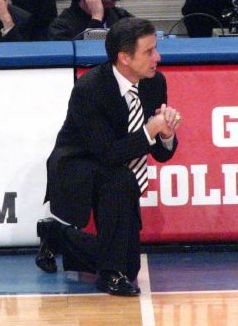
Rick Pitino Blames Officials, Opposing Fans: A Case Play of Scapegoating in Sports

There is a tendency in today's society to blame others rather than accept responsibility and admit one's own shortcomings. It is a trait exhibited by toddlers who throw tantrums and decision-makers everywhere who admonish others rather than admit wrongdoing.

Pitino in the 2007 Big East Tournament
Blaming others, or scapegoating, has become such a prevalent phenomenon, books have been written and associations formed to study the issue.

For the blamer, the act of passing the buck is often more pleasant than acknowledging fault. According to the Scapegoat Society, the discrediting routine known as scapegoating involves distortion of truth, vilification and separated from the incident at hand, the blamer sometimes resembles a conspiracy theorist.

Chris Allen Carter additionally has postulated that blamers are "insecure people driven to raise their own status by lowering the status of their target," while in 1953, Kraupl-Taylor concluded that scapegoating "leads to the satisfaction of unconscious scoptophilia and aggression and gives narcissistic satisfaction to the ego."

In other words, scapegoating and blaming others may temporarily make one feel better about him or herself, but in the end, it's just a psychological defense mechanism meant to shield oneself from responsibility and truth.

But this is a sports website... You get where I'm headed with this.

Wednesday, February 1, 2012

Referee Kelly Sutherland Injured by Puck to Face: Should Visors be Mandatory in the NHL?

NHL Referee Kelly Sutherland was injured during today's Rangers-Sabres hockey contest.

With sharp blades, whizzing pucks and weapon-like sticks, hockey referees and linesmen have one of the most dangerous officiating jobs in sports, which we were unfortunately reminded of on Wednesday night.

Just 5:37 into the first period of the New York Rangers vs. Buffalo Sabres contest, Sutherland found himself directly in the line of fire, as a shot attempt was deflected off a Rangers player, careening directly into Sutherland's face.

Thursday, January 26, 2012

University of Toronto Study: Canadian Hockey Referees Suffer Overwhelming Abuse, Violence, Lack of Support

An emergency medicine resident at the University of Toronto has recently released a study regarding violence and injury in Canadian hockey games, from the referees' perspective.

Published in the Clinical Journal of Sport Medicine, the report is titled "Violence in Canadian Amateur Hockey: The Experience of Referees in Ontario," and was led by Dr. Alun D. "AD" Ackery and was co-authorzed by Dr. Charles Tator and D. Carolyn Snider.

In his abstract, Ackery described the objective of his study as a means "to determine the perceptions and roles of referees about violence and injury in hockey games."

The web-based questionnaire was issued to hockey officials across Canada from various leagues and levels of play, with 92 percent of responses coming from the Ontario area. The NHL prohibited its referees and linesmen from participating in the study.

The results were striking yet not surprising. The following is a list of key findings.

Saturday, January 7, 2012

HS Basketball Fouls Incorrectly Labeled Flagrant on Viral Video

Spectators, coaches and even players often second guess calls made by officials. Periodically—okay, frequently—these onlookers loudly make their opinions known through jeers, taunts, heckles and other uniquely sports-related behavior.

With each call sure to upset 50 percent of the enthusiasts gathered field- or court-side, accepting abuse is an inescapable necessity. Such is the nature of the beast, requiring officials to balance the distinct wants and whines of each side to ensure a fair game.

Officials must exist to perform this very intrinsic function—ensure fairness—and most commonly, complaints directed at officials imply that for one reason or another, one team is being treated unfairly.

Of course, these rules and regulations exist to assist officials in their primary role—ensuring player safety.

When a referee calls too many fouls, the official is accused of not allowing the players to play their sport.

When a referee neglects to call enough fouls or does not adequately address rough play, the official is accused of not ensuring a safe environment for the players.

Such is the case of a recent viral high school basketball video featuring an edited sequence of six fouls, called common or shooting on the floor, but labeled flagrant by the video's creator.

Friday, January 6, 2012

Deaf Soccer Player Issued Yellow Card for Ignoring Whistle

Every so often, there are sports stories that seemingly make no sense. This is one of them.

According to scotsman.com, Scottish Junior Cup player Philip John "P.J." Dolan was issued a yellow card by referee Gavin Duncan for playing significantly past the referee's whistle, going so far as to score a goal and begin celebrating despite the referee and AR's call of offside.

Dolan, who plays for Kilsyth, subsequently received a second yellow for diving, resulting in an automatic sendoff and two-game suspension.

When such an event happens in the United States—most notably in the NBA—the offender is assessed a penalty for showing up the official. The Orlando Magic's Dwight Howard led the league last season with 18 technicals while second place Kobe Bryant picked up 16, many for showing up the referee. Just last night, Bryant received a delay-of-game warning for refusing to give the game ball to the nearest official.

Saturday, December 31, 2011

Behind the Backboard: With Lack of Indisputable Evidence, Referees Make Correct Call on Buzzer-Beater, Game Winner


With just seconds to go in the second half of Friday night's Wagner College vs. Santa Clara basketball contest, the Seahawks and Broncos were tied at 62 points apiece and looked poised for overtime.

That's when Wagner sophomore Kenneth "Kenny" Ortiz stepped in.

After a wild, backboard hitting attempt by Seahawks senior guard Tyler Murray, Ortiz was in the right place at the right time to set up one of the craziest finishes to a college basketball season thus far during the 2011-12 NCAA season.

Ortiz corralled the wild carom, heaving up a frantic prayer just fractions of a second before the final horn sounded, the clock struck zero and the backboard's red lights illuminated.

Sunday, December 25, 2011

Explaining the NBA 2011-12 Season's Points of Emphasis

As the NBA begins its shortened 2012-plus-one-week-of-2011 season, fans might notice some differences on the court in regards to the officiating: how games are being called, as well as some more seemingly cosmetic parts of the game; such as the 24-second shot clock.

Every year, the NBA's competition committee goes through the league's rules book and interpretation manual, occasionally adding, modifying and deleting sections at a time.

Some rule changes are so substantial—and some old rules additionally become so significant—that the committee sends its crew chiefs, referees and other officials a list of those items, called points of emphasis.

Points of emphasis (POE) are often considered the most important year-to-year revisions or adjustments in the officiating arena. Officials are extensively trained in the new curriculum.

Occasionally, some points of emphasis review concepts unchanged from the previous year, but every POE is correspondingly vital.

Prior to the 2011-2012 season, the NBA trained, drilled and exhaustively tested its officials with the following POE for the upcoming year.

According to NBA executive Vice President of Basketball Operations Stu Jackson, many of the following points of emphasis emanate from the universal truth that "players are always going to have tricks in the game."

With the following POE for the 2011-2012 season, the NBA is clearly trying to crack down on the thespian, phony and dangerous sides of basketball: