Showing posts with label Illegal Pitch. Show all posts

Wednesday, April 29, 2026

MLB Ejection 019 - John Libka (1; Chris Cron)

HP Umpire John Libka ejected Athletics hitting coach Chris Cron (quick pitch no-call; QOCN) in the bottom of the 1st inning of the #Royals-#Athletics game. With two out and none on, A's batter Carlos Cortes took a 0-0 fastball from Royals pitcher Michael Wacha for a called first strike. Replays indicate that Wacha engaged the pitcher's plate and in one motion delivered the baseball while Cortes was not reasonably set in the batter's box, the balk-no call was incorrect.* At the time of the ejection, the Royals were leading, 1-0. The A's ultimately won the contest, 5-2.

This is John Libka (84)'s 1st ejection of 2026.
Official Baseball Rule 5.07(a) Comment: "Pitchers may disengage the rubber after taking their signs but may not step quickly on to the rubber and pitch. This may be judged a quick pitch by the umpire."
OBR 6.02(a)(5) Comment: "A quick pitch is an illegal pitch. Umpires will judge a quick pitch as one delivered before the batter is reasonably set in the batter’s box. With runners on base the penalty is a balk; with no runners on base, it is a ball. The quick pitch is dangerous and should not be permitted."

This is the 19th ejection report of the 2026 MLB regular season.
This is the 3rd coach ejection of 2026. Ejection Tally: 12 Managers, 3 Coaches, 4 Players.
This is Oakramengas' 1st ejection of 2026, 2nd in the AL West (LAA 2; OAK? 1; HOU, SEA, TEX 0).
This is Chris Cron's first MLB ejection.
This is John Libka's 1st ejection since August 8, 2025 (Kevin Gausman; QOC = U [Balls/Strikes]).

Wrap: Minnesota Twins vs Tampa Bay Rays, 4/24/26 | Video as follows:

Sunday, April 5, 2026

MLB Ejection 005 - James Jean (1; Craig Albernaz)

HP Umpire James Jean ejected Orioles manager Craig Albernaz (quick pitch no-call/strike one call; QOCY) in the top of the 3rd inning of the #Orioles-#Pirates game. With two out and none on, Orioles batter Blaze Alexander positioned himself in the batter's box as Pirates pitcher Braxton Ashcraft delivered a 0-0 pitch, ruled a strike. Replays do not indicate whether pitcher Ashcraft had started his windup before batter Alexander was reasonably set, the call was irrecusable.* At the time of the ejection, the Pirates were leading, 6-0. The Pirates ultimately won the contest, 8-2.

This is James Jean (61)'s 1st ejection of 2026.
Official Baseball Rule 6.02(a)(5): "A quick pitch is an illegal pitch. Umpires will judge a quick pitch as one delivered before the batter is reasonably set in the batter’s box. With runners on base the penalty is a balk; with no runners on base, it is a ball. The quick pitch is dangerous and should not be permitted."

This is the 5th ejection report of the 2026 MLB regular season.
This is the 5th manager ejection of 2026. Ejection Tally: 5 Managers, 0 Coaches, 0 Players.
This is Baltimore's 1st ejection of 2026, 1st in the AL East (BAL, BOS 1; NYY, TB, TOR 0).
This is Craig Albernaz's 1st career MLB ejection.
This is James Jean's 1st ejection since September 19, 2025 (Pete Walker; QOC = N [Balls/Strikes]).

Sunday, August 11, 2024

Starting from Scratch - No David Bell, It's Not a Ball

When Cincinnati batter Elly De La Cruz stepped out of the batter's box during the middle of Brewers pitcher DL Hall's delivery, the Milwaukee pitcher stopped without throwing the baseball, drawing an argument from Reds manager David Bell, who claimed HP Umpire Phil Cuzzi should have called a pitch clock violation, illegal pitch, balk, or otherwise should have awarded an automatic ball to De La Cruz.

Here's why David Bell was wrong.

As we discussed in MLB Ejection 144 - Jim Wolf (2; Stephen Vogt), a batter's infraction cannot cause a balk (or other violation).

We know that Official Baseball Rule 6.02(a)(1), regarding start-stop balks, does not apply here, because there were no runners on base and the balk rule only applies "if there is a runner, or runners."

With the bases empty, a pitcher can start and stop delivery without penalty, provided they reset and are still able to start a new delivery prior to the expiration of the pitch clock.

However, OBR 5.04(b)(2) Comment, which explicitly applies to balks, also applies to the pitch clock: "If after the pitcher starts their windup or comes to a 'set position' with a runner on, they do not go through with their pitch because the batter has inadvertently caused the pitcher to interrupt their delivery, it shall not be called a balk. Both the pitcher and batter have violated a rule and the umpire shall call time and both the batter and pitcher start over from 'scratch.'" The primary issue for this scenario is, similar to the balk question, there are no runners on base.

OBR 5.04(b)(2) proper states, "The batter shall not leave their position in the batter’s box after the pitcher comes to Set Position, or starts their windup." De La Cruz violated this rule.

The reason the pitch timer is not explicitly mentioned in OBR 5.04 is that the pitch clock is not mentioned anywhere in the Official Baseball Rules—the clock is a policy document, not a rulebook addendum. That is why the start-from-scratch comment to the rule explicitly mentions a runner on base—because without runners, it is not illegal for a pitcher to start-stop, and the rulebook doesn't address the existence of the pitch clock ("clock" and "timer" do not appear in the Official Baseball Rules; those regulations are listed in a separate policy document).

This creates a vacuum of rules coverage, so to bring us to a fair and common sense resolution for this unique situation, we then refer to OBR 8.01(c), the elastic clause for umpires: "Each umpire has authority to rule on any point not specifically covered in these rules."

Accordingly, with OBR 5.04(b)(2)'s starting over from scratch instruction for both a pitcher and a batter having "violated a rule"—which happened when De La Cruz stepped out of the box mid-pitch—and 8.01(c) allowing for common sense rules application, no penalty of an automatic ball (or strike) is imposed. The do-over just results in a complete reset.

Video as follows:

Wednesday, April 10, 2024

The Reasonably Set Pitch Clock Loophole & Alert Walk

We again saw a potential pitch clock loophole as HP Umpire Gabe Morales called Giants pitcher Jordan Hicks for a violation and automatic ball, resulting in a walk, as San Francisco complained that Nationals batter Joey Gallo failed to come set so that Hicks could pitch the baseball.

The issue here is the difference in pre-pitch requirements and restrictions for batters and pitchers between the pitch clock rules and the Official Baseball Rules which pre-date the pitch timer.

To refresh the pitch clock rules state, "Batters must be in the box and alert to the pitcher by the 8-second mark or else be charged with an automatic strike" while pitchers may not come set or begin delivery before the batter satisfies these criteria.

The pre-existing rules, on the other hand, further restrict the pitcher as OBR 6.02(a)(5) Comment (amongst other places) states, "A quick pitch is an illegal pitch. Umpires will judge a quick pitch as one delivered before the batter is reasonably set in the batter’s box. With runners on base the penalty is a balk; with no runners on base, it is a ball. The quick pitch is dangerous and should not be permitted."

Accordingly, a pitcher may not pitch to a batter before said batter is reasonably set, while a batter according to the pitch clock rules is not required to become reasonably set but only alert to the pitcher.

Alert is a lesser standard to achieve than "reasonably set" which means, theoretically, a pitcher may be entrapped into quick pitching a batter who is not "reasonably set" by the expiration of time (since the batter is not required to be).

Then again, perhaps the solution is to reinterpret "reasonably" to weed out any unfair gameplay.

Video as follows:

Monday, April 8, 2024

Angel Again? Step-Off Disengagement Delivery Strikeout

After HP Umpire Angel Hernandez called Yankees batter Gleyber Torres out on strikes in the 1st inning vs Toronto, New York manager Aaron Boone argued the strikeout shouldn't count because Blue Jays pitcher Bowden Francis stepped off the rubber during his delivery, causing Torres to back out of the box.

This disengagement delivery involves two main components: #1, replays indicate pitcher Francis disengaged his pivot foot from the pitcher's plate during delivery, quickly re-engaging and firing home for a called strike three, which (#2) the television on-screen strikeout graphics indicate was located outside (and above) the strike zone.

Let's tackle the strike zone location issue first. When batter Torres stepped back in the batter's box during the pitch sequence, his stance as the pitch neared home plate remained similar to his standing stance—e.g., there was no "crouch" as expected during most pitches. This is reflected by the adjusted computer strike zone data as well as online zone visualizations, all of which agree the pitch was a strike, given Torres' elevated strike zone due to standing back in the batter's box. The location issue was officiated properly.

As for the disengagement issue, we note that all pitches must be made with the pivot foot in (reasonable) contact with the rubber/pitcher's plate. If runners are on base and a pitcher's foot slips and they interrupt delivery, this can be called a start-stop balk pursuant to Official Baseball Rule 6.02(a)(1). But if the bases are empty, there's no penalty other than to allow the pitcher to reset the play, re-engage, and retry the pitch.

...except that as of 2023, we have a pitch clock which means the pitcher might well be under a time crunch that prevents them from properly resetting the play. That appears to be what happened here: pitcher Francis had just three seconds remaining after the inadvertent disengagement, meaning he didn't have time to recover and retry from scratch.

Instead, Francis quickly re-engaged and threw. We now refer to OBR 5.07(a) and 6.02(a)(5), both of which concern an illegal pitch known as the quick pitch: "A quick pitch is an illegal pitch. Umpires will judge a quick pitch as one delivered before the batter is reasonably set in the batter’s box. With runners on base the penalty is a balk; with no runners on base, it is a ball. The quick pitch is dangerous and should not be permitted."

A central component of the quick pitch, however, is spelled out in OBR 5.07(a)(2) Comment: "If, however, in the umpire’s judgment, a pitcher delivers the ball in a deliberate effort to catch the batter off guard, this delivery shall be deemed a quick pitch, for which the penalty is a ball."

It would appear the pitcher did not intend to catch the batter off guard (also, the batter was somewhat reasonably set already) as much as he was rushing in an attempt to catch his own mistake of his pivot foot slipping off the rubber. A common sense approach to this play would be to declare "Time" and simply hit the reset button—no strike three call, no automatic ball, just a redo. This is the fairest outcome. Except the pitch clock was at the three-second mark when Francis slipped off the rubber, so the most likely outcome here would be a pitch clock violation on the pitcher and automatic ball for that reason.

As for who might see this, a pitcher out of Set (or even Hybrid) may have their back or pivot foot out of view of the home plate umpire, who would have to look through the front/free foot or leg to see the pivot foot slipping off the rubber. That's where the 1B and 3B Umpires can help—big time. What appears to have occurred here is 1B Umpire Nic Lentz and/or 3B Umpire and Crew Chief Lance Barksdale observed the disengagement, but also knew that with no runners on, there really isn't a penalty per se for it (not withstanding the pitch timer violation). Unfortunately, no one on the crew seemed to take it a step further to 1) the pitch clock issue, or 2) the quick pitch issue.

Instead, the crew, which did not put the entire play together, allowed the strikeout to stand.

Video as follows:

Tuesday, March 28, 2023

Legality of Nestor Cortes' Delay from Windup Position

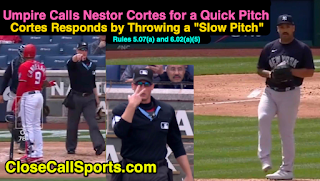
After HP Umpire Reed Basner called Yankees pitcher Nestor Cortes for a quick pitch (automatic ball) during Nationals batter Jeimer Candelario's 3rd inning at-bat in Washington, Cortes reacted by drawing out his windup on the very next pitch. Is this legal or a rules violation?

Official Baseball Rules 5.07(a) and 6.02(a)(5) govern the quick pitch part of the play. OBR 5.07(a) Comment states, "[Pitchers] may not step quickly onto the rubber and pitch. This may be judged a quick pitch by the umpire" and 6.02(a)(5) comment defines a quick pitch as an illegal pitch "delivered before the batter is reasonably set in the batter's box" (penalty with runners: balk; penalty without runners: ball).

The quick pitch was the correct call because pitcher Cortes began his windup motion prior to batter Candelario becoming reasonably set in the batter's box (e.g., he was not alert to the pitcher).

Immediately thereafter, Cortes responded by throwing a *slow pitch* on the ensuing offering, effectively drawing out his windup. Although OBR 5.07(a)(1) pertaining to Windup Position states, "any natural movement associated with his delivery of the ball to the batter commits him to the pitch without interruption or alteration. He shall not raise either foot from the ground, except that in his actual delivery of the ball to the batter, he may take one step backward, and one step forward with his free foot," pitcher Cortes didn't actually stop mid-delivery (no interruption). As for the alteration angle, even if it were to be adjudged a violation of 5.07(a)(1), there is no penalty other than "don't do that"—no automatic ball like a quick pitch.

Video as follows:

Saturday, June 11, 2022

MLB Ejection 066 - Paul Emmel (2; Ramon Laureano)

1B Umpire Paul Emmel ejected Athletics RF Ramon Laureano (balk/quick pitch no-call; QOCY) in the top of the 7th inning of the #Athletics-#Guardians game. With two out and one on (R1), Athletics batter Elvis Andrus struck out on three pitches from Guardians pitcher Enyel De Los Santos; following the third out of the inning, Laureano yelled from the dugout and was ejected. Replays indicate De Los Santos did not balk or quick pitch Andrus, the call was correct. At the time of the ejection, the A's were leading, 7-5. The A's ultimately won the contest, 10-5.

This is Paul Emmel (50)'s 2nd ejection of 2022.
Paul Emmel now has 8 points in the UEFL Standings (4 Previous + 2 MLB + 2 Correct Call = 8).
Crew Chief Paul Emmel now has 4 points in Crew Division (3 Previous + 1 Correct Call = 4).

This is the 66th ejection report of the 2022 MLB regular season.
This is the 21st player ejection of 2022. Prior to ejection, Laureano was 0-4 (SO) in the contest.
This is Oakland's 3rd ejection of 2022, T-2nd in the AL West (HOU 4; OAK, SEA 3; LAA 2; TEX 0).
This is Ramon Laureano's 1st ejection since May 12, 2021 (Ryan Wills; QOC = N [Balls/Strikes]).
This is Paul Emmel's 2nd ejection of 2022, 1st since June 9 (Terry Francona; QOC = Y-c [Obstruction]).

Wrap: Oakland Athletics vs. Cleveland Guardians, 6/11/22 | Video as follows:

Saturday, June 12, 2021

MLB Ejection 073 - Marvin Hudson (1; David Bell)

HP Umpire Marvin Hudson ejected Reds manager David Bell (strike three [no foul ball] call; QOCY) in the bottom of the 4th inning of the #Rockies-#Reds game. With two out and none on, Reds batter Jesse Winker attempted to strike a 0-2 slider from Rockies pitcher German Marquez, ruled a swinging third strike by HP Umpire Hudson. Replays indicate Winker swung at and missed the pitch; the bat did not make contact with the ball, the strike three swinging / no foul ball call was correct. At the time of the ejection, the Reds were leading, 4-3. The Reds ultimately won the contest, 10-3.

The Cincinnati broadcasters referenced a play from the top of the 4th inning in which Wade Miley's initial 0-1 pitch to Rockies batter Elias Diaz was waved off by Hudson. Cincinnati's complaint was that Diaz called time and Hudson granted the request after Miley had started his windup delivery. Official Baseball Rule 5.04(b)(2) states umpires shall not call "Time" after a pitcher has started windup or come to set position.

However, replays additionally indicate Miley began his pitching motion before batter Diaz—who began the sequence outside of the batter's box (for a legal reason after strike one)—was reasonably set in the batter's box, which itself is a violation of OBR 6.02(a)(5): "A quick pitch is an illegal pitch. Umpires will judge a quick pitch as one delivered before the batter is reasonably set in the batter's box. With runners on base, the penalty is a balk; with no runners on base, it is a ball. The quick pitch is dangerous and should not be permitted."

So while "Time" should not be called after a pitcher has started windup, a pitcher shall not start such delivery before the batter is reasonably set in the box. Chicken or egg?

This is Marvin Hudson (51)'s 1st ejection of 2021.
Marvin Hudson now has 5 points in the UEFL Standings (1 Previous + 2 MLB + 2 Correct Call = 5).
Crew Chief Marvin Hudson now has 3 points in Crew Division (2 Prev + 1 Correct Call = 3).

This is the 73rd ejection report of the 2021 MLB regular season.
This is the 38th manager ejection of 2021.
This is Cincinnati's 4th ejection of 2021, 2nd in the NL Central (MIL 6; CIN 4; CHC, PIT 3; STL 2).
This is David Bell's 2nd ejection of 2021, 1st since April 25 (Joe West; QOC = U [Warnings]).
This is Marvin Hudson's 1st ejection since September 5, 2017 (Josh Donaldson; QOC = Y [Balls/Strikes]).

Wrap: Colorado Rockies vs. Cincinnati Reds, 6/12/21 | Video as follows:

Tuesday, April 14, 2020

Case Play Solution 2020-2 - Pitcher's Hidden Ball Trick

Previously in Case Play 2020-2 - Pitcher's Hidden Ball Trick, we asked whether an usual delivery was legal or not. Now, having consulted the Official Baseball Rules, we have an answer also applicable to NCAA college and NFHS high school baseball, with a few caveats.

To solve this pitching puzzle, we went rule-by-rule for those listed on the Case Play. Here were the findings:

OBR 3.07(a): At the professional level, the glove crotch (or webbing)'s color may or may not be legal. Enforcement of the PANTONE 14-series rule is rather difficult without carrying an entire color swatch onto the playing field. Likewise, leave this alone at the lower levels, which have no such rule. All levels of baseball require the glove not be white or gray, which this glove does not appear to be (brown/yellow). This case play pertains to a college pitcher; his glove is legal.

OBR 5.07(a)(1) / NCAA 9-1-a / NFHS 6-1-2 / 6-4-2d: We turn to a compare-and-contrast example of an overseas professional pitcher attempting a similar hidden ball trick maneuver, but ultimately failing due to an interruption to his delivery while transferring the ball from pitching hand to gloved hand behind his back. For the purpose of our case play, there does not appear to be an interruption nor alteration (OBR/NCAA/NFHS) and the pitcher remains in continuous motion (NFHS). This is legal.

OBR 6.02(a)(10) / 6.02(b): Whereas an illegal pitch carries the penalty of a balk with runner(s), this balk rule (remove one hand from the ball) does not transform into an illegal pitch with no runners on base. This rule thus is not applicable.

OBR 6.04(c) / NCAA 5-15-a-3: The unsportsmanlike conduct/game misconduct rule is the thorniest since it is subject to the greatest degree of judgment. In college, this likely would not qualify as unsporting as it would at a lower level (e.g., Little League).

Video as follows:

Wednesday, March 14, 2018

Carter Capps - Back to Old Tricks or Just a Spring Thing?

Carter Capps pitched only 12 innings for the Padres in 2017, months after Major League Baseball added a rule barring his unorthodox pitching style in which Capps "crow hopped" or reset his pivot foot during delivery.

Umpires ruled no violation on Capps' delivery.
With San Diego opting to bring Capps in for relief during a Spring Training game, the Carter Capps crow hop is seemingly back, yet 1B Umpire Gerry Davis' crew didn't call any violation when Capps hop-stepped his way through a scoreless ninth on Tuesday against Chicago.

Replays indicate Capps' pivot foot, initially in contact with the pitcher's plate, appeared to step a second time toward home plate prior to Capps releasing the ball.

To review Capps' crow-hop history, MLB officially outlawed the pivot foot reset ahead of the 2017 season, adding the following language to Official Baseball Rule 5.07(a) Comment:
Related Post2017 Rules Mods, Including IBB Change, Announced (3/2/17).
The pitcher may not take a second step toward home plate with either foot or otherwise reset his pivot foot in his delivery of the pitch. If there is a runner, or runners, on base it is a balk under Rule 6.02(a); if the bases are unoccupied it is an illegal pitch under Rule 6.02(b).
In 2017, Pacific Coast League Umpire Brett Terry ejected El Paso Chihuahuas Manager Rod Barajas for arguing an illegal pitch call 1B Umpire Terry had made on Capps, while HP Umpire JJ January ejected Capps himself after Capps' subsequent pitch wound up hitting the plate umpire.
Related PostCarter Capps Throws Illegal Pitch, Ejected After Hitting Ump (6/26/17).

Yet, Capps was observed seemingly reseting his pivot foot during every delivery on Tuesday afternoon in Peoria. Has baseball suddenly reversed course on the so-called Carter Capps rule, are the rules more lax during Spring Training, or is Capps' move actually legal?

Video, diagramming Capps' delivery, including his second pivot step/reset, as follows:

Friday, September 8, 2017

Did Scherzer Quick Pitch Herrera? About Rule 6.02(a)(5)

Did Nationals pitcher Max Scherzer strike out Phillies batter Odubel Herrera on an illegal quick pitch Friday night in Washington? At first glance, video evidence suggests that Scherzer may have benefitted from HP Umpire Jeff Kellogg's failure to enforce baseball's quick pitch rule, but what does the rule really say? And did Herrera himself violate the batter's box rule?

Did Kellogg miss Scherzer's quick pitch?
The Play: With one out and none on in the top of the 5th inning of Friday's Phillies-Nationals game, Nats pitcher Scherzer delivered a 1-2 fastball to Phillies batter Odubel Herrera for a called third strike. Replays indicate Herrera did not appear to be looking at Scherzer as Scherzer pitched from Windup Position.

The Rule: The variety of illegal pitch known as the "quick pitch" appears in two parts of the Official Baseball Rules. The first (OBR 5.07(a)) pertains to legal pitching deliveries and positions. 5.07(a) carries no real weight, however, unless backed up by an actual rule that penalizes illegal pitches.

That's where Rule 6.02(a)(5) Comment factors in: "A quick pitch is an illegal pitch. Umpires will judge a quick pitch as one delivered before the batter is reasonably set in the batter’s box. With runners on base the penalty is a balk; with no runners on base, it is a ball. The quick pitch is dangerous and should not be permitted."

There it is. Lest you think Rule 6.02(a)(5) only applies to balks (6.02(a) is the "it is a balk when" rule), the rule's comment clarifies that there is indeed a penalty for a quick pitch with no runners on: it's a ball. To reiterate, "The quick pitch is dangerous and should not be permitted." A penalty exists whether or not there are runners. Rule 6.02(b) also states that an illegal pitch thrown with the bases empty shall result in a ball added to the count, unless the batter reaches base.

Analysis: Given the rulebook's strong language toward a quick pitch's danger, why then did HP Umpire Kellogg not call Scherzer for a quick pitch? Is there more to the story than meets the eye?

Batter Herrera jumps out of the box.
Reviewing the at-bat, we see that Scherzer is working briskly, "setting the tempo," so to speak. That's pretty good news for fans of baseball's popular "pace-of-play" issue.

Herrera, on the other hand, isn't readying himself in the box in a particularly hurried fashion—at least not timely enough for the faster-paced Scherzer.

In the second video below, notice Herrera's consistency in his leisurely act of getting set. Pitch-to-pitch, Herrera's cadence is fairly similar. Scherzer, on the other hand, acquiesces to Herrera's "slowness" on Pitch #2 of the at-bat, decides to press Herrera and pitches immediately upon Herrera coming set in the batter's box on Pitch #3, and, finally, delivers Pitch #4 before Herrera has come reasonably set in the batter's box, which results in the baseball arriving at home plate a mere fraction of a second after a visibly startled Herrera jumps backward and out of the left-handed batter's box.

Scherzer's 1-2 delivery to Herrera appears to constitute an illegal quick pitch and, as Rule 6.02(a)(5) Comment states, "is dangerous and should not be permitted." This play should have been called back. The strike three call was incorrect as the ball should have been dead on the illegal pitch thrown to a batter who wasn't reasonably set, play resuming with a 2-2 count.
Related PostRules Review - About Cleveland's Quick Pitch in Seattle (6/9/16).
Related PostMLB Ejection 016 - Ramon De Jesus (John Gibbons) (7/23/17).

What About the Batter's Box Rule?: Though Official Baseball Rule 5.04(b)(4) states, "The batter shall keep at least one foot in the batter’s box throughout the batter’s time at bat," with exceptions allowed for a swing, check swing, "Time" call, pickoff play, fake bunt, wild pitch/passed ball, pitcher delay, or catcher leaving the catcher's box, the penalty for batter's violation is "the umpire shall issue a warning to the batter for the batter’s first violation of this Rule in a game. For a batter’s second or subsequent violations of this Rule in a game, the League President may issue an appropriate discipline."

Note that in Minor League Baseball only, a second violation will result in an automatic strike called with no pitch having been thrown. The ball is automatically dead upon the enforcement of this penalty.

Meanwhile, Rule 5.04(b)(3) states, "If the batter refuses to take his position in the batter’s box during his time at bat, the umpire shall call a strike on the batter. The ball is dead and no runners may advance."

To bring everything full circle, notice that Herrera's preparation ritual takes place with his left foot within the batter's box (if not with both feet in the box). Thus, he is legal. However, even if Herrera was not legal pursuant to batter's box Rule 5.04(b)(4), a quick pitch is still illegal. Similarly, even if an umpire feels a batter is taking too long, the remedy is a Rule 5.04(b)(3) automatic strike—not allowing the pitcher to pitch when the batter isn't looking (something about being "dangerous"). Two wrongs don't make a right, and if a batter is not in compliance with 5.04(b), the umpire shall impose a warning or penalty before a pitch is thrown. As the rule states, "the ball is dead."

Videos (2x) as follows:

Monday, June 26, 2017

Carter Capps Throws Illegal Pitch, Ejected After Hitting Ump

Carter Capps, called for an illegal pitch by 1B Umpire Brett Terry, who ejected Capps' Manager Rod Barajas in an application of professional baseball's new pitchers' rubber restriction rule, himself was ejected by HP Umpire JJ January after hitting January with a bouncing pitch during Sunday's El Paso Chihuahuas vs Albuquerque Isotopes game in the Pacific Coast League.

Prior to the 2017, the Official Baseball Rules Committee added new provisions to illegal pitch and balk rules 5.07(a) Comment, 6.02(a), and 6.02(b) outlawing crow-hop (aka pivot foot reset) maneuvers, such as that historically employed by Capps:
The pitcher may not take a second step toward home plate with either foot or otherwise reset his pivot foot in his delivery of the pitch. If there is a runner, or runners, on base it is a balk under Rule 6.02(a); if the bases are unoccupied it is an illegal pitch under Rule 6.02(b).
1B Umpire Brett Terry ejects Rod Barajas.
With none out and none on in the top of the 8th inning of the Chihuahuas-Isotopes game, Capps threw a 0-0 pitch to Isotopes batter Dustin Garneau, ruled an illegal pitch by 1B Umpire Terry. 3B Umpire Lee Meyers then called Capps for a second illegal pitch due to a similar pivot foot reset motion on the 1-2 delivery. As a result of an ensuing argument, 1B Umpire Terry ejected Chihuahuas Manager Rod Barajas. Replays indicate that in both instances, Capps' illegally reset his pivot foot in his delivery of the pitch, the calls were correct. After an ensuing foul ball, Capps' final pitch in the dirt bounced and hit January. Replays indicate that as January paused to recover at home plate, Capps appeared to make a comment toward January, resulting in a confrontation and ejection; Capps and catcher Rocky Gale had a conference at the mound immediately preceding the fateful pitch. At the time of the ejections, the Isotopes were leading, 9-5. The 'Topes ultimately won the contest, 12-5.

Wrap: El Paso Chihuahuas vs. Albuquerque Isotopes (PCL), 6/25/17 | Video via "Read More"

Thursday, May 18, 2017

Permissible Conduct - Multiple Bench Clears in Atlanta

"What you permit, you promote" is an officiating axiom that may apply to bench clearings, as yet another rhubarb took place in baseball, this time between the Blue Jays and Braves in Atlanta.

Like the first bench clearer of Wednesday—Dodger vs Giants Bench-Clearer and Division of Halves—the twilight edition in Atlanta featured a batter upset with the way a pitcher threw a pitch, and both teams responded by encroaching upon the playing field, as they did for a second time just one inning later when one team took umbrage at a batter celebrating a home run.

Is it getting ridiculous or is it entertainment? We'll discuss that in a minute, but first, here are the plays:

O'Nora tries peacekeeping after Pillar's action.
With two out and none on in the top of the 7th inning of an 8-3 ballgame, Blue Jays batter Kevin Pillar prepared to face 0-2 pitch from Braves pitcher Jason Motte, which came as a swinging strike cutter for the third out of the frame...except that Pillar was upset with Motte's accelerated cadence in delivering the pitch, and verbalized some complaint to that effect, causing Motte to walk towards the plate and Braves catcher Kurt Suzuki to attempt a confrontation of his own as Pillar turned away in a "I want the last word" type of maneuver.

As far as quick pitches are concerned, Ramon De Jesus recently (on April 23) ejected Blue Jays Manager John Gibbons for objecting to his illegal pitch, automatic ball call. For that situation, replays indicated that the batter was not ready to receive the pitch when Gibbons' pitcher delivered it, while in Atlanta, Pillar did appear set to face Motte's pitch—Pillar just did not expect Motte's cadence to be so quick.

The field naturally is halved after Pillar's K.
The key distinction lies in Rule 6.02(a)(5) Comment, which states, "A quick pitch is an illegal pitch. Umpires will judge a quick pitch as one delivered before the batter is reasonably set in the batter’s box. With runners on base the penalty is a balk; with no runners on base, it is a ball. The quick pitch is dangerous and should not be permitted."

Thus, because Pillar was reasonably set in the batter's box when Motte effected his delivery, the pitch was legal and, by rule, not a "quick pitch." Thus, HP Umpire Brian O'Nora—who passionately motioned to the Atlanta bench to return to the dugout—allowed it, and the strikeout stood.

Benches clear a second time in Atlanta.
Just one inning later, Blue Jays batter Jose Bautista hit a solo home run off pitcher Eric O'Flaherty to bring Toronto to within four runs, and flipped his bat in celebration. Upon his arrival at home plate, he became engaged in a verbal entanglement with Braves catcher Suzuki, who, already displeased with Pillar's conduct, wasn't happy that Bautista had celebrated his home run in such fashion. Earlier in the home run trot, Braves first baseman Jace Peterson had attempted to confront Bautista, but Bautista ignored him.

Again, the benches cleared, again the umpires broke up the fray, and again no ejections resulted.

Toronto's most recent bench clearing incident occurred on September 26, 2016, and resulted in four ejections.
Atlanta's most recent bench clearing incident occurred on September 14, 2016, and resulted in one ejection.

Did the benches really need to clear for this?
Prior to this, the Blue Jays fought the Texas Rangers on May 15, 2016, while the Braves fought the Brewers on September 25, 2013 (also as the result of a catcher unhappy with a batter's home run celebration).

Last year, we discussed Psychology & Marketing - Why MLB Discipline is Weak. The premise of the  discussion concerned MLB's aloof attitude regarding discipline for misconduct: without question, a bench clearing incident in high school or college will likely result in at least one ejection, if not an outright forfeited game. In the Majors, however, bad behavior is theatre, and nothing stirs up ratings quite like two entire teams out of their dugouts (and bullpens).

We also discussed authority to impose discipline:
An umpire derives his/her authority from a league office, assignor, conference, UIC, etc., who entrusts said official with carrying out the umpire's duties on game day. Thus, the umpire's decision to dismiss a disrespectful player/coach who has violated the game's rules, logically, must be supported by the office/assignor/conference/UIC, lest the umpire's (and any other umpire's) jurisdiction be diminished and his/her ability to officiate compromised.
If the League itself doesn't particularly care to punish teams who needlessly delay the game with unsporting acts, then its umpires are not in a position to do so either, unless absolutely necessary. In conclusion, "baseball tacitly encourages ejection-able behavior [and bench clearing incidents] through its weak penalties because, as a business—as the American pastime hoping to retain relevance in the new era—it must."

In conclusion, whether this counts as entertainment or a ridiculous mockery of baseball, one thing is for sure: Repeated bench clearing incidents aren't good for baseball's vaunted pace-of-play dilemma. Video via "Read More"

Sunday, April 23, 2017

MLB Ejection 016 - Ramon De Jesus (John Gibbons)

HP Umpire Ramon De Jesus ejected Blue Jays Manager John Gibbons (Illegal Quick Pitch, automatic ball call) in the bottom of the 3rd inning of the Blue Jays-Angels game. With two out and none on, Angels batter Kole Calhoun prepared to receive a 3-1 pitch from Blue Jays pitcher Marcus Stroman. Replays indicate that Stroman began his delivery prior to Calhoun becoming set in the batter's box, resulting in a quick pitch ruling and automatic ball, the fourth ball of Calhoun's at-bat, the call was correct.* At the time of the ejection, the game was tied, 0-0. The Blue Jays ultimately won the contest, 6-2.

This is Ramon De Jesus (18)'s first ejection of the 2017 MLB regular season.
Ramon De Jesus now has 5 points in the UEFL Standings (0 Previous + 3 AAA + 2 Correct Call = 5).
Crew Chief Alfonso Marquez now has 2 points in Crew Division (1 Previous + 1 Correct Call = 2).
*Rule 5.07(a)(2) Comment states, in part, "if, however, in the umpire’s judgment, a pitcher delivers the ball in a deliberate effort to catch the batter off guard, this delivery shall be deemed a quick pitch, for which the penalty is a ball."
Rule 6.02(a)(5) Comment states, "A quick pitch is an illegal pitch. Umpires will judge a quick pitch as one delivered before the batter is reasonably set in the batter’s box. With runners on base the penalty is a balk; with no runners on base, it is a ball. The quick pitch is dangerous and should not be permitted."
Rule 6.02(b) states, "If the pitcher makes an illegal pitch with the bases unoccupied, it shall be called a ball unless the batter reaches first base on a hit, an error, a base on balls, a hit batter or otherwise."

This is the 16th ejection report of 2017.
This is the 9th Manager ejection of 2017.
This is Toronto's 1st ejection of 2017, 2nd in the AL East (BOS, TB 2; TOR 1; BAL, NYY 0).
This is John Gibbons' 1st ejection since September 11, 2016 (Jim Joyce; QOC = Y [Replay Review]).
This is Ramon De Jesus' 1st ejection since Sept 13, 2016 (Tim Wallach; QOC = Y [Balls/Strikes]).

Wrap: Toronto Blue Jays vs. Los Angeles Angels of Anaheim, 4/23/17 | Video via "Read More"

Thursday, June 9, 2016

Rules Review - About Cleveland's Quick Pitch in Seattle

Carlos Carrasco's illegal quick pitch in Seattle, umpire John Hirschbeck's crew presiding, prompted a brief delay during Wednesday's Indians-Mariners game as the crew convened and ultimately returned batter Kyle Seager to the plate (Seager had swung at the 1-2 quick pitch and grounded to the first baseman). The following analysis paints a picture of what HP Umpire Mike Muchlinski, 1B Umpire and Crew Chief John Hirschbeck, 2B Umpire DJ Reyburn, and 3B Umpire Bill Welke considered, discussed, and called.

Diagram of F1's disengagement quick pitch.
By standing on the mound with his pivot foot (right foot) in contact with the pitcher's plate and his free foot (left foot) in front of it, holding the ball in both hands, Carrasco used Set Position, one of two legal pitching positions.

Although Rule 5.07(a) states that, when using Set Position, pitchers shall complete to a complete stop before committing to home plate, the one exception is that with no runners on base, as was the case during Seager's at-bat, the complete stop is not required.

However, Rule 5.07(a)(2) Comment portrays a key consideration for the stop exclusion: "If, however, in the umpire’s judgment, a pitcher delivers the ball in a deliberate effort to catch the batter off guard, this delivery shall be deemed a quick pitch, for which the penalty is a ball."

Replays indicate Carrasco not only attempted a quick pitch, he also illegally disengaged the rubber, his pivot foot (right foot) landing behind the pitcher's plate while his free foot (left foot) appeared to stay put in its position in front of the plate.

Thus, after the umpires convened, Seager was returned to home plate, with a second ball added to the count. Carrasco could have been called for either a quick pitch OR an illegal pitch for illegal disengagement from the rubber. Note that a quick pitch is a subset of the greater category that is "illegal pitch" (Rule 6.02(a)(5): "A quick pitch is an illegal pitch").

NOTE: Rule 6.02(b) states, "If the pitcher makes an illegal pitch with the bases unoccupied, it shall be called a ball unless the batter reaches first base on a hit, an error, a base on balls, a hit batter or otherwise." Thus, had Seager reached first base, the achievement would stand. This could explain why play wasn't immediately killed.

Wednesday, August 15, 2012

Ejections 120, 121: Mike Everitt (3, 4)

HP Umpire Mike Everitt ejected Red Sox 1B Adrian Gonzalez and Manager Bobby Valentine for arguing an illegal pitch (quick pitch) no-call in the top of the 8th inning of the Orioles-Red Sox game. With none out and none on, Gonzalez hit a 1-2 fastball from Orioles pitcher Pedro Strop to second baseman Omar Quintanilla, to first baseman Mark Reynolds for a ground out. Replays indicate Strop, working out of Set Position, did not come to a complete stop pursuant to OBR Rule 8.01(b)[b]; however, Rule 8.01(b) Comment specifies that with no base runners, the pitcher is not required to come to a complete stop following his stretch unless the pitcher's action is a quick pitch as prescribed by Rule 8.05 Comment;^ this pitch was not illegal, the call was correct.* At the time of the ejection, the Orioles were leading, 5-3. The Orioles ultimately won the contest, 5-3.

These are Mike Everitt (57)'s third and fourth ejections of 2012.
Mike Everitt now has 9 points in the UEFL (1 Previous + 2*[2 MLB + 2 Correct Call] = 9).
Crew Chief Tim Welke now has 3 points in the UEFL's Crew Division (1 Previous + 2*[1 Correct] = 3).
*After review, Quality of Correctness has been affirmed unanimously by the UEFL Appeals Board (6-0).
*The following action is illegal: "a pitcher delivers the ball in a deliberate effort to catch the batter off guard."
^"Umpires will judge a quick pitch as one delivered before the batter is reasonably set in the batter’s box."

UEFL Standings Update

These are the 120th and 121st ejections of 2012.
This is the 49th player ejection of 2012. Prior to his ejection, Gonzalez was 1-4 in the contest.
This is the 60th Manager ejection of 2012.
This is the Red Sox's 9th ejection of 2012, 1st in the AL East (BOS 9; NYY, TOR 4; TB 3; BAL 2).
This is Adrian Gonzalez's first ejection since May 1, 2010 (Rob Drake; QOC = Correct).
This is Bobby Valentine's first ejection since July 29 (Brian O'Nora; QOC = Correct).
This is Mike Everitt's first ejection since August 6 (Jim Tracy; QOC = Correct).

Wrap: Red Sox at Orioles, 8/15/12
Video: Amid rumors of manager-player dischord, Bobby V is ejected backing A-Gon over pitch (UEFL)
Video: Sox duo ejected arguing that a quick pitch should have been called (Boston Feed)

Friday, May 27, 2011

Ejections: Ed Hickox (1)

HP Umpire Ed Hickox ejected Nationals third baseman Jerry Hairston Jr. for an illegal pitch no call in the bottom of the 7th inning of the Padres-Nationals game. With one out and one on, Hairston hit a 1-2 fastball from Padres pitcher Clayton Richard to center fielder Cameron Maybin. Replays indicate that Richard did not throw an illegal "quick" pitch, despite Hairston stepping out of the batter's box and requesting time, which was not granted.* At the time of the ejection, the Nationals were leading, 1-0. The Nationals ultimately won the contest, 2-1, on a walk-off home run.

This is Ed Hickox (15)'s first ejection of 2011.
Ed Hickox now has 4 points in the Umpire Ejection Fantasy League (0 Previous + 2 MLB + 2 Correct Call = 4).
Ed Hickox is owned as a Secondary Umpire by 15_and_done, who is now tied for 19th place in the UEFL with 3 points.
*Quality of Correctness was Challenged and Confirmed ("Correct" ==> "Correct").

This is the 51st ejection of 2011.
This is the 22nd player ejection of 2011.
Prior to his ejection, Hairston was 0-3 in the contest.

Wrap: Padres at Nationals 5/27/11 Wrap
Video: Hariston is Ejected by Hickox

Friday, May 20, 2011

Ejections: Rob Drake (1)

HP Umpire Rob Drake ejected Rockies shortstop Troy Tulowitzki for arguing an illegal pitch non-call in the top of the 8th inning of the Rockies-Brewers game. With one out and none on, Tulowitzki took a 2-2 fastball from Brewers pitcher LaTroy Hawkins for a called strike three. Replays indicate the called third strike was slightly above the belt and caught the outer half of the plate. Replays indicate that Hawkins delivered the ball immediately to home after receiving the previous pitch from the set position; he did not disengage the rubber, and had the ball in hands in front of his body before delivering. Hawkins did not come to a complete stop, but is not required to when no runners are on base under Rule 8.01(b) Comment; he did not throw an illegal "quick" pitch. The call was correct. At the time of the ejection, the Rockies were leading, 4-3. The Brewers ultimately won the contest, 7-6, in 14 innings.

This is Rob Drake (30)'s first ejection of 2011.
Rob Drake now has 4 points in the Umpire Ejection Fantasy League (0 Previous + 2 MLB + 2 Correct Call = 4).
Rob Drake is owned as a Secondary Umpire by BSBALLUMP, who is now in 16th place in the UEFL with 3 points.

This is the 42nd ejection of 2011.
This is the 19th player ejection of 2011.
Prior to his ejection, Tulowitzki was 1-4 in the contest.
This is Troy Tulowitzki's second career MLB ejection.

Pitch f/x courtesy Brooks Baseball