Showing posts with label Bona Fide Slide. Show all posts

Sunday, July 28, 2024

MLB Ejection 130 - Alan Porter (4; Brandon Hyde)

1B Umpire Alan Porter ejected Orioles manager Brandon Hyde (Replay Review decision overturning 2B Umpire Sean Barber's slide interference call) in the top of the 9th inning of the #Padres-#Orioles game. With one out and the bases loaded, Padres batter Jurickson Profar hit a 2-2 changeup from Orioles pitcher Yennier Cano on the ground to shortstop Gunnar Henderson, who stepped on second base to force out Padres baserunner R1 Tyler Wade, before colliding with Wade and becoming unable to complete his throw attempt to first base, called slide rule interference by 2B Umpire Barber for a double play. Upon Replay Review as the result of a challenge by Padres manager Mike Shildt, the call was overturned to no interference and a force out (only). At the time of the ejection, the Orioles were leading, 8-6. The Orioles ultimately won the contest, 8-6.

This is Alan Porter (64)'s 4th ejection of 2024.

This is the 130th ejection report of the 2024 MLB regular season.
This is the 65th manager ejection of 2024. Ejection Tally: 65 Managers, 19 Coaches, 46 Players.
This is Baltimore's 4th ejection of 2024, 3rd in the AL East (NYY 8; TOR 7; BAL 4; BOS, TB 3).
This is Brandon Hyde's 3rd ejection of 2024, 1st since July 12 (Will Little; QOC = U [Fighting]).
This is Alan Porter's 4th ejection of 2024, 1st since June 8 (Alex Cora; QOC = Y [Balls/Strikes]).

Thursday, May 23, 2024

Iowa Force Play Slide Rule, Manager Ejection & Missing TV Camera

When umpires called Iowa runner Kyle Huckstorf for a force play slide rule violation in extra innings vs Illinois, a call confirmed via video review, #Hawkeyes manager Rick Heller was ejected, an automatic penalty for arguing a replay decision. Let's review NCAA/college's rulebook as we roll back the tape and find a curious decision by television broadcast led to a lot more confusion than it should have.

NCAA Rule 8-4, the Force Play Slide Rule (FPSR), states among other things, "On any force play, the runner, in the vicinity of the base, must slide on the ground before the base and in a direct line between the two bases. It is permissible for the slider’s momentum to carry them through the base in the baseline extended." A diagram accompanies this provision, indicating prohibit area in grey shading that a runner may not slide into—namely to the left or right of the base at its leading edge or further back.

Whereas Official Baseball Rule 6.01(j) (Sliding into Bases on Double Play Attempts) lists four criteria, the third of which requires a runner to remain on the base after completion of the slide, NCAA's rule allows runners to overslide. This is just one key distinction.

Another is that while OBR requires the violative non-bona fide slide to impede the defensive team for interference to be called (e.g., if a double play is unrealistic anyway, there is no interference call to make), NCAA's FPSR applies a much stricter standard: "Whether the defense could have completed the double play has no bearing on the applicability of this rule." This is also a key difference.

All in all, for OBR/professional/MLB/MiLB games, the camera position known as high third provides a very useful angle for determining whether criterion three of OBR 6.01(j) (able and attempts to remain on base) is satisfied, since high third allows a view of whether or not the runner has slid off the back edge of second base.

But in NCAA/college, high first is much more useful because it shows a clear look of the baseline between first and second base, which is vital for determining whether or not the baserunner violated FPSR.

The television broadcast, for whatever reason, showed only the high third angle but not high first, leading the public and the teams—including Iowa—in the dark about the call which replay was able to not only uphold, but confirm, perhaps because the umpires had access to high first...unless the network for whatever reason decided not to staff that vital camera position.

Video as follows:

Friday, March 29, 2024

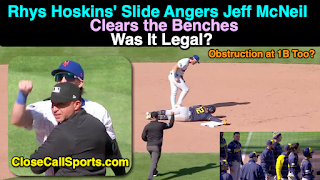
Hoskins' Slide Into McNeil & Obstruction Play at 1B

Following a look at whether Brewers 1B Rhys Hoskins' block of Mets runner DJ Stewart was obstruction or not, we determine whether Hoskins' slide into Mets 2B Jeff McNeil satisfied the bona flide slide rule criteria relative to breaking up double play attempts. Of note, 2B Umpire Jonathan Parra made his MLB debut and was working his first major league game when the benches cleared as a result of Hoskins' slide and McNeil's reaction.

Obstruction: In the bottom of the 2nd inning, Brewers catcher William Contreras threw to first base in an attempt to pickoff Mets baserunner R1 Stewart, with Milwaukee 1B Hoskins receiving the throw and appearing to place his left leg into runner Stewart's path, effectively blocking his access to first base. 1B Umpire Lance Barrett called the runner out, effectively no-calling potential obstruction as the retired runner complained that Hoskins was blocking the bag.

Defined as "the act of a fielder who, while not in possession of the ball and not in the act of fielding the ball, impedes the progress of any runner," the new obstruction point of emphasis instructs umpires to call obstruction as in Official Baseball Rule 6.01(h)(1) or Type A when a fielder blocks the runner's path without possession of the ball unnecessarily, even if the fielder is in the act of fielding at the time.

The goal is to crack down on fielders using the "act of fielding" defense to blatantly block runners' base paths when they distinctly do not need to occupy that space to receive the throw.

Bona Fide Slide: In the top of the 8th inning, Brewers baserunner R1 Hoskins slid into second base on an infield ground ball and potential double play attempt. Hoskins slid through the base, but was able to keep his hand in contact with the second base bag, making contact with Mets 2B McNeil in the process, who took exception and whose reaction spurred both benches to briefly clear.

After Replay Review, the Mets' challenge that Hoskins' slide was illegal was denied and the original call by 2B Umpire Parra of out and no slide violation was confirmed.

The four criteria of a bona fide slide, as in OBR 6.01(j), are 1) begins the slide before reaching the base, 2) able and attempts to reach the base, 3) able and attempts to remain on the base, and 4) slides within reach of the base without changing pathway for the purpose of initiating contact with a fielder.

Replay conclusively determined that R1 Hoskins satisfied all four criteria and, thus, engaged in a legal, bona fide slide.

Note that in college and high school, Hoskins' slide may have violated the force play slide rule (FPSR doesn't exist in pro ball), given that Hoskins' failed to slide in a direct line between the two bases. NCAA Rule 8-4 governs FPSR cases and holds that "the runner’s entire body (feet, legs, trunk and arms) must stay in a straight line between the bases."


Video as follows:

Monday, September 11, 2023

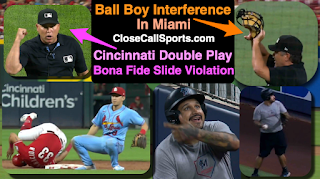
Ball Boy Interference & Non-Bona Fide Slide Violation

Umpires awarded Dodgers runner Mookie Betts home after a ball boy interfered with a fair ball in Miami while Replay Review called a bona fide slide rule violation on Reds runner Christian Encarnacion-Strand in Cincinnati in this edition of Ask CCS.

Ball Attendant Interference
With baserunner Mookie Betts on first base, Dodgers batter Freddie Freeman hit a line drive down the right field line in Miami, ruled a fair ball by 1B Umpire John Libka. But before Mookie could round third base, the Marlins ball boy in right field fielded the fair ground ball and threw it into the stands, resulting in a dead ball pursuant to Official Baseball Rule 6.01(d), entitled "Unintentional Interference."

OBR 6.01(d) states that if a non-uniformed person authorized to be on the playing field (e.g., ball attendant, security guard, etc.) intentionally interferes with a live ball ("intentional" meaning the action was voluntary, not that the intent was to commit interference per se), "the ball shall be dead at the moment of the interference and the umpire shall impose such penalties as in their opinion will nullify the act of interference."

After consultation with 1B Umpire Libka, 2B Umpire DJ Reyburn, and perhaps most importantly (for the angle), 3B Umpire Angel Hernandez, HP Umpire and Crew Chief James Hoye placed Betts at home, ruling that had interference not occurred, Betts would have scored.

Bona Fide Slide Rule Violation Leads to 9th Inning Double Play
In Cincinnati, Reds batter Tyler Stephenson hit a ground ball to Cardinals shortstop Masyn Winn in the bottom of the 9th inning, with Winn throwing to second baseman Tommy Edman as Reds baserunner R1 Christian Encarnacion-Strand slid into second base. Edman's throw to first base came after Stephenson arrived, but St Louis challenged the play, alleging that the runner's slide into second was violative.

The four criteria of OBR 6.01(j) pertaining to bona fide slides on force plays are that
1) the runner begins their slide before reaching the base;
2) is able and attempts to reach the base with their hand or foot;
3) is able and attempts to remain on the base after completion of the slide;
4) slides within reach of the base without changing their pathway to contact a fielder.

Upon review, the Replay Official ruled that R1 failed to satisfy criterion three of the bona fide slide rule, in that the runner failed to remain on the base after completion of the slide. Accordingly, replay overturned 2B Umpire Mark Carlson's no violation call and imposed the illegal slide penalty, which in this case is a double play with batter-runner Stephenson declared out at first in addition to Encarnacion-Strand's force out at second.

Video as follows:

Friday, May 26, 2023

Seattle's Slide Rule Interference Confusion On Rule Sets

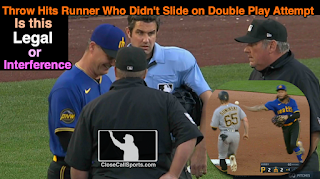
After Mariners shortstop JP Crawford caught Kolten Wong's throw to force out Pirates runner R1 Jack Suwinski at second base, his throw to try and retire batter-runner Tucupita Marcano hit Suwinski's shoulder and flew into the stands, resulting in a throwing error and extra base for Marcano on the force out.

Seattle manager Scott Servais argued with 2B Umpire Marvin Hudson that Suwinski should have been out for violating MLB's bona fide slide rule 6.01(j) because he failed to slide into second base. With replays indicating that Suwinski didn't slide at all and instead ran directly to and through the base, we have to examine professional baseball's slide interference rule to determine whether Servais was correct or not.

Official Baseball Rule 6.01(j), sliding to bases on double play attempts, states that interference occurs under the following circumstance: "If a runner does not engage in a bona fide slide, and initiates (or attempts to make) contact with the fielder for the purpose of breaking up a double play, they should be called for interference under this Rule 6.01."

However, replays indicate that while baserunner Suwinski didn't slide, neither did he initiate contact with the fielder. Under OBR, a runner is not obligated to slide on force plays. Instead, the only rule to get a double play here would be OBR 6.01(a)(5) and interference for retired runners: "Any batter or runner who has just been put out, or any runner who has just scored, hinders or impedes any following play being made on a runner. Such runner shall be declared out for the interference of their teammate."

However, the comment to the rule also states, "If the batter or a runner continues to advance or returns or attempts to return to his last legally touched base after they have been put out, he shall not by that act alone be considered as confusing, hindering or impeding the fielders."

Thus, under OBR, Suwinski's shoulder-ball interaction is not illegal and an interference no-call is the correct call.

Under NCAA, however, Suwinski would be guilty of interference and if this was a college game, Marcano declared out for a double play: "On any force play, the runner, in the vicinity of the base, must slide on the ground before the base and in a direct line between the two bases. It is permissible for the slider’s momentum to carry them through the base in the baseline extended."

As for NFHS, the high school rulebook states, "Simply stated, the runner never has to slide," going onto state that if the runner does slide, said runner is bound by the force play slide rule in use under NCAA's ruleset.

Video as follows:

Tuesday, May 2, 2023

Braves Fail to Challenge Bona Fide Slide Rule Play - Was it Interference?

Atlanta failed to challenge a 7th inning play in New York when Mets baserunner R1 Jeff McNeil slid into Braves shortstop Vaughn Grissom, resulting in a wild throw to first base that allowed batter-runner Daniel Vogelbach to reach and R2 Pete Alonso to score. However, with MLB's bona fide slide rule in effect, was this interference on a force play at second base? Was 2B Umpire Adrian Johnson's interference no-call correct? We investigate.

Recall that Official Baseball Rule 6.01(j) is defined as: "If a runner does not engage in a bona fide slide, and initiates (or attempts to make) contact with the fielder for the purpose of breaking up a double play, they should be called for interference under this Rule 6.01."

The four criteria with which to evaluate potential violations of the bona fide slide rule are as follows. They are written such that a failure to satisfy any one of the criteria means the slide was not bona fide:
1) The runner begins their slide (makes contact with the ground) before reaching the base;
2) Is able and attempts to reach the base with their hand or foot;
3) Is able and attempts to remain on the base (except home plate) after completion of the slide; and
4) Slides within reach of the base without changing their pathway for the purpose of initiating contact with a fielder.

Upon our review of the play, it appears baserunner R1 Jeff McNeil failed to satisfy criterion four (and may have failed to satisfy #2 and #3 as well...the camera angle available isn't as conclusive), meaning this is not a bona fide slide. Thus, had Replay Review been invoked, the proper outcome would have been to overturn the call by declaring both R1 (on the force play) and the batter-runner out (on the interference by R1), and return R2 and R3 to their bases occupied at time of pitch, thus negating the two runs that scored.

Video as follows:

Sunday, October 23, 2022

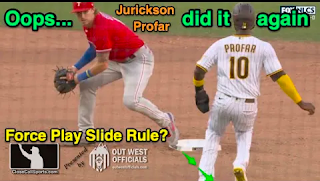
Did Profar Commit a Slide Rule Violation by Not Sliding?

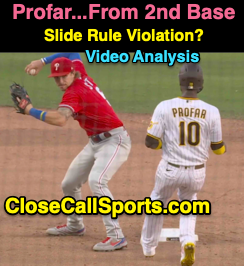
Did San Diego's Jurickson Profar violate baseball's bona fide slide rule by jogging upright into second base instead of sliding—Phillies infielder Bryson Stott threw wide to first base thus preventing a double play during Philadelphia's NLCS against the Padres, but 2B Umpire Quinn Wolcott no-called the potential violation and Phillies manager Rob Thomson opted not to challenge the no-call, despite slide rule violations being eligible for Replay Review.

In the 8th inning of NLCS Game 2, Padres baserunner R1 Profar strolled in front of Stott on a ground ball double play attempt as the Phillies shortstop threw widely to first base. We review whether Profar violated the bona fide slide rule by remaining bipedal throughout the sequence.

Official Baseball Rule 6.01(j) pertains to slide rule violations and outlines four basic criteria for a runner to satisfy to meet the bona fide slide standards:
1) Begin their slide (by making contact with the ground) before reaching the base;
2) Be able and attempt to reach the base with their hand or foot;
3) Be able and attempt to remain on the base with their hand or foot;
4) Slide within reach of the base without changing direction to initiate contact with a fielder.

However, Profar didn't slide so he obviously didn't meet the bona fide slide criteria. The question is whether this is an automatic rules violation for failing to slide and whether it is not interference.

The answer is...for professional baseball, OBR does not require a slide into bases on force plays. The bona fide slide criteria exist for cases in which the runner chooses to slide, but there is no mandatory slide rule. Accordingly, Profar appears to run straight into second base from his base path on the grass (which he is allowed to choose, as all runners are); thus, unless the base path is illegal (which it is not), there is no out on this play, and because the base path rule allows for a runner to choose their own path, this play is legal under OBR.

In NFHS (high school) and NCAA (college), however, the force play slide rule (FPSR) would deem Profar's actions illegal; NCAA requires runners to slide on all force plays (Profar is out for not sliding between the bases on a force play) and in NFHS, although a slide is not required, the FPSR would put Profar out for failing to slide or run between the two bases—Profar's base path may be rules-legal, but when it comes to approaching a base on a force play, the FPSR in NFHS, Profar fails to remain in a straight/direct line between the bases as the middle infielder tags the base and then attempts to throw onto the following base. So under NCAA and NFHS, this is interference due to a FPSR violation.

Video as follows:

Monday, April 18, 2022

Ask UEFL - Bona Fide Slide DP Ends Rockies-Rangers

Tmac
 fields your Ask the UEFL questions regarding a bona fide slide rule interference play that wound up ending last week's Rockies-Rangers game in Texas, with HP Umpire Bill Miller signaling the Replay Review-decided double play much to the chagrin of Rangers manager Chris Woodward, whose team just lost to Colorado.

Play: With one out and one on (R1), Rangers batter Adolis Garcia hit a ground ball from Rockies pitcher Ashton Goudeau on the ground to third baseman Ryan McMahon, who threw to second baseman Brendan Rodgers as Rangers baserunner R1 Mitch Garver slid into second base, before Rodgers then threw wildly to first baseman CJ Cron.

Original Ruling
: 2B Umpire Brian Knight initially ruled Garver out on the force play, but did not make an on-field slide rule interference call.

Challenge & Review: Instead, Rockies manager Bud Black elected to file a manager's challenge for slide rule interference, alleging that Garver, in sliding into and making contact with middle infielder Rodgers, failed to engage in a bona fide slide and thus should be called for interference (rendering the batter-runner Garcia out as well).

Rule: Official Baseball Rule 6.01(j) describes bona fide slide criteria, specifying four main requirements:
1) Runner begins his slide and makes contact with the ground before reaching the base;
2) He is able and attempts to reach the base with his hand or foot;
3) He is able and attempts to remain on the base (except home) after completing the slide; and
4) He slides within reach without changing his path for the purpose of initiating contact with a fielder.
Related Label: Bona Fide Slide

If the runner fails to satisfy even one of those four requirements, and in doing so impedes the defense from completing a potential play, the umpire shall declare the ball dead and rule interference for an illegal (non-bona fide) slide.

Result: Because Colorado was unable to complete its attempted double play as a result of R1 Garver's illegal slide, the Replay Official ruled BR Garcia out for the interfering actions of his teammate, resulting in a game-ending double play.

Video as follows:

Friday, April 8, 2022

Bona Fide Slide Recap as Sox Turn Two on Tigers' INT

When 2B Umpire John Tumpane, prior to Replay Review, ruled Tigers baserunner R1 Jeimer Candelario out at second base as well as batter-runner Miguel Cabrera for his teammate's interference by virtue of failing to make a legal bona fide slide, we found not just our first application of Official Baseball Rule 6.01(j) during the 2022 regular season, but a very clear example of a slide that violates this rule.

As we review MLB's bona fide slide rule, we find there are four general criteria regarding slides on double play attempts, as in OBR 6.01(j):

1) Runner begins to slide and makes contact with the ground before reaching the base;
2) Runner is able and attempts to reach the base with a hand or foot;
3) Runner is able and attempts to remain on the base (except home) after completing the slide; and
4) Runner slides within reach without changing path for the purpose of initiating contact with a fielder.
The soft-fifth requirement, as it were, was added in 2016 and states that the violative slide must have impeded or interfered with the fielder from completing a double play.

Friday in Detroit, any befuddlement regarding Tumpane's 6th inning-ending ruling can easily be cleared up by extracting criterion three: runner Candelario slid past second base, which means he failed to remain on the base after completing the slide, which is an illegal slide pursuant to OBR 6.01(j).

3) He is able and attempts to remain on the base. [NO]

Although not as egregious as other slide interference plays from over the years, this nonetheless is a proper on-field ruling (confirmed via Replay Review) of a double play due to slide rule interference.

NCAA force play slide rule 8-4 requires runners to "slide on the ground before the base and in a direct line between the two bases" while NFHS largely echoes college's FPSR requirement.
Related PlayNCAA CWS - Force Play Slide Rule Negates LSU Run (6/27/17).

Video as follows:

Friday, September 3, 2021

MLB Ejection 160 - Tom Hallion (4; Andy Green)

2B Umpire Tom Hallion ejected Cubs bench coach/acting manager Andy Green (bona fide slide rule interference no-call; QOCY) in the top of the 6th inning of the #Pirates-#Cubs game. With one out and two on (R1, R2), Pirates batter Michael Perez hit a first-pitch sinker from Cubs pitcher Alec Mills on the ground to second baseman Matt Duffy who threw to shortstop Sergio Alcantara as Pirates baserunner Kevin Newman slid, and who threw the ball past first base and out of play. Green was unable to request a manager's challenge due to losing said challenge an inning earlier and Crew Chief reviews for non-HR plays are unavailable prior to the 8th inning. Replays indicate the runner fulfilled the criteria for a bona fide slide criteria, the call was correct.* At the time of the ejection, the Cubs were leading, 5-3. The Cubs ultimately won the contest, 6-5.

This is Tom Hallion (20)'s 4th ejection of 2021.
Tom Hallion now has 10 points in the UEFL Standings (6 Prev + 2 MLB + 2 Correct Call = 10).
Crew Chief Tom Hallion now has 7 points in Crew Division (6 Previous + 1 Correct Call = 7).
*Official Baseball Rule 6.01(j)'s four criteria for a bona fide slide:
(1) begins his slide (i.e., makes contact with the ground) before reaching the base [YES];
(2) is able and attempts to reach the base with his hand or foot [YES];
(3) is able and attempts to remain on the base (except home plate) after completion of the slide [YES];
(4) slides within reach of the base without changing pathway for the purpose of initiating contact with a fielder [YES].

This is the 160th ejection report of the 2021 MLB regular season.
This is Chicago's 7th ejection of 2021, 3rd in the NL Central (MIL 15; CIN 12; CHC 7; STL 6; PIT 3).
This is Andy Green's 1st ejection since Sept 14, 2019 (Carlos Torres; QOC = Y [Check Swing]).
This is Tom Hallion's 4th ejection of 2021, 1st since Aug 18 (Caleb Smith; QOC = U [Foreign Substance]).

Wrap: Pittsburgh Pirates vs. Chicago Cubs, 9/3/21 | Video as follows:

Sunday, June 20, 2021

NCAA CWS Game Ends on Force Play Slide Rule DP

NC State vs Stanford's Opening Round College World Series game ended on an interference-aided double play thanks to NCAA's force play slide rule when baserunner Tommy Troy committed a Cardinal sin by not sliding into second base on a ground ball, ruled by 2B Umpire Billy Van Raaphorst as a game-ending double play.

This was the correct call thanks to college baseball's force-play-slide-rule (FPSR), NCAA Rule 8-4, which states, "On any force play, the runner, in the vicinity of the base, must slide on the ground before the base and in a direct line between the two bases. It is permissible for the slider’s momentum to carry him through the base in the baseline extended."

Unfortunately for Troy, North Carolina second baseman JT Jarrett ran into the direct line between first and second base in order to field batter Grant Burton's ground ball, meaning Troy altered his base path by running to the outside (to his right) of the baseline in order to avoid interfering with Burton fielding a batted ball, as the fielder has the right of way in a batted ball situation.

Doing so complicated matters for Troy, as he no longer would be able to slide in a direct line between first and second base. Fortunately, the FPSR provides an exception for such cases: "A runner need not slide directly into a base as long as the runner slides or runs in a direction away from the fielder to avoid making contact or altering the play of the fielder," but this does not absolve the runner of the need to slide, for the sake of safety, when a different fielder is covering second base.

As the rule states, "This is a safety and an interference rule. Whether the defense could have completed the double play has no bearing on the applicability of this rule."

Thus both runner R1 Troy and batter-runner Burton were declared out for violation of this safety and interference rule. It is important to note this is a college rule, but the professional level (MLB/MiLB) does not have a force play slide rule. Instead, OBR's "bona fide slide" rule 6.01(j) simply states that a runner who engages in a bona fide slide should not be called for interference, but nonetheless does not require that a runner slide as the lower levels do ("A runner who engages in a “bona fide slide” shall not be called for interference under this Rule 6.01").

High School's rulebook (NFHS), meanwhile, states as a 2020 Point of Emphasis, "Simply stated, the runner never has to slide. However, on a force play when he does slide, it must be legal and in a direct line between the two bases."

Video as follows:

Saturday, May 29, 2021

Tennessee's Force Play vs MLB's Bona Fide Slide Rule

Although Tennessee looked to walk off Alabama during NCAA Baseball's SEC Tournament, umpires ruled a force play slide rule violation and interference call when Vols base runner R1 Max Ferguson made illegal contact with Alabama second baseman Peyton Wilson during Bama's inning-ending double play attempt in the bottom of the 9th inning of a then-tied ballgame.

With the bases loaded and one out of a game tied 2-2 in the last of the 9th, Tennessee batter Jake Rucker hit a ground ball on the infield, with Wilson tagging second base to retire Ferguson before attempting a throw to first base to complete the double play as Ferguson slid, 2B Umpire Scott Cline ultimately ruling that Ferguson illegally slid into the base, resulting in an inning-ending double play, instead of a walk-off 3-2 win.

Alabama later went on to win the game, 3-2, but Tennessee still came back to eventually win the double-elimination stage of the tournament.

Rules Difference, FPSR
: College baseball/NCAA (as well as high school ball/NFHS) makes use of a force play slide rule (FPSR) in which a runner must slide in a direct line between two bases. NCAA Rule 8-4 states, "The intent of the force-play-slide rule is to ensure the safety of all players. This is a safety and an interference rule. Whether the defense could have completed the double play has no bearing on the applicability of this rule. This rule pertains to a force-play situation at any base, regardless of the number of outs, except it does not apply to the batter-runner at first base."

[high school deems a slide illegal if "he runner, on a force play, does not slide on the ground and in a direct line between the two bases" in NFHS 2-32-2].

Because of its safety-first emphasis, the rule leaves little room for umpire judgment: if the runner violates its terms, a force play slide rule violation shall be called. The NCAA book includes a diagram which leaves little to the imagination: if the runner makes contact with a fielder in the defense's protected gray area, it shall be deemed a double play. On a force play, the runner "must slide on the ground before the base and in a direct line between the two bases" unless avoiding contact with a fielder (NCAA 8-4-a).

Accordingly, the Tennessee play was properly officiated as an FPSR violation and double play.

Pro Rule, Bona Fide Slide Rule: The Official Baseball Rules employed by MLB and MiLB, however, use a different and more lenient standard: the bona fide slide rule. As previously covered on our site, the runner must meet four criteria (begins slide before reaching base, able and attempts to reach base with hand or foot, able and attempts to remain on base, slides within reach of base without changing pathway to initiate contact with fielder).

Unlike NCAA, however, there is no hard-and-fast protected gray area. OBR 6.01(j) states, "a runner who engages in a “bona fide slide” shall not be called for interference under this Rule 6.01, even in cases where the runner makes contact with the fielder as a consequence of a permissible slide." Therefore, a runner whose slide is bona fide can, all else equal, make legal contact with a fielder that, under NCAA rules, would be illegal under the FPSR language.

Caveat: This does not, however, give the runner carte blanche to contact a fielder during a bona fide slide. OBR 6.01(a)(5) states that, "Any batter or runner who has just been put out, or any runner who has just scored, hinders or impedes any following play being made on a runner. Such runner shall be declared out for the interference of his teammate" (this is different than the willful and deliberate interference standard for non-retired runners interfering with batted balls with the obvious intent to break up a double play, as in OBR 6.01(a)(6)).

Thus, under OBR, an umpire could use judgment to deem whether or not the act of retired baserunner Ferguson's left arm making contact with fielder Wilson's body as Wilson threw to first base met this hinder-or-impede standard that, under NCAA, would be unavailable to the umpire (due to the strict standard requiring the FPSR violation). For this precise situation, OBR is more flexible than NCAA.

Accordingly, if an OBR umpire deemed the hinder-or-impede standard was met, the outcome under OBR could very well match the outcome under NCAA (dead ball, inning-ending double play), but for different reasons.

Video as follows:

Monday, May 17, 2021

Manny Machado Slides Into Edman - Legal Baseball Play?

When Padres baserunner Manny Machado slid into Cardinals second baseman Tommy Edman in San Diego Sunday night, fans debated whether the slide was dirty...but was it legal? We visit the relevant rules to officiate this play.

Play: With none out and one on (R1) in the bottom of the 4th inning, Padres batter Jake Cronenworth hit a first-pitch slider from Cardinals pitcher Kwang-Hyun Kim on the ground to second baseman Tommy Edman, who attempted to tag Padres baserunner R1 Manny Machado, who slid into Edman, after which both players stood up with Machado returning to the Padres' dugout.

Call: 2B Umpire Dan Merzel ruled Machado out and Cronenworth remained at first base.

Rules: The first rule governing this play is Official Baseball Rule 5.09(b)(1), "any runner is out when they run more than three feet away from their base path to avoid being tagged unless their action is to avoid interference with a fielder fielding a batted ball." As Machado appeared to continue along his path to second base without horizontal deviation, we can eliminate OBR 5.09(b)(1).

Next up is OBR 6.01(j), sliding to bases on double play attempts or the bona fide slide rule. For the most part, 6.01(j) is encountered at or near a base, but not always, and in general as the rule states, the runner must de deemed to initiate contact with the fielder "for the purpose of breaking up a double play."

For the purposes of this play, and the aforementioned notwithstanding, one key phrase within this rule clarifies that Machado's slide was legal: "Interference shall not be called where a runner’s contact with the fielder was caused by the fielder being positioned in (or moving into) the runner’s legal pathway to the base." Because Edman clearly is moving into Machado's legal pathway to second base, this exception to interference is applicable.

Willful and deliberate interference rule 6.01(a)(6) also has potential, but, ultimately, if the slide is already deemed legal as a result of the bona fide slide rule, the runner who effects such a legal slide should not be deemed to have willfully and deliberately interfered with a batted ball or fielder in the act of fielding a batted ball with the obvious intent to break up a double play.

No Tag, But Out? Replays clearly indicate Edman never tagged Machado, so why was Machado declared out? The answer is OBR 5.09(b)(2) and abandonment ("leaves the base path, obviously abandoning their effort to touch the next base"). When Machado returned to the Padres dugout, he abandoned and was declared out by 2B Umpire Dan Merzel in accordance with 5.09(b)(2). Had Machado continued to advance to second base without being tagged, the proper call would be to rule him safe at second.

Conclusion: Clean, dirty or anything in between is not within the rulebook's purview (until it turns into intentionally pitching at the batter or something of the sort). Instead, we consider only whether the slide is rules-legal or rules-illegal, and pursuant to the professional ruleset, Machado's slide was not only legal, it was successful in avoiding the middle infielder's tag attempt and would have worked, if not for Machado's abandonment.

Video as follows:

Sunday, April 11, 2021

MLB Ejection 006 - Greg Gibson (1; Mike Borzello)

HP Umpire Greg Gibson ejected Cubs catching coach Mike Borzello (warnings) in the top of the 4th inning of the #Cubs-#Pirates game. After Cubs batter Willson Contreras was hit by a pitch from Pirates pitcher JT Brubaker in the top of the 3rd inning, Cubs batter Anthony Rizzo hit a 3-0 sinker from Brubaker on the ground to Pirates first baseman Colin Moran, who threw to shortstop Kevin Newman as Contreras slid into second base, originally ruled an out (no interference) by 2B Umpire Ryan Additon and overturned to slide rule interference (double play) upon Manager's Challenge by Pirates Manager Derek Shelton.* 

After Pirates batter Dustin Fowler was hit by a pitch in the bottom of the 3rd inning, Cubs batter Kris Bryant in the top of the 4th inning took a first-pitch sinker from Brubaker for a hit-by-pitch, resulting in warnings. Replays indicate the pitch was located off the inner edge of home plate and struck Bryant in the elbow, the call was irrecusable. At the time of the ejection, the Pirates were leading, 4-1. The Pirates ultimately won the contest, 7-1.

This is Greg Gibson (53)'s first ejection of the 2021 MLB regular season.
Greg Gibson now has 2 points in the UEFL Standings (0 Prev + 2 MLB + 0 Irrecusable Call = 2).
Crew Chief Greg Gibson now has 0 points in Crew Division (-1 Previous + 1 Irrecusable Call = 0).

*The four criteria with which to determine whether a runner has engaged in a bona fide slide in accordance with Official Baseball Rule 6.01(j) [YES/NO in regard to Contreras' slide] are:
(1) begins his slide (i.e., makes contact with the ground) before reaching the base [YES];
(2) is able and attempts to reach the base with his hand or foot [NO];
(3) is able and attempts to remain on the base (except home plate) after completion of the slide [NO];
(4) slides within reach of the base without changing his pathway for the purpose of initiating contact with a fielder [MAYBE].
Related Play (for comparison): MLB Ejection 005 - Jerry Layne (1; Joe Maddon) (4/10/21).
Related Post (cc microphones)Tmac's Teachable Moments - Let's Fix Replay (1/19/17).

This is the sixth ejection report of the 2021 MLB regular season.
This is Chicago-NL's 1st ejection of 2021, T-1st in the NL Central (CHC, CIN 1; MIL, PIT, STL 0).
This is Mike Borzello's 1st ejection since August 29, 2020 (Nic Lentz; QOC = U [Warnings]).
This is Greg Gibson's 1st ejection since September 20, 2019 (Dave Roberts; QOC = N [Balls/Strikes]).

Wrap: Chicago Cubs vs. Pittsburgh Pirates, 4/11/21 | Video as follows:

Saturday, April 10, 2021

MLB Ejection 005 - Jerry Layne (1; Joe Maddon)

HP Umpire Jerry Layne ejected Angels Manager Joe Maddon (Replay Review bona fide slide non-interference, safe and out calls; QOCY) in the top of the 3rd inning of the #Angels-#BlueJays game. In the bottom of the 2nd, with none out and two on (R1, R2), Blue Jays batter Danny Jansen hit a 1-1 changeup from Angels pitcher Jose Quintana on the ground to first baseman Albert Pujols who threw to shortstop Jose Iglesias as Blue Jays baserunner R1 Jonathan Davis slid into second base, ruled out (no interference) by 2B Umpire Erich Bacchus and confirmed, in part (no interference => no interference), and overturned, in part (out => safe), as the result of simultaneous Manager's Challenge requests by both Angels Manager Maddon and Blue Jays Manager Charlie Montoyo, respectively.

In the top of the 3rd, with none out and none on, Angels batter Juan Lagares hit a 2-1 sinker from Blue Jays pitcher Steven Matz on the ground to shortstop Bo Bichette, who threw to first baseman Rowdy Tellez as Lagares arrived at first base, ruled out by 1B Umpire Hunter Wendelstedt and confirmed as the result of Angels Manager Maddon's second challenge of the game (authorized because of the variant technology at TD Ballpark). Replays indicate that, in the 2nd, runner Davis' slide was legal (at the pro level, it would have been illegal in NCAA or NFHS), Davis was indeed safe due to a pulled foot, and that, in the 3rd, Lagares was out, the call was correct.* At the time of the ejection, the Blue Jays were leading, 7-0. The Blue Jays ultimately won the contest, 15-1.

This is Jerry Layne (24)'s first ejection of 2021.
Jerry Layne now has 6 points in the UEFL Standings (2 Previous + 2 MLB + 2 Correct Call = 6).
Crew Chief Jerry Layne now has 3 points in Crew Division (2 Prev + 1 Correct Call = 3).
*The four criteria with which to determine whether a runner has engaged in a bona fide slide in accordance with Official Baseball Rule 6.01(j) are:
(1) begins his slide (i.e., makes contact with the ground) before reaching the base [YES];
(2) is able and attempts to reach the base with his hand or foot [YES];
(3) is able and attempts to remain on the base (except home plate) after completion of the slide [YES];
(4) slides within reach of the base without changing his pathway for the purpose of initiating contact with a fielder [YES].

This is the fifth ejection report of the 2021 MLB regular season.
This is the second manager ejection of 2021.
This is LA-Anaheim's 1st ejection of 2021, 1st in the AL West (LAA 1; HOU, OAK, SEA, TEX 0).
This is Joe Maddon's 1st ejection since August 25, 2020 (Clint Vondrak; QOC = N [Balls/Strikes]).

Friday, June 28, 2019

Case Play 2019-4 - Turner's Slide Tackle [Solved]

When MLB adopted its bona fide slide/interference rule, baseball didn't envision a mid-base sliding tackle like that of Dodgers 3B Justin Turner against Diamondbacks SS Nick Ahmed, in the baseline between first and second base, when Ahmed attempted to tag Turner during a ground ball on the infield. This Case Play examines the relevant sliding rules for such a play—does Official Baseball Rule 6.01(j)—Sliding to Bases on Double Play Attempts—apply to slides effected more than 10 feet in front of a base?

The Play: With none out and one on (R1) in the top of the 4th inning of 6/25/19's Dodgers-Diamondbacks game, Dodgers batter Justin Verdugo hit a first-pitch slider from Diamondbacks pitcher Robbie Ray on the ground to shortstop Ahmed (playing on the right side of second base as part of a defensive shift). Ahmed fielded the ball and attempted to tag Turner while looking toward Verdugo for a potential double play at first base. Instead, Turner went into a slide, which caused Ahmed to trip and fall, and allowed Verdugo to reach first base safely.

SIDEBAR: 1B Umpire Alan Porter was patiently positioned at first base waiting for a potential play. It stands to reason that if not for Turner's early slide that tripped up fielder Ahmed, this would have likely resulted in two outs. In other words, this was a double play attempt in the making.

Turner undercuts Ahmed between the bases.
The Call: Initially ruled safe by 2B Umpire Jim Reynolds—he had deemed that Ahmed failed to tag Turner—Crew Chief Mark Wegner signaled that Replay Review had overturned the call to an out on R1 Turner as the result of Diamondbacks Manager Torey Lovullo's challenge.

Case Play Question: Was this the correct ruling, or should a double play have been awarded? If so, is this a reviewable call or would a potential interference call have to come from the umpires on the field? If video hadn't indicated that Ahmed's glove tagged Turner on the shoulder, would the proper call have been to declare all runners safe (as Reynolds ruled), Turner out, or both Turner and Verdugo out?

Answer: There are two rules-correct outcomes here. Either R1 Turner is out or both R1 Turner and BR Verdugo are out. The difference between the first and second outcome is entirely "umpire judgment."

UEFL Case Play 2019-4 Video Answer.
First and foremost, the slide interference/bona fide slide Rule 6.01(j) does not apply here because this is not a play at a base. The purpose of 6.01(j) is to protect the fielder from an illegal slide wherein the fielder attempts to tag a base with his foot to complete a force out (in the furtherance of a potential double play). That rule goes hand-in-hand with the elimination of the "neighborhood play" exemption at second base for double plays.

Here, because there is no attempted tag of a base with a foot—just of a runner with a glove—there is no 6.01(j) protection for the fielder. That makes the play not subject to review for interference (the tag/no tag issue is still reviewable), which means the only way to get a double play here is "old school" Rule 6.01(a)(6), which outlines what willful and deliberate interference is regarding a runner attempting to break up a double play.

This is a purely judgment call, and the intent of the runner shall govern. If you rule that Turner intended to interfere in order to deprive the double play, then you'd get a double play due to willful and deliberate interference. If you rule that Turner did not intend to do this, then only Turner is out.

In this sense, the rule penalizes the nefarious player while ignoring what could be deemed a reckless play by an ignorant runner. Naturally, if your league has a malicious contact clause (which MLB does not), you may deem it appropriate to consider whether the nasty slide has risen to that level.

Official Baseball Rules (OBR) Library
OBR 5.09(a)(13): "A batter is out when—A preceding runner shall, in the umpire’s judgment, intentionally interfere with a fielder who is attempting to catch a thrown ball or to throw a ball in an attempt to complete any play. The objective of this rule is to penalize the offensive team for deliberate, unwarranted, unsportsmanlike action by the runner in leaving the baseline for the obvious purpose of crashing the pivot man on a double play, rather than trying to reach the base. Obviously this is an umpire’s judgment play."
OBR 6.01(a)(6): "It is interference by a batter or a runner when—If, in the judgment of the umpire, a base runner willfully and deliberately interferes with a batted ball or a fielder in the act of fielding a batted ball with the obvious intent to break up a double play, the ball is dead. The umpire shall call the runner out for interference and also call out the batter-runner because of the action of his teammate."
OBR 6.01(j) [Sliding to Bases on Double Play Attempts]: "If a runner does not engage in a bona fide slide, and initiates (or attempts to make) contact with the fielder for the purpose of breaking up a double play, he should be called for interference under this Rule 6.01. A 'bona fide slide' for the purposes of Rule 6.01 occurs when the runner:"
OBR 6.01(j)(1): "begins his slide (i.e., makes contact with the ground) before reaching the base;"
OBR 6.01(j)(2): "is able and attempts to reach the base with his hand or foot;"
OBR 6.01(j)(3): "is able and attempts to remain on the base (except home plate) after completion of the slide; and"
OBR 6.01(j)(4): "slides within reach of the base without changing his pathway for the purpose of initiating contact with a fielder."
OBR 6.01(j): "A slide shall not be a “bona fide slide” if a runner engages in a “roll block,” or intentionally initiates (or attempts to initiate) contact with the fielder by elevating and kicking his leg above the fielder’s knee or throwing his arm or his upper body."
MLBUM 49: "If, in the judgment of the umpire, a runner willfully and deliberately interferes with a fielder attempting to catch a thrown ball or attempting to throw a ball with the obvious intent to deprive the defense of the opportunity to make a double play, the umpire shall declare the runner out for interference and shall also declare the batter-runner out for the interference of his teammate."

Video as follows:

Sunday, May 26, 2019

MLB Ejection 067 - Mike Everitt (1; Scott Servais)

1B Umpire Mike Everitt ejected Mariners Manager Scott Servais (Replay Review decision that upheld 2B Umpire Bill Welke's bona fide slide/interference no call; QOCY) in the bottom of the 7th inning of the Mariners-Athletics game. With none out and one on (R1), A's batter Jurickson Profar hit a 1-1 cutter from Mariners pitcher Mike Leake on the ground to first baseman Edwin Encarnacion, who threw to shortstop JP Crawford covering second as A's baserunner R1 Mark Canha slid into second base, ruled an out and no interference by 2B Umpire Welke and affirmed via Replay Review as the result of a Manager's Challenge by Mariners Manager Servais. Replays indicate Canha engaged in a bona fide slide pursuant to the rule's four criteria as listed below, the call was correct.* Play was reviewed and affirmed by the UEFL Appeals Board (6-0-3), the call was correct. At the time of the ejection, the Athletics were leading, 3-1. The A's ultimately won the contest, 7-1.

This is Mike Everitt (57)'s first ejection of 2019.
Mike Everitt now has 3 points in the UEFL Standings (0 Prev + 2 MLB + 1 Correct-Crewmate = 3).
Crew Chief Mike Everitt now has 1 points in Crew Division (1 Previous + 1 Correct Call = 2).
*Rule 6.01(j), Sliding to Bases on Double Play Attempts, lists four criteria for determining if a runner has engaged in a bona fide slide. If it is not a bona fide slide, AND the runner initiates contact with the fielder for the purpose of breaking up a double play, he should be called for interference:
(1) Begins his slide before reaching the base;
(2) Is able and attempts to reach the base with his hand or foot;
(3) Is able and attempts to remain on the base after completing the slide;
(4) Slides within reach of the base without changing his pathway for purpose of contacting a fielder.^
Futhermore, "Notwithstanding the above, a slide shall not be a 'bona fide slide' if a runner engages in a "roll block," or intentionally initiates (or attempts to initiate) contact with the fielder by elevating and kicking his leg above the fielder's knee or throwing his arm or his upper body."
^Remember, the runner establishes his own base path. There is no runner's lane rule for 6.01(j). If the runner is consistent in his path, regardless of its directionality relative to the base, he shall be deemed not to have changed his pathway, as long as he slides within reach of the base.

This is the 67th ejection report of the 2019 MLB regular season.
This is the 34th Manager ejection of 2019.
This is Seattle's 1st ejection of 2019, T-3rd in the AL West (LAA, HOU 2; OAK, SEA 1; TEX 0).
This is Scott Servais' first ejection since August 20, 2018 (Mike Muchlinski; QOC = Y [Balls/Strikes]).
This is Mike Everitt's first ejection since Sept 6, 2017 (Matt Chapman; QOC = U [USC-NEC]).

Wrap: Seattle Mariners vs. Oakland Athletics, 5/26/19 | Video as follows:

Monday, April 15, 2019

MLB Ejection 021 - Mark Wegner (1; Brandon Hyde)

1B Umpire Mark Wegner ejected Orioles Manager Brandon Hyde (Replay Review decision that upheld 2B Umpire Jim Reynolds' legal slide/non-interference call; QOCN) in the bottom of the 5th inning of the Red Sox-Orioles game. With none out and two on (R1, R3), Red Sox batter Steve Pearce hit a 3-2 changeup on the ground to Orioles third baseman Rio Ruiz, who threw to second baseman Jonathan Villar as Red Sox baserunner Rafael Devers arrived at second base, to first baseman Chris Davis as batter-runner Pearce arrived at first base. Upon review as the result of a Manager's Challenge by Orioles Manager Hyde, 2B Umpire Reynolds' ruling that R1 Devers' slide was legal was confirmed. Replays indicate that Devers slid through the base and into Villar, breaking contact with second base while sliding into the fielder, thus failing to satisfy the third criterion of the bona fide slide rule, which states that the runner must be able to remain on the base after completion of the slide, the call was incorrect.* Ruling was reviewed and affirmed by the UEFL Appeals Board (7-0-2), the call was incorrect. At the time of the ejection, the Orioles were leading, 4-1. The Orioles ultimately won the contest, 8-1.

This is Mark Wegner (42)'s first ejection of 2019.
Mark Wegner now has 0 points in the UEFL Standings (0 Prev + 2 MLB - 2 Incorrect-Crewmate = 0).
Crew Chief Mark Wegner now has 0 points in Crew Division (0 Previous + 0 Incorrect Call = 0).
*Rule 6.01(j) states, "If a runner does not engage in a bona fide slide, and initiates (or attempts to make) contact with the fielder for the purpose of breaking up a double play, he should be called for interference under this Rule 6.01. A “bona fide slide” for purposes of Rule 6.01 occurs when the runner:"
(1) Did the runner begin his slide (e.g., contact the ground) before reaching the base? [YES];
(2) Was runner able & attempted to reach the base with a hand or foot? [YES];
(3) Was runner able & attempted to remain on the base (except HP) after completing the slide? [NO];
(4) Did runner slide within reach of the base without changing his pathway for contact? [YES].

This is the 21st ejection report of the 2019 MLB regular season.
This is the seventh Manager ejection of 2019.
This is Baltimore's 2nd ejection of 2019, 1st in the AL East (BAL 2; BOS, NYY, TB, TOR 0).
This is Brandon Hyde's first ejection since June 23, 2018 (Greg Gibson; QOC = U [USC-NEC]).
This is Mark Wegner's first ejection since October 9, 2017 (John Farrell; QOC = Y [Balls/Strikes]).

Wrap: Baltimore Orioles vs. Boston Red Sox, 4/15/19 | Video as follows:

Saturday, November 24, 2018

ABL Ejections - Geelong-Korea's Dirty Slide Allegation

Dirty slide? Australian Baseball League HP Umpire Michael Lyons ejected Geelong-Korea Manager Dae-Sung Koo and 3B Umpire Stewart Howe ejected pitcher Jin-Woo Kim (interference no call; QOCY) in the top of the 2nd inning of Saturday's Heat-Korea game. With two out and the bases loaded, Perth Heat batter Chris Betts hit a ground ball to Geelong-Korea right fielder Kwang-Min Kwon, who threw to catcher Sun-Gu Han, to shortstop Hwi-Yeon Park as batter-runner Betts slid into second base, resulting in a collision with the shortstop, who failed to catch the ball, ruled legal by 3B Umpire Howe, as Betts continued to advance, winding up at third base on the play, ruled a missed catch error at shortstop. Replays indicate Betts did not appear to intentionally interfere with a thrown ball (OBR 6.01(a)(10)), the throw appeared to sail into the runner, and, because no potential for a double play existed in regard to the play at second base, the bona fide slide rule interference provision (6.01(j)) does not apply, the call was correct.* At the time of the ejections, the Heat were leading, 5-0. The Heat ultimately won the contest, 15-2, in seven innings.

Betts runs past the injured Geelong-Korea SS.
*OBR 6.01(a)(10) states, "It is interference by a batter or a runner when—He fails to avoid a fielder who is attempting to field a batted ball, or intentionally interferes with a thrown ball."
*OBR 6.01(j) does not apply ("for the purpose of breaking up a double play" is a chief criterion). Nonetheless, if 6.01(j) was applicable, the rule requires that a runner "begins his slide (i.e., makes contact with the ground) before reaching the base" and that "interference shall not be called where a runner’s contact with the fielder was caused by the fielder being positioned in (or moving into) the runner’s legal pathway to the base." The question for the umpire would then rest with whether the runner's slide was in front of the base and contact occurred due to the fielder's position in front of the base.

The runner's right leg is on the ground.
OBR 6.01(j) also states, "a slide shall not be a 'bona fide slide' if a runner engages in a 'roll block,' or intentionally initiates (or attempts to initiate) contact with the fielder by elevating and kicking his leg above the fielder’s knee or throwing his arm or his upper body." So, again, assuming this had been potential double play situation, the question is whether the runner intentionally elevated and kicked his leg above the fielder's knee. Naturally, with the fielder's knee on the ground and in front of the base, any contact would naturally be a kick above the knee. Thus, the question is whether the runner's action was 1) intentional and 2) elevated. From this video clip, though the slide looks late and high, I believe the runner would have contacted the ground at, but not necessarily in front of, the base; nonetheless, the contact would not have occurred (in this fashion) had the fielder not blocked the base.

SIDEBAR: Whose Right is it Anyway? This wasn't a collision during an attempt to field a batted ball (it was a thrown ball), so the right-of-way here belongs to the runner. There is no obstruction here (if there was, note that it would be type A--play being made on the runner...dead ball award, etc.), because the runner was not impeded in his attempt to run the bases (he successfully advanced to second, and then third, on this play).

Pitcher Jim-Woo Kim also was ejected.
Accordingly, had there been a potential double play that would have made 6.01(j) relevant, I would have had no interference (QOC for the umpires' INT no-call = Correct) simply because the fielder's act in blocking the runner's pathway to the base, which was necessitated by the throw into the runner, prevented further judgment relative to the runner's slide legality, since the slide was interrupted prior to the base...lest we forget, the fielder did not have the ball (and, anyhow, the fielder's positioning likely would have precluded his realistic opportunity to turn a double play, had there been a trailing runner; the throw could have ended up retiring the sliding runner, but would be very unlikely to afford a realistic opportunity to make a play on a runner at a different base).

Gil's Call: Notwithstanding the legality of the slide in front of the base in the runner's sliding lane such that no elevated kick would have occurred had the fielder stood at or behind the base, I'd expect the League to issue a Heads Up alert for these two teams in the future for a potentially intentional retaliatory hit-by-pitch on this runner's return to the batter's box, if such an officiating warning program exists in the ABL.

Wrap: Perth Heat vs. Geelong-Korea (Australian Baseball League), 11/24/18 | Video as follows:

Thursday, September 27, 2018

Tmac's Teachable - Slide Review and Replay, Too

Today's Tmac's Teachable Moments audio-visual episode concerns Replay Review and a slide rule non-interference play deemed non-reviewable. We revisit our 2017 proposal, "Let's Fix Replay," and analyze the new normal of baseball in the expanded replay review era—calling a runner out for momentarily breaking contact with a base by a fraction of an inch.

This slide was deemed not reviewable.
Slide Interference No-Call Not Reviewed
First, we visit Minnesota for a standard runner-on-first and less-than-two out situation with a ground ball hit up the middle to the shortstop, who flips to the second baseman as the runner from first base slides into, and beyond, the base. The second baseman sustains the contact, and, in doing so, is unable or otherwise fails to throw the ball to first base. 2B Umpire Hunter Wendelstedt declares the runner out at second, but declines to rule interference on the slide.

From our vantage point, this is a roll block-looking slide. Its severity might not be intentional—spikes caught in the dirt, etc.—but the effect is the same, with the runner appearing to roll, sideways, into the middle infielder, who in turn fails to complete a throw to first base.

Although Twins Manager Paul Molitor requests a review, the play comes back as unreviewable because the second baseman failed to complete an attempt to throw to first base (the precise language in the MLB Umpire Manual interpreting slide interference rule 6.01(j) is "In order to be considered an attempted double play, umpires should look for actions by the fielder associated with making a throw toward the next play...the fielder does not need to throw the ball for the umpire to call a violation of the rule, but he needs to demonstrate the intent to make a throw"). Yikes.

This brings us to point number two: Let's Fix Replay.

Related PostTmac's Teachable Moments - Let's Fix Replay (1/19/17).

U2 Blakney indicates the runner is off the base.
Though the related post from 2017 is far more detailed, here are the nuts and bolts of it: mic the crew chief or otherwise clearly communicate replay decisions, require the managers to challenge immediately rather than this "hold" and "clubhouse review" phase of a 30-second delay, give the manager a beanbag and put a stricter time limit on said bag, expand the scope of replay, and limit replay review duration.

Finally, we visit Cleveland to see 2B Umpire Ryan Blakney officiating to the modern era of replay: Baserunner Francisco Lindor appears to slide safely into second base on a stolen base attempt, but Blakney stays with the play and calls Lindor out for briefly breaking contact with the base as the tag is maintained. In a game or league, such as MLB, with video replay, this is a fantastic call because it plays to the video evidence. In that sense, the call is right.

In a league without replay, watch out. Though oversliding remains a concern at all levels of baseball, the "he's off the bag by one inch" argument may not be as easy to make in a non-video level of ball. In that case, we talk about getting the "play" correct as opposed to the "call."

We've heard the phrase "expected call" before, and this isn't an instruction to explicitly officiate to the expected call nor to officiate to the video-supported "one inch margin" call—this is about reading the play and effecting a call that fits the game. By all means, if it's clear that the runner overslid and is out, then bang it as such, but don't guess or assume—this isn't a crew-saver call and doesn't need any overstepping. Be patient, see the entire play, and call it.

Video as follows: