Showing posts with label Hit by Pitch. Show all posts

Friday, August 1, 2025

MANAGER Hit by Pitch During Ejection Tantrum

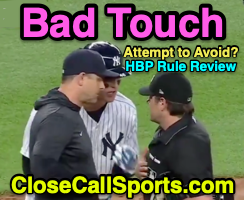
Quebec Capitales' manager was hit by a pitch thrown by his pitcher, on purpose, after being ejected by HP Umpire Jordan Alfonso of the Frontier League. Patrick Scalabrini's antics followed Ottawa Titans batter Jackie Urbaez's hit-by-pitch in the 9th inning, Urbaez's fourth HBP of the game.

Scalabrini's lively demonstration suggests an argument concerning whether Urbaez should have really had four HBPs, or whether he failed to follow the rule that would require he attempt to avoid the pitch.

Official Baseball Rule 5.05(b)(2) states, "The batter becomes a runner and is entitled to first base without liability to be put out (provided he advances to and touches first base) when they are touched by a pitched ball which they are not attempting to hit unless (A) The ball is in the strike zone when it touches the batter, or (B) The batter makes no attempt to avoid being touched by the ball."

If the pitch is in the strike zone when it touches the batter, it is a dead ball strike, and if the pitch is out of the zone and touches the batter who makes no attempt to avoid being touched, it is a ball (no award of first base). The batter only gets the base award if they make an attempt to avoid a ball.

Meanwhile, in college, NCAA Rule 7-4-i awards a strike if the batter "is judged to intentionally make a movement to be hit by a pitch, regardless of where the pitch is located; or allows themself to be intentionally hit by a pitch that is not thrown within the boundaries of the batter’s box unless it was not possible to avoid being hit."

High School (NFHS 8-1-d) is similar to professional ball: "If the batter permits the pitched ball to touch oneself (7-3-4), or if the umpire calls the pitched ball a strike, the hitting of the batter is disregarded except that the ball is dead. It is a strike or ball depending on location of the pitch."

Video as follows:

Tuesday, June 17, 2025

MLB Ejection 074 - Tripp Gibson (1; Dave Roberts)

3B Umpire Tripp Gibson ejected Dodgers manager Dave Roberts (warnings after Shohei Ohtani HBP) in the bottom of the 3rd inning of the #Padres-#Dodgers game. With one out and none on, Dodgers batter Ohtani took a 1-0 fastball from Padres pitcher Randy Vásquez for a hit by pitch, resulting in warnings, which itself followed a Fernando Tatis HBP in the top of the 3rd inning during which Tatis took a 0-1 fastball from Dodgers pitcher Lou Trivino for a hit by pitch. At the time of the ejection, the Dodgers were leading, 2-1. The Dodgers ultimately won the contest, 8-6.
  
This is Tripp Gibson (73)'s 1st ejection of 2025.
*Official Baseball Rule 6.02(c)(9): "If, in the umpire’s judgment, [an Intentionally Pitch at the Batter] violation occurs, the umpire may elect either to (A) expel the pitcher, or pitcher and manager, from the game, or (B) warn the pitcher and managers of both teams..."

This is the 74th ejection report of the 2025 MLB regular season.
This is the 39th manager ejection of 2025. Ejection Tally: 39 Managers, 13 Coaches, 22 Players.
This is Los Angeles' 2nd ejection of 2025, 1st in the NL West (ARI 4; LAD, SD, SF 2; COL 0).
This is Dave Roberts' 1st ejection since August 7, 2024 (Hunter Wendelstedt; QOC = Y [Obstruction]).
This is Tripp Gibson's 1st ejection since August 7, 2024 (Aaron Boone; QOC = Y [Balls/Strikes]).

Saturday, April 8, 2023

Hit By Pitch, Stay Here! Rule Differences & NCAA Strike

An ejection occurred after a home plate umpire called a batter out on strikes for intentionally allowing a pitch to hit him with no attempt to avoid being touched. Not only did the infamous "HBP: Stay Here!" call befall St Mary's batter Blake McDonald, it resulted in a strike call, which, on a 0-2 pitch, produced an inning-ending strikeout (and parting-shot ejection) early during the team's game against Pepperdine University.

This is where college (NCAA) and professional (OBR) rules differ on hit-by-pitch awards and penalties.

In college, such as the St Mary's-Pepperdine game, NCAA Rule 7-4-i states that, "A strike is awarded if the batter is judged to intentionally make a movement to be hit by a pitch, regardless of where the pitch is located; or allows themself to be intentionally hit by a pitch that is not thrown within the boundaries of the batter's box unless it was not possible to avoid being hit." Thus, even though the pitched ball appeared to touch the batter outside of the strike zone, by rule, a strike was nonetheless called.

In MLB or MiLB, though, this same play would result in a ball added to the count, pursuant to OBR 5.05(b)(2), which adjudicates the play differently: "The batter makes no attempt to avoid being touched by the ball...If the ball is in the strike zone when it touches the batter, it shall be called a strike, whether or not the batter tries to avoid the ball. If the ball is outside the strike zone when it touches the batter, it shall be called a ball if they make no attempt to avoid being touched."

For good measure, NFHS (high school) shares OBR (pro)'s rule: the pitch is adjudicated as a ball or a strike depending on its location.

Video as follows:

Saturday, October 29, 2022

Diaz Called Back to Bat After Umpire Rules He Leaned In

Aledmys Diaz grounded out to complete Houston's extra-inning loss to Philadelphia in Game 1 of the 2022 #Phillies-#Astros #WorldSeries, but not after he tried to get on base another way. Two pitches before the game-ending groundout, HP Umpire James Hoye denied Diaz free passage to first base on a hit-by-pitch from Phillies pitcher David Robertson, ruling that Diaz failed to make an attempt to avoid being touched by the ball, which by rule excludes the customary first base award on a standard HBP. 

Official Baseball Rule 5.05(b)(2) states, "The batter becomes a runner and is entitled to first base without liability to be put out when—

They are touched by a pitched ball which they are not attempting to hit unless (A) The ball is in the strike zone when it touches the batter, or (B) The batter makes no attempt to avoid being touched by the ball; If the ball is in the strike zone when it touches the batter, it shall be called a strike, whether or not the batter tries to avoid the ball. If the ball is outside the strike zone when it touches the batter, it shall be called a ball if they make no attempt to avoid being touched."

Accordingly, as leaning into a pitch most certainly doesn't meet the criteria for attempting to avoid it, Diaz was called back to bat.

Interestingly college posits a unique penalty for this violation that is different than OBR (and NHFS), per NCAA Rule 8-2-d-1a: "If the ball is in the strike zone when it touches the batter, or if the batter moves to intentionally get hit or freezes to allow a pitch that is not within the batter's box to hit them, the ball is dead, it shall be called a strike and the batter is not awarded first base."

Video as follows:

Monday, August 15, 2022

Ask UEFL - Yankees' Rizzo Denied HBP by Umpire Reyburn

Yankees manager Aaron Boone fruitlessly argued and Anthony Rizzo bemoaned umpires' lack of accountability after HP Umpire DJ Reyburn denied a hit-by-pitch in New York, despite the pitched ball contacting the batter's leg. But was this the correct call all along?

Official Baseball Rule 5.05(b)(2) governs the case of a pitched ball touching a batter: "The batter becomes a runner and is entitled to first base without liability to be put out (provided they advance to and touch first base) when: They are touched by a pitched ball which they are not attempting to hit unless (A) The ball is in the strike zone when it touches the batter [in which event the pitch is deemed a dead ball strike], or (B) The batter makes no attempt to avoid being touched by the ball [in which event the pitch is adjudged as a dead ball {called ball} or strike depending on its location as it struck the batter]."

Replays suggest that New York batter Rizzo, during Rays pitcher Ryan Yarbrough's 3rd inning, 1-2 curveball, not only made no attempt to avoid being touched by the ball, but that Rizzo may have furthermore leaned his leg in toward home plate, in a potential attempt to increase the likelihood that he would be struck by the ball.

After the ball touched Rizzo, Umpire Reyburn immediately enforced OBR 5.05(b)(2) by calling "Time" to acknowledge the dead ball that occurs when any pitched ball touches a batter before declaring a dead ball [called ball] and ordering Rizzo to remain at-bat, ruling that Rizzo failed to satisfy the terms of the rule that would have afforded him free passage to first base.

By the by, in 2019, Reds batter Derek Dietrich was hit by a pitch located within the strike zone, but was improperly awarded first base. Most times, batters touched by the ball are awarded first base out of habit, but as OBR 5.05(b)(2) indicates, there are two definitive cases in which a batter should not be given a free base when a pitched ball contacts them.

Sidebar: It is legal for a batter to "crowd the plate," provided that the batter is legally positioned with both feet within the batter's box [including touching the box's lines], and a base awarded should be granted pursuant to OBR 5.05(b)(2) unless either exception A [ball in strike zone] or B [makes no attempt to avoid] applies.

On Monday night in New York, Reyburn ensured the rule's attempt-to-avoid provision was applied.

Video as follows:

Tuesday, March 22, 2022

Ask UEFL - SMC-LMU Game-Ending HBP Strike Rule

When Loyola-Marymount University defeated Saint Mary's College on Sunday, 10-9, the game's final call—a hit-by-pitch strike three call for leaning into the ball—drew several questions. From a baseball rules perspective, here is the answer.

Play: With two out and one on (R3) in the top of the 9th inning of a one-run ballgame, trailing team Saint Mary's pinch hitter Javy Espinoza prepared for LMU pitcher Owen Hackman's 2-2 offering. Upon the pitched ball making contact with batter Espinoza's right leg, the home plate umpire ruled Espinoza out to end the game.

Relevant Rule: NCAA Rule 7-4-i states that, in college baseball, a strike is "Awarded if the batter is judged to intentionally make a movement to be hit by a pitch, regardless of where the pitch is located; or allows themself to be intentionally hit by a pitch that is not thrown within the boundaries of the batter's box unless it was not possible to avoid being hit." NCAA 8-2-d-1b further clarifies: "If the ball is within the batter's box occupied by the batter and the batter makes no movement to intentionally get hit by the pitch, the batter is awarded first base. In other words, a batter who freezes inside the batter's box and who is hit by the pitch shall be awarded first base." No matter the batter's movements, if the pitched ball contacts the batter within the strike zone, it is a dead ball strike.

This is a different rule than both high school and professional baseball. NFHS 7-3-4 states that the batter shall not "permit a pitched ball to touch them" unless the touching is unavoidable. The penalty in high school is that the pitch is ruled according to its location. This is similar to MLB/MiLB's way of calling this particular play, as OBR 5.05(b)(2) states that the batter becomes a runner entitled to first base when "touched by a pitched ball which they are not attempting to hit unless (A) The ball is in the strike zone when it touches the batter, or (B) The batter makes no attempt to avoid being touched by the ball." As in high school, the pitch is ruled a strike or ball depending on its location, as if the pitch hadn't touched the batter.

Under all three rulesets, "Time" is called as the ball becomes dead upon touching the batter.

Summary: NCAA's yardstick is whether or not the batter intentionally moved to get hit (tried TO), while NFHS/OBR's standard is whether or not the batter tried to avoid being hit (tried NOT to).

As for SMC-LMU, the umpire's judgment, thus, is whether or not the batter intentionally made a movement to be hit by the pitch or allowed this avoidable touch to occur (and the pitch was not located in the batter's box). If either event occurred, the proper call is dead ball and, with a 2-2 count, strike three, effectively ending the game. Had this occurred in NFHS or OBR, it would have resulted in a 3-2 count if the pitch was located outside of the strike zone or a strikeout if the pitch was thrown in the zone.

Did the batter intentionally make a movement to be hit by this pitch? | Video as follows:

Wednesday, September 29, 2021

Foul Ball vs HBP vs Swinging (Dead Ball) Strike - Herrera

When Phillies batter Odubel Herrera pulled his bat back from a bunt attempt as Mets pitcher Brad Hand's offering ran in, HP Umpire CB Bucknor faced one of baseball's most difficult calls: deciphering whether the result was a foul ball, hit-by-pitch, or dead ball strike due to the batter's attempt to strike the ball.

Tmac breaks down the play as it occurred, with Herrera dropping the bat as the pitch arrived, and the ball first contacting Herrera's person before then making contact with the discarded bat on its way to the ground, producing a distinct sound of a ball hitting a bat, but as Replay Review would show, the primary point of contact (the first point of contact) was the ball hitting Herrera's hand as Herrera attempted to avoid the pitch (as opposed to failing to check a swing or attempting to bunt it), meaning that Herrera was awarded first base with a hit-by-pitch.

Video as follows:

Thursday, April 8, 2021

Conforto Chaos - Umpire's HBP on Strike Three

When Mets batter Michael Conforto took one for the team with a walk-off hit-by-pitch in New York to defeat the Miami Marlins, HP Umpire Ron Kulpa's HBP call took on a peculiar meaning after replays indicated the pitch was located within the strike zone and that Kulpa had begun his strike three (looking) mechanic before abruptly reversing course and signaling that Conforto had been hit by the pitch and thus would be awarded first base.

Play: With one out and the bases loaded in the bottom of the 9th inning of a Marlins-Mets game tied at two, Conforto stepped in for a 1-2 pitch from Miami's Anthony Bass. The pitch, located near the upper inside corner, made contact with Conforto's right elbow.

Call: HP Umpire Kulpa, having initially started to signal strike three, appeared to change his call and communicated that Conforto had been hit by the pitch, awarding Conforto first base as a result, resulting in a Mets win and argument from Marlins Manager Don Mattingly and, potentially a protested game.

Rule: Official Baseball Rule 5.05(b)(2) states that the batter becomes a runner and is entitled to first base without liability to be put out when—"He is touched by a pitched ball which he is not attempting to hit unless (A) The ball is in the strike zone when it touches the batter, or (B) The batter makes no attempt to avoid being touched by the ball." Furthermore, "If the ball is in the strike zone when it touches the batter, it shall be called a strike, whether or not the batter tries to avoid the ball. If the ball is outside the strike zone when it touches the batter, it shall be called a ball if he makes no attempt to avoid being touched."

Analysis
: The first point to note is the pitch was, indeed, located within the strike zone and the baseball appeared to touch the batter while it was located in the strike zone. Accordingly, 5.05(b)(2)(A) applies and renders the judgment relative to whether Conforto attempted to avoid the pitch (or leaned into it) superfluous: as soon as we determine the baseball was in the strike zone when it touched the batter, it doesn't really matter how the batter wound up located in the strike zone: the proper call is a dead ball strike (strike three in this case).

If, however, the umpire ruled the pitch was located outside of the strike zone when it touched the batter, then we must consider how Conforto contorted himself: if Conforto leaned into the pitch (or simply failed to "attempt to avoid being touched"), it would be a dead ball ball and the at-bat would continue with a 2-2 count.

Had Kulpa kept his initial "strike three" call, the outcome of a strikeout would have been correct. By changing to a hit-by-pitch with first base award, the umpire talked himself out of the proper ruling.

Protest: Because judgment calls cannot be protested, the Marlins have but one path to win this protest: If Kulpa maintains that the pitch was located within the strike zone and he awarded Conforto first base even though the baseball was located in the strike zone when it touched Conforto, that would signify an incorrect application of OBR 5.05(b)(2) and, thus, basis for affirming Miami's protest. If, however, Kulpa states that he simply reversed his "strike" call to that of a "ball" by virtue of the pitch being located outside of the strike, then the protest would be denied because pitch location and "did the batter lean into the pitch" decisions are both non-reviewable judgment calls.

After the game, Kulpa spoke with pool reporter Anthony Rieber: "The guy was hit by the pitch in the strike zone. I should have called him out."

Video as follows:

Thursday, October 15, 2020

Tmac - Justin Turner's Kick By Pitch - Kicking Motion

During Los Angeles' NLCS Game 3 blowout of Atlanta, Dodgers batter Justin Turner was awarded first base after sticking his foot into a first-inning pitch. This uncalled distinct kicking motion exposed a problem with Replay Review and pointed out a plate umpire's vulnerability to catcher positioning on balls in the dirt.

With two out and two on (R1, R3) in the top of the 1st inning of a 7-0 game, Turner faced a pitch in the dirt from Braves starter Grant Dayton (now with a 36.00 ERA this postseason series), appearing to kick at the pitch and, in doing so, cause the ball to carom off his right foot and to the backstop.

This play is similar to an elbow lean.
Initially no-called by HP Umpire Jim Reynolds, the Braves challenged that the ball had touched Turner, and Replay Review agreed, ruling the play a hit-by-pitch and awarding Turner first base—despite Turner appearing to intentionally kick at aka lean into the pitch.

The Replay problem here is quite simple: Replay Review is designed only to determine whether or not a pitch made contact with a batter, and Replay Official Mike Muchlinski quickly determined that Turner did come into contact with the baseball.

The plate ump is blocked out.
Unfortunately, Replay Review Regulations prohibit video from determining whether the batter made no attempt to get out of the way of a pitch (much less intentionally leaned into it), as in Official Baseball Rule 5.05(b)(2), which states, "The batter becomes a runner and is entitled to first base without liability to be put out (provided he advances to and touches first base) when—He is touched by a pitched ball which he is not attempting to hit unless (A) The ball is in the strike zone when it touches the batter [outcome: dead ball strike], or (B) The batter makes no attempt to avoid being touched by the ball [outcome: dead ball, ball]."

Replay can determine IF a batter was touched by a pitched ball, but not HOW it happened.

In 2017, we wrote about the problem with not enough plays being reviewable and this is one of them. Through steadfast dedication to being technically correct (the best kind of correct), baseball again misses out on actually officiating this play correctly.

Fix replay, close the loophole.
Lastly, Reynolds is blocked out by the catcher due to the ball in the dirt, the catcher lunging to block it, and Turner moving his back foot deep in the box (as opposed to front foot) into the ball's trajectory. The third base umpire is likely blocked by Turner's body, 1B Umpire Dan Iassogna is looking upward for check swing potential, the second base umpire is on the rim of the outfield grass, and the two line umpires are far removed.

This play is the perfect storm and impetus to, once again, fix Replay Review, and if only the Braves had woken up to play a baseball game on Wednesday, this wrap-up might be a bigger story. Baseball should write LA a thank you card for a history-making scoreboard run-up because the league office got lucky. | Video as follows:

Friday, October 2, 2020

Tmac's Teachable Postseason - HBP Conflict in Chicago

With pitcher Yimi Garcia's Miami Marlins on the cusp of eliminating Willson Contreras' Chicago Cubs from the 2020 postseason, HP Umpire Will Little found himself officiating a hit-by-pitch that gave rise to conflict between two players late at Wrigley Field on Friday afternoon.

With one out and none on in the top of the 8th inning, with Miami holding a 2-0 lead, Contreras took a first-pitch fastball from Garcia for a hit-by-pitch...or did he?

Replays indicate the pitch struck Contreras on the elbow, which he appeared to move directly toward and into the path of the pitched ball, effectively causing the HBP.

Did Contreras lean in?
Accordingly, HP Umpire Little enforced Official Baseball Rule 5.05(b)(2)—"The batter becomes a runner and is entitled to first base without liability to be put out when: He is touched by a pitched ball which he is not attempting to hit unless (A) The ball is in the strike zone when it touches the batter, or (B) The batter makes no attempt to avoid being touched by the ball; (2) If the ball is in the strike zone when it touches the batter, it shall be called a strike, whether or not the batter tries to avoid the ball. If the ball is outside the strike zone when it touches the batter, it shall be called a ball if he makes no attempt to avoid being touched"—by calling "Time" and ordering Contreras back to home plate to resume his at-bat, for failure to attempt to avoid being touched by the ball (even more-so, he appeared to lean into the pitch).

After a brief discussion with Cubs Manager David Ross, Contreras' at-bat continued, with Contreras squaring to bunt the 1-0 pitch before taking his bat back for a called strike on a pitch over the heart of home plate. Contreras, seeing Garcia charging in toward the plate (perhaps in response to a potential bunt), yelled in Garcia's direction.

Little noticed this brewing conflict and subtly stepped in between the two players, and the next pitch from Garcia hit Contreras on the upper arm for a legitimate hit-by-pitch.

Umps tend to both players.
This time, as Contreras walked toward first base, 1B Umpire and Crew Chief Dan Iassogna helped manage the situation by escorting a visible perturbed Contreras to first base as HP Umpire Little headed to the mound and Garcia. 2B Umpire Bill Welke also started toward the middle of the infield, just in case.

In the end, cooler heads prevailed (after further yelling) and the Marlins completed a sweep of the Cubs without incident.

Question: Was the hit-by-pitch intentional? After a so-called fake HBP and yelling toward the pitcher, one could easily surmise that Garcia may have been tempted to intentionally hit Contreras with a pitch, such as the 1-1 fastball into Contreras' bicep—and that's a fair question.

TTM sponsored by OutWestOfficials
However, context is key, and consider the situation: Miami leads the game 2-0 in the 8th inning of a postseason elimination game during a best-of-three series. Chances are, given this context, the pitcher was not attempting to bring the tying run to the plate and, thus, warnings and ejections likely would not be warranted...nonetheless, it behooves umpires to sense the conflict and prepare to react accordingly, as Iassogna and Little did upon the bona fide hit-by-pitch.

Video as follows:

Monday, August 24, 2020

Jose's Navas of Steel - The HBP Strikeout

In this Gil's Call, we talk about guts and gumption: having the courage to make a tough call. For first-year MLB umpire Jose Navas, that opportunity presented itself during Sunday's Reds-Cardinals game, when Cincinnati's Jesse Winker leaned into an Andrew Miller slider for a hit-by-pitch, as Navas overruled the HBP's standard base award and declared Winker out on strikes.

The Play: With none out and none on in the top of the 8th inning, lead-off batter Winker worked his way to a 3-2 count. As pitcher Miller delivered his payoff pitch, Winker was struck in the right elbow (pad) by the pitched ball, drawing a standard "Time" call from HP Umpire Navas.

But instead of awarding Winker first base as a hit batsman, Navas enforced Official Baseball Rule 5.05(b)(2), ruling that the pitch was located in the strike zone: Dead ball, strike three, batter's out.

Navas explains his call to Winker.
FWIW: This pitch's px value was 0.84 with a pz of 2.60. RoboUmp starts balling px values greater than 0.83, so while RoboUmp would have balled this pitch by a margin of about 0.1 inches, the call becomes borderline under UEFL f/x and Zone Evaluation rules.

Furthermore, if an off-speed or slider type pitch has cutting action that may have allowed the ball to catch the back corner of home plate (and with a margin of 0.1 inches, that's a distinct possibility), the batter's act of making contact with the ball deprives the umpire with the opportunity to fully adjudicate pitch location, in which case an umpire might choose to err on the side of awarding the pitcher (for hitting the batter? Only if the batter, through his/her actions, deprived the pitcher of securing a called strike the 'old fashioned' way).

If the pitch is located as a strike, it's a strike.
The Rule: OBR 5.05(b)(2) awards the batter first base without liability to be put out when—"He is touched by a pitched ball which he is not attempting to hit unless (A) The ball is in the strike zone when it touches the batter, or (B) The batter makes no attempt to avoid being touched by the ball; If the ball is in the strike zone when it touches the batter, it shall be called a strike, whether or not the batter tries to avoid the ball. If the ball is outside the strike zone when it touches the batter, it shall be called a ball if he makes no attempt to avoid being touched."

Note, however, that (per 5.05(b)(2) Comment): "A batter shall not be considered touched by a pitched ball if the ball only touches any jewelry being worn by a player (e.g., necklaces, bracelets, etc.)" (this is similar to the laces-of-the-glove rule in that superfluous dangles don't count as part of a person, whereas uniform items e.g., baggy shirts or equipment such as elbow padding/braces do).

FoxTrax indicates the ball touched the zone.
As a matter of technicality, whether Navas ruled that Winker failed to attempt to avoid being touched by the pitched ball is rather irrelevant—because he ruled the baseball was located in the strike zone, it's a strike no matter what Winker tried or didn't try to do. In other words, he invoked OBR 5.05(b)(2)(A), not OBR 5.05(b)(2)(B).

Conclusion: This is an incredibly gutsy call to make—and the correct call—especially relative to 5.05(b)(2)(A)'s auto-strike as opposed to 5.05(b)(2)(B)'s auto-ball. For a triple-digit umpire with single-digit major league experience to make this call should rightly earn praise and high marks on an evaluation.

And the post-call explanations and situation-handling by both Navas and Crew Chief CB Bucknor with both Winker and Manager David Bell were phenomenal.

As I've long said, do what's right, which may not always (and often isn't) congruent with what is easy or popular.

Rules Myth: Recall, whether or not a batter "leans into" the pitch is of zero consequence. The rule simply specifies that if a batter "makes no attempt to avoid being touched by the ball" (for a pitch located outside of the strike zone), which is a significantly lower bar than simply "leaning into" the pitch or not, the proper call is a dead ball, and strike or ball depending on the pitch's location.

Video as follows:

Monday, August 26, 2019

Batter Dietrich Hit by Pitch in Strike Zone Ruling

After Max Muncy admitted to embellishing his injury ("soccer style") in Los Angeles, we cautioned umpires about blind trust. Reds batter Derek Dietrich took a hit-by-pitch on a pitched ball thrown within the strike zone in Miami during Cincinnati's Monday night clash against the Marlins.

This Ask the UEFL play comes from a reader who asks what the HBP options are when a batter is touched by a pitched ball within the strike zone or a batter who fails to avoid being touched by a pitch. In either case, the lesson is not to assume the batter is always a credible witness.

What happens when the HBP is in the zone?
The Play: With two out and one on (R2) in the top of the 2nd inning of Monday's Reds-Marlins game, Reds batter Derek Dietrich took a 2-2 fastball from Marlins pitcher Pablo Lopez for a hit-by-pitch, and was awarded first base by HP Umpire Hunter Wendelstedt.

The Hitch: Replays indicate the pitch was located over the inner half of home plate and below the midpoint (px 0.49, pz 3.02 [sz_top 3.4]), which would indicate the pitch was located within the strike zone (pursuant to the Kulpa Rule, this is a strike by approximately five horizontal inches and, per the Miller Rule, by about three vertical inches).

How about a batter w/ no attempt to avoid?
The Rule: Official Baseball Rule 5.12(b)(2) specifies the standard hit-by-pitch criteria under which a batter is entitled to first base without liability to be put out: "He is touched by a pitched ball which he is not attempting to hit unless (A) The ball is in the strike zone when it touches the batter, or (B) The batter makes no attempt to avoid being touched by the ball."

SIDEBAR: The rule has nothing to do with a batter who "leans in" and touches a pitched ball. Leaning into a pitch to draw a HBP call falls under an extreme case of scenario (B): making no attempt to avoid being touched by the ball.

Outcomes: If the pitch was located in the strike zone, it is a dead ball strike [+1 strike].
If the batter makes no attempt to avoid a pitch out of the zone, it is a dead ball, ball [+1 ball].

Did Dietrich try to avoid the pitched ball?
For the Dietrich play, which begins with a 2-2 count, if the umpire judges that the pitch is located in the strike zone, whether or not Dietrich attempted to avoid being touched by it, the proper call is "Time" and adding a strike to the count (in this case, it would be strike three and the batter would be out).

If the umpire deems the pitch is outside of the strike zone and Dietrich made no attempt to avoid being touched (potentially including a determination that he intentionally leaned into the pitched ball), the proper call is "Time" and adding a ball to the count (in this case, ball three).

If the umpire deems the pitch was outside of the strike zone and Dietrich did make an attempt, however slight, to avoid being touched, the proper call is "Time" and awarding the batter first base.

Video as follows:

Friday, July 5, 2019

Case Play 2019-5 - Batter Causes HBP [Solved]

A batter cannot cause a pitcher to balk, but can he induce a HBP? Giants player Kevin Pillar's errant "Time" request during Padres hurler Luis Perdomo's delivery seemed to cause a hit batsman as HP Umpire Jeff Nelson properly declined Pillar's late request for "Time," resulting in a slowly thrown pitch that bounced into Pillar's left foot on its way to the backstop. Was Nelson's subsequent hit-by-pitch ruling the correct call or should Nelson have reset the play "from scratch"?

The Play: With one out and none on in the top of the 6th inning of July 4's Giants-Padres game, San Francisco batter Pillar requested "Time" from HP Umpire Nelson as San Diego pitcher Perdomo began his delivery; replays indicate Perdomo was into his leg kick as Pillar signaled his timeout request.

Is this disrupted delivery a true HBP?
Nelson properly invoked Official Baseball Rule 5.04(b)(2) Comment and ignored Pillar's untimely request as Perdomo, perhaps thinking "Time" had been called, slowed his delivery and half-heartedly threw a slow pitch that bounced into Pillar's foot.

Case Play Question: As the ball bounced into and away from Pillar, Nelson ruled the pitch a hit batsman and awarded Pillar first base. Was this the correct call and if not, what should the call have been? No pitch? Ball? .... Strike?
Article of Note: Even if Time Not Granted, Batter Cannot Cause a Balk (7/14/18).
Article of Note: Starting From Scratch - Batter Disrupts Pitcher's Delivery (6/29/16).

Case Play Answer: Rule 5.04(b)(2) protects the pitcher from balking as a result of a batter's action, including a batter's late request for "Time" that is denied by the umpire; if the pitcher stops his motion or otherwise balks (with a runner aboard, obviously) as a result of the batter's act, the balk is disregarded and play starts from scratch, one of baseball's only true "do-over" remedies.

However, Rule 5.04(b)(2) does not protect a pitcher from throwing a ball. To better illustrate, consider this timeline of protection: If the batter inadvertently causes the pitcher to disrupt delivery, the pitcher is protected from an infraction of the rules from an illegal delivery (e.g., any balk is nullified). However, if the delivery is not illegal, then the result of the pitcher's delivery shall stand because once the pitch becomes a ball or strike, the umpire shall call it a ball or a strike (or HBP in this case). Protection extends to the conclusion of the balk/illegal pitch rule and does not include the pitch itself, which shall be called 'Ball' or 'Strike,' as the case may be.

Official Baseball Rules Library
OBR 5.04(b)(2) Comment: "Umpires will not call 'Time' at the request of the batter or any member of his team once the pitcher has started his windup or has come to a set position even though the batter claims 'dust in his eyes,' 'steamed glasses,' 'didn’t get the sign' or for any other cause."
OBR 5.04(b)(2) Comment [Cont'd]: "If after the pitcher starts his windup or comes to a 'set position' with a runner on, he does not go through with his pitch because the batter has inadvertently caused the pitcher to interrupt his delivery, it shall not be called a balk. Both the pitcher and batter have violated a rule and the umpire shall call time and both the batter and pitcher start over from 'scratch.'"
OBR 5.04(b)(2): "The batter shall not leave his position in the batter’s box after the pitcher comes to Set Position, or starts his windup. PENALTY: If the pitcher pitches, the umpire shall call 'Ball' or 'Strike,' as the case may be."
OBR 5.05(b)(2): "The batter becomes a runner and is entitled to first base without liability to be put out when—He is touched by a pitched ball which he is not attempting to hit unless (A) The ball is in the strike zone when it touches the batter, or (B) The batter makes no attempt to avoid being touched by the ball."

Video as follows:

Monday, February 25, 2019

NCAA New Rule - Batter K'd for Intent-to-Draw HBP

The NCAA Baseball Rules Committee adopted a new rule for 2019, opting to penalize a batter who leans in to try and draw a HBP by having the umpire call a strike. One week into the season and it just happened, with an ejection for arguing it to boot, issued mere seconds after the head coach strolled out to question the umpire's decision.

Umpire prepares to eject a K-arguing coach.
The Play: It all happened during Army's second game of the young college baseball season against LSU when West Point batter Drake Titus fell behind in the count to LSU pitcher Chase Costello in the top of the 7th inning with one out and two on (R1, R3). With a 2-2 count, Drake's body made contact with Costello's pitch, HP Umpire Eddie Newsom ruling Drake out for, essentially, leaning into the pitch to bail himself out of a two-strike count. Army Head Coach Jim Foster found himself ejected from the game for arguing Newsom's decision.

The Rule (NCAA): NCAA changed Rule 8.2.d.1 after the 2018 season to penalize the batter with a strike and not awarding first base if, in the judgment of the umpire, the batter makes an intentional movement to be hit by a pitch, regardless of where the pitch is located. The guideline goes on to say that if a batter freezes in the box and is hit by the pitch, he shall be awarded first base (prior to 2019, the penalty would simply be a dead ball):
A batter may not make a movement to intentionally get hit by the pitch, regardless of the location of the pitch. He must also avoid being hit whenever possible, unless the pitch is within the batter's box occupied by the batter. If the batter's action is deemed intentional, then:
a) If the ball is in the strike zone when it touches the batter, or if the batter moves to intentionally get hit or freezes to allow a pitch that is not within the batter's box to hit him, the ball is dead, it shall be called a strike and the batter is not awarded first base.
The Rule (OBR): It should be noted that professional baseball (OBR) has no such rule concerning an automatic intentional HBP strike, but does require a batter to make an "attempt to avoid being touched by the ball." If an OBR batter fails to avoid being touched, the penalty is simply a dead ball and the pitch is called a ball or strike depending on pitch location (Rule 5.05(b)(2)).

The Rule (NFHS): High school is similar to pro in that "if [the batter] permits the pitched ball to touch him...the hitting of the batter is disregarded except that the ball is dead. It is a strike or ball depending on location of the pitch." One related baseball rules difference with NFHS is that if a pitched ball touches a batter's loose garment "not worn properly," the batter is not entitled to first base (whereas, for instance, under OBR, it would be a base award).


Umpire-in-Chief rules a HBP strike.
Analysis: There's really not much to analyze from the accompanying in regard to the umpire's judgment—if he deems the batter moved intentionally into the pitch, then the proper call is a strike (strike three in this case). Though the play was reviewed, this is still a judgment call and as a matter of principle, we don't pick apart judgment. Perhaps we might say this is a more likely occurrence with a two-strike count than with a batter-ahead count, but that's neither here nor there. The only analysis here is rather mechanical.

First, our umpire properly rules the play dead by announcing "Time"—the pitched ball has contacted the batter and the ball is dead. Next, he points to the batter's infraction at home plate and indicates the penalty for the violation; in this case, strike three. Because the ball is dead on strike three, the batter is out and all runners hold their positions. The batter walks back to the dugout without argument while the head coach arrives at home plate.

Did the batter place his elbow into the ball?
We see our plate umpire display a "stop sign" mechanic—both because issues of balls/strikes cannot be argued by a coach who has exited the dugout and, likely, in response to something the coach has said. The coach in this case shall be permitted an explanation and clarification as to the new-for-2019 ruling and the rule itself, but shall be warned upon any attempt to argue the call.

Leaving one's position to argue balls and strikes—and the related calls of check swings, warnings, balks, and HBP-related decisions—violates one of baseball's Standards for Removal from the Game.
Related Post: Ejections - What and Wherefore? Standards for Removal (3/29/17).

Video as follows:

Sunday, April 22, 2018

MLB Ejections 023-24 - Cory Blaser (1-2; Davis, Haines)

HP Umpire Cory Blaser ejected Cubs Hitting Coach Chili Davis and Assistant Hitting Coach Andy Haines (Unsportmanlike-NEC/warnings & ejection no-calls; QOCU) in the top of the 1st inning of the Cubs-Rockies game. With two out and none on, Cubs batter Kris Bryant took a 1-2 fastball from Rockies pitcher German Marquez for a hit-by-pitch, the first hit batsman of the game; no warnings or other actions resulted from the HBP. Replays indicate the pitch was located inside and head-high, after which Bryant left the game due to injury, the call was irrecusable. At the time of the ejection, the game was tied, 0-0. The Cubs ultimately won the contest, 9-7.

These are Cory Blaser (89)'s first and second ejections of 2018.
Cory Blaser now has 6 points in the UEFL Standings (2 Prev + 2*[2 MLB + 0 Irrecusable Call] = 6).
Crew Chief Greg Gibson now has 2 points in Crew Division (0 Previous + 2 Irrecusable Call = 2).

These are the 23rd and 24th ejections of the 2018 MLB regular season.
This is Chicago's 1/2nd ejection of 2018, T-1st in the NL Central (CHC, MIL 2; CIN, PIT, STL 0).
This is Andy Haines' first career MLB ejection.
This is Chili Davis' first ejection since September 7, 1997 (Durwood Merrill; QOC = U [Balls/Strikes]).
This is Cory Blaser's first ejection since August 10, 2016 (Barry Bonds; QOC = N [Balls/Strikes]).

Wrap: Chicago Cubs vs. Colorado Rockies, 4/22/18 | Video as follows:

Friday, May 26, 2017

MLB Admits Error on Swinging HBP Strike Non-Review

Despite on-field umpires accepting Boston's challenge of a hit-by-pitch during a swinging strike no-call, a Replay Official failed to review the play, leading MLB to issue a rare statement purporting that its replay staff made a mistake by not reviewing the call.

Unfortunately, this is not the first time this type of replay non-review has occurred, and it's not even the first time that we have written about this type of call, identifying it as potential trouble spot for MLB due to poor replay communication and interpretation in the past of baseball's three types of hit-by-pitches (the take-your-base HBP, the dead ball ball HBP, and the dead ball strike HBP...more on these later).

Remember the ominous line from our pre-season 2017 edition of Tmac's Teachable Moments - Let's Fix Replay, "Let's replay more things...full swings that turn into HBPs are some of the disasters that are not reviewable"?

What is (Y) and isn't (X) reviewable.
Well, the HBP disaster sure reared its ugly head Thursday night at Fenway Park, though at least this time, MLB seems to have taken some initiative to solve the problem of the dead ball strike HBP review by saying that nearly all potential ball-hits-batter situations are to be deemed reviewable.^

Executive Summary: Any play in which a batter may be touched by a pitched ball is generally subject to review, but only if the dispute arises from a question of whether the pitched ball made contact with the batter vs with the bat, or batter vs nothing (but air). Without these material conflicts, the play is not reviewable (e.g., the batter's intent to swing or to avoid a pitched ball is not subject to review), and neither is the issue of whether a pitched ball made contact with the bat vs nothing (but air), nor whether a batted ball made contact with a batter.

The Play: With none out and none on in the top of the 9th inning of Thursday's Rangers-Red Sox game, Rangers batter Nomar Mazara swung at a 2-2 knuckle curve from Red Sox pitcher Craig Kimbrel. Initially ruled a swinging strikeout and wild pitch by HP Umpire Chad Fairchild—the uncaught third strike allowed Mazara to reach first base—Red Sox Manager John Farrell attempted to challenge the play, as replays indicate that the pitched ball struck Mazara's lower leg while he was swinging at it: the proper call would have been a dead ball strike, meaning Mazara would be out. Instead, Mazara ended up on first base.

Although Fairchild and acting Crew Chief Alfonso Marquez agreed to bring the play to video review, the call nonetheless stood, and a visibly unhappy Farrell retained his Manager's Challenge.

After the game, Major League Baseball issued a statement admitting it made a mistake:
During the top of the ninth inning of Thursday's Rangers-Red Sox game, the umpires on the field accepted Boston's challenge that Texas batter Nomar Mazara was hit by the pitch on a swinging strike three. The Replays Official and Replay Supervisor misinterpreted the call on the field and incorrectly deemed the play to be non-reviewable. The call on the field - of no hit by pitch on a swinging strike three - is a reviewable play under the Replay Regulations.
Marquez relays NY's decision to Farrell.
Analysis: Here's what that likely means: Fairchild ruled the play a swinging strikeout and uncaught third strike (as evidenced by Fairchild's "safe" mechanic), but MLB Replay either (1) misunderstood the call as a hit-by-pitch (logically unlikely, given Fairchild's "safe" mechanic), (2) thought Fairchild called a foul ball (unlikely given that the batter-runner ended up on first base) or (3) deemed that an issue of HBP during a swinging third strike is not subject to Replay Review.

This very issue has come up with the Replay Review process before, and the League failed to clearly convey its interpretation regarding the HBP vs swinging strike vs dead ball strike vs foul ball play when it did.

Replay Review Regulation V.G. states that the following is reviewable: "Hit By Pitch. Those plays for which there is a possibility that a pitched ball touches a batter, or his clothing." A traditional, take-your-base hit by pitch is occurs when the batter "is touched by a pitched ball which he is not attempting to hit" (Rule 5.05(b)). Yet, a lesser known variety of the hit-by-pitch appears in both 5.05(b)'s approved ruling and the definition of "Strike": "A STRIKE is a legal pitch when so called by the umpire, which...touches the batter as he strikes at it." The approved ruling for a HBP strike states, "When the batter is touched by a pitched ball which does not entitle him to first base, the ball is dead and no runner may advance."

The Three HBPs: Accordingly, there are three types of hit-by-pitches in baseball: the take-your-base "traditional" HBP, the dead ball ball HBP (aka the "you didn't try and get out of the way" HBP), and the dead ball strike HBP (or "HBP strike," for short; both swinging and not swinging). The first two options require the batter not to have swung at the pitch while the latter is what happens when the batter has attempted a swing (or is struck by a pitched ball within the strike zone).
Ron Kulpa tried to replay a similar dead ball
third strike challenge in 2016, but was
informed that the play was not reviewable

^The three exceptions to the "nearly all HBP situations are reviewable" phrase are intra-HBP disputes, namely (1) take-your-base HBP vs dead ball ball HBP, (2) take-your-base HBP vs dead ball strike HBP, and (3) dead ball ball HBP vs dead ball strike HBP. In other words, a "traditional HBP vs Dead Ball Strike" dispute is really a challenge about "No Swing vs Swing," which has never been a reviewable call (and neither has the umpire's judgment of whether a batter has attempted to avoid being hit by a pitch, nor whether a pitch is located as a ball or a strike).

It goes without saying that the League doesn't want to be in the business of reviewing check swing calls. But does that (or did it) preclude Replay from taking a look at all plays in which the on-field umpires rule that the batter attempted to strike the pitched ball? Why did this mistake happen?

History: In June 2016's Unreviewable - Possibility of HBP Key to Replay Review, we discussed two HBP/bat contact plays with different outcomes, including one similar to Thursday's that the League refused to review.

In Miami, Rockies batter Trevor Story clearly swung at and attempted to hit a 3-2 fastball, ruled a foul ball. After Don Mattingly attempted to challenge the play, alleging the ball hit Story's shoulder as opposed to his bat (thus, a dead ball strike), Replay HQ ruled the play non-reviewable. It is important to note that under both the original ruling (foul ball) and Mattingly's contention (dead ball strike), the batter would be deemed to have swung at the pitch, and foul ball vs HBP is not one of the three exceptions to the reviewable HBP situations clause.

In Houston, Angels batter Mike Trout tried to avoid being hit by a 3-2 fastball, ruled a hit-by-pitch. After AJ Hinch attempted to challenge the play alleging that Trout's bat contacted the pitched ball, the play was overturned to a groundout.

Thus, our table of reviewable plays (assuming the Miami play was properly not reviewed) looks like:
Play Original Call Reviewable?
HBP (No Bat Contact) HBP or "Ball"/"Strike" Yes
HBP vs Batted Ball HBP Yes
HBP vs Batted Ball* Willfully Batted Ball Yes
Swinging vs HBP Strike* Any Strike Call Yes
HBP vs HBP Ball vs HBP Strike Any Type of HBP No
Batted Ball vs No Contact Any No

*HBP vs Batted Ball ("batted ball" means both foul or fair balls) and Swinging vs HBP Strike, where the original call was that the batter was or was not hit by a pitch which he was attempting to swing at, were not reviewed on June 20, 2016 in Miami and Boston on May 25, 2017, though they should have been.

A batted ball call, without the possibility that the pitched ball hit the batter, cannot be reviewed.

Kulpa/Meals Part II: The play was reviewable.
A Proper HBP Review: Just last week (5/19/17), the Orioles successfully challenged that opposing batter Justin Smoak had been hit by a pitch that he swung at in the wake of HP Umpire Jerry Meals' wild pitch/swinging strike call, resulting in a reviewed and overturned call of dead ball strikeout and cancellation of a Blue Jays run. As fate would have it, umpires Kulpa and Jerry Meals went to the headset in this game, as they did in Miami in 2016, only to successfully overturn the call in Baltimore to that of a dead ball strike.

Thursday's mea culpa from MLB clarifies that all intent-congruent hit-by-pitch situations—not only those that entitle the batter to first base—are reviewable. Video via 'Read More'

Saturday, July 23, 2016

Hit in Elbow Fri, Jordan Baker Denies Lean-In HBP Sat

Umpire Jordan Baker called Josh Donaldson back to bat on a HBP-that-wasn't when Donaldson appeared to place his left ("front") elbow into the path of a pitched baseball during the Mariners-Blue Jays game.

Baker calls Donaldson back to the plate.
On the very first pitch to lead off the bottom of the third inning, Mariners pitcher Hisashi Iwakuma threw inside to Blue Jays batter Josh Donaldson, who appeared to place his left arm in the path of the pitched ball, resulting in the ball hitting Donaldson's elbow. For Donaldson, it was a convenient pitch—a benign 70 mph curveball that strayed from its intended spot—and replays indicate he made little attempt to avoid the ball and a similarly negligible attempt to actually hit the pitch.

Although a non-swinging batter is usually awarded first base when he is hit by a pitched ball, this was not the case Saturday as HP Umpire Baker invoked Official Baseball Rule 5.05(b)(2)(B), which is a subsection of the rule awarding the batter first base in the event of a hit-by-pitch:
The batter becomes a runner and is entitled to first base without liability to be put out (provided he advances to and touches first base) when: (2) He is touched by a pitched ball which he is not attempting to hit unless (A) The ball is in the strike zone when it touches the batter, or (B) The batter makes no attempt to avoid being touched by the ball.
With Donaldson clearly making no attempt to avoid the ball, Baker properly enforced OBR 5.05(b)(2)(B) and ordered Donaldson back to the plate to continue his at bat with the count 1-0 ("If the ball is outside the strike zone when it touches the batter, it shall be called a ball if he makes no attempt to avoid being touched"). Replays indicate the pitch had a horizontal px value of -1.179, meaning it was clearly off the plate and out of the zone, but had it been in the zone, Donaldson would have been charged a strike. To be clear, Donaldson's infraction was not that he leaned into the pitch, but that he made no attempt to avoid being touched by the ball.

Baker perhaps was unamused by Donaldson's act after Baker himself was drilled in the left arm by a foul ball during Friday night's contest. That line drive off the bat of Nelson Cruz left an imprint of the baseball's stitch marks on Baker's arm, which was wrapped prior to Saturday's game. It was Baker's second time being struck by a foul ball this season, as he was hit in the hip at third base by another line drive in April.

Saturday, November 28, 2015

Australian Baseball Ejections (x2) - Takahito Matsuda

An ABL batter made no attempt to avoid being touched by a pitched ball, resulting in a pair of ejections in Australia. HP Umpire Takahito Matsuda ejected Melbourne Aces 2B Tanner Vavra & Manager Joe Vavra for arguing a ball (no-HBP / failure to attempt to avoid a pitched ball) call in the bottom of the 7th inning of the Heat-Aces game. With none out and none on, Aces batter T Vavra took a 0-1 fastball from Heat pitcher Daniel Schmidt for a dead ball pitch ruled a ball. Replays indicate the pitch made contact with Vavra's left arm, but Matsuda ruled Vavra failed to attempt to avoid being touched by the ball, the call was correct.* At the time of the ejections, the Heat were leading, 4-1. The Aces ultimately won the contest, 5-4.

* OBR Rule 5.05(b)(2)(B) [formerly 6.08] states that the batter is entitled to first base when "he is touched by a pitched ball which he is not attempting to hit unless the batter makes not attempt to avoid being touched by the ball." Replays indicate Vavra may have actually 'leaned in' to the pitch by extending his elbow toward home plate, but relevant for Matsuda's ruling is that Vavra simply made no attempt to avoid being touched by the ball.
Note: Contrary to the broadcasters' depiction, Matsuda ruled the pitch a ball, not a strike. Had the pitch been located within the strike zone, the proper call would indeed have been a dead ball strike.

Wrap: Perth Heat vs. Melbourne Aces (Australian Baseball League), 11/27/15
(Click the "read more" link for video of this play)

Sunday, April 12, 2015

MLB Ejection 004: Joe West (1; Bryan Price)

3B Umpire Joe West ejected Reds Manager Bryan Price for arguing a hit-by-pitch call made by HP Umpire Kerwin Danley in the top of the 8th inning of the Cardinals-Reds game. With none out and one on, Cardinals batter Jon Jay took a 0-0 fastball from Reds pitcher Jumbo Diaz for a hit-by-pitch. Play was challenged and affirmed by UEFL Appeals Board (6-0-0): Replays indicate that after initially showing bunt, Jay pulled his bat back and, in doing so, successfully checked his swing, and that the ball struck Jay on the left foot while he occupied a legal position within the left-handed batter's box (right foot was touching the line of the box; left foot was in the air), the call was correct. At the time of the ejection, the game was tied, 5-5. The Cardinals ultimately won the contest, 7-5, in 11 innings.

This is Joe West (22)'s first ejection of the 2015 MLB regular season.
Joe West now has 3 points in the UEFL Standings (0 Previous + 2 MLB + 1 Correct Call [Crewmate] = 3).
Crew Chief Joe West now has 3 points in the UEFL Standings (2 Previous + 1 Correct Call = 3).

This is the 4th ejection of the 2015 MLB Regular Season.
This is the 2nd Manager ejection of 2015.
This is the Reds' 1st ejection of 2015, T-1st in the NL Central (CIN, MIL 1; CHC, PIT, STL 0).
This is Bryan Price's first ejection since July 21, 2014 (David Rackley; QOC = Y [Check Swing]).
This is Joe West's first ejection since March 18, 2015 (AJ Pierzynski; QOC = U [Balls/Strikes]).

Wrap: St. Louis Cardinals vs. Cincinnati Reds, 4/12/15
Video: Price argues Jay not entitled to first base, no challenge for review is filed, Price tossed (CIN)

Saturday, March 8, 2014

MLB Instant Replay Review S-11: Allen Bailey (S-1)

Instant replay affirmed HP Umpire Allen Bailey's HBP no-call call in the bottom of the 2nd inning of the Royals-Brewers game. With two out and one on, Brewers batter Martin Maldonado took a 0-2 pitch from Royals pitcher John Lamb for a called ball. Upon instant replay review as the result of a challenge by Brewers Manager Ron Roenicke, Bailey's ruling that Maldonado was not hit by the pitch was upheld, the call was correct. At the time of the instant replay review, the Brewers were leading, 4-0.

This is Allen Bailey (-)'s 1st instant replay challenge/review of Spring Training.
Allen Bailey (-) is now 1/1 (100% Accuracy) in Instant Replay Reviews during Spring Training.

This is the 11th instant replay review of 2014 Spring Training.
Brewers Manager Ron Roenicke is now 0/1 (0% Success) in Instant Replay Challenges/Appeals this Spring.
Umpires are now 11/11 (100% Accuracy) in Instant Replay Reviews during 2014 MLB Spring Training.

Wrap: Kansas City Royals vs. Milwaukee Brewers (Cactus League Spring Training), 3/8/14
Video: Call upheld; HBP non-call stands after instant replay review (MIL)