Showing posts with label Umpire Interference. Show all posts

Thursday, July 3, 2025

Marlins Lose Run on Umpire Interference as Ball Hits U2

Miami lost its tying run, then the game, vs Minnesota when Kyle Stowers' single hit 2B Umpire Emil Jimenez, positioned inside with Marlins baserunner R2 Jesús Sánchez at second. Although appearing to score on the outfield base hit, an umpire interference call returned runner Sánchez to second base, prompting a brief discussion between Marlins manager Clayton McCullough and Crew Chief James Hoye at home plate.

Official Baseball Rule 6.01(f) defines umpire interference: "Umpire’s interference occurs (1) when a plate umpire hinders, impedes or prevents a catcher’s throw attempting to prevent a stolen base or retire a runner on a pick-off play; or (2) when a fair ball touches an umpire on fair territory before passing a fielder."

It's important to note that the final word of this citation—"fielder"—does not include the pitcher for the purposes of this provision. However, if the pitcher (or any fielder) first touches the fair ball, then it is not umpire's interference even if the ball subsequently strikes an umpire working inside, as U2 Jimenez did here.

OBR 5.06(c)(6) proscribes the penalty for umpire interference: "The ball becomes dead and runners advance one base, or return to their bases, without liability to be put out when a fair ball touches a runner or an umpire on fair territory before it touches an infielder including the pitcher, or touches an umpire before it has passed an infielder other than the pitcher; runners advance, if forced."

This means that all returns return to their base as a result of umpire interference, unless forced to advance by virtue of the batter becoming a runner and assuming occupation of first base (e.g., if there's only a runner on second, that runner returns, but if there were runners at first and second at the start of the play, both runners would advance to accommodate the batter-runner's placement at first base).

Video as follows:

Monday, June 26, 2023

Umpire Hit By Batted Ball - It's Not INT So Why "Time"?

2B Umpire Jeff Head took a line drive off the ribs during LSU's dominating College World Series win Monday, but some of you asked whether his "Time" call after being struck by the batted ball was proper, given that it is not interference when an umpire gets hit by a fair ball after it has already passed an infielder.

Although the citation regarding umpire's interference is correct—the only two types of umpire interference (plate umpire interferes with catcher's throw/play after a pitched ball or base umpire hit by a fair batted ball before it passes an infielder [not including the pitcher, provided that it is not interference if it DOES touch the pitcher before the umpire]) do not apply here as the umpire was working outside the infielders—the "Time" question is fairly technical.

And the answer to this question is to look at the play holistically: the game situation when this occurs is none out and none on, meaning that the only runner to pay attention to is the batter-runner, who, on this play, safely advances to, and remains on, first base.

NCAA Rule 6-5-d pertains to calling time when a potential injury occurs (umpire getting struck by a line drive may or not may not be an actual injury, but it could be a potential one), and states, "Time shall be called by the umpire and play is suspended when an umpire or player is injured, except that if injury occurs during a live ball, time shall not be called until no further advance or putout is possible; If a player is injured and cannot proceed to the awarded base(s), a substitute runner may be used to complete the play."

Thus, from a technical rulebook standpoint, the "Time" call is covered under NCAA 6-5-d, though from a more holistic point of view, it hardly matters whether or not "Time" is called—the result of either calling or not calling time is that the batter-runner advances safely to, and remains on, first base.

Video as follows:

Sunday, June 4, 2023

Cronenworth Runs Into Umpire, Ruled Out at 2nd Base

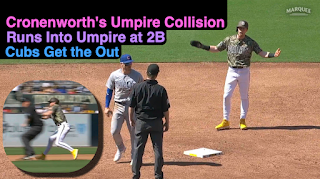
Padres baserunner Jake Cronenworth ran into 2B Umpire Ryan Wills on an infield ground ball as he tried to reach second base, falling over and allowing the Cubs plenty of time to get the out. Should this have been umpire interference or is this nothing...and where should an umpire stand on a play at second base?

To begin, this collision is not umpire interference as there are only two forms of umpire interference in the rulebook: one, when the umpire interferes with the catcher's throw to retire a runner (or interferes with the catcher returning the ball to the pitcher); and, two, when the umpire working inside (as Wills did here) gets hit by a batted ball before the ball has passed an infielder, provided it did not first touch the pitcher.

Thus, there is no umpire interference and no reason to declare the ball dead: 2B Umpire Wills is considered part of the field as Cronenworth runs into him and the out call prevails.

As for position, although an initial stance of Deep B along the infield grass is proper, perhaps we can borrow from the wild pitch principle of clearing the catcher to, instead, "clear the base path" (or potential base path, which includes the baseline) and thus avoid the likelihood of a runner running into the back of an umpire preparing to take a play at the action base.

Video as follows:

Friday, May 12, 2023

Infielder's Throw Hits Umpire on Play at 1st Base

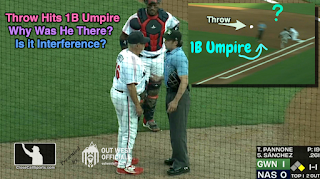
Gwinett Stripers batter Yolmer Sanchez picked up an unusual infield single when Nashville Sounds third baseman Cam Devanney's throw to first base hit 1B Umpire Reed Basner...who was running in front of first base as the throw came in. Let's talk about the umpire interference rule as well as mechanics in a crew of three—why was he there?

Umpire interference is defined in both Official Baseball Rule 5.06(c)(2) and OBR 6.01(f) Comment. It occurs under just two specific circumstances:

"Umpire’s interference occurs (1) when a plate umpire hinders, impedes or prevents a catcher’s throw attempting to prevent a stolen base or retire a runner on a pick-off play; or (2) when a fair ball touches an umpire on fair territory before passing a fielder. Umpire interference may also occur when an umpire interferes with a catcher returning the ball to the pitcher."

Because the case of a non-catcher fielder throwing to retire a runner after a batted ball does not apply, there is no "Time" call to make or out/base to award: the ball is live and the runner, in this case, is safe.

As for the question of why the umpire was inside to begin with, the answer may well have to do with three-person mechanics wherein the 1B Umpire comes into the infield on a base hit to the outfield. Thus, with this batted ball grounded to the back corner of the infield along the left field line, the umpire may have erroneously thought the ball had made its way to the outfield and, thus, it was time to pivot in front of first base.

Unfortunately, the ball was fielded by the third baseman whose long throw to retire the runner ended up hitting the umpire instead.

Video as follows:

Friday, April 14, 2023

Larry Vanover Hit by Throw & Erich Bacchus Hit by Ball

Crew Chief Larry Vanover left the Yankees-Guardians game in Cleveland after being hit in the head by a relay throw, resulting in an extra Guardians run scoring, while 2B Umpire Erich Bacchus called "Time" to enforce the umpire interference rule in Toronto after being hit by a batted ball while working in the infield. Jerry Layne, meanwhile, also left a game due to a foul ball injury to his hand.

Larry Vanover (NYY-CLE): With one out and two on (R1, R2) in the top of the 5th inning, Yankees batter Kyle Higashioka hit a fly ball to deep center field, played off the wall by Guardians center fielder Miles Straw, who threw to shortstop Andres Gimenez, whose relay throw to home hit 2B Umpire Vanover in the side of the head, bouncing high in the air and enabling further advancement of Cleveland's runners.

Vanover left the game and was hospitalized with a head injury and was discharged from Cleveland Clinic two days later.

Erich Bacchus (DET-TOR): 2B Umpire Erich Bacchus found himself in the middle of umpire interference Type 2 in Toronto as he was hit by a batted ball from Blue Jays batter Bo Bichette while working inside: "Umpire’s interference occurs (1) when a plate umpire hinders, impedes or prevents a catcher’s throw attempting to prevent a stolen base or retire a runner on a pick-off play; or (2) when a fair ball touches an umpire on fair territory before passing a fielder." (Official Baseball Rule 6.01(f) Comment). IMPORTANT: The pitcher is not considered as "a fielder" for the purpose of this rule unless the pitcher touches the batted ball first. Weird, right?

Jerry Layne (HOU-PIT): HP Umpire Jerry Layne exited the Astros-Pirates game an out after getting hit in the hand by a foul ball. This is not umpire interference since it's a foul ball. After Layne left the game, call-up umpire Brock Ballou put on the gear and filled in as home plate umpire for the remainder of the contest. Similary, the Mike Estabrook play in Toronto is not umpire interference as the ball was foul.

Video as follows:

Thursday, April 13, 2023

Guerrero Awarded Home on Obstruction...Interference on Next Play

3B Umpire Erich Bacchus awarded Blue Jays baserunner R2 Vlad Guerrero home, scoring a run, due to obstruction by Tigers 3B Ryan Kreidler on a ground ball past third base. On the very next play, HP Umpire Ryan Wills called umpire interference on himself. Article:

To set the scene, with two on (R1 and R2) and two on in the bottom of the 4th inning of the Detroit-Toronto game, Blue Jays batter Whit Merrifield hit a ground ball into the hole on the infield's left side, where it was fielded in a diving play by Detroit shortstop Javier Baez. With Toronto's runners off with the pitch on the hit-and-run, R2 Guerrero had to hurdle the batted ball to avoid interference, signified by 3B Umpire Bacchus' "safe" mechanic.

But when Guerrero rounded third base, he nearly collided with Tigers third baseman Kreidler, who was stuck watching Baez's diving play and thus inadvertently (but still violative of rule) obstructed Guerrero by impeding his path to home plate by forcing Guerrero to run further outside, thus making his journey home a longer one, both in distance and in travel time.

Bacchus pointed at the obstruction and after the play concluded awarded Guerrero home. Under Obstruction Type 2 (Official Baseball Rule 6.01(h)(2)), Bacchus nullified the act by ruling that had obstruction not occurred, Guerrero would have scored, the penalty for OBS Type 2, which keeps play alive until its natural conclusion before the penalty phase of "nullify the act" is imposed.

Was that the correct call? Had this been Obstruction Type 1, Guerrero would be automatically awarded home and the ball would be dead immediately upon obstruction occurring. In order for OBS 1 to happen, though, there would have to have been a play on Guerrero actively occurring at the time of obstruction.

The very next play produced an umpire interference (OBR 6.01(f)) situation when, with the Blue Jays trying a double steal once again, HP Umpire Ryan Wills accidentally hindered or impeded Tigers catcher Eric Haase's attempted throw to third base. The penalty for ump interference is simply to send the runners back to the bases they came from.

Both managers were out to speak with the umpires in the 4th inning about the respective plays (Tigers manager AJ Hinch spoke with 3B Umpire Bacchus about the obstruction play at third while Blue Jays manager Jon Schneider spoke with HP Umpire Wills about the umpire interference play at home), both calls were concisely explained, and the game resumed without further incident in both cases.

Tuesday, May 24, 2022

Ask UEFL - NCAA Loss After Runner-Umpire Collision

Saturday's Henderson State-Northeastern State NCAA DII Tournament game ended on a play in which RiverHawks batter-runner Blaze Brothers collided with the first base umpire while running the bases before getting up and being tagged out sliding into second base.

By the end of the Reddies-RiverHawks NCAA Central Regional game, Northeastern State had cut into Henderson State University's 11-5 lead to begin the 9th inning, tallying five times before the final out at second base.

The rally was cut short thanks to a baseball (and basketball, and football, and hockey) rule common across all levels of play that prescribe no penalty in the event of a runner-umpire collision.

We (very recently) published an Ask the UEFL entitled "Player/Ump Collsions & Umpire Interference" and encourage you to refer to that article and instructional video for an in-depth analysis of the two types of umpire interference.

As for the Reddies-RiverHawks game-ending play, knowing that absent these two circumstances the umpire is considered part of the field—alive and in play—the umpire's task is simple: to do the best job possible in avoiding a runner or fielder. Head on a swivel and try to maintain situational awareness to know where the players are.

If an accident does occur, knowing the rules—that there's nothing that can be done—makes moving on easy, at least by rule. Emotionally, it becomes much harder as game management becomes paramount. Although objectively it is quite obvious what the rule is, this does little to appease a coach who possibly just lost an out or a run.

If this occurs earlier in the game then the final out, offer an explanation. Allow a vent if you will, eject if necessary, and move on with it.

However, if like this game, this results in the final out. The game is indeed over, so there is little value in remaining on the field to confer or discuss the matter with the coach other than to explain what happened, what the rule is, and then to leave.

Video as follows:

Thursday, May 12, 2022

Ask UEFL - Player/Ump Collisions & Umpire Interference

After Cubs shortstop Nico Hoerner left Chicago's game against San Diego Wednesday following Hoerner's collision with 2B Umpire Dan Iassogna in pursuit of a fly ball, we were asked about interference rules in baseball pertaining to contact between a player and umpire while the ball is live and in play. It should obviously go without saying that umpires and players alike both strive to avoid running into the other—both for defensive and injury reasons—but sometimes collisions do occur and when that happens, it's important to know the rules.

Official Baseball Rule 6.01(f) Comment lists the two—and only two—general circumstances that can lead to a call of umpire interference: "Umpire’s interference occurs (1) when a plate umpire hinders, impedes or prevents a catcher’s throw attempting to prevent a stolen base or retire a runner on a pick-off play; or (2) when a fair ball touches an umpire on fair territory before passing a fielder. Umpire interference may also occur when an umpire interferes with a catcher returning the ball to the pitcher."

Umpire Interference Type 1
 occurs when a home plate umpire and catcher make contact as the catcher is attempting to retire a runner who is attempting to steal, or to attempt a pickoff throw, or to throw the ball back to the pitcher.
Prescribed Outcome: The ball remains alive until the catcher's throw arrives at its intended destination (if applicable). If the runner is retired, the interference is ignored. If the runner is not retired, the ball becomes dead and runners return to bases they held at the time of the pitch (unless forced to advance by virtue of the batter becoming a runner).

Umpire Interference Type 2
 occurs when a fair ball makes contact with an umpire who is positioned in fair territory and before the ball has passed a fielder. The pitcher is not considered a fielder for the purpose of this rule. We most often see this brand of UMP INT occur when the second base umpire is positioned on the infield with a runner (or runners) on base and a line drive hits the umpire before getting to the middle infielders.
Prescribed Outcome: The ball is dead at the moment it contacts the umpire and the batter-runner is awarded first base. All other runners return to the bases occupied at time of pitch, unless they are forced to advance by virtue of the batter becoming a runner (e.g., if this occurs when there is only a runner on third base, the runner on third base returns to third [and the batter is awarded first]; if this occurs when there is only a runner on first base, the runner on first base is awarded second base due to the batter being awarded first).

There is no interference
 when an umpire and fielder or runner collide during a batted or thrown ball other than in Type 1. Similarly, there is no interference when a thrown or pitched ball hits an umpire nor when a batted ball hits an umpire, provided (if a fair ball) it has passed a fielder.

Outcome: As such, the ball remains alive and in play. Thus, when Hoerner and Iassogna collided, the ball remained alive and batter Jurickson Profar's triple thus stood.

Video as follows:

Friday, September 14, 2018

Case Play 2018-8 - Kick a Ball, Make a Call [Solved]

Boston clinched a playoff berth Tuesday night following an unusual play in the 6th inning with Toronto at bat, when the home plate umpire inadvertently kicked a wild pitch with a runner at third, calling "Time" and sending the Blue Jays baserunners back to their bases of origin.

HP Umpire Jim Wolf searches for a wild pitch.
What is the proper call for an umpire's kicked ball?

The Play: With one out and one on (R3), Red Sox pitcher Nathan Eovaldi's 3-0 pitch to Jays batter Kendrys Morales dove into the dirt and near HP Umpire Jim Wolf, who inadvertently kicked the ball far away from Red Sox catcher Sandy Leon, prompting Blue Jays baserunner R3 Devon Travis to jog toward home plate. Wolf called "Time" and sent Travis back to third (and awarded Morales first base on ball four).

Question: Is this the correct call and were the runners placed properly (R3 Travis sent back to third and batter-runner Morales to first)? If so, is this umpire interference or does some other rule apply?

Answer: The first thing one should notice about the umpire interference rules as portrayed in 5.06(c)(2), 6.01(f), and the Definition of Terms is that Umpire Interference exists under only two scenarios: 1) The plate umpire hinders the catcher's throw (to a base/runner or back to the pitcher), and, 2) a fair [batted] ball touches an umpire on fair territory before passing a fielder other than the pitcher, or before touching any other player.
Related VideoUEFL University: Umpire's Interference - Reviewing its Two Types (4/23/18).
Related PostStayin' Alive - The Umpire-Aided Triple Play (4/23/18).
Related PostRules 2.00 & 6.01(f): Umpire Interference (7/5/12).

Joe West kicks a ball into left field.
Accordingly, this play is not subject to any of the aforementioned rules. Yet during this play, clearly, baserunner R3 has absolutely zero intention of scoring until the plate umpire kicks the ball. What's the resolution?

Look no further than to Joe West for an example of another kicked ball—this one batted past the infield—that led to an extra base when a batter-runner had no intention of advancing beyond first until 2B Umpire West kicked the ball into shallow left field. Like Wolf, West put a new impetus on the ball by accidentally kicking it away from the fielders (or, more accurately, away from the charging outfielders), but unlike Wolf, West kept play alive because he kicked the ball after it had passed the infielders.
Related PostA Rare Off-The-Cowboy-Joe Double - Rule 5.06(c)(6) (8/24/16).

Counterpoint: How about Unintentional Interference, Rule 6.01(d) Comment, which states, "The question of intentional or unintentional interference shall be decided on the basis of the person’s action. For example: a bat boy, ball attendant, policeman, etc., who tries to avoid being touched by a thrown or batted ball but still is touched by the ball would be involved in unintentional interference. If, however, he kicks the ball or picks it up or pushes it, that is considered intentional interference, regardless of what his thought may have been"?

Or how about the MLBUM interpretation of 5.06(b) (ball goes out of play) that differentiates between a fielder deflecting the ball directly out of play, a fielder accidentally kicking the ball out of play, and a fielder intentionally kicking or deflecting the ball out of play?

Is there a way to incorporate 6.01(d) Comment or the MLBUM interpretation of 5.06(b) by using Rule 8.01(c)—umpiring's elastic clause ("Each umpire has authority to rule on any point not specifically covered in these rules")—to invoke common sense and fair play?
Related PostUEFL Case Play 2018-6 - Kicked Out of Play [Solved] (7/23/18).
Related PostMLB Ejection 057 - Fieldin Culbreth (1; Terry Collins) (6/1/17).

The answer, it turns out, is "no." 6.01(d) does specifically cover the application of unintentional interference by exempting the following classes of persons from its purview: "except members of the team at bat who are participating in the game, or a base coach, any of whom interfere with a fielder attempting to field a batted or thrown ball; or an umpire." [Underlined-bold text added for emphasis.]

Similarly, 5.06(b) very clearly talks about fielders, not umpires.

As 5.06(c)(2), 6.01(f), and Definition of Terms clearly illustrate where precisely umpire interference occurs, it is not within the rules nor within the spirit of the rules to use 8.01(c) to apply discretion to the aforementioned.

This is not umpire interference, the ball shall remain alive, and the runner, unfortunately (for the team that threw the wild pitch, that is), shall be permitted to score. The rules simply don't allow the umpires to correct for a situation caused, initially, by a defensive miscue to begin with. Whether one believes this is fair play or not is, ultimately, irrelevant: the rulebook allows little discretion for choosing when umpire interference does and does not apply.

Silver Lining? Wolf so confidently sold the call from the get-go that there was very little doubt as to what it was and why he made it. Unfortunately, it just wasn't supported by any concrete rule.

The ump giveth and the ump taketh away.
Common Sense and Fair Play: Ruling this play dead and sending the runner back to third base because he had no intention of scoring prior to the umpire's accidental kick might scream out, "that's fair," but it could get you into trouble with a manager who knows the rules real quick.

If Toronto protested the game based on this call (and lost by a reasonable margin, etc.), it stands to reason that the protest would be affirmed based on the rules that dictate this accidental kick by an umpire is not means to call the ball dead and return the runner.

That said, if the explanation was, simply, "I accidentally called time" (which, I don't believe it was...it sure looked like "Time" was purposefully called), it becomes a matter not subject to protest. But knowingly ruling this umpire interference based on the kick is not supported by the rules.

Now if someone could help me out with determining whether Enrico Pallazzo's ejection of Joe West and Hank Robinson had anything to do with umpire interference or not, I'd be much obliged.
Related VideoSEA@LAA: Enrico Pallazzo Ejects Umpires Robinson, Cowboy Joe West (4/1/13).
Related PostEjections 1, 2: Enrico Pallazzo (Joe West, Hank Robinson) (4/1/13).

Official Baseball Rules Library
OBR 5.06(c)(2): "The ball becomes dead and runners advance one base, or return to their bases, without liability to be put out, when—The plate umpire interferes with the catcher’s throw attempting to prevent a stolen base or retire a runner on a pick-off play; runners may not advance."
OBR 5.06(c)(2) Comment: "Umpire interference may also occur when an umpire interferes with a catcher returning the ball to the pitcher."
OBR 6.01(f): "If a thrown ball accidentally touches a base coach, or a pitched or thrown ball touches an umpire, the ball is alive and in play."
OBR 6.01(f) Comment: "Umpire’s interference occurs (1) when a plate umpire hinders, impedes or prevents a catcher’s throw attempting to prevent a stolen base or retire a runner on a pick-off play; or (2) when a fair ball touches an umpire on fair territory before passing a fielder. Umpire interference may also occur when an umpire interferes with a catcher returning the ball to the pitcher."

Video as follows:

Monday, April 23, 2018

Stayin' Alive - The Umpire-Aided Triple Play

Knowing when umpire's interference occurs and when it does not can be crucial, especially when baserunners are involved and a ball bounces off the umpire in an unusual and unexpected way.

Ump INT no-call turns into AAA triple play.
Sunday afternoon in Pawtucket, 1B Umpire Jeremy Riggs had to think quickly when a batted ball bounced off him and back toward Red Sox pitcher William Cueves, who stepped on first base to force out Gwinnett batter-runner Rio Ruiz, before throwing to several teammates who tagged out baserunners Ronald Acuna and Ezequiel Carrera, who were wandering off their bases as if the ball had become dead. So what is the correct call?

Answer: Because batter Ruiz's fair batted ball passed Red Sox first baseman Sam Travis before striking umpire Riggs, umpire's interference did not occur, and the ball was properly kept live and in play. This correctly officiated triple play and potential lack of rules knowledge on the bases may have cost Gwinnett the game, as Pawtucket eventually walked off in extra innings.

Official Baseball Rule 6.01(f) Comment concerns two types of umpire's interference, and states:
Umpire’s interference occurs (1) when a plate umpire hinders, impedes or prevents a catcher’s throw attempting to prevent a stolen base or retire a runner on a pick-off play; or (2) when a fair ball touches an umpire on fair territory before passing a fielder. Umpire interference may also occur when an umpire interferes with a catcher returning the ball to the pitcher.
NOTE: The interference shall be disregarded if the catcher's throw retires the runner. (Rule 5.06(c)(2)).

The penalty for umpire's interference is a dead ball and runners return to their bases occupied at the time of the pitch unless forced to advance by virtue of the batter becoming a runner, in which case the forced runners shall be awarded one base.

To review, umpire's interference only exists if the following conditions are met:

Umpire interference during a catcher's throw.
Type 1 Interference) The catcher must possess the baseball and be attempting a throw on a baserunner. There is no interference if the umpire is hit by a pitched ball or becomes entangled with a catcher who is attempting to field a loose ball. There is no interference if the umpire makes contact with the catcher attempting to retire a batter. Type 1 interference cannot occur during a batted or pitched ball, and does not apply to any umpire who is not the plate umpire nor any fielder who is not the catcher.
Note to plate umpires: If you recognize umpire's interference, keep play alive until the baserunner has been successfully thrown out or not. If the runner is thrown out, disregard the interference. If the runner is not thrown out, call the interference and enforce the penalty (dead ball, runners return). This is a de facto delayed dead ball.

Umpire INT can only occur in certain cases.
Type 2 Interference) The umpire must make contact with a) a fair batted ball, which b) has not passed an infielder other than the pitcher or catcher, and which c) has not made contact with any player on the defensive team (including the pitcher or catcher). It is not interference if an umpire does not touch the baseball in the aforementioned manner. Type 2 interference cannot occur during a thrown, deflected, or pitched ball.

The accompanying video discusses the case of umpire's interference with a multitude of video examples elucidating what is and is not eligible for this particular ruling:

Thursday, October 26, 2017

Leaping Laz - Pickoff Throw at Second Base Hits Umpire

After Astros pitcher Chris Devenski's errant pickoff throw struck 2B Umpire Laz Diaz, Dodgers Manager Dave Roberts fielded a reporter's question concerning the incident during his postgame press conference, conceding that, "Laz was in the right position," before graciously concluding with a smile, "that's baseball, things like that happen."

Houston skipper AJ Hinch quipped, "Laz was perfectly positioned, right where we wanted him."

Was Diaz properly positioned for the pickoff play at second? Let's review the sequence.

2B Umpire Laz Diaz jumps as a ball hits him.
The Play: With two out and the Dodgers having freshly tied the ballgame in the bottom of the 10th inning of Game 2 of the 2017 World Series, Astros pitcher Devenski attempted to pickoff baserunner R2 and potential winning run Kiké Hernández at second base. Devenski's throw to second baseman Jose Altuve was off the mark and to the left side of second base, where it hit 2B Umpire Diaz, who was moving into position to rule on the potential tag play at second base. After hitting Diaz, the ball bounced on the infield dirt, where it was retrieved by Altuve before any advancement by the runner. The Dodgers failed to score and the Astros ultimately won the contest, 7-5, in 11 innings.

Ruling Out Interference: Perhaps at this point it is just a formality, but we nonetheless should quickly address the issue of umpire interference, so as to rule it out. Official Baseball Rule 6.01(f) discusses two, and only two, scenarios when umpire interference may occur:
(1) when a plate umpire hinders, impedes or prevents a catcher’s throw attempting to prevent a stolen base or retire a runner on a pick-off play, or 
(2) when a fair ball touches an umpire on fair territory before passing a fielder. Umpire interference may also occur when an umpire interferes with a catcher returning the ball to the pitcher.
OBR also further discusses the first case in 5.06(c)(2): "The plate umpire interferes with the catcher’s throw attempting to prevent a stolen base or retire a runner on a pick-off play; runners may not advance. NOTE: The interference shall be disregarded if the catcher’s throw retires the runner."
Related PostRules 2.00 & 6.01(f): Umpire Interference (7/5/12).

Diagram of middle infield positions, B & C.
Positioning Analysis: With umpire interference ruled out, it follows that an umpire hit by a thrown ball is part of the playing field—the ball is live ("A pitched or thrown ball touches an umpire...the ball is alive and in play")—but this doesn't necessarily indicate Wednesday night's contact was unavoidable.

For plays with a runner on second base only, the MLB Umpire Manual recommends the second base umpire position himself inside the fielders, though umpires are not necessarily restricted to inside positioning if they are more comfortable outside.

This isn't the first deviation from MLBUM...
This is consistent with MLBUM's general principle that second base umpires are always in with runners on base (except a runner on third only OR an infield-in situation). Is there a two-out exemption? Not for a runner on second, though if the fielders aren't all that deep, that will dictate how deep a second base umpire will be, as an umpire should be out with a drawn-in infield.

Still, the issue isn't so much whether Diaz is in or out here, since, presumably, a drawn-in Diaz on the shortstop side would have simply had even less time to react to the wayward pickoff attempt. Again, it's probably more comfortable to be outside for this play (assuming a left side lock)—it might even help one stay away from a potential umpire interference situation on a batted ball up the middle—and that's quite alright.
Related Post: Much About Second Base & Stolen Pickoff Positioning (4/8/17).

Pick a Side: The question has to do with that great alphabetical divide, to B or not to B (to C)?

Which angle would be more helpful here?
Diaz takes this play positioned on the shortstop side of second base and outside, which gives him the advantage of not having to contend with second baseman Altuve running in toward the pickoff throw. We'll call this position "C-out."

However, taking the play from the left side also opens Diaz up to exactly what happened here—getting nailed by a poor pickoff throw. Taking the play from the right side, on the other hand, greatly weakens this possibility and can be beneficial toward getting an angle on the tag vs runner back into the bag.

Diagram of ordinary umpire positioning.
Refer to the "C Left / B Right" diagram, and imagine, if you will, the various angles that a second base umpire may have for a potential pickoff throw with the second baseman covering. The best angle is probably coming from deep B, inside of second base ("B-in"), while the worst may very well be a similarly right-side position, but well outside of second base.

The key is getting into position to see the leading, third-base-facing edge of second base—where percentages dictate the tag attempt most likely will occur. Recall from 2016 our discussion of the keyhole angle and our projected action area wherein an umpire reads the play and predicts where the imminent tag will occur before it actually happens.
Related Post: Tmac's Teachable Moments - Steal Plays at 3rd Base (7/21/16).

Find the keyhole to increase call accuracy.
The reverse angle of B-in is C-out (which is where Diaz approximately was), which should logically mean that C-out is second-best to B-in, right? If B is about halfway between first and second base, and deep B is further up the baseline/closer to second, then isn't C-out just a logical extension of the B-line akin to the first- or third-baseline extended position for a plate umpire (e.g., "really really deep B")?

Again, the issue isn't solely about positioning, it's about positioning in context of a projected play: If the throw is proper, does Diaz's position afford him the best opportunity to observe the keyhole angle?
Related Post: Tmac's Teachable Moments - Pickoff Tag at First Base (5/15/16).

Tie Breaker: With a tag attempt likely going toward B-in and away from C-out (swipe directionally will go from left-center to the right foul line), B-in is the better position: in general, a tag coming toward an umpire's vision makes the play easier to call and a tag going away is harmful (though a tag running perpendicular to the umpire's stance is ideal, as long as one can count on clearing the fielder or runner so as to actually see the play). Because the tag in this situation likely will be on the left side of the runner's body (the outfield side), viewing from the second base side is beneficial. However, if the throw and tag were to go right-left, C-side would likely fare better than B-side.

In Short: It's about umpire comfort and playing the percentages. Predicting a left-to-right swipe would be an argument in favor of B-in, while a right-to-left could swing things C-ward. For this particular play, assuming a proper throw, we have a pitcher who in all likelihood is throwing to the left/C-side of second base, a tag being made to the C-left side, and a left-to-right attempt (again, to clarify, left-to-right refers to the field... because Altuve is facing the reverse direction, the tag will run from the right side of his body to the left side of his body, or, conversely, left-to-right on Hernandez's body). Removing this assumption of accuracy from our arsenal, we're left with a poor throw to deep C, which means one thing: advantage B.

Video as follows:

Sunday, June 4, 2017

Close Quarters - Carlson Collides with Iglesias on Tag Play

2B Umpire Mark Carlson collided with Tigers shortstop Jose Iglesias during a stolen base tag attempt at second, ultimately resulting in an out call and a fortuitous avoidance of injury. The point of discussion, naturally, is whether a collision could have reasonably been avoided.
Carlson's face barely avoids Iglesias' cleat.

Positioning Discussion
With a runner on first base, the second base umpire is ordinarily positioned within the infield in what is known as "Deep B" or "Deep C." The reference for this is the MLB Umpire Manual's General Principles for four-man umpiring mechanics: "Whenever runner(s) are on base (other than a runner on 3rd base only), the 2nd base umpire will set up inside at 2nd base. The 2nd base umpire may work on either side of 2nd base, depending on which side the umpire feels more comfortable."

For more on midfield umpire positioning, see Much About Second Base & Stolen Pickoff Positioning.

Diagram of ordinary umpire positioning.
For the play at hand, Carlson is positioned at Deep B, as prescribed by MLBUM mechanic. He reads the impending play at second base and takes a read step toward the anticipated action area. The throw from Tigers catcher John Hicks is slightly offline towards the right field side of second base, and as Iglesias moves across the base to retrieve it and tag baserunner Yolmer Sanchez, he collides with the sliding runner, pinballing directly into umpire Carlson, who himself has made a position adjustment in order to better see the tag play.

Umpire Mark Carlson mixes with SS Iglesias.
In analyzing the sequence as it occurred, as is evident in the situation of most missed calls (yes, Carlson's out call here was the correct call), the mishap here occurs as the result of a defensive miscue: if catcher Hicks doesn't throw offline and require Iglesias to make an athletic play, and if baserunner Sanchez's chosen slide doesn't keep his torso elevated through the collision with Iglesias, then the collision with Carlson never happens.

The final piece of the puzzle is to bring forth past evidence to show that sometimes, as an umpire moves into position to observe a play and make a call, the involved player's movements—which usually occur when that player spins out of control due to a collision with some other object—will ensnare the calling umpire simply because of the close quarters that exist when each actor is performing an appropriate function: the defense is attempting to retire a runner, the runner is attempting to legally advance, and the umpire is attempting to adjudicate the play.

Angels runner Hunter accidentally spikes Gibson.
Recall the 2012 injury to home plate umpire Greg Gibson, whom baserunner Torii Hunter inadvertently spiked in the face while sliding/tumbling into home plate. Like Iglesias bouncing off of Sanchez, Hunter similarly bounced off the ground, causing his leg and cleat to swing wildly towards Gibson. Fortunately, on Sunday, Carlson was able to quickly jump backwards and out of the way of Iglesias' left cleat.

Rules Discussion
Though Official Baseball Rule 6.01(f) Comment authorizes umpire interference in the case of a plate umpire hindering a catcher's throw to prevent a stolen base or retire a runner on a pick-off play, or a fair batted ball touches any umpire on fair territory before passing a fielder, 6.01(f) states, "If a thrown ball accidentally touches a base coach, or a pitched or thrown ball touches an umpire, the ball is alive and in play" (see Umpire Interference). If a player collides with the umpire, the ball is similarly alive and in play.

Video via "Read More"

Tuesday, March 14, 2017

Injury Scout - Jeff Nelson Exits, Wolf Collides with Player

Jim Wolf collided with a player while plate umpire Jeff Nelson exited Tuesday's Spring Training action for an undisclosed reason.

D-Backs 2B Leyba calls obstruction on Wolf
During the Rangers-Diamondbacks game at Talking Stick's Salt River Fields, base umpire Jim Wolf collided with Rangers baserunner Cesar Puello as he rounded second base, causing Puello to fall down and, ultimately, be retired. With none out and one on (R1 Puello) in the top of the 6th inning, Rangers batter Jose Trevino hit a fly ball to Diamondbacks left fielder Kristopher Negron, that Negron lost in the sun/sky. After Puello and Wolf collided past second base, the D-Backs fielders recovered to retire Puello in an ensuing rundown.

As we know and Arizona broadcaster Steve Berthiaume remarked, "the umpire is in play." Rule 6.01(f) concerns umpire interference and states that such an event occurs only "(1) when a plate umpire hinders, impedes or prevents a catcher’s throw attempting to prevent a stolen base or retire a runner on a pick-off play; or (2) when a fair ball touches an umpire on fair territory before passing a fielder. Umpire interference may also occur when an umpire interferes with a catcher returning the ball to the pitcher." Accordingly, a player making incidental or inadvertent contact with an umpire (other than a catcher attempting to throw out a baserunner) does not constitute umpire interference. Alan Porter ejected Pirates Manager Clint Hurdle in 2016 during an argument concerning such an umpire-fielder entanglement.

For more on umpire interference, including video examples, see the UEFL topic, "Umpire Interference."

Both Wolf and Puello remained in the ballgame following their fender bender and video of this play is available at the conclusion of this post, via "Read more."

Meanwhile, HP Umpire Jeff Nelson left Tuesday's White Sox-Mariners game in the middle of the 4th inning for an undisclosed reason; he officiated the entire top of the 4th before leaving the field following the frame's third out.

This is Nelson's first departure from a game since leaving the May 23, 2016 Rockies-Pirates game after dirt lodged his eyes.

Nelson was replaced behind home plate by 3B Umpire Mike Cascioppo, while base umpires Adrian Johnson (1B) and Stu Scheurwater (2B => 3B) took care of field duties for the rest of the contest.

Last Game: March 14, 2017 | Return to Play: March 17, 2017 | Total Time Absent: 2 Days

Tuesday, September 13, 2016

MLB Ejection 160 - Alan Porter (4; Clint Hurdle)

1B Umpire Alan Porter ejected Pirates Manager Clint Hurdle for arguing an interference no-call in the bottom of the 6th inning of the Pirates-Phillies game. With none out and two on (R1, R3), Phillies batter Ryan Howard hit a 0-0 fastball from Pirates pitcher Ivan Nova on the ground to first baseman Josh Bell, who threw to shortstop Jordy Mercer for the force out and onto second baseman Adam Frazier as Howard arrived at first base. Replays indicate Howard's foot made contact with the first base bag before the thrown ball touched Frazier's glove while umpire interference as delineated by Rule 6.01(f) did not occur, the call was correct.* At the time of the ejection, the Phillies were leading, 2-1. The Pirates ultimately won the contest, 5-3.

This is Alan Porter (64)'s fourth ejection of the 2016 MLB regular season.
Alan Porter now has 16 points in UEFL Standings (12 Previous + 2 MLB + 2 Correct Call = 16).
Crew Chief Jeff Kellogg now has 9 points in Crew Division (8 Previous + 1 Correct Call = 9).
*Although Hurdle argued that Porter interfered with Frazier's ability to field the position, there is no such rule as umpire interference with an infielder, in this regard. Umpire Interference only exists (and OBR 6.01(f) states):
(1) when a plate umpire hinders, impedes or prevents a catcher’s throw attempting to prevent a stolen base or retire a runner on a pick-off play, or (2) when a fair ball touches an umpire on fair territory before passing a fielder. Umpire interference may also occur when an umpire interferes with a catcher returning the ball to the pitcher. Umpire interference does not apply to contact between a field umpire and a non-catcher.

This is the 160th ejection report of the 2016 regular season.
This is the 65th Manager ejection of 2016.
This is Pittsburgh's 14th ejection of 2016, 1st in the NL Central (PIT 14; CIN 6; CHC 4; MIL 3; STL 1).
This is Clint Hurdle's 6th ejection of 2016, 1st since July 20 (Sam Holbrook; QOC = Y [Foul/INT]).
This is Alan Porter's first ejection since August 6, 2016 (Jose Altuve; QOC = N [Balls/Strikes]).

Wrap: Pittsburgh Pirates vs. Philadelphia Phillies, 9/13/16 | Video available via "read more."

Thursday, July 5, 2012

Rules 2.00 & 6.01(f): Umpire Interference

Interference: Though MLB rules specify that an umpire is routinely considered part of the playing field insofar as the ball generally remains alive and in play after a player or fair ball contacts an umpire, umpire interference provides an exception to this general practice.

Jack be limber, Jack be quick. Jack jump over the candle stick; yet, when Ump Jack isn't quick enough, the following rules are in place to address what happens next.

Umpire Interference (1): At the plate
Rule 2.00 INTERFERENCE (c) [NOTE: Under OBR renumbering, as of 2015, the relevant rule is 6.01(f)]  specifies when umpire interference may be called:
(1) when a plate umpire hinders, impedes or prevents a catcher’s throw attempting to prevent a stolen base or retire a runner on a pick-off play, or (2) when a fair ball touches an umpire on fair territory before passing a fielder. Umpire interference may also occur when an umpire interferes with a catcher returning the ball to the pitcher.
Rule 5.09(b) [NOTE: Under OBR renumbering, as of 2015, the relevant rule is 6.01(f)] further specifies the case of umpire interference at home plate between umpire and catcher:
The plate umpire interferes with the catcher’s throw attempting to prevent a stolen base or retire a runner on a pick-off play; runners may not advance. NOTE: The interference shall be disregarded if the catcher’s throw retires the runner.
Meanwhile, Rule 5.09(f) [presently 5.05(b)(4)] specifies when umpire interference occurs, as it relates to a batted ball:
A fair ball touches an umpire...on fair territory before touching a fielder. If a fair ball touches an umpire after having passed a fielder other than the pitcher, or having touched a fielder, including the pitcher, the ball is in play.
In this scenario, the ball is dead upon the interference and the batter is awarded first base (credited with a single).

Read on for some examples of umpire interference, including video footage:

Tuesday, May 15, 2012

Ejection 031: Bob Davidson (1)

HP Umpire Bob Davidson ejected Phillies Manager Charlie Manuel for arguing an umpire interference no call in the top of the 8th inning of the Astros-Phillies game. With none out and none on, Astros batter Jason Castro struck out swinging on a wild pitch curveball from Phillies pitcher Cliff Lee. As the ball bounded away from catcher Brian Schneider, the catcher & Davidson briefly collided as Schneider attempted to retrieve the loose ball and Davidson completed his swinging mechanic. OBR Rule 2.00(c) (Interference) defines umpire interference as "when a plate umpire hinders, impedes or prevents a catcher's throw attempting to prevent a stolen base or retire a runner on a pick-off play." This and Rule 5.09(b) do not authorize umpire interference on a wild pitch; an umpire is part of the playing field, the call was correct.* At the time of the ejection, the Phillies were leading, 3-1. The Phillies ultimately won the contest, 4-3, in 10 innings.

This is Bob Davidson (61)'s first ejection of 2012.
Bob Davidson now has 4 points in the UEFL (0 Previous + 2 MLB + 2 Correct Call = 4).
Crew Chief Jerry Layne now has 2 points in the Crew Division (1 Previous + 1 Correct Call = 2).
*After review, Quality of Correctness has been affirmed in a 4-0 decision by the UEFL Appeals Board.

UEFL Standings Update

This is the 31st ejection of 2012.
This is the 19th Manager ejection of 2012.
This is Charlie Manuel's and the Phillies' second ejection of 2012.

Wrap: Astros at Phillies 5/15/12
Video: Davidson and Schneider incidentally bump on wild pitch, Manuel argues and is ejected from dugout 
Related Video: Carlos Lee collides with 1B Umpire Hunter Wendelstedt in 1st