Showing posts with label Time Play. Show all posts

Tuesday, August 11, 2026

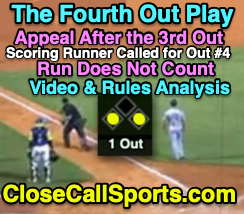
Failed Fourth Out Time Play in Toronto vs Boston

Boston scored a run during Ceddanne Rafaela's sacrifice fly despite Red Sox runner R3 Anthony Seigler failing to tag up, bringing Blue Jays manager John Schneider out of Toronto's dugout as Umpire Crew Chief Chris Guccione explained a cavalcade of rules from time play to fourth out, appeal, and retouch. BOSS Operator & scoreboard factors played a key role in the confusion and we review it all here.

The play: With runners on first and third and one out, Red Sox batter Rafaela hit a fly ball to Blue Jays CF Brett Bateman as baserunners and R1 Nick Sogard and R3 Anthony Seigler ran the bases as if there were two outs, failing to tag up. Toronto appealed R1 Sogard's failure to tag up at first base and ran off the field as the inning ended on the fly out-appeal out double play.

The controversy: Umpires ruled that R3 Seigler's run counted, despite Seigler failing to tag or retouch third base, as required by rule on a caught fly ball.

The confusion: Toronto's Ball-Out-Strike System (BOSS) operator mistakenly keyed two outs on the scoreboard, instead of one, erroneously attributing a second out to the prior play which featured a close catch/no catch call with Blue Jays 1B Vladimir Guerrero Jr. short-hopping Sogard's sharp line drive, ruled no catch (safe) by 1B Umpire Nestor Ceja. The BOSS operator then changed the scoreboard's displayed "2" outs during Rafaela's fly ball, which occurred on the first pitch of the at-bat. The Red Sox baserunners may have falsely relied on the scoreboard's erroneous "2" out display and ran the bases as if there had been two outs.

The rules review: First and foremost, we visit Official Baseball Rule 5.08(a) regarding how a team scores: "One run shall be scored each time a runner legally advances to and touches first, second, third and home base before three players are put out to end the inning." When a play occurs during which a runner may or may not have touched home plate prior to the third out occurring at another base on another runner, a time play occurs in which the plate umpire must determine if the touch of home plate occurred prior to the third out or not.

There is an exception to time plays in OBR 5.08(a): "EXCEPTION:  A run is not scored if the runner advances to home base during a play in which the third out is made (1) by the batter-runner before they touch first base; (2) by any runner being forced out; or (3) by a preceding runner who is declared out because they failed to touch one of the bases."

Toronto may have argued that exception (2) regarding force plays applied, but this is incorrect: "A FORCE PLAY is a play in which a runner legally loses their right to occupy a base by reason of the batter becoming a runner. (Force Play) Comment: Confusion regarding this play is removed by remembering that frequently the “force” situation is removed during the play."

Accordingly, R1 Sogard may have been forced to advance at the beginning of the play, but the force situation was removed when the batter was retired on the fly out to CF. An approved ruling in OBR 5.08 further reinforces that failing to retouch a base is not a force play.

The definition of appeal play thus becomes a factor: "Any runner shall be called out, on appeal, when: (1) After a fly ball is caught, they fail to retouch their original base before they are or their original base is tagged."

Because R3 Seigler touched home plate prior to the appeal play third out on R1 Sogard at first place, R3 Seigler's run counts due to the time play. In order for R3 Seigler's run not to count, the Blue Jays would have to appeal that R3 failed to retouch third base after the caught fly ball. Toronto did not.

Although the third out was the appeal on R1 at first base, R3 could still be appealed under OBR 5.09(c)'s fourth out rule: "If the third out is made during a play in which an appeal play is sustained on another runner, the appeal play decision takes precedence in determining the out. If there is more than one appeal during a play that ends a half-inning, the defense may elect to take the out that gives it the advantage."

Appeals must be made before the next pitch, play, or attempted play, but because the appeal on R1 ended the inning, a fourth out appeal on R3 would have to occur before the defensive team leaves the field, defined as the pitcher and all infielders crossing the foul line/leaving fair territory on the way to the bench.

With no appeal, we revert to a time play, meaning that R3's run counts and the inning is over.

Video as follows:

Wednesday, April 17, 2024

John Libka's Time Play Washout and Umpiring Mechanics

Mariners outfielder Julio Rodríguez's heads up play to throw Reds runner Elly De La Cruz out at third base after catching Nick Martini's fly ball saved Seattle a run, as HP Umpire John Libka ruled R3 Jake Fraley did not score prior to the time play's third out.

We review umpiring mechanics for time play situations—especially of the sacrifice fly-turned-inning-ending-double-play variety—and clarify (again) that an appeal play on a runner for failing to retouch (tag up) after a caught fly ball is not considered a force play, and thus, subject to time play rules.

Time Play Basics: Official Baseball Rule 5.08(a) states that, "One run shall be scored each time a runner legally advances to and touches first, second, third and home base before three players are put out to end the inning." This means that on plays where a third out may occur, it is incumbent on the home plate umpire to prepare for the possibility that they will have to determine whether or not a preceding runner touched home plate prior to the third out being recorded behind them.

On this play, HP Umpire Libka lined up to see both Cincinnati baserunner R3 Fraley's impending touch of home plate and Seattle third baseman Josh Rojas' diving tag attempt on Reds runner R2 De La Cruz. When 3B Umpire Jonathan Parra, himself moving with the play to find the keyhole angle, called R2 De La Cruz out on the tag for the inning's third out, Libka emerged from behind home plate to indicate via the washout signal (similar to a "safe" sign except the arms are more elevated) that R3 Fraley's run would not score, as Fraley hadn't yet touched home plate prior to the third out on De La Cruz.

Exceptions to Time Plays: OBR 5.08(a) provides for three time play exceptions, meaning that even if a lead runner touches home prior to the third out, the run still will not count if the third out is a result of one of these scenarios. These are 1) a batter-runner retired before touching first base, 2) any runner being forced out, and 3) an appeal play for missing a base made on a preceding (ahead of) runner.

Appeal Plays: If any appeal play results on a preceding runner being declared out for the third out of the inning, no following runner is allowed to score. But if an appeal play is made on a following runner, then the preceding runner's run is treated as a Time Play—if the preceding runner touches home prior to the third out, the run will count. It is a rules myth that all tag-up or retouch appeals are treated as force plays—they are not, and are subject to timing rules if the runner being retired is trailing/following/behind the lead runner who is trying to score.

Video as follows:

Tuesday, June 27, 2023

Time Play Teachable - Valentine Lines Up the Tag & Touch

In this Tmac's Teachable Moment, we spot HP Umpire Junior Valentine lining up Guardians baserunner Steven Kwan's touch of home plate as the Angels tagged baserunner Amed Rosario at third base for the final out of the inning. This is a time play and this video is all about time play techniques for the umpire-in-chief.

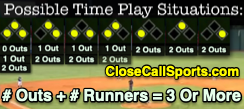
This example is also a reminder that Time Plays can occur when play begins with less than two out (the precise formula is that if the number of outs added to the number of runners on base equals or is greater than three, you've got yourself a potential time play situation).

Video as follows:

Monday, June 5, 2023

MLB Ejection 089 - Jansen Visconti (1; Mark Kotsay)

HP Umpire Jansen Visconti ejected Athletics manager Mark Kotsay (strike three call to Ryan Noda; QOCY) in the top of the 7th inning of the #Athletics-Pirates game. With two out and none on, A's batter Noda took a 3-2 fastball from Pirates pitcher Johan Oviedo for a called third strike. Replays indicate the pitch was located over the heart of home plate and at the hollow of the knee (px -0.15, pz 1.50 [sz_bot 1.61 / RAD 1.49]), the call was correct.* At the time of the ejection, the Pirates were leading, 4-3. The Pirates ultimately won the contest, 5-4.

This is Jansen Visconti (52)'s 1st ejection of 2023.
*This pitch was located 1.12 vertical inches from being deemed incorrect.

A half inning earlier, Pittsburgh took the lead by scoring a run on a time play. With the bases loaded and one out, Pirates batter Jack Suwinski hit a fly ball to right field, caught by A's outfielder Seth Brown, who threw to third base as Pirates baserunners R3 Austin Hedges and R2 Andrew McCutchen tagged up. As Pirates third baseman Jonah Bride caught the thrown ball, McCutchen stopped and got into a brief rundown, providing just a few seconds of extra time to ensure preceding runner R3 Hedges touched home plate and scored a run before the third out was recorded, as signaled by HP Umpire Visconti.

This is the 89th ejection report of the 2023 MLB regular season.
This is the 43rd manager ejection of 2023. Ejection Tally: 43 Managers, 37 Players, 9 Coaches.
This is Oakland's 4th ejection of 2023, T-1st in the AL West (OAK, SEA 4; HOU 3; LAA 2; TEX 1).
This is Mark Kotsay's 3rd ejection of 2023, 1st since May 14 (Dan Bellino; QOC = N [Balls/Strikes]).
This is Jansen Visconti's 1st ejection since June 19, 2022 (AJ Hinch; QOC = Y [Check Swing]).

Wrap: Oakland Athletics vs Pittsburgh Pirates, 6/5/23 | Video as follows:

Wednesday, April 19, 2023

Cardinals Runner Overruns Second Base and is Safe Despite Being Tagged - Did Replay Get it Wrong?

With the bases loaded and two out, Cardinals runner R1 Taylor Motter sensed that a force out at second base would negate a potential St Louis run and opted to run through the base, ruled out by 2B Umpire Adrian Johnson. For good measure, Diamondbacks 2B Ketel Marte tagged Motter's leg past second base, but Replay Review upon Oli Marmol's challenge curiously ruled Motter safe on all accounts, allowing the inning to continue with the bases loaded. Was this the correct call?

Cardinals batter Lars Nootbaar grounded to Arizona shortstop Nick Ahmed, who threw from the hole to Marte at second base, resulting in a bang-bang play as Motter arrived as Marte stepped on the bag. After the play, Cardinals manager Marmol challenged 2B Umpire Johnson's force out call and Replay Review overturned the ruling, finding that baserunner R1 Motter did indeed beat Marte to second base.

However, despite the fact that Marte clearly tagged Motter's thigh past second base, the Replay Official failed to declare Motter out, allowing baserunner R3 Tyler O'Neill to score while depriving us of a time play that was similarly quite close.

The bigger issue here is that Replay's decision to effectively kill play after the third out and disregard the tag that clearly and obviously occurred after the incorrect force out call at second base runs in contrast to how MLB has treated overturned third outs in the past. For instance, the Mets in 2018 ran what we call a "false fourth out" play, in which a catcher after tagging a runner out for the apparent third out continued playing, throwing the ball to third base for another tag and another (false fourth) out. In that game, Replay overturned the out at the plate, but allowed the out at third base to stand, ending the inning.
Related PostFalse Fourth Out - Ball Stays Alive After Third Out (7/25/18).

Thus, it would appear that this is a case not of Replay disregarding the continuous action (tag beyond second base) that occurred after the force out attempt due to the ball becoming dead at the third out, but more likely Diamondbacks manager Torey Lovullo failed to challenge the tag beyond second base that occurred after the force out—a type of false fourth out.

The logic and precedent suggests that either Replay Review has gone rogue on baseball's prior interpretation of this situation or that Lovullo simply didn't get the job done for his team.

Video as follows:

Sunday, October 9, 2022

Cardinals Sniff Out Phillies' 1st-3rd Trick - St Louis Time Play

In signaling no run scored prior to the third out in St Louis, HP Umpire Vic Carapazza capped off a time play in which the Cardinals stymied Philadelphia's attempted 1st-3rd trickery during Game 2 of the NL Wild Card Series, tagging Phillies trailing runner R1 Alec Bohm for the third out before preceding runner R3 JT Realmuto touched home plate.

With two out and runners at the corners (R1, R3) in the top of the 6th inning of the Phillies-Cardinals game, Phillies batter Brandon Marsh quickly fell into a two-strike hole. With a count of 0-2, Philadelphia opted to put trailing baserunner R1 Bohm in motion to try and coax a throw (and attention) from Cardinals pitcher Jordan Montgomery, buying time so lead runner R3 Realmuto could sprint home and score a run.

The play...didn't quite work as expected as Realmuto hesitated significantly between third and home, getting a very late start toward the plate. This led to a situation in which R1 Bohm became engaged in a rundown, and necessitating HP Umpire Carapazza to determine whether R3 Realtmuto would be able to touch home plate, scoring a run, before R1 Bohm would be tagged out for the third out.

Official Baseball Rule 5.08(a) pertains to such time play scenarios: "One run shall be scored each time a runner legally advances to and touches first, second, third and home base before three are put out to end the inning." Note that if the batter becomes the third out before touching first base or any runner is forced out for the third out, no runs can be scored regardless of the timing issue.

Thus, the Bohm pickoff play is a somewhat rarer time play situation than the standard case of a batted ball preceding a time play during subsequent base-running action. Nonetheless, Carapazza determined that the third out occurred at first base prior to the run scoring and indicated, through a waive off or wash-out signal, that the run shall not count.

Video as follows:

Friday, September 2, 2022

Teachable - A Fourth Out Time Play in Chattanooga

For this Teachable Moment, we find ourselves in Chattanooga as the Double-A Lookouts host the Pensacola Blue Wahoos. We're following umpires James Jean, Raul Moreno, and Macon Hammond as they officiate baseball's vaunted "fourth out" appeal play during the top of the 8th inning of a 5-3 ballgame.

Play: With one out and runners at the corners (R1, R3), Blue Wahoos batter Bubba Hollins hits a fly ball to Lookouts center fielder Mike Siani for out #2, who throws home to catcher Daniel Vellojin well after Blue Wahoos baserunner R3 Cobie Fletcher-Vance has crossed home plate as runner R1 Davis Bradshaw tags up from first base and attempts to advance to second. Catcher Vellojin then throws to shortstop Matt McLain, who tags R1 Bradshaw for the third out of the inning.

After the third out, Chattanooga's fielders initially start to jog toward their dugout, but then stop while still in the infield. Shortstop Matt McLain then throws the ball to third baseman Christian Encarnacion-Strand, who steps on third base to appeal that Pensacola R3 Fletcher-Vance left early. HP Umpire Raul Moreno agrees and emphatically calls Fletcher-Vance out on appeal, thus applying the fourth out to the inning and wiping the run off the board.

Analysis: Because leaving a base early on a caught fly ball (technically "failure to retouch a base" in a timely manner [e.g., after the fielder's first touch of the batted fly ball on a catch]) is an appeal play, it can occur after all the action for the play has already transpired. For instance, we usually see appeals occur after the play in question (but before the next pitch is thrown), and this situation is no different. Baserunner R3 Fletcher-Vance is still on the hook for leaving early (failing to timely retouch).

Fourth Out
 potential also means we're dealing with a Time Play scenario. Time plays—which are plays in which umpires may be called upon to determine whether or not a leading runner touched home plate before a trailing runner was declared out for the third out of the inning (that is not a force out)—are possible whenever a third out can be recorded on a play wherein there exists any number of baserunners, which, when added to the number outs to start the play, equal three or greater. In this situation, play began with one out and two runners aboard. One plus two equals three and, accordingly, this is a potential time play. Time play situations are also possible fourth outs, and this possibility manifested here.

Official Baseball Rule 5.09(c): "Appeal plays may require an umpire to recognize an apparent “fourth out.” If the third out is made during a play in which an appeal play is sustained on another runner, the appeal play decision takes precedence in determining the out. If there is more than one appeal during a play that ends a half-inning, the defense may elect to take the out that gives it the advantage."

Accordingly, the out on Fletcher-Vance (via appeal) thus became the true third out of the inning and, pursuant to OBR 5.09(c), R1 Bradshaw's out at second base is disregarded.

Video as follows:

Wednesday, June 29, 2022

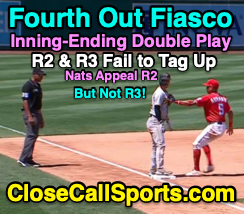
Ask UEFL - Pirates Score as Nats Fail to Appeal Fourth Out

We received many Ask the UEFL questions on a botched appeal play during Wednesday's Pirates-Nationals game in Washington as Pittsburgh scored the go-ahead run thanks to the Nats' failure to appeal a fourth out on Jack Suwinski's baserunning in the 5th inning.

Play: With one out and two on (R2, R3), Pirates batter Ke'Bryan Hayes hit a line drive that was caught on the fly by Nationals first baseman Josh Bell (as signaled by 1B Umpire Mark Wegner), who threw to third baseman Ehire Adrianza as Pirates baserunner R2 Hoy Park arrived at third base (from second). Replays indicate that both R2 Park and lead runner R3 Jack Suwinski failed to tag up after batter Hayes' line drive was caught, and Nats F5 Adrianza tagged R2 Park to appeal that he left early, signaled an out by 3B Umpire Jeremie Rehak. Washington then left the field as Pirates manager Derek Shelton exited his dugout to argue with 1B Umpire Wegner about the catch/trap call.

Call: Upon consultation, the umpires ruled batter Hayes out on the caught batted ball and runner R2 Park out on appeal for failing to tag up. R3 Suwinski's run was allowed to score, however, as the Nationals failed to appeal that R3 left early. The Nationals, having already left the playing field, then attempted to return to the field and appeal R3's infraction, but the umpires denied this attempt, ruling the team had forfeited its opportunity to appeal since the infielders had already left the field for the dugout.

Reducing the Play into Its Parts: There are four distinct parts to this play:
1) Batter Hayes' line drive—was it a catch or a trap?
2) Appeal on R2—is R2 Park safe or out?
3) Time Play with R3—does R3 Suwinksi's run score?
4) Fourth Out—does R3 Suwinski's run score?

Friday, May 20, 2022

Ask UEFL - KBO Run Nullified Due to Force Double Play

This Ask the UEFL question comes from the Korea Baseball Organization, as umpires cancelled a game-winning run in extra innings after a fly ball to left field turned into a double-play on two trailing runners.

During Wednesday's KBO matchup between SSG Landers and Doosan Bears, Bears batter Jo Soo-haeng stepped to the plate with the bases loaded and one out, hitting a fly ball to shallow left field. SSG left fielder Oh Tae-gon dove in attempt to catch the sinking fly, but our 3B Umpire going out on the play signaled "safe" to rule no catch, or trap.

While leading baserunner R3 Kim Jae-ho appeared to score far ahead of the defense retiring trailing runners R2 Jung Soo-bin (tagged out between second and third) and R1 An Jae-seok (forced out at second base), umpires ruled the winning run had not scored after all, leading Doosan to challenge the call.

The call was confirmed via Replay Review: both R1 and R2 were forced out and no run scored, despite R3 touching home plate far in advance of R1 and R2 being put out.

The reason is the same one we see on "standard" inning-ending double plays on a ground ball to the shortstop, who throws to the second baseman for one, and back to the first base for two, negating any potential runs due to the third out force play.

This is not a Time Play: It is a simply a pair of force outs on R2 and R1 for the second and third outs of the inning, respectively. Had the defense instead tagged second base to force R1 out prior to tagging R2, R1's retirement as the inning's second out would have removed the force on R2 such that tagging R2 somewhere between second and third base would be a non-force tag play. In such an event, this would be a time play as R2's third out would no longer be due to a force out, meaning that R3's run would count due to R3 touching home plate prior to the third out (which is not a force out) being made.

The relevant rule, to review, is Official Baseball Rule 5.08(a) Exception, which states, "A run is not scored if the runner advances to home base during a play in which the third out is made (1) by the batter-runner before he touches first base; (2) by any runner being forced out; or (3) by a preceding runner who is declared out because he failed to touch one of the bases."

Although not strictly necessary for a force-third-out play like this one in which OBR 5.08(a) specifically cancels the run as opposed to umpire judgment that is used during a time play, a "score the run" or "disallow the run" signal might help communication-wise. Remember, the wash out signal is distinct from the safe mechanic in that washing out a run is signaled by raising both arms above the head whereas the safe sign is much more horizontal in nature.

In sum, though unconventional, this was an inning-ending force out as both R2 and R1 were forced to advance to their next bases by virtue of the batter becoming a runner (uncaught fly ball) | Video as follows:

Wednesday, April 7, 2021

Time Play Teachable - Fielder's Choice in Oakland

The Oakland Athletics secured win #1 of the 2021 MLB regular season Wednesday against Los Angeles, but not after a curious time play leading to a Dodgers go-ahead run after HP Umpire Dan Bellino conferred with 3B Umpire Adrian Johnson before scoring LA's second run of the game.

Play: With two out and two on (R2, R3), Dodgers batter Zach McKinstry bunted to A's third baseman Matt Chapman as Dodgers baserunner R3 Max Muncy sprinted for home plate and R2 Austin Barnes ran toward third base. Rather than make a play on McKinstry at first base to end the inning, F5 Chapman opted to tag Barnes as he overslid third base, resulting in the inning's third out.

Ruling: Cognizant of the time play situation, HP Umpire Bellino signaled to the press box to score the run, properly ruling that runner Muncy had touched home plate prior to fielder Chapman recording the third out on runner Barnes at third base.

Q&A
: Our Ask the UEFL question is whether it matters that batter-runner McKinstry hadn't yet touched first base at the time of the third out. The answer is no. Official Baseball Rule 5.08(a) states that a run scores when a runner legally touches each base in order before three are out to end the inning. As previously established, R3 Muncy touched home plate before R2 Barnes was tagged for the third out.

The exception to 5.08(a) prescribes, "A run is not scored if the runner advances to home base during a play in which the third out is made (1) by the batter-runner before he touches first base; (2) by any runner being forced out; or (3) by a preceding runner who is declared out because he failed to touch one of the bases," but this itself is not a time play.

The ruling is that "no run shall score during a play in which the third out is made by the batter-runner before he touches first base." In this situation, the third out of the inning was made by R3 Muncy and not the batter-runner McKinstry, and because R3 Muncy touched home plate before R2 Barnes was tagged for the third out, Muncy's run shall count. Had fielder Chapman, instead of tagging Barnes, successfully thrown out batter-runner McKinstry at first base, R3 Muncy's run would not count, regardless of timing involved, because the third out would have been made by the batter-runner before touching first base.

Video as follows:

Friday, July 31, 2020

Analysis of Mets-Red Sox Time Double Play, Errors

Tuesday's Mets-Red Sox game featured an inning-ending bases loaded double time play wherein umpires had to adjust to both teams making key mistakes: Boston ran itself into an out while New York surrendered an unnecessary run. This is a fascinating video to analyze. So what happened?

Play: With one out and the bases loaded in the bottom of the 3rd inning, Red Sox batter Rafael Devers hit a 2-1 slider from Mets pitcher David Peterson on a line drive to second baseman Robinson Cano, who either caught or trapped the batted ball. 2B Umpire Chad Whitson observed the slightest of changes of directions in the ball's flight and ruled a trap/no catch ("safe" mechanic). After Cano threw the ball to shortstop Amed Rosario, Rosario stepped on second base to force out Boston baserunner R1 Jose Peraza.

Boston ran itself out of an inning.
At that time, Red Sox baserunner R2 Andrew Benintendi started to run toward third base, baserunner R3 Kevin Plawecki ran and touched home plate, and the Metsultimately tagged Benintendi out to end the inning. HP Umpire James Hoye in turn signaled to count the run, that Plawecki had scored prior to the third out.

Analysis: For the umpires, it comes down to understanding the situation before the play occurs. While crews might enjoy a pre-game before first stepping onto the field, each official can do him or herself a world of good by pre-playing potential situations before they occur.

Thursday, August 8, 2019

Video Teachable - One-Out Time Play in LA

This Tmac's Teachable Moments video concerns time plays, and specifically a play that occurred with one out and runners at the corners at Dodger Stadium in Los Angeles. Chief Tom Hallion's Crew with HP Umpire Todd Tichenor and 2B Umpire Sean Barber officiated this inning-ending double play as a well-oiled machine, with a run-cancelling call that was affirmed via Replay Review.

The Play: With one out and runners at first and third (R1, R3), Padres batter Greg Garcia hit a ground ball down the right field line to first baseman Max Muncy, who stepped on the base and threw to Chris Taylor at second base as Padres baserunner R1 Franmil Reyes slid into the bag, tagged by infielder Taylor as R3 attempted to score from third base.

The Call: 1B Umpire Tom Hallion signaled batter-runner Garcia out on Muncy's tag of first base following the fair ground ball and 2B Umpire Sean Barber called runner Reyes out at second base as HP Umpire Todd Tichenor waved that R3's run did not score prior to the third out at second base.

Tichenor voids the run for a tardy touch.
Analysis: With a runner at third base, a HP Umpire should generally be afforded the opportunity to get into position for a potential play at home plate on a ground ball to the infield. Different crews may employ different mechanics, and for Hallion's crew, this could mean that 1B Umpire Hallion or 3B Umpire Adam Hamari would be enabled to rule on a fair/foul ground ball in front of the bag (even though, ordinarily, the plate umpire has that responsibility...umpiring is all about adjusting to situations; sometimes it isn't possible to stick with cookie-cutter procedure).

As F3 Muncy touches the ball over fair territory, he steps on first base—it's a nearly simultaneous "fair" and "out" call, which U1 Hallion motions as Muncy throws down to Taylor covering second base.

F3's BR out removes the force on R1 at 2B.
Hallion's out call on the batter-runner indicates to U2 Barber that the force play on San Diego runner R1 Reyes has been removed by virtue of the batter-runner's retirement, and the Dodgers will need to tag the remaining runner for the final out. Barber officiates the tag for the third out of the inning as PU Tichenor observes the base touch of home plate relative to the timing of the tag-out at second base by lining up home plate with second base.

UIC Tichenor lines up the potential time play.
Satisfied that the run did not score prior to the third out of the inning, Tichenor signals that the run should not count by waving his arms above his shoulders. It's important to raise both arms above the shoulders so as not to confuse teams or players with the "safe" mechanic, which is generally effected at shoulder-height or below.

Video as follows:

Saturday, April 28, 2018

Master Mike - Boone Boots a Replay as Scioscia Plays Coy

Friday night's Yankees-Angels game produced an odd run-scoring sequence that left NY Manager Aaron Boone out of time as Halos skipper Mike Scioscia outcoached rookie Boone by strategically opting not to challenge an umpire's apparent missed call on the bases.

A close call, missed chance, and strategy win.
The Play: With one out and two on (R2, R3), Yankees batter Neil Walker hit a fly ball deep to right field, resulting in a leaping catch at the wall by Angels right fielder Kole Calhoun, who threw to shortstop Andrelton Simmons, who in turn stepped on second base to appeal that Yankees baserunner R2 Giancarlo Stanton left the base too early as baserunner R3 Didi Gregorious crossed home plate.

The Call: 2B Umpire Angel Hernandez ruled R2 Stanton out for failing to timely tag up and HP Umpire Alan Porter ruled that R3 Gregorious' run should count because Gregorious scored prior to the third out of the inning.

Replays and Aftermath: Because replays suggest that R2 Stanton did timely tag up and that R3 Gregorious touched home plate after F6 Simmons tagged second base, both managers potentially had reason to consider challenging the play... and because one apparent missed call went against New York while the other went against Anaheim Los Angeles, the skippers had additional reason to pause.

Scioscia immediately exited his dugout to inform the umpires he was considering a challenge. After some thought, he opted not to challenge the call, likely knowing that although Gregorious did not touch home plate until after Simmons' tag at second, the Replay Official would have also reviewed when Simmons left second base relative to Calhoun's first touch, and would have likely reversed U2 Hernandez's out call, thus rendering UIC Porter's time play a moot call, awarding the Yankees not only Gregorious' run, but Stanton's placement at third base with just two out.

As for Boone...well...he Boone'd it. Replays indicate Boone loitered in the dugout after getting word from his video room that Calhoun had, indeed, caught the ball...only thinking to review the tag-up play at second base after more than 30 seconds had passed, which means his time was up and New York was no longer eligible to challenge the call(s).

What Should Have Happened: Batter out on the sac fly, R3 scoring and R2 to third base. Two out.
What Happened Instead: Batter out on the sac fly, R3 scoring. R2 out at second. Three out.

A snapshot at the moment Calhoun catches.
Umpire Responsibilities: In general, with runners at second and third and the infield in, the first base umpire has responsibility for boundary calls involving the right fielder who moves to his left, while the second base umpire has fly ball responsibility for plays that take the right fielder to his right (same coverage as with the bases empty).

Because F9 Calhoun turned and ran to his left, 1B Umpire Bill Miller properly went out into right field and observed Calhoun's catch.

The 2B Umpire's responsibility in this situation is to drift into the infield between first and second and take the tag-up at second base as well as the batter-runner once the batter-runner achieves first base. In addition to the tag-up at second base, the 2B Umpire is to quickly glance toward first to make sure the batter-runner touches first base as he runs by. Replays indicate 2B Umpire Angel Hernandez followed this instruction, though may have turned to see BR's touch at a crucial moment when R2 tagged up. Which base touch is more important here, anyway?

The 3B Umpire lines up the tag-up at third base, and takes the runner from second into third. Replays indicate 3B Umpire Todd Tichenor did this.

The HP Umpire stays home and has all runners at home including the batter-runner as well as R3. HP Umpire Alan Porter stayed home and was in good position to rule on the time play at second base.

Scioscisa strategically chose not to challenge.
What Went Wrong: Prior to ruling on the appeal play at second base, 2B Umpire Hernandez looked toward first, presumably for U1 Miller, possibly because, had Calhoun gone to his right, the first base umpire would have had the tag-up at second; perhaps Hernandez wanted to ensure no conflicting call would be made. However, if this alternate mechanic were in use, Hernandez would have gone out, not Miller. Regardless, this wasn't "wrong" in and of itself; watching BR at the crucial moment was what went wrong for the umpires. Whether right or not, Boone's failure to timely challenge the play was what went wrong for New York: the Yankees failed to control a controlable.

As for Porter, he had to rule whether Gregorious' touch of home plate preceded Simmons' tag of second base—a tall order from over 128 feet away, especially given Simmons' minor stumble at second base. In all, this makes for a very difficult time play; without satisfactory evidence to suggest that the run scored after the third out was made, Porter's call was to score the run. Scioscia could have challenged it, but it turned out to be far more strategic for him not to challenge the play, so, he didn't and in doing so, outcoached Aaron Boone.

Video as follows:

Friday, September 15, 2017

Knowing the Situation - Infield Flies and Time Plays

A crew that knows and communicates situations such as infield fly and time plays crisply stays a step ahead of the game and its fans. A momentary lapse in concentration or communication, however, can render confusion on the base paths. In order to make sure all umpires are on the same page, "each umpire team should work out a simple set of signals" (General Instructions to Umpires). This not only applies to correcting a manifestly wrong decision, but to communicating game situations. In general, specific signals are communicated amongst the crew prior to at-bats during which the following might occur, due to the number of outs or runners on base: 1) Infield Fly, 2) Time Play. Additional communication should take place between at-bats regarding: 1) Number of outs, 2) Rotations (e.g., which field umpire is going out on a fly ball, who is staying home, etc.), and 3) Shifting of responsibilities (e.g., base/plate umpires' responsibilities for an "infield in" situation). Warnings or problem players may also be communicated. Finally, umpires should have a signal to request a consultation amongst the crew.

Think of a rhyme: "Infield Fly, ASL 'Y'"
Infield Fly (most common MLB signal: Both hands are fists with the thumbs and pinky fingers extended outward, similar to the sign for "Y" in American Sign Language, rotated onto its side; also used is the finger-to-hat-brim signal [or fist-to-hat if zero are out]):
By now we know quite well that the infield fly rule contains three criteria: 1) First and second base occupied with less than two out; 2) Batter hits a fair fly ball which is not a line drive or bunt, that; 3) can be caught by any infielder with ordinary effort. We also know that "ordinary effort" is defined in the rulebook as "the effort that a fielder of average skill at a position in [MLB] should exhibit on a play, with due consideration given to the condition of the field and weather conditions."

Here's what a routine infield fly rule-turned-double play looks like when properly officiated:
Infield Fly is called well in advance of the drop.
With one out and two on, the batter hits a shallow fly ball to the second baseman. As the ball reaches its apex, the second base umpire rules infield fly by pointing skyward, a mechanic which is mirrored by the crew. The infielder allows the ball to fall untouched onto the ground in front of him, picks up the ball, and throws to the shortstop covering second base as both baserunners attempt to advance, apparently unaware of the infield fly rule's invocation. R1 advancing from first base is easily tagged and declared out for an inning-ending double play (R2 safe at third).
Related PostInfield Fly Rule Knowledge Costs Giants as Reds Turn Two (7/4/13).

Here's another properly communicated play, this time in reference to an infield fly no-call situation:
A non-infield fly results in a double play.
With none out and runners at first and second, batter hits a high fly ball to shallow left field, where the shortstop attempts to make a play. Umpires determine that the shortstop cannot catch this ball with ordinary effort since winds were gusting above 30 miles-per-hour during the play. Thus, no infield fly call is made. After the ball falls untouched to the grass, shortstop throws to second baseman, who tags baserunner R2 before stepping on the second base bag. Knowing that his crewmate had not invoked the infield fly rule, the second base umpire properly calls both R2 (tag) and R1 (force play) out for a double play. The crew chief entertains the offensive team's argument, explains the call, and the game proceeds without incident.
Related PostOrioles Turn Triple Play on Contested Infield Fly No-Call (5/3/17).

Here's an incorrectly communicated play where an umpire calls an improper force out on an infield fly:
U3 improperly calls R2 out on a non-force.
With one out and two on, batter hits a high fly ball in front of the pitcher's mound. The only umpire to make a call before the ball falls to the ground is the first base umpire. After the ball falls, baserunner R2 takes off for third base, which draws a throw from the first baseman. Before R2 arrives at third base, the fielder covering third catches the ball with his foot in contact with the base, as in a routine force play situation. The third base umpire then declares the runner out at third, apparently unaware that the infield fly had been called. To rectify the situation, the crew rules the batter out and awards R2 third base (as R2 had never been tagged while off his base).
See Attached Video

The sign for time (not "Time" as in time out).
Similarly, Time Plays begin before the pitcher even toes the rubber, with umpires employing another crew signal—often a touch of the wrist similar to the ASL sign for "time" or "watch"—so everyone is on the same page prior to what could very well end up as a time play.

A crew could even borrow a page from ASL by incorporating the number of outs into the time play signal: one finger on the wrist for one out, and two for two outs. Chances are a time play signal won't be necessary with zero outs. It matters not so much what the precise signal is, but rather that all officials are on the same page in regards to intra-crew communication.

An inning-ending double- & time-play in LA.
Naturally, it is also important to know what is and what isn't subject to timing considerations. We're obviously looking for whether a run scored or not before a third out non-force tag, but recall that appeal plays are not force outs, so appeals are also potential time plays. A time play can occur whenever: there are two outs and at least one runner on base; or there is one out and at least two runners on base. Though extremely unlikely, it is also technically possible to have a time play with zero outs and the bases loaded (e.g., batter hits an infield fly [first out], runners attempt to advance; R1 and R2 are both tagged off their bases [second and third outs] prior to R3 touching home plate).
Related PostUEFL Series: Baseball Rules in the Real World (Fourth Out) (1/18/14).

Here is an example of a properly officiated time play:
With one out and runners at the corners, batter's fly ball to left field is caught for the second out as both runners tag. Lead runner R3 crosses home plate as trail runner R2 is tagged out going to second base. Plate umpire observes the play and signals the run has scored prior to the third out having been recorded.
Related PostTmac's Teachable Moments - The Time Play in LA (6/17/16).
Related PostNot So Fast - Unique Time Play Plates Indians a Run (4/4/17).

Infield Fly play, Video as follows:

Tuesday, April 4, 2017

Not So Fast - Unique Time Play Plates Indians a Run

Cleveland scored a tying run against Texas on a unique sacrifice fly time play—a double play—in a key Opening Day situation that drew several questions from the Rangers as to its legality.

Short Version: With one out and two on, batter flies out to left field, runner on third legally tags up and scores, after which the runner on second, running on contact, is left in no-man's land and is easily retired at second base for failing to retouch/tag up after the caught fly. Plate umpire scores the run.

This is the correct call because the runner from third base touched home plate before the third out was recorded at second base. Somewhere along the way, folks began perpetuating the myth that tag-up (base retouch) outs were force outs. It is true that no run may be scored on a play during which the third out is a force out, but it is a baseball fallacy to associate tagging up with "force out."

Long Version: To begin, refer to OBR 5.08(a) EXCEPTION, which states, "A run is not scored if the runner advances to home base during a play in which the third out is made (1) by the batter-runner before he touches first base; (2) by any runner being forced out; or (3) by a preceding runner who is declared out because he failed to touch one of the bases."

Diagram of the Time Play. Run has scored.
Easy enough, right? Well, not so fast. With one out and runners at second and third base in the top of the 3rd inning of Monday's Indians-Rangers game, Indians batter Francisco Lindor hit a 0-1 cutter from Rangers pitcher Yu Darvish on a fly ball to left fielder Jurickson Profar, who caught the airborne ball for the inning's second out. While Indians baserunner R3 Abraham Almonte properly tagged up to try and score on the sacrifice fly, baserunner R2 Carlos Santana ran on contact, and was nearly at third base by the time Profar caught the ball. Profar's throw to the infield was cut off by third baseman Joey Gallo, who threw to second baseman Rougned Odor to easily double off Santana as Almonte crossed home plate. As HP Umpire Mike Winters emphatically signaled to the press box to "score the run," Rangers catcher Jonathan Lucroy turned to argue.

It's a time play! In other words, refer to Rule 5.08(a): "One run shall be scored each time a runner legally advances to and touches first, second, third and home base before three men are put out to end the inning." The question is whether R3 Almonte touched home plate before the third out was recorded, did he beat the out? Replays conclusively indicate he did; the timing was right.

HP Umpire Winters: Score The Run!

That's where the exception to the rule, referenced above, comes into play. Was Santana's out a "runner being forced out" or not? The answer to this question—and the language that proves the myth false—lies in the Definition of Terms: "A FORCE PLAY is a play in which a runner legally loses his right to occupy a base by reason of the batter becoming a runner."

Well, with first base unoccupied, the batter becoming a runner would not legally force either Santana nor Almonte to lose their right to occupy their respective bases.

Had first base been occupied, however, refer to (Force Play) Comment: "Confusion regarding this play is removed by remembering that frequently the 'force' situation is removed during the play." Profar's catch of the fly ball—which retired batter Lindor—would mean the definition's "batter becoming a runner" criterion would not apply, and, thus, no runner would be "forced" to run (the force would be removed and no runner would lose the right to occupy a base).

Therefore, with no force play involving Santana, Rule 5.08(a) EXCEPTION did not apply and Almonte, by virtue of touching home plate before the third out was recorded, legally scored Cleveland's first run of the game. Video via "Read More"

Friday, June 17, 2016

Tmac's Teachable Moments - The Time Play in LA

Tmac presents a teachable moment analyzing the time play in Los Angeles Thursday night.

This is an interesting time play. Too often, I see umpires so anxious to signal time plays with two outs in situations that never actually happen (i.e. runner on 2nd and two outs). At higher levels, a large number on time plays actually occur with one out.... How is this possible? Lets take a look at this play from Thursday's Milwaukee Brewers-LA Dodgers game. One out, runners on 1st and 3rd, and we have Ryan Blakney working the plate and the umpire at 2nd for the call is Crew Chief Mike Everitt. A fly ball is hit to left field that should easily score the runner from 3rd, but we have a crafty runner from 1st that is trying to get into scoring position with two outs. The 3rd base umpire goes out on the play leaving us in a 3-umpire system. Luckily we have a thoroughly engaged plate umpire who is not caught unaware that there a time play developing and he is in a straight line from the back of home to 2nd base for his best possible angle. Blakney scores the run and while there was no angle that clearly showed whether the tag came before or after the runner touched the plate he was emphatic in scoring the run. What makes this play even more difficult is the resulting play at second.

Everitt, who is the 1st base umpire at the beginning of this play has a runner standing, not sliding into 2nd and the tag occurs on the outfield side which makes Blakney's view blocked. Essentially, this is a play that was handled really well by the umpiring crew and I thought it should be brought to light. In addition, who doesn't like hearing Vin Scully's voice!

Sunday, June 1, 2014

MLB Replay Reviews 418-419: Barry, Fagan (02, 06)

Instant Replay Review confirmed 2B Umpire Scott Barry's out call and overturned HP Umpire Clint Fagan's score-the-run call (time play) in the top of the 2nd inning of the Rangers-Nationals game. With two out and two on, Rangers baserunner R1 Alex Rios attempted to steal second base off Nationals catcher Wilson Ramos, who threw to second baseman Danny Espinoza as Rios arrived at second base and Rangers baserunner R3 Elvis Andrus arrived at home plate. Upon Replay Review as the result of simultaneous challenges by Rangers Manager Ron Washington and Nationals Manager Matt Williams, Barry's ruling was affirmed (TEX), the call was correct, and Fagan's ruling was reversed (WAS), the call was incorrect. At the time of the reviews, the Rangers were leading, 1-0. The Rangers ultimately won the contest, 2-0.

This is Scott Barry (87)'s second Replay Review of the 2014 MLB Regular Season.
This is Clint Fagan (82)'s sixth Replay Review of the 2014 MLB Regular Season.
This is Crew Chief Jeff Nelson's 16th, 17th supervised Replay Review of the 2014 season.

This is the 418th, 419th Instant Replay Review of the 2014 MLB Regular Season.
This is Rangers Manager Ron Washington's 15th Replay Review of 2014.
This is Nationals Manager Matt Williams' 13th Replay Review of 2014.
Umpires are now 223/419 (.532 Affirmation Rate) in Replay Reviews during the 2014 MLB season.

Wrap: Texas Rangers vs. Washington Nationals, 6/1/14
Video: Play confirmed, in part, overturned: First simultaneous challenge of year goes Nats' way (WAS)

Saturday, May 24, 2014

MLB Instant Replay Review 357: Brian O'Nora (05)

Instant Replay Review confirmed HP Umpire Brian O'Nora's no score (time play, run cancelled) call in the top of the 6th inning of the Brewers-Marlins game. With two out and two on, Brewers batter Mark Reynolds hit a 1-2 cutter from Marlins pitcher Jacob Turner on a line drive to left fielder Christian Yelich, who threw to third baseman Casey McGehee as Brewers baserunner R1 Carlos Gomez slid into third base (out on the tag) and R2 Ryan Braun arrived at home plate. Upon Replay Review as the result of a challenge by Brewers Manager Ron Roenicke, O'Nora's ruling was affirmed, the call was correct. At the time of the review, the Marlins were leading, 1-0. The Marlins ultimately won the contest, 2-1.

This is Brian O'Nora (7)'s fifth Replay Review of the 2014 MLB Regular Season.
This is Crew Chief Brian O'Nora's 15th supervised Replay Review of the 2014 season.

This is the 357th Instant Replay Review of the 2014 MLB Regular Season.
This is Brewers Manager Ron Roenicke's ninth Replay Review of 2014.
Umpires are now 186/357 (.521 Affirmation Rate) in Replay Reviews during the 2014 MLB season.

Wrap: Milwaukee Brewers vs. Miami Marlins, 5/24/14
Video: Play confirmed; Braun pulls up in front of the plate on third out; O'Nora waives the run (MIL)

Sunday, May 18, 2014

MLB Instant Replay Review 311: Bob Davidson (08)

Instant Replay Review confirmed 2B Umpire Bob Davidson's out call in the top of the 5th inning of the Pirates-Yankees game. With two out and one on, Pirates batter Josh Harrison hit a 0-0 slider from Yankees pitcher Vidal Nuno on a line drive to left fielder Zoilo Almonte, who threw to shortstop Brendan Ryan to first baseman Kelly Johnson as BR Harrison attempted to avoid the tag and Pirates baserunner R1 Travis Snider attempted to score. Upon Replay Review as the result of a challenge by Pirates Manager Clint Hurdle, Davidson's ruling (and Hoye's corollary that the run did not score prior to the third out being recorded) was affirmed, the call was correct.* At the time of the review, the Yankees were leading, 2-1. The Pirates ultimately won the contest, 5-3.

This is Bob Davidson (61)'s eighth Replay Review of the 2014 MLB Regular Season.
This is Crew Chief Bob Davidson's 13th supervised Replay Review of the 2014 season.
*Appellate Interpreter has invoked UEFL Rule 9-1 to rule that U3 is the calling umpire.

This is the 311th Instant Replay Review of the 2014 MLB Regular Season.
This is Pirates Manager Clint Hurdle's 15th Replay Review of 2014.
Umpires are now 160/311 (.514 Affirmation Rate) in Replay Reviews during the 2014 MLB season.

Wrap: Pittsburgh Pirates vs. New York Yankees (Game 2), 5/18/14
Video: Play confirmed; BR is out and run does not count (time play) affirmed after review (PIT)

Saturday, April 26, 2014

MLB Replay Reviews 165, 166: Scheurwater, Nauert (01, 01)

Instant Replay Review overturned 1B Umpire Stu Scheurwater's safe call in the top of the 3rd and confirmed HP Umpire Paul Nauert's run cancellation (time play; third out) in the bottom of the 8th inning of the Rockies-Dodgers game. In the 3rd, with two out and one on, Dodgers pitcher Paul Maholm attempted to pick off Rockies baserunner R1 Brandon Barnes on the glove tag by Dodgers first baseman Adrian Gonzalez. Upon Instant Replay Review as the result of a challenge by Dodgers Manager Don Mattingly, Scheurwater's ruling that Gonzalez did not tag Barnes while he was off his base was reversed, the call was incorrect. At the time of the review, the Rockies were leading, 1-0.

In the 8th, with one out and two on, Dodgers batter Juan Uribe hit a 0-1 fastball from Rockies pitcher Matt Belisle on the fly to right fielder Barnes, who threw to third baseman Nolan Arenado, Dodgers baserunner R2 Yasiel Puig out at third base as R3 Dee Gordon arrived at home plate. Upon Instant Replay Review as the result of a challenge by Dodgers Manager Mattingly, Nauert's ruling that Puig was retired at third base for the third out of the inning prior to Gordon's touch of home plate was affirmed, the call was correct. At the time of the review, the Dodgers were leading, 6-2. The Dodgers ultimately won the contest, 6-3.

This is Stu Scheurwater (85)'s first Replay Review of the 2014 MLB Regular Season.
This is Paul Nauert (39)'s first Replay Review of the 2014 MLB Regular Season.
Stu Scheurwater is now 0/1 (.000 Affirmation Rate) in Replay Reviews in 2014.
Paul Nauert is now 1/1 (1.000 Affirmation Rate) in Replay Reviews in 2014.
Chief Larry Vanover's crew is now 3/7 (.429 Affirmation Rate) in Replay Reviews in 2014.

These are the 165th and 166th Instant Replay Reviews of the 2014 MLB Regular Season.
Dodgers Manager Don Mattingly is now 1/5 (.200 Success) in Replay Reviews in 2014.
Umpires are now 95/166 (.572 Affirmation Rate) in Instant Replay Reviews during the 2014 MLB season.

Video: Mattingly wins LA's first challenge of the year on pickoff play at first base (LAD)
Video: Dodgers' bid for an insurance run in the 8th comes up short on double play (LAD)