Showing posts with label Rule 2.00 [Force Play]. Show all posts

Wednesday, April 17, 2024

John Libka's Time Play Washout and Umpiring Mechanics

Mariners outfielder Julio Rodríguez's heads up play to throw Reds runner Elly De La Cruz out at third base after catching Nick Martini's fly ball saved Seattle a run, as HP Umpire John Libka ruled R3 Jake Fraley did not score prior to the time play's third out.

We review umpiring mechanics for time play situations—especially of the sacrifice fly-turned-inning-ending-double-play variety—and clarify (again) that an appeal play on a runner for failing to retouch (tag up) after a caught fly ball is not considered a force play, and thus, subject to time play rules.

Time Play Basics: Official Baseball Rule 5.08(a) states that, "One run shall be scored each time a runner legally advances to and touches first, second, third and home base before three players are put out to end the inning." This means that on plays where a third out may occur, it is incumbent on the home plate umpire to prepare for the possibility that they will have to determine whether or not a preceding runner touched home plate prior to the third out being recorded behind them.

On this play, HP Umpire Libka lined up to see both Cincinnati baserunner R3 Fraley's impending touch of home plate and Seattle third baseman Josh Rojas' diving tag attempt on Reds runner R2 De La Cruz. When 3B Umpire Jonathan Parra, himself moving with the play to find the keyhole angle, called R2 De La Cruz out on the tag for the inning's third out, Libka emerged from behind home plate to indicate via the washout signal (similar to a "safe" sign except the arms are more elevated) that R3 Fraley's run would not score, as Fraley hadn't yet touched home plate prior to the third out on De La Cruz.

Exceptions to Time Plays: OBR 5.08(a) provides for three time play exceptions, meaning that even if a lead runner touches home prior to the third out, the run still will not count if the third out is a result of one of these scenarios. These are 1) a batter-runner retired before touching first base, 2) any runner being forced out, and 3) an appeal play for missing a base made on a preceding (ahead of) runner.

Appeal Plays: If any appeal play results on a preceding runner being declared out for the third out of the inning, no following runner is allowed to score. But if an appeal play is made on a following runner, then the preceding runner's run is treated as a Time Play—if the preceding runner touches home prior to the third out, the run will count. It is a rules myth that all tag-up or retouch appeals are treated as force plays—they are not, and are subject to timing rules if the runner being retired is trailing/following/behind the lead runner who is trying to score.

Video as follows:

Tuesday, November 22, 2022

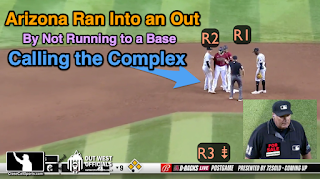
Arizona Runs into Double Play on Force Play Confusion - Teachable

Diamondbacks baserunners ran themselves into a crucial 9th inning double play as confusion on the bases moved Pittsburgh that much closer to a tense win in Arizona. 2B Umpire Adam Hamari is our focus for this Tmac's Teachable Moment.

With none out and the bases loaded in the top of the 9th, D-Backs batter Carson Kelly hit a ground ball to Pirates third baseman Ke'Bryan Hayes, who threw to second baseman Rodolfo Castro, who stepped on second base before throwing back to third base, where Pirates shortstop Kevin Newman stepped on third base before running Arizona runner R2 Emmanuel Rivera back to second base and then tagging Rivera.

Despite initial confusion with an errant "safe" call, umpires correctly officiated the play by declaring both Arizona runners R1 Sergio Alcantara out on the force play at second base and declaring R2 Rivera out on a tag off of second base for a double play. Pirates F6 Newman's touch of third base proved immaterial, as Castro had already forced R1 Alcantara out at second base, removing the force from third.

But, by virtue of Alcantara remaining on the field at second base, preceding runner R2 Rivera hesitated to retouch second base, allowing Pittsburgh fielder Newman enough time to tag Rivera off the base for the second out of the inning, with Alcantara serving as the first out.

Video as follows:

Friday, May 21, 2021

KBO Walk-Off Rundown & Force Play Analysis

The Korea Baseball Organization (KBO)'s SSG Landers walked off the LG Twins 6-5 Friday when the defense forgot to make a play on the winning runner during a groundout to third base and ensuing rundown. Umpires Choi Young-joo, Kang Gwang-hwe, Kwon Young-chul, and Lee Yong-huk presided over the unique walk-off situation that is actually covered by the Official Baseball Rules.

Play: With one out and the bases loaded, Landers batter Lee Jae-won hit a ground ball to Twins third baseman Kim Min-sung, who stepped on third base and threw to catcher Yoo Kang-nam to make a play on Landers baserunner R3 Choo Shin-soo.

What followed was pandemonium for one team and jubilation for the other as the catcher ran R3 back to third base, where trail baserunner R2 Han Yoo-seom was standing. The defense's attention then turned to R2, who retreated toward second base as R3 again broke for the plate, only this time, there was no throw home and he scored the winning run in uncontested fashion.

Analysis
: As stated, the batter with the bases loaded and one out hit a ground ball to the third baseman, who stepped on third base. This forced out R2, as signaled by the umpire right after his fair ball call, and removed R3's obligation to run home, meaning the defense now needed to tag R3. When the catcher ran R3 back to third base and saw R2 begin to run back toward second base, he began to chase R2 as R3 scored, all while the 3B Umpire signaled that R2 was already out (due to the force play).

Official Baseball Rule 6.01(a)(5) Comment states, "If the batter or a runner continues to advance or returns or attempts to return to his last legally touched base after he has been put out, he shall not by that act alone be considered as confusing, hindering or impeding the fielders." This means R2, by virtue of advancing to third then retreating toward second, was legal in the sense that, although R2 was already put out, his actions are not to be construed as retired runner's interference. Accordingly, that means R3's run was legally scored and the game properly declared over in walk-off fashion.

Hypothetical
: Assume that fielder F5 never stepped on third base to force out R2 and, for whatever reason, F2 never stepped on home plate to force out R3. OBR 5.06(a)(2) states that, "Two runners may not occupy a base, but if, while the ball is alive, two runners are touching a base, the following runner shall be out when tagged and the preceding runner is entitled to the base, unless Rule 5.06(b)(2) applies." (b)(2), in turn, states, "If a runner is forced to advance by reason of the batter becoming a runner and two runners are touching a base to which the following runner is forced, the following runner is entitled to the base and the preceding runner shall be out when tagged or when a fielder possesses the ball and touches the base to which such preceding runner is forced."

Plainly, relative to our hypothetical case, if R2 and R3 both stood on third base during a force play situation and both were tagged while on the base, lead runner R3 would be declared out.

But if R2 and R3 both stood on third base when there was no force (e.g., first base was not occupied at the start of the play or the batter-runner was already thrown out at first base, etc.), and both were tagged while on the base, trail runner R2 would be declared out. Note that as long as R3 runs back to third base and remains on the base without going up the left field line (e.g., past the base), there is no runners passing situation: as stated in prior articles, the base, relative to runners passing, is somewhat of a neutral zone.

Video as follows:

Tuesday, April 4, 2017

Not So Fast - Unique Time Play Plates Indians a Run

Cleveland scored a tying run against Texas on a unique sacrifice fly time play—a double play—in a key Opening Day situation that drew several questions from the Rangers as to its legality.

Short Version: With one out and two on, batter flies out to left field, runner on third legally tags up and scores, after which the runner on second, running on contact, is left in no-man's land and is easily retired at second base for failing to retouch/tag up after the caught fly. Plate umpire scores the run.

This is the correct call because the runner from third base touched home plate before the third out was recorded at second base. Somewhere along the way, folks began perpetuating the myth that tag-up (base retouch) outs were force outs. It is true that no run may be scored on a play during which the third out is a force out, but it is a baseball fallacy to associate tagging up with "force out."

Long Version: To begin, refer to OBR 5.08(a) EXCEPTION, which states, "A run is not scored if the runner advances to home base during a play in which the third out is made (1) by the batter-runner before he touches first base; (2) by any runner being forced out; or (3) by a preceding runner who is declared out because he failed to touch one of the bases."

Diagram of the Time Play. Run has scored.
Easy enough, right? Well, not so fast. With one out and runners at second and third base in the top of the 3rd inning of Monday's Indians-Rangers game, Indians batter Francisco Lindor hit a 0-1 cutter from Rangers pitcher Yu Darvish on a fly ball to left fielder Jurickson Profar, who caught the airborne ball for the inning's second out. While Indians baserunner R3 Abraham Almonte properly tagged up to try and score on the sacrifice fly, baserunner R2 Carlos Santana ran on contact, and was nearly at third base by the time Profar caught the ball. Profar's throw to the infield was cut off by third baseman Joey Gallo, who threw to second baseman Rougned Odor to easily double off Santana as Almonte crossed home plate. As HP Umpire Mike Winters emphatically signaled to the press box to "score the run," Rangers catcher Jonathan Lucroy turned to argue.

It's a time play! In other words, refer to Rule 5.08(a): "One run shall be scored each time a runner legally advances to and touches first, second, third and home base before three men are put out to end the inning." The question is whether R3 Almonte touched home plate before the third out was recorded, did he beat the out? Replays conclusively indicate he did; the timing was right.

HP Umpire Winters: Score The Run!
That's where the exception to the rule, referenced above, comes into play. Was Santana's out a "runner being forced out" or not? The answer to this question—and the language that proves the myth false—lies in the Definition of Terms: "A FORCE PLAY is a play in which a runner legally loses his right to occupy a base by reason of the batter becoming a runner."

Well, with first base unoccupied, the batter becoming a runner would not legally force either Santana nor Almonte to lose their right to occupy their respective bases.

Had first base been occupied, however, refer to (Force Play) Comment: "Confusion regarding this play is removed by remembering that frequently the 'force' situation is removed during the play." Profar's catch of the fly ball—which retired batter Lindor—would mean the definition's "batter becoming a runner" criterion would not apply, and, thus, no runner would be "forced" to run (the force would be removed and no runner would lose the right to occupy a base).

Therefore, with no force play involving Santana, Rule 5.08(a) EXCEPTION did not apply and Almonte, by virtue of touching home plate before the third out was recorded, legally scored Cleveland's first run of the game. Video via "Read More"

Thursday, July 3, 2014

MLB Instant Replay Review 649: Vic Carapazza (07)

Instant Replay Review overturned 1B Umpire Vic Carapazza's safe (missed tag) call in the top of the 2nd inning of the Blue Jays-Athletics game. With one out and three on, Blue Jays batter Anthony Gose hit a 0-0 fastball from Athletics pitcher Sonny Gray on the ground to first baseman Nate Freiman, who attempted to tag Blue Jays baserunner R1 Munenori Kawasaki before throwing to A's catcher Stephen Vogt, who tagged home plate as Blue Jays baserunner R3 Edwin Encarnacion attempted to score. Upon Replay Review as the result of a challenge by Blue Jays Manager John Gibbons, Carapazza's ruling was reversed, the call was incorrect. At the time of the review, the game was tied, 0-0. The Athletics ultimately won the contest, 4-1.

This is Vic Carapazza (19)'s seventh Replay Review of the 2014 MLB Regular Season.
This is Crew Chief Bill Miller's 37th supervised Replay Review of the 2014 Season.
*Athletics Manager Bob Melvin elected to play the remainder of the game under formal protest, alleging that had the call at first base been out (removed the force), Vogt would have tagged Encarnacion, resulting in a double play. Instead, Replay Review determined that Encarnacion's run scored for lack of a tag to his person. The protest was dropped after the game as the result of Oakland's 4-1 victory.
Regarding Protests: Replay Regulation II.K.4 states, "Official Baseball Rule 4.19 shall have no applicability to these Replay Regulations. No protest shall ever be permitted on judgment decisions by the Replay Official. Moreover, a violation of any rule or procedure set forth herein shall not constitute a basis for protesting a game."

This is the 649th Instant Replay Review of the 2014 MLB Regular Season.
This is the Toronto Blue Jays' 31st Replay Review of 2014.
Umpires are now 336/649 (.518 Affirmation Rate) in Replay Reviews during the 2014 MLB season.

Saturday, April 19, 2014

Baseball Rules Series: Replay's New Normal (Fourth Out)

MLB's Instant Replay Review introduced a new fourth out to the game, a false fourth out of sorts, as exemplified during the Braves-Mets game Friday night. The Rays, for instance, ran "fourth out" drills during Spring Training practices, but this marks the first false fourth out situation to arise during a regular season affair.

Umpires Hoberg, Wegner, Hallion & Cooper.
With two out and one on in the bottom of the second inning, Mets batter Travis d'Arnaud hit a 3-2 slider from then-no-hitter hopeful Braves pitcher Aaron Harang on the ground to second baseman Dan Uggla, who threw to first baseman Freddie Freeman as d'Arnaud arrived at first base, ruled out by 1B Umpire Eric Cooper. Sensing a challengeable play at first, F3 Freeman quickly wheeled and fired the ball to third base, where F5 Chris Johnson and Mets baserunner R1 Lucas Duda converged upon the hot corner, Duda tagged while off the base for a potential fourth out, as ruled by 3B Umpire Pat Hoberg.

After the play, Mets Manager Terry Collins visited Cooper to discuss the close play at first base and to consider using his challenge; however, as Hoberg mechanized, Duda was the "fourth out" at third base and, had Collins challenged and the out call at first been overturned via Replay Review, Duda would have become the official third out of the inning attempting to advance to third base.

The challenge, however, would have the very real-world effect of breaking up Harang's no-hit bid.

Replay Review-inspired fourth out situations join the already-in-existence appeal play fourth out in which an appeal on a baserunner made after the "third out" of the inning is recorded will have the effect of superseding the real-time third out and instead become the official third out. For instance, with one out, R2 and R3, B1 hits a line drive caught on the fly by F1. R2 and R3 were running on contact and have no hope of getting back to their bases to tag. Seeing this, F1 casually throws the ball to F6, who slowly strolls over and tags second base for the third out of the inning (R2 retired). R3, however, never stopped running and touched home plate prior to F6's touch of second base. If the defensive team appeals R3's violation at third base, R3 becomes the third out of the inning in order to cancel the score. If the defense doesn't appeal R3's violation, R3's run counts. This situation occurred during a Dodgers-Diamondbacks game and is documented in the UEFL Series: Baseball Rules in the Real World (Fourth Out).

Wrap: Atlanta Braves vs. New York Mets, 4/18/14
Video: With two out, after a close play at first, 1B Freddie Freeman gets a fourth out just in case (ATL)

Saturday, January 18, 2014

UEFL Series: Baseball Rules in the Real World (Fourth Out)

MLB fans suffer from lack of rules knowledge, this is no secret—though so do members of the media, players and even managers/coaches. According to a 2013 rules quiz, out of 10 true-or-false questions, fans averaged a score of 3.7 out of 10, the media 4.4, players 5.5, and managers/coaches 6.6. Leading the pack was Brad Ziegler of the Arizona Diamondbacks with a perfect score (10/10), followed closely by David Ross and John Farrell of the Boston Red Sox with a 9/10 score.

At the bottom of the leaderboard was ESPN's Aaron Boone, who somehow managed a one-of-ten score on the 10 question, two-option (true or false) exam.

The Red Sox are one of a small number of MLB teams that consult a rules expert for such matters, which may very well explain their better-than-average scores. Boone allegedly does not reach out.

The 10-question test posed 10 hypothetical scenarios that, for the most part, were not based on reality and did not previously occur during professional games.

Umpires go through much scenario-based training such that when a rare or odd situation occurs, making the proper call is second nature. For instance, Jim Joyce talked about his obstruction call to end a World Series game for the first time in baseball history as completely instinctual. For the fans, perhaps rules education based on specific situations and scenarios would be more appealing if they were actually rooted in reality. The UEFL presents a new series, Baseball Rules in the Real World, that attempts to do just that. We begin with "Failed Fourth Out," featuring a game-changing play from April 12, 2009.

In an effort to persuade clubs and fans alike towards education, the UEFL presents real world concerning plays and situations that did take place in baseball and, at times, cost teams an out, run or even a win entirely because of a lack of rules knowledge or recognition. This Baseball Rules in the Real World series will encompass Ask the UEFL as historically rules-related plays are presented and analyzed. Feel free to comment with plays you would like to see on real world.
R3 Ethier hustles to score as R2 freezes.


For the rules rookies amongst us (welcome and congratulations for choosing to better yourselves!), Team A refers to the offensive team, Team B the defensive team, PU the plate umpire and U1/U2/U3 the first/second/third base umpire. B1 is the batter and/or batter-runner, R1 is the runner that starts the play on first base, R2 at second base and R3 at third base. F1 is the pitcher, F2 the catcher and so on.

Ethier Scores on Double Play to Tie Game at 1 ("Failed Fourth Out," April 12, 2009 [Video]).
Situation: We begin with "Failed Fourth Out." With one out in the top of the 2nd inning of a 1-0 ballgame, R2 Juan Pierre and R3 Andre Ethier, B1 Randy Wolf hit a line drive to F1 Dan Haren. R2 and R3 were running on contact, so as F1 Haren caught the liner for the inning's second out, both runners were far off their respective bases. F1 Haren threw to F5 Felipe Lopez, who casually strolled to R2 Pierre and nonchalantly applied the tag for the third out of the inning. During the interim, and prior to F5's tag of R2, R3 Ethier, who never broke stride, touched home plate. Lopez kept the ball and returned to the Arizona dugout. After the inning's end, Dodgers bench coach Bob Schaefer and manager Joe Torre met with PU Larry Vanover to discuss the play (the scoreboard erroneously showed a 1-0 Arizona lead). After consultation with U3 Charlie Reliford, the Dodgers were credited with a run, the score adjusted to a tie, 1-1.

Ruling: Correct call. R3's run scores because he touched home plate prior to the third out of the inning, because the third out was not a force out (Rule 4.09[a]).* This is a time play. To negate the run, Team B would have had to appeal R3's failure to tag up prior to Team B leaving the field ("For the purpose of this rule, the defensive team has 'left the field' when the pitcher and all infielders have left fair territory on their way to the bench or clubhouse"):
Appeal plays may require an umpire to recognize an apparent “fourth out.” If the third out is made during a play in which an appeal play is sustained on another runner, the appeal play decision takes precedence in determining the out. If there is more than one appeal during a play that ends a half-inning, the defense may elect to take the out that gives it the advantage. (Rule 7.10)
*Rule 2.00 (Force Play) defines such a play "in which a runner legally loses his right to occupy a base by reason of the batter becoming a runner." OBR goes on to give a very similar example of a play that does not qualify as a force out: "Not a force out. One out. Runner on first and third. Batter flies out. Two out. Runner on third tags up and scores. Runner on first tries to retouch before throw from fielder reaches first baseman, but does not get back in time and is out. Three outs. If, in umpire’s judgment, the runner from third touched home before the ball was held at first base, the run counts." This is what we have here.

The Dodgers went on to win the ballgame, 3-1, which means the failed fourth out may have played a significant role in LA's win.
Umpires: HP: Larry Vanover. 1B: Sam Holbrook. 2B: Dan Iassogna. 3B: Charlie Reliford (crew chief).

Wrap: Los Angeles Dodgers vs. Arizona Diamondbacks, 4/12/09