Showing posts with label Rule 2.00 [Overslide]. Show all posts

Tuesday, September 20, 2022

Teachable Quickie - Oversliding a Base with Bill Miller

2B Umpire Bill Miller calls Brewers batter-runner Keston Hiura out for oversliding second base in this CCS Quickie Teachable. When it is apparent that Hiura, having batted a ball to left field, will attempt to stretch his single into a double, Miller takes his position to see Pirates infielder Kevin Newman's tag attempt on Hiura.

In addition to simply determining whether batter-runner Hiura is safe or out on the tag, Miller must also deduce whether, if Hiura was indeed tagged while off second base, whether this overslide was caused by fielder Newman illegally forcing the runner off of a base attained legally.

Video as follows:

Saturday, May 14, 2022

Ask UEFL - Anderson Safe After Donaldson Pushes Runner Off Base

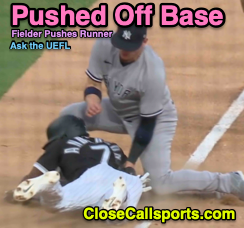
In a physical play that wound up clearing the benches, 3B Umpire Chris Guccione ruled White Sox baserunner Tim Anderson safe at third base during Chicago's game against New York Friday, as Yankees third baseman Josh Donaldson appeared to push the runner off third base while making a tag.

This edition of Ask the UEFL answers the question of what happened, with references to the Official Baseball Rules' definition of oversliding ("the act of an offensive player when their slide to a base, other than when advancing from home to first base, is with such momentum that they lose contact with the base"), and, more importantly, the MLB Umpire Manual's interpretation of fielder-runner contact that results in the runner no longer touching the base.

According to MLBUM, "If in the judgment of an umpire, a runner is pushed or forced off a base by a fielder, intentionally or unintentionally, at which the runner would have otherwise been called safe, the umpire has the authority and discretion under the circumstances to return the runner to the base they were forced off following the conclusion of the play."

As such, because runner R3 Anderson slid headfirst in the direction of the left field foul pole and appeared to touch third base prior to Donaldson's tag, only for Anderson to then fall off the base to his left—a direction Anderson never slid in until Donaldson made contact with him—it can be concluded that Donaldson illegally pushed Anderson off the base and, thus, the remedy is to declare the runner safe.
Related PostReplay Rewind - Runner Pushed Off Base (6/25/18).

Note: This is not Obstruction, as Donaldson possessed the ball in his glove prior to blocking Anderson's path to the base. Were it obstruction, it would have been Type One (play being made on runner).

Video as follows:

Friday, April 29, 2022

MLB Ejection 018 - Manny Gonzalez (1; Mike Matheny)

3B Umpire Manny Gonzalez ejected Royals manager Mike Matheny (out call; QOCY) in the bottom of the 2nd inning of the #Yankees-#Royals game. With one out and one on (R2), Royals baserunner R2 Bobby Witt Jr attempted to steal third base and became involved in a rundown when Yankees pitcher Nestor Cortes stepped off the mound and threw to second baseman Gleyber Torres, who chased Witt to third base, ruled out by 3B Umpire Gonzalez after being tagged while not on a base. Replays indicate Witt slid toward third base and contact with fielder Torres occurred as Witt broken contact with or overslid past third base, the call was correct. At the time of the ejection, the Yankees were leading, 2-1. The Yankees ultimately won the contest, 12-2.

This is Manny Gonzalez (79)'s 1st ejection of 2022.
Manny Gonzalez now has 4 points in the UEFL Standings (0 Prev + 2 MLB + 2 Correct Call = 4).
Crew Chief Jeff Nelson now has 1 point in Crew Division (0 Previous + 1 Correct Call = 1).
We discussed the OVERSLIDING principle in 2020's article Was Max Muncy's Fall From 2nd Base a Legal Out? (10/24/20) pertaining to a situation in which Dodgers runner Muncy was tagged out in the World Series by Rays shortstop Willy Adames. Definition is as follows.
"OVERSLIDE (or OVERSLIDING) is the act of an offensive player when their slide to a base, other than when advancing from home to first base, is with such momentum that they lose contact with the base."
MLB Umpire Manual: "If in the judgment of an umpire, a runner is pushed or forced off a base by a fielder, intentionally or unintentionally, at which the runner would have otherwise been called safe, the umpire has the authority and discretion under the circumstances to return the runner to the base he was forced off following the conclusion of the play."

This is the 18th ejection report of the 2022 MLB regular season.
This is the 7th manager ejection of 2022.
This is Kansas City's 1st ejection of 2022, T-1st in the AL Central (CWS, KC 1; CLE, DET, MIN 0).
This is Mike Matheny's 1st ejection since May 23, 2021 (Adrian Johnson; QOC = N [Check Swing]).
This is Manny Gonzalez's 1st ejection since October 3, 2021 (Derek Shelton; QOC = Y [Replay Review]).

Wrap: New York Yankees vs. Kansas City Royals, 4/29/22 | Video as follows:

Sunday, June 20, 2021

Intent to Advance - When Overrun Protection Terminates

During Friday's Mets-Nationals game, New York batter-runner Billy McKinney reached on a fielder's choice, running safely past first base as Washington shortstop Trea Turner's throw sailed over Erick Fedde's head, 1B Umpire Adam Hamari watching the ball as Josh Harrison, backing up the play, retrieved it.

Harrison then tagged McKinney, alleging the runner attempted to advance to second base and, in doing so, lost the overrun protection ordinarily afforded to batter-runners at first base.

Official Baseball Rule 5.09(b)(4) is brief: "Any runner is out when they are tagged, when the ball is alive, while off their base. EXCEPTION: A batter-runner cannot be tagged out after overrunning or oversliding first base if they return immediately to the base."

OBR 5.09(b)(11) expands on the premise: "Fails to return at once to first base after overrunning or oversliding that base. If [the batter-runner] attempts to run to second they are out when tagged. If, after overrunning or oversliding first base they start toward the dugout, or toward their position, and fails to return to first base at once, they are out, on appeal, when they or the base is tagged."

This can also be an appeal play, as in OBR 5.09(c)(3): "Any runner shall be called out, on appeal, when—they overrun or overslide first base and fail to return to the base immediately, and they or the base is tagged prior to the runner returning to first base."

In Washington, it appeared that 1B Umpire Hamari was watching the ball to make sure it didn't go out of play at the time of McKinney's attempt to advance to second, HP Umpire/Crew Chief Kerwin Danley likely saw the same thing (remember Rule 8.00's General Instruction to Umpires: "Keep your eye everlastingly on the ball while it is in play. It is more vital to know just where a fly ball fell or a thrown ball finished up than whether or not a runner missed a base"), 3B Umpire Chad Fairchild may not have had a proper angle, and 2B Umpire CB Bucknor was still engaged with the sliding runner/fielder interaction at second base to make sure it wasn't a bona fide slide violation.

Nonetheless, if the umpires had seen McKinney's actions and interpreted those movements as an attempt to advance, McKinney would have been declared out upon Harrison's tag.

Video as follows:

Friday, April 16, 2021

Gimenez Puts Out Eaton - Tmac & Gil Debate

White Sox batter-runner Adam Eaton pushed Indians shortstop Andres Gimenez after 2B Umpire Bill Miller called Eaton out on a tag play, alleging that Gimenez illegally forced him off of second base to create the out. In our debate, Gil says safe & tmac says out. What's the rule?

Play: With one on and none out, White Sox batter Adam Eaton hit a ground ball to Indians right fielder Josh Naylor, who threw to third baseman Jose Ramirez as Tim Anderson slid into third base and back to shortstop Andres Gimenez as Eaton slid into second base, ruled out by 2B Umpire Bill Miller.

Rule: As a reference point, we consider the Official Baseball Rules' definition for overslide/oversliding ("the act of an offensive player when his slide to a base, other than when advancing from home to first base, is with such momentum that he loses contact with the base") and the MLB Umpire Manual's approved interpretation: "If in the judgment of an umpire, a runner is pushed or forced off a base by a fielder, intentionally or unintentionally, at which the runner would have otherwise been called safe, the umpire has the authority and discretion under the circumstances to return the runner to the base he was forced off following the conclusion of the play."

Considerations & History: As we reviewed during the 2020 World Series when Dodgers batter-runner Max Muncy slid into second base and Rays shortstop Willy Adames, several questions help toward solving this puzzle: Did the runner have body control that would have enabled him to undoubtedly remain on the base if not for the fielder's actions? Did the runner push the fielder off-balance first or did the fielder on his own volition push or force the runner from the base? Perhaps the most famous instance of this type of play was Kent Hrbek lifting Ron Gant's foot off of first base during the 1991 World Series.

Remember, the MLBUM interpretation states the fielder's actions may be either intentional or unintentional, but the underlying question is whether the fielder's actions were caused by the runner or not. If so, we might have incidental contact, but if not, we might have a situation where this interp could apply.

Finally, as this play concluded with a benches-clearing incident, we consider Eaton's post-play shove of Gimenez. Could further disruption to the game have been prevented by the umpire getting in between the players or is the "new normal" to let players have at it and sort out the trouble afterward? With replays clearly indicating Eaton continuing to argue with Miller during the unsportsmanlike event, could Miller's refraining from entering the fray have saved an escalation between Eaton and Miller?

Video as follows:

Sunday, October 25, 2020

Willy Adames' Subtle Push Part II - Fool Me Twice

After Max Muncy's Game 4 adventure with Rays SS Willy Adames at second base, Tampa Bay's shortstop tried for an encore performance with Dodgers runner Austin Barnes during #WorldSeries Game 5, resulting in another umpire's out call. Was this call the proper one or did Adames get greedy?

To review, 2B Umpire Mark Carlson during Game 4 declared Los Angeles batter-runner Max Muncy out at second base after an overslide into Adames, during which both players tumbled to the ground on the third-base side of the bag.

In our analysis, we discussed Official Baseball Rule 5.09(b)(4), the Definition of Terms' entry for oversliding, and MLB Umpire Manual standard for a fielder pushing or forcing a runner off a base. Conclusion: Carlson's call was correct; the runner was properly declared out on the tag after oversliding second base.

In Game 5, Adames repeated his putout antics by tagging Barnes as he slid headfirst into second base and attempted to remain on the base with his left foot. This, too, resulted in an out call from 2B Umpire Laz Diaz.

Compare and Contrast, Gil's Call
: Unlike the Muncy play, it would appear that Barnes was forced or pushed off of second base by Adames.

The reason for this is two-fold. First, compared to Game 4's play in which Muncy appeared to be the player responsible for the bulk of the forceful contact with his opponent (Muncy crashed into Adames), in Game 5, Adames appears to be the player responsible for the collision by virtue of diving into (or onto) Barnes, who is sliding headfirst and has only his legs at the base.

Second, Adames appears to actively direct his right hand—his non-glove hand without the ball—directly into Barnes' left leg and, in doing so, pushes Barnes off the base. Although the rule does not require the act to be intentional in order for the umpire to judge that a runner has been improperly pushed off of a base, it appears that Adames' act—not the runner's momentum—primarily caused Barnes to break contact with the base, meaning the proper remedy would be to declare the runner safe.

That said, this is a judgment call, and if the umpire's judgment, Barnes would have been unable to hold the base even without the fielder's perceptively illegal intervention, the proper call would be to declare the runner out—even if the fielder intentionally caused the runner to come off of the base.

Your mileage may vary | Video as follows:

Saturday, October 24, 2020

Was Max Muncy's Fall From 2nd Base a Legal Out?

When Dodgers batter-runner Max Muncy slid into second base during the 5th inning of Saturday's #WorldSeries game, Rays shortstop Willy Adames tagged him out, but was there an illegal force-off that 2B Umpire Mark Carlson missed? Momentum notwithstanding, should Muncy have been declared safe for the fielder's improperly forcing him off of second base?

In 2018, we reviewed a similar fielder-pushes-runner-off-base question in Anaheim, when Blue Jays infielder Devon Travis kept a tag on Anaheim's Jose Fernandez, finding an out as Fernandez momentarily lifted his left foot off of the bag. Even before that, Twins first baseman Kent Hrbek may too have pulled Braves baserunner Ron Gant off of first base during Game 2 of the 1991 World Series. What's the rule?
Related PostReplay Rewind - Runner Pushed Off Base (6/25/18).

With Official Baseball Rule 5.09(b)(4) appearing rather generic (a runner is out when "he is tagged, when the ball is alive, while off his base"), the bread and butter for this call is found in the Definition of Terms: "OVERSLIDE (or OVERSLIDING) is the act of an offensive player when his slide to a base, other than when advancing from home to first base, is with such momentum that he loses contact with the base."

Voluntary adjustment or forced off?
Even more to the point, the MLB Umpire Manual states, "If in the judgment of an umpire, a runner is pushed or forced off a base by a fielder, intentionally or unintentionally, at which the runner would have otherwise been called safe, the umpire has the authority and discretion under the circumstances to return the runner to the base he was forced off following the conclusion of the play."

Finally, this play is largely officiated, just as Carlson does here, with patience and great regard for its totality: To determine whether the "runner would have otherwise been called safe," several questions must be asked.

Has the runner's slide left him with momentum into the base? Has he proven himself to possess body control thus enabling him to undoubtedly remain on the base, if not for the fielder's actions? Did the fielder exert his own momentum onto the runner to cause the runner to break contact with the base? Would the runner have had a tough time remaining on the base without the fielder's presence? Who initiated the bulk of the contact to begin with?

Gant is vertical while Muncy is leaning.
This play between Muncy and Adames contrasts with Gant and Hrbek thusly: When Gant steps back into first base, he remains vertical and appears to arrest his momentum that would have otherwise taken him into foul territory. Muncy, however, appears to maintain a lean to the left of the base (oriented toward third base) even prior to falling into Adames' arms; he doesn't appear to be trying for third, naturally, but nonetheless portrays a center of gravity that is consistently moving away from second base without the same deceleration displayed by Gant.

The aforementioned occurs prior to the fielders' potential actions in forcing the runner off the base: In Minnesota, Hrbek pulls his glove upward while hooked underneath Gant's leg, thus causing Gant to rise off the base, all occuring after Gant demonstrated body control while remaining in an upright posture.

Meanwhile, in Arlington, Muncy is already falling toward third base prior to Adames wrapping his arms and potentially pulling backward.

For this reason—body control demonstrated by Gant and not by Muncy—it would appear that 2B Umpire Mark Carlson correctly ruled Muncy out at second base, for failing to demonstrate that he would have been unequivocally safe if not for Adames' actions.

Video as follows:

Thursday, September 27, 2018

Tmac's Teachable - Slide Review and Replay, Too

Today's Tmac's Teachable Moments audio-visual episode concerns Replay Review and a slide rule non-interference play deemed non-reviewable. We revisit our 2017 proposal, "Let's Fix Replay," and analyze the new normal of baseball in the expanded replay review era—calling a runner out for momentarily breaking contact with a base by a fraction of an inch.

This slide was deemed not reviewable.
Slide Interference No-Call Not Reviewed
First, we visit Minnesota for a standard runner-on-first and less-than-two out situation with a ground ball hit up the middle to the shortstop, who flips to the second baseman as the runner from first base slides into, and beyond, the base. The second baseman sustains the contact, and, in doing so, is unable or otherwise fails to throw the ball to first base. 2B Umpire Hunter Wendelstedt declares the runner out at second, but declines to rule interference on the slide.

From our vantage point, this is a roll block-looking slide. Its severity might not be intentional—spikes caught in the dirt, etc.—but the effect is the same, with the runner appearing to roll, sideways, into the middle infielder, who in turn fails to complete a throw to first base.

Although Twins Manager Paul Molitor requests a review, the play comes back as unreviewable because the second baseman failed to complete an attempt to throw to first base (the precise language in the MLB Umpire Manual interpreting slide interference rule 6.01(j) is "In order to be considered an attempted double play, umpires should look for actions by the fielder associated with making a throw toward the next play...the fielder does not need to throw the ball for the umpire to call a violation of the rule, but he needs to demonstrate the intent to make a throw"). Yikes.

This brings us to point number two: Let's Fix Replay.
Related PostTmac's Teachable Moments - Let's Fix Replay (1/19/17).

U2 Blakney indicates the runner is off the base.
Though the related post from 2017 is far more detailed, here are the nuts and bolts of it: mic the crew chief or otherwise clearly communicate replay decisions, require the managers to challenge immediately rather than this "hold" and "clubhouse review" phase of a 30-second delay, give the manager a beanbag and put a stricter time limit on said bag, expand the scope of replay, and limit replay review duration.

Finally, we visit Cleveland to see 2B Umpire Ryan Blakney officiating to the modern era of replay: Baserunner Francisco Lindor appears to slide safely into second base on a stolen base attempt, but Blakney stays with the play and calls Lindor out for briefly breaking contact with the base as the tag is maintained. In a game or league, such as MLB, with video replay, this is a fantastic call because it plays to the video evidence. In that sense, the call is right.

In a league without replay, watch out. Though oversliding remains a concern at all levels of baseball, the "he's off the bag by one inch" argument may not be as easy to make in a non-video level of ball. In that case, we talk about getting the "play" correct as opposed to the "call."

We've heard the phrase "expected call" before, and this isn't an instruction to explicitly officiate to the expected call nor to officiate to the video-supported "one inch margin" call—this is about reading the play and effecting a call that fits the game. By all means, if it's clear that the runner overslid and is out, then bang it as such, but don't guess or assume—this isn't a crew-saver call and doesn't need any overstepping. Be patient, see the entire play, and call it.

Video as follows:

Monday, June 25, 2018

Replay Rewind - Runner Pushed Off Base

A Blue Jay possibly pushing an Angel off a base for an out headlines this edition of Replay Rewind.

Hrbek/Gant Part III: Saturday's Blue Jays-Angels game took an interesting turn in the 7th inning when Anaheim batter Ian Kinsler hit a fly ball to Toronto left fielder Teoscar Hernandez, who caught the ball as Angels baserunner R1 Jose Fernandez tagged from first base, arriving at second ahead of infielder Devon Travis' tag, as the pair collided.

Did the runner or fielder cause the breach?
Replays indicate that as Travis kept his glove on Fernandez's inner-thigh, he may have pushed the runner upward as Fernandez's left leg momentarily broke contact with the base. Did Travis' action cause the runner to lose his balance and break contact with the base or did runner Fernandez place himself in jeopardy?

Perhaps a rules check might help. Rule 5.09(b)(4) places the runner out when—"He is tagged, when the ball is alive, while off his base," while the Definition of Terms states, "OVERSLIDE (or OVERSLIDING) is the act of an offensive player when his slide to a base, other than when advancing from home to first base, is with such momentum that he loses contact with the base."

As to the issue of a fielder acting on a runner in legal contact with a base, "A runner acquires the right to an unoccupied base when he touches it before he is out. He is then entitled to it until he is put out, or forced to vacate it for another runner legally entitled to that base" (Rule 5.06(a)(1)). To reiterate, only another offensive player can force a runner to vacate a base.

The runner clearly beat the tag, and the tag clearly was held on the runner as the runner came off the base, but did the runner's momentum cause him to lose contact with the base or was it the fielder's action in pressing on his upper leg with the glove? What's the call?

In 2015, we first discussed the issue of a fielder pushing a runner off a base relative to Replay Review: in short, whether illegal pushing has occurred is not reviewable. If the on-field umpire rules that the fielder pushed the runner off the base, the runner is safe and the play cannot be reviewed. If the on-field umpire judges that the fielder did not push the runner off the base—as 2B Umpire Laz Diaz ruled here—the play is reviewable and the runner will be safe or out depending on if he was tagged off the base or not.
Related PostReviewing the Unreviewable, the 2015 Hrbek/Gant Play (5/2/15).

Gil's Call: One way of looking at this play is to consider whether the runner or fielder is responsible for the runner's broken contact. In general, unless proven otherwise, the runner is responsible for his/her own actions and must ensure that the base is held. This means that the runner must slide into a base that does not cause the runner to overslide or otherwise lose contact with the base due to excess momentum.

Travis' glove presses upward on Fernandez.
The exception occurs only when a fielder interrupts a runner to such a degree that the fielder overwhelmingly causes the runner to lose contact with the base.

The MLB Umpire Manual tells it this way: "If in the judgment of an umpire, a runner is pushed or forced off a base by a fielder, intentionally or unintentionally, at which the runner would have otherwise been called safe, the umpire has the authority and discretion under the circumstances to return the runner to the base he was forced off following the conclusion of the play."

That said, if, in the umpire's judgment, the runner has proven body control—proven that the base can be held—and the runner's broken contact is thus a result of the fielder's action through no fault of the runner, only then should the runner be declared safe.

Conclusion: The totality of the play, which features a legal collision between fielder and runner, suggests that the runner, due to his significant speed into second base, would have likely momentarily broken contact with the base had the fielder not been present, due to the speed and force of impact during his feet-first pop-up slide.

We've seen this type of review before.
It was this same force that downed the fielder and primarily caused the runner to lose his balance. As such, the runner's lack of body control suggests he would not have been able to remain on the base absent the fielder's actions, which means Rule 5.06(a)(1)'s interpretation does not apply and the runner should be declared out pursuant to Rule 5.09(b)(4).

That said, this all goes back to one of the most fundamental arguments against Replay Review: Is this—the issue of oversliding a base by mere fractions of an inch—really the type of play we want to overturn? Is replay too technical?
Related PostReplay Rewind - Technically Correct or Spiritual Travesty? (6/9/18).

Video as follows:

Saturday, May 2, 2015

Reviewing the Unreviewable, the 2015 Hrbek/Gant Play

A runner pushed off of a base by a fielder's glove is not reviewable as umpire Andy Fletcher and crew chief Jerry Meals found out Friday night in Texas. With two out and one on in the 8th inning, A's baserunner R1 Mark Canha attempted to steal second base, resulting in a close play with Rangers shortstop Elvis Andrus. Replays indicate Canha slid to the outer edge of second base and that contact with the base broke upon Andrus' hard tag. Did Andrus commit an illegal act?

Fletcher and Meals consulted with New York's Replay Operations Center, but quickly returned after being told the play of a runner being pushed off a base is not reviewable. The A's ultimately won the contest, 7-5.

Officially deemed a "rules check," this is the first unreviewable play discussed with MLBAM HQ since September 20, 2014's untimely tag-up at third base play in Kansas City, in which umpires ultimately elected to reverse the original (and incorrect) on-field ruling after conference. At the time, some speculated that KC showing the play on the Stadium's videoboard contributed to the decision.

Video: Bob Melvin argues runner improperly pulled off base, no review, out call sticks (OAK)

OBR Rule 7.08(c) [circa 2014] states that a runner is out when "he is tagged, when the ball is alive, while off his base," as would occur as the result of an overslide, as in Rule 2.00 [OVERSLIDING]: "the act of an offensive player when his slide to a base, other than when advancing from home to first base, is with such momentum that he loses contact with the base."

History (Video Link): In Game 2 of the 1991 World Series, Twins first baseman Kent Hrbek tagged out Braves batter-runner Ron Gant, returning to first base, after 1B Umpire Drew Coble ruled Gant overslid the base on his return. Gant had argued that Hrbek forcibly pushed his foot off the base.