Showing posts with label Rule 2.00 [Dead Ball]. Show all posts

Tuesday, February 18, 2025

Clemson's Hidden Ball Trick vs Ole Miss Was Illegal

Clemson pulled off a hidden ball trick against Ole Miss during the 2025 Shriners Children's College Showdown, but while umpires called an "out" when Tigers 3B Josh Paino tagged runner Collin Reuter at third base, the rules state the out should never have happened because the ball was declared dead following the previous play.

Clemson is no stranger to hidden ball tricks at third base, having successfully executed the trick play during the 2024 NCAA season. In reviewing that play, we outlined several rules requirements for the defense in securing this kind of an out.

The difference between that play and the present one, however, is that in the Ole Miss game, "Time" was out while last season, "Time" was very much still in.

In other words, Clemson's Paino completed the prior play by attempting a tag on baserunner Reuter at third base, ruled "safe" by the rotating umpire. After the tag attempt, however, the umpire also called "Time" which was mirrored by the returning 3B Umpire on the left field line.

College, professional, and high school rule codes all agree: "While the ball is dead, no player may be put out" (NCAA 6-1-a). OBR 5.06(c)(2) continues, "...no bases may be run and no runs may be scored." The exceptions to this include awarded bases that occurred during live ball action (e.g., overthrow into the stands) or a dead-ball appeal (in high school only; appeals are live-ball only in college and pro).

Meanwhile, a ball does not become live again until, at the earliest, the pitcher is back on the rubber and the umpire calls "Play": "The plate umpire shall call “Play” as soon as the pitcher takes their place on his plate with the ball in their possession."

Because the pitcher in this game remained on the grass throughout the entire sequence (which, had the ball remained live, would have been proper as college requires a pitcher remain off the mound during a hidden ball trick attempt), the dead ball was unable to become live again, meaning this out call at third base during a dead ball should never have happened. In other words, a hidden ball trick generally cannot happen after a "Time" call immediately preceding it.

Video as follows:

Sunday, September 15, 2024

MLB Ejection 172 - Dan Iassogna (3; Joshua Miller)

3B Umpire Dan Iassogna ejected Astros pitching coach Joshua Miller (Replay decision: HBP call) in the bottom of the 9th inning of the #Astros-#Angels game. With none out and one on, Angels batter Mickey Moniak attempted to check his swing on a 1-2 sinker from Astros pitcher Caleb Ferguson, ruled a hit-by-pitch by HP Umpire CB Bucknor and affirmed as no swing on appeal by 3B Umpire Iassogna. Upon Replay Review as a result of a challenge by Angels manager Ron Washington, HP Umpire Bucknor's foul ball call was overturned to a hit-by-pitch. Replays indicate the pitch hit Moniak's hand, the call was correct. At the time of the ejection, the Astros were leading, 6-1. The Astros ultimately won the contest, 6-4.

This is Dan Iassogna (58)'s 3rd ejection of 2024.

This is the 172nd ejection report of the 2024 MLB regular season.
This is the 28th coach ejection of 2024. Ejection Tally: 86 Managers, 28 Coaches, 58 Players.
This is Houston's 10th ejection of 2024, 1st in the AL West (HOU 10; OAK 8; SEA 7; LAA, TEX 6).
This is Joshua Miller's first career MLB ejection.
This is Dan Iassogna's 3rd ejection of 2024, 1st since May 2 (James Rowson; QOC = Y [Balls/Strikes]).

Friday, September 22, 2023

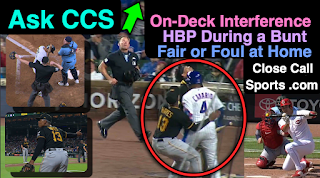
On-Deck Interference, A Bunt HBP & Fair-Foul at Home

An on-deck batter interference in Chicago, batter hit by a pitch while attempting a bunt in Cincinnati and catcher pouncing on a fair ball over home plate in New York comprise a trio of umpire Ask CCS questions over the past week.

On-Deck Interference: Cubs batter Patrick Wisdom's foul fly ball near Chicago's third base dugout drew two Pirates, including third baseman Ke'Bryan Hayes, who collided with Cubs on-deck batter Alexander Canario, who was trying to get out of the catcher's way but accidentally backed into the oncoming third baseman. After consultation, Crew Chief Alan Porter signaled batter Wisdom out for interference of his teammate Canario (who then came up to bat).

Official Baseball Rule 6.01(b), known as Fielder Right of Way, prescribes that, "The players, coaches or any member of a team at bat shall vacate any space (including both dugouts or bullpens) needed by a fielder who is attempting to field a batted or thrown ball." Whether intentional or not, an on-deck batter, dugout coach, etc. who hinders a fielder attempting to field a batted ball is guilty of interference, and the at-bat batter shall be called out for the interference of their teammate.

HBP During Bunt: Reds batter Luke Maile's attempted bunt ended unsuccessfully, as the pitched ball made contact with his hand coiled around the bat, either instead of or (more importantly) before contacting the bat. Play continued and Minnesota retired Maile at first base. Umpires went to Replay Review as the result of a Reds challenge and Replay HQ overturned the call, Crew Chief Marvin Hudson announcing that a dead ball strike would be charged to Maile for the ball hitting his hands first.

Fair or Foul at Home: Yankees batter-runner Gleyber Torres remained in the right-handed batter's box on a chopper at home plate as Blue Jays catcher Alejandro Kirk waited for the batted ball to spin back toward home plate and into fair territory before fielding the ball and tagging Torres out.

OBR's diagram of home plate confirms that the base itself is entirely in fair territory, with the intersection of the two foul lines (which themselves are within fair territory too) located at the point of home plate.

Video as follows:

Tuesday, August 23, 2022

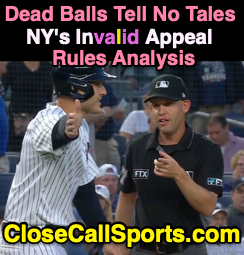
Ask UEFL - NY's Failed Dead Ball Appeal Distraction

During Monday's Mets-Yankees Subway Series, a first-inning attempted appeal play prompted confusion from both New York teams as Mets starting pitcher Max Scherzer's throw into center field when Yankees runner Anthony Rizzo took off toward second during an appeal of Andrew Benintendi's tagging up timeliness ultimately didn't count, leading Yanks manager Aaron Boone to seek an explanation from the umpires (and for some of you to seek an explanation from us!).

Here's why the appeal didn't count:

Although the too-long-didn't-read version is "the ball was dead," there's a bit more to it than that, so let's dive in.

We begin with Yankees batter DJ LeMahieu hitting a sacrifice fly to right field, allowing baserunner R3 Benintendi to score on a close play at the plate. As Mets manager Buck Showalter and company considered whether or not to request a Replay Review of HP Umpire Lance Barrett's safe call, umpires called "Time" and the ball became dead.

Although no challenge to the play at the plate was requested, the Mets felt that Benintendi may have left third base prior to right fielder Starling Marte's first touch of the fly ball, so the team from Queens set up to appeal at third base.
Relevant Rule: OBR 5.09(c)(1): "Any runner shall be called out, on appeal, when, after a fly ball is caught, they fail to retouch their original base before they or their original base is tagged."

Sensing the impending appeal, Yankees baserunner R1 Rizzo, perhaps worried that R3 Benintendi might have left early and that the appeal would be successful, took off for second base, sacrificing himself in the hopes of drawing a throw from Mets pitcher Scherzer, with the goal of goading the Mets into making a play on Rizzo so as to prevent the possibility of an appeal on Benintendi, since no appeal may occur once the defensive team has made a play or attempted play after the continuous action of the play-to-be-appealed has ended. A throw to retire (or in an attempt to retire) Rizzo qualifies as a "play or attempted play." Important to note: this "play or attempted play" rule is exclusive to professional baseball as high school and college rules state that the defense does not lose the right to its appeal if the offense initiates a play before the next pitch. The offensive "bait" play to prevent an appeal on another runner, thus, works in pro ball but not in high school/college.
Relevant Rule: OBR 5.09(c): "Any appeal under this rule must be made before the next pitch, or any play or attempted play."

Scherzer took Rizzo's bait, but threw the ball wildly into center field, enabling Rizzo to advance to third base...before the umpires ordered Rizzo back to first base, ruling that none of what just occurred actually happened. This is because HP Umpire Barrett never put the ball back into play by stating "Play" such that the entire sequence—Rizzo's advancement, wild throw into center field taking away the opportunity to appeal—occurred while the ball was still dead, meaning that none of it counted because under the professional (and NCAA/college) ruleset, the ball must be live during an appeal (in NFHS/high school, the ball can be dead during an appeal...runners can't advance during dead balls [unless it's a pre-existing base award from a live ball period] in all rulesets).
Relevant Rule: OBR 5.06(c): "While the ball is dead no player may be put out, no bases may be run and no runs may be scored, except that runners may advance one or more bases as the result of acts which occurred while the ball was alive."

Once play was reset, Scherzer took the rubber, batter Josh Donaldson entered the batter's box, HP Umpire Barrett put the ball back into play, thus making it live, the appeal was properly executed (Rizzo didn't try to draw a throw this time), and 3B Umpire Dan Merzel signaled "safe," ruling that Benintendi left third base in a timely manner after all.
Relevant Rule: OBR 5.09(c) Comment: "Time is not out when an appeal is being made."

tldr: the ball was dead | Video as follows:

Friday, May 7, 2021

Analysis of Texas Softball Umpires' Foul Ball Confusion

Today's Ask the UEFL concerns a softball video many of you sent in from Texas in which umpires appeared to allow the offense to run the bases and score runs during a foul ball wide of third base, an ensuing overthrow intended for the pitcher, and a ball thrown onto the field from the stands.

The Play: With runners on first and third base, the batter hits a ground ball to the outside of third base—a foul ball. The left fielder retrieves the ball and throws to an infielder, whose throw back to the pitcher goes wild as a second ball is thrown onto the field, seemingly from the stands. The offensive team runs the bases on the overthrow, with both runners and the batter coming around to touch home plate.

Aftermath: The umpires confer and, although the video ends before the final resolution is given, the offensive team's reaction suggests the umpires rendered a ruling in which run(s) were permitted to score.

Analysis: First and foremost, softball or baseball, the ball is dead on a foul ball and during a dead ball, no bases may be run, as in Official Baseball Rule 5.06(c) [similar NCAA softball rule is 6.9.5]: "While the ball is dead no player may be put out, no bases may be run and no runs may be scored, except that runners may advance one or more bases as the result of acts which occurred while the ball was alive (such as, but not limited to a balk, an overthrow, interference, or a home run or other fair ball hit out of the playing field)."

As this game was a high school affair between Jefferson High School and Ysleta High, the relevant NFHS rule is 5-2-2-b ("a runner may not advance").

Gil's Call
: I am known in the officiating world as what's called an over-communicator: I am of the mindset that mechanics are made to be used and I might give signals that other officials might deem superfluous or unnecessary. Some officials take to the mindset of only give signals as absolutely necessary, and that's a valid stance as well; I've simply found that it doesn't work for a kinesthetic learner as myself.

The way the communication philosophy relates to this play is thus: Unless a foul ball is exorbitantly obvious (such as a batted ball out of play), I "go through the motions" of putting my arms up in the standard "Time" mechanic, to signal a dead ball. I likely won't verbalize "Foul" or anything to that effect on a play where the ball is plainly foul, like this one, but I nonetheless put arms up if for nothing else than for my own edification.

Saturday, June 22, 2019

MLB Ejection 100 - Chris Guccione (1; Gabe Kapler)

HP Umpire Chris Guccione ejected Phillies Manager Gabe Kapler (check swing dead ball strike three call by 1B Umpire Mike Everitt) in the bottom of the 4th inning of the Marlins-Phillies game. With one out and none on, Phillies batter Scott Kingery attempted to check his swing on a 0-2 fastball from Marlins pitcher Elieser Hernandez, ruled a dead ball (HBP) by HP Umpire Guccione and a swinging third strike on appeal by 1B Umpire Everitt. Ruling was reviewed and adjudicated by the UEFL Appeals Board (8-0), the call was incorrect. At the time of the ejection, the Phillies were leading, 2-1. The Marlins ultimately won the contest, 5-3.

This is Chris Guccione (68)'s first ejection of 2019.
Chris Guccione now has -3 points in the UEFL Standings (-3 Prev + 2 MLB - 2 QOCN-crewmate = -3).
Crew Chief Mike Everitt now has -2 points in Crew Division (-2 Previous + 0 Incorrect Call = -2).
*OBR Definition of Terms: "A STRIKE is a legal pitch when so called by the umpire, which: (e) Touches the batter as he strikes at it."

This is the 100th ejection report of the 2019 MLB regular season.
This is the 52nd Manager ejection of 2019.
This is Philadelphia's 2nd ejection of 2019, 4th in the NL East (ATL, WAS 5; NYM 3; PHI 2; MIA 1).
This is Gabe Kapler's 1st ejection since March 22, 2018 (Tom Hallion; QOC = U [Throwing At]).
This is Chris Guccione's 1st ejection since June 10, 2016 (Dale Sveum; QOC = Y [Check Swing]).

Wrap: Miami Marlins vs. Philadelphia Phillies, 6/22/19 | Video as follows:

Sunday, April 21, 2019

MLB Ejection 035 - Paul Emmel (1; Mickey Callaway)

3B Umpire Paul Emmel ejected Mets Manager Mickey Callaway (check swing dead ball strike two call) in the top of the 7th inning of the Mets-Cardinals game. With one out and none on, Mets batter Robinson Cano attempted to check his swing on a 0-1 fastball from Cardinals pitcher Andrew Miller, ruled a hit-by-pitch by HP Umpire Bruce Dreckman and a dead ball strike (pitched ball hitting the batter as he swings) on appeal by 3B Umpire Emmel. Play was reviewed and adjudicated by the UEFL Appeals Board (0-8-1), the call was incorrect.* At the time of the ejection, the Cardinals were leading, 6-3. The Cardinals ultimately won the contest, 6-4.

This is Paul Emmel (50)'s first ejection of 2019.
Paul Emmel now has -4 points in the UEFL Standings (-2 Prev + 2 MLB - 4 Incorrect Call = -4).
Crew Chief Paul Emmel now has -1 points in Crew Division (-1 Previous + 0 Incorrect Call = -1).
*OBR Definition of Terms: "A STRIKE is a legal pitch when so called by the umpire, which: (e) Touches the batter as he strikes at it."

This is the 35th ejection report of the 2019 MLB regular season.
This is the 15th Manager ejection of 2019.
This is New York's 2nd ejection of 2019, T-1st in the NL East (ATL, NYM 2; WAS 1; MIA, PHI 0).
This is Mickey Callaway's 2nd ejection of 2019, 1st since April 13 (Alfonso Marquez; QOC = Y [Balls/Strikes]).
This is Paul Emmel's first ejection since August 24, 2017 (Clint Hurdle; QOC = Y [Balls/Strikes]).

Wrap: New York Mets vs. St. Louis Cardinals, 4/21/19 | Video as follows:

Wednesday, July 25, 2018

False Fourth Out - Ball Stays Alive After Third Out

Meet the Mets, for New York's NL squad has introduced, and replicated, the fourth out play—Replay Review style—which we'll dub the "false fourth out," named so because this unique play resulted in a failed run actually scoring while a trailing runner was declared out when the defense, sensing that a third out call at home plate may be subject to Replay Review, played upon a trailing runner to secure a fourth out in the event that the third out at home were to be overturned (which is precisely what happened).

False or reverse fourth out: a logical proof.
Today's Ask the UEFL column utilizes a logical proof to find out what exactly is and isn't legal here—it's a real headache, considering that two out of the three codes fail to formally recognize that which umpires have stipulated for generations: A half-inning cannot categorically end until the potential for a fourth out or similar appeal has ended.

By now, we've run through our fair share of fourth out plays (defined in Official Baseball Rule 5.09(c) as a play in which the defense appeals that a runner who scored prior to the third out, which was declared upon a trailing teammate, has committed a baserunning infraction, such as leaving early on a caught fly ball or failing to touch a base, such that this "fourth out" supersedes apparent third out on the trailing runner and, thus, the cancels the apparent run), but now it's time to meet the Replay Review version of this extra out.

First, the terminology. Since this isn't an appeal play—it's simply a play on a runner—this isn't a true fourth out play, as in 5.09(c). This is a simple "tag the runner off the base" play, as in 5.09(b)(4), so we'll call it a "false fourth out."

Sidebar: For an example of a "real" and old-fashioned fourth out play, see the following related post.
Related PostUEFL Series: Baseball Rules in the Real World (Fourth Out) (1/18/14).

The History: Shortly after expanded instant replay's invocation in 2014, an April contest between the Braves and Mets first drew our attention to false fourth outs when, with two outs and one on, a ground ball to the second baseman and close play at first base where the batter-runner was ruled out by 1B Umpire Eric Cooper, gave way to a play at third base on lead runner R1.

Umpires discussed the '14 false fourth out play.
That's right: Although Braves first baseman Freddie Freeman drew an out call from Cooper on the batter-runner for the third out of the inning, he nonetheless threw the ball to third base, where third baseman Chris Johnson tagged out Lucas Duda for the potential fourth out of the inning.

Satisfied with Cooper's call at first base—not that any potential runs could have been scored on the play—Mets Manager Terry Collins opted not to challenge, but had he challenged, and had the play at first base been overturned, the Braves' election to pursue a false fourth out at third might very well have ended the inning regardless.
Related PostBaseball Rules Series: Replay's New Normal (Fourth Out) (4/19/14).

The Play: Fast forward to Tuesday, July 24, 2018, also at Citi Field, when Padres Manager Andy Green challenged the following play in the top of the 3rd inning of the Padres-Mets game: With two outs and the bases loaded, Padres batter Wil Myers singled on a line drive to left fielder Michael Conforto, baserunner R3 Austin Hedges scoring easily.

Conforto threw to catcher Devin Mesoraco in an attempt to retire baserunner R2 Manuel Margot, attempting to score from second base, ruled out on Mesoraco's tag by HP Umpire Manny Gonzalez for the apparent third out of the inning.

The Mets played on R1 after the third out.
Sensing a false fourth out play and challengeable call at the plate (i.e., that the runner might have actually been safe), catcher Mesoraco continued playing and threw to third baseman Phillip Evans as Padres baserunner R1 Carlos Asuaje, having seen HP Umpire Gonzalez's third out call, slowed up and jogged into Evans' halfhearted tag, observed by 3B Umpire Laz Diaz as a potential fourth out.

The Replay: When video replays conclusively indicated that baserunner Margot was safe at home plate, the Replay Official quickly overturned that element of the play before turning his attention to third base, whereupon he applied a reverse fourth out of sorts to baserunner Asuaje, thus declaring Margot safe at home on the Mesoraco's missed/late tag and time play, and Asuaje out at third base for the official third out of the inning—the opposite, or reverse, of what usual fourth out appeals look like.

The Rule: The biggest question before us is whether reverse or false fourth out plays are covered in the Replay Review regulations—they actually are, in a roundabout way—and whether they are legal. Here's what regulation IV says about correcting an incorrect call, as it relates to its effect on other players:
If Replay Review results in a change to a call that had been made on the field, the Replay Official, to the extent feasible, shall exercise his discretion to place both Clubs in the same position they would have been in had the call on the field been correct. This shall include placing runners where he thinks those runners would have been at the conclusion of the reviewed play if the reviewed call had been correctly made in the first instance.
Ok, so if the Replay Official thought that the trailing runner would have been out at third had the correct call (in this instance, "safe") been made at home plate in real-time, then declaring said runner out as a result of the overturned call is the proper move.

But what if the umpire's incorrect call (or mechanics) caused the trail runner to alter his behavior?

According to IV.A.3., the Replay Official is to consider five factors when placing runners. They are:
a) the depth of fly balls [not applicable for this particular play];
b) the speed of the runners;
c) location of runners at time of initial call;
d) number of outs at the time of the play;
e) "whether the incorrect call affected the subsequent behavior or conduct of the offensive or defensive players."

To summarize, the Replay Official is essentially tasked with mentally simulating what would have happened had the correct call been made, and may allow a call subsequent to the initial incorrect call to stand if the Replay Official believes that this subsequent call was not affected by the initial incorrect call.

Little did MLB know, it was Pandora's box.
The Problem: The aforementioned principles are fairly easy to grasp when overturned calls occur with less than two out, but what if a third out is part of the equation?

The initial incorrect call here results in the third out of the inning, and Regulation IV.A.4. states, "The Replay Official may not declare a runner out based on a play the umpire believes would have occurred subsequent to the play subject to Replay Review."

The Point: So what's the big deal? The defense threw to third anyway and got a fourth out. That's not a play that "would have occurred"—that's a play that actually did occur.

The Counterpoint: The fact that the umpire declared the third out means the inning is over, so any action that follows the third out is no longer an actual play—it's now a play that "would have occurred" and by rule the Replay Official can't declare a runner out based on a play the umpire believes "would have occurred."

These are both solid arguments, but which is correct?

The Proof: The primary argument against declaring the "fourth out" runner going to third out on review is that the play technically didn't occur since the apparent third out at home plate killed the inning or otherwise caused the half-inning to end. Yet this is not accurate and makes an underlying assumption that is not true regarding when the ball becomes dead—though it is supported by a series of odd and largely inapplicable rules and interpretations, which we will refer to momentarily.

We know that when the ball is dead, no bases may be run and no runs scored, or outs recorded except for actions which occurred while the ball was live (the specific rule here is 5.09(b)(4): "a runner is out when—he is tagged ,when the ball is alive, while off his base")...but does the third out actually cause the ball to become dead?

Rule 5.09(e) states, "When three offensive players are legally put out, that team takes the field and the opposing team becomes the offensive team."

Furthermore, 5.09(c) regarding appeals states that any appeal of a violation that "occurs during a play which ends a half-inning, the appeal must be made before the defensive team leaves the field."

Rule 5.09(c) Comment also states, "Time is not out when an appeal is being made." We've long known that professional baseball requires live ball appeals (as opposed to dead ball appeals in NFHS).
Related PostRare Real-Time Appeal Retires Runner over Retouch Rule (6/15/17).

Yes, the ball can stay alive after out #3.
Thus, time is not out simply because the third out has occurred. In this case, time is only out when the defense has left the field, thrown the ball out of play, etc. And we know this because the ball is always live when an appeal is made and if the ball is always live during an appeal, and an appeal can occur after the third out of the inning, then, transitively speaking, the ball must be live during an appeal effected after the third out of the inning.

Since the defense leaving the field, the ball being taken out of play, etc. is what usually happens after the third out, it's not too far of a leap to lump in "third out" and "dead ball" together, but, as Rule 5.09(c)'s fourth out illustrates, the ball remains live in the immediate aftermath of the third out. It becomes dead as the result of an action that could potentially occur simultaneously with the third out being recorded, but the act that causes the ball to become dead is not the third out itself.

The Counterpoint view that equates "third out" with "dead ball" is not entirely illogical, either, though it is not always true. After all, only NCAA acknowledges that the half-inning is not over until the fourth out potential has concluded—even the high school rule, which is fairly detailed, fails to formally acknowledge that the half-inning does not always end upon the third out, and the only OBR interpretation related to when a half inning begins pertains expressly to situations concerning curfews and time limits.

NFHS: "A half-inning ends when there is a third out or when, in the last inning, the winning run is scored. In either case, if there is a delayed out declared by the umpire for a baserunning infraction, a possible fourth out may be recognized";
NCAA: [Not Covered, but interpreted as...]: "The half-inning ends when the third out has been recorded or, in the case of a possible appeal that would extend the half-inning, when the pitcher and all infielders have left fair territory";
OBR: [Not Covered, but interpreted as, PBUC, in the specific context of curfews and time limits...]: "An inning or half inning starts immediately after the third out is made in the preceding inning."

The third out does not "kill" the inning.
Ever since replay came to the big leagues, however, it has been all but codified in actual rules and interpretations that a half-inning does not end upon the third out, so long as a manager is able to challenge a call.

Instead, the Replay Review regulations introduced a new term to the rules lexicon, one that existed in broadcasting for quite some time: that of the "inning break," a purgatory state between two half-innings that, by rule, does not begin until the manager has either decided not to challenge a third out call, or the challenged call has resulted in the third out of the inning (II.E.1).

Thus, if the "inning break" cannot commence until a play is either challenged or accepted as final, then it logically would follow that the entirety of the preceding half-inning has not, in fact, ended until finalization of the third out, which means F2 is legally allowed to play on R1 as a false fourth out based on his belief that the play could be challenged and the call overturned.

"A DEAD BALL is a ball out of play because of a legally created temporary suspension of play"—thus, the inning break, and not the third out, creates this temporary suspension of play.

Conversely, "a LIVE BALL is a ball which is in play." Got it? In = Live, Out = Dead.

As Manny calls "out", F2 isn't playing on R1.
Putting it another way, if the third out truly ended the half-inning at the moment of the out, then the accompanying photograph of the plate umpire calling the runner out while the catcher is sprawled on the ground, prior to his play on R1, would indicate that the Replay Official was incorrect in overturning the call at third base and, moreover, and more to the point, that all fourth outs would be impossible given the inning's conclusion at the moment of the third out due to appeals' requirement that the ball remain "in play."

Accordingly, if there is a continuation of play that results in the apparent third out of the inning—such as a fourth out appeal or false fourth out that keeps the ball "in play" like that which occurred in New York Tuesday night—the ball remains alive until such time as playing action has ceased and the defense has left the field (or the ball has become dead for another cause, such as being removed from the playing field, expiration of the Replay Review decision-making time limit and the inning break's commencement, etc.), at which time the Replay Official simulates what would have happened had the initial incorrect call been a correct call, knowing full well that F2's actions in securing a false fourth out indicates that, had the correct call been made, the third out likely would have been made at third base.

Conclusion: Because time is not out in the immediate aftermath of the third out, this affords the Replay Official discretion to call the baserunner jogging toward third base out on a false fourth out tag attempt, thus scoring the run while declaring the trail runner out and, finally, judging the inning to have concluded.

Video as follows:

Tuesday, June 12, 2018

MLB Ejection 058 - Stu Scheurwater (1; Mickey Callaway)

HP Umpire Stu Scheurwater ejected Mets Manager Mickey Callaway (batter's failure to attempt to avoid being hit by a pitch; QOCY) in the top of the 6th inning of the Mets-Braves game. With one out and one on (R1), Mets batter Brandon Nimmo took a 2-1 curveball from Braves pitcher Jesse Biddle for a called third ball; despite the pitch touching Nimmo, HP Umpire Scheurwater ordered Nimmo remain at-bat pursuant to Rule 5.05(b)(2)(B). Replays indicate Nimmo made no attempt to avoid being touched by the ball, the call was correct.* At the time of the ejection, the Braves were leading, 1-0. The Braves ultimately won the contest, 8-2.

This is Stu Scheurwater (85)'s first ejection of 2018.
Stu Scheurwater now has 8 points in the UEFL Standings (4 Prev + 2 MLB + 2 Correct Call = 8).
Crew Chief Gary Cederstrom now has 8 points in Crew Division (7 Previous + 1 Correct Call = 8).
*Official Baseball Rule 5.05(b)(2) states, "The batter becomes a runner and is entitled to first base without liability to be put out when—He is touched by a pitched ball which he is not attempting to hit unless (A) The ball is in the strike zone when it touches the batter, or (B) The batter makes no attempt to avoid being touched by the ball."
*When a pitched ball touches the batter in the strike zone, the ball is dead and the pitch is declared a strike.
*When a pitched ball touches the batter outside of the strike zone, and the batter makes no attempt to avoid being touched by the ball, the ball is dead and the pitch is declared a ball.

This is the 58th ejection report of the 2018 MLB regular season.
This is the 25th Manager ejection of 2018.
This is New York-NL's 2nd ejection of 2018, T-2nd in the NL East (WAS 3; ATL, NYM 2; MIA, PHI 0).
This is Mickey Callaway's first ejection since August 3, 2016 (Fieldin Culbreth; QOC = N-C [Replay Review]).
This is Stu Scheurwater's first ejection since August 16, 2017 (Scott Servais; QOC = N [Check Swing]).

Wrap: New York Mets vs. Atlanta Braves, 6/12/18 | Video as follows:

Thursday, April 26, 2018

Funny Foul - Returning Runners When Ball is Dead

Leave it to an Adrian Beltre practical joke to teach us the importance of knowing when the ball has a status of live or dead. Tuesday in Texas, Beltre attempted to advance from first to third base when a replacement baseball handed to a catcher after a foul ball sailed over the pitcher's glove and into center field, Beltre providing one last glimpse of sunshine before landing on the Disabled List.

Beltre's joke gives us a valuable lesson.
The Play: With one out and Beltre on first base, batter Jurickson Profar fouled off a 1-1 offering from A's pitcher Andrew Triggs into the stands behind the third base dugout. After HP Umpire Vic Carapazza handed catcher Jonathan Lucroy a replacement ball, Lucroy's return throw to Triggs was wild and wound up in center field. In his latest hometown hustle, Beltre ran toward second, rounded the base, and sprinted into third as the Arlington crowd roared its approval.

The Call: Naturally, 3B Umpire Greg Gibson raised his hands to signal "Time" and prodded Beltre back to first base while a bemused Carapazza explained to Rangers Manager Jeff Banister why Beltre was being returned to first base.

Analysis: When Profar's batted ball became foul abruptly after his bat struck the pitch, the ball became dead, pursuant to Official Baseball Rule 5.06(c)(5), which portrays one situation under which the ball becomes dead:
A foul ball is not caught, in which case runners return to their bases. The umpire-in-chief shall not put the ball in play until all runners have retouched their bases.
As the sole baserunner who began the play on first base, Beltre was obligated to return to first.

3B Umpire Gibson and Beltre rehash the play.
Though Carapazza handed catcher Lucroy a replacement ball, the rules book is also very clear about precisely when a dead ball becomes live once again; simply handing the ball to a fielder does not signify that the umpire has "put the ball in play."

Instead, Rule 5.12 continues: "After the ball is dead, play shall be resumed when the pitcher takes his place on the pitcher's plate with a new ball or the same ball in his possession and the plate umpire calls 'Play.' The plate umpire shall call 'Play' as soon as the pitcher takes his place on his plate with the ball in his possession."

As for the ball's status, Rule 5.12(a) states, "Between the call of 'Time' and the call of 'Play' the ball is dead."
Related PostCalling Time to Avoid a Balk - When a Ball Becomes Dead (5/10/16).

Thus, because pitcher Triggs never took his place on the pitcher's plate with the ball in his possession, plate umpire Carapazza never called "Play." Because Carapazza never called "Play," the ball was dead during the time in which Beltre attempted to advance from first to third base.

We return to Rule 5.06(c) to see why Beltre is not legally allowed to do this: "While the ball is dead no player may be put out, no bases may be run and no runs may be scored, except...as the result of acts which occurred while the ball was alive."

Beltre's hustle is all for laughs & all for naught.
Conclusion: Though it seems a foregone conclusion that a runner cannot advance on a foul ball, it is nonetheless important to know where each baserunner has begun play in the event the runner needs to be instructed to return (as well as in calculating certain base awards as prescribed by rule), and it is similarly vital to note when a live ball becomes dead and vice versa, so as to prevent illegal advancement of runners (and, similarly, so as to avoid an improper balk call, appeal play, or the like).

It seems rather silly—and Beltre has a habit of turning gameplay into smiling situations—but a momentary lapse in judgment or failure to strictly enforce rules pertaining to live vs dead ball status could lead to trouble if a runner is permitted to advance or awarded a base when otherwise prohibited by rule to do so.

Video as follows:

Thursday, August 31, 2017

NPB Game Suspended After Flock-of-Birds Delay

8/30's NPB (Japan) Eagles-Lions game at Kobo Park Miyagi in Sendai was suspended due to rain and a flock of birds that refused to leave the stadium, ultimately leading to a call of animal abandonment.

Birds encircle players at Kobo Park Miyagi.
With the Saitama Seibu Lions leading 8-4 heading into the bottom of the 8th inning, the Tohuku Rakuten Golden Eagles, who call Kobo Park Miyagi home and play alongside Saitama Seibu in the NBP's Pacific League, scored four times before rain put a halt to play.

As the delay concluded and umpires Kimihiro Akimura,  Masuda Shohei, Tetsuo Yamaji, and Argana Shoji prepared to resume play, a flock of birds descended on the stadium—perhaps under the impression, during the rain delay, that the game had ended—flying in circles and disrupting the defensive players. After pulling players off the field, stadium personnel attempted to chase the birds into the outfield before shutting off the lights in an attempt to get the flock to leave.

Kobo shut off its lights to coax the birds away.
By that time, however, the attempted bird removal delay—which at one point involved a drone dispatched to patrol the outfield sky—had spanned past the 40-minute mark and hadn't yet proven successful, resulting in an ultimate decision to call off the game, leading to its suspension or, what in OBR, would be Rule 7.02(a):
A game shall become a suspended game that must be completed at a future date if the game is terminated for any of the following reasons:
Kobo's scoreboard says: The Game is Over.
Before we leave this one to the birds, which is a situation not explicitly addressed in the rulebook, note that OBR 7.02(a)(6) mandates the game shall become suspended if play is terminated with the score tied: "It is a regulation game that is called with the score tied."

Finally, let's review what happens if a ball were to strike a bird during play. In sum, a batted or thrown ball remains live and in play, while a pitched ball becomes dead ("no pitch"):
If a batted or thrown ball strikes a bird in flight or other animal on the playing field, the ball is considered alive and in play, the same as if had not touched the bird or animal.
If a pitched ball strikes a bird in flight or other animal on the playing field, the pitch is nullified and play shall be resumed with the previous count. 
Seagulls show up late in San Francisco.
Examples: In 2009, a group of Cleveland-area gulls helped give the home team a walk-off victory by distracting Royals outfielder Coco Crisp on a line drive to center field. One seagull was struck by the batted ball as it attempted to fly away; the batted ball was kept alive and in play. Meanwhile, Randy Johnson in 2001 threw a pitch that struck a bird flying by. Both the ball and bird were declared dead, and the circumstance of a pitched ball striking a bird was added to the MLB Umpire Manual shortly thereafter.

The Japanese phalarope (link is to the North American Audubon Field Guide, although red and red-necked phalaropes are two phalarope species that inhabit the Japanese Empire's coastal region; Sendai is a coastal city in Japan's Miyagi Prefecture) is known to engage in circling behavior as displayed in Sendai on Wendesday: "In courtship, female flies in wide circle, calling."

Gulls eat popcorn at Oakland's Coliseum.
In Major League Baseball, perhaps the bird with greatest invasion potential is the San Francisco Bay Area seagull, which has been feasting on the discarded peanuts and Cracker Jack of AT&T Park ever since the formal dedication of McCovey Cove. The gulls' usual MO is make an appearance late in a Giants game, usually the 9th inning when fans are filing out, leaving behind food and other treats for the eastern Pacific Coast's scavenging fowl. Seagulls have also been spotted in other ballparks near the water, including in Oakland, San Diego, Seattle, and at Chicago's Wrigley Field.

Wrap: Tohoku Raketten Golden Eagles vs. Saitama Seibu Lions, 8/30/17 | Video as follows: