Showing posts with label Unintentional Interference. Show all posts

Monday, September 11, 2023

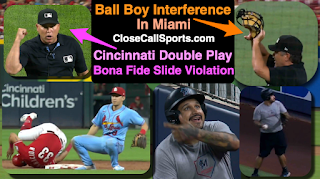
Ball Boy Interference & Non-Bona Fide Slide Violation

Umpires awarded Dodgers runner Mookie Betts home after a ball boy interfered with a fair ball in Miami while Replay Review called a bona fide slide rule violation on Reds runner Christian Encarnacion-Strand in Cincinnati in this edition of Ask CCS.

Ball Attendant Interference
With baserunner Mookie Betts on first base, Dodgers batter Freddie Freeman hit a line drive down the right field line in Miami, ruled a fair ball by 1B Umpire John Libka. But before Mookie could round third base, the Marlins ball boy in right field fielded the fair ground ball and threw it into the stands, resulting in a dead ball pursuant to Official Baseball Rule 6.01(d), entitled "Unintentional Interference."

OBR 6.01(d) states that if a non-uniformed person authorized to be on the playing field (e.g., ball attendant, security guard, etc.) intentionally interferes with a live ball ("intentional" meaning the action was voluntary, not that the intent was to commit interference per se), "the ball shall be dead at the moment of the interference and the umpire shall impose such penalties as in their opinion will nullify the act of interference."

After consultation with 1B Umpire Libka, 2B Umpire DJ Reyburn, and perhaps most importantly (for the angle), 3B Umpire Angel Hernandez, HP Umpire and Crew Chief James Hoye placed Betts at home, ruling that had interference not occurred, Betts would have scored.

Bona Fide Slide Rule Violation Leads to 9th Inning Double Play
In Cincinnati, Reds batter Tyler Stephenson hit a ground ball to Cardinals shortstop Masyn Winn in the bottom of the 9th inning, with Winn throwing to second baseman Tommy Edman as Reds baserunner R1 Christian Encarnacion-Strand slid into second base. Edman's throw to first base came after Stephenson arrived, but St Louis challenged the play, alleging that the runner's slide into second was violative.

The four criteria of OBR 6.01(j) pertaining to bona fide slides on force plays are that
1) the runner begins their slide before reaching the base;
2) is able and attempts to reach the base with their hand or foot;
3) is able and attempts to remain on the base after completion of the slide;
4) slides within reach of the base without changing their pathway to contact a fielder.

Upon review, the Replay Official ruled that R1 failed to satisfy criterion three of the bona fide slide rule, in that the runner failed to remain on the base after completion of the slide. Accordingly, replay overturned 2B Umpire Mark Carlson's no violation call and imposed the illegal slide penalty, which in this case is a double play with batter-runner Stephenson declared out at first in addition to Encarnacion-Strand's force out at second.

Video as follows:

Wednesday, March 29, 2023

Giant Un vs Intentional Ball Attendant Interference

As Athletics left fielder Conner Capel slid in attempt to catch Giants batter Bryce Johnson's foul fly ball, San Francisco ball dude Harvey reached in front of Capel and touched the baseball, ruled no catch (foul ball) by the umpire as Oakland sought an interference call. We now review the Official Baseball Rules concerning interference by a person authorized to be on the playing field.

In the bottom of the 6th inning of the final Spring Training Battle of the Bay, Giants batter Johnson hit a fly ball into foul territory in left, Capel giving chase and going into a slide in an attempt to catch the ball at the tarp along the short wall. As Capel slid into position with his glove outstretched, however, the ball attendant ("ball dude" in SF) attempted a catch of his own, with ball dude Harvey's glove contacting the ball before Capel had a chance to play it. Capel ultimately came away with the baseball, but the damage had already been done by Harvey's premature touch, resulting in a foul ball [no catch] call by 3B Umpire Nate Tomlinson (umpires in Spring tend to switch bases every few innings; Alex Tosi was originally at third base but had moved to first base for this inning).

Official Baseball Rule 6.01(d) is called Unintentional Interference, and states, "In case of unintentional interference with play by any person herein authorized to be on the playing field (except members of the team at bat who are participating in the game, or a base coach, any of whom interfere with a fielder attempting to field a batted or thrown ball; or an umpire) the ball is alive and in play. If the interference is intentional, the ball shall be dead at the moment of the interference and the umpire shall impose such penalties as in their opinion will nullify the act of interference."

The comment to OBR 6.01(d) states, "The question of intentional or unintentional interference shall be decided on the basis of the person’s action. For example: a ball attendant, police officer, etc., who tries to avoid being touched by a thrown or batted ball but still is touched by the ball would be involved in unintentional interference. If, however, they pick up the ball, catch it, or touch the ball by intentionally pushing or kicking at the ball, this act would constitute intentional interference."

Because ball dude Harvey clearly tried to catch the ball (as opposed to avoid it), this is an example of intentional interference, the penalty for which is to call "Time" and nullify the act. In order to nullify the act, 3B Umpire Tomlinson would have had to determine whether or not fielder Capel would have caught the ball, had Harvey not interfered.

Crew Chief Bill Miller ultimately announced that Replay Review had confirmed the "safe" call, but OBR 6.01(d) interference is not reviewable (unlike fan interference, which is reviewable as a boundary call). Thus, Replay was used here simply to determine whether or not Capel caught the ball cleanly, which, thanks to Harvey's touch, he clearly did not.

Video as follows:

Sunday, May 29, 2022

Ask UEFL - Base Award Breakdown (On Second Glance)

In this Ask the UEFL, we take a play from the Double-A Mississippi Braves vs Pensacola Blue Wahoos game in which umpires awarded bases on an overthrown ball that became unplayable, a call that might not be as obvious as one might have thought on first glance.

Discussion Play: With two out and one on (R1), Mississippi Braves batter Trey Harris hit a soft ground ball to Pensacola Blue Wahoos catcher Paul McIntosh, who threw wildly to first base and down the right field line, where the ball became unplayable as it rolled into the on-field bullpen.

The Call: 1B Umpire Raul Moreno called "Time" to signal the ball was out of play and after conferring with crewmates James Jean (3B Umpire & Crew Chief) and Macon Hammond (HP Umpire), the crew awarded the batter-runner Harris second base and awarded baserunner R1 Andrew Moritz home plate.

The Rule: Official Baseball Rule 5.06(b)(4)(G) is what first comes to mind and states that the batter and runners shall advance "Two bases when, with no spectators on the playing field, a thrown ball goes into the stands, or into a bench (whether or not the ball rebounds into the field), or over or under or through a field fence, or on a slanting part of the screen above the backstop, or remains in the meshes of a wire screen protecting spectators. The ball is dead. When such wild throw is the first play by an infielder, the umpire, in awarding such bases, shall be governed by the position of the runners at the time the ball was pitched; in all other cases the umpire shall be governed by the position of the runners at the time the wild throw was made."

QOC: Thus, BR should get second base (which is what happened) and R1 should get third base (which is not what happened, right? Wrong. Upon closer examination, we see that either a bullpen player/coach or ball attendant fielded the live ball in foul territory, meaning we now have to refer to a different rule to determine base awards, which is precisely what this crew did by conferring.

The Unintentional Intentional Interference Rule
: OBR 6.01(d) states that in the case of unintentional interference with a person on the playing field, the ball remains alive and in play, but in the case of intentional interference, the ball is dead and penalties are imposed to nullify the act of interference. The rule also spells out what is meant by the word intentional: "The question of intentional or unintentional interference shall be decided on the basis of the person’s action. For example: a bat boy, ball attendant, policeman, etc., who tries to avoid being touched by a thrown or batted ball but still is touched by the ball would be involved in unintentional interference. If, however, he kicks the ball or picks it up or pushes it, that is considered intentional interference, regardless of what his thought may have been."

If the interference is unintentional, the ball remains alive and in play.
If the interference is intentional, the ball is dead & penalties imposed to nullify the act of interference.

Thus, because the person in the bullpen picked the ball up, 1B Umpire Moreno ruled not a dead ball due to thrown-out-of-play, but instead called intentional interference (no mind-reading necessary here as it would be for "intentionally throwing at the batter"), the penalty for which is as follows: "If the interference is intentional, the ball shall be dead at the moment of the interference and the umpire shall impose such penalties as in his opinion will nullify the act of interference."

This allowed the umpires to place the batter-runner at second base, ruling he would have achieved that base had interference not occurred, and to award lead runner R1 home plate, ruling he would have advanced and scored had interference not occurred.

Video as follows:

Friday, June 7, 2019

Read the Rule, Rizzo - Ball Boy Non-Interference

Chicago's Anthony Rizzo ran into an out due to a lack of rules knowledge concerning a Wrigley Field security guard's unintentional interference during a batted ball. Cubs batter Kris Bryant's double down the left field line led to a Cardinals' inning-ending out as Marcell Ozuna stayed with the play to throw the confused Rizzo out at home to end Chicago's 5th inning threat.

Types of Interference in the Outfield (or Infield)
Fan Interference: Perhaps it is apropos that we just wrote about fan interference, and reviewed Official Baseball Rule 6.01(e), which states that the penalty for spectator interference is: "the ball shall be dead at the moment of interference and the umpire shall impose such penalties as in his opinion will nullify the act of interference."
Related PostReplay Rewind - Fan INT & Com Clarity (6/7/19).

Intentional interference on-field in Texas.
Unintentional Interference: Unlike the aforementioned fan interference that causes a dead ball immediately upon its occurrence, so-called unintentional interference can only occur as a result of a ball coming into contact with a person authorized to be on the playing field who are not uniformed personnel nor umpires—namely ball boys and bat girls, security guards, and police officers.

The rule reference is OBR 6.01(d), which states: "In case of unintentional interference with play by any person herein authorized to be on the playing field (except members of the team at bat who are participating in the game, or a base coach, any of whom interfere with a fielder attempting to field a batted or thrown ball; or an umpire) the ball is alive and in play. If the interference is intentional, the ball shall be dead at the moment of the interference and the umpire shall impose such penalties as in his opinion will nullify the act of interference."

The following articles illustrate additional considerations for officiating this brand of interference.
Related PostWhen Unintentional Interference Turns Intentional (9/2/18).
Related PostBall Boy Interference: Judging Intent of Non-Team Persons (4/12/13).

Culbreth ejects Collins over a similar play.
Prior Play: In 2017, Fieldin Culbreth ejected Terry Collins for arguing an unintentional interference foul ball call by HP Umpire Roberto Ortiz when a Mets batboy attempting to avoid a foul ball unintentionally collided with Mets fielder Wilmer Flores.

Because the batboy did not intentionally initiate contact with Flores (nor with the ball), the proper call was made: unintentional interference. To be clear, unintentional interference can occur when a batboy-type person makes contact with a batted or thrown ball, or with a player.
Related PostMLB Ejection 057 - Fieldin Culbreth (1; Terry Collins) (6/1/17).

We diagrammed this play in 2018.
Analysis: So there you have it. When Cubs batter Bryant hit a double down the left field line, the bounding ball bounced into the Cubs' left field warning track security officer, who himself was attempting to avoid the ball (perhaps due to his proximity to the ball girl, he jumped back and to his left instead of forward and to his right).

By giving up on Friday's play in Chicago, Rizzo demonstrated his rules ignorance—as did the Cardinals' Paul DeJong—while Ozuna, who did raise his arm, nonetheless kept running after the ball and threw home in baseball's version of playing to the whistle as Rizzo jogged into an out at the plate, a simple call for HP Umpire Mark Carlson.

Maddon speaks to U3 Gorman.
Mechanics: The one thing we didn't see that we could have is 3B Umpire Brian Gorman giving a "safe"-type mechanic to communicate his ruling that the interference by an authorized on-field person was unintentional. In general, "safe" tells players and teams that play is alive and no infraction of the rules has occurred. Other than "safe," the only other mechanic, if one were to be given, here would be a signal declaring the ball dead (due to intentional interference, which this was not). Thus, "safe" and no mechanic at all signify the exact same thing: the ball remains live and in play.

SIDEBAR: Unlike fan interference, unintentional interference is not reviewable. Despite Joe Maddon putting his hands up to hold the umpires, this play could not be referred to video.

Compare to Intentional Interference by On-Field Persons:
This is intentional interference.
By rule, plays like Friday's sequence in Chicago are deemed "unintentional interference," which results in the ball being kept alive and in play. It is important from a rules standpoint to understand that "unintentional interference" doesn't refer directly to whether the non-team authorized person actually intended to interfere with a live ball, but to the result of this person's action.

In other words, this rule uses a different definition of "intentional" than, say, the rule about a pitcher intentionally throwing at a batter.

For instance, a ball attendant sitting on a stool who fields a ground ball, believing that the ball was foul despite the umpire's ruling that the ball was fair, has not intended to interfere per se—but, by virtue of this person's intentional act in fielding the ball, this person has indeed committed intentional interference.

As OBR 6.01(d) states, if the interference by such an authorized non-uniform person (which, again, includes a non-roster ball attendant in uniform) is an intentional act—as in this person intentionally seeks to touch the ball—then the penalty is similar as to that for fan interference: dead ball and nullify the act.

Until then, read the rules and don't stop playing before the ball is declared dead.

Video as follows:

Monday, November 5, 2018

Case Play 2018-9 - Walk-off Appeal Madness

As the 2018 Arizona Fall League All-Star Game ended on a walk-off base hit, 1B Umpire Nestor Ceja lingered for a few extra seconds as first baseman Peter Alonso tried calling for an appeal, claiming that batter-runner Meibrys Viloria failed to touch first base.

East All-Star Alonso calls out to deaf ears.
The Play: With one on (R3) and two out in the bottom of the 9th inning of a tied ballgame, West All-Stars batter Viloria hit a line drive to the gap in right-center field, easily scoring baserunner R3 Buddy Reed from third base. As Viloria approached and rounded first base, an onslaught of celebrating teammates pushed and shoved him away from the bag such that Viloria was unable to touch first base as he ran by.

Both U1 Ceja and F3 Alonso noticed Viloria's struggle and non-touch, as Ceja remained in the vicinity and Alonso tried calling for the ball to retire Viloria for the inning's third out and send the AFL's Fall Stars game into extras.

Ceja, waiting for appeal, is trapped in the mob.
The theatre turned out to be all for naught, as Viloria, after rounding first base without actually touching it, fought through a mob of celebrating teammates to return to and touch first base, all while the baseball remained in right-center field, the East All-Stars having given up on the play.

Question: Assume Alonso's teammates in the outfield were actually paying attention and threw the ball to Alonso as Viloria fought through his teammates to return to first base. What would be the proper ruling if... A) Alonso tagged Viloria while off his base (or tagged first base before Viloria returned to touch it)? B) Alonso was unable to get to Viloria (or the base) before Viloria returned due to the human traffic jam caused by the West All-Star celebration?

And, if you're really daring, C) A security guard picked up the baseball and threw it back to Alonso, who then tagged Viloria while off his base (go ahead and assume the bases were loaded, too)?

This Q resembles a 2015 play in AZ.
Yes, this is meant as a reference to the walk-off non-appeal play in Arizona from 2015, when Reds second baseman Brandon Phillips tried to appeal R2 and R3's failures to touch their respective bases on a bases loaded, one-out, walk-off single. A security officer retrieved and threw the ball to Phillips, who tagged several bases in an attempt to appeal the baserunning infractions. Crew Chief Larry Vanover said that because R3 touched home and BR touched first, the game was over, thus leaving the security guard issue unanswered.

MLB added an interpretation to Rule 5.08(b) since then [formerly known as 4.09(b)] to state that a base hit does not qualify as a 5.08(b) game-ending play since 5.08(b) now requires an event that "forces the batter and all other runners to advance without liability of being put out." The rule used to say "...which forces the runner on third to advance" only. MLB since made it clear that 5.08(b) (f/k/a 4.09(b)) only applies to bases-loaded without liability of being put out situations. This time, the batter-runner hasn't yet touched first, so we ask the question again.
Related PostCase Play 2015-07, Merkle Revisited [Solved] (8/10/15).

Official Baseball Rules Library
OBR 5.09(c)(2): "Any runner shall be called out, on appeal, when—With the ball in play, while advancing or returning to a base, he fails to touch each base in order before he, or a missed base, is tagged."
OBR 5.09(c): "Any appeal under this rule must be made before the next pitch, or any play or attempted play. If the violation occurs during a play which ends a half-inning, the appeal must be made before the defensive team leaves the field...For the purpose of this rule, the defensive team has 'left the field' when the pitcher and all infielders have left fair territory on their way to the bench or clubhouse."
OBR 6.01(a)(4): "It is interference by a batter or a runner when—Any member or members of the offensive team stand or gather around any base to which a runner is advancing, to confuse, hinder or add to the difficulty of the fielders. Such runner shall be declared out for the interference of his teammate or teammates."
OBR 6.01(a)(8): "It is interference by a batter or runner when—In the judgment of the umpire, the base coach at third base, or first base, by touching or holding the runner, physically assists him in returning to or leaving third base or first base."
OBR 6.01(b) [Fielder Right of Way]: "The players, coaches or any member of a team at bat shall vacate any space (including both dugouts or bullpens) needed by a fielder who is attempting to field a batted or thrown ball...If a member of the team at bat (other than a runner) hinders a fielder’s attempt to field a thrown ball, the ball is dead, the runner on whom the play is being made shall be declared out and all runners return to the last legally occupied base at the time of the interference."
OBR 6.01(d) [Unintentional Interference]: "In case of unintentional interference with play by any person herein authorized to be on the playing field (except members of the team at bat who are participating in the game, or a base coach, any of whom interfere with a fielder attempting to field a batted or thrown ball; or an umpire) the ball is alive and in play. If the interference is intentional, the ball shall be dead at the moment of the interference and the umpire shall impose such penalties as in his opinion will nullify the act of interference."

Video as follows:

Sunday, September 2, 2018

When Unintentional Interference Turns Intentional

After judging a batted ball hit down the left field line in Texas as fair, 3B Umpire Angel Hernandez ruled intentional interference by a person authorized to be on the playing field (a security guard), awarding the batter second base and capping off a play that began as unintentional interference.

Intentional Interference doesn't require intent.
The Play: With one out and none on, Rangers batter Carlos Tocci hit a line drive past third base and down the left field line, where it bounced off the wall in foul territory before ricocheting off a security guard's stool and ultimately coming to rest lodged between the guard's arm and torso.

The Call: With no one on base to begin the play, the call is quite simple: place Tocci at second base. But what if there was a runner at first base? Would he have scored?

The Rule: Official Baseball Rule 6.01(d) discusses what happens when a live ball comes into contact with a person authorized to be on the playing field. In sum, there are two types of interference that may result with this person: unintentional and intentional.

If the interference is unintentional, the ball remains alive and in play.
If the interference is intentional, the ball is dead & penalties imposed to nullify the act of interference.
U3 Hernandez tracks the ball down the line.

The definitions of unintentional and intentional may seem self-explainatory, but they're not: there is a distinct difference between the English language definitions of these terms and how the Official Baseball Rules treats them.

6.01(d) Comment spells out the OBR standard, and, in what may come as a surprise, actual intent doesn't have all that much to do with it.
The question of intentional or unintentional interference shall be decided on the basis of the person’s action. For example: a bat boy, ball attendant, policeman, etc., who tries to avoid being touched by a thrown or batted ball but still is touched by the ball would be involved in unintentional interference. If, however, he kicks the ball or picks it up or pushes it, that is considered intentional interference, regardless of what his thought may have been.
Analysis: The security guard at Globe Life Park in Arlington began this play trying to avoid being touched by Tocci's batted ball. Though the ball caromed off his stool, he still attempted to avoid being touched, meaning that during this bounce off the stool, the ball was still alive and in play; the interference was unintentional during this time.

The ball then settled into his arm/torso pocket—we've referred to this as an "umpire's glove" in the past when it involved the home plate umpire—and remained out of play as he kept his arm stationary. The difference, obviously, is that the specific rule that covers what happens when a ball lodges in the umpire's paraphernalia is different than the rule about a nonuniform person's interaction with a live ball.
Related PostLodged or Handled - CB Bucknor Cradles Pitched Ball (7/27/18).
Related PostUEFL Case Play 2018-4 - Bicep of Bellino [Solved] (6/1/18).

As the ball settled into the arm/torso pocket, it became dead as the guard is said to have acted upon the ball (as opposed to the other way around), thus constituting intentional interference, even though he clearly did not intend to interfere. The ball falling out of play due to lodging in the arm/torso pocket is the tipping point that makes this intentional interference.

Penalty: Pursuant to 6.01(d), Hernandez and crew awarded the batter-runner the base they felt would nullify the act of interference. Had there been a runner on first, the umpires would have had to consider whether that runner may have scored absent the interference.

Fair play treats the entire action as intentional.
Splitting Hairs: Though the rules book does not differentiate explicitly between whether "nullify the act" applies only to the act of intentional interference during a sequence where both unintentional and intentional interference elements are present (it just says, "If the interference is intentional, the ball shall be dead at the moment of the interference and the umpire shall impose such penalties as in his opinion will nullify the act of interference"), the most logical course of action pursuant to the tenet of common sense and fair play is to treat the entire ball-guard interaction (from stool to arm/torso pocket) as a singular act of intentional interference; there was no protracted time delay from one bounce to the next and both actions occurred, essentially, in one fell swoop.

This is important because it establishes that the various "lodged ball" provisions of the rules do not apply, which means that no specific base award is mandated, compared to the automatic one-base award for a pitched ball lodging in the umpire's paraphernalia. It's also not a ground rule double as the box score indicates...

Conclusion: To simplify matters in the spirit of common sense and fair play, the entire interaction with the ball is treated as one big instance of interference that so happens to be intentional because it ended up with the guard possessing the ball. Batter and runners are placed so as to nullify the act of interference.
Also SeeBall Boy Interference: Judging Intent of Non-Team Persons (4/12/13).

Video as follows:

Sunday, March 4, 2018

Wanted Dead or Alive - Recording a Backswing Strikeout

Dodgers pitcher Brian Moran struck out Giants batter Andrew McCutchen Sunday afternoon on an eventual dead ball due to unintentional backswing contact that sent two stealing runners back to the bases whence they came. The following rules refresher clarifies interference vs. backswing contact, and busts a potential rule myth related to this play occurring with two strikes on the batter.

Plate Umpire Ripperger tracks the play.
With one out and two on (R1, R2) in the bottom of the 3rd inning of the Dodgers-Giants game, Giants batter McCutchen swung and missed a 3-2 pitch from Moran as baserunners R2 Joe Panik and R1 Brandon Belt attempted to advance, Dodgers catcher Yasmani Grandal's throw to third baseman Logan Forsythe arriving as Panik slid safely into the base.

With replays indicating McCutchen's follow-through made contact with Grandal during the course of his throw, HP Umpire Mark Ripperger ruled the play dead and sent the runners back to their bases of origin.

The Rule: OBR 6.03(a)(3) states, "A batter is out for illegal action when—He interferes with the catcher’s fielding or throwing by stepping out of the batter’s box or making any other movement that hinders the catcher’s play at home base."

Meanwhile, 6.03(a)(3) & (4) Comment states, "If, however, the catcher makes a play and the runner attempting to advance is put out, it is to be assumed there was no actual interference and that runner is out—not the batter...If a batter strikes at a ball and misses and swings so hard he carries the bat all the way around and, in the umpire’s judgment, unintentionally hits the catcher or the ball in back of him on the backswing, it shall be called a strike only (not interference). The ball will be dead, however, and no runner shall advance on the play."

Unlike Cutch, Travis was out.
Analysis: Plate umpire Ripperger administered this play properly. McCutchen's actions on Grandal did not cause the ball to become dead immediately, but once his throw failed to retire baserunner Panik, the ball became dead due to unintentional backswing contact.
Penalty: Runners return, batter is charged a strike (with a 3-2 count, McCutchen was out on three strikes, but NOT on interference).

As for the question of potential batter interference, McCutchen remained in the batter's box (a legal position) for the entire sequence, and, save for the bat contacting Grandal, committed no other infraction. Even though he swung and missed, he is still granted permission to stand in the batter's box through the completion of his natural swing/at-bat movement.

This is most certainly not an example of potential retired batter/runner's interference: because unintentional backswing contact is not "true" interference, this play cannot qualify for such "retired batter/runner's interference" consideration. For a related play that should clear up why backswing contact doesn't result in a runner being declared out if it's strike three on the batter, refer to the following Case Play link from 2016 concerning a 2-2 swing-and-a-miss by Red Sox batter David Ortiz. There is no "double whammy" in professional ball.
Related PostCase Play 2016-9 - A Backswing on Strike 3 [Solved] (8/26/16).
  • IMPORTANT NOTE (Baseball Rules Difference): NFHS (high school) rules does allow for a "double whammy" if the follow-through contact occurs with two strikes on the batter because, under high school rules, follow-through contact is interference. The double play isn't automatic, but it can be called if the umpire rules the interference prevented the defense from getting a second out.
  • In NCAA (college), like in MiLBUD/PBUC, "on a third strike, the ball is dead and the batter is out." Return the runners; unintentional backswing contact is not interference.
  • Finally, unintentional backswing contact is the term used in college and pro ball, while high school uses the term "follow-through interference." It does not matter whether the contact was intentional or not at the high school level; any follow-through contact between bat and catcher that hinders the catcher's further play is interference that causes the batter to be declared out (unless, for example, with less than two out, a runner stealing home is tagged out, in which case the ball remains live and interference is ignored), or, with two strikes on the batter, may subject the offense to a "double whammy" (both batter and runner declared out) if the umpire believes the interference prevented a possible double play.
  • Backswing interference in high school is a different infraction entirely and occurs when the batter's bat contacts the catcher prior to the pitcher's delivery, and results in an immediate dead ball (reset the play).
By contrast, on April 24, 2017, umpire Toby Basner riled up Toronto with a batter interference declaration in Anaheim when he ruled that Blue Jays batter Devon Travis, in stepping out of the batter's box while swinging at strike three, interfered with Angels catcher Martin Maldonado's throw (which was unsuccessful in retiring a baserunner). The key difference, naturally, is that while both McCutchen and Travis made bat contact with the respective catchers on the backswing, Travis illegally stepped out of the batter's box, as in 6.03(a)(3), whereas McCutchen remained in the box. Travis = INT (batter out, runners return); Cutch = Backswing Contact (Dead ball strike, runners return).
Related PostSorry Toronto - Batter's Interference Call Was Correct (4/24/17).

Wrap: Los Angeles Dodgers vs. San Francisco Giants (Spring Training), 3/4/18 | Video as follows:

Thursday, June 1, 2017

MLB Ejection 057 - Fieldin Culbreth (1; Terry Collins)

3B Umpire Fieldin Culbreth ejected Mets Manager Terry Collins (unintentional interference foul ball call by Roberto Ortiz) in the top of the 4th inning of of the Brewers-Mets game. With one out and the bases loaded, Brewers batter Eric Sogard hit a 0-1 curveball from Mets pitcher Zack Wheeler on a fly ball into foul territory near the third base dugout. Replays indicate that as Mets third baseman Wilmer Flores attempted to catch the batted ball, he collided with a batboy, who was attempting to get out of the way. Initially ruled an out by HP Umpire Roberto Ortiz, the call was reversed to that of unintentional interference after consultation amongst the umpires and a determination that the batboy did not intend to interfere with the play, the call was correct.* Play was reviewed and affirmed by the UEFL Appeals Board (8-0-1), the call was correct. At the time of the ejection, the Brewers were leading, 2-0. The Brewers ultimately won the contest, 2-1.

This is Fieldin Culbreth (25)'s first ejection of the 2017 MLB regular season.
Fieldin Culbreth now has 5 points in the UEFL Standings (2 Previous + 2 MLB + 1 QOCY-Crewmate = 5).^
Crew Chief Fieldin Culbreth now has -4 points in Crew Division (-5 Previous + 1 Correct Call = -4).
*Rule 6.01(d), titled Unintentional Interference states, "In case of unintentional interference with play by any person herein authorized to be on the playing field (except members of the team at bat who are participating in the game, or a base coach, any of whom interfere with a fielder attempting to field a batted or thrown ball; or an umpire) the ball is alive and in play. If the interference is intentional, the ball shall be dead at the moment of the interference and the umpire shall impose such penalties as in his opinion will nullify the act of interference."
*Rule 6.01(d) Comment states, "The question of intentional or unintentional interference shall be decided on the basis of the person’s action. For example: a bat boy, ball attendant, policeman, etc., who tries to avoid being touched by a thrown or batted ball but still is touched by the ball would be involved in unintentional interference. If, however, he kicks the ball or picks it up or pushes it, that is considered intentional interference, regardless of what his thought may have been."
^Roberto Ortiz is Calling and Fieldin Culbreth is the Secondary umpire pursuant to UEFL Rule 6-2-c.

This is the 57th ejection report of 2017.
This is the 31st Manager ejection of 2017.
This is NY-NL's 2nd ejection of 2017, T-2nd in the NL East (MIA 5; NYM, WAS 2; ATL, PHI 1).
This is Terry Collins' first ejection since July 30, 2016 (Jeff Kellogg; QOC = Y [Replay Review]).
This is Fieldin Culbreth's first ejection since August 3, 2016 (Terry Francona; QOC = N-C [Replay]).

Wrap: Milwaukee Brewers vs. New York Mets, 6/1/17 | Video via "Read More"