Showing posts with label Base Path. Show all posts

Monday, June 8, 2026

Did Jays' Clement Run Out of the Base Path to Avoid Henderson?

Did Blue Jays runner Ernie Clement run out of his base path to avoid Orioles SS Gunnar Henderson's tag attempt? 2B Umpire Nic Lentz didn't think so, signaling safe ruling the play legal because the runner was attempting to avoid the fielder who was fielding a batted ball. So what happened? Let's take a look.

With one out and two on (R1, R3) in the bottom of the 6th inning of the #Orioles-#BlueJays game, Blue Jays batter Brandon Valenzuela hit a 1-1 knuckle curve from Orioles pitcher Shane Baz on the ground to Henderson, who fielded the ball and attempted to tag Blue Jays baserunner R1 Clement before ultimately throwing the ball to first baseman Pete Alonso to retire the batter-runner as Baltimore campaigned for an out of the base path call, claiming R1 Clement ran too far to avoid Henderson's tag attempt.

Official Baseball Rule 5.09(b)(1) states, "Any runner is out when they run more than three feet away from their base path to avoid being tagged unless their action is to avoid interference with a fielder fielding a batted ball.  A runner’s base path is established when the tag attempt occurs and is a straight line from the runner to the base they are attempting to reach safely."

Baltimore manager Craig Albernaz discussed the play with Lentz, who ruled that runner Clement remained legal in his circuitous route to second base, stating he did not illegally run more than three feet to avoid a tag.

After the game, Lentz acknowledged that Henderson did reach out for a tag attempt, Clement's base path was nonetheless legal: "The runner has the right to establish his basepath, and so Clement had established his basepath to avoid the fielder from potential interference."

In doing so, Lentz applied the OBR 5.09(b)(1) exception to OOB, ruling that Clement's action was "to avoid interference with a fielder fielding a batted ball."

Even though Henderson had already fielded the ball before Clement veered far to his right, the MLB Umpire Manual's interpretation of what fielding a batted ball actually is provides further context: "If, after a player has fielded a batted ball but before they are able to throw the ball, a runner hinders or impedes such fielder, the runner shall be called out for interference."

Although this MLBUM rules interp extends the act of fielding protection to after the fielder has already fielded the baseball, the fielder's act of running toward a runner with the ball and reaching an arm out in a tag attempt signifies that the fielder has achieved "able to throw the ball" status; they have simply chosen not to throw quite yet.

Whereas at first glance, the runner clearly ran more than three feet from his established base path to avoid a tag, the question thus becomes whether his action was to avoid interference with a protected fielder, which U1 Lentz ruled is precisely what it was.

Added Wendelstedt, "It actually is a very gentlemanly thing to do." He really said that.

Video as follows:

Friday, July 18, 2025

Little Turf Means It's a Trap & Tag Attempt Base Path Plays

Consecutive plays confused Tigers manager AJ Hinch as Replay upheld a no catch/trap call on Rangers batter Kyle Higashioka's line drive to Riley Greene before 2B Umpire Alfonso Márquez ruled an out of the base path infraction did not occur when runner Higashioka avoided Detroit fielder Javier Báez's tag attemp on Jonah Heim's ground ball, resulting in an error. Let's review.

We begin with one out and none on in the bottom of the 3rd inning with Higashioka's line drive to left fielder Greene, ruled no catch by 3B Umpire Carlos Torres and challenged by Detroit. Replay Review returned a "call stands" verdict, deeming that video evidence was not clear or convincing to suggest the call's quality of correctness. 

The TV broadcast pondered what would happen if half of the ball was cleanly caught by the glove while the other half bounced off the turf. The Official Baseball Rules' definition of catch states, "A CATCH is the act of a fielder in getting secure possession in their hand or glove of a ball in flight and firmly holding it; providing they do not use their cap, protector, pocket or any other part of their uniform in getting possession."

Because "IN FLIGHT describes a batted, thrown, or pitched ball which has not yet touched the ground or some object other than a fielder," a half-glove, half-ground situation would not qualify as a catch.

On the very next play, Rangers batter Heim hit a ground ball to Báez, who attempted to tag baserunner R1 Higashioka before ultimately throwing to first base (an overthrow for an error). 2B Umpire Márquez ruled R1 Higashioka did not run out of his base path, explaining to a befuddled manager Hinch there was no tag attempt.

Although replays indicate there actually was a tag attempt later in the sequence, OBR 5.09(b)(1) states, "Any runner is out when they run more than three feet away from their base path to avoid being tagged unless their action is to avoid interference with a fielder fielding a batted ball. A runner’s base path is established when the tag attempt occurs and is a straight line from the runner to the base they are attempting to reach safely."

Because the runner already ran to the right field side of the baseline between first and second base prior to the fielder's tag attempt, R1's base path was established from this point and, therefore, he did not run more than three feet away from his base path to avoid the tag (even if he ran more than three feet away from the baseline...just not his personal base path).

Video as follows:

Sunday, July 6, 2025

MLB Ejection 095 - Adam Hamari (1; John Mallee)

1B Umpire Adam Hamari ejected Cubs assistant hitting coach John Mallee (out of the base path call on Ian Happ; QOCN) in the bottom of the 3rd inning of the #Cardinals-#Cubs game. With none out and the bases loaded, Cubs batter Happ hit a 0-1 sweeper from Cardinals pitcher Matt Svanson on the ground to first baseman Willson Contreras, who attempted to tag batter-runner Happ in front of first base, ruled out of the base path by 1B Umpire Hamari. Replays indicate that Happ did not run more than three feet away from his base path in order to avoid Contreras' tag, the call was incorrect.* At the time of the ejection, the Cubs were leading, 6-0. The Cubs ultimately won the contest, 11-0.
  
This is Adam Hamari (78)'s 1st ejection of 2025.
*Official Baseball Rule 5.09(b)(1): "Any runner is out when they run more than three feet away from their base path to avoid being tagged unless their action is to avoid interference with a fielder fielding a batted ball. A runner’s base path is established when the tag attempt occurs and is a straight line from the runner to the base they are attempting to reach safely."

This is the 95th ejection report of the 2025 MLB regular season.
This is the 15th coach ejection of 2025. Ejection Tally: 50 Managers, 15 Coaches, 30 Players.
This is Chicago's 6th ejection of 2025, 1st in the NL Central (CHC 6; PIT 4; CIN, STL 3; MIL 2).
This is John Mallee's first career MLB ejection.
This is Adam Hamari's 1st ejection since June 25, 2024 (Mike Shildt; QOC = U [USC-NEC]).

Saturday, May 24, 2025

Dodgers-Mets Obstruction, Tag-Up & Pirates Out of Base Path

Dodgers 3B Max Muncy's visual obstruction and Shohei Ohtani/Michael Conforto's timely tag-up in New York and Pirates runner Alexander Canario's out of the base path calls feature in this rules analysis trio. How did the umpires do?

Muncy's Obstruction: With one out and a runner on third, Mets batter Pete Alonso hit a fly ball to Dodgers right fielder Toescar Hernández, who threw home in time to retire baserunner R3 Starling Marte, with HP Umpire Ryan Blakney signaling the runner out on the tag. 3B Umpire Tripp Gibson, however, called "Time" and ruled obstruction on Dodgers 3B Muncy, awarding Marte home for a Mets run.

According to the MLB Umpire Manual pertaining to official rule interpretations, Muncy committed obstruction by intentionally positioning himself to block R3 Marte's view of the fielder catching the sacrifice fly: "This is obstruction under Official Baseball Rule 6.01(h)(2). The umpire should call the infraction when it occurs and award bases, if any, in the appropriate manner."

Ohtani & Conforto's Timely Tag-Ups: Also in this game, New York unsuccessfully challenged 2B Umpire Marvin Hudson's call that Dodgers baserunners R1 Ohtani and R2 Conforto did not leave early (fail to retouch) second base on an outfield fly ball that was caught. Mets outfielders Juan Soto and Tyron Taylor briefly juggled the fly ball before Taylor ultimately caught it. Replays indicate R2 Conforto left second base after Soto's first touch of the fly ball, but before Taylor's eventual catch.

According to the Official Baseball Rule's definition of a catch, "Runners may leave their bases the instant the first fielder touches the ball." This means Conforto timely retouched by leaving second base after fielder Soto's touch, even if he left before the bobbled ball was eventually caught.

Canario's Out of the Base Path Overslide: In Pittsburgh, HP Umpire Mark Wegner called Pirates baserunner Alexander Canario out at home for running more than three feet away to avoid a tag on a play at the plate. Runner Canario overslid home plate and, in doing so, Wegner ruled that Canario ran out of his base path, since the base path from the start of the tag attempt ends at the base to which the runner is trying.

OBR 5.09(b)(1) states, "Any runner is out when they run more than three feet away from their base path to avoid being tagged unless their action is to avoid interference with a fielder fielding a batted ball. A runner’s base path is established when the tag attempt occurs and is a straight line from the runner to the base they are attempting to reach safely."

Video as follows:

Sunday, March 30, 2025

Out of Base Path Call Against M's Solano Ends Game

Umpire Stu Scheurwater's out of the base path call against Seattle batter-runner Donovan Solano ended the A's-Mariners game as Stu ruled that Solano ran more than three feet from his established base path to avoid first baseman Tyler Soderstrom's tag. Did he?

Out of the base path calls near first base are one of the only instances in which painted lines on the baseball field are helpful for adjudication. This is because the distance from the foul line to the lane line along the first baseline is exactly three feet, by rule.

To review, out of the base path is as follows: "Any runner is out when they run more than three feet away from their base path to avoid being tagged unless their action is to avoid interference with a fielder fielding a batted ball. A runner’s base path is established when the tag attempt occurs and is a straight line from the runner to the base they are attempting to reach safely" (Official Baseball Rule 5.09(b)(1)).

While the runner's lane interference rule, as pertains to the physical markings on the ground, states: "The chalk lines marking the threefoot lane are a part of that lane and a batter-runner is required to have both feet within the three-foot lane" (OBR 5.09(a)(11)).

So although the runner's lane rule itself bears no relevance to this tag play at first base, because Solano was positioned on the fair territory side of the runner's lane at the beginning of F3 Soderstrom's tag attempt, and because Solano then ran onto the foul territory side of the runner's lane, we know that Solano must have run more than three feet from his base path to avoid the tag, and, thus, is out of the base path.

Video as follows:

Monday, July 1, 2024

MLB Ejection 103 - Brennan Miller (3; Pat Murphy)

HP Umpire Brennan Miller ejected Brewers manager Pat Murphy (out of the base path call by 1B Umpire Brian O'Nora; QOCY) in the top of the 5th inning of the #Brewers-#Rockies game. With one out and none on, Brewers batter Joey Ortiz bunted a first-pitch fastball from Rockies pitcher Austin Gomber to Gomber, who lunged and attempted to tag batter-runner Ortiz as he avoided the tag en route to first base, ruled out of the base path by 1B Umpire O'Nora. Replays indicate batter-runner Ortiz ran more than three feet away from his base path to avoid the tag, the call was correct.* At the time of the ejection, the game was tied, 3-3. The Rockies ultimately won the contest, 8-7, in 10 innings.

This is Brennan Miller (55)'s 3rd ejection of 2024.
Official Baseball Rule 5.09(a)(1): "Any runner is out when they run more than three feet away from their base path to avoid being tagged unless their action is to avoid interference with a fielder fielding a batted ball. A runner’s base path is established when the tag attempt occurs and is a straight line from the runner to the base they are attempting to reach safely."

This is the 103rd ejection of the 2024 MLB regular season.
This is the 52nd manager ejection of 2024. Ejection Tally: 52 Managers, 14 Coaches, 37 Players.
This is Milwaukee's 5th ejection of 2024, 1st in the NL Central (MIL 5; CHC, PIT, STL 4; CIN 3).
This is Pat Murphy's 3rd ejection of 2024, 1st since April 30 (Chris Guccione; QOC = U [Fighting]).
This is Brennan Miller's 3rd ejection of 2024, 1st since May 31 (Craig Counsell; QOC = Y [Fair/Foul]).

Thursday, June 27, 2024

MLB Ejection 100 - Tripp Gibson (2; Matt Quatraro)

3B Umpire Tripp Gibson ejected Royals manager Matt Quatraro (out of base path on Nick Loftin; QOCY) in the bottom of the 5th inning of the #Guardians-#Royals game. With two out and one on, Royals batter Hunter Renfroe hit a ground ball to Guardians third baseman José Ramírez, who attempted to tag Royals baserunner R2 Loftin running between second and third base, resulting in an out of the base path ruling from 3B Umpire Gibson. Replays indicate Loftin ran more than three feet away from his base path to avoid a tag and this deviation was not part of his attempt to avoid interfering with a fielder fielding a batted ball, the call was correct.* At the time of the ejection, the Guardians were leading, 1-0. The Royals ultimately won the contest, 2-1.

This is Tripp Gibson (73)'s 2nd ejection of 2024.
*Official Baseball Rule 5.09(b)(1): "Any runner is out when they run more than three feet away from their base path to avoid being tagged unless their action is to avoid interference with a fielder fielding a batted ball. A runner’s base path is established when the tag attempt occurs and is a straight line from the runner to the base they are attempting to reach safely."

This is the 100th ejection of the 2024 MLB regular season.
This is the 50th manager ejection of 2024. Ejection Tally: 50 Managers, 14 Coaches, 36 Players.
This is Kansas City's 2nd ejection of 2024, T-2nd in the AL Central (CWS 6; KC, MIN 2; CLE 1; DET 0).
This is Matt Quatraro's 2nd ejection of 2024, 1st since June 13 (Paul Clemons; QOC = Y [Obstruction]).
This is Tripp Gibson's 2nd ejection of 2024, 1st since May 28 (Daniel Moskos; QOC = Y [Balk]).

Thursday, May 30, 2024

Was Cody Bellinger Out of the Base Path or Did Arenado Obstruct?

When Cardinals pitcher Sonny Gray's pickoff throw behind Cubs baserunner Cody Bellinger caught the Chicago runner in a rundown, Bellinger lunged to his right to avoid St Louis 3B Nolan Arenado's tag. 3B Umpire Cory Blaser called Bellinger out for running more than three feet away from his base path to avoid the tag, but was he? Or did Arenado obstruct Belli instead?

Official Baseball Rule 5.09(b)(1) states that a runner is out when "they run more than three feet away from their base path to avoid being tagged unless their action is to avoid interference with a fielder fielding a batted ball. A runner’s base path is established when the tag attempt occurs and is a straight line from the runner to the base they are attempting to reach safely."

Remember, the base path is established only when the tag attempt begins, meaning that while the ball is still in flight, no such line can be drawn.

Meanwhile, we have the issue of potential obstruction. OBR's Definition of Terms states, "OBSTRUCTION is the act of a fielder who, while not in possession of the ball and not in the act of fielding the ball, impedes the progress of any runner" while OBR 6.01(h)(1) pertaining to Type 1 Obstruction specifies that when obstruction occurs while a play is being made on the obstructed runner, the runner is awarded the next base ("The obstructed runner shall be awarded at least one base beyond the base they had last legally touched before the obstruction").

In a similar token to when to begin a base path, we need to address when to begin considering a fielder to be "in the act of fielding," while noting the pre-season point of emphasis declaring that a fielder who blocks the runner's path should be called for obstruction if they do not legitimately need to occupy that space to field the baseball.

By virtue of fielder Arenado running at Bellinger—and into his path to third base—prior to teammate Masyn Winn even releasing the baseball, we know Arenado cannot be considered in the act of fielding when he initially impedes Bellinger and this play, thus, becomes a candidate for Obstruction Type 1 (Type A), effectively cancelling the later base path issue since play is dead at the moment of Obstruction 1 (had it been OBS 2, then "nullify the act" would get involved after the play's natural conclusion).

Video as follows:

Tuesday, May 7, 2024

Skunk in the Outfield - When a Runner Runs into RF

How can a runner run well into the grass in right field and not be ruled out of the base path? Welcome to baseball's skunk in the outfield play, a distraction gambit that works because of the base path rule's wording regarding tag attempts and most defensive teams' tendency not to know the rule nor how to respond to a play like this.

Usually occurring with runners on first and third, the skunk in the outfield play begins when the runner on first activates by jogging into right field—usually diagonally toward deep center. The runner's positioning is key because this play in which the offense tries to distract the defense by drawing a play on the 'skunk' in the outfield, thus enabling the runner on third base to score during the confusion, relies on a legal exploitation of baseball's out of the base path rule.

Official Baseball Rule 5.09(b)(1) states that, "any runner is out when they run more than three feet away from their base path to avoid being tagged (exception: to avoid interference). A runner's base path is established when the tag attempt occurs and is a straight line from the runner to the base they are attempting to reach safely."

The "when the tag attempt occurs" part of this rule is very important for this play to work, since the offensive team relies on the defensive players' confusion, such that the fielders may forget to try and make a play on the runner in right field. Without a tag attempt, a base path is not established and, thus, the runner playing the part of 'skunk' cannot be declared out for running outside of their base path.

This is not abandonment (OBR 5.09(b)(2)) because the runner is not abandoning their effort to touch the next base (they'll run toward a base eventually if the play works properly) nor is this a travesty of the game since the runner is not running the bases in reverse order to make a travesty of the game (they might be running sideways, but not in reverse order).

As soon as the fielder attempts a tag attempt, even from tens of feet away, the runner's base path to whichever base they are trying for is established and the runner is in jeopardy of an out-of-the-base-path call if they run more than three feet away from the direct line between them and that base, if their running away is in order to avoid the fielder's tag (or play).

BUT—and here's another big reason the 'skunk' play is legal—if the runner then moves toward the other base in the rundown (e.g., retreats toward first base if they were previously trying for second), then the base path drawing process starts over and there needs to be a new tag attempt to establish the line toward the new base they are attempting to reach safely—first base.

And so on and so forth until someone gets tired of one of baseball's last legal ways to waste time.

Video as follows:

Tuesday, September 5, 2023

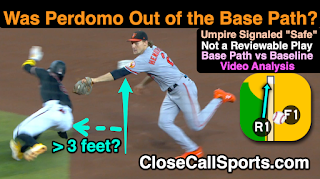
Perdomo Safe From a Base Path Call Out in Arizona

As Orioles SS Gunnar Henderson fielded a 5th inning infield ground ball of the bat of Arizona's Corbin Carroll, Diamondbacks baserunner R1 Geraldo Perdomo veered onto the grass to try and avoid Henderson's eventual tag, ruled safe by 2B Umpire Tom Hanahan and upheld via Replay Review after an Orioles challenge by manager Brandon Hyde.

Perdomo later scored on Cedric Mullins' RBI single off of Baltimore pitcher Jack Flaherty.

With the knowledge that the only reviewable aspect of this play pertained to the physical tag attempt, we answer your questions regarding the other, unreviewable part—Hanahan's out of the base path no call (safe) on Perdomo as the runner attempted to evade the fielder.

Official Baseball Rule 5.09(b)(1) describes the condition upon which a runner is out for a base path violation: "Official Baseball Rule 5.09(b)(1): "Any runner is out when they run more than three feet away from their base path to avoid being tagged unless their action is to avoid interference with a fielder fielding a batted ball. A runner’s base path is established when the tag attempt occurs and is a straight line from the runner to the base they are attempting to reach safely."

As we have discussed in prior videos, a runner establishes their own base path, which is separate and distinct from a baseline (defined as a direct line between consecutive bases). Furthermore, a runner's base path is not established until the tag attempt occurs (begins) and the runner is restricted by the three-foot provision in OBR 5.09(b)(1) until the runner arrives at the next (or previous) base, the fielder loses possession of the ball (e.g., by throwing it or dropping it), or the fielder stops the tag attempt (e.g., to play on another runner).

Replays indicate baserunner R1 Perdomo, coincidentally, appeared to be positioned within the baseline as F6 Henderson fielded the baseball and ran more than three feet away to avoid the fielder's tag, which satisfies the criteria for an out of the base path call.

Video as follows:

Tuesday, July 18, 2023

MLB Ejection 153 - Adam Hamari (4; Mark Kotsay)

HP Umpire Adam Hamari ejected A's manager Mark Kotsay (out of the base path call on Tony Kemp; QOCY) in the bottom of the 1st inning of the #RedSox-#Athletics game. With one out and one on (R3 Kemp), Red Sox pitcher Joe Jacques' 1-0 sinker to A's batter Jordan Diaz bounced off of Red Sox catcher Jorge Alfaro's mitt into foul territory along the left field side. A's R3 Kemp ran toward home plate as Alfaro recovered the ball and dove in an attempt to tag Kemp, who jumped to avoid the tag, ruled out of the base path by HP Umpire Hamari. Replays indicate R3 Kemp ran more than three feet from his established base path (direct line from runner to base established when tag attempt begins), the call was correct.* At the time of the ejection, the game was tied, 0-0. The A's ultimately won the contest, 3-0.

This is Adam Hamari (78)'s
Official Baseball Rule 5.09(b)(1): "Any runner is out when they run more than three feet away from their base path to avoid being tagged unless their action is to avoid interference with a fielder fielding a batted ball. A runner’s base path is established when the tag attempt occurs and is a straight line from the runner to the base they are attempting to reach safely."

This is the 153rd ejection report of the 2023 MLB regular season.
This is the 71st manager ejection of 2023. Ejection Tally: 71 Managers, 63 Players, 19 Coaches.
This is Oakland's 7th ejection of 2023, 1st in the AL West (OAK 7; LAA, SEA, TEX 6; HOU 3).
This is Mark Kotsay's 4th ejection of 2023, 1st since June 5 (Jansen Visconti; QOC = Y [Balls/Strikes]).
This is Adam Hamari's 4th ejection of 2023, 1st since May 20 (Jesse Winker; QOC = Y [Pitch Clock]).

Wrap: Boston Red Sox vs Oakland Athletics, 7/18/23 | Video as follows:

Wednesday, June 28, 2023

MLB Ejection 121 - Derek Thomas (1; Dave Martinez)

HP Umpire Derek Thomas ejected Nationals manager Dave Martinez (out of the base path call; QOCY) in the top of the 6th inning of the #Nationals-#Mariners game. With none out and one on, Nats batter Dominic Smith hit a first-pitch fastball from Mariners pitcher Logan Gilbert to right fielder Teoscar, who threw to second baseman Jose Caballero to catcher Tom Murphy as Nationals baserunner Keibert Ruiz arrived at home plate, ruled out of the base path by HP Umpire Thomas. Replays indicate Ruiz appeared to deviate by more than three feet from his base path, the call was correct.* At the time of the ejection, the Nationals were leading, 3-0. The Nationals ultimately won the contest, 4-1.

This is Derek Thomas ()'s 1st ejection of 2023.
Official Baseball Rule 5.09(b)(1) states, "Any runner is out when—They run more than three feet away from their base path to avoid being tagged unless their action is to avoid interference with a fielder fielding a batted ball. A runner’s base path is established when the tag attempt occurs and is a straight line from the runner to the base they are attempting to reach safely. A runner’s base path is established when the tag attempt occurs and is a straight line from the runner to the base he is attempting to reach safely."

This is the 121st ejection report of the 2023 MLB regular season.
This is the 59th manager ejection of 2023. Ejection Tally: 59 Managers, 49 Players, 13 Coaches.
This is Washington's 3rd ejection of 2023, 4th in the NL East (MIA, PHI 7; NYM 5; WAS 3; ATL 1).
This is Dave Martinez's 2nd ejection of 2023, 1st since June 22 (Doug Eddings; QOC = Y [Balls/Strikes]).
This is Derek Thomas' first career MLB ejection.

Wrap: Washington Nationals vs Seattle Mariners, 6/28/23 | Video as follows:

Saturday, May 6, 2023

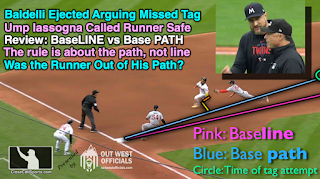
MLB Ejection 044 - Dan Iassogna (2; Rocco Baldelli)

3B Umpire Dan Iassogna ejected Twins manager Rocco Baldelli (out of base path no call; QOCY) in the bottom of the 4th inning of the #Twins-#Guardians game. With none out and two on (R1, R3), Guardians batter Josh Naylor hit a ground ball to Twins third baseman Jose Miranda, who committed an error, prompting Guardians baserunner R1 Jose Ramirez to try for third base. As the return throw arrived between second and third base, Ramirez moved to his right to successfully avoid the tag, ruled not to have violated the base path rule. Replays indicate runner Ramirez did not run more than three feet away from his base path established at the time of the tag attempt to avoid being tagged, the call was correct.* At the time of the ejection, the Guardians were leading, 1-0. The Guardians ultimately won the contest, 4-3.

This Dan Iassogna (58)'s 2nd ejection of 2023.
Official Baseball Rule 5.09(b)(1) states: "Any runner is out when they run more than three feet away from their base path to avoid being tagged unless their action is to avoid interference with a fielder fielding a batted ball. A runner’s base path is established when the tag attempt occurs and is a straight line from the runner to the base they are attempting to reach safely."

This is the 44th ejection report of the 2023 MLB regular season.
This is the 22nd manager ejection of 2023. Ejection Tally: 22 Managers, 17 Players, 5 Coaches.
This is Minnesota's 2nd ejection of 2023, 2nd in the AL Central (CWS 3; MIN 2; KC 1; CLE, DET 0).
This is Rocco Baldelli's 2nd ejection of 2023, 1st since April 15 (James Hoye; QOC = U [Illegal Substance]).
This is Dan Iassogna's 2nd ejection of 2023, 1st since April 23 (Willson Contreras; QOC = N [Balls/Strikes]).

Wednesday, September 14, 2022

Teachable - Runner Runs Past Base to Avoid Canceled Tag

This Rules Review and Teachable twofer sees 2B Umpire John Libka officiate a bizarre play in which Phillies baserunner R1 Odubel Herrera runs past second base to avoid Marlins fielder Jazz Chisholm's tag, which is pulled back.

With one out and one on (R1) in Philadelphia, a ground ball arrives in the glove of Miami second baseman Chisholm in advance of Phillies runner R1 Herrera. Herrera then veers to his left in order to avoid Chisholm's tag, but Chisholm, as the players get closer to each-other, cancels his tag attempt as R1 Herrera runs by, untouched, while also failing to touch second base.

Our Rules Review of out of base path OBR 5.09(b)(2): "Any runner is out when—they run more than three feet away from their base path to avoid being tagged unless their action is to avoid interference with a fielder fielding a batted ball. A runner’s base path is established when the tag attempt occurs and is a straight line from the runner to the base he is attempting to reach safely" then morphs into a Teachable Moment as 2B Umpire Libka now has to officiate a diving play taking place behind second base as Herrera reaches his arm for the bag and Chisholm reaches his glove for Herrera's arm.

Video as follows:

Tuesday, August 30, 2022

MiLB Ejection - Umpire's Safe Call Sparks Dispute

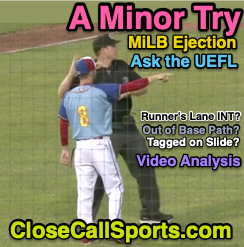
A Minor League ejection in Jersey Shore led to the ejection of BlueClaws manager Keith Werman, courtesy 1B Umpire Jacob McConnell after a safe call during Brooklyn Cyclones batter JT Schwartz's infield single.

Play: With one out and one on (R3), batter Schwartz hit a 1-2 pitch on the ground back to BlueClaws pitcher Dominic Pipkin, who lunged in an attempt to tag a diving Schwartz, ruled safe by 1B Umpire McConnell, who was positioned inside, toward the middle infield, which is where the field umpire ordinarily will stand in a two-person umpire crew with a runner on third base and one out.

Questions: After speaking with Werman, McConnell met with HP Umpire Trevor Mathews to discuss the play, as Mathews by virtue of his position at home plate may have possessed new information relative to Schwartz's baserunning.

Consideration 1, Runner's Lane Interference: The first by rule question to ask is whether batter-runner Schwartz could have been guilty of a runner's lane interference violation, as replays indicate a foot may have exited the lane prematurely. However, seeing as no throw was made to first base, and Official Baseball Rule 5.09(a)(11) [RLI] requires as a prerequisite, a "throw at first base," we have no RLI simply because there was no throw to make RLI a possibility for this play.

Consideration 2, Out of Base Path
: The second question is whether batter-runner Schwartz ran/slid more than three feet away from his base path to avoid being tagged. OBR 5.09(b)(1) states "a runner's base path is established when the tag attempt occurs and is a straight line from the runner to the base they are attempting to reach safely," so under this criterion, it would appear Schwartz did not violate the three-foot out of the base path rule. This part of the play, for what it's worth, is where HP Umpire Mathews' input is most valid, as Mathews' angle up the line provides a wonderful view for a potential deviation (had this play been eligible for RLI, Mathews would have responsibility for that call, as well).

Consideration 3, Tag Attempt: That leaves us with the question of whether the fielder actually tagged the runner. Replays suggest this did not occur, leaving the umpires to keep their original ruling of "safe" which led to the ejection of BlueClaws skipper Werman.

Video as follows:

Monday, May 30, 2022

Ask UEFL - Out of Base Path Considerations in Seattle

2B Umpire Tripp Gibson called Mariners baserunner R1 Eugenio Suarez out for running more than three feet away from his base path to avoid Astros second baseman Mauricio Dubon's tag, giving us a chance to review baseball's out-of-the-base-path rules in our latest Ask the UEFL.

With runners on first and second base and one out during Saturday's Houston-Seattle game, Mariners batter Adam Frazier hit a soft grounder to F4 Dubon, who fielded it and immediately turned to try and tag R1 Suarez, who veered to his right to avoid the fielder.

In ruling Suarez out for runner more than three feet laterally to avoid Dubon's tag, we visit umpire Gibson's base path calculus.

The tag attempt here begins no earlier than when Dubon fields the baseball—as soon as the ball is no longer a batted ball, remember, the right-of-way rules switch to favor the runner, so if you were thinking the runner legally tried to avoid a fielder making a play on a batted ball, that would be slightly tardy.

Instead, when F4 Dubon first turns to try and tag R1 Suarez, we freeze our picture and draw a line from the runner to the base being progressed to (second base)—that's Suarez's base path. As long as that same fielder who has attempted a tag still has a potential tag play (remember, the fielder must retain the ball to have a potential tag play on the runner), the runner is restricted from trying to avoid the fielder by running more than three feet to the left or right of the established base path.

Note: We do not punish the defense for adapting and suddenly trying to play on another runner, if their failure to tag the primary runner was caused by the runner's illegal avoidance maneuver. If the fielder's sudden pivot toward another runner is caused by the first runner's three-foot or greater lateral movement, the proper call is out-of-the-base-path.

If the runner runs more than three feet to avoid the fielder—as U1 Gibson rules that R1 Suarez did here—the proper call is to declare the runner out pursuant to Official Baseball Rule 5.09(b)(1), which calls for an out when the runner "runs more than three feet away from his base path to avoid being tagged unless his action is to avoid interference with a fielder fielding a batted ball. A runner’s base path is established when the tag attempt occurs and is a straight line from the runner to the base he is attempting to reach safely."

Recall that a baseline is a direct line between two bases (coinciding with the left and right field foul lines between home plate and third/first base, respectively) and has no bearing on this play.
A base path, on the other hand, is a direct line from the runner to the base being tried for, and is established at the moment of a tag attempt.

The base path "resets" or must be recalculated from the runner's new position every time the fielder throws the ball to someone else or makes another play. For instance, the base path resets every time a fielder throws the ball to a teammate during a rundown.

Video as follows:

Thursday, June 3, 2021

New York Misinformation - Base Path is Not a Baseline

After 1B Umpire Alan Porter called Tampa Bay batter-runner Kevin Kiermaier safe in the 5th inning of Thursday's #Rays-#Yankees, New York manager Aaron Boone came out to argue as YES broadcasters mused about the baseline and runner's lane. Unfortunately, the rule about a base path has nothing to do with either of those concepts, meaning all within earshot of a television tuned to YES in New York were witness to misinformation regarding the out of the base path rule.

Play: With one out and none on, Kiermaier hit a 0-1 changeup from Yankees pitcher Gerrit Cole on the ground to first baseman DJ LeMahieu, who attempted to tag Kiermaier as he ran to first base.

Call
: Kiermaier avoided LeMahieu's tag and 1B Umpire Porter ruled him safe. Yankees manager Boone campaigned for a base-running infraction, but to no avail: the safe call stood.

Rule: Official Baseball Rule 5.09(b)(1) governs this play and states that "any runner is out when they run more than three feet away from their base path to avoid being tagged unless their action is to avoid interference with a fielder fielding a batted ball. A runner’s base path is established when the tag attempt occurs and is a straight line from the runner to the base they are attempting to reach safely."

In other words, the runner sets their own base path and is allowed three feet to the left or right of that established position on their way to the next (or previous) base in order to avoid a tag.

Not the Rule: The 45-foot runner's lane painted on the ground to the right of the foul line is rules-relevant for one and only one play: runner's lane interference, which occurs when a batter-runner outside of the lane "interferes with the fielder taking the throw at first base" (OBR 5.09(a)(11)). If there is no throw (or no fielder taking a throw), there can bee no runner's lane interference, meaning the lane line is immaterial during a tag play.

The baseLINE, meanwhile, is simply a direct line between any two bases, such as the painted foul line between home and first base. The baseline has no relevance for a base path call such as the Kiermaier play and the only relevance of both the foul line and runner's lane line is that we know, dimensionally, the distance between the two lines is three feet. Thus, we have an impromptu painted ruler or yardstick on the ground that we could conceivably apply to Kiermaier's journey.

Analysis
: Accordingly, Porter's only consideration is whether Kiermaier deviated by more than three feet, pursuant to OBR 5.09(b)(1), to avoid being tagged. Umpire Porter could use the three-foot wide yardstick known as the runner's lane to help guide him to determine what three feet might actually look like, but the runner's lane itself is meaningless for this play. All that is relevant is whether Kiermaier ran more than three feet away from his base path—which he establishes well into foul territory—to avoid being tagged. If so, the runner would be out for running away from (or out of) his base path to avoid being tagged. If not, the runner is safe. 

Video as follows:

Sunday, May 16, 2021

Obstruction Scores Andrus After Elvis' Embellishment

HP Umpire John Libka awarded A's baserunner Elvis Andrus home plate on an obstruction call after Andrus ran into Twins catcher Ben Rortvedt, leading to complaints ranging from "he's on the grass" to "he flopped"...but what does the rule actually say and, by rule, was the umpire's ruling correct?

Play: With one out and two on (R2, R3) in the top of the 5th inning of Sunday's Athletics-Twins game, A's batter Ramon Laureano hit a ground ball to Twins shortstop Andrelton Simmons, who threw home as runner R3 Andrus ran toward the plate. Catcher Rortvedt caught the ball and began chasing Andrus back to third base, eventually throwing the ball to third base to continue the rundown.

Call
: At this point, Andrus turned back toward home plate and collided with Rortvedt, falling to the ground as HP Umpire Libka called obstruction on Rortvedt, awarding Andrus home as a result, scoring a run for Oakland and charging an error to Minnesota's Rortvedt. Even more consequential? The A's ultimately won the contest by one run, 7-6.

Rule: To determine whether this was the correct call or not, we first must consult Official Baseball Rules 6.01(h)(1) pertaining to obstruction ("the act of a fielder who, while not in possession of the ball and not in the act of fielding the ball, impedes the progress of any runner"): "If a play is being made on the obstructed runner, or if the batter-runner is obstructed before they touch first base, the ball is dead and all runners shall advance, without liability to be put out, to the bases they would have reached, in the umpire’s judgment, if there had been no obstruction. The obstructed runner shall be awarded at least one base beyond the base they had last legally touched before the obstruction. Any preceding runners, forced to advance by the award of bases as the penalty for obstruction, shall advance without liability to be put out."

Analysis
: We review the play and observe Andrus, throughout the course of the rundown, has chosen a base path on the edge of the infield grass in fair territory.* We use this information as a guide to conclude that because Andrus makes contact with Rortvedt on the edge of the infield grass in fair territory, it is reasonable to say that Andrus did not run significantly out of his way solely to contact the fielder.

That said, it is apparent that Andrus appears to stick his arm out in exaggerated fashion to heighten the level of contact and that Andrus appears to embellish this contact by falling onto the ground in a similar exaggeration. However, as much of a potential flop as the falling might be, we are restricted to considering OBR 6.01(h)(1) and the definition of obstruction: Rortvedt is a fielder not in possession of the ball and not in the act of fielding the ball, having thrown the ball to another player. Accordingly, this is obstruction, because at the time of the interaction, Andrus was running toward home plate and even if he was impeded ever so slightly, the fact remains that he was impeded and, thus, is entitled to an obstruction call.

*Remember, a runner choses their own base path and is not out for being outside of this base path (not baseline, see OBR 5.09(b)(1) and our series on Base Path situations for further information) unless the runner deviates by more than three feet from a direct line between the runner and the base the runner is attempting to achieve, in order to avoid a tag.

Finally, this is an example of obstruction type 1 (Type A OBS) because a play was being made on the runner at the time: After Libka calls "Time" (type 1 causes the ball to become dead), the obstructed R3 Andrus gets home plate and all runners behind him get whatever bases the umpires believe they would have achieved had obstruction not occurred.

In hockey this perhaps would be a two-for-interference / two-for-embellishment coincidental minor penalties situation, but in baseball, it is only obstruction on the defense. The rules do not allow for a diving call in this play.

Video as follows:

Saturday, May 1, 2021

MLB Ejection 025 - Andy Fletcher (1; Bryce Harper)

1B Umpire Andy Fletcher ejected Phillies bench player Bryce Harper (out of base path call by 2B Umpire Jose Navas; QOCN) in the bottom of the 7th inning of the #Mets-#Phillies game. With one out and one on (R1), Phillies batter Matt Joyce hit a ground ball to Mets second baseman Jeff McNeil, who threw to shortstop Francisco Lindor, to first baseman Pete Alonso, Phillies baserunner R1 Andrew McCutchen ruled out for running more than three feet away from his base path to avoid a tag and Phillies batter-runner Joyce ruled out upon Replay Review as the result of a challenge by Mets manager Luis Rojas. Replays indicate McCutchen did not deviate from his base path to avoid a tag in contravention of Official Baseball Rule 5.09(b)(1), the call was incorrect.* At the time of the ejection, the game was tied, 4-4. The Mets ultimately won the contest, 5-4.

This is Andy Fletcher (49)'s 1st ejection of 2021.
Andy Fletcher now has 0 points in the UEFL Standings (0 Prev + 2 MLB - 2 Incorrect [Crewmate] = 0).
Crew Chief Andy Fletcher now has 0 points in Crew Division (0 Previous + 0 Incorrect Call = 0).
*OBR 5.09(b)(1) states that "any runner is out when—He runs more than three feet away from his base path to avoid being tagged unless his action is to avoid interference with a fielder fielding a batted ball. A runner’s base path is established when the tag attempt occurs and is a straight line from the runner to the base he is attempting to reach safely."

This is the 25th ejection report of the 2021 MLB regular season.
This is the eighth player ejection of 2021. Prior to ejection, Harper did not appear in the contest.
This is Philadelphia's 2nd ejection of 2021, T-1st in the NL East (NYM, PHI 2; MIA 1; ATL, WAS 0).
This is Bryce Harper's 1st ejection since Sept 5, 2020 (Roberto Ortiz; QOC = Y [Fair/Foul]).
This is Andy Fletcher's 1st ejection since May 17, 2019 (Bruce Bochy; QOC = N-c [Check Swing]).

Wrap: St. Louis Cardinals vs. Pittsburgh Pirates, 5/1/21 | Video as follows:

Wednesday, March 4, 2020

Case Play 2020-1 Answer - Standoff is Out of Line

After a college stalemate between catcher & runner led to a benches-clearing brawl, we made a Case Play of it. After consulting the relevant rules, it is apparent that the umpire could have declared the leading runner out earlier for running more than three feet away from his base path to avoid a tag.

Recap: Attempting to score on a hit to the outfield, a runner evades a catcher's tag near home plate, incidentally failing to touch the plate in the process. As the runner prepares to correct his base touching error, he sees the catcher ready to apply the tag and waits somewhere well behind the batter's box until the catcher acts.

The catcher, who in turn starts to chase the runner, quickly retreats to cover home plate, wary of the trailing runner who might attempt to score. A stalemate ensues, and finally ends with the preceding runner diving into an out with the catcher quickly tagging the trailing runner as well for a double play.
Related PostCase Play 2020-1 - Home Plate Standoff & Brawl (3/2/20).

The two primarily related rules here are those of the appeal play and those of the out-of-base-path. Let's tackle each possibility.

The catcher begins to chase the runner.
Appeal Play: NCAA rule 8-6-a-4 states that a runner is out on appeal when "the runner does not touch home plate and does not make an attempt to touch it. The fielder may touch either the runner or home plate." Official Baseball Rule 5.09(b)(12) is the related professional rule and states, "[Runner is out when] in running or sliding for home base, he fails to touch home base and appeals to the umpire for the decision." And, for good measure, NFHS (high school) rule 8-2-6b affords a live ball appeal for a runner missing a base, with 8-2-5 declaring, "If a runner who misses any base (including home plate) or leaves a base to early, desires to return to touch the base, he must do so immediately."

In this situation, because the initial "you missed the base" interaction between catcher and runner occurs off camera and we cannot conclusively determine what any potential catcher-umpire interaction was, it is difficult to determine whether the catcher actually appealed the runner's legality. For this reason, we err on the side of the call on the field, but nonetheless, the rule is designed such that the catcher is not required to physically chase a runner who makes no attempt to score or correct his no-touch error.

Runner clearly deviates by more than 3 feet.
Out of Base Path: NCAA rule 8-5-a states that a runner is out when, "In running to any base, while trying to avoid being tagged out, the runner runs more than three feet left or right from a direct line between the base and the runner’s location at the time a play is being made." The pro rule is OBR 5.09(b)(1) ("more than three feet away from his base path to avoid being tagged...established when the tag attempt occurs and is a straight line from the runner to the base") and high school is NFHS 8-4-2a ("runs more than three feet away from a direct line between bases to avoid being tagged...he establishes his baseline as directly between his position and the base toward which he is moving"). Remember, the MLB Umpire Manual states, "Base path rules still apply to the runner" in situations when the runner misses home plate.

Sidebar: NFHS uses the term "baseline" while OBR is "base path".

Ichiro Suzuki safely slides into home.
This is the rule the runner violated; he clearly runs more than three feet away from the direct line between his position at the time of the play or attempted tag (when he's off-camera behind the left-handed batter's box) and home plate. This is evident when he winds up well beyond the right-handed batter's box and more than three feet away from home plate. We contrast this in a video with Ichiro Suzuki successfully avoiding this call during a game in Baltimore.

Other Potential Outs:
Teammate Interference: OBR 6.01(a)(4) would declare the runner out for interference and cause the ball to become dead when "any member or members of the offensive team stand or gather around any base to which a runner is advancing, to confuse, hinder or add to the difficulty of the fielders." Naturally, it would appear the runner's own act of running well outside of his base path caused the on-deck batter to become more involved in the play than he would otherwise have been, in which case the on-deck batter's presence would become somewhat of a red herring (also: did he actually confuse/hinder or attempt to confuse/hinder his opponent?).

Video as follows: