Showing posts with label Angel Hernandez. Show all posts

Tuesday, May 28, 2024

Umpire Angel Hernandez Retires After 33 Years of MLB

Longtime MLB umpire Angel Hernandez confirmed he is retiring, telling USA Today he wants to spend more time with his family. The 62-year-old umpire who began his big league career in the National League 33 years ago, in May 1991, winds down his eventful major league on-field experience with over 3,800 regular season games worked, 12 Division Series, eight League Championship Series, and two World Series.

Hernandez drew national ire in 2013 when, as acting crew chief, his crew reviewed and ultimately upheld an Oakland Athletics double off the high left field wall in Cleveland. Although replays indicate the batted ball hit a railing beyond the wall and caromed back into the field—MLB stated it should have been a home run—and A's manager Bob Melvin was ejected arguing that point, we would come to find out that the replay angles the crew had access to on the circa-2013 in-stadium "limited replay" monitor, which was a small screen by today's standards were inconclusive, according to MLB's Terence Moore, who wrote, "I agree with the umpires."

Nonetheless, the national spectacle that followed resulted in the modern Replay Operations Center headquarters in New York we see today, a $30 million project that doesn't include the annual $2+ million salaries of the two additional umpire crews that staff it, added to the then-68 full-time MLB umpires for a modern-day roster of 76 (not including the costs of non-umpire Replay HQ staff).

Hernandez changed baseball in a different way in 2017, filing a lawsuit against the league in which he alleged racially-motivated and national origin-motivated discrimination.

Although this opened Hernandez up to further ridicule—such a reporters facetiously adding accents to the letters "á" in his name despite its spelling never containing accents before, a practice that continues to this day (seriously, look at the MLB Umpire Media Guide where umpires who want accents in their names [such as Alfonso Márquez] have them there, Hernandez is unaccented in all legal proceedings, etc.)—his lawsuit opened the door for other umpires who may have avoided baseball due to an undoubtedly discriminatory past. 

And although Hernandez lost his suit and appeal, uncovering potential problems in baseball spurred the sport to change how it conducts business to include more umpires in its community, as well as perhaps inspired other umpires to speak out against discriminatory practices (note: we have yet to discuss a 2024 discrimination suit recently filed by an umpire who worked in the minor leagues).

After an eventful career, Hernandez walks away from baseball having fundamentally made his mark.

Video as follows:

Monday, May 6, 2024

Calls of the Month - April 2024

CloseCallSports
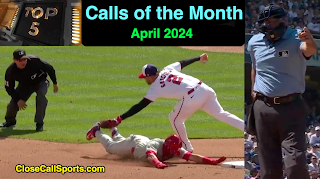
' Top 5 Calls of the Month for April 2024 feature umpires whose concentration and keen eye allowed them to accurately assess close plays across Major League Baseball.

5) Alex Tosi's check swing hit-by-pitch in Cincinnati is confirmed via Replay Review.

4) Brian Walsh's out of play ruling on an overthrown ball is confirmed in Cincinnati.

3) CB Bucknor's out call on a force play at second base in Detroit is confirmed.

2) Angel Hernandez's HBP call in Los Angeles is confirmed by the slightest of margins.

1) Jonathan Parra's out call on a stolen base attempt in DC is confirmed by a tag on the heel.

Video as follows:

Monday, April 8, 2024

Angel Again? Step-Off Disengagement Delivery Strikeout

After HP Umpire Angel Hernandez called Yankees batter Gleyber Torres out on strikes in the 1st inning vs Toronto, New York manager Aaron Boone argued the strikeout shouldn't count because Blue Jays pitcher Bowden Francis stepped off the rubber during his delivery, causing Torres to back out of the box.

This disengagement delivery involves two main components: #1, replays indicate pitcher Francis disengaged his pivot foot from the pitcher's plate during delivery, quickly re-engaging and firing home for a called strike three, which (#2) the television on-screen strikeout graphics indicate was located outside (and above) the strike zone.

Let's tackle the strike zone location issue first. When batter Torres stepped back in the batter's box during the pitch sequence, his stance as the pitch neared home plate remained similar to his standing stance—e.g., there was no "crouch" as expected during most pitches. This is reflected by the adjusted computer strike zone data as well as online zone visualizations, all of which agree the pitch was a strike, given Torres' elevated strike zone due to standing back in the batter's box. The location issue was officiated properly.

As for the disengagement issue, we note that all pitches must be made with the pivot foot in (reasonable) contact with the rubber/pitcher's plate. If runners are on base and a pitcher's foot slips and they interrupt delivery, this can be called a start-stop balk pursuant to Official Baseball Rule 6.02(a)(1). But if the bases are empty, there's no penalty other than to allow the pitcher to reset the play, re-engage, and retry the pitch.

...except that as of 2023, we have a pitch clock which means the pitcher might well be under a time crunch that prevents them from properly resetting the play. That appears to be what happened here: pitcher Francis had just three seconds remaining after the inadvertent disengagement, meaning he didn't have time to recover and retry from scratch.

Instead, Francis quickly re-engaged and threw. We now refer to OBR 5.07(a) and 6.02(a)(5), both of which concern an illegal pitch known as the quick pitch: "A quick pitch is an illegal pitch. Umpires will judge a quick pitch as one delivered before the batter is reasonably set in the batter’s box. With runners on base the penalty is a balk; with no runners on base, it is a ball. The quick pitch is dangerous and should not be permitted."

A central component of the quick pitch, however, is spelled out in OBR 5.07(a)(2) Comment: "If, however, in the umpire’s judgment, a pitcher delivers the ball in a deliberate effort to catch the batter off guard, this delivery shall be deemed a quick pitch, for which the penalty is a ball."

It would appear the pitcher did not intend to catch the batter off guard (also, the batter was somewhat reasonably set already) as much as he was rushing in an attempt to catch his own mistake of his pivot foot slipping off the rubber. A common sense approach to this play would be to declare "Time" and simply hit the reset button—no strike three call, no automatic ball, just a redo. This is the fairest outcome. Except the pitch clock was at the three-second mark when Francis slipped off the rubber, so the most likely outcome here would be a pitch clock violation on the pitcher and automatic ball for that reason.

As for who might see this, a pitcher out of Set (or even Hybrid) may have their back or pivot foot out of view of the home plate umpire, who would have to look through the front/free foot or leg to see the pivot foot slipping off the rubber. That's where the 1B and 3B Umpires can help—big time. What appears to have occurred here is 1B Umpire Nic Lentz and/or 3B Umpire and Crew Chief Lance Barksdale observed the disengagement, but also knew that with no runners on, there really isn't a penalty per se for it (not withstanding the pitch timer violation). Unfortunately, no one on the crew seemed to take it a step further to 1) the pitch clock issue, or 2) the quick pitch issue.

Instead, the crew, which did not put the entire play together, allowed the strikeout to stand.

Video as follows:

Thursday, April 4, 2024

Angel's Swinging Strike Call & the Unreviewable Play

Detroit manager AJ Hinch argued after being told he couldn't challenge HP Umpire Angel Hernandez's foul tip call in the 11th inning in New York because Hernandez's on-field ruling that batter Spencer Torkelson swung at the pitch is not a reviewable play.

In Ejection 003 - Vic Carapazza (1; Dylan Moore), we discussed how check swing decisions—specifically whether or not the batter struck at a pitch—are not reviewable. In that game, Cleveland successfully challenged that batter Ramón Laureano was hit by a pitch, with Replay Review awarding Laureano first base as a result. Seattle had contended Laureano swung at the ball as it touched him, which the on-field umpires did not call (the crew ruled Laureano did not swing at the pitch), so the scope of the replay solely focused on whether the ball struck the batter or not. Finding that it did, the natural award was first base, relying on the umpires' on-field "no swing" ruling.

In Ejection 004 - Mike Muchlinski (1; Derek Shelton), we concentrated on the mechanics of calling a check swing, finding that the home plate umpire bears primary responsibility with such a play, and if they deem that the batter did in fact swing at the pitch, then by rule they are supposed to unilaterally call the swing from behind the plate (not appeal to a field umpire). The first and third base umpires may rule on appeal when the plate umpire calls "no swing" but not when the plate umpire calls a strike (by swing or by location).

Putting these lessons together brings us to Thursday in New York, when HP Umpire Hernandez called a foul tip on Tigers batter Torkelson in the 11th inning. While Detroit initially sought to challenge this call, alleging the pitched ball touched batter Torkelson's hands and not the bat, the umpires informed manager Hinch that due to Hernandez's ruling that Torkelson did indeed swing, the play was not reviewable.

This is correct, in part, and not entirely correct, in part. First, we know that Replay cannot review whether or not a batter has attempted to strike a pitch (swing/no swing is not reviewable). But, there is an ever-so-slight difference between the on-field ruling of foul tip and what the Tigers allege happened, which is a pitched ball touching the batter. Add in Hernandez's call "...as he struck at it" and we find the difference Replay could make here is between a foul tip—a live ball—and a dead ball strike (obviously, a dead ball).

In this situation, it doesn't sound like much of a difference, but had the catcher tried to pick off a runner and either retired the runner or overthrew the fielder, allowing runners to advance, the live vs dead ball call would loom large. On a foul tip (live ball), the runner could be deemed out or could advance to score a run on the catcher's throwing error, while on a dead ball (dead ball strike), no further action could occur and any pickoff attempts would be nullified.

Jeff McNeil & Angel Hernandez Disagree About Time Out

Mets batter Jeff McNeil and HP Umpire Angel Hernandez exchanged words in the bottom of the 6th inning of New York's Thursday matinee vs Detroit over a pitch clock rule-related "Time" out request, an instance of confusion increasingly spreading throughout baseball when batters—restricted to one "Time" request per at-bat—and umpires can't seem to agree as to when said batter actually wants to use their allotted pause.

During McNeil's 6th inning at-bat, Tigers pitcher Joey Wentz committed a pitch timer violation on the 1-2 pitch, failing to start his delivery prior to the expiration of time. After a subsequent curveball in the dirt, McNeil turned to speak with Hernandez, which the umpire took as a request for "Time", signaling as much as McNeil replied he hadn't asked for time out.

This situation resolved without consequence—McNeil walked on the next pitch—but as we know from the Seoul Series and HP Umpire Andy Fletcher's pitch timer violation strikeout for excessive time out requests by Padres batter Xander Bogaerts, crossed wires can produce at-bat defining consequences.

My proposal to fix this miscommunication malady is simple: implement a protocol that requires batters to visually request "Time" by raising a hand with open palm facing the umpire. This way, there (ideally) will be no confusion of whether a batter verbally requested "Time" or was commenting on something else.

Video as follows:
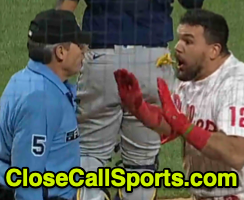
Friday, March 8, 2024

Spring Ejections 1-2 - Angel Hernandez (Lynn, Marmol)

HP Umpire Angel Hernandez ejected Cardinals pitcher Lance Lynn and manager Oliver Marmol (arguing balls/strikes) in the bottom of the 3rd inning of a #Cardinals-#Nationals Spring Training game. With one out and none on, Hernandez warned the St Louis dugout about arguing balls and strikes. Lynn was ejected after objecting to a ball call on a subsequent pitch; Marmol for arguing Lynn's ejection. This game was not televised and its stadium not equipped with pitch tracking data, the call was irrecusable. At the time of the ejections, the Cardinals were leading, 5-4. The Cardinals ultimately won the contest, 7-6.

These are Angel Hernandez (5)'s 1st and 2nd ejections of Spring Training.
*OBR 6.04(d) states, "When a manager, player, coach or trainer is ejected from a game, they shall leave the field immediately and take no further part in that game. They shall remain in the clubhouse or change to street clothes and either leave the park or take a seat in the grandstand well removed from the vicinity of their team’s bench or bullpen."

These are the 1st and 2nd ejection reports of 2024 MLB Spring Training.
This is the 1st player ejection of Spring 2024. Prior to ejection, Lynn's line was 2.0 IP, 4 ER.
This is the 1st manager ejection of Spring 2024. Ejection Tally: 1 Manager, 1 Player, 0 Coaches.
This is St Louis' 1-2nd ejection of S-2024, 1st in the Grapefruit League (STL 2; All Others 0).
This is Lance Lynn's 1st ejection since August 18, 2021 (Nic Lentz; QOC = U [Illegal Substance-USC]).
This is Oliver Marmol's 1st ejection since August 22, 2023 (Brennan Miller; QOC = N [Balls/Strikes]).
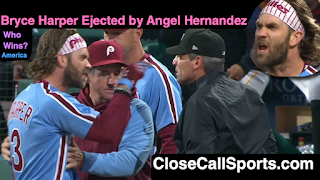
This is Angel Hernandez's 1st ejection since Sept 28, 2023 (Bryce Harper; QOC = U [Check Swing]).

Thursday, September 28, 2023

MLB Ejection 237 - Angel Hernandez (1; Bryce Harper)

3B Umpire Angel Hernandez ejected Phillies 1B Bryce Harper (check swing strike three call) in the bottom of the 3rd inning of the #Pirates-#Phillies game. With one out and none on, Harper attempted to check his swing on a 3-2 slider from Pirates pitcher Luis Ortiz, ruled a ball by HP Umpire James Hoye and called a swinging strike on appeal by 3B Umpire Hernandez. At the time of the ejection, the game was tied, 1-1. The Pirates ultimately won the contest, 3-2.

This is Angel Hernandez (5)'s 1st ejection of 2023.

This is the 237th ejection report of the 2023 MLB regular season.
This is the 95th player ejection of 2023. Ejection Tally: 108 Managers, 95 Players, 34 Coaches.
This is Philadelphia's 12th ejection of 2023, 2nd in the NL East (MIA 16; PHI 12; NYM 6; ATL 4; WAS 3).
This is Bryce Harper's 4th ejection of 2023, 1st since Sept 15 (Alex Tosi; QOC = N [Balls/Strikes]).
This is Angel Hernandez's 1st ejection since April 24, 2022 (Kyle Schwarber; QOC = Y [Balls/Strikes]).

Monday, September 18, 2023

Houston's Thrown Glove and the Two-Base Award

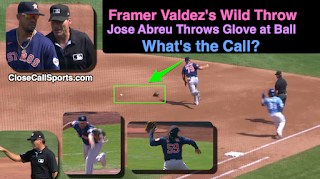
Astros pitcher Framber Valdez struggled to field a soft ground ball by Royals batter Logan Porter and threw wildly to first base, Houston 1B Jose Abreu throwing his glove to stop the ball. Although Abreu's thrown glove struck Valdez's thrown ball, keeping it on the infield, HP Umpire Derek Thomas and 3B Umpire John Libka both saw a rules infraction and 2B Umpire James Hoye's crew met after the play to determine base awards.

Official Baseball Rule 5.06(b)(4) specifies base awards and indicates that each runner (including the batter-runner) may advance without liability to be put out: "(C) Three bases, if a fielder deliberately throws their glove at and touches a fair ball" or "(E) Two bases, if a fielder deliberately throws their glove at and touches a thrown ball."

The rule states that in both situations, "The ball is in play, and the award is made from the position of the runner at the time the ball was touched."

Replays indicate that as Valdez's wild throw approached the vicinity of first base, 1B Umpire Angel Hernandez was concentrating on the potential play at the base and thus wasn't looking at the infraction as it occurred (this is a proper mechanic from the first base umpire), 2B Umpire Hoye was similarly looking at second base for a potential play on R1, and thus 3B Umpire Libka and HP Umpire Thomas had the call.

Libka, however, appeared to signal "Time" while Thomas simply pointed at the thrown glove/ball contact—Thomas' mechanic is correct as the ball is in play on such a violation.

After the play, the crew determined that batter-runner Porter would be placed at second base because he had not yet reached first base at the time of the glove/ball touching while lead runner R1 Nick Loftin would receive third base...which replays indicate was incorrect, as Loftin was in contact with second base at the time of the ball touch occurred.

For what it's worth, the relevant rule for a pitched ball is OBR 5.06(b)(3), which awards runners (but not batters) one base without liability to be put out when "A fielder deliberately touches a pitched ball with their cap, mask or any part of their uniform detached from its proper place on their person."

Video as follows:

Tuesday, August 15, 2023

Angel Hernandez's Unlawful Discrimination Appeal Dismissed

The United States Court of Appeals for the Second Circuit dismissed plaintiff Angel Hernandez's discrimination lawsuit appeal against Major League Baseball, ruling in a summary order that despite a factual imbalance between white and minority crew chiefs, Hernandez's team failed to prove a statistically significant disparity in promotion rates, not to mention the case for discrimination or disparate treatment.

In 2021, a New York Southern District Court judge dismissed Hernandez's original discrimination case against MLB, opening up the door to appeal, when the court ruled that "the fact that no or very few minorities were promoted [is] 'statistically meaningless.'"

That ruling itself followed MLB's allegation that there is "no evidence" of a diversity problem in baseball.

Regardless of where one stands on the diversity problem issue, the question is not whether such a problem exists, but whether unlawful discrimination or disparate treatment occurred in relation to the treatment of Mr. Hernandez, either by named decision-maker, then-Chief Baseball Officer Joe Torre, Peter Woodfork, or others in the Commissioner's Office.

And in sum, the court found that Hernandez failed to prove that element of the prima facie case, leading to the District Court's summary dismissal and, now, the Appeals Court's summary order of dismissal.

Video as follows:

Monday, August 7, 2023

Angel Hernandez's Balk in NY & Plate Blocking in SD

Angel Hernandez called a balk on Yankees pitcher while Replay Review awarded Los Angeles a run thanks to Padres catcher Gary Sanchez's plate blocking violation in San Diego. We answer your questions about each play.

Yankees Balk
In the 6th inning of Sunday's Astros-Yankees game, HP Umpire Angel Hernandez called a balk on Yankees pitcher Wandy Peralta for failing to step directly to first base on a pickoff throw with baserunner Chas McCormick at first. Official Baseball Rule 6.02(a)(3) regarding balks states, "It is a balk when the pitcher, while touching their plate, fails to step directly toward a base before throwing to that base."

Replays indicate a balk did occur as Peralta appeared to step toward home plate more than toward first base, but complicating perception was that Hernandez was the only umpire to call it. Even so, although 1B Umpire Todd Tichenor or 3B Umpire Alex Tosi called the balk, it still was a step balk.

Padres Block
With runners at the corners and one out in the top of the 2nd inning of Sunday's Dodgers-Padres game, Dodgers batter Austin Barnes bunted the ball to Padres first baseman Ji Man Choi, who charged in and flipped the ball to catcher Sanchez as Dodgers baserunner R3 Enrique Hernandez slid head-first into Sanchez's knee, ruled out by HP Umpire Gabe Morales.

After Dodgers manager Dave Roberts challenged the play, Replay Review overturned Morales' out call, deeming that catcher Sanchez did block the runner, despite the throw originating from a drawn in infielder.

Although plate blocking rule OBR 6.01(i)(2) states, "It shall not be considered a violation of this Rule 6.01(i)(2) if the catcher blocks the pathway of the runner in a legitimate attempt to field the throw (e.g., in reaction to the direction, trajectory or the hop of the incoming throw, or in reaction to a throw that originates from a pitcher or drawn-in infielder)," a throw from a drawn-in infielder doesn't give a catcher carte blanche to block access to home plate. The difference is whether the catcher's blocking was intentional or unintentional.

For outfield throws, for instance, we know that catchers may be called for blocking (without the ball) whether they did it intentionally or unintentionally, but for the drawn-in infielder exception, this ruling indicates that while unintentional blocking is permitted for a drawn-in infielder throw, intentionally blocking the plate by sticking a knee out unecessarily is still illegal.

Video as follows:

Saturday, July 22, 2023

Angel Hernandez Rehab Tour Begins in Charlotte

Injured Major League umpire Angel Hernandez worked his first rehab assignment in Triple-A Charlotte on Friday, calling the Redbirds-Knights minor league game at third base as he works his way back to MLB.

Hernandez joined Anthony Perez, Reed Basner, and James Jean for a crew of four. This is standard procedure for a medium-to-long term umpire injury, to test out how the umpire feels physically and get things back to speed. If all the checkboxes pass muster, just a few rehab games are needed before the umpire will return to the major leagues.

Also rehabbing in Charlotte was White Sox injured list third baseman Yoán Moncada as both baseball personnel work on returning to their respective MLB roles.

Video as follows:

Tuesday, May 16, 2023

Where in the World is Angel Hernandez - Umpire Scheduling

MLB Umpire Angel Hernandez has not worked a game since April 3 in Chicago, his crew's Opening Day, leading many of you to ask where in the world is he? We discuss how the umpire scheduling process works and sleuth around to discover that a back injury—not anything more nefarious as some of you had posited—is behind this 33-year big league umpire's early season absence.

Many umpires who find themselves on officiating's Injured List for a significant period of time will work rehab games in the minor leagues as they prepare to return; to date, Hernandez has not yet but the general procedure is to hold off until medical clearance and once the doctor says okay, the umpire can begin work to return to the field.

Video as follows:

Tuesday, March 14, 2023

Player Uniforms and Rules About Unbuttoned Shirts

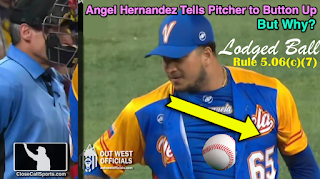
While many fans took to twitter to comment on HP Umpire Angel Hernandez's strike zone during Tuesday's Venezuela-Nicaragua World Baseball Classic game, we zeroed in Venezuela pitcher José Quijada's unbuttoned shirt in the 7th inning and Hernandez's direction for Quijada to button up his uniform top.

To figure out what this is all about—yes, this is the ever-so-exciting discussion about the player uniform rules—we turn to Official Baseball Rule 3.03 (OBR is used in the WBC) and find that only one provision of the rule concerns buttons: "(h) Glass buttons and polished metal shall not be used on a uniform." NCAA Rule 1-14-e is the only uniform rule in any code to specifically mention buttoning or zipping up a uniform top, but that only pertains to a pitcher wearing a jacket while being a baserunner.

Other than that scenario, it appears HP Umpire Hernandez may have practiced some preventative officiating—addressing a potential safety or rules issue to prevent oddities from occurring later on as a result of the unbuttoned shirt. OBR 5.06(c)(7), for instance, discusses lodged balls or balls that find their way into a player's uniform—if a ball were to go into Quijada's shirt, for instance, the resulting penalty would be a one base award for the batter and all baserunners (if deemed inadvertent). The MLB Umpire Manual further expands OBR 5.06(c)(7) to apply to batted and thrown, in addition to pitched, balls.

Video as follows:

Sunday, September 11, 2022

Angel Hernandez's Stuck Ball Ruling in Mets-Marlins

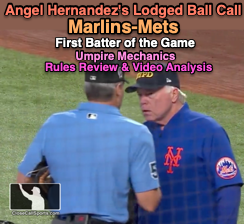
When HP Umpire Angel Hernandez called "Time" to declare a Mets batter Brandon Nimmo's line drive to left-center field stuck/lodged beneath the Marlins outfield wall's padding, and thus out of play, we were asked two main questions. First, is this even a home plate umpire's call? And, second, what is the rule? Was the call correct or not?

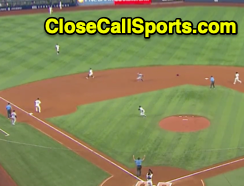
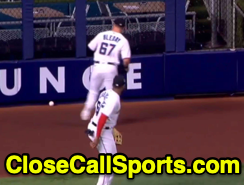
With none out and none on, Mets batter Nimmo led off the game with an extra base hit to the gap. The Marlins outfielders had trouble retrieving the batted ball, and Nimmo hustled to third base for an apparent triple. But HP Umpire Hernandez had called "Time" because the reason Miami had a tough time fielding the ball was, according to the call, because the ball had become stuck beneath the padding on the warning track in the outfield.

Whose Call is It Anyway?
The second base umpire is positioned on the outfield grass to start plays with no runners on, and 2B Umpire and Crew Chief Chad Fairchild opted not to go out on the line drive into the gap, but to come in and take the baserunner into second base instead. The go-out vs stay-in criteria is whether or not the hit is a "trouble ball," that is a baseball that might be subject to interference, become a ground rule double, or another complicated boundary issue for which an umpire in the outfield would be beneficial.

Because U2 Fairchild came in and began tracking the baserunner and thus stopped looking at the ball in the outfield, 3B Umpire Shane Livensparger pitched in and watched the ball in the outfield, as his responsibilities for the baserunner hadn't yet begun. As for home plate, the plate umpire generally won't rule on outfield stadium boundary issues in crews that are not employing one- or two-person mechanics.

The rule itself is Official Baseball Rule 5.06(b)(4)(F) and states, "Each runner including the batter-runner may, without liability to be put out [the ball is dead], advance—Two bases, if a fair ball bounces or is deflected into the stands outside the first or third base foul lines; or if it goes through or under a field fence, or through or under a scoreboard, or through or under shrubbery or vines on the fence; or if it sticks in such fence, scoreboard, shrubbery or vines."

MLB has ruled plays like this "lodged balls" before, but as is usually the case with lodged ball plays, video is ultimately inconclusive and Replay Review accordingly ruled this "Call Stands" and thus New York manager Buck Showalter lost his early challenge. (plate umpires in 4 person crews...don't make this call unless it's absolutely necessary...especially if your league uses replay.)

Video as follows:

Thursday, September 8, 2022

Marlins-Phillies Crash Play on a Legal Base Block

After Marlins pitcher Richard Bleier fielded a soft ground ball and dove on first base ahead of Phillies batter-runner Brandon Marsh's arrival, ruled an out by 1B Umpire Angel Hernandez with no obstruction (or interference) violation for blocking the runner's access to first base, Philadelphia manager Rob Thomson challenged the call, which was confirmed via Replay Review as an out.

In an extension of our prior analyses on the home plate collision rule, we again find that a fielder has the right to block the runner's path to a base if the fielder already has possession of the ball when they begin their blocking action, and are attempting to retire that runner.

In this case, pitcher Bleier fielded and maintained possession of the baseball while falling on top of first base, meaning that his low block on runner Marsh was legal: Bleier, with possession of the ball, attempted to retire the runner by legally tagging first base. Despite the significant contact between the opposing players, this is a legal play that also adheres to the "Angel is Everywhere" rule.

Video as follows:

Thursday, June 23, 2022

Teachable - Angel's Angle on Back-Pick Tag at First Base

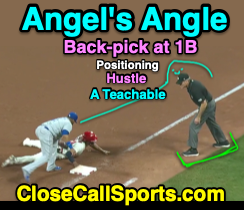
When Replay Review affirmed 1B Umpire Angel Hernandez's out call on Royals catcher Salvador Perez's pickoff attempt throwing behind Cardinals baserunner R1 José Rondón, it brought to the forefront the importance of angles in the furtherance of making accurate calls on the bases.

In this Tmac's Teachable Moment, we follow Hernandez throughout the pitch-to-pickoff sequence, noting the umpire's hustle to ensure he is in the proper position to attain the keyhole angle most optimal for making this call.

The pre-pitch planning with a runner on first base begins with positioning to rule on a potential pickoff play originating with the pitcher. Coincidentally, this position also lends itself to calling balks or other pitch-based infractions.

As the pitch is thrown—noting that the first base umpire has no check swing responsibilities for a left-handed batter—we see Hernandez hustle to his right, toward the foul line, primarily for a potential fair/foul decision on a batted ball. As positioning to rule on a potential pickoff takes the umpire into a beneficial angle for a potential balk, so too does angling oneself to officiate fair/foul for a potential back-pick from the catcher.

When that throw does occur, Hernandez is already in position at first base to make a call on a fast play.

Video as follows:

Thursday, June 2, 2022

Ask UEFL - Angel in the Infield Fly & Intentional Drop?

Tmac
 answers two questions for the price of one in this Ask the UEFL infield fly and intentional drop rule double feature in a game between the Orioles and Cardinals with umpire Angel Hernandez behind the plate in St Louis. With none out and two on (R1, R2), Orioles batter Chris Owings' sacrifice bunt attempt goes horribly awry as the pitch from Nick Wittgren is bunted high into the air in front of the pitcher's mound.

Baltimore Pitcher Wittgren permits the batted ball to fall to the ground untouched before picking up the fair ball and throwing to third base to force out the lead runner, with third baseman Nolan Arenado throwing on to second base to force out R1 Robinson Chirinos.

The two-pronged question—why isn't this an infield fly and why isn't this an intentional drop—rely on two sections of the Official Baseball Rules. First, the Definition of Terms states, "An infield fly is a fair fly ball (not including a line drive nor an attempted bunt) which can be caught by an infielder with ordinary effort, when first and second, or first, second and third bases are occupied, before two are out."

OBR 5.09(a)(12) discusses intentional drops and states that the batter is out when "An infielder intentionally drops a fair fly ball or line drive, with first, first and second, first and third, or first, second and third base occupied before two are out. The ball is dead and runner or runners shall return to their original base or bases."

However, the pertinent part for this particular play is the following APPROVED RULING: "In this situation, the batter is not out if the infielder permits the ball to drop untouched to the ground, except when the Infield Fly rule applies."

When HP Umpire Hernandez signals "safe," Angel is thus communicating two different, but related, no-calls: It is not an infield fly because it is an attempted bunt, and it is not an intentional drop because the fielder permitted the ball to drop untouched and the infield fly does not apply.

Video as follows:

Sunday, April 24, 2022

MLB Ejection 013 - Angel Hernandez (1; Kyle Schwarber)

HP Umpire Angel Hernandez ejected Phillies LF Kyle Schwarber (strike three call; QOCY) in the bottom of the 9th inning of the #Brewers-#Phillies game. With one out and one on, Schwarber took a 3-2 sinker from Brewers pitcher Josh Hader for a called third strike. Replays indicate the pitch was located at the outer edge of home plate and at the hollow of the knee (px -0.89, pz 1.69), the call was correct.* At the time of the ejection, the Brewers were leading, 1-0. The Brewers ultimately won the contest, 1-0.

This is Angel Hernandez (5)'s 1st ejection of 2022.
Angel Hernandez now has 5 points in the UEFL Standings (1 Prev + 2 MLB + 2 Correct Call = 5).
Crew Chief James Hoye now has 2 points in Crew Division (1 Previous + 1 Correct Call = 2).
*UEFL Rule 6-2-b-1 (Kulpa Rule): |0| < STRIKE < |.748| < BORDERLINE < |.914| < BALL.
This pitch was located 0.29 horizontal inches from being deemed an incorrect call.

This is the 13th ejection report of the 2022 MLB regular season.
This is the 5th player ejection of 2022. Prior to ejection Schwarber was 1-4 (2 SO) in the contest.
This is Philadelphia's 1st ejection of 2022, T-2nd in the NL East (WAS 2; MIA, PHI 1; ATL, NYM 0).
This is Kyle Schwarber's 1st ejection since April 13, 2019 (Gabe Morales; QOC = Y [Check Swing]).
This is Angel Hernandez's 1st ejection since May 5, 2021 (Brady Singer; QOC = Y [Balk]).

Wrap: Milwaukee Brewers vs. Philadelphia Phillies, 4/25/22 | Video as follows:

Thursday, April 21, 2022

Angel's Devil in the Details on Ball Four Hand-Mouth Award

When Angel Hernandez, arguably the most scrutinized umpire in Major League Baseball these days, called Toronto's Yusei Kikuchi for an automatic ball after the Blue Jays pitcher licked his fingers while on the rubber, he correctly awarded Red Sox batter JD Martinez first base on ball four, a move that drew widespread attention and criticism for a "technical" call.

With none out and none on in the bottom of the 2nd inning, Kikuchi stepped onto the pitcher's plate as he waited for Martinez to become ready in the batter's box. While still in contact with the rubber, Kikuchi then put his hand to his mouth and returned his hand to the baseball resting in his glove, before quickly attempting to disengage the rubber.

But 1B Umpire Angel Hernandez recognized an infraction of the rules and accordingly called a ball—the fourth of Martinez's at-bat—resulting in a 3-2 walk without ball four physically being thrown in Boston. The penalty for a first offense is a warning, and any subsequent violations result in an automatic ball. Replays indicate Kikuchi was warned for this same infraction an inning earlier; thus, the subsequent violation resulted in a ball added to the count.

Hernandez enforced Official Baseball Rule 6.02(c)(1)—the first of MLB's nine "pitching prohibitions"—which states that a pitcher shall not, "While in the 18-foot circle surrounding the pitcher’s plate, touch the ball after touching their mouth or lips, or touch their mouth or lips while in contact with the pitcher’s plate. The pitcher must clearly wipe the fingers of their pitching hand dry before touching the ball or the pitcher’s plate."

The exception to this rule is that a pitcher may blow on a cold hand if both teams agree to it prior to the game, but this exception does not extend to the licking of fingers. Accordingly, this rule was properly enforced. It is not often seen because pitchers will often either 1) go to their mouth while not on the rubber (legal), and/or 2) clearly wipe their free hand on their pants leg or other part of the uniform in accordance with OBR 6.02(c)(1). Hernandez is serving as interim crew chief while Sam Holbrook is absent.

Video as follows:

Wednesday, April 13, 2022

Teachable - Rundown Obstruction is No Angel

After Braves runner Guillermo Heredia scored on obstruction by Nationals catcher Keibert Ruiz, we received an Ask the UEFL about 3B Umpire Angel Hernandez's call: was this really obstruction? Tmac put together a Teachable to help unravel the rundown mystery in Atlanta.

Play & Call: With one out and two on (R1, R2), Braves batter Ozzie Albies hit a ground ball to Nats first baseman Josh Bell, who stepped on first and threw to second base (thus removing the force play), ensnaring trailing baserunner R1 Orlando Arcia in a rundown between first and second. As this was happening, Braves lead runner R2 Heredia broke for home plate, drawing a throw and setting up a rundown between third and home. Heredia ultimately collided with Washington catcher Ruiz, drawing an obstruction call from 3B Umpire Hernandez.

Analysis
: This is an example of Obstruction Type 1 (formerly Type A), a runner obstructed while a play is being made on the runner. Official Baseball Rule 6.01(h)(1) states: "If a play is being made on the obstructed runner, or if the batter-runner is obstructed before they touch first base, the ball is dead and all runners shall advance, without liability to be put out, to the bases they would have reached, in the umpire’s judgment, if there had been no obstruction. The obstructed runner shall be awarded at least one base beyond the base they had last legally touched before the obstruction."

By contrast, Type 2 obstruction (OBR 6.01(h)(2)) applies to a situation wherein a runner is obstructed while no play is being made on said runner (e.g., a batted ball is rolling toward the outfield wall while R1 is obstructed rounding second base) and states that runners are awarded bases pursuant to a nullify-the-act-of-obstruction principle. 
On Type 1 obstruction, the ball is immediately dead.
On Type 2 obstruction, the ball is dead at the end of the play.

Thus, R2 Heredia is automatically awarded home plate while R1 Arcia is given the base he would have reached had there been no obstruction. In real-time, this turned out to be an award of third base while on video replay, it looks as if R1 Arcia might more properly have been placed at second base.

OBR vs NCAA vs NFHS: In OBR (and NCAA), Obstruction Type 1 results in an immediate dead ball while Type 2 keeps the ball alive until conclusion of play. NFHS likes to keep things alive for all obstruction cases until the natural conclusion of play.

Sidebar: Regardless, another question we were asked pertains to R2 Heredia's base path and whether any infraction occurred here relative to the baseline. The answer is that R2 ran legally. Remember, "A runner’s base path is established when the tag attempt occurs and is a straight line from the runner to the base he is attempting to reach safely" (OBR 5.09(b)(1)). Thus, Heredia's base path effectively resets each time a new Nats player throws the ball to a teammate and is established anew when the new fielder receives the ball and engages in an attempt to tag (e.g., chase) the runner (a baseline is just a line on the ground that doesn't mean much other than fair/foul and a certain intentional interference by retired runner rule).

Video as follows: