Showing posts with label Rule 2.00 [Appeal]. Show all posts

Saturday, May 24, 2025

Dodgers-Mets Obstruction, Tag-Up & Pirates Out of Base Path

Dodgers 3B Max Muncy's visual obstruction and Shohei Ohtani/Michael Conforto's timely tag-up in New York and Pirates runner Alexander Canario's out of the base path calls feature in this rules analysis trio. How did the umpires do?

Muncy's Obstruction: With one out and a runner on third, Mets batter Pete Alonso hit a fly ball to Dodgers right fielder Toescar Hernández, who threw home in time to retire baserunner R3 Starling Marte, with HP Umpire Ryan Blakney signaling the runner out on the tag. 3B Umpire Tripp Gibson, however, called "Time" and ruled obstruction on Dodgers 3B Muncy, awarding Marte home for a Mets run.

According to the MLB Umpire Manual pertaining to official rule interpretations, Muncy committed obstruction by intentionally positioning himself to block R3 Marte's view of the fielder catching the sacrifice fly: "This is obstruction under Official Baseball Rule 6.01(h)(2). The umpire should call the infraction when it occurs and award bases, if any, in the appropriate manner."

Ohtani & Conforto's Timely Tag-Ups: Also in this game, New York unsuccessfully challenged 2B Umpire Marvin Hudson's call that Dodgers baserunners R1 Ohtani and R2 Conforto did not leave early (fail to retouch) second base on an outfield fly ball that was caught. Mets outfielders Juan Soto and Tyron Taylor briefly juggled the fly ball before Taylor ultimately caught it. Replays indicate R2 Conforto left second base after Soto's first touch of the fly ball, but before Taylor's eventual catch.

According to the Official Baseball Rule's definition of a catch, "Runners may leave their bases the instant the first fielder touches the ball." This means Conforto timely retouched by leaving second base after fielder Soto's touch, even if he left before the bobbled ball was eventually caught.

Canario's Out of the Base Path Overslide: In Pittsburgh, HP Umpire Mark Wegner called Pirates baserunner Alexander Canario out at home for running more than three feet away to avoid a tag on a play at the plate. Runner Canario overslid home plate and, in doing so, Wegner ruled that Canario ran out of his base path, since the base path from the start of the tag attempt ends at the base to which the runner is trying.

OBR 5.09(b)(1) states, "Any runner is out when they run more than three feet away from their base path to avoid being tagged unless their action is to avoid interference with a fielder fielding a batted ball. A runner’s base path is established when the tag attempt occurs and is a straight line from the runner to the base they are attempting to reach safely."

Video as follows:

Wednesday, May 7, 2025

Runner Misses Base in Boston, But Replay Says He's Safe???

When Replay Review ruled Rangers batter-runner Wyatt Langford safe at first base, even though he failed to touch it on an infield ground ball, Red Sox manager Alex Cora visited umpire Dan Iassogna for a "call confirmed" explanation. Soon after, Cora walked back to Boston's dugout, appearing satisfied with the crew chief's rationale...so what was the reason Houck was safe?

With one out and two on, Rangers batter Langford hit a ground ball to Red Sox pitcher Tanner Houck, who threw low to first base, where first baseman Romy Gonzalez failed to catch the low throw as batter-runner Langford danced around Gonzalez to avoid him.

1B Umpire Adam Beck slowly gestured "safe" as Boston opted to challenge the call, alleging that Langford was actually out because first baseman Gonzalez did eventually pick up the baseball while standing on first base.

Replay Review returned a "call confirmed" decision, ruling the runner safe at first base, even though the runner missed the bag on his initial run through and even though the fielder's foot was in contact with first base, while he held the baseball, before the runner could return to touch the missed base.

This is an appeal play pursuant to Official Baseball Rule 5.09(c)(2), which states, "Any runner shall be called out, on appeal, when: With the ball in play, while advancing or returning to a base, they fail to touch each base in order before they, or a missed base, is tagged."

An appeal is defined as "the act of a fielder in claiming violation of the rules by the offensive team," and the MLB Umpire Manual includes a case play whose scenario mirrors that which occurred in Boston.

It states, "Batter-runner hits a ground ball and beats the play at first base but misses the bag...The proper mechanic is for the umpire to make no call on the play because the batter-runner has not yet touched first base. If the defense appeals by tagging the runner (or base) and appealing that the runner missed first base before the runner returns to first base, the batter-runner would be declared out."

Accordingly, Replay Review applied the MLBUM case play to adjudicate this sequence. The runner is ultimately safe because Boston failed to make a clear and unmistakeable appeal claiming a violation of rules by the offensive team, which is a higher standard than a simple tag out. Whereas inadvertently stepping on the base while holding the baseball might result in an out during a force play, this is insufficient to effect an appeal because it lacks clear communication to the umpire of intent to appeal a violation of the rules.

The only part of this play officiated improperly therefore was the umpire's safe mechanic: the proper mechanic is to make no call until either the defense appeals or the runner returns to touch the missed base. But without a defensive appeal, the runner is safe regardless for having beaten the play.

Video as follows:
Thursday, August 29, 2024

Mets Lose Base Touch Challenge on Retouch Requirement Rule

Although Diamondbacks runner Jake McCarthy stumbled back onto the first base side after sliding into second on his way to third, Mets manager Carlos Mendoza lost his base touch challenge as umpires determined McCarthy did not violate a rule by not retouching second base while advancing to third base, leaving at least one broadcaster stumped. What happened?

McCarthy slid feet-first into second base before popping up to advance to third on New York catcher Francisco Alvarez's throwing error. In doing so, however, McCarthy stepped toward the right field/first base side of second, leading New York to appeal a missed base touch at second, with the thought process being that because McCarthy stepped back onto the first base side of the bag, he was required to retouch second before advancing to third (last time by principle).

Official Baseball Rule 5.06(b)(1) states, "In advancing, a runner shall touch first, second, third and home base in order. If forced to return, they shall retouch all bases in reverse order, unless the ball is dead under any provision of Rule 5.06(c). In such cases, the runner may go directly to their original base."

2B Umpire Malachi Moore, however, signaled McCarthy safe and, after Replay Review as a result of Mendoza's challenge, crew chief Bill Miller announced the call had been confirmed, much to the surprise of SNY. Why did Replay confirm this call despite McCarthy clearly stepping to the first base side of the base?

Although McCarthy clearly stepped onto the "prior" side of second base, he did so not as part of an attempt to return (see forced to return, above), but incidentally as part of a recovery from an off-balance slide as he attempted to advance to third. Thus, because the runner was not intending to return, there was no retouch requirement; accordingly, the call was confirmed because the runner did touch second base at some point during the sequence.

Video as follows:
Sunday, August 25, 2024

MLB Ejection 158 - James Jean (2; Patrick Wisdom)

HP Umpire James Jean ejected Cubs 3B Patrick Wisdom (strike three call; QOCY) in the top of the 4th inning of the #Cubs-#Marlins game. With two out and none on, Cubs batter Wisdom took a 1-2 slurve from Marlins pitcher Adam Oller for a called third strike. Replays indicate the pitch was located over the outer edge of home plate and thigh-high (px 0.66, pz 2.50), the call was correct.* At the time of the ejection, the Marlins were leading, 3-1. The Marlins ultimately won the contest, 7-2.

In the bottom of the 8th inning, Cubs pitcher Julian Merryweather intentionally walked Marlins batter Jesús Sánchez, who was pinch run for by Cristian Pache. Miami then appealed that batter-runner Sánchez failed to touch first base during his intentional walk prior to being substituted for by Pache, ruled out by 1B Umpire Cory Blaser, pursuant to Official Baseball Rule 5.09(c)(2), which puts a runner out on appeal when "while advancing or returning to a base, they fail to touch each base in order before they, or a missed base, are tagged," while OBR 5.05(b)(1) Comment states, "A batter who is entitled to first base because of a base on balls, including an award of first base to a batter by an umpire following a signal from a manager, must go to first base and touch the base before other base runners are forced to advance. This applies when bases are full and applies when a substitute runner is put into the game...If they fail to touch the base to which they are entitled and attempt to advance beyond that base they may be put out by tagging them or the base they missed."

This is James Jean (61)'s 2nd ejection of 2024.
*UEFL Rule 6-2-b-1 (Kulpa Rule): |0| < STRIKE < |.748| < BORDERLINE < |.914| < BALL.
This pitch was located 3.05 horizontal inches from being deemed incorrect.

This is the 158th ejection report of the 2024 MLB regular season.
This is the 53rd player ejection of 2024. Ejection Tally: 80 Managers, 25 Coaches, 53 Players.
This is Chicago's 6th ejection of 2024, T-2nd in the NL Central (MIL 8; CHC, PIT, STL 6; CIN 3).
This is Patrick Wisdom's 1st ejection since Sept 23, 2022 (Ryan Wills; QOC = Y [Balls/Strikes]).
This is James Jean's 2nd ejection of 2024, 1st since June 30 (Jose Altuve; QOC = N [Fair/Foul]).

Wrap: Miami Marlins vs Chicago Cubs, 8/25/24 | Video as follows:
Wednesday, June 26, 2024

A's Lose Run on Odd Retired Runner's Interference

Oakland lost a run in Anaheim as HP Umpire John Bacon declared A's baserunner Kyle McCann out at home after he missed home plate and was physically assisted by Athletics just-scored runner Armando Alvarez in returning to touch the missed base before the Angels had the opportunity to appeal. Was this the correct call?

Although Official Baseball Rule 6.01(a)(8) puts a runner out when "the base coach at third base, or first base, by touching or holding the runner, physically assists them in returning to or leaving third base or first base," Alvarez, who scored seconds earlier, is not a coach and the base assistance came at home plate, not first or third base.

OBR 6.01(a)(5) pertaining to recently-retired runner's interference states, "It is interference by a batter or a runner when any batter or runner who has just been put out, or any runner who has just scored, hinders or impedes any following play being made on a runner. Such runner shall be declared out for the interference of their teammate."

But with Angels pitcher Roansy Contreras appearing oblivious to McCann's initial missed base touch at home, was the home team even planning to appeal the play? Does it even matter?

According to a Wendelstedt Manual interpretation, no it does not: "A runner is out...when a member of the offensive team, other than a another runner running the bases, physically assists..."

Because just-scored Alvarez was not a "runner running the bases" at the time of the physical assistance, this is considered interference by a retired/scored runner, which puts McCann out for Oakland depriving the Angels of the free choice of a potential appeal on the missed base touch.

Video as follows:
Wednesday, June 12, 2024

Ejections Aplenty from Pitch Clock Strikeout to Game-Losing Missed Base Appeal

In just one minor league game, we had ejections for arguing a pitch clock violation strikeout, a missed base touch appeal resulting in a loss, a water cooler thrown from the dugout onto the field (oh and a "simple" balls/strikes argument too). HP Umpire Kyle Stutz ejected both managers—Midland's Gregorio Petit and San Antonio's Luke Montz—in a 4-3 ballgame that ended with a base touch appeal that RockHounds runner Denzel Clarke missed third on what initially was a game-winning 3-RBI home run by Cooper Bowman that instead turned into a game-ending double when umpires affirmed San Antonio's appeal.

The ejections began early when HP Umpire Stutz ejected RockHounds manager Petit for arguing a strike call in the 2nd inning. In the 4th, HP Umpire Stutz also ran Missions manager Luke Montz after batter Brandon Valenzuela struck out due to a pitch clock violation with a two-strike count. Valenzuela had stepped out of the box after strike two, but didn't appear to request "Time" from the umpire, meaning the pitch clock continued to run until Stutz called Valenzuela for failing to be in the batter's box and alert to the pitcher by the eight-second mark.

Finally, the game ended with fanfare as with San Antonio holding a 4-2 lead with two outs in the bottom of the 9th inning, with runners at the corners, Midland batter Cooper Bowman appeared to hit a game-winning three-RBI home run to left field to seal a 5-4 final in favor of the RockHounds. However, after the play, San Antonio appealed that Midland baserunner R1 Denzel Clarke failed to touch third base, a ruling affirmed for the third out of the inning, meaning that both Clarke and batter-runner Bowman's runs did not count.

Official Baseball Rule 5.08(a) states, "A run is not scored if the runner advances to home base during a play in which the third out is made (1) by the batter-runner before he touches first base; (2) by any runner being forced out; or (3) by a preceding runner who is declared out because they failed to touch one of the bases."

To get the out, OBR 5.09(c)(2)'s appeal process was invoked: "Any runner shall be called out, on appeal, when with the ball in play, while advancing or returning to a base, they fail to touch each base in order before they, or a missed base, are tagged."

Accordingly, the final score reverted to a 4-3 tally favoring San Antonio (lead runner Brennan Milone's run counted, as he preceded Clark on the bases), with several ejections following, including one for throwing a water cooler onto the field from the now-losing Midland dugout.

Video as follows:

Saturday, June 8, 2024

White Sox Appeal Play Gone Awry - What Happened?

Red Sox batter Jarren Duran reached on White Sox pitcher Garrett Crochet's throwing error on an infield ground ball, winding up at third. Sensing that Duran may have failed to touch first base in all the commotion, Chicago prepared for an appeal, but as Crochet threw to first, Duran took off for home plate, trying to distract the White Sox. Officially a stolen base, Crochet's throw once again evaded first baseman Andrew Vaughn.

We review baseball's appeal rules to figure out if Chicago still retained the right to appeal Duran's purported missed base touch at first and if anything else may have been missed here.

Official Baseball Rule 5.09(c)(2) states that "any runner shall be called out, on appeal, when with the ball in play, while advancing or returning to a base, they fail to touch each base in order before they, or a missed base, are tagged."

Appeals can occur at any time prior to the next pitch, play, or attempted play—which can include an appeal made during the live ball associated with the continuous action featuring the alleged base-running infraction (sometimes called a "real time appeal"), or it can be made after the ball has been returned to the pitcher and the pitcher has engaged the rubber (a "standard appeal"). In a standard appeal, the umpire puts the ball in play (if the ball had been declared dead), upon which the pitcher steps off the rubber and throws (or, theoretically, runs) to the base at which the appeal is being made.

Note: NFHS / high school allows live or dead ball appeals; OBR/NCAA require live ball appeals.

The key part to this play is the "any appeal under this rule must be made before the next pitch, or any play or attempted play" part of the rule. So too is that "An appeal is not to be interpreted as a play or an attempted play."

Had Vaughn caught Crochet's throw and instead, distracted by Duran stealing home, threw home, Chicago would have lost its right to appeal at first base and whatever resulted at home plate (safe/out on the catcher's tag) would prevail. In order for this "play or attempted play" to occur, Vaughn would have to actually physically possess the baseball; even though replays indicate he may have motioned as if he were throwing home, he did not possess the baseball and, thus, this was not a play or attempted play.

The MLB Umpire Manual substantiates this: "A play or attempted play is interpreted as a legitimate effort by a defensive player who has possession of the ball to actually retire a runner."

Accordingly, even though Crochet's throw evaded Vaughn's glove, it stayed in play in foul territory near right field, and was retrieved by Vaughn, who (although video doesn't capture this) immediately returned to and tagged first base to appeal. This is important to note as well, because a ball that falls out of play here would close the appeal window: "Once the defensive team “errs” (i.e., throws the ball out of play) in its attempt to appeal at third on the runner originally on second, it loses its right to make an appeal."

1B Umpire Alan Porter called Duran "safe" at first base, ruling that Duran did not miss the base.

White Sox manager Pedro Grifol briefly discussed the play with HP Umpire Sean Barber, but ultimately Crochet returned to the mound and threw a pitch, sealing the finality of Duran's stolen base.

There was one thing Chicago failed to do was challenge 1B Umpire Porter's safe/touch call. That's it.

Video as follows:

Friday, May 24, 2024

Team Loses Playoff Game When Runner Misses Home

New Jersey's Northern Highlands lost its state playoff game when Mount Olive appealed to the umpire that a runner missed home plate to negate three runs...for the final out of the game. How did one runner missing home cost his team three runs, and, the game? Read on.

With two out and two runners on base in the 7th inning against Mount Olive (the NFSIAA high school baseball tournament plays seven innings), Northern Highlands appeared to hit a home run, out of the park. As preceding runner R2 rounded third base, he began jumping in celebration, ultimately jumping directly over and past home plate without touching it, while the two following runners—R1 and the batter-runner—did properly touch home plate.

Every level of baseball requires runners to touch each base in order when advancing (or retreating). The equivalent rule for professional baseball is OBR 5.06(b)(1) Advancing Bases, for college is NCAA 8-6-3, and is NFHS 8-2-1 in high school.

After the play defensive team appealed during a live ball, but before the next pitch or play (or attempted play), that the preceding/lead runner missed his base touch, the HP Umpire ruled R2 out, which by rule also negates any runs that may have been scored by trailing runners who touched home plate after R2.

So instead of a 3-3 game with two outs in the 7th, the appeal made it a 3-0 final score, the third out courtesy of an appeal for a runner who missed home plate.

One small footnote is that because this was a high school game, the defense could have elected to appeal the play verbally, without having to go through the live ball pitcher-disengages-then-throws-to-catcher procedure. NFHS is different than both OBR and NCAA in this regard by allowing dead ball appeals (prior to the next pitch or play) in NFHS rule 8-2-6: "A coach or any defensive player, with or without the ball, may make a verbal appeal on a runner missing a base or leaving a base too soon on a caught fly ball." If you're in high school and concerned about properly appealing during live ball, bear in mind that a dead ball appeal is an option at the NFHS level.

Video as follows:

Wednesday, May 15, 2024

TOR-BAL Obstruction & 'Late' Check Swing Appeal

When Toronto's Daulton Varsho collided with Orioles 2B Jorge Mateo during a stolen base attempt as he attempted to advance to third base on an overthrow, 2B Umpire Brian O'Nora called Obstruction Type 2(B), but didn't award Varsho third base. Later, Blue Jays batter Vlad Guerrero attempted to check his swing on a 3-1 pitch with George Springer stealing second, ruled a ball by HP Umpire Chad Fairchild, but reversed to a strike after a 'late' check swing appeal to 1B Umpire Brennan Miller by Baltimore.

Obstruction: The first decision making business regarding the Varsho play is to determine whether this is Type 1 (A) or Type 2 (B) obstruction. Type 1 applies to a play being made on the runner at the time of the obstruction OR the batter-runner being obstructed prior to reaching first base while Type 2 applies in every other situation in which obstruction occurs. With the ball rolling free in the outfield at the time of obstruction, this is an example of Type 2.

Type 1 (A) kills play immediately, with umpires automatically awarding the obstructed runner at least one base beyond the last legally touched base at the time of obstruction. All other runners are placed where they would have ended up had obstruction not occurred.

Type 2 (B), however, keeps play alive until no further action is possible. After this, pursuant to Official Baseball Rule 6.01(h)(2), "The umpire shall then call “Time” and impose such penalties, if any, as in their judgment will nullify the act of obstruction."

Because Varsho, after being obstructed, retreated to second base, 2B Umpire Brian O'Nora determined he could only protect the runner back to second. Because no further attempt was made to run to third—and perhaps of greater importance, the center fielder backed up the play and retrieved the ball quickly—O'Nora could not deem that runner Varsho would have made it to third had obstruction not occurred.

'Late' Check Swing Appeal: With a runner on first running on a 3-1 pitch to Vlad Guerrero, HP Umpire Chad Fairchild called ball four as Orioles catcher James McCann threw to try and retire the runner. After baserunner George Springer slid safely into second base, Baltimore, after a few seconds of delay, appealed the check swing (no swing) call to 1B Umpire Miller, who ruled Guerrero had swung for strike two.

Other than pitch clock timer-related restrictions, a check swing appeal is treated the same as any other appeal such as a base touch appeal—it may be made at any time until the next pitch, play, or attempted play (that is not part of the continuous action [e.g., the stolen base try] of the original play).

OBR allows both catchers or managers to request such an appeal: "The manager or the catcher may request the plate umpire to ask his partner for help on a half swing when the plate umpire calls the pitch a ball, but not when the pitch is called a strike.... Appeals on a half swing must be made before the next pitch, or any play or attempted play."

As such, even though the umpires conferred afterward, no pitch, play or attempted play had occurred, meaning this was a valid appeal, even if it was a tad 'late'—but not too late.

No, "fielder interference" and "he's in the baseline" don't apply (or make any sense here).

Video as follows:

Sunday, May 12, 2024

Umpire Calls Runner Out for Missing Home Plate on HR, Coach Ejected

Sergio Guerra thought he hit his first home run of the season, only to be called out by HP Umpire Asa Howard for failing to physically touch home plate when Utah Valley appealed the Tarleton State batter's baserunning infraction. Head Coach Fuller Smith was ejected arguing the umpire's ruling.

In calling Guerra out on the defense's successful appeal, umpires enforced NCAA Rule 8-6-3, which states that a runner may be called out on appeal for missing a base when "The runner fails to touch each base in order when advancing or returning to a base. Either the runner or the missed base may be tagged."

College isn't the only level to require base touches; all codes agree on this matter. The equivalent rule for professional baseball is OBR 5.06(b)(1) Advancing Bases and for high school is NFHS 8-2-1.

So next time you spy an umpire running alongside a home run hitter in the infield like 1B Umpire Clayton Hamm did alongside Guerra here, or see a plate umpire lean in to look at home plate as the runner approaches, this is precisely what they are looking for: a required base touch, in case there is an appeal play afterward.

Video as follows:

Wednesday, April 17, 2024

John Libka's Time Play Washout and Umpiring Mechanics

Mariners outfielder Julio Rodríguez's heads up play to throw Reds runner Elly De La Cruz out at third base after catching Nick Martini's fly ball saved Seattle a run, as HP Umpire John Libka ruled R3 Jake Fraley did not score prior to the time play's third out.

We review umpiring mechanics for time play situations—especially of the sacrifice fly-turned-inning-ending-double-play variety—and clarify (again) that an appeal play on a runner for failing to retouch (tag up) after a caught fly ball is not considered a force play, and thus, subject to time play rules.

Time Play Basics: Official Baseball Rule 5.08(a) states that, "One run shall be scored each time a runner legally advances to and touches first, second, third and home base before three players are put out to end the inning." This means that on plays where a third out may occur, it is incumbent on the home plate umpire to prepare for the possibility that they will have to determine whether or not a preceding runner touched home plate prior to the third out being recorded behind them.

On this play, HP Umpire Libka lined up to see both Cincinnati baserunner R3 Fraley's impending touch of home plate and Seattle third baseman Josh Rojas' diving tag attempt on Reds runner R2 De La Cruz. When 3B Umpire Jonathan Parra, himself moving with the play to find the keyhole angle, called R2 De La Cruz out on the tag for the inning's third out, Libka emerged from behind home plate to indicate via the washout signal (similar to a "safe" sign except the arms are more elevated) that R3 Fraley's run would not score, as Fraley hadn't yet touched home plate prior to the third out on De La Cruz.

Exceptions to Time Plays: OBR 5.08(a) provides for three time play exceptions, meaning that even if a lead runner touches home prior to the third out, the run still will not count if the third out is a result of one of these scenarios. These are 1) a batter-runner retired before touching first base, 2) any runner being forced out, and 3) an appeal play for missing a base made on a preceding (ahead of) runner.

Appeal Plays: If any appeal play results on a preceding runner being declared out for the third out of the inning, no following runner is allowed to score. But if an appeal play is made on a following runner, then the preceding runner's run is treated as a Time Play—if the preceding runner touches home prior to the third out, the run will count. It is a rules myth that all tag-up or retouch appeals are treated as force plays—they are not, and are subject to timing rules if the runner being retired is trailing/following/behind the lead runner who is trying to score.

Video as follows:

Tuesday, July 25, 2023

Red Sox Turn Two on Catch & Failure-to-Tag Appeal Play

Atlanta hit into an odd inning-ending double play to end the 1st inning in Boston as 2B Umpire Mike Estabrook ruled that Red Sox second baseman Christian Arroyo caught Braves batter Marcell Ozuna's bases-loaded line drive. After the play, Boston appealed that Braves baserunner Austin Riley failed to tag up after the catch, with 3B Umpire Andy Fletcher sustaining the appeal for the inning's final out.

The call itself of catch vs no catch is quite close and not at issue here. What is a potential problem is the umpire's mechanics at second base, as the out signal was so small relative to what it could have been...did the runner from third even have a chance to see it? We might never know.

Video as follows:

Sunday, April 9, 2023

Odor Misses Home, Kim Scores, Odor Out on Appeal for Trying to Return to Touch a Missed Base

Padres baserunner Rougned Odor's 4th inning run against Atlanta was wiped off the board after a successful Braves appeal that Odor failed to touch home plate. HP Umpire Chad Fairchild declared Odor out even though replays show Odor returning to touch home plate. Why is that and how does Odor's teammate Ha-Seong Kim factor in?

With two on (R2, R3) and one out, Padres batter Trent Grisham hit a ground ball to Braves first baseman Matt Olson, who threw to catcher Travis d'Arnaud as Padres baserunner R3 Odor attempted to score from third base. Olson's throw evaded d'Arnaud's catcher's mitt and bounced to the backstop as Odor scampered past home plate and trailing baserunner R2 Kim jogged into score an apparent second run, after which R1 Odor, who had missed touching home plate his first time by, returned to touch the missed base.

After the play, however, Braves manager Brian Snitker spoke with HP Umpire Chad Fairchild and when the ball was put back into play, Braves pitcher Charlie Morton stepped off the rubber and threw to catcher d'Arnaud, who stepped on home plate and, after discussion, Umpire Fairchild ruled Odor out for failing to touch home plate.

Even though replays clearly indicate that Odor did return to touch home plate, he did so illegally.

Official Baseball Rule 5.09(c)(2) regarding appeal plays explains why Odor was out: "Any runner shall be called out on appeal when, with the ball in play, while advancing or returning to a base, they fail to touch each base in order before they, or a missed base, are tagged" while OBR 5.09(c)(2)'s Approved Ruling contains the answer key for this particular play: "No runner may return to touch a missed base after a following runner has scored."

Thus, Odor was called out because he returned to touch the missed base after following runner Kim had already scored, which is not allowed. This might sound akin to runners passing, but these two rules are distinct and different. For one, the Odor missed base play is an appeal play: Odor is not out unless the defense properly appeals (live ball appeals only in professional ball, etc.) while if this was a runners passing situation, Odor would have been declared out immediately upon the infraction (e.g., not an appeal play).

Video as follows:

Friday, March 3, 2023

Orioles Runner, Awarded 3rd, Called Out at 2nd on Appeal

Despite Orioles runner Maverick Handley being awarded third base on a ball out of play, Pittsburgh nonetheless retired him at second for an inning-ending Spring Training double play. How can an umpire call a runner out despite a base award? Article:

With one out and one on (R2 Handley), Orioles batter Robert Neustrom hits a fly ball into foul territory, near the first base dugout. Pirates catcher Jason Delay catches the ball before stepping into the dugout (the second step [step below dugout lip] is considered “into the dugout”). HP Umpire Derek Thomas declares Neustrom out on the catch and calls “Time” to award R2 Handley third base on the catch-and-carry into dead ball territory.

This is a legal catch pursuant to Official Baseball Rule 5.09(a)(1) Comment: "A fielder may reach into, but not step into, a dugout to make a catch, and if they hold the ball, the catch shall be allowed. A fielder, in order to make a catch on a foul ball nearing a dugout or other out-of-play area (such as the stands), must have one or both feet on or over the playing surface (including the lip of the dugout) and neither foot on the ground inside the dugout or in any other out-of-play area."

When the ball is put back into play, Pirates pitcher Kyle Nicolas throws to second baseman Nick Gonzalez, who steps on second base to appeal that R2 Handley failed to retouch second base after catcher Delay’s catch. 2B Umpire and Crew Chief Chad Fairchild affirms the appeal and calls Handley out to end the inning.

The Official Baseball Rules state that a runner must fulfill their base running responsibilities—including base touches [and retouches]—even when they are awarded bases and the ball has become dead…otherwise they may be appealed on and declared out for failing to touch a base.

For reference, OBR 5.06(b)(3) states, "Each runner, other than the batter, may without liability to be put out, advance one base when—A fielder, after catching a fly ball, steps or falls into any out-of-play area" while 5.06(b)(3)(C) Comment states, "If a fielder, after having made a legal catch, should step or fall into any out-of-play area, the ball is dead and each runner shall advance one base, without liability to be put out, from their last legally touched base at the time the fielder entered such out-of-play area."

(Think, for instance, about a home run hit out of the playing field. This is technically a four-base award, but the batter and any runners must touch all bases in order before scoring, even though the ball has become dead and they have been awarded bases.)

Friday, October 7, 2022

Rays Lose Replay Review Challenge of Guardians HR Base Touch

Rays manager Kevin Cash filed an unsuccessful challenge during Game 1 of Tampa Bay's AL Wild Card Series against Cleveland, alleging that Guardians baserunner Amed Rosario failed to touch second base during teammate Jose Ramirez's home run in the 6th inning. Replay Review upheld 2B Umpire Quinn Wolcott's safe (legal touch) call.

Believe or not, there are a handful of relevant rules for this play.

Official Baseball Rule 5.06(b)(1) obligates runners to touch bases: "In advancing, a runner shall touch first, second, third and home base in order."

OBR 5.09(c)(2) authorizes defensive appeals for a runner's failure to touch their bases: "Any runner shall be called out on appeal when, with the ball in play, while advancing or returning to a base, they fail to touch each base in order before they, or a missed base, is tagged."

And OBR 5.06(b)(4) clarifies that even though OBR 5.09(c)(2) refers to "with the ball in play," bases awarded still must be touched: "The fact a runner is awarded a base or bases without liability to be put out does not relieve them of the responsibility to touch the base they are awarded and all intervening bases."

We also review the MLB Umpire Manual interpretation for past/prior as well as last time by: "If the runner retouches first and then second in advancing to the awarded base, the runner’s failure to touch second base in returning to first is “corrected” under the theory that touching the base the “last time by” corrects any previous error."

Video as follows:

Tuesday, October 4, 2022

Replay Rules Boston's Martinez Short of 1B vs New York

You asked us to take a look at a Replay Review decision that overturned 1B Umpire Paul Clemons' safe call on a play at first base when Red Sox batter-runner JD Martinez lunged for but missed touching first base as Yankees first baseman Marwin Gonzalez stretched to receive a throw.

Although there exists an MLB Umpire Manual interpretation holding that a runner shall be declared "safe" even if they miss a base based on timing alone, the fact of the matter is that in this case, the batter-runner (by virtue of being short of first base) hadn't yet reached first base when the fielder first possessed the ball. Had batter-runner Martinez instead overstepped first base and failed to touch the backside of the base after already having reached it, then the proper call from Replay would be to declare the runner safe, unless New York were to have filed a proper appeal before manager Aaron Boone challenged the play.

From MLBUM: "If the batter-runner misses first base, or a runner misses their next base, they shall be considered as having reached the next base, as referred to in the Note to Official Baseball Rule 5.06(b)(3)(D) and as stated in the Approved Ruling of Official Baseball Rule 6.02(a): 'A runner who misses the first base to which they are advancing and who is called out on appeal shall be considered as having advanced one base for the purpose of this rule.'"

If the Yankees failed to appeal prior to requesting a Replay Review, it would be too late to appeal after the review's conclusion and the runner Martinez would be ruled safe if the Replay Official determined his foot missed first base, but that the runner did, indeed, reach or arrive at first base prior to the fielder possessing the baseball.

Video as follows:

Monday, September 26, 2022

Ask - Washington Loses Run on Miami's Chaser Appeal

Already 43 games behind first place in the NL East, the Washington Nationals lost an apparent run in Miami after Marlins catcher Nick Fortes successfully appealed to HP Umpire Bill Miller that Nats baserunner CJ Abrams failed to touch home plate, a call affirmed via Replay Review.

With none out and two on (R1 Vargas, R3 Abrams) in the 2nd inning of Sunday's affair in Miami, Nationals batter Victor Robles hit a ground ball to Marlins pitcher Edward Cabrera, who threw home to catcher Fortes as runner R3 Abrams slid toward home plate. HP Umpire Miller made no signal, only ruling R3 Abrams out after catcher Fortes pursued Abrams to the visitor's first-base dugout at Marlins Park to apply a tag.

The Appeal Rule: Pursuant to Official Baseball Rule 5.09(c)(2), a runner is out on appeal when "they fail to touch each base in order before they, or a missed base, are tagged."

Furthermore, the MLB Umpire Manual advises what to do when both the runner misses their base touch and the fielder misses their tag of the runner, as Miller ruled occurred in Miami: "the umpire shall make no signal on the play...the runner must then be tagged if they attempt to return to the plate; if they continue on their way to the bench, the defense may make an appeal."

If the runner returns to the plate before being tagged, the umpire may then signal the runner safe.

If the runner makes no attempt to return to the plate, as occurred in Miami, the catcher has two options to appeal. For this play, F2 Fortes could have either tagged home plate or tagged the runner Abrams; so-called "accidental" appeals wherein the fielder inadvertently steps on the base with the ball don't count, meaning that Fortes would have to make it clear to HP Umpire Miller that stepping on the base was an intentional act alleging that runner Abrams failed to legally touch it—pursuing the runner to the warning track in front of their dugout in order to apply a tag, while time-consuming, is also a valid appeal option, meaning that Miller properly ruled on Fortes' appeal, declaring runner Abrams out for failing to touch a base. 

Video as follows:

Friday, September 2, 2022

Teachable - A Fourth Out Time Play in Chattanooga

For this Teachable Moment, we find ourselves in Chattanooga as the Double-A Lookouts host the Pensacola Blue Wahoos. We're following umpires James Jean, Raul Moreno, and Macon Hammond as they officiate baseball's vaunted "fourth out" appeal play during the top of the 8th inning of a 5-3 ballgame.

Play: With one out and runners at the corners (R1, R3), Blue Wahoos batter Bubba Hollins hits a fly ball to Lookouts center fielder Mike Siani for out #2, who throws home to catcher Daniel Vellojin well after Blue Wahoos baserunner R3 Cobie Fletcher-Vance has crossed home plate as runner R1 Davis Bradshaw tags up from first base and attempts to advance to second. Catcher Vellojin then throws to shortstop Matt McLain, who tags R1 Bradshaw for the third out of the inning.

After the third out, Chattanooga's fielders initially start to jog toward their dugout, but then stop while still in the infield. Shortstop Matt McLain then throws the ball to third baseman Christian Encarnacion-Strand, who steps on third base to appeal that Pensacola R3 Fletcher-Vance left early. HP Umpire Raul Moreno agrees and emphatically calls Fletcher-Vance out on appeal, thus applying the fourth out to the inning and wiping the run off the board.

Analysis: Because leaving a base early on a caught fly ball (technically "failure to retouch a base" in a timely manner [e.g., after the fielder's first touch of the batted fly ball on a catch]) is an appeal play, it can occur after all the action for the play has already transpired. For instance, we usually see appeals occur after the play in question (but before the next pitch is thrown), and this situation is no different. Baserunner R3 Fletcher-Vance is still on the hook for leaving early (failing to timely retouch).

Fourth Out
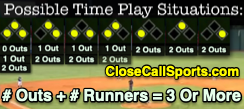
 potential also means we're dealing with a Time Play scenario. Time plays—which are plays in which umpires may be called upon to determine whether or not a leading runner touched home plate before a trailing runner was declared out for the third out of the inning (that is not a force out)—are possible whenever a third out can be recorded on a play wherein there exists any number of baserunners, which, when added to the number outs to start the play, equal three or greater. In this situation, play began with one out and two runners aboard. One plus two equals three and, accordingly, this is a potential time play. Time play situations are also possible fourth outs, and this possibility manifested here.

Official Baseball Rule 5.09(c): "Appeal plays may require an umpire to recognize an apparent “fourth out.” If the third out is made during a play in which an appeal play is sustained on another runner, the appeal play decision takes precedence in determining the out. If there is more than one appeal during a play that ends a half-inning, the defense may elect to take the out that gives it the advantage."

Accordingly, the out on Fletcher-Vance (via appeal) thus became the true third out of the inning and, pursuant to OBR 5.09(c), R1 Bradshaw's out at second base is disregarded.

Video as follows:

Tuesday, August 23, 2022

Ask UEFL - NY's Failed Dead Ball Appeal Distraction

During Monday's Mets-Yankees Subway Series, a first-inning attempted appeal play prompted confusion from both New York teams as Mets starting pitcher Max Scherzer's throw into center field when Yankees runner Anthony Rizzo took off toward second during an appeal of Andrew Benintendi's tagging up timeliness ultimately didn't count, leading Yanks manager Aaron Boone to seek an explanation from the umpires (and for some of you to seek an explanation from us!).

Here's why the appeal didn't count:

Although the too-long-didn't-read version is "the ball was dead," there's a bit more to it than that, so let's dive in.

We begin with Yankees batter DJ LeMahieu hitting a sacrifice fly to right field, allowing baserunner R3 Benintendi to score on a close play at the plate. As Mets manager Buck Showalter and company considered whether or not to request a Replay Review of HP Umpire Lance Barrett's safe call, umpires called "Time" and the ball became dead.

Although no challenge to the play at the plate was requested, the Mets felt that Benintendi may have left third base prior to right fielder Starling Marte's first touch of the fly ball, so the team from Queens set up to appeal at third base.
Relevant Rule: OBR 5.09(c)(1): "Any runner shall be called out, on appeal, when, after a fly ball is caught, they fail to retouch their original base before they or their original base is tagged."

Sensing the impending appeal, Yankees baserunner R1 Rizzo, perhaps worried that R3 Benintendi might have left early and that the appeal would be successful, took off for second base, sacrificing himself in the hopes of drawing a throw from Mets pitcher Scherzer, with the goal of goading the Mets into making a play on Rizzo so as to prevent the possibility of an appeal on Benintendi, since no appeal may occur once the defensive team has made a play or attempted play after the continuous action of the play-to-be-appealed has ended. A throw to retire (or in an attempt to retire) Rizzo qualifies as a "play or attempted play." Important to note: this "play or attempted play" rule is exclusive to professional baseball as high school and college rules state that the defense does not lose the right to its appeal if the offense initiates a play before the next pitch. The offensive "bait" play to prevent an appeal on another runner, thus, works in pro ball but not in high school/college.
Relevant Rule: OBR 5.09(c): "Any appeal under this rule must be made before the next pitch, or any play or attempted play."

Scherzer took Rizzo's bait, but threw the ball wildly into center field, enabling Rizzo to advance to third base...before the umpires ordered Rizzo back to first base, ruling that none of what just occurred actually happened. This is because HP Umpire Barrett never put the ball back into play by stating "Play" such that the entire sequence—Rizzo's advancement, wild throw into center field taking away the opportunity to appeal—occurred while the ball was still dead, meaning that none of it counted because under the professional (and NCAA/college) ruleset, the ball must be live during an appeal (in NFHS/high school, the ball can be dead during an appeal...runners can't advance during dead balls [unless it's a pre-existing base award from a live ball period] in all rulesets).
Relevant Rule: OBR 5.06(c): "While the ball is dead no player may be put out, no bases may be run and no runs may be scored, except that runners may advance one or more bases as the result of acts which occurred while the ball was alive."

Once play was reset, Scherzer took the rubber, batter Josh Donaldson entered the batter's box, HP Umpire Barrett put the ball back into play, thus making it live, the appeal was properly executed (Rizzo didn't try to draw a throw this time), and 3B Umpire Dan Merzel signaled "safe," ruling that Benintendi left third base in a timely manner after all.
Relevant Rule: OBR 5.09(c) Comment: "Time is not out when an appeal is being made."

tldr: the ball was dead | Video as follows:

Thursday, July 28, 2022

Ask the UEFL - Batted Ball Deflects Off Pitcher's Head

This quick Ask the UEFL came to us as a fairly simple question: "Is this an infield fly?" With one out and two on (R1, R2) in Cincinnati, Reds batter Donovan Solano hit a batted ball directly off Marlins pitcher Daniel Castano's head, the batted ball bouncing high in the air before settling into the glove of Reds third baseman Joey Wendle for the inning's second out. 

Stipulating that the pitcher's health is of greater importance than the play itself—especially when a concussion-inducing hit to the head is concerned—we were nonetheless asked about the rules implications of such an odd sequence as the ball remained live after the moment of injury.

Succinctly, this is not an infield fly—even though the ball careened high into the air and was caught at an angle similar to that of a fly ball. The definition of the term states, in part, "An INFIELD FLY is a fair fly ball (not including a line drive nor an attempted bunt) which can be caught by an infielder with ordinary effort, when first and second, or first, second and third bases are occupied, before two are out." Because the batted ball can best be described as a line drive, it is therefore ineligible for the infield fly rule. The third baseman could have allowed the ball to fall untouched and all runners would have been forced to advance (this is not an intentional drop, either).

Finally, we note that if R1 or R2 wished to try and advance to their next base, they would not have to wait until the third baseman ultimately caught the ball, but instead could have legally left their bases the moment the ball first touched the pitcher. Although Official Baseball Rule 5.09(c)(1) states: "Any runner shall be called out on appeal when—after a fly ball is caught, they fail to retouch their original base before they or their base is tagged," the definition of catch prevails because it directly addresses the concept of touch-without-catch: "Runners may leave their bases the instant the first fielder touches the ball."

Video as follows: