Showing posts with label Ground Rules. Show all posts

Saturday, May 2, 2026

MLB Ejections 022-23 - Carapazza, Wendelstedt (SF x2)

2B Umpire Vic Carapazza ejected Giants director of ml pitching Frank Anderson & HP Umpire Hunter Wendelstedt ejected Giants pitcher/bench player Adrian Houser (Replay Review decision upholding out call on ball that hit the catwalk/ground rules; QOCY) in the top of the 2nd inning of the #Giants-#Rays game. With two out and none on, Giants batter Heliot Ramos hit a fly ball that struck the ceiling or catwalk of Tropicana Field and was caught by Rays center fielder Cedric Mullins, ruled an out by 2B Umpire Carapazza, and affirmed as an out by Replay Review following a Crew Chief-initiated review. Pursuant to Tropicana Field ground rules, a batted ball that strikes the upper catwalks is deemed in play and may be caught for an out while a batted ball striking the lower catwalk rings in fair territory is a home run; replays do not conclusively indicate where the ball contacted the ceiling/catwalk/angled support rod, the call was correct.* At the time of the ejections, the game was tied, 0-0. The Rays ultimately won the contest, 5-1.

This is Hunter Wendelstedt (21)'s 1st ejection of 2026.
This is Vic Carapazza (19)'s 3rd ejection of 2026.
*Tropicana Field Ground Rules: "Batted ball that strikes either of the upper catwalks (known as the 'A-Ring' and the 'B-Ring'), including the masts that support each of those catwalks as well as any angled support rods that connect the 'B-Ring' to the masts that support the 'C-Ring' in fair territory: In Play. If caught by fielder, batter is out and runners advance at own risk."

These are the 22nd and 23rd ejection reports of the 2026 MLB regular season.
This is the 6th player ejection of 2026.
This is the 14th coach ejection of 2026.  Ejection Tally: 14 Managers, 3 Coaches, 6 Players.
This is San Francisco's 2/3rd ejection of 2026, 1st in the NL West (SF 3; ARI, COL, LAD, SD 0).
This is Frank Anderson's first career MLB ejection.
This is Adrian Houser's first career MLB ejection.
This is Vic Carapazza's 3rd ejection of 2026, 1st since April 7 (Jorge Soler; QOC = U [Fighting]).
This is Hunter Wendelstedt's 1st ejection since Sept 3, 2024 (Andrew Benintendi; QOC = N [Balls/Strikes]).

Monday, August 12, 2024

Padres Lose Game-Tying HR After Ball Hits Wall

What looked like Padres batter Ha-Seong Kim's game-tying home run vs Miami in the 9th inning turned into a double after Replay Review determined the ball that left the playing field failed to do so "in flight" and as such entitled the batter-runner to just two bases.

With two outs in the top of the 9th inning, and Miami leading San Diego 7-6, Padres batter Kim hit a 1-0 fastball from Marlins pitcher Andrew Nardi on a fly ball to deep left-center field where left fielder Kyle Stowers leapt to try and make a game-winning catch, only to see the ball bounce off the outfield wall, then his glove, before caroming over the wall.

Initially ruled a home run by 2B Umpire Scott Barry, Replay overturned the call to a double, which ultimately resulted in a Padres loss as Luis Campusano struck out swinging to end the game.

Should the home run have stood? Here is the rule used to justify the call.

Official Baseball Rule 5.05(a) discusses base awards, granting four bases for a fair ball that passes over a fence while giving just two bases for a bounding fair ball deflected by the fielder into the stands.

There is a specific MLB Umpire Manual interpretation on this point stating "a fair fly ball striking the top of the outfield wall and bounding over the wall shall be ruled a home run."

MLBUM continues, "A fair fly ball striking the top of the outfield wall and bounding back onto the playing field shall be treated the same as a fair fly ball that strikes the outfield wall and rebounds back onto the playing field (in play but may not be caught for the purposes of an out)".

Of similar importance, OBR defines "in flight" as "a batted, thrown, or pitched ball which has not yet touched the ground or some object other than a fielder."

Accordingly, because the fair fly ball struck the outfield fence and bounded back onto the playing field before then changing direction a second time upon hitting the fielder's glove and ultimately bouncing over the wall, it is deemed a ball rebounding onto the playing field and, thus, a double when the fielder deflected this now-bounding (and not "in flight") ball out of play.

Video as follows:

Tuesday, December 27, 2022

Correcting Broadcast Blasphemy in Runner Placement Play

When Dodgers broadcasters Joe Davis and Orel Hershiser incorrectly stated that the base award for a thrown ball bouncing out of play is based on the batter-runner's location at the time of the ball leaving the field (in this case, bouncing into and out of the Dodger Stadium camera well), Tmac decided to correct the record.

Official Baseball Rule 5.06(b)(4)(G) states that a runner advances two bases from their position *at the time the wild throw is made."* In turn, because R1 Kris Bryant was located between second and third base (having passed second base) at the time of the wild throw, his two-base award takes him to third base and to home plate, scoring a run.

The umpires initially ruled that Rockies batter-runner Brendan Rodgers had not yet arrived at first base when center fielder Cody Bellinger released his throw, resulting in a Rockies challenge for runner placement, a call that was confirmed as the Replay Official conclusively determined that batter-runner Rodgers was indeed somewhere between home plate and first base at the time of the throw, confirming the on-field umpires' ruling and making Rodgers' two-base award first base and second base.

*Please note there are limited exceptions to this rule, but none of them award bases based upon the runner's position at the time the ball left the playing field. The main exception pertains to a ball thrown out of play by an infielder on the fielder's first play (usually on a ground ball). In such a case, the runners are awarded two bases based on their positions at the time of the pitch.

Video as follows:

Thursday, August 4, 2022

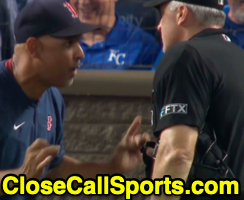
MLB Ejection 119 - Bill Welke (3; Alex Cora)

HP Umpire Bill Welke ejected Red Sox manager Alex Cora (Replay Review decision that upheld HR [out of play fair ball] call by 3B Umpire Gabe Morales; QOCN) in the bottom of the 7th inning of the #RedSox-#Royals game. With none out and two on, Royals batter Salvador Perez hit a 0-0 fastball from Red Sox pitcher Darwinzon Hernandez on a line drive to left field, ruled a home run by 3B umpire Gabe Morales and upheld as such following a challenge by Red Sox manager Cora. Replays indicate the batted ball struck the top corner of the outfield wall/padding adjacent to the foul pole but did not make contact with the foul pole above the fence-line before rebounding into the field of play, the call was incorrect.* At the time of the ejection, the Royals were leading, 7-3. The Royals ultimately won the contest, 7-3.

This is Bill Welke (3)'s 3rd ejection of 2022.
Bill Welke now has -2 points in the UEFL Standings (0 Previous + 2 MLB - 4 Incorrect Call = -2).
Crew Chief Bill Welke now has 1 point in Crew Division (1 Previous + 0 Incorrect Call = 1).
*The Kauffman Stadium Ground Rules provide that a "batted ball in flight that strikes any portion of the seating area safety fencing, including the railings," shall be considered in play similar to a ball striking the top of an outfield wall. If the ball then bounds over the outfield wall and out of play, it is a home run. If it bounds back onto the playing field, it is considered in play. A ball striking a foul pole below the fence-line shall be considered in play, similar to a ball hitting off the outfield wall.
Pursuant to the universal ground rules, "all yellow lines are in play."

This is the 119th ejection report of the 2022 MLB regular season.
This is the 64th manager ejection of 2022.
This is Boston's 4th ejection of 2022, 3rd in the AL East (NYY, TOR 8; BOS 4; BAL, TB 3).
This is Alex Cora's 3rd ejection of 2022, 1st since May 11 (Adam Beck; QOC = N [Balls/Strikes]).
This is Bill Welke's 3rd ejection of 2022, 1st since May 22 (Kevin Cash; QOC = Y [Balls/Strikes]).

Wrap: Boston Red Sox vs. Kansas City Royals, 8/4/22 | Video as follows:

Sunday, May 2, 2021

Rhys Hoskins' HR Overturned to Double in Philadelphia

With New York leading 8-5 in the bottom of the 9th inning of Sunday's #Mets-#Phillies game, Philadelphia's 1B Rhys Hoskins appeared to tie the score with a 3-run home run, only for umpires to overturn the call to a double upon Replay Review. Was this the rules-correct decision?

The Play: With two out and two on (R1, R3), Philadelphia was down to its last two strikes when Hoskins appeared to tie the game on an Edwin Diaz fastball with a three-run home run to deep right-center field, ruled a home run by 1B Umpire Jose Navas. After a Crew Chief Review, Replay HQ overturned Navas' ruling and HP Umpire Andy Fletcher signaled that New York had awarded Hoskins a double.

Ground Rule
: According to MLB's Ground Rules for Citizen's Bank Park in Philadelphia, a ball that strikes the top of the outfield fence or scoreboard and rebounds onto the playing field shall be ruled in play. The railing/chain link fence at the top of the wall in Philadelphia is considered part of the outfield fence.

Replay Decision: Clear and convincing visual evidence indicates the batted ball struck the top of the railing and caromed back onto the playing field, resulting in an overturned call. Placing baserunners was the most difficult decision for New York, but with two outs, the Replay Official, finding that runner R1 Matt Joyce was running on contact, properly awarded Joyce three bases (scoring a run), ruling that had the umpires called Hoskins' hit in play, Joyce would have scored. The Replay Official also placed Hoskins at second base—a literal ground rule double.

Aftermath: Ensuing batter Bryce Harper struck out swinging, stranding tying run Hoskins on base to end the game with a Mets victory, final score 8-7.

Video as follows:

Monday, November 12, 2018

Soto's Ground Rule Out as Fly Ball Hits Tokyo Dome Roof

MLB All-Star Juan Soto lost a potential three run home run when his fly hit the Tokyo Dome roof, turning into a routine "ground rule out" when Samurai Japan caught the ball, cuing Don Mattingly and 1B Umpire Eric Cooper to have a brief conversation about the perils of playing in a domed stadium. Spoiler: Coop & Crew got the call right.

Kobayashi explains the catch call to Don.
The Play: With one out and two on (R1, R2), in the top of the 4th inning of Game 3 of the best-of-five MLB-Japan All-Star Series, Soto hit a fly ball into deep right field that caromed off one of the white panels that comprise the stadium's high ceiling and into RF Shogo Akiyama's waiting glove, on the warning track just shy of the wall.

The Call: Cooper ruled Soto out, the second out of the inning as opposed to a three-run home run. After convening HP Umpire Kyohei Makita, 2B Umpire Kazuhiro Kobayashi, and 3B Umpire Quinn Wolcott, Cooper affirmed his original ruling and maintained the out call.

For an illustration of the Tokyo Dome ground rules, we visit the former Major League stadium in Minnesota, the Hubert Humphrey Metrodome (the Met and Tokyo Dome share iconic design elements, including the iconic paneled dome cover). Let's just say the rules are a lot easier to comprehend in these domes than Tropicana Field's catwalk system in Tampa Bay.

Ball Strikes Metro/Tokyo Dome in Flight and Falls Back into Play: Live Ball.
Eddie Guardado catches a deflected fly ball.
When Minnesota's Randy Bush hit a fly ball off one such panel at the Metrodome in 1983, Toronto's Buck Martinez was able to adjust and catch the batted ball in foul territory for an out. The same thing happened to Detroit's Rob Deer in 1992—twice!—with Minnesota shortstop Greg Gagne catching both for outs. And then there's the infamous Chili Davis fly ball that hit a hanging speaker and was caught by Baltimore's Mark McLemore, or Eddie Guardado's even more notable diving catch on a fly ball that deflected off another such speaker.
Related Video: Pitcher Guardado races off mound and dives to make the catch in foul territory.
Related Video: Greg Gagne hits two inside-the-park home runs thanks to the Metrodome roof.

Ball Strikes, and Remains, in the Space Between Two Panels: Double (if Fair), Foul (if Foul).
Shohei Ohtani's perfect hit turned into two.
This scenario doesn't happen all that often, but because of the unique system of panels that comprise the pressurized domed roof, a baseball can get lost between the tiles and come to rest in the roof itself. If this happens, as it did to Shohei Ohtani playing for Team Japan against Team Netherlands in the World Baseball Softball Confederation's Global Series 2016, the official ruling is a ground rule double for the batter. Oakland's Dave Kingman did the same thing at the Metrodome on May 4, 1984, and was similarly awarded two bases.
Related Video: Shohei Ohtani hits ball through the roof at Tokyo Dome!!

SIDEBAR: These are real "ground rule doubles," opposed to those commonplace batted balls that land on the field before bouncing over the wall and into the stands that lay-folk like to call "ground rule doubles" (they're "rulebook doubles" or "two-base awards").

In conclusion, no, there is no Replay Review in the MLB-Japan All-Star Series, but even if there was, Cooper's call would have been confirmed: that's a live ball and a catch—a ground rule out if there ever was one.

Video as follows:

Sunday, May 20, 2018

Batted Ball Caroms off Wall Into Stands - HR or 2B?

On Saturday, Jose Altuve's batted fly ball exited Houston's playing field unusually as it hit the top of the padding on a lower portion of the outfield fence, bouncing over the right-center field wall and into the stands: Is this a A) home run, B) double, or C) Let's just have Replay Review sort it out?

Bouncing batted ball in Houston: HR or 2B?
The Play: With one out and none on in the bottom of the 8th of Saturday's Indians-Astros game, Altuve hit a 0-1 slider from Indians pitcher Neil Ramirez on a fly ball to right field, where it struck the lower padded portion of the outfield fence and caromed directly into the stands, without ever touching the ground nor any player.

The Call: After 2B Umpire Jeremie Rehak's initial home run ruling and consultation with Crew Chief Bill Miller (working third base) and crewmates Todd Tichenor (HP) and Alan Porter (1B), Miller declared the play a home run, drawing a brief dissent from Indians Manager Terry Francona, and an immediate election to initiate a Crew Chief Review.

Bill Miller announces the result of a Replay.
Replay Review: After a brief review, the Replay Official deemed the play a two-base award, determining that the ball hitting the wall's midsection constituted a bounding ball. By rule, any bounding ball that exits the playing field is a two-base award. The answer to the above question is C B.

All jokes aside, there is no option C (instant replay) at most levels of ball, so knowing this rule is of great importance. Here's why this is a two-base award:

Precedent: What's unusual about Saturday's play in Houston is that a very similar play transpired just three years ago and the umpires acted nearly identically as they did Saturday. In 2015, Gerry Davis' crew similarly encountered a batted ball that deflected off the middle of an outfield wall in Kansas City and subsequently bounced over an adjacent portion of the wall. Like Miller's crew, Davis' crew originally ruled the play a home run, a decision subsequently overturned via Replay Review to a two-base award.
Related Post: 2B Bounding Ball Over Ground Rules-Less Kauffman

See Official Baseball Rule 5.05(a)(7) ("A fair ball, after touching the ground, bounds into the stands, or passes through, over or under a fence, or through or under a scoreboard, or through or under shrubbery, or vines on the fence, in which case the batter and the runners shall be entitled to advance two bases"), which establishes that a bounding ball that exits the playing field results in a two-base award.

This is obviously not a traditional ball-hits-ground situation, is not covered by the Minute Maid Park nor Universal Ground Rules, and is not covered by the MLB Umpire Manual's interpretation that a ball which strikes the top of the wall and exits the playing field is a home run.

The top of the wall is in play until it isn't.
However, Wendelstedt shares a NFHS interpretation of this particular play (8.3.3) that finds that the ball must clear the fence in flight or on deflection from a fielder in order to be considered a home run, which, in OBR, is Rule 5.05(a)(5) ("A fair ball passes over a fence or into the stands at a distance from home base of 250 feet or more") and Rule 5.05(a)(9) ("if deflected [by a fielder] into the stands or over the fence in fair territory, the batter shall be entitled to a home run"); the middle of the fence is not "in flight" enough. See: Jose Canseco for more.

SIDEBAR: A batted ball in flight deflected by a fielder into the stands in foul territory (to the foul side of the pole) is a two-base award.

The reason that a ball that hits the top of the wall and immediately bounces out of play is considered a home run even though the ball is not physically "in flight" once it touches the top of the wall is because MLBUM specifically interprets the issue of a ball striking the top of the wall and no further permutation or possibility. This same interpretation holds that the top of the wall is considered both in play (insofar as a ball that strikes the top of the wall and caroms back into the playing field is in play) and out of play (insofar that a ball that comes to rest on the top of the wall is considered dead).

For more on the top-of-the-wall interpretation, see this incorrect Replay Review decision from 2017.
Related Post: Replay Review, Ground Rules, and Levi's Landing (9/1/17).

Spirit of the Rule: An interesting note about related Ground Rules history pertains to a recent change to the Dodger Stadium ground rules, which suggests the spirit in which the home run rule exists. In the past, Dodger Stadium featured a ground rule that held that if a batted ball in flight hit any part of a bullpen gate in the outfield and bounced into the stands, the ruling would be a home run.

Illustration of Dodger Stadium's ground rule.
Upon review, this ground rule was found to be in conflict with the Official Baseball Rules, which, according to Rule 4.05, is illegal ("ground rules...shall not conflict with the official playing rules").

As a result, the ground rule was changed to "Batted ball hitting bullpen gate in either left or right field at a point above the lower wall and continuing over the lower wall in fair territory: Home Run."

The purpose of this change was to bring the ground rule into compliance with the prevailing interpretation that a ball must achieve the wall's height in order to be eligible to be considered a home run pursuant to Rule 5.05(a)(5) [there is no minimum height issue for a batted ball deflected by a fielder, as in 5.05(a)(9)]. This explains why a ball bouncing into the stands from the top of the wall is a home run and why a ball bouncing into the stands after bouncing off the wall at a height below its top is considered a bounding ball and not a home run.

Minute Maid Park agrees: "Batted ball strikes higher wall or railing at a point above the lower wall and rebounds over lower wall: Home Run." There is no ground rule for a point lower than the top of the lower wall.

Without a Ground Rule to address it, as in KC, a less-than-top-of-wall-to-stands hit is two-bases.

Miller grabs the headsets in Houston.
Conclusion: The ball did not strike the top of the wall in Houston; it bounced off the middle of the fence below the height of the top of the wall it bounced over. For that reason, this bounding ball was subject to Rule 5.05(a)(7), making it eligible for a two-base award upon subsequently clearing the adjacent outfield wall at a point higher than at which it initially struck the padded fence (making it ineligible for the aforementioned Houston ground rule). Score it a double for Altuve.

As far as Replay Review is concerned, this is a rare instance in which the Replay Official overturned a matter of rule interpretation, as opposed to a simple judgment call...unless, somehow, the umpires did not see the ball striking anything below the height of the lower fence-adjacent wall in right field.

That's Odd: Maybe this rule interpretation reversal has something to do with Miller's Friday snappiness with Houston's on-field Replay Technician...

Video as follows:

Saturday, April 14, 2018

The Tarp Lodge - A Ball Still Moving Cannot Be Stuck

A Boston blooper turned into a Baltimore blunder Friday at Fenway Park when Orioles batter Adam Jones' pop-fly in shallow right field fell onto the field's tarp, setting up a challenge to determine whether the ball was stuck, lodged, or free, as Red Sox RF Mookie Betts threw out a jogging Jones, who had eased up, assuming the ball was out of play.

Replay Review: O's Manager Buck Showalter challenged 1B Umpire Stu Scheurwater's ruling that the baseball was live and in play along the right field wall.

Analysis: When Jones' batted ball bounced from fair territory to the LL Bean tarp along the right field fence-line, many of those on the playing field—including Jones—likely lost sight of the ball as it dropped behind the apex of the tarp. Official Baseball Rule 5.05(a)(7) states that the batter becomes a runner when, among others:
Any fair ball which, either before or after touching the ground, passes through or under a fence, or through or under a scoreboard, or through any opening in the fence or scoreboard, or through or under shrubbery, or vines on the fence, or which sticks in a fence or scoreboard, in which case the batter and the runners shall be entitled to two bases.
Rule 5.06(b)(4)(F) is the equivalent for runners ("...Two bases, if a fair ball bounces or is deflected into the stands outside the first or third base foul lines; or if it goes through or under a field fence, or through or under a scoreboard, or through or under shrubbery or vines on the fence; or if it sticks in such fence, scoreboard, shrubbery or vines").

Is this ball stuck behind the tarp?
When it comes to tarps, the Universal Ground Rules simply states, "A catch may be made on the field tarp." Fortunately the MLB Umpire Manual helps further establish that Rule 5.06(b)(4)(F) applies to tarps: "A ball that goes behind a field tarp or wall padding without leaving the playing field should also be considered to be lodged and the same two base award applies. The determination of whether a ball is lodged is subject to Replay Review."

We usually see this with batted balls that roll to the outfield wall, when the question becomes whether or not the ball has become stuck in the small space formed by warning track, base of the wall, and bottom of the wall's padding, which generally protrudes several inches onto the playing field. Colloquially, as long as the ball indeed sticks underneath the padding, it is considered out of play. If the ball remains in motion or appears loose, it is considered in play simply because the ball has not yet proven itself to be "stuck" or otherwise out of play. For instance, a ball that rolls underneath wall padding, only to carom back onto the naked warning track is in play.
Related Post: Cause You're Stuck in the Wall - Batted Ball Out of Play (9/20/16).

Cederstrom & Scheurwater await a decision.
Back to Fenway, the potential lodge location is created by the curved tarp and vertical padded wall: as long as the ball is moving and accessible to the fielder, it is live and in play; when it comes to rest, it may be deemed "stuck" and out of play.

Here is some support from MLBUM, regarding its interpretation of batted balls that land on top of outfield walls—not directly applicable, but the interp gives an idea of how motion influences a ball's status: "A fair fly ball striking the top of the outfield wall and remaining on the top of the wall shall be deemed a ground-rule double...A fair fly ball that strikes the top of the outfield wall and is picked up by a spectator while still in motion shall be ruled a home run. A fair fly ball that lands on top of the outfield wall and is picked up by a spectator after coming to a stop shall be deemed a ground-rule double."
Related Post: Replay Review, Ground Rules, and Levi's Landing (9/1/17).

Hidden from view, this ball is not dead yet.
Conclusion: As long as the ball is still in motion and accessible to a fielder, it is alive and in play, if for no other reason than it is not yet dead; once the ball stops moving, it is subject to remedial action, such as Rule 5.06(b)(4)(F), and a two-base award from time-of-pitch would be appropriate.

As umpire Mike DiMuro once said, "Ultimately, the proper ruling must be made by the base umpire who is responsible for the flight of the ball – and it is only possible to do so by running out to the fence to visually discern and confirm that the ball is indeed lodged or stuck. If the fielder dislodges the ball by grabbing it and removing it, then it can no longer be considered lodged or stuck."

Because of Betts' speed in retrieving the baseball, however, it is difficult even with instant replay to determine whether the ball came to rest—whether it was truly stuck behind the tarp. The Replay Official, faced with this inconclusive evidence, ruled that the call should stand: Jones is credited with a single and Betts with a 9-6 putout.

That said, if Betts' arrival to the ball is a split second later, perhaps the evidence would then be clear and convincing that the ball, indeed, was "stuck." | Video as follows:

Friday, September 1, 2017

Replay Review, Ground Rules, and Levi's Landing

A batted ball poised to land atop the green metal roof on AT&T Park's right field wall went to Replay Review a home run and came out the other end a fan interference-aided double.

Replay Review spent 5 minutes on this play.
*UPDATE*: MLB Admits HR Replay Error in Giants Game (9/1/17).

This play is an exercise in ground rule particulars for AT&T Park, a quick revisit to baseball's fan interference rules, and a discussion of the definition of a rather common dictionary term. It's also a rudimentary review of sound structural engineering in the earthquake country known as California, and how a simple case of construction best practices led to a confusing situation.

The Play: With none out and one on (R2) in the bottom of the 9th inning of a 5-1 Cardinals-Giants game, Giants batter Brandon Crawford hit a 2-2 pitch from Cardinals reliever John Brebbia to deep right field near the foul pole. As the ball descended toward the wall, a fan reached across and in front of the foul pole to catch the live ball before it struck the outfield wall, roof, or pole.

The Call: 1B Umpire Tom Woodring signaled "home run," a call that contained several significant elements. First, Woodring ruled the ball fair. Second, Woodring ruled the ball left the playing field in flight. Third, Woodring ruled the ball had not been subject to spectator interference before leaving the playing field (or if it had, that the ball would have been a home run regardless of the fan's actions).

Conflict: Local Ground Rules vs Universal Ground Rules - Which Rule Supersedes the Other?
A fan reaches to grab a batted ball in flight.
Unfortunately, local ground rules in San Francisco appear somewhat in conflict with the Universal Ground Rules issued by the Office of the Commissioner. According to the AT&T Park Ground Rule Particulars, "batted ball landing on green metal on top of right field wall: Home Run." By contrast, the Commissioner's Universal Ground Rules issued for use at all MLB stadiums state, "all yellow lines are in play." As evidenced by the attached photograph, there is a yellow line painted onto the green metal on top of the right field wall at AT&T Park: the foul pole is clearly recessed and does not begin at the front edge of the green metal, yet no rule specifically states that a foul pole must be positioned at the front edge of dead ball territory (and, for structural engineering reasons we'll discuss later, it would be irresponsible to place the foul pole here). Again, however, a Universal Ground Rule does say that "all yellow lines" are in play.

Meanwhile, Official Baseball Rule 4.05, entitled "Special Ground Rules," states:
The manager of the home team shall present to the umpire-in-chief and the opposing manager any ground rules he thinks necessary covering the overflow of spectators upon the playing field, batted or thrown balls into such overflow, or any other contingencies. If these rules are acceptable to the opposing manager they shall be legal. If these rules are unacceptable to the opposing manager, the umpire-in-chief shall make and enforce any special ground rules he thinks are made necessary by ground conditions, which shall not conflict with the official playing rules.
The MLB Umpire Manual, regarding a fly ball striking the top of a wall, posits several contingencies:
A) "Unless provided otherwise by local ground rule, a fair fly ball striking the top of the outfield wall and bounding back onto the playing field shall be treated the same as a fair fly ball that strikes the outfield wall and rebounds back onto the playing field";
B) "Unless provided otherwise by local ground rule, a fair fly ball striking the top of the outfield wall and bounding over the wall shall be ruled a home run";
C) "Unless provided otherwise by a local ground rule, a fair fly ball striking the top of the outfield wall and remaining on the op of the wall shall be deemed a ground-rule double";
D) "Unless provided otherwise by local ground rule, a fair fly ball striking the top of the outfield wall that in the umpire's judgment would have bounded over the wall if not for the permissible action of a spectator shall be ruled a home run. A fair fly ball that strikes the top of the outfield wall and is picked up by a spectator while still in motion shall also be ruled a home run. A fair fly ball that lands on top of the outfield wall and is picked up by a spectator after coming to a stop shall be deemed a ground-rule double."

Thus, in conclusion, based on the MLB Umpire Manual's verbiage, the local ground rule supersedes the Universal Ground Rules insofar as a fair fly ball at the outfield wall is concerned. Thus, we're back to the AT&T Park ground rule about a batted ball "landing" on the green metal. Conflict solved.

Dictionary Definition, Landing: "an act of returning to the ground or another surface after a flight." As any pilot or aviation enthusiast will surely tell you, a full-stop "landing" encompasses everything from descending through the air until the airplane finally comes to rest.

Two types of outfield wall at AT&T Park.
Here's an ejection over an argument about
the concrete slant portion of the wall.
So can the ball still be moving/is the initial "strike" on the metal enough for a "landing"?
Back to the airplane example, I'm sure most of us have been on flights with a "bounce" landing: the plan bounces on the runway before finally completing its touchdown. Would you consider the first "bounce" part of the overarching "landing"? A glimpse at the MLBUM's "D)" provision might be a clue: if a spectator picks up a ball while it is still in motion, it is a home run. If a spectator picks it up after coming to rest, it is a ground rule double.

Wait, a spectator can cause a fair batted ball hit on top of a wall to be a home run or a ground rule double based on when (s)he touches it? Yes, per the MLBUM, it's a HR if touched while the ball is on top of the wall and still in motion, and a ground-rule double if touched while on top of the wall after the ball has come to rest, unless provided otherwise by a local ground rule. Still, a nice little loophole to consider if you're a fan of the home team.

In this case, AT&T Park's ground rule states a batted ball landing on the green metal is a home run.

Fieldin Culbreth displays a fan INT signal.
Spectator Interference Rule: Fan interference occurs when "a spectator reaches out of the stands, or goes on the playing field, and (1) touches a live ball or (2) touches a player and hinders and attempt to make a play on a live ball." Meanwhile, the ball becomes dead when it leaves the playing field or is touched by a fan. If the fan in San Francisco never reached out beyond the green metal roof atop the wall, then he never satisfied the "reaches out of the stands" provision of the spectator interference rule; thus, this play is not subject to a call of fan interference.

Let's see what the final call ended up being.

Woodring (L) and Everitt await NY's ruling.
The Review and Call: Upon Crew Chief Review initiated by 3B Umpire Mike Everitt (having just returned from Tuesday's injury in Colorado), the Replay Official in New York elected to overturn 1B Umpire Woodring's call and ruled the play a double, concluding that the fan had reached out of the stands and touched a live ball, and that, absent the fan's actions, the ball would not have landed on the green metal atop the right field wall.

As a result, the baserunner was awarded two bases (2B => HP) and the batter was similarly awarded two bases, for a double.

Actual location vs spot required for fan INT.
Conclusion: Based on the aforementioned discussion, side angle replays, and AT&T Park Ground Rule Particulars, there should have only been two potential outcomes for this play:
1) Woodring's HR call stands as called, or;
2) Woodring's HR call is overturned to that of foul ball.

The attached image demonstrates the fan's proximity toward the playing-edge of the right field wall, which would have been a necessary achievement in order to draw a call of spectator interference.

Thus, the Replay Official either employed particularly unique judgment in approximating the fan's reach past the leading edge of the green metal roof or failed to properly apply the local ground rule for AT&T Park's green metal-capped wall in right field.

Could the Giants Protest? Assume the ground rule was wholly misapplied. Replay Review Regulation II.L.4 dictates what happens when a team protests a Replay Review decision: "Official Baseball Rule 7.04 (formerly Rule 4.19 [concerning protests]) shall have no applicability to these Replay Regulations. No protest shall ever be permitted on judgment decisions by the Replay Official. Moreover, a violation of any rule or procedure set forth herein shall not constitute a basis for protesting a game."

Logically, this would be a HR without the fan.
History of the Right Field Wall at San Francisco's AT&T Park (and Why the Foul Pole is Recessed): In 2012, we discussed Rule 1.04 regarding field dimensions, and specifically cited the Giants' departure from Candlestick Park to AT&T Park. Due to the new stadium's proximity to San Francisco Bay and McCovey Cove, the Giants were granted an exemption to OBR 1.04's standard 325-foot minimum length for a foul line; in San Francisco, the right field foul line spans 309 feet. In exchange for the exemption, San Francisco built a higher-than-usual wall along the fair territory right field boundary: the wall is 24 feet high (in honor of Willie Mays, who wore #24). The spectator area along the top of the wall is presently known as "Levi's Landing" and the green metal roof atop the wall, which juts out above the right field warning track, was designed to minimize questions of spectator interference; hence the ground rule calling for an automatic home run for a ball landing on the green metal. Meanwhile, the foul pole is recessed because it would be structurally unsound for a foul pole to be placed on top of what amounts to a balcony: because the foul pole is of considerable height, it requires a foundation; no earthquake-conscious engineer, architect, or contractor in good faith would allow such a tall structure in California to be placed on the edge of a balcony without adequate support underneath.
Related Post: Rule 1.04 [2.01] Note (a): Minimum Field Dimensions (6/19/12).

Video as follows:

Saturday, May 20, 2017

MLB Ejection 041 - Mike Winters (1; Bob Melvin)

2B Umpire Mike Winters ejected A's Manager Bob Melvin (base award/runner placement) in the bottom of the 2nd inning. With one out and two on, A's batter Josh Phegley hit a 0-1 fastball from Red Sox pitcher Drew Pomeranz on the ground to catcher Christian Vazquez, whose throw to first base was wild and bounded out of play by lodging in the right field bullpen.* Accordingly, the umpires awarded the batter-runner and base runners two bases from their location at the time of the pitch, pursuant to Official Baseball Rule 5.06(b)(4)(G), the call was correct. At the time of the ejection, the Red Sox were leading, 2-1. The A's ultimately won the contest, 8-3.

This is Mike Winters (33)'s first ejection of the 2017 MLB regular season.
Mike Winters now has 3 points in the UEFL Standings (-1 Previous + 2 MLB + 2 Correct Call = 3).
Crew Chief Mike Winters now has 2 points in Crew Division (1 Previous + 1 Correct Call = 2).
*According to Oakland Coliseum Ground Rules, a ball lodging on, under or in the bullpen seating area is Out of Play. A ball is considered "lodged" when, in the umpire's judgment, it is unplayable.
^Rule 5.06(b)(4)(G) states, "Each runner including the batter-runner may, without liability to be put out, advance—two bases when...a thrown ball goes into the stands, or into a bench [bullpen]...When such wild throw is the first play by an infielder, the umpire, in awarding such bases, shall be governed by the position of the runners at the time the ball was pitched."

This is complicated by the Oakland Coliseum's large playing surface.
5.06(b)(4) Approved Ruling: "The term 'when the wild throw was made' means when the throw actually left the player’s hand and not when the thrown ball hit the ground, passes a receiving fielder or goes out of play into the stands. The position of the batter-runner at the time the wild throw left the thrower’s hand is the key in deciding the award of bases. If the batter-runner has not reached first base, the award is two bases at the time the pitch was made for all runners. The decision as to whether the batter-runner has reached first base before the throw is a judgment call."
This is the 41st ejection report of 2017.
This is the 22nd Manager ejection of 2017.
This is Oakland's 2nd ejection of 2017, T-1st in the AL West (OAK, TEX 2; SEA 1; HOU, LAA 0).
This is Bob Melvin's 1st ejection since July 15, 2016 (Mark Wegner; QOC = Y [Balls/Strikes]).
This is Mike Winters' 1st ejection since March 24, 2017 (Avisail Garcia; QOC = U [Balls/Strikes]).

Wrap: Boston Red Sox vs. Oakland Athletics, 5/20/17 | Video via "Read More"

Thursday, September 29, 2016

The Price is Wrong as Reds Fail to Replay Walk-Off 2B

A Cardinals' walk-off double stood when Cincinnati failed to timely challenge the game-ending play in St. Louis.

Diagram of Busch Stadium's left field wall.
With two outs and a runner on first base in the bottom of the 9th inning of a tied ballgame in St. Louis Thursday evening, Cardinals batter Yadier Molina hit a line drive to left field that bounced on the warning track before caroming up and off of the wall or recessed advertising panel in left field, ruled alive and in play by 3B Umpire Scott Barry, as baserunner R1 Matt Carpenter hustled around the from first base to score the game-winning run.

Busch Stadium ground rules address the top of the wall situation in left field, specifying that a batted ball in flight striking the top of the wall above the padding and rebounding onto the playing field shall be ruled in play. A ball in flight or otherwise that strikes beyond the top of the wall shall be ruled out of play.

St. Louis celebrates its walk-off win.
Thus, with regard to Molina's game-ending hit Thursday night, the bounding ball hitting the recessed advertising panel atop the padded wall, which is depicted on the right side of the above diagram, is to be considered out of play, whereas a ball that merely hits the top of the padded wall (as indicated by the teardrop marked "2") before rebounding onto the playing field is to be considered in play.

If the batted ball bounced out of play, pursuant to Rule 5.05(a), the proper award is two bases to both batter Molina and runner Carpenter, meaning he would be placed at third base. If the ball remained in play, the run obviously would count.

In other words, this was a crucial game-ending call that Cincinnati had nothing to lose by challenging.

Yet they failed to challenge the play. By the time Reds Manager Bryan Price sought out HP Umpire and Crew Chief Bill Miller to request a Replay Review, the umpires had already left the playing field.

Pursuant to Replay Regulation II.D.1 (Timing of Manager Challenges and Crew Chief Reviews), "A challenge to a play that ends the game must be invoked immediately upon the conclusion of the play, and both Clubs shall remain in their dugouts until the Replay Official issues his decision."

Replays indicate that nearly 30 seconds transpired from the conclusion of the game-ending play and Price's departure from the dugout to seek out an umpire. In other words, he was too late: the umpires had already left the field, and were under no obligation to entertain the manager's delay (furthermore, entertaining Price's challenge after such a delay would run afoul of II.D.1).

Price blamed MLB's rule for his non-challenge.
In post-game comments to the press, Price explained that his team was allotted 10 seconds to decide whether or not to challenge the play, and that he felt 10 seconds was insufficient to make such a determination: Price stated that his team did not have a real-time view of the play and, thus, didn't see it fall into dead ball territory. [NOTE: 10 seconds refers to a Manager's Challenge of a third-out play. As pertains to a game-ending "walk-off" situation, as well as a third-out Crew Chief Review, the Replay Regulation states the manager must leave the dugout to seek a challenge or request for review immediately after the conclusion of the play. "Immediately" may reasonably be interpreted as "10 seconds."]

Price also stated that a game with playoff implications should be treated more leniently in regards to the rule. While St. Louis has a chance to make the Wild Card, Price's Reds have been eliminated from playoff contention since earlier this season. Cincinnati's record as of Thursday night is 67-92.

In what may come as a shock to no one, Price in his comments displayed a lack of rules knowledge.

Unlike a potential Manager's Challenge that may occur at any other point during the game, wherein a manager might "hold" up play while he consults with his video coordinator, a challenge on the game's final play must be filed immediately, which leaves no time to internally review the play. Because Price failed to timely challenge Barry's "in play" call, the game was considered final the moment the final umpire exited the field and deemed Cincinnati had failed to immediately challenge the call.

In other words, the moment Price referenced a need to have more time to review the play and/or receive a phone call from the video room, his argument ran contrary to the spirit of immediately.

Managers have previously been ejected (Walt Weiss, by Jerry Layne, 6/17/15) and have even protested games (Joe Maddon, of Bob Davidson, 8/26/14) over complaints that the opposing manager took too long to request a Replay Review, suggesting there are at least a few skippers out there that have read the Replay Regulations well enough to at least have an inkling as to Replay Review timing. Perhaps had Miller honored Price's untimely challenge, Mike Matheny would have joined Weiss and Maddon in being ejected for or protesting the cause (in his own post-game presser, Matheny referenced the timely requirement in filing a challenge "immediately" after a game-ending play, indicating he knew of the rule). After all, the desire to win has always trumped fair play.

Saturday, August 20, 2016

Case Play 2016-8 - Time Goes Out During Play [Solved]

Orlando Arcia ended up on third base after collecting his first career hit when Jean Segura threw the ball into the Brewers dugout as Arcia stood at first base.

Umpires O'Nora, Segal, Tumpane & Kellogg.
The Play: With two out and one (R3) on during Milwaukee's weekend series in Arizona, Arcia hit a line drive into right field, scoring the runner from third. When the ball was subsequently thrown back into the infield with Arcia content and standing at first base with his first career RBI single, Diamondbacks second baseman Jean Segura threw the milestone baseball toward the Brewers dugout, as is MLB tradition, where Scooter Gennett was waiting on the top step, with a foot on the warning track, to retrieve it, while 1B Umpire John Tumpane was waiting to rule on the legality of the play.

Replays indicate that HP Umpire Jeff Kellogg appeared to call "time" before F4 Segura released his throw.

Question: Given the aforementioned play, consider the following variations relative to when the plate umpire called "Time" and state where batter-runner Arcia should be placed for each scenario.
(A) Umpire calls "Time" before Segura throws the ball (as occurred during the aforementioned play).
(B) Umpire calls "Time" after Segura throws the ball, but before it arrives at the dugout (is in the air).
(C) Umpire calls "Time" after Segura's throw is caught by Gennett, who is still outside the dugout.
(D) Umpire calls "Time" after Segura's throw is caught by Gennett, who is back inside the dugout.

Solution: In general, play is suspended at the moment an umpire calls "Time" [5.12(a)]; however, ensuing action such as the departure from the playing field of a ball that had been thrown before "Time" was called, may determine certain penalties or awards to be applied during the dead ball period [6.01(h) Comment]. As such...
(A) B1 Arcia remains at first base, as "Time" had been called prior to Segura's throw.
(B) B1 Arcia is awarded third base (two bases from the time of the throw).
(C) B1 Arcia is awarded third base.
(D) B1 Arcia is awarded third base.
Final note: Gennett's actions of catching the throw on the lip of the dugout (live ball territory) simply means that the play becomes dead the moment he intentionally grabbed the ball (only applicable to scenarios (C) and (D)). The "nullify the act" portion of the interference rule means that the umpires shall apply their judgment to determine whether, if not for the interference, Segura's throw would have exited the playing field and, thus, entitled Arcia to third base.
Postscript Note: Naturally, common sense would dictate that the throw wasn't "wild" but merely a post-play courtesy for a rookie Major Leaguer who just collected his first career big league hit.

Official Baseball Rules Library
OBR 5.06(b)(4)(G): "Each runner including the batter-runner may, without liability to be put out, advance—Two bases when, with no spectators on the playing field, a thrown ball goes into the stands, or into a bench (whether or not the ball rebounds into the field), or over or under or through a field fence, or on a slanting part of the screen above the backstop, or remains in the meshes of a wire screen protecting spectators. The ball is dead. When such wild throw is the first play by an infielder, the umpire, in awarding such bases, shall be governed by the position of the runners at the time the ball was pitched; in all other cases the umpire shall be governed by the position of the runners at the time the wild throw was made."
OBR 5.12(a): "When an umpire suspends play, he shall call “Time.” At the umpire-in-chief’s call of “Play,” the suspension is lifted and play resumes. Between the call of “Time” and the call of “Play” the ball is dead."
OBR 5.12(b): "The ball becomes dead when an umpire calls 'Time.'"
OBR 6.01(d): "In case of unintentional interference with play by any person herein authorized to be on the playing field (except members of the team at bat who are participating in the game, or a base coach, any of whom interfere with a fielder attempting to field a batted or thrown ball; or an umpire) the ball is alive and in play. If the interference is intentional, the ball shall be dead at the moment of the interference and the umpire shall impose such penalties as in his opinion will nullify the act of interference."
OBR 6.01(h) Comment: "The ball is immediately dead when this signal ["Time" due to obstruction] is given; however, should a thrown ball be in flight before the obstruction is called by the umpire, the runners are to be awarded such bases on wild throws as they would have been awarded had not obstruction occurred."
Universal Ground Rules: "Ball on the top step (lip) of the dugout is in play."

Video available via "Read more"

Wednesday, July 22, 2015

2B Bounding Ball Over Ground Rules-Less Kauffman

A Pirates' fly ball bouncing off and over the outfield wall in Kansas City produced a rule-book double upon a Crew Chief review, effectively overturning the umpires' original on-field ruling of a home run. With replays clearly showing Starling Marte's drive hitting high off the fence in left field before kicking in the air and landing beyond the wall, all while in fair territory, Pittsburgh Manager Clint Hurdle was left wondering how such a high-flying hit could be declared anything but a homer, especially after ruled a home run on the field by 3B Umpire Phil Cuzzi and crew chief Gerry Davis.

Here's how.

Official Baseball Rule 6.09 (2015 OBR 5.05(a)(5)) states that a batter shall have hit a home run and be entitled to touch all four bases when, "A fair ball passes over a fence or into the stands at a distance from home base of 250 feet or more." Oddly enough, the rule governing a fair ball passing over the fence at this distance greater than 250' fails to include the term "fly ball," but the phrase makes an appearance just one sentence later, in regards to the no-longer existing short dimension: "A fair fly ball that passes out of the playing field at a point less than 250 feet from home base shall entitle the batter to advance to second base only."

Regardless, the rule regarding a home run pertains specifically to a "fair fly ball," and moreso we're looking for a fair fly ball that passes over top of the wall. Replays clearly indicate the ball hit the wall several feet below its top (since, at Kauffman Stadium, the railing/chain-link portion in front of fans is considered part of the outfield wall [we thought MLB might want to shift Kauffman away from the Universal Ground Rules following that particular 2011 play, but...they didn't]), meaning that we essentially have a ball hitting mid-wall, and caroming off that at a height that enabled it to bounce out of the playing field.

Remember this photo? KC's lack of Stadium-specific
ground rules has once again caused confusion.
Subsequent provision (8) governs, "Any bounding fair ball is deflected by the fielder into the stands, or over or under a fence on fair or foul territory, in which case the batter and all runners shall be entitled to advance two bases." Yet we also know, pursuant to provision (9), that "Any fair fly ball is deflected by the fielder into the stands, or over the fence into foul territory, in which case the batter shall be entitled to advance to second base; but if deflected into the stands or over the fence in fair territory, the batter shall be entitled to a home run."

So at this point, our key distinction is "bounding fair ball" versus "fair fly ball," or simply "bounding" vs "fly."

Bounding: A bounding ball is one that has bounced (and specifically bounced off of the ground, wall, or any other object which is not a defensive player); we see the term "bounded" in two places within the rules: Regarding fair/foul status on a batted ball passing first or third base, and regarding a fair ball entering the stands. A ball is said to be "bounding to the outfield" if it has been batted, and more practically, if it has touched the ground prior to the front edge of first/third base. A ball is bounding over the wall, similarly, if it has touched the playing field in some way prior to leaving it.

Fly: A ball is on the fly as long as it has not been touched (e.g., catching a ball "on the fly" for an air out). In the case of passing first/third base for determining fair/foul, in stark contrast to a bounding ball, a fly ball is not adjudged to be fair/foul until it is no longer a fly - until it has touched something, or more overtly, has changed direction from its natural descent. Usage: Sacrifice fly, infield fly, etc.

Deflected: To cover all of our bases, a deflected ball is one whose trajectory has changed by virtue of a player touching the ball - whether after being a bounding ball or a fly ball. Usage: As in (9), a defensive player deflecting a fly ball over the fence in fair territory results in a home run.

As you can see, bounding and fly are mutually exclusive and, generally speaking, a fly ball could precede a bounding ball on the same play, but a bounding ball will not precede a fly ball.

Kauffman Stadium in Kansas City has long held no unique ground rules (which itself has caused major problems in the past, even with replay review in existence), meaning that the actual OBR set of rules referenced above were the only regulations governing this play. (So this is effectively our second campaign to get Kauffman its own set of ground rules since we've now seen two HR/Not HR calls ruled incorrectly on the field on balls first striking below the full height/railing of the wall, since the Universal Ground Rules predates Kauffman's addition of the spectator-friendly railing extension. Other facilities, such as Pittsburgh, have ground rules specifically addressing height disparities amongst its outfield walls [at PNC Park, a similar play pursuant to ground rule would likely be a home run; absent ground rule, it would be a two-base award similar to the present play in KC].)

Replays of the Pirates non-HR indicate the fair fly ball struck the outfield wall in left field, at which point the fly ball became a bounding ball. The now-bounding ball caromed high in the air before falling on the out-of-play side of the fence in left (also in fair territory). Because a bounding ball exited the playing field, as opposed to a fly ball in flight, Rule 6.09 (2015 OBR 5.05(a)(8)) took effect (as opposed to, say 5.05(a)(5)), meaning the batter was awarded two bases for the bounding ball exiting the playing field.

Video: Starling is sent to second on fly ball ruling which is reversed to the status of "bounding" (PIT)

Sunday, November 16, 2014

Case Play (ABL Ejection): Stepping Over the Line

An umpire's out/live ball in play vs. dead ball call sparked an ejection in the Australian Baseball League this weekend as 3B Umpire Neil Poulton ejected Adelaide Bite Manager Brooke Knight for arguing a live ball call in the bottom of the 5th inning of the Heat-Bite game. With none out and two on, Bite batter Chan Moon hit a sacrifice fly to Heat left fielder Tim Smith in foul territory, Bite baserunner R3 Rocky Gale scoring as R1 Michael Miller remained at first base. At issue was not the validity of the out (catch) call, but whether F7 Smith "fell" before throwing the ball back into the infield and keeping Miller at first base. The ground rules for the Norwood Oval specify that an out-of-bounds line shall exist in the corners of the outfield, in front of the bullpens, and that a fielder or ball crossing this line shall be deemed out of play.

Momentum carries F7 across the OOP line.
The ABL uses the Official Baseball Rules; pursuant to OBR Rule 5.10(f), "When a fielder, after catching a fly ball, falls into a bench or stand," the ball is dead. However, "If a fielder after making a catch steps into a bench, but does not fall, the ball is in play and runners may advance at their own peril." Rule 7.04(c) specifies that each runner may advance one base when "A fielder, after catching a fly ball, falls into a bench or stand, or falls across ropes into a crowd when spectators are on the field." Rule 6.05(a) Comment similarly states that the "ball is in play unless the fielder, after making a legal catch, falls into a dugout or other out-of-play area, in which case the ball is dead." Replays indicate F7 Smith slid and caught the ball in the field of play, appearing to regain his footing before stepping over the out-of-play line (see attached photograph).

Q: Does this constitute a "fall" under Rule 5.10(f) or a "step into a bench"? Is a bullpen a bench?
HINT: MLBUM #24(5).
Case Play Note: Yes, the 2014 UEFL season has concluded. However, up to two Case Play points for the 2015 UEFL season may be gained through contributing to this discussion.

Wrap: Perth Heat vs. Adelaide Bite (Australian Baseball League), 11/15/14
Video: Sac fly to LF gives Bite a 3-1 lead and fireworks, too, on question of Smith's status (ABL)

Wednesday, May 21, 2014

MLB Instant Replay Review 336: Bill Welke (09)

Instant Replay Review confirmed HP Umpire Bill Welke's live ball (ground rule, fair) call in the bottom of the 9th inning of the Athletics-Rays game. With one out and none on, Rays batter Logan Forsythe hit a 3-1 fastball from Athletics pitcher Sean Doolittle on a pop fly on the infield and off of the upper catwalk (mast between 'A' and 'B-Ring'). Upon Replay Review as the result of a request by A's Manager Bob Melvin and initiation by Crew Chief Brian Gorman, Welke's ruling was affirmed, the call was correct. At the time of the review, the Athletics were leading, 3-2. The Athletics ultimately won the contest, 3-2.

This is Bill Welke (52)'s ninth Replay Review of the 2014 MLB Regular Season.
This is Crew Chief Brian Gorman's 13th supervised Replay Review of the 2014 season.

This is the 336th Instant Replay Review of the 2014 MLB Regular Season.
This is Athletics Manager Bob Melvin's 19th Replay Review of 2014.
Umpires are now 176/336 (.524 Affirmation Rate) in Replay Reviews during the 2014 MLB season.

Wrap: Oakland Athletics vs. Tampa Bay Rays, 5/21/14
Video: Play confirmed; Ball hits catwalk in fair territory for a base hit single in the ninth (TB)

Sunday, April 20, 2014

MLB Instant Replay Review 118: Tom Hallion (01)

Instant Replay Review confirmed 2B Umpire Tom Hallion's out-of-play no-call (ball remained in play) in the top of the 10th inning of the Braves-Mets game. With two out and none on, Braves batter Justin Upton hit a 0-0 slider from Mets pitcher Kyle Farnsworth to deep left-center field and off the wall. Upon Instant Replay Review as the result of a challenge by Mets Manager Terry Collins, Hallion's ruling that the ball did not exit and remained on the field of play was affirmed, the call was correct. At the time of the review, the contest was tied, 3-3. The Mets ultimately won the contest, 4-3, in 14 innings.

This is Tom Hallion (20)'s first Instant Replay Review of the 2014 Regular Season.
Tom Hallion is now 1/1 (1.000 Affirmation Rate) in Replay Reviews in 2014.
Crew Chief Tom Hallion's crew is now 3/4 (.750 Affirmation Rate) in Replay Reviews in 2014.

This is the 118th Instant Replay Review of the 2014 MLB Regular Season.
Mets Manager Terry Collins is now 2/3 (.667 Success) in Instant Replay Reviews during 2014.
Umpires are now 72/118 (.610 Affirmation Rate) in Instant Replay Reviews during the 2014 MLB season.

Wrap: Atlanta Braves vs. New York Mets, 4/20/14
Video: Play stands; Mets lose challenge as replay confirms Upton's triple remained in play (NYM)

Sunday, May 19, 2013

On the Black: Official Foul Pole Coloring Scheme Explained

When umpires reversed Matt Joyce's double to a foul pole-aided home run call in the top of the 6th inning of the Rays-Orioles game, veteran crew chief Gerry Davis, 1B Umpire Dan Iassogna and crewmates Brian Knight and Mark Carlson employed instant replay review (Knight staying on the field) and some official and ground rule quick thinking to rule a home run pursuant to the functional—yet absolutely rules-correct—yellow-black-yellow color scheme.

Contrary to Rays TV broadcasters Dewayne Staats and Brian Anderson's summation of instant replay review triggers, umpires do not have to call a home run initially in order to initiate a review: The call must concern fair ball boundary call (e.g., a home run), but is not required to be called a home run on the field to be reviewed. As announced in 2008, instant replay may be invoked to determine whether a home run is fair or foul, has left the playing field or whether the play has been subject to fan interference.

Camden Yards' right field corner and foul pole.
As illustrated by the diagram to the right, four unique 'zones' are created by the modern yellow-black-yellow foul pole coloring scheme wherein a foul pole extends upward from atop and behind or flush with an outfield wall.

The following is an MLB universal ground rule: "all yellow lines are in play." For the purposes of this rule, a "yellow line" is defined as a painted marking, as in the line painted on the outfield wall as in Zone 3. The yellow paint which covers the foul pole proper, as in Zone 1, does not constitute a "yellow line." To differentiate between the "yellow line" and the yellow-painted foul pole, both foul poles at Camden Yards and many other baseball stadiums feature a section of black paint at the base (Zone 2).

Meanwhile, in an attempt to reduce confusion, some ballparks have employed different color schemes to replace the yellow-black-yellow sequence. For instance, both Yankee and Dodger Stadiums' painted foul lines on their left and right field walls is white with yellow foul poles, though curiously the Yankees still use the black ridge for a white-black-yellow combination while the Dodgers cut out the middle man with a straight white-to-yellow configuration. The New York Mets experimented with white-orange for a time.

Dodgers' white-to-yellow.
The Oriole Park at Camden Yards ground rules specify that:

>> A fair bounding ball striking the railing above the cement wall down the right field line in foul territory is in play;
>> A batted ball in flight striking on the top of the out-of-town scoreboard in right field or the railing above the scoreboard is a home run;
>> >> A ball striking the facing of the scoreboard and rebounding onto the playing field is in play.

Fenway Park (Boston)'s black mark.
As such, OBR and ground rule working in concert specify that all batted balls, on the fly, striking the Camden Yards RF corner's:

- Zone 1 (above wall, foul pole yellow): Shall be a fair ball and home run;
- Zone 2 (above wall, foul pole black): Shall be a fair ball and home run;
- Zone 3 (wall, fair territory): Shall be a fair ball and in play (if the ball subsequently strikes the foul pole in flight, it is a HR);
- Zone 4 (all areas, foul territory): Shall be a foul ball and out of play (in play only if it is a fair bounding ball and bounces back onto field).

Accordingly, Davis and umpires Iassogna and Carlson correctly awarded Joyce a home run to give the Rays a 3-1 advantage.

Video: Showalter's lobby for a foul ball call backfires, as the umpires reverse course in Tampa's favor (TB)