Showing posts with label UEFL University. Show all posts

Tuesday, January 3, 2023

Getting Set - Using Body Position to Improve Call Accuracy

In this Teachable Moment, tmac spies 2B Umpire Greg Gibson making a safe (pulled foot) call in Minnesota, a reviewed-and-affirmed call made possible by Gibson's use of sound umpiring technique in pivoting and getting set prior to the critical action of the play.

Gibson's static positioning allows him to maintain a constant head height and thus keep his eyes in similar constancy, which increases the likelihood of seeing the play clearly and making the correct call.

Video as follows:

Tuesday, November 29, 2022

Watching 1B Umpire Wills on a Wild Throw to 1st Base

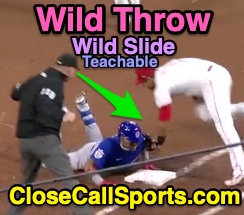
When Replay Review upheld HP Umpire Phil Cuzzi's ruling that a Reds wild throw at first base remained on the playing field, it gave us a chance to take a closer look at 1B Umpire Ryan Wills officiating the backend of this play with Cubs batter-runner Christopher Morel sliding back into first base after making an initial attempt toward second.

Wills adjusts his position by moving toward first base and preparing for a potential tag play on the runner's dive back into the base, properly declaring the runner safe on the untimely tag.

This Teachable Moment illustrates the importance of remaining with one's responsibilities (Wills has the batter-runner) while allowing your crewmate to take other elements of the play that may need to be officiated (Cuzzi takes the boundary call near the dugout).

Video as follows:

Thursday, November 10, 2022

Teachable Tripp - Moving to a Tricky Double Whacker

Tmac's Teachable Moment
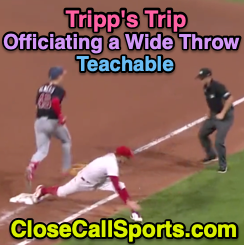
 this Thursday features 1B Umpire Tripp Gibson moving to adjust his position as Phillies first baseman Rhys Hoskins stretches to catch a throw wide of first base as Nationals batter-runner Joey Meneses arrives at the bag.

The key to officiating this play is to read the fielder, in this case Hoskins. As the play develops, Hoskins appears poised to lunge into foul territory to try and field the throw, which tells U1 Gibson to similarly move toward foul territory in order to officiate the pulled foot vs tagged base aspect of the play.

By virtue of attaining a keyhole angle to see the foot and base interaction, Gibson is able to rule the runner safe by virtue of a pulled foot.

Video as follows:

Saturday, October 22, 2022

Analysis as Replay Overturns Eddings' Transfer Call at 2B

Tmac
 provides instant analysis of a Replay Review decision during Game 3 of the Padres-Phillies NLCS in which Replay Review overturned 2B Umpire Doug Eddings' out (transfer) call at second base.

Positioning proves key on a play in which Eddings elects to work from the outside and tmac argues for a return to more traditional, inside positioning for 2B Umpires when there is a runner on base, in order to see plays such as catch/no catch transfers in the middle infield.

Video as follows:

Friday, October 21, 2022

Why Umpire Barrett Denied Machado's Time Out Request

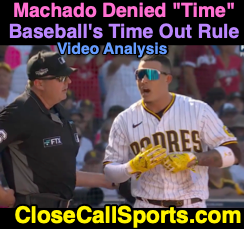
After striking out to end the 3rd inning in Game 2 of the Phillies-Padres NLCS, San Diego batter Manny Machado turned to argue with Lance Barrett about the HP Umpire's failure to grant Machado's "Time" request. Here's why the time out was denied.

Official Baseball Rule 5.04(b)(2) governs this situation and states, "Umpires will not call “Time” at the request of the batter or any member of their team once the pitcher has started their windup or has come to a set position even though the batter claims “dust in his eyes,” “steamed glasses,” “didn’t get the sign” or for any other cause."

Although replays do not conclusively indicate whether or not Machado timely requested "Time" or did so only after Phillies pitcher Aaron Nola began his windup delivery because the TV broadcast was busy concentrating on the health of broadcaster John Smoltz's Starbucks drink and thus cut to the pitch sequence too late, we see that Machado previously struck out during a playoff game in Los Angeles when, as a member of the Dodgers, a late time-out request was similarly denied by that game's plate umpire, Hunter Wendelstedt.

To deny a request, an umpire simply ignores it and calls the pitch as per usual | Video as follows:

Monday, October 17, 2022

Pondering Playoff Porter's Perfectly Positioned Plays

Tmac
 noticed that 1B Umpire Alan Porter went 2-for-2 on Replay Review during Game 4 of the Yankees-Guardians ALDS in Cleveland, and we now review the two plays at first base, with a Teachable eye on Porter's positioning in making both of these calls.

For the first play, Cleveland batter Jose Ramirez hit a fly ball to shallow left field, which fell to the ground for a base hit. New York quickly recovered, however, and threw behind Ramirez at first base, leaving Porter to officiate a tag play on the batter-runner's shoulder, an out call confirmed via Replay Review.

For the second play, Porter ruled that Gabriel Arias' foot couldn't keep contact with first base while lunging to receive a thrown ball as Yankees batter-runner Aaron Judge arrived at first base, a call that stood on Replay Review to put Cleveland out of their two allotted challenges (one for regular season, two for postseason).

Video as follows:

Tuesday, October 11, 2022

Eye of Iassogna - Keeping an Eye Everlasting on the Ball

Just minutes into Game 1 of the #Guardians-#Yankees American League Division Series in New York, ALDS Crew Chief and 2B Umpire Dan Iassogna called Cleveland baserunner Amed Rosario safe on an attempted steal of second base after Yankees third baseman Josh Donaldson dropped the ball.

With a 1-2 pitch to batter Jose Ramirez, and the Yankees employing a shift with three infielders on the right side of second base—which will be illegal beginning in 2023—2B Umpire Iassogna prepared for a potential stolen base attempt. As Ramirez swung at and missed pitcher Gerrit Cole's 98-mph fastball, Rosario ran toward second base, sliding in as the shifted-over Donaldson ran by to stab at the ball and tag.

As the play developed and fielder Donaldson's momentum took him toward right field, U2 Iassogna stuck with the action area of the play, following the path of the baseball, which had come loose after Donaldson's glove made contact with Rosario's helmet.

After confirming the dropped ball, Iassogna nonchalantly signaled the runner safe. This might sound like a simple call—the ball is rolling on the infield dirt after all—but mechanically, it's easy to lose one's timing and officiate such a play too early by giving a premature out signal. Instead, Iassogna remained patient, and was thus able to practice baseball's General Instructions to Umpires (Official Baseball Rule 8.00):

"Keep your eye everlastingly on the ball while it is in play. It is more vital to know just where a fly ball fell, or a thrown ball finished up then whether or not a runner missed a base. Do not call the plays too quickly, or turn away too fast when a fielder is throwing to complete a double play. Watch out for dropped balls after you have called a player out."

Video as follows:

Friday, September 30, 2022

Teachable - A Base Touch Rotation with John Tumpane

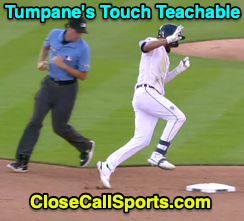
For this Teachable, we watch an umpiring rotation during Tigers batter Riley Greene's triple as Detroit hosted Minnesota. After 2B Umpire Marvin Hudson goes out on a fly ball to the gap, 3B Umpire John Tumpane runs to fill in the vacated second base position, watching for batter-runner Greene's touch of second base.

Behind the play, HP Umpire Ryan Blakney has also rotated up the foul line to prepare for a play into third base and 1B Umpire Charlie Ramos is prepared to rotate to home plate if need be.

With no runners, the 2B Umpire is obliged to go out on any ball the umpire senses may become a "trouble" ball—which is those that may be subject to interference, catch/no catch issues, or stadium boundary questions such as a ball getting stuck in a wall or bounding out of play.
Sidebar: The following Mets-Marlins play from September 11, 2022 is an example of what might transpire if a 2B Umpire opts not to pursue a ball into the outfield that does indeed become a trouble ball, creating an umpiring coverage vacuum in the outfield that ultimately sees the home plate umpire make a lodged ball call.

Thus, it is important that all umpires on the field be prepared to rotate to new positions for new responsibilities as play develops, as Hudson's crew does in Detroit—Tumpane becoming the umpire in the middle as the Twins unsuccessfully appealed a missed base, ruled safe by Tumpane, and upheld via Replay Review.

Video as follows:

Tuesday, September 27, 2022

Teachable - Cuzzi Uses the Force Tag at 2nd

In this Teachable, we spotlight 2B Umpire Phil Cuzzi, who attains a keyhole angle to officiate a mid-baseline tag play when Yankees fielder Anthony Rizzo lunges to tag Rays baserunner Randy Arozarena between first and second base.

This is both a force and tag play, and as the ground ball from batter Isaac Paredes is hit toward Rizzo, Cuzzi adjusts his position to prepare for a multitude of possibilities, including a potential throw to second base, throw to first base, or—as occurred here—a tag attempt on baserunner R1 Arozarena. Upon observing Arozarena's stop, Cuzzi stops as well to preserve the optimal angle he has cultivated.

Cuzzi's out call was challenged by Rays manager Kevin Cash and affirmed by Replay Review.

Video as follows:

Thursday, September 22, 2022

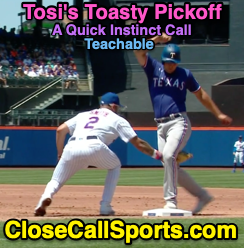
Teachable - Tosi's Toasty Pickoff Play

Mets pitcher Carlos Carrasco's snap pickoff throw to first base might have caught baserunner Nathaniel Lowe off the bag, but 1B Umpire Alex Tosi was there to observe New York first baseman Dominic Smith's quick tag and instinctively call the runner out, a call confirmed via Replay Review following a Texas challenge.

As Tmac reviews in this Teachable Moment, Tosi trusts his eyes (and possibly ears) to come up with an immediate out call, spying the fielder's glove making contact with the runner's right knee prior to the runner's left foot returning to touch first base.

The moral of the story is through experience, umpires can learn to trust their instincts to assist in quick-reflexes plays such as this one.

Video as follows:

Tuesday, September 20, 2022

Teachable Quickie - Oversliding a Base with Bill Miller

2B Umpire Bill Miller calls Brewers batter-runner Keston Hiura out for oversliding second base in this CCS Quickie Teachable. When it is apparent that Hiura, having batted a ball to left field, will attempt to stretch his single into a double, Miller takes his position to see Pirates infielder Kevin Newman's tag attempt on Hiura.

In addition to simply determining whether batter-runner Hiura is safe or out on the tag, Miller must also deduce whether, if Hiura was indeed tagged while off second base, whether this overslide was caused by fielder Newman illegally forcing the runner off of a base attained legally.

Video as follows:

Sunday, September 18, 2022

Cardinals Win When Reds' Throw Hits Runner - Legal?

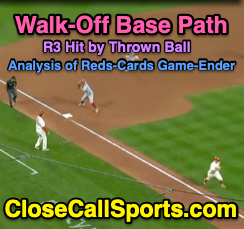
When Reds shifted-in outfielder Nick Senzel's throw hit Cardinals runner R3 Andrew Kniznzer in the back, allowing St Louis to score the game winning run to walk off Cincinnati in the 11th inning, with HP Umpire Chad Fairchild signaling baserunner Knizner safe at home, Cincinnati briefly contested the ruling...was this a legal play or should Knizner have been called out for interference, or for some other violation of the rules?

Play: With none out and the bases loaded in the bottom of the 11th inning of a 0-0 game, Cardinals batter Paul Goldschmidt hit a sharp ground ball to the third base position, being played by drawn-in outfielder Senzel, who threw home to try and retire Knizner to keep the game scoreless. The baseball hit Knizner in the back and bounced away, allowing St Louis to score the one and only run of the ballgame.

Analysis of Possible Outs
: It is important to note that Knizner began his jaunt to home plate in foul territory before veering to his left and running in fair territory, which is where he was struck by the thrown ball. The reason this is important to note is so one can refer to the base path rules:

The only way a runner may be called for being out of the base path is if they run more than three feet to avoid a tag attempt. No tag? No base path violation. With a thrown ball, there was no tag attempt and thus no base path violation. Reference: Official Baseball Rule 5.09(b)(1).

Instead, the most realistic possibility for an out call here would be to deem that baserunner Knizner intentionally interfered with a throw, the penalty for which is to declare a dead ball, runners return (and, of course, the violating runner is out). However, replays suggest no such infraction occurred as Knizner was already running in fair territory prior to the throw being released and never looked back toward the throw or baseball, suggesting that Knizner did not intentionally attempt to react to the throw by making an unnatural movement to interfere. The runner’s decision to move to fair territory is immaterial to this end simply because the rule concerns interference with a THROW, and because no throw had occurred prior to the runners step across the foul line, the runner logically could not have run in an intentional way to interfere with a throw that did not exist yet. Reference: OBR 5.09(b)(3).

Video as follows:

Friday, September 16, 2022

Home Plate Blocking Rule Exemption in Dodgers-DBacks

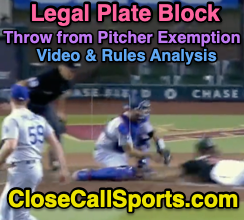
When Dodgers catcher Austin Barnes tagged Diamondbacks baserunner R3 Jake McCarthy out at home on a delayed steal in the bottom of the 9th inning of a tied game, Arizona manager Torey Lovullo sought to challenge HP Umpire Vic Carapazza's out call, alleging Barnes illegally blocked the runner's path to home plate. After review, however, Crew Chief Adrian Johnson announced a confirmed no violation call (tag out stands), with Replay determining no plate blocking violation occurred. Why?

Official Baseball Rule 6.01(i)(2) pertains to home plate collisions and restricts the catcher from illegally blocking the runner's pathway on a play at the plate unless the catcher has possession of the ball or is imminently fielding it. Given MLB's spate of overturning out calls on throws from the outfield to plate blocking violations, and thus awarding runners home plate in the process, Lovullo's plate blocking challenge made sense.

But in reality, it was doomed from the start. Embedded within OBR 6.01(i)(2) is a provision about throws from the drawn-in infield: "it shall not be considered a violation of this Rule 6.01(i)(2) if the catcher blocks the pathway of the runner in a legitimate attempt to field the throw (e.g., in reaction to the direction, trajectory or the hop of the incoming throw, or in reaction to a throw that originates from a pitcher or drawn-in infielder)."

The reason pitchers (such as Dodgers relief pitcher Evan Phillips, who threw the ball home here) and drawn-in infielders specifically are exempt, as it were, from the ordinary plate blocking restrictions is timing. As the MLB Replays twitter account explained, "the speed at which the play developed exempted the catcher from any potential violation."

In conclusion, this means that throws that originate from the infield grass (e.g., not cut-off or relays from the outfield or another infielder, and also not infielders in normal or double-play depth deep in the dirt) absolve the catcher of the pre-reception positioning responsibility since there simply isn't enough time to do both a pre-position AND field the throw AND tag the runner.

Naturally, this rule still requires the position not be taken until it is certain the drawn-in infielder or pitcher will actually throw the baseball to home plate. For this play in which the baserunner put on a delayed (attempted) steal of home plate, the throw originated from Los Angeles pitcher Phillips, thus qualifying for an exemption to the ordinary plate blocking restrictions.

Video as follows:

Wednesday, September 14, 2022

Margot Called for Backswing Interference Twice in Same AB

After Tampa Bay batter Manuel Margot was called for backswing interference twice during the same at-bat by HP Umpire Ramon De Jesus during the Rays-Jays game in Toronto, we were asked to review the relevant rule, which is called follow-through contact at the high school level.

Although the rule is grouped under the parent of Batter Illegal Action provisions (a batter is out for illegal action when—), the backswing act does not result in an automatic out: "If a batter strikes at a ball and misses and swings so hard they carry the bat all the way around and, in the umpire’s judgment, unintentionally hit the catcher or the ball in back of them on the backswing, it shall be called a strike only (not interference). The ball will be dead, however, and no runner shall advance on the play" (Rule 6.03(a)(4) Comment).

Accordingly, De Jesus upon deeming that Margot's bat made contact with Blue Jays catcher Danny Jansen as part of Margot's natural follow-through (such that the contact was not an intentional act to interfere), properly administered the penalty by calling "Time" and returning Rays baserunner Randy Arozarena to first base. It does not matter whether or not the catcher actually throws the ball (e.g., Jansen was unable to throw during the first infraction): this is called when contact occurs.

If the throw retires the runner, the infraction is ignored. | Video as follows:

Thursday, September 8, 2022

Reds-Cubs Batter Interference - Benefit of Doubt to Defense

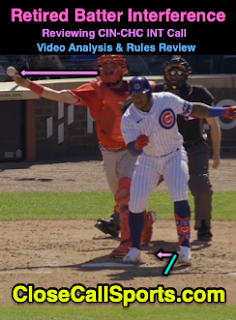
After HP Umpire Lew Williams ruled Cubs baserunner R1 Alfonso Rivas out for teammate and retired batter Nelson Velazquez's interference at home plate by stepping out of the batter's box and hindering Reds catcher Austin Romine's throw to second base, we were asked to review the batter interference rule.

An important distinction to note is that the Official Baseball Rules contain two potentially relevant provisions—one which applies to a batter who has not been retired or become a runner, and another which applies to a batter or runner who has been retired and nonetheless impedes a fielder attempting to play on a teammate.

OBR 6.03(a)(3) pertains to a still-active batter (e.g., batter has not struck out): "A batter is out for illegal action when—they interfere with the catcher’s fielding or throwing by stepping out of the batter’s box or making any other movement that hinders the catcher’s play at home base."

OBR 6.01(a)(5) pertains to a batter or runner who has been put out (including a batter that just struck out): "Any batter or runner who has just been put out, or any runner who has just scored, hinders or impedes any following play being made on a runner. Such runner shall be declared out for the interference of their teammate."

Thus, with Velazquez swinging and missing at a 3-2 pitch, we have a recently retired batter.

Because Velazquez seemed to step in front of Cincinnati catcher Romine after swinging and missing for a strikeout, the benefit of the doubt goes to the defense. Thus, it is logical to conclude that Velazquez, by stumbling to his right and in front of catcher Romine's left side, hindered or impeded Romine by causing the catcher to adjust by veering or throwing to his right more than he otherwise would have had Velazquez not stepped onto home plate. Because the throw was wild and to the right of its intended destination as well, we can conclude that interference—which does NOT require contact—likely occurred.

Video as follows:

Ejection Criteria - Baseball's Standards for Removal

In continuation of our educational series, we review baseball's criteria for ejection, also known as the Standards for Removal from the Game. The following list comprises a majority of reasons an umpire may eject a player, coach, or manager from a ballgame ranging from physical abuse, battery, and assault, to personal, profane, and prolonged complaining.

Several of these Standards may be found via the UEFL Baseball Video Rulebook.

Standard 1) Profanity or Vulgar Insults Directed at/of Umpire: This criterion comprises statements of obscenity and unsporting personal insults of an umpire.

Standard 2) Physical Contact with an Umpire: This includes so-called bumping an umpire and other instances of improperly touching an umpire.

Standard 3) Refusal to Stop Arguing / Delaying the Game: Also known as prolonged or continued complaining, this standard includes an on-field argument that the player/coach/manager continues even after being instructed/warned by an umpire to stop, as well as continued complaining from the field or from the dugout. Continued Complaining ejections also apply to arguing a call from a prior game or prior inning.

Standard 4
) Leaving Position to Argue Balls and Strikes (Including Half Swings): Leaving one's position to argue ball/strike calls, which include check swings *and balks* is ground for ejection from the game.

Standard 5) Arguing a Replay Review or Any Changed Call: Arguing a Replay Official's decision to confirm/stand/overturn a call or arguing an on-field umpiring crew's decision to change a call is ground for ejection. This provision also includes citing video evidence to contradict an on-field ruling.

Standard 6
) Use of Histrionic Gestures or Gesturing Toward an Umpire: Using exaggerated body movements or gestures to dispute an umpire's action is ground for ejection. Throwing objects from the dugout or bullpen is also included under this provision.

Standard 7) Actions Intended to Ridicule: This includes actions such as a player drawing a line with their bat to indicate where they thought a pitch was located, or a manager mimicking an umpire's calls/signals or covering home plate with dirt.

Standard 8
) Throwing Equipment in Disgust: This includes throwing equipment as well as a uniform item in reaction to a call or during the course of an argument. A batter throwing a helmet or manager throwing a hat is covered by this provision.
- - S8: Intermediate Warning) Umpires may issue an equipment violation as an intermediary step in lieu of ejection for throwing equipment in disgust for less severe infractions of this provision. For instance, a batter who throws a bat after striking out may be warned (and fined) via an equipment violation instead of ejected outright, if the umpire judges the infraction of minor severity. However, severe violations as well as any violation of this provision after being warned (via equipment violation) shall result in ejection.

Standard 9
) Failure to Comply with an Umpire's Order: If a game participant refuses to comply with an umpire's order to do or refrain from doing something that affects the administration of the Official Baseball Rules (including pace of play initiatives), the offender may be ejected for such failure to comply. This includes ejections for refusing to enter the batter's box (MLB only — some lower levels have intermediary penalties, such as automatic strikes).

Standard 10
) Arguing or Disputing a Warning or Ejection (or Lack Thereof): A player, coach, or manager shall be ejected for disputing an umpire or umpiring crew's decision to warn or eject a participant, or decision to refrain from issuing such warning or ejection. An umpire's decision relative to a participant's game status (warning/ejection) is final and may not be argued.

Standard 11) Intentionally Throwing at Batter: A pitcher or pitcher and their manager may be ejected for intentionally throwing at an opposing batter. In lieu of ejection, the umpire may issue warnings to both teams that the next such infraction will result in the ejection of the offending pitcher and their manager.

Standard 12
) Unsporting NEC and Fighting: Participating or being charged with fighting shall result in automatic ejection of the offender(s) (lower levels, e.g., NCAA & NFHS, may have more strict rules regarding unsporting situations, than professional baseball). Unsporting actions not elsewhere specified—which includes the provisions referred to in Official Baseball Rule 6.04(a) [Unsportsmanlike Conduct] [incitement, language, calling "Time" to try and induce a balk or movement to distract the batter]—are included here, as well as foreign substance ejections (e.g., pine tar on pitcher or corked bat).

Video as follows:

Tuesday, September 6, 2022

Tracking Umpires During Runner's Lane Interference Play

Thanks to Staten Island (Atlantic League)'s press box wide camera angle and field overview, we were able to keep tabs on all three umpires during a recent runner's lane interference sequence vs Lancaster.

Play: With a runner on first base and less than two out, the umpiring crew of three is configured such that the third base umpire is working inside, on the infield grass. The batter bunts a ball in front of home plate, where it is fielded by the catcher and thrown to the first baseman. The thrown ball hits the batter-runner in the back and bounces away from first base.

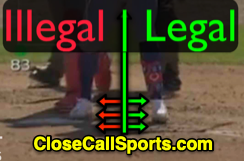
Rule: A brief reminder is that RLI is listed in Official Baseball Rule 5.09(a)(11): The batter is out if—"in running the last half of the distance from home base to first base, while the ball is being fielded to first base, they run outside (to the right of) the three-foot line, or inside (to the left of) the foul line, and in the umpire’s judgment in so doing interfere with the fielder taking the throw at first base, in which case the ball is dead." There are further provisions and exceptions, but none apply here.

HP Umpire
: After the batter bunts the ball, the plate umpire signals the ball fair while stepping onto the foul line between home plate and first base. Upon observing the thrown ball strike the runner, the plate umpire calls "Time" and rules the batter-runner out for runner's lane interference.
Analysis: This is a textbook case of runner's lane interference and the mechanics for such a play.

1B Umpire
: After the ball is bunted, the first base umpire moves into position to officiate a potential out/safe play at first base—on the tag, the throw, etc. When the plate umpire signals "Time", the first base umpire mirrors the "Time" mechanic in order to amplify the plate umpire's declaration of a dead ball. 
Analysis: The first base umpire properly signals "Time" to mirror his crew-mate while withholding any "out" call, as runner's lane interference is the plate umpire's call to make, given that the plate umpire was in position and called "Time" to make it.

3B Umpire
: Starting inside, this third base umpire has opted to work in Deep B position—a few meters to the first base side of second base, and physically closer to home plate, on the edge of the infield grass.
Analysis: The peril of starting in the Deep B position in a crew of three is that the third base umpire has responsibility for the existing baserunner R1's potential advancement to third base, in addition to a play at second. Thus, starting on the right field side of second base, as opposed to the left field side as in Deep C position, could potentially threaten the umpire's ability to attain an optimal angle to officiate a potential play at third base. This is a personal preference, as even prior to the batted ball, U3 working inside will take all stolen base attempts/tags at second.

Other than this, the primary responsibility for this call lies with the home plate umpire, who puts on a clinic for how to officiate this type of a play.

Video as follows:
Sunday, September 4, 2022

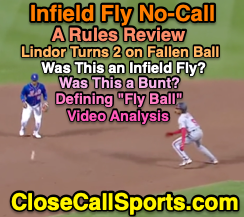
Ask - Infield Fly No-Call Leads to Double Play in New York

After New York shortstop Francisco Lindor allowed a batted ball to drop untouched before turning an inning-ending double play during Saturday's #Nationals-#Mets game, questions surrounding the umpires' infield fly no-call sprung up: why wasn't the batter declared out pursuant to the infield fly rule?

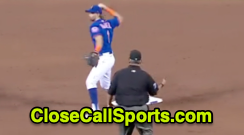
Play: With one out and two on (R1, R2), Nationals batter Luis Garcia hit a first pitch-changeup from Mets pitcher Max Scherzer in the air, whereupon Mets shortstop Lindor let the ball drop to the dirt before fielding it and throwing to second baseman Jeff McNeil, who threw to third baseman Eduardo Escobar, who tagged advancing Nats baserunner R2 CJ Abrams.

Call: Although umpires did not signal "infield fly" on the play, and although 2B Umpire Manny Gonzalez clearly signaled Mets baserunner R1 Lane Thomas out on second based on a force play, the game score's play-by-play account has this as "[batter] Luis Garcia pops into a double play" before concluding with, "Luis Garcia out at 1st."

Conflict of Calls and Scoring Decision via Stats Stringer: Since the Mets never threw the ball to first base, the only explanation for Garcia being out would be if this play was declared an infield fly, despite replays indicating evidence to the contrary (such as no signal, and U2 Gonzalez's force out call).

Rule: The infield fly rule is defined as: "a fair fly ball (not including a line drive nor an attempted bunt) which can be caught by an infielder with ordinary effort, when first and second, or first, second and third bases are occupied, before two are out. The pitcher, catcher and any outfielder who stations himself in the infield on the play shall be considered infielders for the purpose of this rule."

The batter is out, and the ball remains live (runners can advance at their own peril, with liability to be put out).

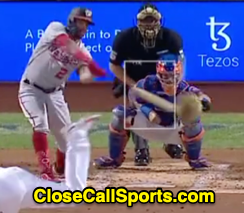
Analysis: With the less-than-two-out and runners-on-first-and-second criteria clearly satisfied, we turn to the "attempted bunt" portion of the rule. Replays indicate the batter appeared to contact the ball during a check swing—this is not a bunt and thus the bunt exemption does not apply.

Furthermore, this is not a line drive ("a batted ball that goes sharp and direct from the bat to a fielder without touching the ground").

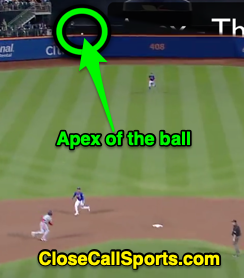
With replays indicating fielder Lindor could have caught this ball with ordinary effort, we turn to whether it satisfies the "fly ball" criterion or not. The definition for FLY BALL is of little help: "batted ball that goes high in the air in flight."

Thus, we are left with a subjective judgment call on whether this particular batted ball traveled "high" enough in the air. Judging by the ball's apex, one could certainly make an argument in favor of declaring this an infield fly. Note that the rule does not make any reference to amount of time the ball is airborne: the only criteria are whether a fair fly ball could be caught by an infielder with ordinary effort.

As for the intentional drop rule, OBR 5.09(a)(12) requires the infielder to have physically touched the baseball in order to merit a call; additionally, it is superseded by the infield fly rule: "In this situation, the batter is not out if the infielder permits the ball to drop untouched to the ground, except when the Infield Fly rule applies."

This is therefore not an intentional drop and may or may not be an infield fly, depending on your subjective interpretation of the word "high".

Video as follows:
Friday, September 2, 2022

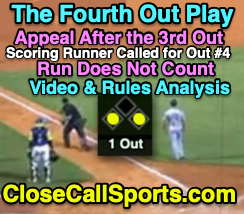
Teachable - A Fourth Out Time Play in Chattanooga

For this Teachable Moment, we find ourselves in Chattanooga as the Double-A Lookouts host the Pensacola Blue Wahoos. We're following umpires James Jean, Raul Moreno, and Macon Hammond as they officiate baseball's vaunted "fourth out" appeal play during the top of the 8th inning of a 5-3 ballgame.

Play: With one out and runners at the corners (R1, R3), Blue Wahoos batter Bubba Hollins hits a fly ball to Lookouts center fielder Mike Siani for out #2, who throws home to catcher Daniel Vellojin well after Blue Wahoos baserunner R3 Cobie Fletcher-Vance has crossed home plate as runner R1 Davis Bradshaw tags up from first base and attempts to advance to second. Catcher Vellojin then throws to shortstop Matt McLain, who tags R1 Bradshaw for the third out of the inning.

After the third out, Chattanooga's fielders initially start to jog toward their dugout, but then stop while still in the infield. Shortstop Matt McLain then throws the ball to third baseman Christian Encarnacion-Strand, who steps on third base to appeal that Pensacola R3 Fletcher-Vance left early. HP Umpire Raul Moreno agrees and emphatically calls Fletcher-Vance out on appeal, thus applying the fourth out to the inning and wiping the run off the board.

Analysis: Because leaving a base early on a caught fly ball (technically "failure to retouch a base" in a timely manner [e.g., after the fielder's first touch of the batted fly ball on a catch]) is an appeal play, it can occur after all the action for the play has already transpired. For instance, we usually see appeals occur after the play in question (but before the next pitch is thrown), and this situation is no different. Baserunner R3 Fletcher-Vance is still on the hook for leaving early (failing to timely retouch).

Fourth Out
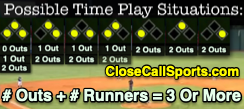
 potential also means we're dealing with a Time Play scenario. Time plays—which are plays in which umpires may be called upon to determine whether or not a leading runner touched home plate before a trailing runner was declared out for the third out of the inning (that is not a force out)—are possible whenever a third out can be recorded on a play wherein there exists any number of baserunners, which, when added to the number outs to start the play, equal three or greater. In this situation, play began with one out and two runners aboard. One plus two equals three and, accordingly, this is a potential time play. Time play situations are also possible fourth outs, and this possibility manifested here.

Official Baseball Rule 5.09(c): "Appeal plays may require an umpire to recognize an apparent “fourth out.” If the third out is made during a play in which an appeal play is sustained on another runner, the appeal play decision takes precedence in determining the out. If there is more than one appeal during a play that ends a half-inning, the defense may elect to take the out that gives it the advantage."

Accordingly, the out on Fletcher-Vance (via appeal) thus became the true third out of the inning and, pursuant to OBR 5.09(c), R1 Bradshaw's out at second base is disregarded.

Video as follows:
Tuesday, August 30, 2022

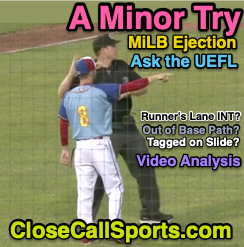
MiLB Ejection - Umpire's Safe Call Sparks Dispute

A Minor League ejection in Jersey Shore led to the ejection of BlueClaws manager Keith Werman, courtesy 1B Umpire Jacob McConnell after a safe call during Brooklyn Cyclones batter JT Schwartz's infield single.

Play: With one out and one on (R3), batter Schwartz hit a 1-2 pitch on the ground back to BlueClaws pitcher Dominic Pipkin, who lunged in an attempt to tag a diving Schwartz, ruled safe by 1B Umpire McConnell, who was positioned inside, toward the middle infield, which is where the field umpire ordinarily will stand in a two-person umpire crew with a runner on third base and one out.

Questions: After speaking with Werman, McConnell met with HP Umpire Trevor Mathews to discuss the play, as Mathews by virtue of his position at home plate may have possessed new information relative to Schwartz's baserunning.
Consideration 1, Runner's Lane Interference: The first by rule question to ask is whether batter-runner Schwartz could have been guilty of a runner's lane interference violation, as replays indicate a foot may have exited the lane prematurely. However, seeing as no throw was made to first base, and Official Baseball Rule 5.09(a)(11) [RLI] requires as a prerequisite, a "throw at first base," we have no RLI simply because there was no throw to make RLI a possibility for this play.
Consideration 2, Out of Base Path
: The second question is whether batter-runner Schwartz ran/slid more than three feet away from his base path to avoid being tagged. OBR 5.09(b)(1) states "a runner's base path is established when the tag attempt occurs and is a straight line from the runner to the base they are attempting to reach safely," so under this criterion, it would appear Schwartz did not violate the three-foot out of the base path rule. This part of the play, for what it's worth, is where HP Umpire Mathews' input is most valid, as Mathews' angle up the line provides a wonderful view for a potential deviation (had this play been eligible for RLI, Mathews would have responsibility for that call, as well).

Consideration 3, Tag Attempt: That leaves us with the question of whether the fielder actually tagged the runner. Replays suggest this did not occur, leaving the umpires to keep their original ruling of "safe" which led to the ejection of BlueClaws skipper Werman.

Video as follows: