Showing posts with label Gary Cederstrom. Show all posts

Thursday, December 17, 2020

Gary Cederstrom Named to North Dakota Hall of Fame

One year removed from his Major League retirement, ex-MLB umpire Gary Cederstrom will be inducted into the North Dakota Officials Association (NDOA) Hall of Fame in a nod to his football and basketball referee service at the high school level that set the foundation for his officiating career.

Cederstrom, who retired from baseball following his 2019 World Series assignment and who picked up a UEFL Award for 2019 Crew Chief of the Year on his way out, began officiating high school football and basketball games in 1975 in his hometown of Minot.

After a brief absence coinciding with his 31-year side job as a Major League Baseball umpire, Cederstrom returned to the North Dakota High School Activities Association and resumed his career as a high school football white hat, working his first game since the MLB World Series on the North Dakota gridiron in August 2020.

Cederstrom will be inducted as part of the 2020-21 North Dakota Officials Association Hall of Fame class.

Saturday, August 22, 2020

Retired MLB Ump Cederstrom's New Career - High School Football Referee

After 31 years of service as an MLB umpire, Gary Cederstrom retired after working Game 7 of the 2019 World Series. But retirement was short lived as Cede worked his first game since the Fall Classic: as a high school football referee in North Dakota.

The North Dakota High School Activities Association, with fewer coronavirus cases to manage than many other states across the country, proceeded with its fall sports season, kicking off its football campaign Friday night across the state, and at TGU Towner High School, that's where Cederstrom found himself albeit not in his umpiring uniform, but in black and white stripes and a white hat.

The NDHSAA welcomed Minot, ND's Cederstrom and his crew to Friday Night Lights, noting that prior to TGU's Friday night victory over Trenton HS, Cederstrom's last athletic contest officiated was Game 7 of the 2019 World Series.

Cederstrom isn't the only umpire to stay engaged with officiating after retiring from baseball.

Jake O'Donnell served as an NBA referee from 1967-1995, while moonlighting during basketball's offseason as an American League umpire from 1968-1971...former Minor League umpire Bill Spooner joined the NBA referee staff after retiring from baseball...after retiring from umpiring, Bill Roemer became a state representative in Ohio, introducing House Bill 208 to bring the penalty for assaulting a sports official in line with that of teachers, school administrators, and bus drivers.

And, of course, Bob Davidson returned to the high school field on April 1, 2019.
Related Post: Bob Davidson to Return to Baseball for Third Time (4/1/19).

Thursday, February 20, 2020

Gary Cederstrom Retires Following World Series Finale

31-year AL and MLB umpire Gary Cederstrom has retired, electing to exit baseball on top, having officiated the 2019 World Series (and ALDS), bringing his career totals to 3,579 regular season games officiated, along with three Wild Card Games, nine Division Series, eight League Championship Series, and four World Series.

The North Dakota native and NDSU Bison fan worked his way through the Midwest League, Eastern League, and American Association before his 1989 American League debut.

Amongst Cederstrom's 41 career big league ejections were Paul O'Neill, Terry Collins, Joe Girardi, Buck Martinez, and, most recently, Eric Thames in 2019, which was Cede's first ejection since Bruce Bochy in 2017, which in turn was his first since Miguel Cabrera in 2015.
Related Label: Gary Cederstrom

Cederstrom truly leaves the game on top, having been named the UEFL's Crew Chief of the Year following the 2019 season. He also won the Crew Chief of the Year Award in 2015.
Related Post: 2019 UEFL Award for Crew Chief - Gary Cederstrom (11/6/19).

Congratulations, Gary! We'll have news on other staff changes—including retirements and promotion activity—in the coming days.

Wednesday, November 6, 2019

2019 UEFL Award for Crew Chief - Gary Cederstrom

Gary Cederstrom wins the UEFL's 2019 Crew Chief of the Year Award [2018 Winner: Ted Barrett].
Voting Results (10%+): Cederstrom (18.2%), Barrett (16.4%), Sam Holbrook (11.3%), Joe West (10.7%).

Gary Cederstrom is the Umpire Ejection Fantasy League's 2019 Crew Chief of the Year, his second time receiving the award (2015). Cederstrom, who made his MLB debut in 1989 (30 years ago), had the first ejection of the 2019 regular season (Eric Thames).

Three of four members of Cederstrom's regular season crew (Cederstrom, Marvin Hudson, Adrian Johnson) made the 2019 postseason, and for Cederstrom, it was his fifth consecutive appearance. He chiefed both the Division Series and World Series.

He finished the year +19 in Crew Division, fourth amongst MLB crew chiefs (Larry Vanover & Sam Holbrook 23, Tom Hallion 21).

UEFL Awards History, Gary Cederstrom
Crew Chief of the Year: 2015.

Gary Cederstrom now has 18 points in the Umpire Ejection Fantasy League (17 Previous + 1 Award = 18).
The next postseason award, Honorable Umpire of the Year, will be released this evening.

Wednesday, July 3, 2019

Mets End Game on Bobbled Foul Tip

When Yankees batter Brett Gardner made contact with a 3-2 fastball from Mets pitcher Edwin Diaz, NYM catcher Wilson Ramos bobbled the ball and caught it for a...game-ending foul tip strikeout? As umpire Gary Cederstrom—who became yet the latest umpire hit by a pitch or foul ball during a Mets game in 2019—signaled the final out, we review an odd looking non-fly-ball.

The Play: With two out in the 9th inning, Yankees batter Brett Gardner swung and fouled a 3-2 fastball from Mets pitcher Edwin Diaz off the glove of catcher Wilson Ramos and into the air, whereupon the ball ricocheted off Ramos' free hand and back into his glove for a game-ending catch.

Ramos catches a flying foul tip for strike 3.
The Call: This play was ruled a swinging strikeout by HP Umpire Gary Cederstrom, specifically a foul tip.

The Rule: This is indeed a foul tip. Although the Official Baseball Rules' definition of the term states, "A FOUL TIP is a batted ball that goes sharp and direct from the bat to the catcher’s hands and is legally caught. It is not a foul tip unless caught and any foul tip that is caught is a strike, and the ball is in play. It is not a catch if it is a rebound, unless the ball has first touched the catcher’s glove or hand," the most relevant rule is found in OBR 5.09(a)(2) Comment, which refers to "The batter is out when—a third strike is legally caught by the catcher."

The tail end of a foul tip in Milwaukee, 2015.
OBR 5.09(a)(2) Comment states, "If a foul tip first strikes the catcher’s glove and then goes on through and is caught by both hands against his body or protector, before the ball touches the ground, it is a strike, and if third strike, batter is out. If smothered against his body or protector, it is a catch provided the ball struck the catcher’s glove or hand first."

Analysis: The comment's hypothetical scenario is pretty much what happened here, and it's also what happened in a UEFL Case Play from 2015, when HP Umpire Ryan Blakney similarly ruled a foul tip when Diamondbacks batter Jarrod Saltalamacchia's offering deflected off Brewers catcher Martin Maldonado's glove and into the air, where it was caught on the fly by the diving catcher.
Related Post: Case Play 2015-04, The Flying Foul Tip [Solved] (6/8/15).

As we wrote in the Case Play, the main consideration is what the ball touched first after coming off the bat. If it's the hands/glove/mitt, it can be legally caught. If it's another part of the catcher's equipment or body, it cannot be legally caught.

To summarize:
Bat => Catcher's Hand, Glove, or Mitt => Caught or Smothered = FOUL TIP.
Bat => Anything Else => Caught or Smothered = FOUL BALL.
The ball's first point of contact: the mitt.

Implications: Finally, we'll discuss what this means in real life. Recall that the ball remains live during a foul tip, but is dead on a foul ball. Thus, if we had less than two outs (or less than two strikes) in New York, our baserunner could have legally stolen third base while the catcher was juggling the foul tip—and because it was a foul tip and not a legally caught foul ball (e.g., an actual fly ball that is caught in the air), there is no requirement to "tag up" or retouch a base. In such event, a quick-thinking catcher—with less than two strikes on the batter—might strategically choose to let the ball fall to the ground for the express purpose of preventing a potential stolen base.

But with two strikes, it's better to catch the ball for a strikeout | Video as follows:

Friday, May 3, 2019

Tmac's Teachable - Runner's Interference

In this Teachable Moment, we discuss runner's interference and the great call of both Gary Cederstrom and Quinn Wolcott during a recent Nationals game. On this play in Washington, notice the fielder has his progress impeded by the Cardinals runner from second base while within reach of a ground ball.

Today's Teachable considers interference.
This is interference and there does NOT need to be contact. This is a great call and one of the harder plays to judge in real time. When we have interference that is not intentional by a runner, the play is over. The runner is out and all other runners go back to the base they occupied on the time of pitch.

Because the interference was not a willful and deliberate act with the obvious intent to break up a double play, the batter-runner will be, by rule, placed on first. Because the batter-runner is awarded first base, R1 is forced to advance to second, and we'll continue with an added out and runners at first and second.

If this was intentional (willful and deliberate) interference, we would get two outs, but clearly it's not. The fielder has the right of way until the ball has passed him. When the fielder no longer has a play on the ball that has passed him, the runner has the right of way, which has made for some interesting plays in the past.

IMPORTANT NOTE, NFHS: High School Rule 8-4-2g differs slightly from the college/pro version in that a double play can be awarded whether or not the interference is intentional.

3B Umpire Cederstrom enforces interference.
Calling INT, like many calls, is helped by being in the right position. One thing you can do is anticipate a tag or attempt. This will help you see any potential out of the base path violation, a tag, a missed tag, or an interference/obstruction call if the fielder misses the ball.

Some plays are really tough, as evidenced by the next play in Milwaukee on another potential interference. There's contact and the fielder is also slowed by the runner. Do you have INT?  If you do, what are your mechanics? If you said point to the interference, yell, "That's Interference!" then call "Time," call R1 out, and place B/R at first, congrats: you got the call right and, uh oh.. here comes a head coach/manager.  No need to fear here's how that convo goes...

Did the runner interfere with the fielder?
Let the coach/manager talk...... He's likely asking for an explanation and this is where knowing the rules really helps. Emphasize that in your judgement the runner hindered the fielder by making contact with him as he was attempting to field a ground ball. By rule, the runner is out and batter is placed at first. If he continues try to walk away; don't engage in a protracted discussion. Also, understand if you don't call INT that you need to know the rules as well. Why don't you have INT on this play?

Here are the rules you'll want to get into:
OBR 5.09(b)(3): "Any runner is out when—He intentionally interferes with a thrown ball; or hinders a fielder attempting to make a play on a batted ball."
OBR 6.01(a)(10): "It is interference by a batter or a runner when—He fails to avoid a fielder who is attempting to field a batted ball, or intentionally interferes with a thrown ball."
OBR 6.01(a)(6): "If, in the judgment of the umpire, a base runner willfully and deliberately interferes with a batted ball or a fielder in the act of fielding a batted ball with the obvious intent to break up a double play, the ball is dead. The umpire shall call the runner out for interference and also call out the batter-runner because of the action of his teammate."
OBR 6.01(a) Penalty: "PENALTY FOR INTERFERENCE: The runner is out and the ball is dead."
NCAA 8-5-d: "A runner is out when—The runner interferes intentionally with a throw or thrown ball, or interferes with a fielder who is attempting to field a batted ball. If a double play is likely, and the runner intentionally interferes with the fielder who is attempting to field or throw the ball, both runner and batter-runner shall be declared out."
NFHS 8-4-2g: "Any runner is out when he—intentionally interferes with a throw or a thrown ball; or he hinders a fielder on his initial attempt to field a batted ball...If, in the judgment of the umpire, a runner including the batter-runner interferes in any way and prevents a double play anywhere, two shall be declared out (the runner who interfered and the other runner involved)."

This close play at first base happened as well.
You've heard me say this a lot, but working the bases requires focus. For instance, our close "was it interference or not?" play in Milwaukee was immediately followed by a pitcher-covering-first situation, leaving a slew of questions: did the Colorado pitcher catch the ball before the runner got to the base? Did the pitcher slide his heel on the base or did he miss his tag entirely (was the ball in his glove at the time?)? If he did tag the base, where was the runner's foot at the time? And so forth.

As many of the followers of this site get ready for the second half of their HS seasons, and the upcoming summer baseball schedule make sure you expect the unexpected and then look like $1 million bucks by nailing the call. Until next time, have fun out there and happy umpiring!

Video as follows:

Friday, March 29, 2019

MLB Ejection 001 - Gary Cederstrom (1; Eric Thames)

3B Umpire Gary Cederstrom ejected Brewers PH Eric Thames (check swing strike three call; QOCX) in the bottom of the 4th inning of the Cardinals-Brewers game. With two out and one on (R3), Thames attempted to check his swing on a 3-2 slider from Cardinals pitcher Jack Flaherty, ruled a ball by HP Umpire Marvin Hudson and overturned to a swinging third strike on appeal by 3B Umpire Cederstrom. Play reviewed and affirmed by the UEFL Appeals Board (9-0-0), the call was correct. At the time of the ejection, the game was tied, 4-4. The Cardinals ultimately won the contest, 9-5.

This is Gary Cederstrom (38)'s first ejection of the 2019 MLB regular season.
Gary Cederstrom now has 4 points in the UEFL Standings (0 Prev + 2 MLB + 2 Correct Call = 4).
Crew Chief Gary Cederstrom now has 1 point in Crew Division (0 Previous + 1 Correct Call = 1).

This is the first ejection of the 2019 MLB regular season.
This is the first player ejection of 2019. Prior to ejection, Thames was 0-1 (SO) in the contest.
This is Milwaukee's 1st ejection of 2019, 1st in the NL Central (MIL 1; CHC, CIN, STL, MIL, PIT 0).
This is Eric Thames' first career MLB ejection.
This is Gary Cederstrom's first ejection since June 16, 2017 (Bruce Bochy; QOC = N [Balls/Strikes]).

Wrap: St. Louis Cardinals vs. Milwaukee Brewers, 3/29/19 | Video as follows:

Wednesday, August 23, 2017

Umpire-in-Chief Authority - When Two Calls Conflict

Two umpires made two opposing calls on the same play Tuesday night in Anaheim, with umpire-in-chief Gary Cederstrom making the final call pursuant to Official Baseball Rule 8.03(c), which granted the veteran crew chief authority to rectify a conflicting situation.

From behind the fielder, Stu thinks he sees a foul ball.
The Play: With two out and none on in the top of the 6th inning of the Rangers-Angels game, Rangers batter Robinson Chirinos hit a 1-0 breaking ball from Angels pitcher Keynan Middleton on the ground up the foul line in front of third base. With the batted ball bouncing in foul territory while the speedy Chirinos ran toward first base, Angels third baseman Luis Valbuena jaunted over the field the ball as it took a final turn back toward fair territory as it approached third base. As Valbuena, positioned in foul territory, reached back in attempt to grab the ball before it reached the plane along the foul line, he moved his glove as to catch the ball and immediately sweep it toward his foul-leaning body.

The Calls: HP Umpire Gary Cederstrom, following the bouncing ball, ruled that Valbuena's glove first made contact with the baseball as it was positioned over fair territory, and accordingly mechanized a fair ball. Meanwhile, 3B Umpire Stu Scheurwater from his position behind Valbuena, ruled that Valbuena successfully prevented the ball from reaching the plane along foul line, and, thus, called the play foul while gesturing "Time" with his arms. As such (and most likely hoping for such a call), Valbuena pointed to Scheurwater's call and did not make an attempt to retire Chirinos.

The Rule: OBR 8.03(c) granted plate umpire Cederstrom the authority to make a final ruling:
If different decisions should be made on one play by different umpires, the umpire-in-chief shall call all the umpires into consultation, with no manager or player present. After consultation, the umpire-in-chief (unless another umpire may have been designated by the League President) shall determine which decision shall prevail, based on which umpire was in best position and which decision was most likely correct. Play shall proceed as if only the final decision had been made.
The parenthetical ("unless another umpire may have been designed by the League President") simply means that the Crew Chief shall act as the umpire-in-chief's place during the multiple-calls situation described by OBR 8.03(c).

In this situation, Cederstrom was both the Crew Chief as well as the umpire-in-chief (HP Umpire).

Cederstrom and Scheurwater have a consultation.
Mechanics, Whose Call is it, Anyway (and Why)? Because the ball had not yet reached the front edge of the base when it was first touched by a fielder, this call belongs to the plate umpire. Had the ball arrived at the front edge of third base prior to being touched by a fielder, the call would belong to the field (base) umpire. The rationale here is that the plate umpire has the best angle to see a ball being played in front of a fielder ahead of the corner bases, while a field umpire has the best angle to judge whether a ball has passed first or third base in fair vs foul territory.

Thinking about this another way, we know by rule that a ball that hasn't yet reached first or third base is neither fair nor foul until an action occurs to make it such (e.g., a fielder touches the ball). Similarly, a ball that has already bounced, as in the Texas-Anaheim play, will become fair or foul no later than when it reaches the front edge of first or third base. Accordingly, the plate umpire is responsible for declaring an all-else-equal ground ball fair or foul by fielder's touch, while the field/base umpire has primary responsibility for declaring an all-else-equal ground ball fair or foul by the ball-passing-over-base standard (which has nothing to do with a fielder's touch).

From his position in front, Gary sees "fair."
Chief Cederstrom Decides: As the plate umpire making one of the two conflicting calls, Cederstrom had the advantage of having seen the play. As the plate umpire, Cederstrom also had primary responsibility for making this call prior to the ball arriving at the base (though it was very close): with no runners on base on a ball not being hit into the danger "triangle" near home plate (e.g., where runner's lane interference is a potential call to make), there are no special considerations in play; there is no potential play at the plate for which a plate umpire might need to get in position (thus, the plate umpire won't transfer his fair/foul responsibility to the third base umpire).

About the ball being so close to the base, consider what we discussed just the other day regarding Crew Consultation and Getting the Call Right (Hanahan's MiLB ejection): "An umpire is urged to seek help when that umpire's view is blocked or positioning prevents such umpire from seeing crucial elements of a play." When comparing Scheurwater and Cederstrom's angles (forget whether the ball reached the base for a second), it sure appeared that Scheurwater's view may have been blocked while Cederstrom was in better position to officiate this play.

Thus, as the plate umpire with the best angle on a batted ball that had not yet reached third base, Cederstrom properly ruled the ball fair and furthermore judged that fielder Valbuena did not have a play on batter-runner Chirinos; thus, Cederstrom awarded Chirinos first base.

Sidebar (BRD): In NCAA college, a double-call similarly reverts to the UIC's judgment (NCAA Rule 3-6-i).

This rule does not specifically exist in high school. Rather, for NFHS high school play, Rule 10-2-3l states the UIC shall, "Rectify any situation in which an umpire’s decision that was reversed has placed either team at a disadvantage."

Under all codes, the ball becomes dead as soon as any of the umpires calls "Foul" or "Time" (NFHS 5-1-1h, "inadvertently announces 'Foul' on a ball that touches the ground") The only question remaining is whether, in the designated chief's judgment, the fielder would have retired the batter had the play not been killed prematurely. In this case, the answer was "no" and the runner was granted safe passage to first base.

Video as follows:

Saturday, July 15, 2017

Boston Files Protest Over Odd Interference No-Call

Boston filed a protest alleging interference by Yankees baserunner Matt Holliday as umpires determined no rule infraction occurred during a peculiar sequence Saturday afternoon at Fenway Park.

Is Holliday guilty of interference in Boston?
The Play: With none out and one on (R1) in the top of the 11th inning of the Yankees-Red Sox game, Yankees batter Jacoby Ellsbury hit a 2-2 sinker from Red Sox pitcher Robby Scott on the ground to first baseman Mitch Moreland, who threw to shortstop Xander Bogaerts at second base to retire baserunner R1 Holliday before the return throw to first base wound up striking Ellsbury, resulting in a fielder's choice force out call (no interference). Replays indicate that as Moreland fielded the batted ball, baserunner R1 Holliday—perhaps under the mistaken belief that Moreland had tagged first base before throwing to Bogaerts—retreated to first base, beginning his slide into his base of origin as Bogaerts stepped on second base to force him out. Due to Holliday's slide into first base, fielder Moreland was unable to field Bogaerts' return throw, which arrived around the time Ellsbury passed first base, the ball hitting Ellsbury and deflecting up the right field foul line, after which Ellsbury remained on first base.

Farrell presents his case to Chief Cederstrom.
The Call: 2B Umpire Adrian Johnson ruled R1 Holliday out on the fielder's choice, and 1B Umpire Gabe Morales ruled Ellsbury safe on the uncaught return throw, further ruling that no interference had occurred.

The Argument: Red Sox Manager John Farrell argued with HP Umpire and Crew Chief Gary Cederstrom that Holliday's slide into first base had prevented fielder Moreland from fielding Bogaerts' throw, and, thus, Holliday had committed interference. Farrell argued that this interference should have resulted in a double play. After the four umpires consulted to discuss the play, the interference no-call prevailed, with Cederstrom and Cooper opting to consult with the Replay Operations Center for a rules check regarding interference and its applicability to the aforementioned play. In all, play was denied for approximately nine minutes.

Official Baseball Rule 6.01: Interference, Obstruction and Catcher Collisions
(a) Batter or Runner Interference: It is interference by a batter or a runner when:
(4) Any member or members of the offensive team stand or gather around any base to which a runner is advancing, to confuse, hinder or add to the difficulty of the fielders. Such runner shall be declared out for the interference of his teammate or teammates;
(5) Any batter or runner who has just been put out, or any runner who has just scored, hinders or impedes any following play being made on a runner. Such runner shall be declared out for the interference of his teammate (see Rule 6.01(j))...
(10) He fails to avoid a fielder who is attempting to field a batted ball, or intentionally interferes with a thrown ball...if the base runner’s interference is adjudged not to be intentional, the batter-runner shall be awarded first base...
(j) If a runner does not engage in a bona fide slide, and initiates (or attempts to make) contact with the fielder for the purpose of breaking up a double play, he should be called for interference under this Rule 6.01...A runner who engages in a 'bona fide slide' shall not be called for interference under this Rule 6.01, even in cases where the runner makes contact with the fielder as a consequence of a permissible slide.

Holliday's slide prevents Moreland's catch.
Analysis: The analysis will comprise of two parts. First, it will address which precise rule applies to this play (versus which provisions don't apply), and, second, we'll discuss the history of this applicable rule and its application to rule what is and is not interference (yes, we had a recent Case Play on this very rule).

To best investigate this play, it will be helpful to go rule-by-rule, point-by-point. Let's begin.
> Rule 6.01(a)(4) states that it is interference when a member of the offense stands or gathers at a base "to confuse, hinder or add to the difficulty of the fielders." 6.01(a)(4) does not apply to this play, as it would require R1 Holliday to have stood (or gathered) at first base with the express purpose of confusing, hindering, or adding to the difficulty of the fielders. Without this intent, it is not interference.
> OBR 6.01(a)(5), also known as recently-retired runner's interference, states that a runner who has been erased from the bases (via an out or score) is guilty of interference if he hinders or impedes a following play. 6.01(a)(5) does apply in any event in which a runner commits a hindering or impeding act after leaving his base path (e.g., abandoning his normal base-running responsibilities), but does not apply when the runner is simply completing a base running maneuver that has begun prior to his retirement. OBR 6.01(a)(5) is the applicable rule.*
> OBR 6.01(a)(10) applies to a runner who intentionally interferes with a thrown ball. As Holliday never actually touched the throw (nor did he appear to intentionally interfere), 6.01(a)(10) does not apply.
> OBR 6.01(j) is the force play slide interference rule, and states, in part, "A runner who engages in a 'bona fide slide' shall not be called for interference under this Rule 6.01." Holliday's slide met the bona fide slide rule criteria (slid into base, held the base, etc.), and 6.01(j) cannot apply for that reason. Is it possible to Rule 6.01(j) interference when a runner retreats to a base and commits an illegal slide? Yes, if the runner initiates (or attempts to initiate) contact with a fielder for the purpose of breaking up a double play.

About Recently Retired Runner's Interference and Residue of a Legitimate Attempt to Run the Bases: Regarding this brand of interference, the Wendelstedt umpiring manual specifies the precise case of a batter-runner who continues running to first base after being retired (say, on a caught bunt or a third strike that results in an out [e.g., a dropped third strike with first base occupied and less than two out]), and specifies that the retired batter-runner may be guilty of retired runner's interference if he interferes with the play being made back into first base while running outside of the running lane.

In other words, per Wendelstedt, the batter-runner is not out if he "hinders or impedes a following play" if he is legitimately running the bases, even though he has already been retired.

Holiday makes a legit attempt to run the bases.
An even easier "out" here is gleaned from the standard case of a bona fide slide (as illustrated above, and seen during the course of a majority of big league double play attempts). If recently-retired runner's interference applied to any case where a baserunner hindered or impeded the following play being made on another runner, then it would be illegal to slide into second (or third, e.g.) base after being forced out: in other words, if the logic here is that Holliday was out for interfering with the play at first base after being retired at second base, then so too should be all runners who slide into second base after the pivot man receives the ball.

Clearly, a runner is allowed to complete a legal base-running maneuver (e.g., a bona fide slide) and he will not be called for recently-retired runner's interference if he is otherwise legal in his running of the bases as he is put out.

Crew Chief Cederstrom signals the protest.
As for the question of whether Holliday is legally allowed to run (return) to first base: Quite obviously R1 Holliday is forced to advance by virtue of the batter's becoming a runner, but if Holliday legitimately believes the force has been removed, he is permitted to try and return to his base of origin. This is a legal base-running maneuver and only becomes a problem if he actually returns to first base—having not yet been put out—while the batter-runner is standing on first base at the same time.

If this wasn't a legal running of the bases, Rule 5.06(b)(2) ("If a runner is forced to advance by reason of the batter becoming a runner and two runners are touching a base to which the following runner is forced, the following runner is entitled to the base and the preceding runner shall be out when tagged or when a fielder possesses the ball and touches the base to which such preceding runner is forced") would not exist, and a runner would be liable to be declared out for abandonment or for some other cause while retreating to an occupied base. The rule is clear: someone must be put out by the defense, not by the umpire.

Similarly, see Rule 5.09(b)(6), which states, in part, "If the forced runner, after touching the next base, retreats for any reason towards the base he had last occupied, the force play is reinstated, and he can again be put out if the defense tags the base to which he is forced." Again, if retreating was an illegal base-running action, then Rule 5.09(b)(6) would not exist.

Accordingly, Holliday is legally permitted to run to first base and, in accordance with the aforementioned Wendelstedt citation, he is not to be declared out simply for completing his legal base-running action.

RED HERRING: If you're looking at Rule 6.01(a)(5) Comment ("If the batter or a runner continues to advance after he has been put out...") and believe that retreating to a base precludes any protection from interference, you're getting caught up in semantics that don't affect the interpretation of this play.

Relevant Post: Case Play 2017-4 - Hurdling a Retired Runner [Solved] (4/30/17)
A similar play occurred in Anaheim in April.
The aforementioned Case Play concentrates specifically on the case of recently-retired runner's interference as occurred during an April game in Anaheim.

Succinctly, with Angels baserunner R3 Ben Revere caught in a rundown between third and home, trail runner R1 Cliff Pennington rounded second and prepared to advance to third base. As Oakland pitcher Kendall Graveman ran R3 Revere back to third, retreating runner Revere began a slide, and was tagged out by Graveman before making it to the bag. With Revere out, trail runner R1 Pennington tried advancing to third base, and F1 Graveman tried to jump over the recently-retired Revere in order to make a play on Pennington. As the fielder leapt over Revere, the recently-retired runner completed his unsuccessful "pop-up" slide and, in doing so, essentially upended Graveman as he attempted to complete the double play on Pennington (he was successful).

In answering this Case Play, we found that Revere's slide into third base constituted a legal running of the bases, even though he subsequently made contact with Graveman after being tagged out as Graveman attempted a play on following runner Pennington. In sum, if the umpires ruled runner Revere's slide—including the pop-up element—as part of a legitimate attempt to run the bases, then he did not interfere with Graveman's play on the following runner. If, however, the umpires ruled that the totality of Revere's slide was not a legitimate attempt at running the bases or that he intended to impede Graveman's play at Pennington, then the proper call would be a double play due to recently-retired runner's interference.

Conclusion: As for the play at Fenway Park, since Holliday entered his slide (prior to or concurrent with Bogaerts retiring him) in a legitimate attempt to run the bases—however misguided it might have been—and furthermore did not intentionally hinder the defense, he did not violate retired runner's interference rule 6.01(a)(5) nor any other rule concerning interference.

Epilogue: Just-scored runner's INT.
One More Illustration: If you're still lost, it might be helpful to consider the second aspect of Rule 6.01(a)(5), which concerns "any runner who has just scored." Consider the attached image of a just-scored interference play at Citi Field in 2013. During that play, Marlins baserunner Juan Pierre legally ran through home plate, but ultimately collided with Mets catcher John Buck as Buck attempted to make a play on a following runner. HP Umpire Jim Joyce properly ruled Pierre's teammate (Dobbs) out at second base for Pierre's interference for his having run through the base, and, in doing so, completing his base-running responsibility before making contact with the catcher. The question is not whether the recently-retired or just-scored runner actually impeded or hindered the fielder, but whether he did so in an illegal way, for instance, by virtue of an illegal slide, intentional act, or illegitimate action following the achievement of a base.

Video as follows:

Friday, June 16, 2017

MLB Ejection 067 - Gary Cederstrom (1; Bruce Bochy)

HP Umpire Gary Cederstrom ejected Giants Manager Bruce Bochy (ball four call) in the bottom of the 7th inning of the Giants-Rockies game. With none out and none on, Rockies batter DJ LeMahieu took a 3-2 slider from Giants pitcher Jeff Samardzija for a called fourth ball. Replays indicate the pitch was located over the inner edge of home plate (px -.729, pz 3.214), the call was incorrect. At the time of the ejection, the Rockies were leading, 7-5. The Rockies ultimately won the contest, 10-8.

This is Gary Cederstrom (38)'s first ejection of the 2017 MLB regular season.
Gary Cederstrom now has 0 points in the UEFL Standings (2 Previous + 2 MLB - 4 Incorrect = 0).
Crew Chief Gary Cederstrom now has -4 points in Crew Division (-4 Previous + 0 Incorrect Call = -4).
*UEFL Rule 6-2-b-1 (Kulpa Rule): |0| < STRIKE < |.748| < BORDERLINE < |.914| < BALL.

This is the 67th ejection report of 2017.
This is the 35th Manager ejection of 2017.
This is San Francisco's 2nd ejection of 2017, T-2nd in the NL West (LAD 5; COL, SF 2; SD 1; ARI 0).
This is Bruce Bochy's first ejection since July 15, 2016 (Mike Estabrook; QOC = Y [Balls/Strikes]).
This is Gary Cederstrom's first ejection since Sept 2, 2015 (Miguel Cabrera; QOC = Y-C [Balls/Strikes]).

Wrap: San Francisco Giants vs. Colorado Rockies, 6/16/17 | Video via "Read More"

Friday, April 7, 2017

Force Play Slide Rule Makes First Appearance of 2017

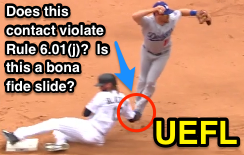
Runner intent is a key component of MLB's bona fide slide interference rule, which made its first appearance of the 2017 season by way of Replay Review during Friday's Dodgers-Rockies game.

The Play: With none out and two on (R1, R2) in the bottom of the 5th inning, Rockies batter DJ LeMahieu hit a 1-0 changeup from Dodgers pitcher Hyun-Jin Ryu on the ground to third baseman Justin Turner, who threw to second baseman Logan Forsythe as Rockies baserunner R1 Charlie Blackmon slid into second base.

U2 Cederstrom observes Blackmon's slide.
After 2B Umpire Gary Cederstrom ruled Blackmon out (and nothing further) on the force play, Dodgers Manager Dave Roberts filed a Manager's Challenge alleging Blackmon's slide violated sophomore slide rule 6.01(j), which states, "If a runner does not engage in a bona fide slide, and initiates (or attempts to make) contact with the fielder for the purpose of breaking up a double play, he should be called for interference under this Rule 6.01."

After observing replays indicating contact between Blackmon's right hand and Forsythe's left foot, Dodgers color commentator Orel Hershiser opined, "That would be slightly ticky-tac."

Analysis: As a matter of bookkeeping, it is important to make the distinction between pre-2016 interference 6.01(a)(5) and aforementioned bona fide slide rule interference 6.01(j). The reason for this technical distinction is that 6.01(a)(5) is not reviewable via Replay Review, while 6.01(j) is subject to video review, though as we'll discuss in a moment, it doesn't much matter.

OBR 6.01(a)(6), by the way, states, "If, in the judgment of the umpire, a base runner willfully and deliberately interferes with a batted ball or a fielder in the act of fielding a batted ball with the obvious intent to break up a double play, the ball is dead. The umpire shall call the runner out for interference and also call out the batter-runner because of the action of his teammate. In no event may bases be run or runs scored because of such action by a runner."

Even though "willful and deliberate" interference [6.01(a)(6)] is not reviewable, that fact is rather superfluous. The standard for declaring an extra out for violation of the bona fide slide rule is less than it is for "willful and deliberate" interference.

As we detailed as part of our introduction to 2016's new bona fide slide FPSR rule, there are four criteria under 6.01(j) which the runner sliding into the base must satisfy in order to be considered legal. As relates to Blackmon's actions, they are:
1) Begins his slide and makes contact with the ground before reaching the base - YES;
2) Is able and attempts to reach the base with his hand or foot - YES;
3) Is able and attempts to remain on the base (except home) after completing the slide - YES; and
4) Slides within reach without changing his path for the purpose of initiating contact with a fielder - ?.

Upon review, this slide was deemed illegal.
And as we wrote back then, "As has been interpretation in years past, the intent of the runner may be cause alone for an interference ruling. For instance, a runner may satisfy the new bona fide slide criteria, but if the umpire rules the runner intentionally attempted to initiate contact with the fielder, then double play interference may be called."

Rule 6.01(j) continues, "A slide shall not be a 'bona fide slide' if a runner engages in a 'roll block,' or intentionally initiates (or attempts to initiate) contact with the fielder by elevating and kicking his leg above the fielder’s knee or throwing his arm or his upper body."

Crew Chief Cederstrom announces the call.
Thus, it is apparent that in electing to overturn Cederstrom's call, the Replay Official deemed that Blackmon's actions constituted "throwing his arm or his upper body" and that Blackmon intentionally initiated contact with Forsythe for the purpose of breaking up a double play, the penalty for which is interference under Rule 6.01.

In accordance with the penalty for interference, Rockies baserunner R2 Kyle Freeland was returned to second base and, with two out, did not score; Dodgers first baseman Scott Van Slyke was credited with the second put-out on batter-runner LeMahieu. In the end, it made little difference, as Colorado won the game, 2-1.

Video available via "Read more"

Saturday, November 7, 2015

2015 UEFL Award for Best Crew Chief - Gary Cederstrom

Gary Cederstrom wins the UEFL's 2015 Crew Chief of the Year Award. [2014 Winner: Ted Barrett]
Voting Results (Top 3): Gary Cederstrom (23%), Ted Barrett (21%), Dale Scott (10%).

Gary Cederstrom is the Umpire Ejection Fantasy League's 2015 Crew Chief of the Year, which marks his first UEFL Award. Cederstrom finished 2015 with one ejection; he ejected zero times in 2014. In addition to the rare ejection (Ejection 190)—Cederstrom last ejected someone in 2012—Cederstrom was treated to the privilege of serving as crew chief during the controversial Chase Utley-Ruben Tejada play at second base during Game 2 of the National League Division Series. Following that round of postseason play, Cederstrom was named as crew chief of the World Series, his third such assignment.

Gary Cederstrom now has 16 points in the Umpire Ejection Fantasy League (15 Previous + 1 Award = 16).
The next postseason award, Honorable Umpire of the Year, will be released tomorrow.

Wednesday, September 2, 2015

MLB Ejection 190: Gary Cederstrom (1; Miguel Cabrera)

3B Umpire Gary Cederstrom ejected Tigers 1B Miguel Cabrera for arguing a strike three call by HP Umpire Quinn Wolcott in the top of the 4th inning of the Tigers-Royals game. With none out and none on, Cabrera took a 3-2 fastball from Royals pitcher Yordano Ventura for a called third strike. Replays indicate the pitch was located over the inner half of home plate and below the midpoint (px -.57, pz 3.41 [sz_top 3.48]) (the first pitch of the at-bat referred to was properly officiated as a strike as well), the call was correct. At the time of the ejection, the Royals were leading, 4-0. The Royals ultimately won the contest, 12-1.

This is Gary Cederstrom (38)'s first ejection of 2015.
Gary Cederstrom now has 8 points in the UEFL Standings (5 Previous + 2 MLB + 1 Correct-Cremate = 8).
Crew Chief Gary Cederstrom now has 16 points in Crew Division (15 Previous + 1 Correct Call = 16).

This is the 190th ejection of the 2015 MLB Regular Season.
This is the 85th player ejection of 2015. Prior to ejection, Cabrera was 1-2 (SO) in the contest.
This is the Tigers' 8th ejection of 2015, 2nd in the AL Central (KC 12; DET 8; CEL, CWS 6; MIN 4).
This is Miguel Cabrera's first ejection since May 21, 2014 (Tim Timmons; QOC = Y [Check Swing]).
This is Gary Cederstrom's first ejection since May 22, 2012 (Carlos Ruiz; QOC = Y [Balls/Strikes]).

Wrap: Detroit Tigers vs. Kansas City Royals, 9/2/15
Video: Miggy continues his histrionics after striking out, drawing the crew chief's attention & ejection (DET)

Wednesday, September 17, 2014

MLB Instant Replay Reviews 1192-1197: Sept 17, 2014

September 17, 2014 featured the following MLB Instant Replay Review decision:

TypeR#PosUmpireRU#TeamRT#NameInnPreResult
R11921BDeMuth, Dana13SF42Bruce Bochy6OutStands
R11931BFoster, Marty15TB57Joe Maddon8SafeOverturned
R11942BDiaz, Laz14KC35Ned Yost1SafeOverturned
R11951BJoyce, Jim4MIN38Ron Gardenhire6SafeOverturned
R1196HPRipperger, Mark14OAK40Bob Melvin9SafeStands
R11971BCederstrom, Gary21TEX46Tim Bogar9OutOverturned

MLB Instant Replay Review Videos (MLB Advanced Media):
Video 1192: SF@ARI: Double play stands after challenge in 6th
Video 1193: NYY@TB: Safe call at first overturned in the 8th
Video 1194: CWS@KC: Safe call at second overturned in the 1st
Video 1195: DET@MIN: Safe call at first overturned in the 6th
Video 1196: TEX@OAK: A's challenge safe call, stands in 9th
Video 1197: TEX@OAK: Rangers challenge out in 9th, overturned

Sunday, September 7, 2014

MLB Instant Replay Reviews 1122-1129: Sept 7, 2014

September 7, 2014 featured the following MLB Instant Replay Review decisions:

TypeR#PosUmpireRU#TeamRT#NameInnPreResult
R11221BTichenor, Todd15CWS36Robin Ventura4SafeOverturned
R11233BCederstrom, Gary20NYY30Joe Girardi4SafeOverturned
R11241BBarber, Sean12ATL33Fredi Gonzalez1SafeOverturned
R11251BSchrieber, Paul17CIN31Bryan Price9OutOverturned
R11262BJohnson, Adrian17WAS39Matt Williams8SafeOverturned
R11272BWelke, Bill15LAA40Mike Scioscia1SafeStands
R11281BIassogna, Dan16SD34Bud Black8SafeOverturned
R11291BWinters, Mike14DET38Brad Ausmus7SafeStands

MLB Instant Replay Review Videos (MLB Advanced Media):
Video 1122: CWS@CLE: Kipnis out at first after challenge in 4th
Video 1123: KC@NYY: Escobar out at third after challenge in 4th
Video 1124: ATL@MIA: Yelich picked off after challenge in the 1st
Video 1125: NYM@CIN: Reds load the bases after challenge in 9th
Video 1126: PHI@WSH: Revere out at second after challenge in 8th
Video 1127: LAA@MIN: Dozier safe as call stands in the 1st
Video 1128: SD@COL: LeMahieu out at first after challenge in 8th
Video 1129: SF@DET: Safe call stands after challenge in the 7th