Showing posts with label Jonathan Parra. Show all posts

Monday, May 6, 2024

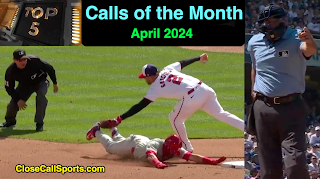
Calls of the Month - April 2024

CloseCallSports
' Top 5 Calls of the Month for April 2024 feature umpires whose concentration and keen eye allowed them to accurately assess close plays across Major League Baseball.

5) Alex Tosi's check swing hit-by-pitch in Cincinnati is confirmed via Replay Review.

4) Brian Walsh's out of play ruling on an overthrown ball is confirmed in Cincinnati.

3) CB Bucknor's out call on a force play at second base in Detroit is confirmed.

2) Angel Hernandez's HBP call in Los Angeles is confirmed by the slightest of margins.

1) Jonathan Parra's out call on a stolen base attempt in DC is confirmed by a tag on the heel.

Video as follows:

Saturday, May 4, 2024

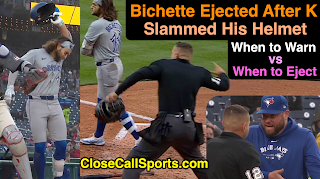
MLB Ejection 039 - Jonathan Parra (1; Bo Bichette)

HP Umpire Jonathan Parra ejected Blue Jays SS Bo Bichette (strike three call; QOCY) in the top of the 5th inning of the #BlueJays-#Nationals game. With two out and none on, Blue Jays batter Bichette took a 3-2 sinker from Nationals pitcher Jake Irvin for a called third strike. Replays indicate the pitch was located over the outer edge of home plate and thigh-high (px 0.79, pz 2.63), the call was correct.* At the time of the ejection, the Blue Jays were leading, 4-0. The Blue Jays ultimately won the contest, 6-3.

This is Jonathan Parra (121)'s 1st ejection of 2024.
*UEFL Rule 6-2-b-1 (Kulpa Rule): |0| < STRIKE < |.748| < BORDERLINE < |.914| < BALL.
This pitch was located 1.45 horizontal inches from being deemed incorrect.

This is the 39th ejection report of the 2024 MLB regular season.
This is the 17th player ejection of 2024. Prior to ejection, Bichette was 1-3 (SO) in the contest.
Ejection Tally: 17 Managers, 6 Coaches, 16 Players.
This is Toronto's 3rd ejection of 2024, 2nd in the AL East (NYY 4; TOR 3; BOS, TB 1; BAL 0).
This is Bo Bichette's first career MLB ejection.
This is Jonathan Parra's first career MLB ejection.

Wednesday, April 17, 2024

John Libka's Time Play Washout and Umpiring Mechanics

Mariners outfielder Julio Rodríguez's heads up play to throw Reds runner Elly De La Cruz out at third base after catching Nick Martini's fly ball saved Seattle a run, as HP Umpire John Libka ruled R3 Jake Fraley did not score prior to the time play's third out.

We review umpiring mechanics for time play situations—especially of the sacrifice fly-turned-inning-ending-double-play variety—and clarify (again) that an appeal play on a runner for failing to retouch (tag up) after a caught fly ball is not considered a force play, and thus, subject to time play rules.

Time Play Basics: Official Baseball Rule 5.08(a) states that, "One run shall be scored each time a runner legally advances to and touches first, second, third and home base before three players are put out to end the inning." This means that on plays where a third out may occur, it is incumbent on the home plate umpire to prepare for the possibility that they will have to determine whether or not a preceding runner touched home plate prior to the third out being recorded behind them.

On this play, HP Umpire Libka lined up to see both Cincinnati baserunner R3 Fraley's impending touch of home plate and Seattle third baseman Josh Rojas' diving tag attempt on Reds runner R2 De La Cruz. When 3B Umpire Jonathan Parra, himself moving with the play to find the keyhole angle, called R2 De La Cruz out on the tag for the inning's third out, Libka emerged from behind home plate to indicate via the washout signal (similar to a "safe" sign except the arms are more elevated) that R3 Fraley's run would not score, as Fraley hadn't yet touched home plate prior to the third out on De La Cruz.

Exceptions to Time Plays: OBR 5.08(a) provides for three time play exceptions, meaning that even if a lead runner touches home prior to the third out, the run still will not count if the third out is a result of one of these scenarios. These are 1) a batter-runner retired before touching first base, 2) any runner being forced out, and 3) an appeal play for missing a base made on a preceding (ahead of) runner.

Appeal Plays: If any appeal play results on a preceding runner being declared out for the third out of the inning, no following runner is allowed to score. But if an appeal play is made on a following runner, then the preceding runner's run is treated as a Time Play—if the preceding runner touches home prior to the third out, the run will count. It is a rules myth that all tag-up or retouch appeals are treated as force plays—they are not, and are subject to timing rules if the runner being retired is trailing/following/behind the lead runner who is trying to score.

Video as follows:

Friday, March 29, 2024

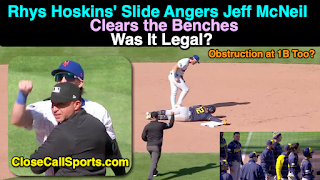
Hoskins' Slide Into McNeil & Obstruction Play at 1B

Following a look at whether Brewers 1B Rhys Hoskins' block of Mets runner DJ Stewart was obstruction or not, we determine whether Hoskins' slide into Mets 2B Jeff McNeil satisfied the bona flide slide rule criteria relative to breaking up double play attempts. Of note, 2B Umpire Jonathan Parra made his MLB debut and was working his first major league game when the benches cleared as a result of Hoskins' slide and McNeil's reaction.

Obstruction: In the bottom of the 2nd inning, Brewers catcher William Contreras threw to first base in an attempt to pickoff Mets baserunner R1 Stewart, with Milwaukee 1B Hoskins receiving the throw and appearing to place his left leg into runner Stewart's path, effectively blocking his access to first base. 1B Umpire Lance Barrett called the runner out, effectively no-calling potential obstruction as the retired runner complained that Hoskins was blocking the bag.

Defined as "the act of a fielder who, while not in possession of the ball and not in the act of fielding the ball, impedes the progress of any runner," the new obstruction point of emphasis instructs umpires to call obstruction as in Official Baseball Rule 6.01(h)(1) or Type A when a fielder blocks the runner's path without possession of the ball unnecessarily, even if the fielder is in the act of fielding at the time.

The goal is to crack down on fielders using the "act of fielding" defense to blatantly block runners' base paths when they distinctly do not need to occupy that space to receive the throw.

Bona Fide Slide: In the top of the 8th inning, Brewers baserunner R1 Hoskins slid into second base on an infield ground ball and potential double play attempt. Hoskins slid through the base, but was able to keep his hand in contact with the second base bag, making contact with Mets 2B McNeil in the process, who took exception and whose reaction spurred both benches to briefly clear.

After Replay Review, the Mets' challenge that Hoskins' slide was illegal was denied and the original call by 2B Umpire Parra of out and no slide violation was confirmed.

The four criteria of a bona fide slide, as in OBR 6.01(j), are 1) begins the slide before reaching the base, 2) able and attempts to reach the base, 3) able and attempts to remain on the base, and 4) slides within reach of the base without changing pathway for the purpose of initiating contact with a fielder.

Replay conclusively determined that R1 Hoskins satisfied all four criteria and, thus, engaged in a legal, bona fide slide.

Note that in college and high school, Hoskins' slide may have violated the force play slide rule (FPSR doesn't exist in pro ball), given that Hoskins' failed to slide in a direct line between the two bases. NCAA Rule 8-4 governs FPSR cases and holds that "the runner’s entire body (feet, legs, trunk and arms) must stay in a straight line between the bases."


Video as follows: