Umpire Jim Joyce is officially off the Disabled List after working Friday's Spring Training debut matchup of the Cactus League's Seattle Mariners and Oakland Athletics. Joyce joined HP Umpire Doug Eddings and fellow MLB umpires Brian Runge and Ron Kulpa on the bases. As is customary during Spring Training, Joyce, Runge and Kulpa rotated through the three base positions throughout the contest.
Joyce had suffered a season-ending knee injury last year, working his last 2011 contest on June 9th. AAA fill-in John Tumpane was Joyce's replacement. Prior to his injury, Joyce had compiled four ejections and 16 points in 2011's UEFL.
Friday, March 2, 2012


MLB Announces Second Wild Cards, Added Playoff Game: How This Affects Umpire Ejection Fantasy League
Umpire Ejection Fantasy League: Help us decide how MLB's expanded postseason and second wild cards will impact the UEFL in 2012
After several days of speculation, Major League Baseball sent out an official press release, announcing their much-anticipated plan of expanding the postseason to 10 teams in 2012, as opposed to eight, which was the 2011 model. The additional two teams will be comprised of a second Wild Card, one in each league (AL/NL).
The UEFL has long attributed points for postseason umpiring assignments according to the following schedule:
+1 point for a Division Series appearance (+2 for DS Crew Chief)
+2 points for a Championship Series appearance (+3 for CS Crew Chief)
+3 points for a World Series appearance (+4 for WS Crew Chief)
Current Poll: With the new Wild Card playoff game—which is officially and technically part of the postseason, it is not a Game 163 tiebreaker—how should the UEFL attribute postseason points?
Option A: WC = 1 point, DS = 1 point, CS = 2 points, WS = 3 points, -cc = +1 point (any assignment)
Option B: WC = 1, DS = 1, CS = 2, WS = 3, -cc = +1 (DS, CS and WS, but not WC)
Option C: WC = 1, DS = 2, CS = 3, WS = 4, -cc = +1 (any assignment)
Option D: WC = 0 [nothing], DS = 1, CS = 2, WS = 3, -cc +1 (any assignment, including WC)
Option E: WC = 0 [nothing], DS = 1, CS = 2, WS = 3, -cc +1 (DS, CS and WS, but not WC)
In essence, Options A, B, D and E maintain our present DS/CS/WS points structures, Option C adds a point to preserve the sliding scale, Option D only recognizes the WC crew chief and Option E recognizes none of the WC umpires.
*WC = Wild Card, DS = Division Series, CS = Championship Series, WS = World Series, -cc = Crew Chief
How should the UEFL attribute Wild Card postseason play-in assignment points (Rule 4-3)?
After several days of speculation, Major League Baseball sent out an official press release, announcing their much-anticipated plan of expanding the postseason to 10 teams in 2012, as opposed to eight, which was the 2011 model. The additional two teams will be comprised of a second Wild Card, one in each league (AL/NL).
The UEFL has long attributed points for postseason umpiring assignments according to the following schedule:
+1 point for a Division Series appearance (+2 for DS Crew Chief)
+2 points for a Championship Series appearance (+3 for CS Crew Chief)
+3 points for a World Series appearance (+4 for WS Crew Chief)
Current Poll: With the new Wild Card playoff game—which is officially and technically part of the postseason, it is not a Game 163 tiebreaker—how should the UEFL attribute postseason points?
Option A: WC = 1 point, DS = 1 point, CS = 2 points, WS = 3 points, -cc = +1 point (any assignment)
Option B: WC = 1, DS = 1, CS = 2, WS = 3, -cc = +1 (DS, CS and WS, but not WC)
Option C: WC = 1, DS = 2, CS = 3, WS = 4, -cc = +1 (any assignment)
Option D: WC = 0 [nothing], DS = 1, CS = 2, WS = 3, -cc +1 (any assignment, including WC)
Option E: WC = 0 [nothing], DS = 1, CS = 2, WS = 3, -cc +1 (DS, CS and WS, but not WC)
In essence, Options A, B, D and E maintain our present DS/CS/WS points structures, Option C adds a point to preserve the sliding scale, Option D only recognizes the WC crew chief and Option E recognizes none of the WC umpires.
*WC = Wild Card, DS = Division Series, CS = Championship Series, WS = World Series, -cc = Crew Chief
How should the UEFL attribute Wild Card postseason play-in assignment points (Rule 4-3)?
Thursday, March 1, 2012
MLB Umpire Alfonso Marquez Gives Back to His Native Mexico
The United States of America hardly owns a monopoly over officiating camps, clinics and schools and MLB umpire Alfonso Marquez—the first and only Mexican born umpire on the big league staff—is back in his native Mexico, doing exactly what umpires like Dana DeMuth, Greg Gibson and Hunter Wendelstedt have done here: Fonsie is giving back.
Marquez and fellow MLB umpire Ted Barrett traveled to El Carmen, Nuevo Leon, Mexico this past week and have been working to train, evaluate and instruct young umpires looking to climb the ladder in baseball's Mexican League (La Liga Mexicana de Béisbol).
In an interview with La Afición, Marquez discussed the enjoyment he takes from giving back, also admitting his next big dreams: to receive a promotion to crew chief and to work a World Baseball Classic, since Marquez was injured and unable to work during the most recent WBC.
 |
| Márquez, MiLB coordinator Jorge Bauzá and Ted Barrett in Monterrey. Photo: Liga Mexicana de Béisbol |
In an interview with La Afición, Marquez discussed the enjoyment he takes from giving back, also admitting his next big dreams: to receive a promotion to crew chief and to work a World Baseball Classic, since Marquez was injured and unable to work during the most recent WBC.
Unconfirmed: MLB won't expand instant replay in 2012
According to a source, MLB will not expand instant replay in 2012. It is unknown whether the umpires' union or playing rules committee (or some other MLB entity) rejected the proposal, but if this rumor is confirmed as accurate, it will be the first update regarding the expanded replay proposal since late 2011, when the players and owners ratified their newest labor contract with expanded replay on the docket. At the time, the deal was still pending umpire approval.
 |
| Baseball's Instant Replay "Box" |
As I wrote in December (MLB News: Proposed Labor Deal Includes Expanded Instant Replay), the new CBA indicated a desire to expand instant replay to include Fair/Foul, Catch/No Catch (Catch/Trap) and Stadium-wide Spectator Interference calls (the present model only allows for instant replay when the spectator interference occurs in fair territory where it might interfere with a home run).
According to the UEFL's August 2011 poll, 36 percent of UEFL'ers were in support of Fair/Foul replay, 30 percent supported Catch/No Catch and 68 percent supported spectator interference.
At the time of this post's publishing, no other sources have confirmed nor denied this anonymous account; as such, this is being posted under the heading of Unconfirmed Rumor. This is the first we at the UEFL have heard regarding possible instant replay expansion since 2011 and it is the first we have heard regarding MLB potentially not expanding replay after all.
Saturday, February 25, 2012
Rick Pitino Blames Officials, Opposing Fans: A Case Play of Scapegoating in Sports
There is a tendency in today's society to blame others rather than accept responsibility and admit one's own shortcomings. It is a trait exhibited by toddlers who throw tantrums and decision-makers everywhere who admonish others rather than admit wrongdoing.
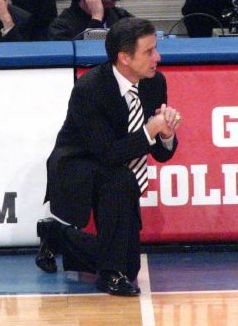 |
| Pitino in the 2007 Big East Tournament |
Blaming others, or scapegoating, has become such a prevalent phenomenon, books have been written and associations formed to study the issue.
For the blamer, the act of passing the buck is often more pleasant than acknowledging fault. According to the Scapegoat Society, the discrediting routine known as scapegoating involves distortion of truth, vilification and separated from the incident at hand, the blamer sometimes resembles a conspiracy theorist.
Chris Allen Carter additionally has postulated that blamers are "insecure people driven to raise their own status by lowering the status of their target," while in 1953, Kraupl-Taylor concluded that scapegoating "leads to the satisfaction of unconscious scoptophilia and aggression and gives narcissistic satisfaction to the ego."
In other words, scapegoating and blaming others may temporarily make one feel better about him or herself, but in the end, it's just a psychological defense mechanism meant to shield oneself from responsibility and truth.
But this is a sports website... You get where I'm headed with this.
Friday, February 24, 2012
Umpire Ejection Fantasy League: Introducing the UEFL Portal on our Sixth Anniversary
Close Call Sports and The Umpire Ejection Fantasy League are pleased to introduce our latest venture: The UEFL Portal. February 24, 2012 is the sixth anniversary of the Umpire Ejection Fantasy League and we couldn't think of a better birthday present than the new UEFL Portal.
The UEFL Portal website is a one-stop source for MLB umpire ejection statistics, with a database that extends back to 2005 with detailed ejection data posted for the 2008-2011 seasons.
For a virtual tour, feel free to consult the following video. High Definition and/or full screen viewing are recommended.
The UEFL Portal houses several key Umpire Ejection Fantasy League pages, while the Portal home page contains important UEFL information, such as upcoming pre-season dates and deadlines and miscellaneous 2011 statistics:
 |
| The Umpire Ejection Fantasy League presents the UEFL Portal |
For a virtual tour, feel free to consult the following video. High Definition and/or full screen viewing are recommended.
- Member Roster: A sortable list of UEFL members, which will contain specific draft order information upon the conclusion of the registration period. The Member Roster also contains the draft board, which will fill as the draft progresses.
- Appeals Board: UEFL members recently voted to create an Appeals Board that will routinely rule on issues of challenged Qualities of Correctness. This page contains information for prospective Appeals Board candidates, such as position requirements and deadlines. During the season, the Appeals Board page will contain a sortable linked list detailing each and every action taken and decision rendered by the Board.
- MLB Ejection List: This sortable list will display every ejection that occurs during the 2012 season: the Ejection number, ejecting umpire, ejected person, etc. The ejection number will be linked to the ejection blog post on the CCS website, while the umpire entry will be linked to the appropriate umpire's profile page (see Umpire Roster/Stats).
- Ejections Feed: This page lists recent MLB ejections, as reported by the Umpire Ejection Fantasy League blog at CCS. All entries are linked.
- Umpire Roster / Stats: Every MLB and AAA fill-in umpire is listed on the Umpire Roster/Stats page, along with their 2011 ejection and UEFL points totals and +/- figure (see the page for more details). Clicking on any umpire's name takes you to his UEFL profile: a page that includes ejection history since 2005, detailed information about the umpire's 2011 ejections, a biography, post-season and special event appearances and recent activity, which links back to the UEFL blog at CCS.
- Historical Data: This page includes summary ejection statistics since the 2005 season and comprehensive ejection information for every official regular or post-season ejection since 2008. Detailed fields include ejected person, position and team, whether the ejected person's team was winning pre-ejection and how that team fared post-ejection (runs scored and allowed), inning of ejection (offense or defense), reason for ejection, play result, umpire classification (calling or secondary) and of course, Quality of Correctness.
- UEFL Rules Book: As approved by the UEFL membership at the conclusion of the 2011 season, the 2012 Official Rules of the Umpire Ejection Fantasy League appear in their entirety.
Though not listed on the UEFL Portal, we always welcome feedback and suggestions, either via e-mail, the UEFL blog on the CCS website or the CCS general forum.
Thank you and we hope you enjoy the UEFL Portal, accessible at http://portal.closecallsports.com.
Thank you and we hope you enjoy the UEFL Portal, accessible at http://portal.closecallsports.com.
Wednesday, February 22, 2012
MLB Institutes Pace-of-Game Pitcher Warmup Rule to Prevent Stalling
Q: What do MLB manager Joes Girardi, Maddon and Torre all have in common?
A: They have all employed a strategy that, in 2012, will be illegal in baseball.
 Earlier this offseason, MLB's Playing Rules Committee had proposed a modification to OBR 3.05, which governs pitchers and their substitutes. The tweak was recently approved by MLB, the players' and umpires' unions, meaning the new rule will take effect in 2012.
Under MLB's newest rule, managers will be prohibited from "sending his current pitcher out to warm up with no intention of having him pitch because a relief pitcher is not ready to enter the game."
MLB has recently taken a significant interest in finding ways to speed up the pace of the average baseball game, which currently runs about three hours. This Rule 3.05 modification is expected to limit managers' ability to stall in order to allow a cold reliever an opportunity to warm in the bullpen, before entering the game and receiving even more warmup pitches.
In other words, "last minute bullpen managing" will be a thing of the past and skippers will be forced to return to a time during which they had to plan ahead.
A: They have all employed a strategy that, in 2012, will be illegal in baseball.

Under MLB's newest rule, managers will be prohibited from "sending his current pitcher out to warm up with no intention of having him pitch because a relief pitcher is not ready to enter the game."
MLB has recently taken a significant interest in finding ways to speed up the pace of the average baseball game, which currently runs about three hours. This Rule 3.05 modification is expected to limit managers' ability to stall in order to allow a cold reliever an opportunity to warm in the bullpen, before entering the game and receiving even more warmup pitches.
In other words, "last minute bullpen managing" will be a thing of the past and skippers will be forced to return to a time during which they had to plan ahead.
Sunday, February 19, 2012
Referee Ejects Former Basketball Players Attending Game as Team Guests: About Ejecting Fans
NCAA basketball official Karl Hess has quite the legacy, both as an official and as a player at Liberty University—in 2006, Hess' number 11 jersey was retired by the Flames during a halftime ceremony that included Hess, his wife and Liberty Director of Athletics Jeff Barber.
Hess is Liberty's all-time career top scorer with 2,373 points and is also the program's leader in field goals (951), free throws (471), free throw percentage (89.9%), assists (648) and is tied for first in games played (120). His 1980 Flames team won the NCCAA National Championship, as Hess earned All-Tournament and MVP Awards for his efforts.
As an official, Hess. He was crew chief for the 2007 NCAA Men's National Championship game between Florida and Ohio State and worked the Final Four in 2008 and 2009, with a Sweet Sixteen matchup in 2010. He has been invited to work the NCAA Tournament annually since 1996.
With such success comes a bounty of naysayers and hecklers; taunting and harassment.
On Saturday, Hess had finally had enough and used the powers vested in him by the NCAA Rules Book to take care of a problem situation.
In Raleigh, North Carolina to work the Florida State vs. N.C. State, Hess began receiving the traditional heckles that fans often bestow upon officials, only the source of this verbal barrage wasn't quite what one might expect.
Former N.C. State Wolfpack star players Tom Gugliotta and Chris Corchiani—who, like Hess, have had their jerseys retired by their alma mater—had taken their seats behind the scorer's table and were allegedly hurling insult after insult toward the officiating crew and Hess in particular.
When traditional heckling gave way to petty insults and abuse that crossed the line, Hess called for the disrespectful fans' removal from the facility. Moments later, stadium security arrived and escorted Gugliotta and Corchiani out of the RBC Center.
 |
| Official Karl Hess at the NCAA Tournament |
As an official, Hess. He was crew chief for the 2007 NCAA Men's National Championship game between Florida and Ohio State and worked the Final Four in 2008 and 2009, with a Sweet Sixteen matchup in 2010. He has been invited to work the NCAA Tournament annually since 1996.
With such success comes a bounty of naysayers and hecklers; taunting and harassment.
On Saturday, Hess had finally had enough and used the powers vested in him by the NCAA Rules Book to take care of a problem situation.
In Raleigh, North Carolina to work the Florida State vs. N.C. State, Hess began receiving the traditional heckles that fans often bestow upon officials, only the source of this verbal barrage wasn't quite what one might expect.
Former N.C. State Wolfpack star players Tom Gugliotta and Chris Corchiani—who, like Hess, have had their jerseys retired by their alma mater—had taken their seats behind the scorer's table and were allegedly hurling insult after insult toward the officiating crew and Hess in particular.
When traditional heckling gave way to petty insults and abuse that crossed the line, Hess called for the disrespectful fans' removal from the facility. Moments later, stadium security arrived and escorted Gugliotta and Corchiani out of the RBC Center.
Friday, February 17, 2012
Umpire Academy Owner Jim Evans Apologizes for Racially Insensitive Incident
Less than a week removed from umpiring's biggest story of the 2012 offseason, the name owner of the Jim Evans Academy for Professional Umpiring has unequivocally and without qualification apologized for the racially inappropriate incident which occurred during a staff bowling party during the 2012 professional course, stating, "I apologize I regret it sincerely (sic)."
In an exclusive interview with WKMG-Orlando, Evans admitted he was too slow to react to the inappropriate costume perpetrated by JEAPU Director Jason Klein, as by the time Evans noticed that Klein and his three teammates were wearing white conical covers and robes emblazoned with "Klein's Kleaning Krew"—with the capital "KKK" emphasized—it was too late and the team had changed into standard bowling attire.
In an exclusive interview with WKMG-Orlando, Evans admitted he was too slow to react to the inappropriate costume perpetrated by JEAPU Director Jason Klein, as by the time Evans noticed that Klein and his three teammates were wearing white conical covers and robes emblazoned with "Klein's Kleaning Krew"—with the capital "KKK" emphasized—it was too late and the team had changed into standard bowling attire.
Sunday, February 12, 2012
2012 NFHS Football Rules Changes
After meeting in Indianapolis three weeks ago, the Football Rules Committee for the National Federation of State High School Associations approved multiple rules changes. These eight changes were approved by the NFHS Board of Directors and announced Thursday. There were both major rule changes, as well as minor changes and clarifications. The rules changes are as follows:
 Major Changes:
Losing a Helmet
The first change is to NFHS Rule 3-5-10, which governs when a time-out occurs regarding (a) an injured player, (b) a player that displays signs and symptoms of a concussion, (c) and player that is bleeding or has blood on his person or jersey. The rule change is an addition to the rule that now requires a player who loses their helmet during a live-ball to sit out one play. According to NFHS, the helmet must come completely off during the live-ball play for the rule to apply. Players are exempted from having to sit out a play if the helmet coming loose can be directly attributed to a foul, such as a facemask. NFHS cites data showing a great frequency of players losing their helmetsduring the course of a live-ball play. According to Kentucky High School Athletic Association commissioner and chair of the Football Rules Committee, Julian Tackett, the aim is for players to stop wearing their helmets loose. The intent is to have players wearing properly fitted helmets that are worn tight around the head. NFHS' press release did not state whether a time-out may prevent a player having to sit out a play. Under Rule 3-5-10a, an injured player is required to sit a play out, if an official discovers the injury and delays the ready for play whistle, regardless if a team takes a charged time-out after the fact.

Losing a Helmet
The first change is to NFHS Rule 3-5-10, which governs when a time-out occurs regarding (a) an injured player, (b) a player that displays signs and symptoms of a concussion, (c) and player that is bleeding or has blood on his person or jersey. The rule change is an addition to the rule that now requires a player who loses their helmet during a live-ball to sit out one play. According to NFHS, the helmet must come completely off during the live-ball play for the rule to apply. Players are exempted from having to sit out a play if the helmet coming loose can be directly attributed to a foul, such as a facemask. NFHS cites data showing a great frequency of players losing their helmetsduring the course of a live-ball play. According to Kentucky High School Athletic Association commissioner and chair of the Football Rules Committee, Julian Tackett, the aim is for players to stop wearing their helmets loose. The intent is to have players wearing properly fitted helmets that are worn tight around the head. NFHS' press release did not state whether a time-out may prevent a player having to sit out a play. Under Rule 3-5-10a, an injured player is required to sit a play out, if an official discovers the injury and delays the ready for play whistle, regardless if a team takes a charged time-out after the fact.
Subscribe to:
Posts
(
Atom
)