Saturday, September 10, 2022

MLB Ejection 158 - Jeff Nelson (3; David Bell)

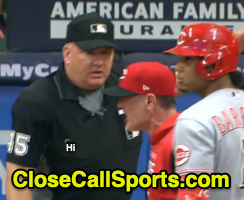
HP Umpire Jeff Nelson ejected Reds manager David Bell (check swing strike three call by 1B Umpire Manny Gonzalez) in the top of the 8th inning of the #Reds-#Brewers game. With one out and none on, Reds batter Jose Barrero attempted to check his swing on a 0-2 curveball from Brewers pitcher Matt Bush, ruled a ball by HP Umpire Nelson and called a swinging strike on appeal by 1B Umpire Gonzalez. Play was reviewed and adjudicated by the UEFL Appeals Board, the call was correct. At the time of the ejection, the Brewers were leading, 3-1. The Brewers ultimately won the contest, 5-1.

This is Jeff Nelson (45)'s 3rd ejection of 2022.

This is the 158th ejection report of the 2022 MLB regular season.
This is the 86th manager ejection of 2022.
This is Cincinnati's 4th ejection of 2022, T-4th in the NL Central (CHC 9; STL 6; PIT 5; CIN, MIL 4).
This is David Bell's 4th ejection of 2022, 1st since Sept 6 (Carlos Torres; QOC = Y [Balls/Strikes]).
This is Jeff Nelson's 3rd ejection of 2022, 1st since Sept 6 (John Schneider; QOC = Y [Balls/Strikes]).

Wrap: Cincinnati Reds vs Milwaukee Brewers, 9/10/22 | Video as follows:

MLB Ejections 156-157 - H Wendelstedt (2-3; ARI x2)

HP Umpire Hunter Wendelstedt ejected Diamondbacks DH Ketel Marte and manager Torey Lovullo (strike one call; QOCY) in the top of the 7th inning of the #Dbacks-Rockies game. With none out and none on, Diamondbacks batter Marte took a 0-0 sinker from Rockies pitcher Justin Lawrence for a called first strike. Replays indicate the pitch was located over the outer half of home plate and at the hollow of the knee (px -0.54, pz 1.53 [sz_bot 1.72 / RAD 1.60 / MOE 1.52]), the call was correct.* At the time of the ejections, the Rockies were leading, 4-1. The Rockies ultimately won the contest, 4-1.

These are Hunter Wendelestedt (21)'s 2nd and 3rd ejections of 2022.
*This pitch was located 0.12 vertical inches from being deemed incorrect.

These are the 156th and 157th ejection reports of the 2022 MLB regular season.
This is the 51st player ejection of 2022. Prior to ejection, Marte was 1-2 (SO) in the contest.
This is the 85th manager ejection of 2022.
This is Arizona's 6/7th ejection of 2022, 1st in the NL West (ARI 7; SD 6; SF 5; COL 3; LAD 1).
This is Ketel Marte's 1st ejection since July 19, 2019 (Sam Holbrook; QOC = N [Balls/Strikes]).
This is Torey Lovullo's 4th ejection of 2022, 1st since August 16 (Cory Blaser; QOC = Y [Balls/Strikes]).
This is H Wendelstedt's 2/3rd ejection of 2022, 1st since Sept 9 (Brendan Rodgers; QOC = ? [Check Swing]).

Wrap: Arizona Diamondbacks vs Colorado Rockies, 9/10/22 | Video as follows:

Ask - Hair Check and the Pitcher Foreign Substance Rule

HP Umpire Ted Barrett took the unusual step of checking Guardians pitcher James Karinchak's hair for foreign substances, after Twins manager Rocco Baldelli filed a request to inspect the Cleveland reliever. Official Baseball Rule 6.02(c)(7) prohibits a pitcher from having "on their person, or in their possession, any foreign substance." The penalty for violation is immediate ejection and automatic suspension.

Pursuant to a directive from the MLB Commissioner's Office in June 2021, umpires already pursue enhanced illegal substance checks for every pitcher when they are removed from the game or at the conclusion of the inning after coming into the game (starting pitchers are checked multiple times at the end of their half-innings of work).

This makes Bald-elli's hirsute request somewhat rare for the post-2021 edict era, but nonetheless a legal one. There is no penalty for requesting an inspection and the umpire declaring the opposing pitcher to be legal.

Contrast this to the National Hockey League's stick measurement rule, which states that if the referee finds the complainant's allegation is with merit, the opposing player shall be assessed a penalty, but if the complaint is unsuccessful and the referee deems no violation has occurred, the complaining club receives a bench minor penalty for delay of game.

Video as follows:

Friday, September 9, 2022

MLB Ejection 155 - H Wendelstedt (1; Brendan Rodgers)

3B Umpire Hunter Wendelstedt ejected Rockies 2B Brendan Rodgers (check swing strike three call) in the bottom of the 5th inning of the #Diamondbacks-#Rockies game. With none out and none on, Rockies batter Rodgers attempted to check his swing on a 3-2 fastball from Diamondbacks pitcher Kevin Ginkel, ruled a ball by HP Umpire Adam Hamari and called a swinging strike on appeal by 1B Umpire Wendelstedt. This play is under review by the UEFL Appeals Board, the call was *PENDING*. At the time of the ejection, the Diamondbacks were leading, 10-8. The Rockies ultimately won the contest, 13-10.

This is Hunter Wendelstedt (21)'s 1st ejection of 2022.

This is the 155th ejection report of the 2022 MLB regular season.
This is the 50th player ejection of 2022. Prior to ejection, Rodgers was 0-3 (2 SO) in the contest.
This is Colorado's 3rd ejection of 2022, 4th in the NL West (SD 6; ARI, SF 5; COL 3; LAD 1).
This is Brendan Rodgers' first career MLB ejection.
This is Hunter Wendelstedt's 1st ejection since August 19, 2021 (AJ Hinch; QOC = Y [Replay Review]).

Wrap: Arizona Diamondbacks vs Colorado Rockies, 9/9/22 | Video as follows:

MLB Announces Rules Changes for 2023 - A Review

Major League Baseball announced the following rules changes for its 2023 season, including a ban on infield shifts, bigger bases, pitch clocks, and pickoff/disengagement limits. MiLB has been used as a testing ground for several of these new rules, and Baseball now believes it is time to bring them to the MLB level.

(Effective) Ban on Infield Shifts: This rule requires that all four infielders—defined as the first baseman, second baseman, shortstop, and third baseman, for the purpose of this rule—begin play with both feet within the infield and on their proper side of the infield. This effectively eliminates a shortstop's ability to begin play on the second base side of the field, or on the outfield grass, etc.

Bigger Bases: MLB's 15 inches square bases will increase in size to 18 inches square (home plate retains the same dimensions), which should assist in both offense (stolen bases) and safety, giving batter-runners and first basemen more room to peacefully co-exist without stepping on each-other's feet...Manny.

Pitch Clocks: The pitch clocks are finally a Major League reality starting in 2023. Even though stadiums have had clocks ever since Replay Review time limits and Inning-Break timers were introduced, the pitch clock will introduce a 30-second timer between batters, 20-second timer with runners on base, and 15-second timer with the bases empty.

The batter must be in the box and alert to the pitcher by the eight-second mark on the clock (penalty: automatic strike) while the pitcher must begin a motion to deliver the pitch (or pickoff attempt) by the zero-second expiration of time (penalty: automatic ball). There is also a limit of two "free" disengagements (pickoff attempts/step-offs) during each plate appearance, with a penalty for the third disengagement a one-base award for any baserunners (exception: if the pickoff throw retires the runner, then the out shall prevail and there is no penalty).

What do you think of these new rules for MLB? | Video as follows:

Thursday, September 8, 2022

Marlins-Phillies Crash Play on a Legal Base Block

After Marlins pitcher Richard Bleier fielded a soft ground ball and dove on first base ahead of Phillies batter-runner Brandon Marsh's arrival, ruled an out by 1B Umpire Angel Hernandez with no obstruction (or interference) violation for blocking the runner's access to first base, Philadelphia manager Rob Thomson challenged the call, which was confirmed via Replay Review as an out.

In an extension of our prior analyses on the home plate collision rule, we again find that a fielder has the right to block the runner's path to a base if the fielder already has possession of the ball when they begin their blocking action, and are attempting to retire that runner.

In this case, pitcher Bleier fielded and maintained possession of the baseball while falling on top of first base, meaning that his low block on runner Marsh was legal: Bleier, with possession of the ball, attempted to retire the runner by legally tagging first base. Despite the significant contact between the opposing players, this is a legal play that also adheres to the "Angel is Everywhere" rule.

Video as follows:

Reds-Cubs Batter Interference - Benefit of Doubt to Defense

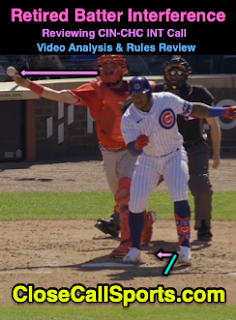
After HP Umpire Lew Williams ruled Cubs baserunner R1 Alfonso Rivas out for teammate and retired batter Nelson Velazquez's interference at home plate by stepping out of the batter's box and hindering Reds catcher Austin Romine's throw to second base, we were asked to review the batter interference rule.

An important distinction to note is that the Official Baseball Rules contain two potentially relevant provisions—one which applies to a batter who has not been retired or become a runner, and another which applies to a batter or runner who has been retired and nonetheless impedes a fielder attempting to play on a teammate.

OBR 6.03(a)(3) pertains to a still-active batter (e.g., batter has not struck out): "A batter is out for illegal action when—they interfere with the catcher’s fielding or throwing by stepping out of the batter’s box or making any other movement that hinders the catcher’s play at home base."

OBR 6.01(a)(5) pertains to a batter or runner who has been put out (including a batter that just struck out): "Any batter or runner who has just been put out, or any runner who has just scored, hinders or impedes any following play being made on a runner. Such runner shall be declared out for the interference of their teammate."

Thus, with Velazquez swinging and missing at a 3-2 pitch, we have a recently retired batter.

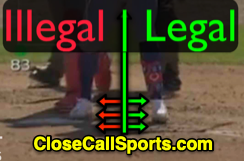
Because Velazquez seemed to step in front of Cincinnati catcher Romine after swinging and missing for a strikeout, the benefit of the doubt goes to the defense. Thus, it is logical to conclude that Velazquez, by stumbling to his right and in front of catcher Romine's left side, hindered or impeded Romine by causing the catcher to adjust by veering or throwing to his right more than he otherwise would have had Velazquez not stepped onto home plate. Because the throw was wild and to the right of its intended destination as well, we can conclude that interference—which does NOT require contact—likely occurred.

Video as follows:

Ejection Criteria - Baseball's Standards for Removal

In continuation of our educational series, we review baseball's criteria for ejection, also known as the Standards for Removal from the Game. The following list comprises a majority of reasons an umpire may eject a player, coach, or manager from a ballgame ranging from physical abuse, battery, and assault, to personal, profane, and prolonged complaining.

Several of these Standards may be found via the UEFL Baseball Video Rulebook.

Standard 1) Profanity or Vulgar Insults Directed at/of Umpire: This criterion comprises statements of obscenity and unsporting personal insults of an umpire.

Standard 2) Physical Contact with an Umpire: This includes so-called bumping an umpire and other instances of improperly touching an umpire.

Standard 3) Refusal to Stop Arguing / Delaying the Game: Also known as prolonged or continued complaining, this standard includes an on-field argument that the player/coach/manager continues even after being instructed/warned by an umpire to stop, as well as continued complaining from the field or from the dugout. Continued Complaining ejections also apply to arguing a call from a prior game or prior inning.

Standard 4
) Leaving Position to Argue Balls and Strikes (Including Half Swings): Leaving one's position to argue ball/strike calls, which include check swings *and balks* is ground for ejection from the game.

Standard 5) Arguing a Replay Review or Any Changed Call: Arguing a Replay Official's decision to confirm/stand/overturn a call or arguing an on-field umpiring crew's decision to change a call is ground for ejection. This provision also includes citing video evidence to contradict an on-field ruling.

Standard 6
) Use of Histrionic Gestures or Gesturing Toward an Umpire: Using exaggerated body movements or gestures to dispute an umpire's action is ground for ejection. Throwing objects from the dugout or bullpen is also included under this provision.

Standard 7) Actions Intended to Ridicule: This includes actions such as a player drawing a line with their bat to indicate where they thought a pitch was located, or a manager mimicking an umpire's calls/signals or covering home plate with dirt.

Standard 8
) Throwing Equipment in Disgust: This includes throwing equipment as well as a uniform item in reaction to a call or during the course of an argument. A batter throwing a helmet or manager throwing a hat is covered by this provision.
- - S8: Intermediate Warning) Umpires may issue an equipment violation as an intermediary step in lieu of ejection for throwing equipment in disgust for less severe infractions of this provision. For instance, a batter who throws a bat after striking out may be warned (and fined) via an equipment violation instead of ejected outright, if the umpire judges the infraction of minor severity. However, severe violations as well as any violation of this provision after being warned (via equipment violation) shall result in ejection.

Standard 9
) Failure to Comply with an Umpire's Order: If a game participant refuses to comply with an umpire's order to do or refrain from doing something that affects the administration of the Official Baseball Rules (including pace of play initiatives), the offender may be ejected for such failure to comply. This includes ejections for refusing to enter the batter's box (MLB only — some lower levels have intermediary penalties, such as automatic strikes).

Standard 10
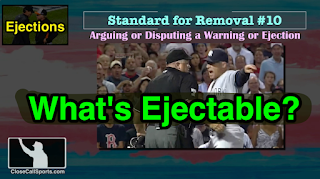
) Arguing or Disputing a Warning or Ejection (or Lack Thereof): A player, coach, or manager shall be ejected for disputing an umpire or umpiring crew's decision to warn or eject a participant, or decision to refrain from issuing such warning or ejection. An umpire's decision relative to a participant's game status (warning/ejection) is final and may not be argued.

Standard 11) Intentionally Throwing at Batter: A pitcher or pitcher and their manager may be ejected for intentionally throwing at an opposing batter. In lieu of ejection, the umpire may issue warnings to both teams that the next such infraction will result in the ejection of the offending pitcher and their manager.

Standard 12
) Unsporting NEC and Fighting: Participating or being charged with fighting shall result in automatic ejection of the offender(s) (lower levels, e.g., NCAA & NFHS, may have more strict rules regarding unsporting situations, than professional baseball). Unsporting actions not elsewhere specified—which includes the provisions referred to in Official Baseball Rule 6.04(a) [Unsportsmanlike Conduct] [incitement, language, calling "Time" to try and induce a balk or movement to distract the batter]—are included here, as well as foreign substance ejections (e.g., pine tar on pitcher or corked bat).

Video as follows:

Wednesday, September 7, 2022

Analysis of Blue Jays Plate Blocking Violation in Baltimore

Replay Review's decision to overturn HP Umpire Jeff Nelson's out call on Blue Jays catcher Alejandro Kirk's attempted tag of Orioles baserunner Adley Rutschman based on MLB's home plate collision/blocking rule, thus deeming Baltimore's runner safe, scoring a run, brought the catcher blocking criteria to light nary one month since Toronto benefited from the same overturned call in Minnesota.

To review, Official Baseball Rule 6.01(i)(2) states: "Unless the catcher is in possession of the ball, the catcher cannot block the pathway of the runner as they are attempting to score. If, in the judgment of the umpire, the catcher without possession of the ball blocks the pathway of the runner, the umpire shall call or signal the runner safe. Not withstanding the above, it shall not be considered a violation of this Rule 6.01(i)(2) if the catcher blocks the pathway of the runner in a legitimate attempt to field the throw (e.g., in reaction to the direction, trajectory or the hop of the incoming throw, or in reaction to a throw that originates from a pitcher or drawn-in infielder)."

Accordingly, Replay determined that Jays catcher Kirk moved into the runner's pathway when it was not necessary—this was deemed a non-legitimate attempt to field the throw as New York judged that the catcher did not need to block the pathway of the runner in order to field the throw. As we saw in Minnesota, it appears the league office desires for catchers to wait until the last possible moment—or at least later than the movements we are seeing in these recent plays—before veering into the runner's path to field the throw.

On first glance, this appears to put catchers in a difficult position—especially as was the case with Kirk—because Rutschman was barely at the edge of the dirt circle at the time Kirk first took possession of the ball.

Video as follows:

Tuesday, September 6, 2022

MLB Ejection 154 - Jeff Nelson (2; John Schneider)

HP Umpire Jeff Nelson ejected Blue Jays interim manager John Schneider (ball three call; QOCY) in the bottom of the 7th inning of the #BlueJays-#Orioles game. With one out and none on, Orioles batter Ryan Mountcastle took a 2-0 slider from Blue Jays pitcher Yimi Garcia for a called third ball. Replays indicate the pitch was located over the outer edge of home plate and below the hollow of the knee (px 0.80, pz 1.40 [sz_bot 1.76 / RAD 1.64]), the call was correct. At the time of the ejection, the Orioles were leading, 6-5. The Orioles ultimately won the contest, 9-6.

This is Jeff Nelson (45)'s 2nd ejection of 2022.
*Warnings were issued after a mid-7th benches-clearing incident.
This pitch was located 3.88 vertical inches from being deemed incorrect.
Related Play: Blue Jays Pitcher Gausman Called for Balk on 1st Pitch with Runners (9/5/22).

This is the 154th ejection report of the 2022 MLB regular season.
This is the 84th manager ejection of 2022.
This is Toronto's 10th ejection of 2022, 2nd in the AL East (NYY 11; TOR 10; BOS 6; BAL 4; TB 3).
This is John Schneider's 2nd ejection of 2022, 1st since August 27 (Shane Livensparger; QOC = Y [B/S]).
This is Jeff Nelson's 2nd ejection of 2022, 1st since April 16 (Charlie Montoyo; QOC = N [Balls/Strikes]).

Wrap: Toronto Blue Jays vs Baltimore Orioles, 9/6/22 | Video as follows: