Saturday, February 25, 2023

Pitch Clock Violation Strikes on 1st Day of Spring Training

Padres batter Manny Machado was penalized for violating MLB's new pitch clock rules on the first day of 2023 Spring Training, with HP Umpire Ryan Blakney awarding an automatic strike during Friday's Seattle-San Diego game when Mariners pitcher Robbie Ray was unable to deliver his pitch to Machado because batter Machado was not ready to receive it in time.

With one out and none on in the bottom of the 1st inning, Machado failed to appear in the batter's box and alert to the pitcher (ready for the pitch) with eight seconds remaining in the pitch clock countdown timer, which is the new rule's requirement. As a result, Blakney called "Time" and awarded an automatic strike, making the count 0-1. The at-bat continued in short order with Machado getting a base hit.

To review, the 2023 Pitch Clock rules for Major League Baseball are:
30-second timer will be used between batters;
20-second timer will be used between pitches with runners on base;
15-second timer will be used between pitches with zero runners on base.
The clock begins when the umpire declares "Play", the pitcher receives the ball (if time is already in), or the prior play concludes (as applicable).

The batter must be ready to go (in the box and alert to the pitcher) at the eight-second mark.
The pitcher must be ready to go (the pitching motion must begin) by the zero-second expiration of time.
Batter violation penalty: Automatic Strike / Pitcher violation penalty: Automatic ball.
Penalty for Arguing: Ejection.

Related PostMLB Announces Rules Changes for 2023 - A Review (9/9/22).

Video as follows:

Thursday, February 16, 2023

Carlson's Read Step on Awkward Throw at 1st Base

For this Teachable, 1B Umpire Mark Carlson demonstrates the light touch of a read step to adapt and adjust to an awkward throw at first base, as Cubs batter-runner Willson Contreras attempts to avoid Twins fielder Miguel Sano's tag on Josh Donaldson's off-line throw.

In officiating this play, Carlson trusts his instincts to move from the focal point of Sano's foot, which comes off the bag, to follow the ball toward Contreras' batting glove, which is tagged prior to the batter-runner arriving at first base. Carlson's call of "out" was confirmed via Replay Review.

Video as follows:

Tuesday, February 7, 2023

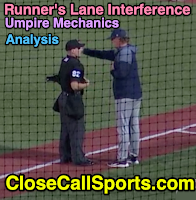
Runner's Lane Interference - A Mechanics Review

HP Umpire Nathan Hall did not hesitate to call runner's lane interference after deeming that a batter veered out of the running lane on a play to first base, a definitive decision from the very beginning that features in our Play Breakdown, sponsored by Umpire Placement Course (umpcourse.com), gateway to job placement across several professional leagues, including the Northwoods League, where this play took place.

With two out and two on (R1, R2) in the top of the 8th inning of the Wausau Woodchucks vs Traverse City Pit Splitters, a ground ball back to the pitcher's mound turned into an eventful few seconds for HP Umpire Hall as he first cleared the catcher to signal the batted ball fair before setting up along the foul line between home plate and first base.

Having observed that the Woodchucks batter-runner appeared to run inside (to the left of) the runner's lane (sidebar: both "inside" and "outside" the lane are illegal; within the lane is legal), Hall called "Time" to indicate runner's lane interference, ruling that the runner's illegal positioning constituted interference when the Pit Splitters pitcher's throw to first base hit the runner's helmet before bouncing into right field.

Hall then discusses the play with Wausau's manager before the game resumes.

Video as follows:

Monday, February 6, 2023

MLB Hires 10 Call-Up Umpires to Full-Time Staff

After a consolidated-era 10 major league umpires retired following the 2022 season, MLB has hired 10 call-ups to fill the vacancies. The new full-time umpires on Major League Baseball's staff range in age from 31 (Brennan Miller) to 40 (Nick Mahrley) and bring a combined 2,608 games of MLB experience during their service as MiLB call-up umpires. 

The most experienced new-hires (Shane Livensparger and Mahrley) began their minor league careers in 2009 while Edwin Moscoso began working in professional baseball most recently (2014). Livensparger and Mahrley tie for the most games of MLB experience at their 2023 hiring (382 games apiece) while Malachi Moore has the least games worked at the major league level (156).

In the table below, we have summarized these data, along with stats and ranks for replay overturn rate and plate scores (listed below the table). For both the Replay Rank and Plate Rank columns, the highest attainable rank is one, the lowest 24, and are compared to the field of all 2022 call-up umpires for whom we have data.
Name Age First Year of MiLB MLB Experience Replay Overturn Rate Replay Rank Plate Score Plate Rank
Bacchus, Erich 32 2012 234 12.3 14 93.5 19
Beck, Adam 34 2013 253 18.1 5 94.4 4
Ceja, Nestor 35 2012 253 11.5 16 93.7 15
Livensparger, Shane 38 2009 382 9.3 21 94.3 7
Mahrley, Nick 40 2009 382 10.6 19 93.6 17
Miller, Brennan 31 2013 195 16.3 6 93.5 18
Moore, Malachi 32 2012 156 11.1 17 92.1 24
Moscoso, Edwin 33 2014 333 15.1 9 94.6 2
Tosi, Alex 34 2011 187 9.1 22 94.5 3
Valentine, Junior 35 2011 233 13.1 13 94.3 6

Plate Score Accuracy Rank, 2022 MiLB Call-Ups [Compiled Data is Career-Based]
1. Ballou, Brock: 94.8;
2. Moscoso, Edwin: 94.6;
3. Tosi, Alex: 94.5;
4. Beck, Adam: 94.4 [94.39];
5. Riggs, Jeremy: 94.4 [94.35];
6. Valentine, Junior: 94.3 [94.33];
7. Livensparger, Shane: 94.3 [94.31];
8. MacKay, Alex: 94.2;
9. Williams, Lew: 94.2;
10. Wills, Ryan: 94.1;
11. Merzel, Dan: 94.0;
12. Bacon, John: 93.8;
13. Vondrak, Clint: 93.7 [93.74];
14. Tomlinson, Nate: 93.7 [93.66];
15. Ceja, Nestor: 93.7 [93.65];
16. Ramos, Charlie: 93.6 [93.64];
17. Mahrley, Nick: 93.6 [93.55];
18. Miller, Brennan: 93.5 [93.53];
19. Bacchus, Erich: 93.5 [93.52];
20. Clemons, Paul: 93.4;
21. Arrieta, David: 93.2;
22. Rosenberg, Randy: 93.1;
23. Navas, Jose: 92.9;
24. Moore, Malachi: 92.1.

Video as follows:

Tuesday, January 17, 2023

2023 MLB Call-Up Umpire Hiring Outlook

Here at Closecallsports, our replay guru TMAC has watched every single replay and charted it since the inception of expanded replay.  Besides needing a hobby, over the next few weeks TMAC will share that data with you in three parts.  The first will be an analysis of all the MILB Call-up umpires.  MLB will be announcing 10 new hires soon!  

In 2022 there were 670 calls overturned (OT) by the replay system, or one in every 3.63 games.  Remember there are four umpires assigned to regular season affairs so that comes to one OT every 14.5 games as the average for each umpire.  If 14.5 is the barometer, you will notice some better and some not quite up to the MLB average.  That average takes into account ALL umpires, both Full-Time, and MILB Call-Ups! 

We will sort each umpire in two ways!  The top chart is by games worked and the lower is by fewest overturns per game.  There is no analysis on total replay reviews.  We only concentrate on overturned calls.  Over the long haul, OTs are the best way to determine who has the best judgement on calls not only that are eligible for replay review, but decisions that encompass all aspects of the game with the exception of handling situations and balls and strikes!    

Nick Mahrley: 476 Games/45 OTs Overturn Rate 1 in 10.6 games
Shane Livensparger: 382/41 OTs: Overturn Rate 1/9.3
Edwin Moscoso: 332/22 OTs: Overturn Rate 1/15.1
Jeremy Riggs: 263/10 OTs: Overturn Rate 1/26.3
Adam Beck: 253/14 OTs: Overturn Rate 1/18.1 
Nestor Ceja: 253/22 OTs: Overturn Rate 1/11.5
Ryan Wills: 250/19 OTs: Overturn Rate 1/13.2
Dan Merzel: 241/6 OTs: Overturn Rate 1/40.2
Junior Valentine: 235/18 OTs: Overturn Rate 1/13.1
Eric Bacchus 234/19 OTs: Overturn Rate 1/12.3
Brennan Miller: 195/12 OTs: Overturn Rate 1/16.3
Alex Tosi: 191/21 OTs: Overturn Rate 1/9.1
Malachi Moore: 156/14 OTs: Overturn Rate 1/11.1
John Bacon: 149/14 OTs: Overturn Rate 1/10.6
Charlie Ramos: 138/10 OTs: Overturn Rate 1/13.8
Clint Vondrak: 133/11 OTs: Overturn Rate 1/12.1
Jose Navas: 130/8 OTs: Overturn Rate 1/16.3
Nate Tomlinson: 92/6 OTs: Overturn Rate 1/15.3
Paul Clemons: 73/4 OTs: Overturn Rate 1/18.3
Alex MacKay: 47/5 OTs: Overturn Rate 1/9.4
Randy Rosenberg 39/5 OTs: Overturn Rate 1/7.8
David Arrieta: 39/1 OT: Overturn Rate 1/39
Brock Ballou: 30/5 OTs: Overturn Rate 1/6
Lew Williams 28/2 OTs: Overturn Rate 1/14

1) Dan Merzel: Overturn Rate 1 Overturn per 40.2 Games (1/40.2)
2) David Arrieta: 1/39
3) Jeremy Riggs: 1/26.3
4) Paul Clemons: 1/18.3
5) Adam Beck: 1/18.1
T6) Brennan Miller: 1/16.3
Jose Navas: 1/16.3
8) Nate Tomlinson: 1/15.3
9) Edwin Moscoso: 1/15.1
10) Lew Williams: 1/14
11) Charlie Ramos: 1/13.8
12) Ryan Wills: 1/13.2
13) Junior Valentine: 1/13.1
14) Eric Bacchus: 1/12.3
15) Clint Vondrak: 1/12.1
16) Nestor Ceja: 1/11.5
17) Malachi Moore: 1/11.1
18) John Bacon: 1/10.6 (10.64)
19) Nick Mahrley: 1/10.6 (10.58)
20) Alex MacKay: 1/9.4 
21) Shane Livensparger: 1/9.3
22) Alex Tosi: 1/9.1
23) Randy Rosenberg: 1/7.8
24) Brock Ballou: 1/6

Notes: 
- David Arrieta wasn’t flipped until his 29th MLB game and he’s on a stretch now of 10 straight.  
- Nate Tomlinson was OT’d three times in his first MLB game, but in his 91 since, he’s been wrong via review only three times also! 
- Brock Ballou’s body of work is small so after one year it’s best to wait for more complete data.
- Dan Merzel’s one overturn in every 40 + games is the best for a call-up at the end of a season since replay began (minimum 50 total MLB games).
- Edwin Moscoso had a breakthrough 2022 season with four flips in 145 games or 1/36.3

This data is by no means the be all and end all but combined with ball-strike success rate it would be a great way to point yourself in the right direction when selecting the newest full-time MLB umpires.  

In our next data drop, we’ll do the same with the replay stats, but we’ll apply our breakdown to the Crew Chiefs!  The data may just surprise you! 

Friday, January 13, 2023

All Triple-A Games to Use Electronic Strike Zone Tech

All 30 Triple-A ballparks will house electronic balls and strikes technology in 2023, according to an ESPN report. Half of the games will use RoboUmp's fully-Automated Balls/Strikes System (ABS), in which the computer calls all pitches, while half of the games will feature a hybrid challenge system, in which human umpires continue calling balls and strikes, but teams (specifically, pitchers, catchers, and batters) will be allowed to challenge three umpire calls per game (retaining the challenge if the call is overturned).

Minor League Baseball in 2022 expanded its automated strike zone tests with the introduction of ABS to certain Spring Training sites in Florida, as well as certain selected minor league games in AAA West and Low-A Southeast.

This itself followed the Atlantic League's 2022 announcement that it would abandon its ABS RoboUmp experiment, following a few years of significant computer errors that led to contentious strike calls and ejections, most frequently of pitching coach Frank Viola.

In 2021, an Arizona Fall League game had to be ended early after both teams ran out of pitchers due to ABS RoboUmp's strict strike zone, leading to more ball calls than customary for a baseball game, which in turn required all 12 pitchers to throw more pitches.

The imminent 2023 Triple-A setup of half-full ABS and half-challenge system, as we point out scientifically, stipulates that the computer will get it wrong some of the time. For instance, strike zone heights will be calculated based on a percentage of total batter height (every person has different body  proportions, meaning this methodology is error-prone), while the addition of an inch to either side of home plate in calculated horizontal ball/strike calls is, itself, not quite the correct radius of a baseball.

This, of course, is in addition to the plethora of computer strike zone errors we have previously reported on.
Related PostDude, What Happened Last Night? About Pitch f/x Error (8/30/16).

Video as follows:

Tuesday, January 10, 2023

Jeff Nelson Officiates a Back-Tag in the Middle Infield

On a first-and-third base hit to left field, Blue Jays runner R1 Santiago Espinal rounded second base in anticipation of a throw to the plate on the lead runner—a throw that instead was cut off and found its way to second base as Espinal dove back. 2B Umpire Jeff Nelson, reading the cutoff sequence, gradually drifted along the first base side of second, anticipating a potential play on the trailing R1 Espinal.

This call would stand via Replay Review as the result of an Orioles challenge, but no camera had a better angle than 2B Umpire Nelson, who worked throughout the play to gain a position and keyhole angle with which to see a potential back-tag situation, which is precisely what ended up happening.

Video as follows:

Tuesday, January 3, 2023

Getting Set - Using Body Position to Improve Call Accuracy

In this Teachable Moment, tmac spies 2B Umpire Greg Gibson making a safe (pulled foot) call in Minnesota, a reviewed-and-affirmed call made possible by Gibson's use of sound umpiring technique in pivoting and getting set prior to the critical action of the play.

Gibson's static positioning allows him to maintain a constant head height and thus keep his eyes in similar constancy, which increases the likelihood of seeing the play clearly and making the correct call.

Video as follows:

Thursday, December 29, 2022

MLB-High 10 Umpires Retire During 2022-2023 Off-Season

It's official—10 Major League Baseball umpires have retired following the 2022 season, a record-high for the unified MLB era and most since 1999, when a failed contract strategy led to 22 resignations. Seven crew chiefs and three 'number twos' won't return in 2023, opening the door to call-up umpires looking for a full-time job as well as current backup chiefs looking for a permanent promotion to that role. This retiring class combined for 261 years of on-field Major League experience.

The retirements of Greg Gibson (10/6/22), Tom Hallion (12/8/22), and Jim Reynolds (12/21/22) were previously disclosed by the indivual umpires prior to this announcement of all 10 retirements.

Retirements, Listed as Name, Service Time (Seasons with 1+ games)
- Postseason & total ejection stats listed on following lines:

Ted Barrett, 26 Years (29 Seasons AL/MLB [1994-2022]): Crew Chief with 3,400 regular season games.
6 Wild Cards (2012, 13, 15, 16, 20, 22)
- 12 Division Series (2000, 01, 02, 03, 06, 07, 11, 14, 17, 18, 19, 21)
- 10 League Championship Series (2005, 08, 09, 10, 12, 13, 15, 16, 20, 22)
- 5 World Series (2007, 11, 14, 18, 21)
> 65 MLB ejections

Greg Gibson, 24 Years (25 Seasons NL/MLB [1997-2019, 2021-22]): Crew Chief with 2,746 games.
- 3 Wild Cards (2012, 13, 18)
- 10 Division Series (2001, 03, 04, 06, 07, 09, 10, 11, 15, 21)
- 5 League Championship Series (2005, 12, 13, 14, 18)
- 1 World Series (2011)
> 92 MLB ejections

Marty Foster, 24 Years (27 Seasons AL/MLB [1996-2022]): Number Two with 2,745 games.
- 1 Wild Card (2020)
- 3 Division Series (2006, 08, 17)
> 110 MLB ejections

Tom Hallion, 30 Years (32 Seasons NL/MLB [1985-99, 2005-19, 2021-22]): Crew Chief w 3,645 games.
- 10 Division Series (1996, 97, 2008, 12, 13, 14, 16, 18, 19, 21)
- 5 League Championship Series (1998, 2007, 09, 10, 11)
- 2 World Series (2008, 21)
> 102 MLB ejections

Sam Holbrook, 22½ Years (22 Seasons A/NL/MLB [1996-99, 2002-19, 2021]): Crew Chief w 2,423 games.
- 1 Wild Card (2012)
- 7 Division Series (2005, 07, 10, 13, 16, 19, 21)
- 4 League Championship Series (2008, 09, 11, 12)
- 3 World Series (2010, 16, 19)
> 78 MLB ejections

Jerry Meals, 26 Years (31 Seasons NL/MLB [1992-2022]): Crew Chief with 3,303 games.
- 3 Wild Cards (2020, 21, 22)
- 9 Division Series (1999, 2004, 05, 09, 10, 11, 14, 19, 20)
- 3 League Championship Series (2008, 17, 21)
- 2 World Series (2014, 20)
> 61 MLB ejections

Paul Nauert, 22½ Years (24 Years NL/MLB [1995-99, 2002-20]): Number Two with 2,450 games.
- 1 Wild Card (2020)
- 6 Division Series (2004, 08, 10, 13, 14, 17)
- 1 League Championship Series (2016)
- 1 World Series (2017)
> 33 MLB ejections

Jim Reynolds, 22½ Years (24 Years AL/MLB [1999-2022]): Crew Chief with 2,815 games.
- 3 Wild Cards (2015, 17, 20)
- 7 Division Series (2005, 07, 08, 12, 13, 14, 18)
- 5 League Championship Series (2010, 15, 16, 17, 20)
- 2 World Series (2014, 18)
> 43 MLB ejections

Tim Timmons, 22½ Years (23 Years NL/MLB [1999-2021]): Number Two with 2,746 games.
- 2 Wild Cards (2013, 20)
- 3 Division Series (2005, 09, 18)
- 4 League Championship Series (2011, 14, 15, 20)
- 1 World Series (2018)
> 90 MLB ejections

Bill Welke, 22½ Years (24 Years AL/MLB [1999-2022]): Crew Chief with 2,816 games.
- 3 Wild Cards (2014, 16, 20)
- 6 Division Series (2003, 06, 08, 11, 15, 20)
- 4 League Championship Series (2014, 16, 17, 19)
- 1 World Series (2015)
> 102 MLB ejections

Video as follows:

Tuesday, December 27, 2022

Correcting Broadcast Blasphemy in Runner Placement Play

When Dodgers broadcasters Joe Davis and Orel Hershiser incorrectly stated that the base award for a thrown ball bouncing out of play is based on the batter-runner's location at the time of the ball leaving the field (in this case, bouncing into and out of the Dodger Stadium camera well), Tmac decided to correct the record.

Official Baseball Rule 5.06(b)(4)(G) states that a runner advances two bases from their position *at the time the wild throw is made."* In turn, because R1 Kris Bryant was located between second and third base (having passed second base) at the time of the wild throw, his two-base award takes him to third base and to home plate, scoring a run.

The umpires initially ruled that Rockies batter-runner Brendan Rodgers had not yet arrived at first base when center fielder Cody Bellinger released his throw, resulting in a Rockies challenge for runner placement, a call that was confirmed as the Replay Official conclusively determined that batter-runner Rodgers was indeed somewhere between home plate and first base at the time of the throw, confirming the on-field umpires' ruling and making Rodgers' two-base award first base and second base.

*Please note there are limited exceptions to this rule, but none of them award bases based upon the runner's position at the time the ball left the playing field. The main exception pertains to a ball thrown out of play by an infielder on the fielder's first play (usually on a ground ball). In such a case, the runners are awarded two bases based on their positions at the time of the pitch.

Video as follows: