Showing posts with label Computer Strike Zone. Show all posts

Wednesday, April 8, 2026

MLB Ejection 010 - Carlos Torres (1; Matt Blake)

HP Umpire Carlos Torres ejected Yankees pitching coach Matt Blake (ball two call to Nick Kurtz; QOCY) in the top of the 3rd inning of the #Athletics-#Yankees game. With one out and none on, A's batter Kurtz took a 1-0 fastball from Yankees pitcher Will Warren, ruled a ball by HP Umpire Torres. New York declined to challenge the pitch call. Replays indicate the pitch was located off the inner edge of home plate and thigh-high (px 0.80, pz 3.10 [sz_top 3.41]), the call was correct.* At the time of the ejection, the Yankees were leading, 2-0. The Athletics ultimately won the contest, 3-2.

This is Carlos Torres (37)'s 1st ejection of 2026.
*This pitch was located 0.13 horizontal inches from being deemed an incorrect call.

This is the 10th ejection report of the 2026 MLB regular season.
This is the 1st coach ejection of 2026. Ejection Tally: 7 Managers, 1 Coaches, 2 Players.
This is New York's 1st ejection of 2026, 1st in the AL East (BAL, BOS, NYY, TOR 1; TB 0).
This is Matt Blake's 1st ejection since July 23, 2025 (Manny Gonzalez; QOC = N [Balls/Strikes]).
This is Carlos Torres' 1st ejection since August 6, 2025 (Joshua Miller; QOC = U [Check Swing]).

Wrap: Athletics vs New York Yankees, 4/8/26 | Video as follows:

Thursday, February 20, 2025

Robo Ump (ABS Challenge System) Debuts at MLB Spring

Baseball's electronic 'robo ump' Automated Ball/Strike System (ABS) debuted in MLB Spring Training and it took only a half inning before Chicago challenged HP Umpire Tony Randazzo's ball call, with ABS overturning it to a strike. Here's how ABS will work during its MLB Spring Training experiment and what that could mean for the future of TV's on-screen strike zone box graphic.

MLB brings the formerly Triple-A ABS challenge system to select Spring Training games in 2025, reducing team challenges to two per club (down from three in Triple-A). As is the case in Triple-A, only a batter, catcher, or pitcher may challenge a ball or strike call and the challenge request (indicated by tapping one's head) must be made immediately after the call in question. Teams lose their challenges with an unsuccessful challenge while they retain their challenges if the review results in an overturned call.

Taking a 17-inch wide home plate, ABS calculates every batter's strike zone the same way: the bottom of the zone stands at 27% of a batter's height, while the top is 53.5% of their height, regardless of where their actual hollows-beneath-the-knee and midpoint-between-belt-and-shoulders actually line up.

ABS also calculates the depth of home plate a little differently than TV. Whereas TV broadcasts display the ball's projected location at the front edge of home plate, ABS uses the middle of the plate's depth (the back edge of the plate's rectangle portion / base of triangle vs. TV's front edge).

In other words, ABS does not address the 2D vs 3D strike zone problem nor does it address the issue of fluctuating zone height in real-time, but it appears to serve more as a game management tool than one of absolute accuracy: the hope is that teams will buy in to ABS and if it's successful in that regard, it won't matter if ABS is actually accurate because the players and managers will accept it on its face alone.

MLB has indicated it may no longer be a fan of television's graphical strike zone, since TV's methodology conflicts with ABS: the league is concerned discrepancies between TV and ABS might make it harder to sell fans and teams alike on the challenge system. Will ABS spell the end of K-Zone on TV? Will it matter that ABS makes incorrect calls sometimes? Stay tuned...

Video as follows:

Thursday, August 8, 2024

MLB Ejection 143 - Bill Miller (1; David Bell)

HP Umpire Bill Miller ejected Reds manager David Bell (strike three call to Elly De La Cruz; QOCY) in the top of the 7th inning of the #Reds-#Marlins game. With two out and none on, De La Cruz took a 2-2 slider from Marlins pitcher Andrew Nardi for a called third strike. Replays indicate the pitch was located over the outer edge of home plate and below the hollow of the knee (px 0.36, pz 1.52 [sz_bot 1.61 / RAD 1.49]), the call was correct.* At the time of the ejection, the game was tied, 3-3. The Reds ultimately won the contest, 10-4, in 10 innings.

This is Bill Miller (26)'s 1st ejection of 2024.
*This pitch was located 1.32 vertical inches from being deemed incorrect.

This is the 143rd ejection report of the 2024 MLB regular season.
This is the 72nd manager ejection of 2024. Ejection Tally: 72 Managers, 22 Coaches, 49 Players.
This is Cincinnati's 4th ejection of 2024, 5th in the NL West (MIL, PIT 6; CHC, STL 5; CIN 4).
This is David Bell's 4th ejection of 2024, 1st since June 23 (Todd Tichenor; QOC = Y [Balls/Strikes]).
This is Bill Miller's 1st ejection since September 9, 2023 (Brian Snitker; QOC = U [Throwing At]).

Tuesday, August 15, 2023

MLB Ejection 201 - Chad Whitson (1; Gabe Kapler)

HP Umpire Chad Whitson ejected Giants manager Gabe Kapler (strike one call to Wade Meckler; QOCY) in the bottom of the 4th inning of the #Rays-#Giants game. With none out and none on, Meckler took a first-pitch fastball from Rays pitcher Zack Littell for a called first strike. Replays indicate the pitch was located over the outer half of home plate and at the midpoint (px -0.60, pz 3.52 [sz_top 3.40 / RAD 3.52]), the call was correct.* At the time of the ejection, the game was tied, 0-0. The Giants ultimately won the contest, 7-0.

This is Chad Whitson (62)'s 1st ejection of 2023.
*This pitch was located 1.00 vertical inches from being deemed incorrect.

This is the 201st ejection report of the 2023 MLB regular season.
This is the 92nd manager ejection of 2023. Ejection Tally: 92 Managers, 80 Players, 29 Coaches.
This is San Francisco's 3rd ejection of 2023, T-4th in the NL West (SD 9; ARI 7; COL; LAD, SF 2).
This is Gabe Kapler's 2nd ejection of 2023, 1st since June 29 (John Tumpane; QOC = Y [Balls/Strikes]).
This is Chad Whitson's 1st ejection since Sept 18, 2021 (Willson Contreras; QOC = Y [Balls/Strikes]).

Wrap: Tampa Bay Rays vs San Francisco Giants, 8/15/23 | Video as follows:

Friday, August 11, 2023

ABS Stops Calling Strikes, Manager Ejected in 20-4 Romp

HP Umpire Takahito Matsuda ejected Charlotte Knights manager Justin Jirschele in the 9th inning of a 20-4 blowout game designed as a full Automated Ball/Strike System (ABS) affair, meaning that computers rather than the umpire called all balls and strikes for the game...except that in the 9th, ABS seemed to stop calling strikes and Gwinnett tacked on four more runs thanks to six walks (there was also a hit-by-pitch).

Indeed, even the Gameday computer readout seemed to be missing a few pitches during multiple at-bats in the 9th inning as catcher-turned-position player pitching Xavier Fernández threw 33 pitches (just five of them strikes) as the three-plus hour game slowly trudged to a lopsided conclusion.

The final score was Gwinnett Stripers 20, Charlotte Knights 4.

Video as follows:

Wednesday, July 5, 2023

Ghani Ejects LeCroy After Computer Ball/Strike Call

HP Umpire Darius Ghani ejected Rochester Red Wings manager Matthew LeCroy after IronPigs batter Weston Wilson's successful challenge on an apparent inning-ending strike three call, reversed by computer to ball three instead, extending the frame as Rochester was on its way to the dugout.

With two out and one on, Wilson took a 2-2 pitch from Red Wings pitcher Wily Peralta for a called third strike. After the call, Wilson animatedly tapped his helmet to signify a challenge request, which HP Umpire Ghani acknowledged with a head-tap of his own, resulting in an overturned ruling as the computer deemed the pitch low for ball three.

LeCroy was then ejected for arguing a combination of the replay result and Ghani's acceptance of Wilson's challenge. By rule, a pitch location challenge filed by the batter, pitcher, or catcher shall occur immediately after the call in question and replays indicate that although Wilson did react to the initial call, he fairly quickly signaled a challenge via the hand-to-head gesture.

LeCroy was previously ejected by Taka Matsuda in May, during a game in which both teams combined for six unsuccessful challenges as the quasi-Automated Ball Strike System (challenge) computer upheld all six Matsuda pitch calls.
Related PostChallenge Checkup - Umpire Matsuda 6-for-6 w Ejections (5/22/23).

Video as follows:

Monday, May 22, 2023

Challenge Checkup - Umpire Matsuda 6-for-6 w Ejections

We check in on the Triple-A ball/strike challenge system as the Red Wings and Bisons used all six of their combined challenges on HP Umpire Taka Matsuda's ball/strike calls in Buffalo, leading to a later ejection of Rochester pitcher Tyler Danish for arguing balls and strikes when his team was out of challenges. The challenge process takes about 15-20 seconds and, here, upheld all six of Matsuda's calls.

HP Umpire Matsuda also ejected Rochester's manager Matthew LeCroy for arguing a check swing call by 3B Umpire Andrew Koerkel, positioned inside at C in a crew of three.

Video as follows:

Wednesday, May 3, 2023

Checking in with Triple-A's Ball/Strike Challenge System

We join a Sacramento River Cats vs Oklahoma City Dodgers game to check in on Triple-A's ball/strike challenge system, similar to that we first proposed in 2019. 3B Umpire Tom Hanahan's ejection of River Cats manager Dave Brundage and yet-another-balk make an appearance as well.

Over the weekend, the Triple-A Dodgers tested MiLB's challenge system in its stadium. Several River Cats players challenged a handful of pitches throughout the game.
RelatedFixing the Strike Zone - Pitch Challenge Proposal (10/28/19).

To review, the challenge system being tested in the minor leagues as follows:
> Teams receive three ball/strike pitch location challenges per game.
> Offense: The batter may challenge a called strike (looking). No other person may challenge a strike.
> Defense: The pitcher or catcher may challenge a called ball. No other person may challenge a ball.
> Challenges from these three players must occur immediately after the pitch.
> If the offense/defense wins the challenge and the umpire's on-field ruling is overturned, that team retains the challenge expended. If the offense/defense loses the challenge and the umpire's on-field ruling is upheld, that team loses the challenge.

Video as follows:

Friday, January 13, 2023

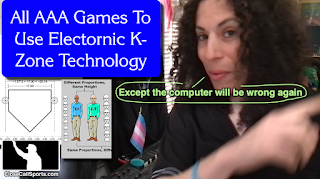
All Triple-A Games to Use Electronic Strike Zone Tech

All 30 Triple-A ballparks will house electronic balls and strikes technology in 2023, according to an ESPN report. Half of the games will use RoboUmp's fully-Automated Balls/Strikes System (ABS), in which the computer calls all pitches, while half of the games will feature a hybrid challenge system, in which human umpires continue calling balls and strikes, but teams (specifically, pitchers, catchers, and batters) will be allowed to challenge three umpire calls per game (retaining the challenge if the call is overturned).

Minor League Baseball in 2022 expanded its automated strike zone tests with the introduction of ABS to certain Spring Training sites in Florida, as well as certain selected minor league games in AAA West and Low-A Southeast.

This itself followed the Atlantic League's 2022 announcement that it would abandon its ABS RoboUmp experiment, following a few years of significant computer errors that led to contentious strike calls and ejections, most frequently of pitching coach Frank Viola.

In 2021, an Arizona Fall League game had to be ended early after both teams ran out of pitchers due to ABS RoboUmp's strict strike zone, leading to more ball calls than customary for a baseball game, which in turn required all 12 pitchers to throw more pitches.

The imminent 2023 Triple-A setup of half-full ABS and half-challenge system, as we point out scientifically, stipulates that the computer will get it wrong some of the time. For instance, strike zone heights will be calculated based on a percentage of total batter height (every person has different body  proportions, meaning this methodology is error-prone), while the addition of an inch to either side of home plate in calculated horizontal ball/strike calls is, itself, not quite the correct radius of a baseball.

This, of course, is in addition to the plethora of computer strike zone errors we have previously reported on.
Related PostDude, What Happened Last Night? About Pitch f/x Error (8/30/16).

Video as follows:

Thursday, November 3, 2022

Playing the Times' 'You Be the Ump' Strike Zone Game

After the New York Times released an online "You Be the Ump" strike zone game, we decided to test our RoboUmp skills at this simulation of what virtual home plate umpires see...in a matter of speaking.

Lindsay discusses certain aspects of the simulation's accuracy (or lack thereof) regarding the umpire's point of view and absence of a catcher, as well as technical topics such as the width of a baseball or officiating mechanics such as working the slot.

Video as follows:

Sunday, October 30, 2022

Pat Hoberg Calls Perfect Game in World Series Gm 2

Home Plate Umpire Pat Hoberg called a perfect game during Houston's victory over Philadelphia in Game 2 of the 2022 #WorldSeries between the Phillies and Astros. He saw 129 callable pitches—which includes balls and called strikes but excludes all swings—and officiated all of them correctly.

The reason Fox Sports' FoxTrax on-screen TV graphic zone may have differed from Hoberg's pitch calling is a tale as old as PitchCast, StatCast, Pitch f/x, and QuesTec, combined. Television visualizations still have trouble with vertical strike zones (computers have problems drawing these zones too), while PitchCast sacrifices accuracy for expediency, leading to errors in broadcast TV depictions.

The UEFL f/x look:
Balls: 89 called balls outside strike zone / 0 called balls within strike zone = 89/89 = 100% accuracy.
Strikes: 40 called strikes within strike zone / 0 called strikes outside strike zone = 40/40 = 100% accuracy.
Total Raw Accuracy Score: 129/129 = 100% accuracy (+0 Nu [Neutral Skew, favored neither team]).

Video as follows:

Thursday, August 25, 2022

CCS Stats Explanation - How to Read Pitch Strike Zone Data (px, pz)

If you've watched our MLB content, you'll notice certain variables and numbers appear on-screen during ball/strike ejections. In this illustrative video, we will teach you how to read pitch strike zone data—px, pz, RAD, MOE, etc.—to calculate umpire expected ball/strike calls. All numerical values presented are in feet.

In this video, you will learn about the following variables:
px - The pitch's horizontal location.
pz - The pitch's vertical location.
sz_bot - The batter's bottom-of-zone boundary.
sz_top - The batter's top-of-zone boundary.
RAD - The radius of a baseball subtracted from sz_bot or added to sz_top.
MOE - The margin of error variable applied to vertical pitch values (it is embedded within the core formula for horizontal location, since horizontal is a static entity whereas vertical changes depending on each batter's individual sz_bot and sz_top values).

For horizontal location, Umpire Expected Calls:
All else equal, |0| < STRIKE < |.748| < BORDERLINE-ABSOLUTE STRIKE < |0.831| < BORDERLINE-ABSOLUTE BALL < |.914| < BALL. This is known as the Kulpa Rule (UEFL Rule 6-2-b-1).

For vertical location, Umpire Expected Calls:
All else equal, BALL < sz_bot - RAD +/- MOE < STRIKE < sz_top + RAD +/- MOE < Ball. The borderline zone for vertical pitches is located in the span between sz_bot - RAD - MOE to sz_bot - RAD + MOE, and between sz_top + RAD - MOE to sz_top + RAD + MOE. This is known as the Miller Rule UEFL Rule 6-2-b-2).

Video as follows:

Sunday, May 22, 2022

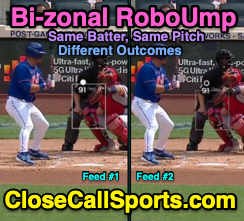
Same Pitch Nets Different RoboUmp Calls by Feed

TV's home and away broadcast feeds disagreed with each other over whether HP Umpire Gabe Morales' ball four call during Eduardo Escobar's at-bat during Tuesday's Cardinals-Mets game was correct as one broadcast showed ball while the other had strike. Determining QOC from the visual strike zone box alone, thus, depends on whether one watched St Louis or New York's broadcast, as the TV called the same pitch two different ways depending on which feed was being used.

Although alarmingly common, RoboUmp's mostly-hidden secret of occasionally displaying two different strike zone and pitch representations for the same exact pitch took center stage during Game 1 of STL-NYM's doubleheader, but only to an esoteric few who actually watched both broadcast feeds and noticed the ambiguous absurdity on a ball four call that produced very little fanfare.

If you were to have watched the home Mets feed, you would have seen an apparent strike but if you were to have watched the visiting Cardinals feed, you would have seen an apparent ball. Video analysis indicates the two broadcasts used different on-screen graphic strike zone boxes for the same batter, on the same pitch.

The pitch data, however, is direct from MLB and confirms that Cardinals pitcher Miles Mikolas 3-2 sinker to Mets batter Escobar was correctly ruled ball four: With a px value of 0.25, pz 3.47, sz_bot 3.14 and RAD 3.26, the pitch missed high by 2.52 vertical inches, well outside of both UEFL f/x and Zone Evaluation's respective margins of error—the pitch was a ball, though if you were to have watched the wrong broadcast, you'd never know it.

Video as follows:

Monday, January 24, 2022

As Atlantic League Folds RoboUmp Experiment, MLB Steps Up Automated Strike Zone in Minor Leagues

Whereas the Atlantic League last week issued a news release announcing it has abandoned its Automated Ball/Strike System experiment by virtue of returning pitch calling duties to human plate umpires, MLB looks to double-down on RoboUmp technology, bringing ABS to its minor league affiliates, including Triple-A.

According to Axios, MLB quietly announced, through its seasonal jobs board, it may be seeking to experiment with ABS in Triple-A West (formerly Pacific Coast League), as well as certain lower levels: "Major League Baseball (MLB) will be operating the Automated Ball and Strike system (ABS) in select Spring Training venues in Florida, in AAA West and Low-A Southeast, and potentially in other non-MLB games and venues," the posting states.

MLB's minor league ABS recruitment follows Atlantic League President Rick White's explanation of the league's elimination of an automated strike zone: "test rules and equipment are transitional by definition: Some elements remain, others are tweaked and still others are abandoned. That's why MLB and the ALPB conduct the tests."

Now that MLB will look to install the Hawkeye data-powered computer zone technology, we can refer to several recent instances of RoboUmp's use in affiliated baseball, such as its puzzling calls during an October Arizona Fall League game that led teams and umpires to end the game in the 8th inning due to both teams having exhausted their pitchers trying to satiate ABS' 22-walk-producing strike zone.

A smattering of ball/strike arguments regarding ABS also befell the 2019 (pre-COVID) AFL, including HP Umpire Jose Navas' October 15, 2019 ejection of batter Jacob Heyward for arguing a computer-called strike three call. Whereas a number of players subsequently complained about ABS following the AFL implementation, MLB Commissioner Rob Manfred at the time announced ABS will nonetheless debut in 2020.

Tuesday, January 18, 2022

Atlantic League Nixes Robot Umpires, Will Return to Human-Called Strike Zone in 2022

After two years of testing MLB's Automated Ball-Strike System, the Atlantic League will revert to having human umpires call pitches, explaining RoboUmp's cancelation as a natural part of the experiment process while stopping short of deeming the test unsuccessful: "Test rules and equipment are transitional by definition: Some elements remain, others are tweaked and still others are abandoned. That's why MLB and the ALPB conduct the tests."

The ALPB's news release also indicated the formerly independent MLB partner league will return its experimental 61'6" mound distance to the "accepted norm" of 60-feet, six-inches for its 2022 season.

News of the Atlantic League's RoboUmp cancelation follows several high-profile instances of peculiar ball/strike decisions from the computer umpire, many of which we have documented at Close Call Sports under the label "Computer Strike Zone" such as Frank Viola's pair of ejections arguing ball/strike calls made by the ABS computer. It also comes one year after MLB described the Atlantic League's ABS test as a "success."

MLB Commissioner Rob Manfred, currently presiding over an owners-players union dispute and lockout that continues to threaten Spring Training and potentially part of the 2022 regular season, previously cited his support for implementing the electronic ABS zone at the Major League level, specifically citing the Atlantic League experiment as evidence of RoboUmp's success. Meanwhile, then-Chief Baseball Officer Joe Torre disagreed, stating, "I don't see the robotic strike zone happening."

Now that the Atlantic League has scrapped the project, will Minor League Baseball—not without its own set of ABS controversies—follow suit?

Saturday, October 23, 2021

RoboUmp's Odd Strike Zone Gets AFL Game Called Early

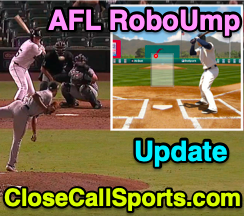
Teams ran out of pitchers leading to a game getting called early as the 2021 Arizona Fall League's electronic umpire experiment proved problematic during Saturday's Solar Sox vs Rafters game at Salt River Fields at Talking Stick. RoboUmp's demi-sized strike zone helped produce 22 walks as Mesa and Salt River bled through 12 pitchers before the teams and umpires agreed to call off the game in the 8th inning with Salt River leading, 15-7. The Automated Ball-Strike System (ABS) is only in use for games played at Salt River Fields.

According to Keith Law at The Athletic, several rule changes were in use during the game, including a variable pitch clock, ban on shifts, and of course an automated strike zone that rendered HP Umpire Alex McKay little more than a computer mouthpiece. (If you're wondering what happens to the MiLB call-ups during the offseason, you can find some working the Arizona Fall League; McKay's crew included 1B Umpire Malachi Moore, 2B Umpire Ryan Wills, and 3B Umpire Kyle McCrady).

Returns from the game indicate an issue that has plagued electronic zones since their very inception: an unforgiving, and in this case small, strike zone that continues to fall short of the standard to which human umpires call balls and strikes. The Atlantic League version, for instance, occasionally fell prey to the opposite problem: strike zones that were too large.

For this reason, our postseason plate performance scores continue to be given in a three-metric format: UEFL f/x with a roughly one-inch margin of error nestled between the larger buffer of Zone Evaluation Equivalent and the zero-error model the viewing audience sees known as ML Public (although our version of ML Public features postgame processing data point correction whereas what fans see on TV is raw and uncorrected).

Saturday, July 10, 2021

Checking in With RoboUmp's Auto Ball/Strike System

We check in with the MLB-partnered Atlantic League's automated ball/strike system (ABS) experiment colloquially referred to as RoboUmp during a recent Lexington Legends vs Lancaster Barnstormers series and find, similar to when the computerized umpire test began severals ago in the ALPB, that RoboUmp appears to still have trouble calling balls and strikes.

Because, frankly, we just don't have the time to sit through an entire game looking for close calls, we found a random smattering of...interesting...decisions by ABS, including a strike three call on a pitch that, well, let's just say evaded detection by the broadcast crew for a good period of time after the delayed strike three mechanic was actually made. 

Jordan Pacheco, the batter called for the strikeout, took to Twitter to express his frustration: "Thank you @MLB for putting the automated strike zone in the @AtlanticLg."

So much for that Trackman-to-Hawkeye upgrade. For a collection of articles about the computer strike zone, the Atlantic League, and beyond (including links to articles that contain video highlighting RoboUmp's best plate work), visit the following article.
Related PostMLB Announces Atlantic League as First Partner (9/23/20).

Video as follows:

Thursday, March 11, 2021

MLB Announces Experimental MiLB Rules for 2021 Season

MLB issued a press release formally announcing several experimental rules for Minor League Baseball's 2021 season, splitting up the tests by level of play such that Low-A through Triple-A will each try out different changes this summer.

Citing fan preferences—"We are listening to our fans" according to MLB Senior VP of On-Field Operations Michael Hill—MLB announced the following changes for MiLB in 2021, a new-look minor league system after MLB restructured its entire operation during last year's extended offseason and the end of its last agreement with the National Association of Professional Baseball Leagues, as elucidated in the BallPark Digest article "RIP Minor League Baseball: 1901-2020" in which MLB's plan to eliminate up to 42 teams is revealed.

And when teams go away, so too do the umpires who would have been assigned to those games.

As for the 2021 MiLB experiments, by level, they are as follows:

> Triple-A: Larger Bases, from 15 to 18 square inches, which corresponds to a 44% in base size. MLB cites a desire to reduce player injuries and collisions; this is not the first time MLB discussed increasing base size for that purpose and tested this in the Atlantic League in 2019.
Related PostAtlantic League Debuts New Rules, E-Zone (7/10/19).

> Double-A: Defensive Position restrictions, e.g., elimination of the shift, also from the 2019 Atlantic Lg.
> High-A: Step Off Rule requires pitchers disengage rubber prior to throwing to a base or face the penalty of a balk. This is another Atlantic League innovation from 2019.
> Low-A: Limit pitcher step/pick offs to two per plate appearance. After that, a third pickoff attempt during the same plate appearance that does not retire a runner will result in a balk call.
> Low-A Southeast: Implementation of Automated Ball-Strike System (ABS), the robot/electronic strike zone technology previously seen in the Atlantic League.
> Low-A West: Various pace of play initiatives, such as pitch clock time limit enforcement/new rules.

MLB announced it implemented the new rules "consistent with the preferences of our fans," who took to twitter shortly thereafter to express their dissatisfaction with the news by writing things such as "Fire Manfred into the sun" and "The only thing MLB hates more than baseball is baseball fans."

Video as follows:

Tuesday, October 13, 2020

Postgame Computer Balances Tumpane, Hoberg Scores

Between umpires John Tumpane and Pat Hoberg, only two out of 276 callable pitches seen Monday were improperly officiated. When we introduced UEFL f/x 3.0's multi-stage plate score format for the 2020 MLB postseason, we explained that baseball's strike zone computer runs in phases, returning multiple scores because the technology is unable to reliably assess batter height during real-time gameplay.

For instance, during one such postseason game, the computer changed batter strike zone height values in 53% of the pitches it tracked during post-game processing.

Alternately, one could say the computer changed its original answer over half the time.

Put differently, for over half of the pitches thrown, a trigger activated during post-game analysis that compelled an adjustment to the batter strike zone height, such as a close pitch near the edge of the zone/boundary. 53% of all pitches were adjusted, and the 47% of the pitches not adjusted...may well have been adjusted had the post-game analysis stayed true to the process of adjustment (as it is, possibly to save computing power or other labor, the computer only adjusts certain pitches).

Sometimes these adjustments change umpire QOCs and sometimes they don't.

Preliminary: During each game, StatCast uses placeholder values for batter bottom/top strike zone boundaries known as sz_bot and sz_top, respectively, regardless of the batter's actual stance during the pitch subject to evaluation. Thus, the score returned after each game known as the Preliminary score is based on placeholder height values and is a best-guess expectation of what the batter zone heights should be.

Final: After each game, the computer gets to work replacing many of these placeholder sz_bot and sz_top values with actual/observed figures. Sometimes they might match the placeholders and sometimes they don't. In the end, a new plate score is generated known as the Final score, generally scraped the morning after the game but occasionally later on game-day.

Tumpane's Prelim score was perfect.
Oftentimes, an umpire's Preliminary score will improve in the Final calculation, while, other times, it will decrease, as the computer calculates whether a zone height adjustment affected Quality of Correctness for a given edge pitch call.

Monday's LCS Umpires: Between Tumpane and Hoberg, the umpires saw 276 pitches and officiated 274 properly during Monday's League Championship Series action for a combined UEFL f/x score of 99.3%. Both figures (274/276 and 99.3%) are true for Preliminary and for Final numbers.

But between Preliminary and Final, both individual umpires saw adjustments.

Tumpane: Tumpane famously earned the first perfect preliminary plate score in UEFL f/x postseason history Monday afternoon in San Diego, scoring 90/90 Balls + 45/45 Strikes = 135/135 = 100%.

Hoberg's final score increased by 1.
Which meant the only place for baseball's computer to adjust Tumpane would be downward, and the computer didn't fail to disappoint, dropping one of Tumpane's called strikes to the incorrect category based on actual vs placeholder (or expected) batter height, and changing his 135/135 to 134/135, or 99.3%.

Hoberg: On the other side of balance sheet, Hoberg originally scored 91/91 Balls + 48/50 Strikes = 139/141 = 98.6%, and his post-game processing adjustment changed an incorrect strike call to a correct strike call, bumping his score to 140/141 = 99.3%.

Combined: In the end, baseball maintained pitch calling equilibrium as the Preliminary full-day score for Tumpane + Hoberg of 181/181 Balls + 93/95 Strikes = 274/276 = 99.3% remained the same overnight, which is an effect that happens quite often with computer processing: over the whole, the adjustments tend to largely balance out, though during individual games, they might increase or decrease a specific umpire's score.

Conclusion: Unfortunately for the robot umpire concept, the macro view of averages isn't quite good enough: the technology must be perfected to call pitches to accurate, adjusted batter height in real-time, specific to the game in which the pitch occurs and, as the Tumpane/Hoberg flip-flop demonstrates, the computer has not yet proven itself consistently and accurately capable of this: not while a majority of pitches are routinely changed during post-game processing. As such, the computer's adjustment to reflect overall umpire accuracy while nonetheless altering individual scores suggests a proof of technology's shortcomings.

PS: What was the pitch that took Tumpane's UEFL f/x perfect game away (he's still perfect on ML Private)? A strike one call to Austin Meadows in the bottom of the 2nd inning with pz 3.63 / RAD 3.51 / MOE 3.42 and sz_top 3.41.

That's right, Tumpane missed out on a post-game processed perfecto by 0.1 inches.

Video as follows:

Monday, October 12, 2020

Perfect Game for John Tumpane is First in UEFL History

When home plate umpire John Tumpane stepped off the field following Game 2 of the 2020 American League Championship Series between the Houston Astros and Tampa Bay Rays, he accomplished a UEFL first: Tumpane called a perfect game with 135 correct calls over 135 callable pitches thrown for a Preliminary UEFL f/x score of 100%.*

In all, the baseball world has seen some eagle-eyed umpiring over the past few postseasons, beginning with Joe West's 99.4% mark in a near-perfect Game 3 of the 2018 Red Sox-Astros ALCS, 99.3% score by James Hoye during Game 4 of the 2019 Houston-Tampa Bay ALDS, and, earlier in the 2020 postseason, Jordan Baker's 99.4% finalized score in Game 1 of the American League Wild Card Series between the New York Yankees and Cleveland Indians.

However, Tumpane's perfect game is a UEFL first. According to an article from The Ringer, no umpire has ever called a perfect game for both teams, though 25 umpires have called a perfect game for one team or the other.
As far as the ML Public score is concerned, Tumpane's preliminary number was 96.3% (130/135) with a matching 100% rating for ML Private, meaning that while the ML Public perfection problem persists, Tumpane not only beat the computer using the ZE estimate, but also, for the first time, put up a flawless performance using UEFL f/x criteria for day-of plate scores.

And just to prove that perfection isn't good enough for some people, career ejectee Josh Donaldson took to twitter to complain about Tumpane, tweeting, "Top 3 worst ump in the game" and "Trust me this guy has no idea what the zone is in the rule book. He's never wrong in his words."

So there you have it: the umpire who "has no idea what the zone is" just called a perfect game, preliminarily.

*Update: The post-game processed Final numbers brought Tumpane's plate score down from 135/135 to 134/135 = 99.3% (Skew: +1 HOU). For more information on UEFL f/x 3.0 and how Preliminary (same day) vs Final (overnight or postgame processing) numbers work, visit our introductory article:

PS: What was the pitch that took Tumpane's UEFL f/x perfect game away from Preliminary to Final (he's still perfect on ML Private)? A strike one call to Austin Meadows in the bottom of the 2nd inning with pz 3.63 / RAD 3.51 / MOE 3.42 and sz_top 3.41. That's right, Tumpane missed out on a post-game processed perfecto by 0.1 inches.

Video as follows: