Showing posts with label Infield Fly. Show all posts

Thursday, October 9, 2025

Cubs Wanted Infield Fly Rule on Dropped Ball in Chicago

Cubs manager Craig Counsell sought an infield fly rule call after Chicago 1B Michael Busch lost track of Brewers batter William Contreras' fly ball in the sun, allowing Milwaukee to load the bases in the 1st inning of NLDS Game 3.

With runners on first and second base with one out, Contreras hit a high fly ball in front of first base, on the infield.

The Official Baseball Rules defines the infield fly: "An INFIELD FLY is a fair fly ball (not including a line drive nor an attempted bunt) which can be caught by an infielder with ordinary effort, when first and second, or first, second and third bases are occupied, before two are out. The pitcher, catcher and any outfielder who stations themself in the infield on the play shall be considered infielders for the purpose of this rule."

Accordingly, the infield fly rule has four criteria: 1) first and second (or bases loaded), 2) before two are out, 3) the batter hits a fair fly ball (not line drive nor bunt), 4) that can be caught by an infielder with ordinary effort.

The first three criteria were plainly satisfied, which leaves us with #4: the ordinary effort criterion.

We thus turn to OBR's definition of that term: "ORDINARY EFFORT is the effort that a fielder of average skill at a position in that league or classification of leagues should exhibit on a play, with due consideration given to the condition of the field and weather conditions."

Because F3 Busch, the fielder we would expect to make a play on this ball, lost the ball in the afternoon Chicago sun, the "weather conditions" provision of the ordinary effort definition gets triggered: 1B Umpire Lance Barksdale, looking directly at Busch, ruled that this particular weather condition turned Busch's potential catch from requiring effort that was ordinary into extraordinary.

Umpires therefore ruled ordinary effort was not satisfied, which is why an infield fly was not declared.

Video as follows:

Wednesday, July 31, 2024

Boston's Infield Fly Interference Play - Part 3 of Ongoing Saga

After umpires called an inning-ending double play due to runner Tyler O'Neill's interference during Rafael Devers' infield fly in Boston, Red Sox manager Alex Cora argued with 1B Umpire John Bacon and 2B Umpire Andy Fletcher—who both called the infraction–to no avail, now the third time infield fly interference has occurred in baseball this season after remaining largely dormant for the past decade.

With one out and runners at first and second base in the bottom of the 7th inning, Boston batter Devers hit a first-pitch sweeper from Mariners pitcher Tayler Saucedo for a fly ball somewhat near first base. While attempting to field the fly ball, Seattle first baseman Justin Turner collided with Boston baserunner R1 O'Neill, off his base, resulting in an interference call from the two closest umpires as the runner hindered and impeded Turner's ability to make a play.

At the conclusion of play, umpires declared O'Neill out for interference and Devers out on the infield fly rule, thus ending the inning.

Recall baseball's right of way rules relative to baserunning, interference, and obstruction:
On a batted ball, the FIELDER has the right to field the ball.
At any other time, the RUNNER has the right to run the bases.

Accordingly, on Devers' batted ball, the fielding team—Seattle—had right of way privileges. Official Baseball Rule 6.01(a)(10) puts a runner out for interference when "they fail to avoid a fielder who is attempting to field a batted ball, or intentionally interfere with a thrown ball, provided that if two or more fielders attempt to field a batted ball, and the runner comes in contact with one or more of them, the umpire shall determine which fielder is entitled to the benefit of this rule, and shall not declare the runner out for coming in contact with a fielder other than the one the umpire determines to be entitled to field such a ball."

The tricky part is on baserunner interference, the ball is ordinarily dead at the moment of interference. When interference occurs during an infield fly, however, "the ball remains alive until it is determined whether the ball is fair or foul. If fair, both the runner who interfered with the fielder and the batter are out. If foul, even if caught, the runner is out and the batter returns to bat."

Because the ball in this situation remains alive solely for the purpose of determining fair/foul status, the umpire must decide which fielder to protect—who may ordinarily be expected to try for the fly—while the ball is still in the air and before any fielder is camped under it. For this reason, it does not matter that Mariners second baseman Jorge Polanco ultimately caught the ball—it was dead before the catch even happened.

Based on the timing requirement, Turner was deemed the protected fielder and, thus, O'Neill's interference resulted in an infield fly-aided inning-ending double play.

Video as follows:

Wednesday, May 29, 2024

MLB Ejection 063 - Vic Carapazza (3; Aaron Boone)

2B Umpire Vic Carapazza ejected Yankees manager Aaron Boone (infield fly interference double play; QOCY) in the top of the 1st inning of the #Yankees-#Angels game. With none out and the bases loaded, Yankees batter Giancarlo Stanton hit a 0-0 changeup from Angels pitcher Tyler Anderson for a fly ball on the infield, ruled an infield fly. As Angels shortstop Zach Neto attempted to catch the fly ball, he and Yankees baserunner R2 Juan Soto made contact behind second base, resulting in an interference call by 2B Umpire Vic Carapazza. Because the interference occurred during an infield fly, both Soto (interference) and batter Stanton (infield fly rule) were called out for a double play. Replays indicate Soto, while not in contact with second base, interfered with Neto's fielding of a batted ball, the call was correct. At the time of the ejection, the game was tied, 0-0. The Yankees ultimately won the contest, 2-1.

This is Vic Carapazza (19)'s 3rd ejection of 2024.
OBR Definition of Infield Fly: "If interference is called during an Infield Fly, the ball remains alive until it is determined whether the ball is fair or foul. If fair, both the runner who interfered with the fielder and the batter are out."

This is the 63rd ejection of the 2024 MLB regular season.
This is the 27th manager ejection of 2024. Ejection Tally: 27 Managers, 10 Coaches, 26 Players.
This is New York's 5th ejection of 2024, 1st in the AL East (NYY 5; TOR 4; BAL 2; BOS, TB 1).
This is Aaron Boone's 3rd ejection of 2024, 1st since April 22 (Hunter Wendelstedt; QOC = U [Check Swing]).
This is Vic Carapazza's 3rd ejection of 2024, 1st since May 11 (Alex Cintron; QOC = Y-c [Balls/Strikes]).

Saturday, May 25, 2024

MLB Calls Chicago About Infield Fly Interference

Major League Baseball purportedly called Chicago and said umpire Junior Valentine's infield fly interference double play call to end Thursday's Orioles-White Sox game wasn't necessary and shouldn't have happened. The following is a deep dive into the history of this rule and how the league's hasty response to a 2012 play at Dodger Stadium led to a situation that enabled this game-ending call to occur.

As stated in our White Sox Lose After Infield Fly Interference Double Play (5/23/24) article, Valentine's ruling that White Sox baserunner R2 Andrew Vaughn interfered with Orioles shortstop Gunnar Henderson as he attempted to field a batted ball off the bat of Andrew Benintendi during an infield fly situation was proper pursuant to the Official Baseball Rules.

OBR 6.01(a)(10) ("Any runner is out when—they fail to avoid a fielder who is attempting to field a batted ball, or intentionally interfere with a thrown ball") puts Vaughn out for interference—no matter how slight the interference is—and kills play immediately upon such interference. For Valentine, there was no "wait and see if the ball is caught" moment, as the rulebook requires that play be declared dead immediately upon the interference.

The book's Infield Fly Rule definition then mandated that both the runner who interfered and the batter be declared out for interference and the infield fly rule, respectively, resulting in a double play. With one out in the 9th, this double play resulted in the third out of the inning, which also happened to be the final out of the game.

When MLB's Senior VP of On-Field Operations Michael Hill purportedly contacted Chicago to decry the way this game ended, it was an alleged expression of a widespread opinion: that this double play to end the game interference-and-infield-fly call simply "looked" off-putting and ended the game on a sour note.

Yet according to the rules, this is the correct call. In 2012, 1B Umpire Todd Tichenor called Dodgers batter Andre Ethier out for interfering with Marlins first baseman Derek Lee during Los Angeles batter Luis Cruz's infield fly (runners on first and second, less than two out). The rulebook at the time didn't provide for what to do with interference during an infield fly, and after a very lengthy conference, umpires ruled Ethier out and returned Cruz to bat.

During the subsequent offseason, MLB's Rules Committee decided this was not a fair outcome and crafted a new infield fly rule amendment, writing that interference during a fair infield fly is a dead ball double play (only the runner is out on a foul ball).

Season after season, this rule of response sat dormant at the major league level...until a similar situation occurred in Chicago, this one much higher-profile with much more devastating consequences.

So while MLB might not like the outcome, under the rule change the league itself made in 2013, this is the correct call. The only question is how to fix it for next time, if we don't want this to be the case.

Here are six rule change proposals, ranging from removing the fielder's "right of way" protection on an infield fly since the batter is out anyway, treating interference during an infield fly like obstruction type 2 (effectively, a delayed dead ball), only penalizing intentional interference with a double play, and more. What do you think should happen?

Video as follows:

Thursday, May 23, 2024

White Sox Lose After Infield Fly Interference Double Play

Chicago's comeback against Baltimore came up short when 3B Umpire Junior Valentine called White Sox baserunner Andrew Vaughn for interference during batter Andrew Benintendi's pop up for a rare INT-infield fly rule double play to end the game. Pedro Grifol argued, as did Chicago's broadcasters, but to no avail...although unpleasant to end the game, Valentine's call was correct.

With one out and runners on first and second base in the bottom of the 9th inning of an 8-6 (Orioles) ballgame, Chicago batter Benintendi hit a 0-1 fastball from Orioles pitcher Craig Kimbrel high on the infield, resulting in umpires declaring an infield fly. As Orioles shortstop Gunnar Henderson jogged in to make a play on the fly ball, White Sox runner R2 Vaughn casually backed toward the fielder, creating a situation in which Henderson was forced to go around Vaughn to field the batted ball.

By rule, this is interference, which is what 3B Umpire Valentine called. Recall that during a batted ball, the fielder has the right to field it (one protected fielder per play), but at any other time, the runner has the right to run unencumbered (unless the fielder possesses the baseball or must occupy the space while in the act of fielding).

The rules citation is Official Baseball Rule 6.01(a)(10) ("Any runner is out when—they fail to avoid a fielder who is attempting to field a batted ball, or intentionally interfere with a thrown ball").

Interference during an infield fly throws a peculiar wrench into the affairs, which creates a dead ball that results in a double play, as long as the infield fly is fair. OBR's definition for Infield Fly specifies that: "If interference is called during an Infield Fly, the ball remains alive until it is determined whether the ball is fair or foul. If fair, both the runner who interfered with the fielder and the batter are out. If foul, even if caught, the runner is out and the batter returns to bat."

Accordingly, umpires declared runner Vaughn out for interfering with Henderson (remember, interference's standard is hinder or impede; there is NO contact requirement) and, as the ball became dead at the moment of interference relative to everything except determining fair/foul, there is no question of "wasn't Henderson going to catch it anyway?" When a dead ball occurs, no further action—including fielders recording outs—can take place.

The penalty for interference is to declare the runner out and the batter is also declared out, due to the infield fly (fair ball).

Video as follows:

Thursday, April 11, 2024

A's-Rangers Double Play - Infield Fly or Ordinary Effort?

Oakland turned an inning-ending double play against Texas when Rangers batter Jared Walsh's soft infield pop fly evaded diving A's second baseman Zack Gelof near the pitcher's mound, with 2B Umpire Tom Hanahan initially appearing to signal an infield fly, before declaring the batter safe, electing not to invoke the infield fly rule because none of the Athletics infielders could have caught the batted ball with ordinary effort.

With one out and runners on first and second base in the bottom of the 7th inning, Walsh's quasi-fly ball initially attracted speculation that the infield fly rule would be invoked, but as second baseman Gelof slid in an unsuccessful attempt to catch the batted ball, Oakland recovered and turned the inning-ending double play when umpires ruled the infield fly rule did not apply.

Gelof's slide may have tipped the scales against ruling this play an infield fly, as pitcher Austin Adams would have had to range backwards, off the mound to field the ball and Gelof was the other closest infielder, meaning that according to the umpire, no infielder was in a place where this ball could have been caught with ordinary effort.

This might be the infield fly counterweight to LF Umpire Sam Holbrook's infamous postseason infield fly call in Atlanta, when the umpire ruled that a shortstop deep into left field could have caught a fly ball with ordinary effort because he was camped under the ball before suddenly vacating that position.

Although formally termed an "infield fly" the definition and rule may more accurately be deemed the "infielder fly rule."

An infield fly is defined as "a fair fly ball (not including a line drive nor an attempted bunt) which can be caught by an infielder with ordinary effort, when first and second, or first, second and third bases are occupied, before two are out," and the infield fly rule results in the batter being declared automatically out while the ball itself remains live.

When Walsh's batted ball fell to the ground and the infield fly rule was not invoked, that forced both preceding baserunners R1 and R2 to advance, allowing pitcher Adams to turn a double play when both R1 Adolis García and R1 Jonah Heim didn't advance.

Video as follows:

Tuesday, September 26, 2023

That Time SF Scored On Barry Bonds' Infield Fly Rule Play

San Francisco scored a tying run on a pop fly in front of home plate when the defense seemingly forgot or didn't know the infield fly rule and tagged the base instead of the runner attempting to score in this throwback to Barry Bonds' oddest run-producing hit in 2003.

With one out and the bases loaded in the 5th inning on May 13, 2003, Giants batter Bonds hit a fair fly ball, which Montreal infielders failed to catch. HP Umpire Jim Joyce, however, had signaled "Infield Fly, If Fair" and when the ball dropped and was touched in fair territory, Giants baserunner R3 Neifi Perez slyly jogged home from third base, waiting for the Expos to clear the way and subtly stepping on home plate, scoring the tying run for San Francisco.

As soon as HP Umpire Joyce signaled R3 Perez safe, the Montreal infield turned to argue with the umpire as Giants trailing runners R2 Marquis Grissom and R1 Rich Aurilia advanced to third and second base, respectively.

When Expos Manager Frank Robinson emerged from his dugout and strode to home plate, he yelled not at Joyce, but at his players, for failing to know the infield fly rule.

To review, the infield fly rule's core criteria are:
> Less than two out;
> Runners on first and second or bases loaded;

and the call is effectuated when
> The batter hits a fair fly ball that can be caught by an infielder employing ordinary effort.

After Joyce signaled the infield fly (if fair), then pointed the ball fair when it was touched on the bounce, he signaled batter-runner Bonds out, thus removing the force play on all baserunners (with no batter-runner in the picture, the runners are no longer forced to advance and thus may remain at their original bases).

Montreal didn't appear to know the infield fly rule removes the force out, as fielders stepped on home plate, as if to try and force out R3 Perez. HP Umpire Joyce made no signal (as there was no call to make), only signaling "safe" when R3 Perez successfully ran to and touched home plate without Montreal trying to tag his person.

And that's the story of how Barry Bonds drove in a run (although it was technically not an RBI) on an infield fly ball.

Video as follows:

Saturday, August 19, 2023

Vlad Guerrero's Smart Play - Untouched Drop Turns Two

Toronto's Vlad Guerrero's smart play in the field led to a Blue Jays double play against Cincinnati when Reds batter Will Benson's infield fly ball with one out and a runner on first base fell to the ground untouched, with Guerrero throwing to first base to retire batter-runner Benson (who didn't run the play out), leading to a double play via tag as the lead baserunner was retired during a rundown. Umpires had a lot to consider here and we review the various rules involved.

The rules discussed include the infield fly rule (we eliminate an infield fly possibility, because only first base was occupied with less than two out [e.g., not first and second or bases loaded]), Official Baseball Rule 6.01(a)(10) fielder protection on a batted ball against batter/runner interference (Guerrero was the protected fielder entitled to field this fly ball), OBR 5.09(a)(12) the intentional drop rule (dead ball, batter is out -- only occurs if the fielder TOUCHES the ball before intentionally dropping it...Guerrero didn't touch the fly ball), and OBR 5.09(b)(6)the force being removed on the lead runner when the batter was retired which necessitated a tag of the runner instead of the base.

Video as follows:

Thursday, May 18, 2023

CCS Twofer - Bundy's Sticky Ejection & Intentional Drop ?

The third inning of the Syracuse-Norfolk game proved eventful when Triple-A Mets pitcher Dylan Bundy was ejected by 1B Umpire Robert Nunez for failing a foreign substance inspection. Seconds earlier, Syracuse turned a double play on an intentional drop no-call when 3B Umpire Dillon Wilson ruled that Mets second baseman Ronny Mauricio did not intentionally drop a line drive from Tides batter Daz Cameron, resulting in an inning-ending double play with runners on first and second and one out.

Moments later, the entire crew of three umpires met along the third base dugout to inspect Bundy's glove and hand, with Crew Chief Nunez signaling Bundy's ejection seconds later for violating the illegal substance rule.

Official Baseball Rule 5.09(a)(12) puts the batter out for a fielder's intentional drop under certain circumstances: "An infielder intentionally drops a fair fly ball or line drive, with first, first and second, first and third, or first, second and third base occupied before two are out. The ball is dead and runner or runners shall return to their original base or bases."

The intentional drop rule is related, but distinct from, the infield fly rule, which is the better-known rule. Here's a quick comparison of the intentional drop rule vs the infield fly rule. The primary differences are an intentional drop rule applies to a runner on first (only) as well as runners on first and second or the bases loaded with less than two out (the infield fly rule is R1 & R2 or the bases loaded, but NOT R1 only), an infield fly is called whether or not the fielder touches the ball (the intentional drop rule requires the fielder touch and drop the ball), and an infield fly keeps the ball alive while the intentional drop rule causes it to become dead.

Infield Fly Rule: R1 & R2 or bases loaded with <2 out
Intentional Drop Rule: R1, R1 & R3, R1 & R2, or loaded w <2 out

Infield Fly: Fair fly ball that can be caught w ordinary effort
Intention Drop: Fair fly or line drive intentionally dropped

Infield Fly: Batter out, ball remains live, runners advance at their own risk.
INT Drop: Batter out, ball is dead, runners return.

Video as follows:

Sunday, September 4, 2022

Ask - Infield Fly No-Call Leads to Double Play in New York

After New York shortstop Francisco Lindor allowed a batted ball to drop untouched before turning an inning-ending double play during Saturday's #Nationals-#Mets game, questions surrounding the umpires' infield fly no-call sprung up: why wasn't the batter declared out pursuant to the infield fly rule?

Play: With one out and two on (R1, R2), Nationals batter Luis Garcia hit a first pitch-changeup from Mets pitcher Max Scherzer in the air, whereupon Mets shortstop Lindor let the ball drop to the dirt before fielding it and throwing to second baseman Jeff McNeil, who threw to third baseman Eduardo Escobar, who tagged advancing Nats baserunner R2 CJ Abrams.

Call: Although umpires did not signal "infield fly" on the play, and although 2B Umpire Manny Gonzalez clearly signaled Mets baserunner R1 Lane Thomas out on second based on a force play, the game score's play-by-play account has this as "[batter] Luis Garcia pops into a double play" before concluding with, "Luis Garcia out at 1st."

Conflict of Calls and Scoring Decision via Stats Stringer: Since the Mets never threw the ball to first base, the only explanation for Garcia being out would be if this play was declared an infield fly, despite replays indicating evidence to the contrary (such as no signal, and U2 Gonzalez's force out call).

Rule: The infield fly rule is defined as: "a fair fly ball (not including a line drive nor an attempted bunt) which can be caught by an infielder with ordinary effort, when first and second, or first, second and third bases are occupied, before two are out. The pitcher, catcher and any outfielder who stations himself in the infield on the play shall be considered infielders for the purpose of this rule."

The batter is out, and the ball remains live (runners can advance at their own peril, with liability to be put out).

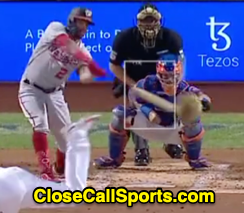
Analysis: With the less-than-two-out and runners-on-first-and-second criteria clearly satisfied, we turn to the "attempted bunt" portion of the rule. Replays indicate the batter appeared to contact the ball during a check swing—this is not a bunt and thus the bunt exemption does not apply.

Furthermore, this is not a line drive ("a batted ball that goes sharp and direct from the bat to a fielder without touching the ground").

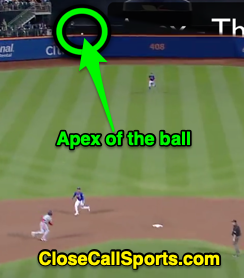
With replays indicating fielder Lindor could have caught this ball with ordinary effort, we turn to whether it satisfies the "fly ball" criterion or not. The definition for FLY BALL is of little help: "batted ball that goes high in the air in flight."

Thus, we are left with a subjective judgment call on whether this particular batted ball traveled "high" enough in the air. Judging by the ball's apex, one could certainly make an argument in favor of declaring this an infield fly. Note that the rule does not make any reference to amount of time the ball is airborne: the only criteria are whether a fair fly ball could be caught by an infielder with ordinary effort.

As for the intentional drop rule, OBR 5.09(a)(12) requires the infielder to have physically touched the baseball in order to merit a call; additionally, it is superseded by the infield fly rule: "In this situation, the batter is not out if the infielder permits the ball to drop untouched to the ground, except when the Infield Fly rule applies."

This is therefore not an intentional drop and may or may not be an infield fly, depending on your subjective interpretation of the word "high".

Video as follows:

Saturday, August 20, 2022

Rules Review - LLWS Flashy Triple Play Turned Foul Ball

The Little League World Series' Italy vs Australia elimination game produced an absolutely wild and wacky sequence that began as a bases-loaded, none-out triple play before umpires corrected it to, and Replay Review confirmed, the ultimate call of a foul ball. From the infield fly rule to fair/foul to interference, we review the Official Baseball Rules to determine what happened and what could have transpired had things turned out differently.

Play: With none out and the bases loaded in the top of the 3rd inning, a batter Team Italy, trailing Australia 5-0, hit a high fly ball along the first baseline, on the infield between home plate and first base. The ball fell untouched and was fielded by Australia's first baseman, who threw to the catcher ahead of Italy's runner. The catcher stepped on home plate before throwing to the third baseman, who tagged Italy's lead runner R3 as he ran back toward third base. Having tagged R3, Australia's third baseman then threw to the second baseman, who stepped on second base and then tagged Italy's trailing runner R1 as R1 ran toward second base. Following this, Italy's middle runner R2 took off for third base and Australia's second baseman threw to the third baseman, who tagged R2 as he slid into third base.

Call: The HP Umpire declared an Infield Fly and a fair ball, the 3B Umpire declared R3 out at third base, the 2B Umpire declared R1 out at second base, and then the 3B Umpire declared R2 out at third base.

Correcting the Fourth Out...and More: After the apparent triple play, the umpires conferred and determined that the batted ball had become foul, thus negating all subsequent action. The play was ruled a foul ball, which was confirmed after manager's challenge by Australia, and Italy's batter returned to bat.

Remember, even with all other criteria satisfied (runners on first and second [or bases loaded] with less than two out, batted ball is a fly ball which is not a line drive  nor bunt that can be caught be an infielder with ordinary effort), it is only an infield fly if the batted ball is fair [it is not an infield fly if the ball is foul], and the umpire's mechanic should be "Infield Fly, if Fair."

What if (Case Play): Although the ball was foul, let us assume for the purpose of discussion it was fair instead. In that case, the batter would be out for the Infield Fly, R3 would be out on the tag while off-base, and R1 would be out on the tag while off-base (R2's apparent out would be irrelevant and superfluous).

In that sense, the umpires officiated the infield fly portion of this play properly in real-time...the portion of the play that occurred after the first baseman fielded the baseball.

A Confounding Variable, Regardless of Fair/Foul: Replays indicate that while the batted ball was in flight, Australia's first baseman and Italy's baserunner R1 made contact while R1 was not touching first base. In this sense, presuming the umpires would have identified the first baseman F3 as the fielder entitled to field the batted ball pursuant to Official Baseball Rule 6.01(a)(10), R1 should be declared out for interference ("Fails to avoid a fielder who is attempting to field a batted ball...if two or more fielders attempt to field a batted ball and the runner comes in contact with one or more of them, the umpire shall determine which fielder is entitled to the benefit of this rule"). The fielder has the right of way in this situation.

This would then activate the Infield Fly Interference rule (from the definition of terms): "If interference is called during an Infield Fly, the ball remains alive until it is determined whether the ball is fair or foul. If fair, both the runner who interfered with the fielder and the batter are out. If foul, even if caught, the runner is out and the batter returns to bat."

Recap: If the umpires protect the pitcher as the fielder entitled to field the ball, foul ball is the correct call.

However, if the umpires identified the first baseman as the fielder entitled to field the ball, the proper call would have been a foul ball, but with the additional declaration that the runner from first base R1 is out for interference.

Under the Case Play scenario wherein the batted ball is fielded in fair territory and the pitcher is the protected fielder, this is a triple play (batter-runner out on the infield fly, R3 out on tag, R1 out on tag).

Under the Case Play scenario wherein the batted ball is fielded in fair territory and the first baseman is the protected fielder, this is a double play (R1 out on interference & batter-runner out on the infield fly).

Video as follows:

Thursday, July 28, 2022

Ask the UEFL - Batted Ball Deflects Off Pitcher's Head

This quick Ask the UEFL came to us as a fairly simple question: "Is this an infield fly?" With one out and two on (R1, R2) in Cincinnati, Reds batter Donovan Solano hit a batted ball directly off Marlins pitcher Daniel Castano's head, the batted ball bouncing high in the air before settling into the glove of Reds third baseman Joey Wendle for the inning's second out. 

Stipulating that the pitcher's health is of greater importance than the play itself—especially when a concussion-inducing hit to the head is concerned—we were nonetheless asked about the rules implications of such an odd sequence as the ball remained live after the moment of injury.

Succinctly, this is not an infield fly—even though the ball careened high into the air and was caught at an angle similar to that of a fly ball. The definition of the term states, in part, "An INFIELD FLY is a fair fly ball (not including a line drive nor an attempted bunt) which can be caught by an infielder with ordinary effort, when first and second, or first, second and third bases are occupied, before two are out." Because the batted ball can best be described as a line drive, it is therefore ineligible for the infield fly rule. The third baseman could have allowed the ball to fall untouched and all runners would have been forced to advance (this is not an intentional drop, either).

Finally, we note that if R1 or R2 wished to try and advance to their next base, they would not have to wait until the third baseman ultimately caught the ball, but instead could have legally left their bases the moment the ball first touched the pitcher. Although Official Baseball Rule 5.09(c)(1) states: "Any runner shall be called out on appeal when—after a fly ball is caught, they fail to retouch their original base before they or their base is tagged," the definition of catch prevails because it directly addresses the concept of touch-without-catch: "Runners may leave their bases the instant the first fielder touches the ball."

Video as follows:

Thursday, June 2, 2022

Ask UEFL - Angel in the Infield Fly & Intentional Drop?

Tmac
 answers two questions for the price of one in this Ask the UEFL infield fly and intentional drop rule double feature in a game between the Orioles and Cardinals with umpire Angel Hernandez behind the plate in St Louis. With none out and two on (R1, R2), Orioles batter Chris Owings' sacrifice bunt attempt goes horribly awry as the pitch from Nick Wittgren is bunted high into the air in front of the pitcher's mound.

Baltimore Pitcher Wittgren permits the batted ball to fall to the ground untouched before picking up the fair ball and throwing to third base to force out the lead runner, with third baseman Nolan Arenado throwing on to second base to force out R1 Robinson Chirinos.

The two-pronged question—why isn't this an infield fly and why isn't this an intentional drop—rely on two sections of the Official Baseball Rules. First, the Definition of Terms states, "An infield fly is a fair fly ball (not including a line drive nor an attempted bunt) which can be caught by an infielder with ordinary effort, when first and second, or first, second and third bases are occupied, before two are out."

OBR 5.09(a)(12) discusses intentional drops and states that the batter is out when "An infielder intentionally drops a fair fly ball or line drive, with first, first and second, first and third, or first, second and third base occupied before two are out. The ball is dead and runner or runners shall return to their original base or bases."

However, the pertinent part for this particular play is the following APPROVED RULING: "In this situation, the batter is not out if the infielder permits the ball to drop untouched to the ground, except when the Infield Fly rule applies."

When HP Umpire Hernandez signals "safe," Angel is thus communicating two different, but related, no-calls: It is not an infield fly because it is an attempted bunt, and it is not an intentional drop because the fielder permitted the ball to drop untouched and the infield fly does not apply.

Video as follows:

Sunday, September 26, 2021

MLB Ejection 185 - Bill Miller (4; Mike Shildt)

HP Umpire Bill Miller ejected Cardinals manager Mike Shildt (infield fly rule/changed out/safe/"Time" call by 2B Umpire Doug Eddings; QOCN) in the bottom of the 9th inning of the #Cardinals-#Cubs game. With one out and two on (R1, R2), Cubs batter Frank Schwindel hit a 1-0 slider from Cardinals pitcher Giovanny Gallegos in the air along the third-base line, dropped in fair territory and ruled an infield fly as Cubs baserunners R2 Austin Romine advanced to third base and R1 Rafael Ortega advanced to second base. Replays indicate the batted ball fit the criteria of an infield fly (less than two out, R1 & R2, fair fly ball that could have been caught by an infielder employing ordinary effort) and that the Cardinals fielders tagged the bases, as in a force play, instead of tagging the runners, but also tagged Cubs runner Ortega after Ortega stepped off second base; although 2B Umpire Eddings called "Time" prior to the tag out (and no runner may be tagged out in this fashion while the ball is dead), the play was not subject to being declared dead in accordance with OBR 5.12 (Calling "Time"), the call was incorrect. At the time of the ejection, the Cardinals were leading, 4-2. The Cardinals ultimately won the contest, 4-2.

This is Bill Miller (26)'s 4th ejection of 2021.
Bill Miller now has 8 points in the UEFL Standings (8 Prev + 2 MLB - 2 Incorrect-Crewmate = 8).
Crew Chief Bill Miller now has 7 points in Crew Division (7 Previous + 0 Incorrect Call = 7).

This is the 185th ejection report of the 2021 MLB regular season.
This is the 84th manager ejection of 2021.
This is St Louis' 4th ejection of 2021, 4th in the NL Central (MIL 16; CIN 12; CHC 8; STL 4; PIT 3).
This is Mike Shildt's 5th ejection of 2021, 1st since July 25 (Ron Kulpa; QOC = N [Replay Review]).
This is Bill Miller's 4th ejection of 2021, 1st since July 20 (Joe Maddon; QOC = Y [Balls/Strikes]).

Wrap: St Louis Cardinals vs Chicago Cubs, 9/26/21 | Video as follows:

Thursday, June 10, 2021

MLB Ejection 072 - Sean Barber (Dusty Baker) & Infield Fly

HP Umpire Sean Barber ejected Astros manager Dusty Baker (fair ball call; QOCY) an inning after 2B Umpire John Tumpane ruled Red Sox batter Rafael Devers out on the infield fly rule during Thursday's #Astros-#RedSox game. In the bottom of the 6th inning, with one out and two on (R1, R2), Red Sox batter Devers hit a fly ball to Astros shortstop Carlos Correa, resulting in an infield fly declaration by 2B Umpire Tumpane that put Devers out before Correa dropped the ball. As we've discussed many, many times, umpires consider several criteria regarding an infield fly.*

1) First and second base were occupied with less than two outs (one out, R1, R2).
2) The batter hit a fair fly ball which was not a line drive nor a bunt.
3) It could be caught by infielder Correa with ordinary effort. This was established as Correa positioned himself in the outfield facing the infield, or, colloquially, was "camped."

As for the ejection, in the top of the 7th inning, with one out and one on (R1), Astros batter Yuli Gurriel hit a 1-2 sinker from Red Sox pitcher Adam Ottavino in front of home plate, ruled fair by HP Umpire Barber upon the baseball being initially touched in fair territory by Red Sox catcher Christian Vasquez, and resulting in a double play as Astros baserunner Yordan Alvarez was tagged out while off his base by Red Sox second baseman Christian Arroyo. Replays indicate Gurriel's batted ball was retrieved by Red Sox catcher Christian Vazquez in fair territory and that the batted ball did not touch Gurriel's person, the call was correct. At the time of the ejection, the Red Sox were leading, 12-8. The Red Sox ultimately won the contest, 12-8.

This is Sean Barber (29)'s 2nd ejection of 2021.
Sean Barber now has 4 points in the UEFL Standings (0 Previous + 2 MLB + 2 Correct Call = 4).
Crew Chief Brian Gorman now has 3 points in Crew Division (2 Prev + 1 Correct Call = 3).
*"An INFIELD FLY is a fair fly ball (not including a line drive nor an attempted bunt) which can be caught by an infielder with ordinary effort, when first and second, or first, second and third bases are occupied, before two are out...On the infield fly rule the umpire is to rule whether the ball could ordinarily have been handled by an infielder-not by some arbitrary limitation such as the grass, or the base lines."

This is the 72nd ejection report of the 2021 MLB regular season.
This is the 37th manager ejection of 2021.
This is Houston's 1st ejection of 2021, T-4th in the AL West (OAK 3; LAA, TEX 2; HOU, SEA 1).
This is Dusty Baker's 1st ejection since August 9, 2020 (Nick Mahrley; QOC = Y [Balls/Strikes]).
This is Sean Barber's 2nd ejection of 2021, 1st since April 26 (Bob Melvin; QOC = N [Replay Review]).

Wrap: Houston Astros vs. Boston Red Sox, 6/10/21 | Video as follows:

Wednesday, June 2, 2021

MLB Ejection 059 - Scott Barry (1; Larry Rothschild) & Ask the UEFL Dropped Fly Ball Double Play in Chicago

HP Umpire Scott Barry ejected Padres pitching coach Larry Rothschild (ball three call; QOCY) in the bottom of the 5th inning of the #Padres-#Cubs game. With none out and none on, Cubs batter Nick Martini took a 2-0 curveball from Padres pitcher Pierce Johnson for a called third ball. Replays indicate the pitch was located over the inner half of home plate and above the midpoint (px -0.35, pz 3.62 [sz_top 3.32 / RAD 3.44]), the call was correct.* At the time of the ejection, the game was tied, 1-1. The Cubs ultimately won the contest, 6-1.

This game also featured an Ask the UEFL double play that ended the bottom of the 4th inning when Cubs batter PJ Higgins, with one out and the bases loaded, hit a fly ball to shallow left field, where Padres shortstop Ha-Seong Kim and left fielder Tommy Pham collided while attempting to catch the batted ball. As the ball fell to the ground, Cubs baserunners R2 Rafael Ortega and R1 Eric Sogard failed to advance to their next bases, resulting in an inning-ending double play when the Padres forced Ortega and Sogard out by tagging third and second base, respectively.

This is Scott Barry (87)'s 1st ejection of 2021.
Scott Barry now has 5 points in the UEFL Standings (1 Prev + 2 MLB + 2 Correct Call = 5).
Crew Chief Dan Iassogna now has 4 points in Crew Division (3 Previous + 1 Correct Call = 4).
*This pitch was located 3.16 vertical inches from being deemed an incorrect call.

This is the 59th ejection report of the 2021 MLB regular season.
This is San Diego's 5th ejection of 2021, 1st in the NL West (SD 5; COL 2; LAD, SF 1; ARI 0).
This is Larry Rothschild's 1st ejection since May 20, 2017 (Scott Barry; QOC = Y [Balls/Strikes]).
This is Scott Barry's 1st ejection since May 15, 2019 (Ian Kinsler; QOC = Y [Balls/Strikes]).

Wrap: San Diego Padres vs. Chicago Cubs, 6/2/21 | Video as follows:

Thursday, August 6, 2020

CPBL Demotes Umpire After Infield Fly Call

A controversial bases-loaded infield fly rule call overseas resulted in a 10-minute delay and, after the game, the calling umpire's demotion from the CPBL to Taiwan baseball's minor leagues. Was the call correct and why or why not? We dive into the rules to answer this question.

Starting with the definition of Infield Fly Rule would be most helpful: "An INFIELD FLY is a fair fly ball (not including a line drive nor an attempted bunt) which can be caught by an infielder with ordinary effort, when first and second, or first, second and third bases are occupied, before two are out. The pitcher, catcher and any outfielder who stations himself in the infield on the play shall be considered infielders for the purpose of this rule."

According to Official Baseball Rule 5.09(a)(2)(5), "A batter is out when—An Infield Fly is declared." and an umpire shall declare an infield fly when "it seems apparent that a batted ball will be an Infield Fly."

To summarize, an umpire has three key checkmarks to dole out in determining whether the infield fly criteria has been satisfied and should only declare an infield fly after all three boxes are marked.
(1) First & second base must be occupied with less than two out (third may or may not be occupied).
(2) The batter must hit a fair fly ball (a ball hit into the air), which is not a line drive nor a bunt, that;
(3) In the umpire's judgment, can be caught by an infielder (F1 - F6) employing ordinary effort.

Compare to Sam Holbrook's 2012 INF Fly.
Gil's Call: Back to the August 6 CPBL game between the Fubon Guardians and Rakuten Monkeys, I've color-coded the three criteria above as to my personal judgment as to their satisfaction. Yes, this is clearly a potential infield fly situation: runners are at first and second base with one out. Criteria number two is where I start to lose my willingness to call an infield fly: The batter definitely hits the ball into the air, but its trajectory and low arc suggests it may not quite fit the fly ball mold.

Even with room for interpretation as to this rule's second point, the third criterion—can be caught by an infielder employing ordinary effort—should seal the deal. Recall that "ordinary effort" is defined as, "the effort that a fielder of average skill at a position in [CPBL in this case] should exhibit on a play, with due consideration given to the condition of the field and weather conditions."

An extended argument from the home team.
Based on this definition, I do not believe the second baseman could have caught this ball with ordinary effort. Accordingly, even if we were to have deemed fair fly ball criterion two as satisfied, we would be prohibited by rule from calling 'infield fly' due to failure to satisfy the rule's ordinary effort clause.

The second part of the analysis pertains to game management. When 2B Umpire Qiu Jingyan made the infield fly call, 1B Umpire Ji Huawen, after observing his partner call infield fly, mirrored the point mechanic. That's fine.

This bump-the-ump produced a warning.
When the crew conferred to discuss the call, this would have been the prime opportunity to reverse the call and load the bases...IF any of the other umpires A) saw that it wasn't an infield fly and B) the calling umpire were to have allowed such an overturn [remember, umpires by rule cannot unilaterally overturn another umpire's judgment call...see OBR 8.02(c)'s "no umpire shall criticize, seek to reverse or interfere with another umpire's decision unless asked to do so by the umpire making it"].

When HP Umpire Luo Junhong, who appeared to be our crew chief, made the crew's final call, the crew entertained Rakuten's manager—fine. But once the manager began walking back toward his dugout, only to turn around and physically push through multiple umpires enroute to physically bumping the calling umpire, that should have been addressed.

Umpire Odo in Star Trek cites the USC rule.
Physical contact with an umpire in the course of an argument is not a warning, it's grounds for immediate ejection. The rule is 6.04(a)(4) Unsportsmanlike Conduct and reads, "No manager, player, substitute, coach, trainer or batboy shall at any time, whether from the bench, the coach’s box or on the playing field, or elsewhere make intentional contact with the umpire in any manner...PENALTY: The offender shall be removed from the game and shall leave the playing field, and, if a balk is made, it shall be nullified."

The following article from 2019 provides more insight on the infield fly rule and its implications for both the offense and defense.
Related PostYankees Doubled Up on Infield Fly - Learn the Rule! (3/28/19).

In 2018, we discussed the issue of reversing calls made during a potential infield fly situation.
Related PostForgetful Infield Fly - Reversing Calls Across Levels (3/21/18).

And in 2017, we discussed IFR situations and how to judge a batted ball as an infield fly or not.
Related PostKnowing the Situation - Infield Flies and Time Plays (9/15/17).

And there's a lot more where that came from.
Related PostOrioles Turn Triple Play on Contested Infield Fly No-Call (5/3/17).
Related PostInfield Fly and a Double Play - Back to Basics for Phillies (4/11/16).

Video as follows:

Tuesday, June 11, 2019

Case Play 2019-3 - Infield Fly Interference [Solved]

This week's Ask the UEFL Case Play concerns an infield fly rule play complicated by an intervening case of interference between the batter-runner and first baseman attempting to catch a batted ball. Though this video example comes from softball—and features an off-field umpire, UIC, or supervisor walking onto the field to join in on the on-field crew's conference—we'll analyze this peculiar play in accordance with baseball rules.

The Play: With one out and the bases loaded, the score a 6-6 tie, in the bottom of the final inning of regulation during a Spanish Fork-Bear River state tournament semifinal game, a Bear River batter hits a fly ball in the infield along the foul line between home plate and first base. Due to the batted ball's trajectory, the umpires easily declare an infield fly (if fair). As the batter-runner approaches first base, an interaction occurs with the Spanish Fork first baseman, resulting in the fielder dropping the fair ball as Bear River baserunner R3 attempts to score from third base. The ensuing throw home is late and the offensive team celebrates the apparent winning run.

BR and F3 interact up line near first base.
The Call: Having deemed the interaction between batter-runner and fielder attempting to catch a batted ball illegal, the first base umpire declares "interference" and calls "Time" to kill the play. After consultation, the umpires declare an inning-ending double play and nullify the run.

Question: When is a batter out during an infield fly play? Is it when the umpire first declares the infield fly, and if so, what happens if the already-out batter goes on to interfere with a fielder attempting to make a play on the ball, and does this cause the ball to become dead? Assuming Official Baseball Rules, was the inning-ending double play call correct?
Umpires get both coaches together.

Answer: In short, under OBR, the batter is out and the runner is returned to third base. The ball becomes dead upon the moment it is ruled a fair ball, meaning the play at home plate never happened.

Under NFHS Softball Rule 8-6-16, the runner closest to home is out if, in the umpire's judgment, interference by a retired runner prevents a double play. All other runners must return to bases last touched at the time of interference.

For OBR's ruleset, we have a slightly similar—yet different—rule in 6.01(a)(5), which states a runner on whom the fielder is playing shall be declared out if a recently-retired batter or runner interferes.

The answer to this Case Play lies in OBR's definition of Infield Fly Rule, which states in part, "If interference is called during an infield fly, the ball remains alive until it is determined whether the ball is fair or foul." As soon as fair/foul is determined, the ball becomes dead. There is no interference with a play on R3, as the ball was already dead before a potential play on R3 occurred.

VIDEO Answer: IFR & INT Case Play.
The interference is with the fielder's attempt to catch a fly ball, not with the fielder's subsequent attempt to make a play on another runner as the interference occurred prior to this attempt, meaning, the ball was already dead before the play on the other runner (R3) occurred.

As for, "If fair, both the runner who interfered with the fielder and the batter are out," the runner who interfered is the batter, which means the rule's transitive translation is, "if fair, both [the batter] and the batter are out."

As we discussed in April this season, no runner can be declared out twice during the same play (unless otherwise allowed by rule, e.g., intentional or deliberate interference to break up a double play); the batter is thus out (once) and all runners returned to their bases. Continue the inning with two outs and the bases loaded.
Related PostR2 Out Twice in False Triple Play - Crazy College Caper (4/11/19).

Finally, OBR 5.09(a)(2)(5) states the batter is out when an Infield Fly is declared. It's important to note the difference between declaring an Infield Fly and enforcing one, as well as the timeline concerning when a ball becomes dead during such play and how this relates to an Infield Fly. The batter is out on "Infield Fly, if Fair" assuming that the ball is fair. A foul ball, obviously, would cancel the infield fly rule, but the batter would still be out for interference with a fielder attempting to catch a batted ball.

Given the timeline of events with a batter interfering on an infield fly to the first baseman, it would be pretty difficult for the batter to interfere with a subsequent play on a teammate—largely because the ball becomes dead so quickly, and also because the ball is still in flight at the time of interference when the fielder is pursuing the batted ball, not looking at retiring another runner. Either way, the proper result under OBR is to declare the batter out and return all runners.

For what it's worth, visiting team Spanish Fork ultimately defeated Bear River, 8-6.

Official Baseball Rules Library:
OBR Definition [Infield Fly Rule]: "If interference is called during an infield fly, the ball remains alive until it is determined whether the ball is fair or foul. If fair, both the runner who interfered with the fielder and the batter are out. If foul, even if caught, the runner is out and the batter returns to bat."
Related PostMLB Modifies Interference Rules, Including Infield Fly Case (2/19/13).
OBR 5.09(a)(2)(5): "A batter is out when—An Infield Fly is declared." The umpire is to declare the infield fly when "it seems apparent that a batted ball will be an Infield Fly."
OBR 6.01(a)(5): "Any batter or runner who has just been put out, or any runner who has just scored, hinders or impedes any following play being made on a runner. Such runner shall be declared out for the interference of his teammate."

Video as follows:

Thursday, March 28, 2019

Yankees Doubled Up on Infield Fly - Learn the Rule!

Not knowing a rule proved costly to a team just two hours into MLB Opening Day 2019. Two Yankees runners didn't know the infield fly rule, leading to a double play as runners tried advancing when they didn't need to. Umpire Fieldin Culbreth's crew of Paul Nauert, CB Bucknor, and DJ Reyburn didn't fare much better, as only 3B Ump Reyburn signaled for the infield fly call on a pop-up in front of home plate. So our Analysis of the Season (so far) brings us to the Bronx and a common rule that in this day and age at baseball's highest level still gets botched by players who don't realize the situation.

The Play: With one out and runners on first and second base, Yankees batter Gary Sanchez hit a pop fly in front of home plate, where Orioles catcher Jesus Sucre dropped the ball in fair territory. Upon picking up the fair ball from the ground, Sucre threw to third baseman Rio Ruiz to second baseman Jonathan Villar (to shortstop Richie Martin to second baseman Villar to catcher Sucre), trapping Yankees baserunner R2 Luko Voit in a rundown, Voit having taken off from second base when Sucre dropped the fly ball. After Sucre applied the tag on Voit, the inning was over and the Yankees out on an infield fly-assisted double play.

Culbreth observes Sucre dropping a fly ball.
The Proper Call: We'd like to see a declaration from our action umpire of "Infield fly, if fair!" because the pop-up could very well become a foul ball due to being so close to home plate. We'd also like a ruling on the interaction between catcher and batter-runner (remember, the catcher is entitled to field the ball with protection from BR interference and the principle of the Armbrister tangle-untangle applies). Finally, when it is apparent there is no interference and the dropped ball is fair, we would like a signal for the fair ball (point fair) and another reiteration of the infield fly (point to the sky), now affirming our initial declaration of the infield fly rule and calling the batter out because the infield fly has indeed manifested as a fair ball.

The Rule: Our three criteria for an infield fly are: A) first and second occupied (or bases loaded) with less than two out, B) the batter hits a fair fly ball which is not a line drive nor bunt, C) that, in the umpire's judgment, can be caught by any infielder (F1-F6) employing ordinary effort. The following article provides a more in-depth review of the infield fly rule.
Related PostInfield Fly and a Double Play - Back to Basics for Phillies (4/11/16).

A sample crew signal for infield fly potential.
Analysis: HP Umpire and Crew Chief Fieldin Culbreth quickly determined F2 Sucre was the fielder entitled to field this batted ball. Watching the replay, Culbreth signals "safe" as if to say, "there was no interference or obstruction between Sanhez and Sucre." Culbreth's next mechanic is to point the ball fair when Sucre dropped the ball, having first touched it in fair territory.

However, what we're missing from our plate umpire is an infield fly signal. Before the play even begins, we must be alert to the possibility of an infield fly (most crews will communicate pre-play to this end): runners on first and second or bases loaded with less than two out.

We wrote about crew communication for infield flies in 2017. Read the following article for more.
Related PostKnowing the Situation - Infield Flies and Time Plays (9/15/17).

UIC calls IF, which is mirrored by U1/2.
Unfortunately, the umpire everyone is looking at here, HP Umpire Culbreth, never signals the infield fly while all eyes are at home plate. So let's assume Culbreth, due to the activity at home plate between F2 and BR, didn't see the fly ball: there's a lot happening and he didn't see the batted ball until it bounced off the catcher's mitt. Fine.

In MLB, we still have three base umpires left to provide back-up, and the video indicates an infield fly signal comes from only 3B Umpire DJ Reyburn, who points to the sky and makes it known this is an infield fly rule application. Oddly enough, though it doesn't appear that 2B Umpire CB Bucknor actually signaled for the infield fly, he nonetheless appeared not to declare R1 Miguel Andujar out at second base when F4 Villar stepped on the base while holding the ball (as the infield fly removes the force), but U3 Reyburn is our crew-saver on this play. The accompanying image from a Giants-Phillies game indicates a crew properly calling and mirroring the infield fly mechanic.

Result: Thus, with the batter automatically out due to the infield fly rule, the runners are no longer forced to advance. They do so anyway, and the crew properly officiates the rundown and tag on Voit for the final out of the inning.

What happens if an umpire fails to call IF?
Other Levels (NCAA / NFHS): Assume in a crew of two or three, U3 wasn't there to bail us out: no Reyburn = no infield fly call. What happens when the crew fails to call an infield fly on a play that is clearly an infield fly - not a borderline "ordinary effort" dispute, but an obvious fair fly ball on the infield?

Whereas OBR (professional baseball) and NCAA (college) rules state that an infield fly only exists when an umpire makes such a ruling, the National Federation of High Schools rulebook contains the following phrase: "both teams have the responsibility to know when conditions exist for an infield fly" (10.2.3 Situations F&G). Thus, under NFHS, the possibility exists for an infield fly to be ruled after the fact even if no umpire on the field signals it in real-time (the best prevention for this is to be prepared beforehand).

As for OBR/NCAA, if a crew fails to rule an infield fly during the play, the general guidance is to place runners where the crew chief believes they would have been had the correct call (of infield fly) been made (OBR), while NCAA notes that crews "should be conservative on their placement of base runners." Just as in HS, the best way to prevent this is to be alert and prepared to the possibility and likelihood of an infield fly.
Related PostForgetful Infield Fly - Reversing Calls Across Levels (3/21/18).

Wrap: Baltimore Orioles vs. New York Yankees, 3/28/19 | Video as follows:

Wednesday, March 21, 2018

Forgetful Infield Fly - Reversing Calls Across Levels

Umpires reversed an erroneous force out call during an infield fly rule play in Grapefruit League action, scoring a run that had seemingly been nullified just moments earlier. By now, we know what the infield fly rule is and how to communicate when a potential IFR situation occurs, but what happens if an umpire or entire crew forgets to call "infield fly" when it occurs? Is the batter still out or are runners forced to advance—and what happens if a fielder attempts to force out a baserunner or a time play occurs at home, as was the case in Florida?

Recap: To briefly review the infield fly rule's three criteria: 1) First and second (at least) occupied with less than two out; 2) batter hits a fair fly ball that is not a line drive nor a bunt, that; 3) can be caught by any infielder using ordinary effort. For more about the infield fly rule, including its definition, ordinary effort, and pre-play communication, see the following two articles:
Related Post: Infield Fly and a Double Play - Back to Basics for Phillies (4/11/16).
Related PostKnowing the Situation - Infield Flies and Time Plays (9/15/17).

Mechanics confusion reigned in Florida.
So now that we know what should happen during an infield fly play, it's time to explore what happens when things go awry, including rules differences amongst the NFHS, NCAA, and OBR codes.

Perhaps true to the Spring Training moniker, umpire Jeff Kellogg's crew encountered an infield fly situation over the weekend that took an odd turn when the plate umpire forewent an infield fly signal as a fly ball dropped untouched on the infield with the bases loaded.

The Play (Annotated with the infield fly criteria): With one out and the bases loaded, Twins batter Byron Buxton swung and hit a fair fly ball in front of home plate, where Red Sox catcher Blake Swihart, in what should have been a routine catch, bobbled and dropped the batted ball. Pitcher Rick Porcello picked up the loose ball, tagged home plate, and thew to second baseman Brock Holt, who tagged Twins baserunner R2 Bobby Wilson between second and third base.

Sidebar, in case you were wondering: the infield fly rule takes precedence over the intentional drop rule; this is due, in part, to the fact that an infield fly is declared before the ball reaches the fielder [i.e., before the fielder has a chance to intentionally drop it].
Related Post: Phillips' DP Attempt Reversed by Intentional Drop Rule (9/19/17).

The Call: Confounding the issue, while 2B Umpire Tim Timmons properly signaled the infield fly (batter out), plate umpire Kellogg signaled baserunner R3 out upon F1 Porcello's tag of home plate; no call was immediately made when F4 Holt tagged R2 Wilson (who appeared to have given up as a result of observing both B1 and R3 being declared out for outs #2 and #3), as Timmons' back was to the tag.

This produced a logically impossible double play: Once the batter (or any trailing baserunner) is declared out, the force on any preceding baserunner is removed; R3 should not have been declared out via force at home.

2B Umpire Tim Timmons calls Buxton out.
The End Result: After discussion amongst the three umpires, batter Buxton was declared out pursuant to the infield fly rule, R3 Aybar's out was reversed to a run scored, and R2 Wilson was declared out because of F4 Holt's tag. The problem, naturally, lies in the erroneous out call on the fake force/tag at home, upon which Aybar ceased to exist as a baserunner (and took away the potential for a time play, as would normally occur with a runner trotting home from third base with two outs, as was the case when Wilson was tagged for the final out of the inning, though U2 didn't call the out when it occurred because he wasn't facing the play [and because three outs had already transpired, however erroneous the third out was]). Did Kellogg's force-out mechanic cause Boston to give up on R3 Aybar? (Logically, it has to be yes, since R3 had already been "retired.")

Not as clear, however, is its effect on R1 Zack Granite (who advanced to second) and R2 Wilson (who abandoned ship after the phantom "third out" at home plate). By rule, Kellogg's force out call caused Aybar to disappear, meaning the umpires had to correct an error. The relevant rule under OBR to correct the mistake is 8.02(c), which states, in part:
If the umpires consult after a play and change a call that had been made, then they have the authority to take all steps that they may deem necessary, in their discretion, to eliminate the results and consequences of the earlier call that they are reversing, including placing runners where they think those runners would have been after the play, had the ultimate call been made as the initial call, disregarding interference or obstruction that may have occurred on the play; failures of runners to tag up based upon the initial call on the field; runners passing other runners or missing bases; etc., all in the discretion of the umpires.
Kellogg spots the error and convenes his crew.
To be crystal clear, the "call that they are reversing" in this situation was Kellogg's force out call of Aybar at home plate; no other call was reversed. Timmons' earlier infield fly call was not modified in any way.

If the crew believed that, had Kellogg made the correct call in real-time (which would have been a no-call on R3 at home), Aybar would have scored, then the solution to "eliminate the results and consequences of the earlier call that they are reversing" is to score the run, whether or not Aybar physically touched home plate prior to F4 Holt's tag of R2 Wilson (since, again, Aybar technically did not exist as R3 after the phantom force, and F4 Holt's tag of R2 Wilson was superfluous [and a fourth out in its own right]).

Gil's Call: There are probably three realistic options for this play, all of which involve declaring the batter out pursuant to the infield fly rule, as declared by Timmons in real-time.

The first option is what Kellogg's crew decided to do: B1 out, R3 scores, R2 out. The second is the same as the first, except that R3's run does not count. The third essentially "kills" the play at the moment of error: B1 out, R1 to 1st, R2 to 2nd, and R3 to 3rd (this approach is rather similar to an NCAA procedure for changing "no catch" to "catch" [see below]).

However, because of Rule 8.02(c)'s requirement to place runners "where [the umpires] think those runners would have been after the play, had the ultimate call been made as the initial call," options #1 or #2 are likely most reasonable. There stands a good chance that R1 Granite would have attempted to advance to second base even without Kellogg's call at home, meaning that R2 Wilson would have been hung out to dry regardless of the incorrect initial call. Which solution is "more correct?" That's for the umpires on the field to decide, likely taking into consideration Aybar's speed for a mental time play calculation.

> QOC Consideration: Pursuant to precedent established in Dale Scott's 2012 ejection of Padres Manager Bud Black for arguing an inadvertent "time" mechanic-turned triple play, QOC here is likely incorrect.
Related PostEjections: Dale Scott (1) (4/15/12).

Rules Difference: The aforementioned is the pro (OBR) rule, but what of NCAA college or NFHS high school?

NCAA: The college book doesn't directly address the case of a changed infield fly, but does include a section called "Appendix E: Getting the Call Right." Similarly, this portion of the rules book does not specifically address bungled infield fly plays (though it does specifically state what must happen when a call of "catch" is changed to "no catch" [dead ball, batter awarded first, baserunners awarded one base from time-of-pitch] and "no catch" to "catch" [dead ball, batter out, baserunners returned to bases occupied at time-of-pitch], both on balls hit into the outfield or any foul ball [or, if an infield-bound "no catch" call is changed to a "catch," when that decision would result in the third out or no runners are on base]).

In high school, teams must know the situation.
There exists a note within Appendix E which states, "The Crew Chief and crew should be conservative on their placement of base runners," and, additionally, "Some calls cannot be reversed without creating larger problems." Nonetheless, Part D of Appendix E states, "Both NCAA philosophy and umpire integrity – consistent with NCAA rules – dictate that calls are reversed in this situation [when the umpire's initial decision is clearly erroneous]." Judgment calls exempted from reversal include tag plays when the fielder clearly holds on to the ball (e.g., stolen base attempts), force plays (when the ball isn't dropped and the foot not pulled), and pitch location ball/strike calls. The Porcello/Buxton/Aybar play is not, however, a judgment call; it is a rules application issue that should be addressed.

NFHS: The high school case book states that players and teams are responsible for knowing when an infield fly situation exists, even when the umpire erroneously forgets to call "infield fly" or calls it at an inappropriate time ("both teams have the responsibility to know when conditions exist for an infield fly" 10.2.3 Situations F & G). High school explicitly requires a batter erroneously declared out to attempt to reach base safely in order to be awarded the base after the play. By that token, NFHS would likely score Aybar's run based on the crew chief's duty to "rectify any situation in which an umpire's decision that was reversed has placed either team at a disadvantage," since the teams were responsible for knowing the infield fly situation. In the end, perhaps this is a situation in which the umpires legitimately do not know whether Aybar beat the third out (due to, again, the erroneous force play for the premature third out at home plate), in which case, a healthy dose of game management will be most vital.

Video as follows: