The 2014 NCAA Final Four Officials roster has been released and the following referees were selected to work the 2014 tournament's semifinal and championship game rounds, either as an on-court official or as a table-side alternate.
• Pat Adams, Mobile, Alabama
• Joe DeRosa, North Canton, Ohio
• Verne Harris, Denver, Colorado
• John Higgins, Omaha, Nebraska
• Michael Roberts, Atlanta, Georgia
• Doug Shows, Rome, Georgia
• Doug Sirmons, Virginia Beach, Virginia
• Michael Stephens, Cranston, Rhode Island
• Mike Stuart, Maryville, Tennessee
• Terry Wymer, North Baltimore, Ohio
Showing posts with label NCAAB. Show all posts
Showing posts with label NCAAB. Show all posts
Monday, March 31, 2014


Saturday, December 14, 2013
Close Call of the Week: NBA Flagrant & Technical Ejections
Referees Scott Foster (crew chief), David Jones (R) & Marat Kogut (R2/Umpire) ejected Portland Trail Blazers center Meyers Leonard for a flagrant foul penalty two and Philadelphia 76ers center Daniel Orton for a technical foul in the 4th quarter of the Trail Blazers-76ers game. With 7:19 remaining in the 4th period, Leonard and Orton became entangled at the lower defensive block, away from the ball. Replays indicate Leonard committed a takedown upon Orton, both players falling to the ground as Leonard was whistled for the flagrant foul (type two). During the dead ball skirmish on the ground, Orton appeared to punch/throw an elbow at Leonard's jaw, resulting in a technical foul and ejection. At the time of the ejections, the Trail Blazers were leading, 126-92. The Trail Blazers ultimately won the contest, 139-105.
Wrap: Portland Trail Blazers vs. Philadelphia 76ers, 12/14/13
Video: Physical altercation during play in blowout game leads to throw down, elbow to the mouth
Discussion Point: How is play resumed? What is the proper ruling in college (NCAA), high school (NFHS)?
NBA: Instant Replay is used to determine Leonard (herein "A1")'s foul constituted a flagrant foul penalty two—the takedown was both excessive and unnecessary. Orton (herein "B1") was assessed a technical foul for unsportsmanlike acts during the dead ball period immediately after A1's FF2 foul. The technical is shot first. Because both players were ejected, play is resumed with one technical foul free throw, taken by any of the four remaining players on the floor for Portland (herein "Team A"). Immediately thereafter, the opposing ("Team A") coach shall select the shooter from Philadelphia (herein "Team B")'s bench to shoot the two free throws for the flagrant foul. Team B basketball at the free throw extended. (Rules 12A-V-j, 12B-IV-b, 13-I-a(3), Case Play 123).
- tldr, A1=FF2, B1=Tech, A1 & B1 = Ejected; 1 Tech FT to Team A; 2 FF2 FTs to Team B (HC A choice); B ball.
NCAA: Using Instant Replay, officials rule A1's foul constitutes a flagrant 2 personal foul, resulting in automatic ejection, as in the NBA ruling. B1 is issued a Class A Unsporting Technical for flagrantly (severe/extreme) contacting an opponent while the ball is dead; he too is automatically ejected by rule. Because this is a false double foul (second foul occurred while the clock was stopped for the first foul) and includes a contact dead ball technical foul, the fouls are penalized in the order they occurred. After awarding two free throws for the flagrant foul to B1's substitute, any player from Team A shoots two free throws for the technical foul. Team A basketball at the division line. (Rules 8-3-2, 8-3-4, 10-1-17, 10-1-PENALTY-d-2, 10-3-1-d/e, 10-3-PENALTY, 11-2-1-d-1, A.R. 235).
- tldr, A1=FF2, B1=Cl A Tech, A1 & B1 = Ejected; 2 FF2 FTs to B1's sub; 2 Tech FTs to Team A; A ball.
NFHS: Officials rule A1's foul constitutes a flagrant personal foul, resulting in automatic disqualification to the team bench. B1 is assessed a flagrant technical foul for his dead ball actions, resulting in automatic disqualification to the team bench. As in the NCAA scenario, this is a false double foul; each foul carries its own penalties and are penalized in the order they occurred. After awarding two free throws for the flagrant foul to B1's substitute, any player from Team A shoots two free throws for the technical foul. Team A basketball at the division line. (Rules 8-2, 8-3, 8-6-3, 10-3-7, 10-PENALTY-7).
- tldr, A1=FF, B1=Flag Tech, A1 & B1 = Disqualified; 2 FF FTs to B1's sub; 2 Tech FTs to Team A; A ball.
Monday, November 11, 2013
Basketball: To Save or Not to Save? Two Points in Question
With basketball season well underway, it's time for a quick rules review. During last week's Falcons-Wildcats NCAA Men's Basketball game, Kentucky freshman James Young attempted to save a ball headed out of bounds, throwing the ball high above his head back onto the court, a successful save...until the ball happened to fly straight through opponent Montevallo's basket, referees ruling a two-point award for the Falcons pursuant to NCAA Rule 5, Section 1, Article 4, Provision a (5-1.4.a), which states, “When a player scores a field goal in the opponent’s basket, it shall count two points for the opponent regardless of the location on the playing court from where it was released. Such a field goal shall not be credited to a player in the scorebook but shall be indicated with a footnote.” NFHS and NBA codes agree (NFHS 5-2-1 "two points for the team into whose basket the ball is thrown" and 5-2-3 and NBA 5-I-d), though the NBA credits such a goal to "the opposing player nearest the player whose actions caused the ball to enter the basket."
Scenario: (a) Had Young saved the ball but instead had been a member of the Falcons team, what would be the result? (b) What if instead of entering the goal, the ball clanked off the rim and was rebounded by a (Falcons) teammate and the Falcons were unable to get a shot off in, for instance, 23 [NBA] or 34 [NFHS/NCAA] seconds? (c) Young is fouled in the act of saving the ball, after releasing the ball: score the goal?
(a)
Answer, NFHS: Three points (5-2-1, "A successful try, tap or thrown ball from the field by a player who is located behind the team's own 19-foot, 9-inch arc counts three points" / Though a try is "an attempt by a player to score two or three points by throwing the ball into a team's own basket" [4-41-2], a try is not presently required for a three-point goal [Case Play 5.2.1 SITUATION B]).
Answer, NCAA: Three points (5-1.4, "A successful try from beyond the three-point line shall count three points..." and 5-1.1, "A try for field goal is an attempt by a player to score two or three points by throwing or tapping the ball into his basket" / BUT Approved Ruling [A.R.] 138[1], "Score three points [on pass attempt entering basket]" // NCAA Rules Error [AR clearly specifies that a ball thrown [passed] @ basket shall be scored two-, or three-, if successful, but does not account for this scenario in Rule 5-1.4 re: 3-pt FG tries]).
Answer, NBA: Three points (5-I-c, "A successful field goal attempt from the area outside the three-point field goal line shall count three points" and 4-X, "A field goal attempt is a player's attempt to shoot the ball into his basket for a field goal...the term is also used to include the flight of the ball until it becomes dead or is touched by a player" and Case Book 370, "If a ball on its upward flight [e.g., pass] toward the basket...continues into the basket, three points shall be awarded").
(b)
Answer, NFHS: No penalty (for states not employing a shot clock) / Shot clock violation (for states using a 30- or 35-second boys' shot clock; for instance, CIF addition NFHS 9-14, "the team in control shall attempt a try within 35 seconds").
Answer, NCAA: Shot clock violation (9-12.4, "It is a violation when a try for field goal does not leave the shooter's hand before the expiration of the allotted shot-clock time...or when it does leave the shooter’s hand before the expiration of the allotted shot-clock time and the try does not subsequently strike the ring or flange or enter the basket" and A.R. 136, "When a passed [thrown] ball hits the ring and does not enter the basket, there is no reset of the shot clock").
Answer, NBA: No penalty (7-IV-c, "the 24-second clock shall be reset...(2) ball from the playing court contacting the basket ring of the team which is in possession" and Case Book 437, "The 24-second clock is reset anytime the ball from inbounds touches the basket ring of the team which has possession").
(c)
Answer, NFHS: No. Young was never in the act of shooting [no try or tap for goal] and, therefore, the ball became dead immediately upon the foul being committed (6-7, "The ball becomes dead, or remains dead, when...7. a foul occurs...EXCEPTION: a. Article 7 occurs while a try or tap for a field goal is in flight").
Answer, NCAA: No (6-5-1, "The ball shall become dead or remain dead when...d. an official blows the whistle except when a try is in flight" and A.R. 176 "dead while in flight...not a legal try").
Answer, NBA: Yes (6-IV-a, "The ball becomes dead and/or remains dead when...(1)official blows his/her whistle...EXCEPTION: If a field goal attempt is in flight, the ball becomes dead when the goal is made, missed or touched by an offensive player").
All codes agree: continuous motion does not apply when no try for field goal or free throw exists.
Wrap: Montevallo Falcons vs. Kentucky Wildcats, 11/4/13
Video: Falling out of bounds, Young's emergency toss comes crashing through opposing team's bucket
Video: In an attempt to save teammate's blocked shot, Young accidentally throws ball into wrong goal (ALT)
 |
| Young saves ball, back to bucket. |
(a)
Answer, NFHS: Three points (5-2-1, "A successful try, tap or thrown ball from the field by a player who is located behind the team's own 19-foot, 9-inch arc counts three points" / Though a try is "an attempt by a player to score two or three points by throwing the ball into a team's own basket" [4-41-2], a try is not presently required for a three-point goal [Case Play 5.2.1 SITUATION B]).
Answer, NCAA: Three points (5-1.4, "A successful try from beyond the three-point line shall count three points..." and 5-1.1, "A try for field goal is an attempt by a player to score two or three points by throwing or tapping the ball into his basket" / BUT Approved Ruling [A.R.] 138[1], "Score three points [on pass attempt entering basket]" // NCAA Rules Error [AR clearly specifies that a ball thrown [passed] @ basket shall be scored two-, or three-, if successful, but does not account for this scenario in Rule 5-1.4 re: 3-pt FG tries]).
Answer, NBA: Three points (5-I-c, "A successful field goal attempt from the area outside the three-point field goal line shall count three points" and 4-X, "A field goal attempt is a player's attempt to shoot the ball into his basket for a field goal...the term is also used to include the flight of the ball until it becomes dead or is touched by a player" and Case Book 370, "If a ball on its upward flight [e.g., pass] toward the basket...continues into the basket, three points shall be awarded").
(b)
Answer, NFHS: No penalty (for states not employing a shot clock) / Shot clock violation (for states using a 30- or 35-second boys' shot clock; for instance, CIF addition NFHS 9-14, "the team in control shall attempt a try within 35 seconds").
Answer, NCAA: Shot clock violation (9-12.4, "It is a violation when a try for field goal does not leave the shooter's hand before the expiration of the allotted shot-clock time...or when it does leave the shooter’s hand before the expiration of the allotted shot-clock time and the try does not subsequently strike the ring or flange or enter the basket" and A.R. 136, "When a passed [thrown] ball hits the ring and does not enter the basket, there is no reset of the shot clock").
Answer, NBA: No penalty (7-IV-c, "the 24-second clock shall be reset...(2) ball from the playing court contacting the basket ring of the team which is in possession" and Case Book 437, "The 24-second clock is reset anytime the ball from inbounds touches the basket ring of the team which has possession").
(c)
Answer, NFHS: No. Young was never in the act of shooting [no try or tap for goal] and, therefore, the ball became dead immediately upon the foul being committed (6-7, "The ball becomes dead, or remains dead, when...7. a foul occurs...EXCEPTION: a. Article 7 occurs while a try or tap for a field goal is in flight").
Answer, NCAA: No (6-5-1, "The ball shall become dead or remain dead when...d. an official blows the whistle except when a try is in flight" and A.R. 176 "dead while in flight...not a legal try").
Answer, NBA: Yes (6-IV-a, "The ball becomes dead and/or remains dead when...(1)official blows his/her whistle...EXCEPTION: If a field goal attempt is in flight, the ball becomes dead when the goal is made, missed or touched by an offensive player").
All codes agree: continuous motion does not apply when no try for field goal or free throw exists.
Wrap: Montevallo Falcons vs. Kentucky Wildcats, 11/4/13
Video: Falling out of bounds, Young's emergency toss comes crashing through opposing team's bucket
Video: In an attempt to save teammate's blocked shot, Young accidentally throws ball into wrong goal (ALT)
Tuesday, July 2, 2013
NCAA Suspends Mulkey for Disparagement of Officials
The NCAA suspended Baylor women's basketball coach Kim Mulkey for making disparaging comments about the officials following Baylor's regional semifinal loss to Louisville on March 31 that eliminated the Bears from the NCAA Division I women's tournament.
The Women's Basketball Committee described Mulkey's behavior as "unacceptable" and having "no place in the women's basketball championship. Chairperson Carolayne Henry noted the decision was unanimous and based on Mulkey's history.
In 2011, Mulkey received a public reprimand for complaining about a referee.
As such, Mulkey's second violation in three years prompted the Committee to issue a more severe penalty in the postseason suspension, reprimand and withholding of the postseason travel per diem, which carries the effect of a fine.
In 2011, UC Santa Barbara Gauchos soccer player Machael David was suspended three games for verbal abuse of the referee following a 2010 postseason match. Seniors Waid Ibrahim and Tim Pontius were also punished via the per diem sanction while head coach Tim Vom Steeg was issued a public reprimand and fined $600.
Following the 2012 Men's Water Polo Championship, the NCAA suspended UCLA head coach Adam Wright one postseason game for his verbal abuse of officials following elimination from the tournament.
News: Baylor coach Mulkey given one-game postseason suspension, reprimand (NCAA)
Saturday, April 6, 2013
2013 NCAA Men's Basketball Tourney: Final Four Referees
The NCAA DI Committee selected the following 10 officials for the 2013 Final Four, including three rookies:
» John Cahill (Albany, NY) [11th Final Four] — Big East and SEC Conferences
» Mike Eades (Princeton, WV) [First Final Four] — ACC and Big Ten Conferences
» Tony Greene (Atlanta, GA) [Seventh Final Four] — SEC and Big East Conferences
» Karl Hess (Forrest, VA) [Sixth Final Four] — ACC and Big East Conferences
» John Higgins (Omaha, NE) [Fourth Final Four] — Big 12 and Missouri Valley Conferences
» Les Jones (Chesapeake, VA) [Fifth Final Four] — ACC and Big East Conferences
» Randy McCall (Highland Ranch, CO) [Fourth Final Four] — Mountain West and Pac-12 Conferences
» Doug Sirmons (Virginia Beach, VA) [First Final Four] — Big 12 and ACC Conferences
» Mark Whitehead (Denham Springs, LA) [Fourth Final Four] — Big 12 and Missouri Valley Conferences
» Terry Wymer (North Baltimore, OH) [First Final Four] — Big Ten and MAC Conferences
In the wake of Pac-12 Coordinator Ed Rush's controversial remarks and resignation, no official primarily associated with the Pac-12 was selected to work the NCAA Men's Basketball Final Four.
Wednesday, March 6, 2013
Stanford-Cal Fight: NCAA Rule Restricts Bench Personnel
Officials Mike Scyphers (crew chief; referee), Tony Padilla (umpire 1) and Tommy Nunez (umpire 2) ejected Stanford guard Gabriel Harris, Cal forward Richard Solomon, Stanford assistant coaches Charles Payne and Mark Madsen and Cal assistant coach Gregg Gottlieb for leaving the bench area and entering the playing court during a fight in the second half of the Stanford-Cal game. With 5:04 remaining in the second period, a loose ball on the ground led to a held ball situation and skirmish, resulting in the declaration of a fighting situation. Stanford's Chasson Randle, Dwight Powell and Aaron Bright, and Cal's Allen Crabbe, Justin Cobbs and Tyrone Wallace were all charged with personal fouls for their roles during the play. At the time of the ejections, Stanford was leading, 72-53. Stanford ultimately won the contest, 83-70.
With broadcasters and fans alike wondering why assistant coaches—who were presumably on the court to separate combatants—officials Mike Scyphers, Tony Padilla and Tommy Nunez correctly assessed the fabled "leaving the bench" penalties, not withstanding actions of players on the court at the time of the brawl.
Pursuant to NCAA Rule 10-6-2-j and 10-6-2-EJECTION, "any individual who leaves the bench area and enters the playing court but does not participate in a fight (Art. 2.j.) ... shall be ejected but is not subject to suspension." The exception to EJECTION is embodied within 10-6-2-j, and states, "the head coach may leave the bench area in this case to prevent the situation from escalating." Bench personnel—including assistants, substitutes and trainers—are not authorized to leave the bench for any reason during a fight.
Accordingly, head coaches Johnny Dawkins (Stanford) and Mike Montgomery (Cal) were not penalized.
Complicating matters, the UC Berkeley public address erroneously made the announcement, "the entire Stanford assistant coaching staff has been ejected" (instead, only Payne and Madsen were penalized).
Trivia: Several personnel involved have NBA connections. Stanford AC Mark Madsen is a former Laker & Timberwolf while Tommy Nunez is a former NBA referee. Gottlieb is CBS personality Doug Gottlieb's brother.
Wrap: Stanford Cardinal at California (Berkeley) Golden Bears (Pac-12 Conference Game), 3/6/13
Video: Held ball with 5:04 left to play turns into shoving match and a "handful" of ejections (ESPN)
Monday, February 18, 2013
NCAA: Discipline After Correct Call, Incorrect Administration
Following Sunday night's Wichita St-Illinois State NCAA men's basketball game, officials David Hall, Gerry Pollard and Paul Janssen were disciplined by the Missouri Valley Conference for what the MVC has determined was an incorrect penalty administration.
With 49 seconds remaining in the 2nd half of the contest, Illinois State forward Jackie Carmichael attempted to claim a defensive rebound, jumping to secure the basketball before a Wichita State foul at 41.2 seconds (0:40 per play-by-play score sheet) stopped play.
Following the officiating crew's use of instant replay review, Carmichael was assessed a flagrant 1 foul after it was determined that Carmichael's kick to Shockers guard Tekele Cotton's upper torso, head and/or neck area while Cotton stood in front of the end line was excessive and/or unnecessary (restricted area does not apply).
NCAA Rule 4-29-c specifies a flagrant 1 foul includes "a personal foul that is deemed excessive in nature and/or unnecessary, but not based solely on the severity of the act." Included under the flagrant 1 category are provisions (1) excessive contact with an opponent while playing the ball and (6) illegal contact with an elbow that occurs above the shoulders of an opponent when the elbows are not swung excessively.
Rule 2-3 ("Elastic Power") grants the referee the authority to make decisions on any points not specifically covered in the rules. Pursuant to this Rule, referee Hall was well within his right to deem Carmichael's foot-based contact a flagrant 1 personal foul pursuant to the terms of 4-29-c-1 or 4-29-c-6 or under any other provision of 4-29-c, as a kick to and through (be it the chest area or upward) may be properly interpreted as excessive and/or unnecessary.
Rule 2-13-2-d authorizes officials to initiate instant replay review in order to determine whether a flagrant 2 personal or contact technical foul has occurred if (a) there is a foul called for contact [did not occur] or (b) a coach requests the official to review whether such a foul occurred [basis for present case].
This procedure shall be used during the first dead ball after the clock was stopped, which did occur.
Rule 2-13-d-3 was then correctly applied, "The infraction(s) should be penalized and play shall be resumed...[at] stoppage of play." In other words, officials should have awarded Wichita State (offended team) two free throws and continued by awarding the ball to Wichita State at the stoppage of play (following Illinois State's bonus free throws). Under no circumstance was Wichita State to receive the ball in lieu of Illinois State's bonus free throws and officials correctly effected this procedure.
Illinois State's Johnny Hill was accordingly awarded his bonus first and successfully converted both attempts.
Following Hill's free throws with the lane cleared and perhaps as a result of the confusion in enforcing a retroactively reviewed and assessed flagrant foul which chronologically took place before a foul which produced free throws (both teams were in the bonus), free throw shooter Cotton became lost in the shuffle.
This is where the crew erred and instead, free throws were inaccurately awarded to Cotton's teammate Cleanthony Early, who successfully converted both free throws, a correctable error pursuant to Rule 2-12-1-c (permitting a wrong player to attempt a free throw). Unfortunately, this error was not recognized nor rectified.
Wichita State was then improperly awarded possessesion of the basketball on their end line (the proper in bounds location should have been "where the stoppage of play occurred to review the flagrant act"; 2-13-d-3). Regardless, Wichita State inbounded the ball into their backcourt, making this placement error moot.
Following Early's two scores, Illinois State led, 67-62. Wichita State ultimately won the contest, 68-67.
Lastly for those pondering possible nefarious conduct on the part of Wichita State in Early's free throw attempts, Rule 10-6-1-c specifies a Class B technical foul shall be called when a player "knowingly attempts a free throw to which he is not entitled." It is not clear whether Early possessed this definitive knowledge when he accepted the free throws.
In sanctioning the officiating crew (undisclosed punishment), the MVC confirmed its penalties were for allowing an improper player to attempt free throws and not because of a judgment call.
Wrap: Wichita State Shockers vs. Illinois State Redbirds, 2/17/13
Video: Video replay used to rule a flagrant 1 foul while ESPNU broadcaster declares, "there's no 'size 16' rule"
News: Refs Disciplined Following Carmichael Kick (WIBW)
Saturday, February 9, 2013
NCAAB: Yes, He Can. Remaining in Game with 2 Technicals
During Saturday's Ole Miss-Missouri game, a fighting incident occurred during the contest's second half. With 7:30 remaining in the second period, Missouri Tigers forward Alex Oriakhi committed a flagrant one foul against Rebels guard Marshall Henderson, provoking an unsportsmanlike dead ball incident during which a brief fighting incident transpired. Ole Miss Rebels forward Reginald "Reggie" Buckner was ejected from the contest with a flagrant Class A technical foul for fighting (threw punch) while officials Anthony Jordan (Referee), Patrick Evans (U1) and Tim Clougherty (U2) issued Class A technical fouls to Tigers forward Laurence Bowers and Rebels forward Murphy Holloway for their respective unsportsmanlike conduct.
The tech was Bowers' second of the contest, leaving some fans—not to mention the CBS broadcast crew—questioning why Bowers was not ejected for receiving two technicals.
Were Jordan, Evans and Clougherty correct in allowing Bowers to remain in the contest?
Video: Bowers hangs on the rim and is assessed a Class B technical foul pursuant to NCAA Rule 10-6-1-f
Video: Bowers receives his second T of the game during a charged fight to Buckner, but is not tossed (Soon)
In short, yes. Though Bowers did in fact receive a prior technical foul, his infraction was for grasping a basket in an excessive and emphatic manner, an action which by rule is not deemed unsporting (10-6-1-f). Specifically, NCAA Rules stipulate this non-unsporting technical foul shall be deemed a Class B technical foul.
Under the college rule, a player must be ejected after being assessed: two Class A technical fouls (10-5-a:f), one flagrant technical A foul, or one Class A and two Class B technical fouls. Individuals actively participating in a fight shall be ejected and subject to suspension (10-7).
Because Bowers possessed one Class A and just one Class B technical foul, his penalties did not qualify for automatic ejection pursuant to Rule 10-5-Ejection, allowing him to remain in the contest.
This rule is similar in principle to, for instance, NFHS high school's direct vs. indirect technical fouls charged to a head coach. In NBA basketball, a player receiving two such technical fouls shall be ejected.
The Missouri Tigers ultimately won the contest, defeating the Ole Mis Rebels, 98-79.
Friday, January 4, 2013
Misleading: Replay Rules, Clock Error Key in COL-AZ Play
With time running out in the second half of Thursday's NCAA Men's Basketball Colorado-Arizona contest, Buffalo guard Sabatino Chen attempted to beat the buzzer, draining a three-point field goal to give Colorado an apparent 83-80 victory—until instant replay came into the picture.
After what Pac-12 coordinator Ed Rush described as a "thorough review courtside [with] multiple angles of the play," officials Verne Harris, James Breeding and Randy McCall waived off the basket.
Colorado coach Tad Boyle, perceptually spurned by the call, was vocal and offered a strong opinion:
Meanwhile, television viewers watching in realtime on ESPNU were treated to a press box view appearing to show Chen releasing the ball with 0.2 seconds displayed on the broadcast graphic scoreboard's game clock.
Unfortunately, the broadcast graphic and arena scoreboard were not precisely in sync—specifically, while the graphic registered 0.2 seconds remaining in the period, the scoreboard atop the backboard read "0.0." Indeed, the graphic had suffered from an approximately two-tenths-of-a-second time delay the entire game (e.g., when the graphic read 3.3 seconds, the actual in-arena scoreboard read 3.1 seconds).
Because the on-screen game clock display and official game clock were not in complete synchronization, the graphic could not be used to determine when the ball was released and the officials were left to consider the red LED lights behind the backboard (NCAA Rule 2-13-1).
Views from other angles appeared to show the difference between finger-touch and release at 0.0 to be within one or two frames, making such a clock error or malfunction absolutely vital.
Furthermore, in football, hockey and baseball, inconclusive video in regards to an original ruling reverts to the call on the field as being correct. In basketball, this is not necessarily the case.
As distinct from football, baseball and hockey replay rules, a standard of incontrovertibility or conclusiveness does not appear in the NCAA Basketball rules book in regards to use of replay to judge an on-court ruling—because NCAA Basketball replay is not used to review an official's on-floor call, but instead is used to determine what occurred on the floor, the standard is of "definitive information."
For instance, in NCAA Football, Rule 12-1-2 requires "indisputable video evidence" in order to reverse an on-field decision, such as whether a ball was snapped before time expired. In NCAA Basketball, by contrast, officials make the call using replay as opposed to reviewing an on-court ruling, meaning a more lenient burden of proof in order to effect either call (e.g., good or time expired).
Had the Colorado-Arizona call occurred in football, a definitive on-court ruling would have been rendered at the time of the real-time play and replay would have been used to determine the accuracy of this ruling. Under football rules, had calling (center) official Harris instantaneously ruled the field goal good, the burden of proof (indisputable video evidence) would have been on disallowing the score. Had Harris instantaneously ruled the field goal late (time expired), evidence must have been indisputable in suggesting the shot was released in time.
Because basketball's "definitive information" standard is used in relation to the events on the floor as opposed to the call on the floor, the standard with which to confirm or overturn a call changes.
For an imperfect metaphor, consider a criminal case's "reasonable doubt" (as in football/hockey/baseball) versus a civil trial's "preponderance of evidence" (as in basketball).
Wrap: Colorado Buffalo vs. Arizona Wildcats, 1/3/13
Video: Chen's bucket does not count after replay review confirmation the ball was released late (ESPN)
After what Pac-12 coordinator Ed Rush described as a "thorough review courtside [with] multiple angles of the play," officials Verne Harris, James Breeding and Randy McCall waived off the basket.
Colorado coach Tad Boyle, perceptually spurned by the call, was vocal and offered a strong opinion:
Get rid of instant replay ... If human error is part of the game, let the officials call the game. Players, coaches and officials will make mistakes. It's part of the game.
 |
| Red light: Is the ball on fingertips or in air? |
Unfortunately, the broadcast graphic and arena scoreboard were not precisely in sync—specifically, while the graphic registered 0.2 seconds remaining in the period, the scoreboard atop the backboard read "0.0." Indeed, the graphic had suffered from an approximately two-tenths-of-a-second time delay the entire game (e.g., when the graphic read 3.3 seconds, the actual in-arena scoreboard read 3.1 seconds).
Because the on-screen game clock display and official game clock were not in complete synchronization, the graphic could not be used to determine when the ball was released and the officials were left to consider the red LED lights behind the backboard (NCAA Rule 2-13-1).
Views from other angles appeared to show the difference between finger-touch and release at 0.0 to be within one or two frames, making such a clock error or malfunction absolutely vital.
Furthermore, in football, hockey and baseball, inconclusive video in regards to an original ruling reverts to the call on the field as being correct. In basketball, this is not necessarily the case.
As distinct from football, baseball and hockey replay rules, a standard of incontrovertibility or conclusiveness does not appear in the NCAA Basketball rules book in regards to use of replay to judge an on-court ruling—because NCAA Basketball replay is not used to review an official's on-floor call, but instead is used to determine what occurred on the floor, the standard is of "definitive information."
For instance, in NCAA Football, Rule 12-1-2 requires "indisputable video evidence" in order to reverse an on-field decision, such as whether a ball was snapped before time expired. In NCAA Basketball, by contrast, officials make the call using replay as opposed to reviewing an on-court ruling, meaning a more lenient burden of proof in order to effect either call (e.g., good or time expired).
Had the Colorado-Arizona call occurred in football, a definitive on-court ruling would have been rendered at the time of the real-time play and replay would have been used to determine the accuracy of this ruling. Under football rules, had calling (center) official Harris instantaneously ruled the field goal good, the burden of proof (indisputable video evidence) would have been on disallowing the score. Had Harris instantaneously ruled the field goal late (time expired), evidence must have been indisputable in suggesting the shot was released in time.
Because basketball's "definitive information" standard is used in relation to the events on the floor as opposed to the call on the floor, the standard with which to confirm or overturn a call changes.
For an imperfect metaphor, consider a criminal case's "reasonable doubt" (as in football/hockey/baseball) versus a civil trial's "preponderance of evidence" (as in basketball).
Wrap: Colorado Buffalo vs. Arizona Wildcats, 1/3/13
Video: Chen's bucket does not count after replay review confirmation the ball was released late (ESPN)
Friday, November 9, 2012
Carrier Classic Condensation Cancellation: Playing Outside
Friday night's Walmart Carrier Classic between the Ohio State Buckeyes and Marquette Golden Eagles experienced a 45 minute delay prior to a postponement due to condensation gathering on the deck and playing surface of the USS Yorktown aircraft carrier in Charleston, South Carolina.
As officials Tim Cahill, Bo Boroski & Gene Steratore gathered with players for the opening tip, personnel on the court detected water had returned to the wooden playing surface after the floor had been wiped clean moments earlier. The officials met with both head coaches, athletic directors and persons in charge of the event, determining the cause was condensation caused by the drop in temperature from a high in the 70s during the day's earlier women's game to a level in the mid-40s as the men's game was scheduled to begin. The women's game was successfully completed.
After another round of toweling the floor, both teams attempted to warm up until officials and the teams decided to postpone the tip-off by another 20 minutes, hoping a subsequent temperature's drop into the low-40s would eliminate the condensation issue. In 1892, Johannes Petrus Kuenen discovered that gas compressed beyond the point of condensation would result in liquid evaporation, instead of an increased rate of condensation. Kuenen's discovery—retrograde condensation—was what organizers hoped to achieve by waiting the additional 20 minutes, or a total delay of approximately 45 minutes.
After the 20 minute waiting period, the officials and schools determined retrograde condensation had not occurred, the floor was still wet, and the game at that point was called and postponed.
Saturday, March 31, 2012
Lane Violation: Craft, Ohio State Latest Casualties of NCAA Basketball Free Throw Rule
Ohio State Buckeyes guard Aaron Craft was called for a lane violation after purposely missing the second of a one-and-one free throw situation toward the end of the OSU vs. Kansas Final Four semi-final game.
This has been the NCAA Tournament of the lane violation, the March Madness of fundamental, yet technical basketball rules. Somehow, this has also been the postseason of lapses: in judgment, in memory and in knowledge.
It certainly is no comfort to Ohio State that Craft had been warned about lane violations earlier in this year's NCAA Tournament. When warned by an official not to cross the restraining line too early during a free throw on March 17, Craft acknowledged his understanding: "I saw it yesterday [with Notre Dame]."
Speaking of Notre Dame, that game was one of two huge situations in which the lane violation has taken a team out of contention late in a ballgame: 16-seed UNC Asheville was correctly penalized for a lane violation while trying to upset No. 1 Syracuse, while the aforementioned Fighting Irish frittered away its own opportunity to shoot bonus free throws in the waning moments of its loss to Xavier, that call having been made by referee Mike Stuart.
For those wondering why mention the official's name, we will see Mike Stuart on Monday during the NCAA National Championship game between Kansas and Kentucky.
Today, however, it was Tom Eades, Jamie Luckie and Pat Adams who were tasked with officiating Craft's over-exuberant end-of-game sequence.
To reiterate once and for all—and with the hope that this call doesn't have to rear its head once again during Monday's National Championship game—NCAA Basketball Rule 9-1-d, "the free-thrower shall not leave the semicircle before the try contacts the ring, flange, or backboard or until the free throw ends."
NCAA Basketball Rule 9-1-c, "the free-thrower shall not break the vertical plane of the free-throw line with either foot until the ball strikes the ring, flange, or backboard or until the free throw ends."
Tuesday, March 27, 2012
NCAA Basketball: Final Four Referees
With the Final Four just around the corner, the following NCAA officials have been named to this prestigious round of the tournament taking place in New Orleans over the March 30 weekend. Included are the referees' names, hometowns, a brief biography and a list of most common conferences worked:
- Pat Adams (Mobile, Ala.) has worked NCAA Division I basketball since the 1990s and has officiated the NCAA Tournament annually since the 1996-1997 season. Was an alternate at the 2010 Final Four; cousin of NBA referee Bennie Adams. SEC and C-USA Conferences.
- Roger Ayers (Roanoke, Va.) has worked NCAA D1 basketball since 1994 and the NCAA Tournament since 2006-07. Was part of the LA-Lafayette vs. W-Kentucky, six men on the floor game. ACC and Big East Conferences.
- Joe DeRosa (North Canton, Ohio) has worked NCAA D1 since 2010-11, the NCAA Tournament since 2010-11 and worked NBA for 21-years prior to college, including 11 NBA Finals. At the time DeRosa cited his retirement as "refereeing for all of the wrong reasons." By officiating college, DeRosa is able to spend more time at home: this is his first Final Four. Big 12 and Horizon Conferences.
- Tom Eades (Central City, Ky.) has worked NCAA D1 and NCAA Tourney since the 1990s and the 2010 National Championship Game. This is his third Final Four in five years. SEC and Missouri Valley Conferences.
- Verne Harris (Denver, Co.) has worked NCAA D1 since 1987 and college since 1980. Has officiated the NCAA Tournament since 1997 and the National Championship twice: 2004 and 2005. Worked the 2011 Final Four. WAC, Mountain West and Pac-12 Conferences.
- Les Jones (Chesapeake, Va.) has worked D1 basketball for 15 years and will work his fourth consecutive Final Four: he worked 92 games in 2009-2010 and is poised to have worked nearly 90 by this season's end. ACC and Big East Conferences
- Jamie Luckie (Charlotte, Nc.) has worked D1 basketball for nearly 20 years and has refereed NCAA Tournament games since 2000-01. This is his third straight Final Four. ACC, SEC and Big East Conferences.
- Doug Shows (Rome, Ga.) has worked D1 basketball since the early 90s and the NCAA Tournament annually since 1998, with a one-year gap in 2003. This is his second consecutive Final Four. SEC and Big East Conferences.
- Mike Stuart (Maryville, Tn.) has worked regular D1 basketball since 1994 and the NCAA Tournament since 2000 and will have worked nearly 90 games by this season's end. It was Stuart who correctly called a lane violation against Notre Dame during their loss to Xavier earlier this tournament. This is his third Final Four in four years. Big 12 and Big East Conferences.
- Mark Whitehead (Denham Springs, La.) has worked the NCAA Tournament every year since 1996 and will have worked nearly 90 games by season's end (high of 95 in 2009-10). This is his second consecutive Final Four and third overall. Big 12 and Missouri Valley Conferences.
Congratulations to these ten officials and best of luck during Final Four weekend.
Saturday, March 17, 2012
Notre Dame Lane Violation Proves Costly Against Xavier
Talk about déjà vu, not 24 hours after a lane violation against UNC-Asheville stunted a late-game upset attempt, the Notre Dame Fighting Irish have been burned by the same exact violation of this NCAA basketball rule.
Just as was the case during Asheville vs. Syracuse, the late game lane violation call during Xavier vs. Notre Dame was the Correct Call (CC). Combined with an intentional foul called against Notre Dame seconds later after a ND defender grabbed and yanked a Xavier player's jersey before and during an inbounds pass (another Correct Call (CC)), the 2.8 second mark of March Madness' second round Xavier-Notre Dame game was devastating for the Fighting Irish.
In the blink of an eye, Notre Dame squandered its chance to shoot bonus free throws and saw a workable 65-63 deficit turn into a 67-63 hole with Xavier in possession of the basketball.
Both calls were correct, though this fact did nothing to quell the ire of...the...Irish. [editor's note: Come on, really???]
Still, with Notre Dame's lane violation Friday and UNC-Asheville's violation on Thursday on very similar plays, we must wonder whether rules knowledge is really poor outside of the officiating community or whether nerves and the prospect of scoring a huge upset interfered with both teams' players from thinking rationally. At the very least, we know at least two referees were not deterred from making this very gutsy call at crucial moments in their respective ball games.
Regardless, here's NCAA Basketball Rule 9, Section 1, Article 2, Provision g.
Just as was the case during Asheville vs. Syracuse, the late game lane violation call during Xavier vs. Notre Dame was the Correct Call (CC). Combined with an intentional foul called against Notre Dame seconds later after a ND defender grabbed and yanked a Xavier player's jersey before and during an inbounds pass (another Correct Call (CC)), the 2.8 second mark of March Madness' second round Xavier-Notre Dame game was devastating for the Fighting Irish.
In the blink of an eye, Notre Dame squandered its chance to shoot bonus free throws and saw a workable 65-63 deficit turn into a 67-63 hole with Xavier in possession of the basketball.
Still, with Notre Dame's lane violation Friday and UNC-Asheville's violation on Thursday on very similar plays, we must wonder whether rules knowledge is really poor outside of the officiating community or whether nerves and the prospect of scoring a huge upset interfered with both teams' players from thinking rationally. At the very least, we know at least two referees were not deterred from making this very gutsy call at crucial moments in their respective ball games.
Regardless, here's NCAA Basketball Rule 9, Section 1, Article 2, Provision g.
Players not in a legal marked lane space shall remain behind the free- throw line extended and behind the three-point field-goal line until the ball strikes the ring, flange or backboard, or until the free throw endsKeep on calling those rules as written, folks. It is an official's job to enforce the rules, not to rewrite or ignore them. Well done by our March Madness officials these past two days in achieving that goal.
Thursday, March 15, 2012
Reviewing the Officials' Calls at the end of No. 1 Syracuse vs. No. 16 UNC-Asheville
NCAA Basketball Referee Ed Corbett was thrown under the bus by Director of Officiating John Adams Thursday afternoon after a series of controversial calls and perceived missed calls went against underdog No. 16 UNC-Asheville, a team that had tried to defeat No. 1 Syracuse during the Second Round of the NCAA Tournament colloquially known as March Madness.
Throughout the UNC-Asheville vs. Syracuse contest, fans complained of several close calls they felt were gross misses. Let's go to the tape, it's time for a video analysis. The following three plays shall be discussed:
Throughout the UNC-Asheville vs. Syracuse contest, fans complained of several close calls they felt were gross misses. Let's go to the tape, it's time for a video analysis. The following three plays shall be discussed:
- Goaltend, Basket Interference or No-Call
- Lane Violation Against UNC-Asheville or No-Call
- Foul Against UNC-Asheville, Ball Awarded Out of Bounds to UNC-Asheville or Syracuse
Saturday, March 10, 2012
NC State vs. UNC: End of Game Sequence Correctly Officiated
The end of game NC State vs. UNC sequence was correctly officiated. The following video breakdown shows why (click here for video). The following plays have been reviewed:
Play 1: Kendall Marshall and Alex Johnson No-Call: Disposition: CNC (Correct No-Call)
Play 2: Richard Howell Buzzer-Beater No-Call: Disposition: CNC (Correct No-Call)
Continue past the jump to see why.
Saturday, February 25, 2012
Rick Pitino Blames Officials, Opposing Fans: A Case Play of Scapegoating in Sports
There is a tendency in today's society to blame others rather than accept responsibility and admit one's own shortcomings. It is a trait exhibited by toddlers who throw tantrums and decision-makers everywhere who admonish others rather than admit wrongdoing.
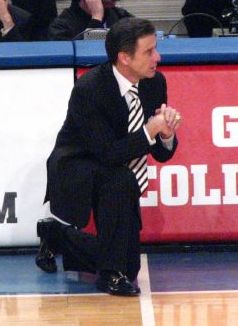 |
| Pitino in the 2007 Big East Tournament |
Blaming others, or scapegoating, has become such a prevalent phenomenon, books have been written and associations formed to study the issue.
For the blamer, the act of passing the buck is often more pleasant than acknowledging fault. According to the Scapegoat Society, the discrediting routine known as scapegoating involves distortion of truth, vilification and separated from the incident at hand, the blamer sometimes resembles a conspiracy theorist.
Chris Allen Carter additionally has postulated that blamers are "insecure people driven to raise their own status by lowering the status of their target," while in 1953, Kraupl-Taylor concluded that scapegoating "leads to the satisfaction of unconscious scoptophilia and aggression and gives narcissistic satisfaction to the ego."
In other words, scapegoating and blaming others may temporarily make one feel better about him or herself, but in the end, it's just a psychological defense mechanism meant to shield oneself from responsibility and truth.
But this is a sports website... You get where I'm headed with this.
Sunday, February 19, 2012
Referee Ejects Former Basketball Players Attending Game as Team Guests: About Ejecting Fans
NCAA basketball official Karl Hess has quite the legacy, both as an official and as a player at Liberty University—in 2006, Hess' number 11 jersey was retired by the Flames during a halftime ceremony that included Hess, his wife and Liberty Director of Athletics Jeff Barber.
Hess is Liberty's all-time career top scorer with 2,373 points and is also the program's leader in field goals (951), free throws (471), free throw percentage (89.9%), assists (648) and is tied for first in games played (120). His 1980 Flames team won the NCCAA National Championship, as Hess earned All-Tournament and MVP Awards for his efforts.
As an official, Hess. He was crew chief for the 2007 NCAA Men's National Championship game between Florida and Ohio State and worked the Final Four in 2008 and 2009, with a Sweet Sixteen matchup in 2010. He has been invited to work the NCAA Tournament annually since 1996.
With such success comes a bounty of naysayers and hecklers; taunting and harassment.
On Saturday, Hess had finally had enough and used the powers vested in him by the NCAA Rules Book to take care of a problem situation.
In Raleigh, North Carolina to work the Florida State vs. N.C. State, Hess began receiving the traditional heckles that fans often bestow upon officials, only the source of this verbal barrage wasn't quite what one might expect.
Former N.C. State Wolfpack star players Tom Gugliotta and Chris Corchiani—who, like Hess, have had their jerseys retired by their alma mater—had taken their seats behind the scorer's table and were allegedly hurling insult after insult toward the officiating crew and Hess in particular.
When traditional heckling gave way to petty insults and abuse that crossed the line, Hess called for the disrespectful fans' removal from the facility. Moments later, stadium security arrived and escorted Gugliotta and Corchiani out of the RBC Center.
 |
| Official Karl Hess at the NCAA Tournament |
As an official, Hess. He was crew chief for the 2007 NCAA Men's National Championship game between Florida and Ohio State and worked the Final Four in 2008 and 2009, with a Sweet Sixteen matchup in 2010. He has been invited to work the NCAA Tournament annually since 1996.
With such success comes a bounty of naysayers and hecklers; taunting and harassment.
On Saturday, Hess had finally had enough and used the powers vested in him by the NCAA Rules Book to take care of a problem situation.
In Raleigh, North Carolina to work the Florida State vs. N.C. State, Hess began receiving the traditional heckles that fans often bestow upon officials, only the source of this verbal barrage wasn't quite what one might expect.
Former N.C. State Wolfpack star players Tom Gugliotta and Chris Corchiani—who, like Hess, have had their jerseys retired by their alma mater—had taken their seats behind the scorer's table and were allegedly hurling insult after insult toward the officiating crew and Hess in particular.
When traditional heckling gave way to petty insults and abuse that crossed the line, Hess called for the disrespectful fans' removal from the facility. Moments later, stadium security arrived and escorted Gugliotta and Corchiani out of the RBC Center.
Saturday, January 28, 2012
West Virginia vs. Syracuse: Officials Miss Goaltending Call while ESPN Analyst Loses Mind...Only After Seeing Instant Replay
Goaltending or no-call, that is the question.
The Syracuse Orange men's basketball team survived a scare at the hands of West Virginia Saturday afternoon, a game decided only when the final horn had sounded and time had expired.
With the shot clock turned off and 26.3 seconds to play in a Syracuse-led 63-61 ballgame, West Virginia's Truck Bryant attempted an early three-point shot, only to have the try miss the backboard, rim and net entirely. After Mountaineers forward Deniz Kilicli recovered the air ball, Kilicli put up a quick two-point try with 11 seconds remaining.
Friday, January 27, 2012
NCAA Basketball Mid-Season Point of Emphasis: Sportsmanship and Technical Fouls
NCAA National Coordinator of Officials John Adams recently posted a memo on the NCAA Men's Basketball Central Hub at referee mega-site ArbiterSports, which serves as a mid-season point of emphasis, so to speak.
Adams, from his personal observations and discussions with regional advisors, concluded that "officials are reluctant to enforce Rule 10, Section 5," or the group of unsporting technicals informally known as the sportsmanship rules.
For a picture perfect example of an official correctly enforcing Rule 10, Section 5, watch the following video of Oklahoma State Cowboys guard Markel Brown receive his second technical and be ejected for taunting his opponent. Brown was issued his first technical for similar unsporting behavior.
Thursday, January 19, 2012
Roy Williams' Original FSU Plan Was to Pull Entire Team: UNC is Lucky That Didn't Happen
The very first page of the 2011-12 NCAA Men's and Women's Basketball Rules Book is titled, "Respect. It's the name of the game." On Saturday, UNC got very close to violating that basic tenet of collegiate sport.
 With the FSU Seminoles on the verge of a 33-point upset over the then-No. 3 North Carolina Tar Heels, UNC head coach Roy Williams appeared to pull his bench from the court in the game's final moments as hundreds of excited FSU fans prepared to rush the court, leaving behind five walk-ons to finish the game.
Given the circumstances, the decision for UNC's bench to leave the court before the final horn was a sensible choice made in the interest of safety.

Given the circumstances, the decision for UNC's bench to leave the court before the final horn was a sensible choice made in the interest of safety.
Subscribe to:
Posts
(
Atom
)