Showing posts with label Intentional Drop. Show all posts

Monday, May 18, 2026

MLB Ejection 030 - Tripp Gibson (1; Will Venable)

HP Umpire Tripp Gibson ejected White Sox manager Will Venable (obstruction call by 2B Umpire Mike Muchlinski; QOCY) in the bottom of the 3rd inning of the #WhiteSox-#Mariners game. With two out and one on, Mariners batter Randy Arozarena hit a 0-0 cutter from White Sox pitcher Noah Schultz on a line drive to left fielder Tristian Peters, who threw home ahead of Mariners baserunner R1's Jhonny Pereda's arrival, ruled obstruction by 2B Umpire Muchlinski with Pereda awarded home. Replays indicate R1 Pereda made contact with White Sox 2B Sam Antonacci while rounding second base and that Montgomery impeded runner Pereda's progress, the call was correct.* At the time of the ejection, the Mariners were leading, 2-0. The Mariners ultimately won the contest, 6-1.

This is Tripp Gibson (73)'s 1st ejection of 2026.
*Official Baseball Rule 6.01(h)(2): "If no play is being made on the obstructed runner, the play shall proceed until no further action is possible. The umpire shall then call “Time” and impose such penalties, if any, as in their judgment will nullify the act of obstruction." 
OBR Definition: "OBSTRUCTION is the act of a fielder who, while not in possession of the ball and not in the act of fielding the ball, impedes the progress of any runner."
OBR 5.09(a)(12): "Batter is out when an infielder intentionally drops a fair fly ball or line drive, with first, first and second, first and third, or first, second and third base occupied before two are out. The ball is dead and runner or runners shall return to their original base or bases."

This is the 30th ejection report of the 2026 MLB regular season.
This is the 18th manager ejection of 2026. Ejection Tally: 18 Managers, 4 Coaches, 8 Players.
This is Chicago's 1st ejection of 2026, 3rd in the AL Central (MIN 4; DET 2; CWS, KC 1; CLE 0).
This is Will Venable's 1st ejection since Sept 9, 2025 (Vic Carapazza; QOC = Y [Balls/Strikes]).
This is Tripp Gibson's 1st ejection since July 13, 2025 (John Schneider; QOC = Y [Replay Review]).

Saturday, August 19, 2023

Vlad Guerrero's Smart Play - Untouched Drop Turns Two

Toronto's Vlad Guerrero's smart play in the field led to a Blue Jays double play against Cincinnati when Reds batter Will Benson's infield fly ball with one out and a runner on first base fell to the ground untouched, with Guerrero throwing to first base to retire batter-runner Benson (who didn't run the play out), leading to a double play via tag as the lead baserunner was retired during a rundown. Umpires had a lot to consider here and we review the various rules involved.

The rules discussed include the infield fly rule (we eliminate an infield fly possibility, because only first base was occupied with less than two out [e.g., not first and second or bases loaded]), Official Baseball Rule 6.01(a)(10) fielder protection on a batted ball against batter/runner interference (Guerrero was the protected fielder entitled to field this fly ball), OBR 5.09(a)(12) the intentional drop rule (dead ball, batter is out -- only occurs if the fielder TOUCHES the ball before intentionally dropping it...Guerrero didn't touch the fly ball), and OBR 5.09(b)(6)the force being removed on the lead runner when the batter was retired which necessitated a tag of the runner instead of the base.

Video as follows:

Thursday, May 18, 2023

CCS Twofer - Bundy's Sticky Ejection & Intentional Drop ?

The third inning of the Syracuse-Norfolk game proved eventful when Triple-A Mets pitcher Dylan Bundy was ejected by 1B Umpire Robert Nunez for failing a foreign substance inspection. Seconds earlier, Syracuse turned a double play on an intentional drop no-call when 3B Umpire Dillon Wilson ruled that Mets second baseman Ronny Mauricio did not intentionally drop a line drive from Tides batter Daz Cameron, resulting in an inning-ending double play with runners on first and second and one out.

Moments later, the entire crew of three umpires met along the third base dugout to inspect Bundy's glove and hand, with Crew Chief Nunez signaling Bundy's ejection seconds later for violating the illegal substance rule.

Official Baseball Rule 5.09(a)(12) puts the batter out for a fielder's intentional drop under certain circumstances: "An infielder intentionally drops a fair fly ball or line drive, with first, first and second, first and third, or first, second and third base occupied before two are out. The ball is dead and runner or runners shall return to their original base or bases."

The intentional drop rule is related, but distinct from, the infield fly rule, which is the better-known rule. Here's a quick comparison of the intentional drop rule vs the infield fly rule. The primary differences are an intentional drop rule applies to a runner on first (only) as well as runners on first and second or the bases loaded with less than two out (the infield fly rule is R1 & R2 or the bases loaded, but NOT R1 only), an infield fly is called whether or not the fielder touches the ball (the intentional drop rule requires the fielder touch and drop the ball), and an infield fly keeps the ball alive while the intentional drop rule causes it to become dead.

Infield Fly Rule: R1 & R2 or bases loaded with <2 out
Intentional Drop Rule: R1, R1 & R3, R1 & R2, or loaded w <2 out

Infield Fly: Fair fly ball that can be caught w ordinary effort
Intention Drop: Fair fly or line drive intentionally dropped

Infield Fly: Batter out, ball remains live, runners advance at their own risk.
INT Drop: Batter out, ball is dead, runners return.

Video as follows:

Sunday, September 4, 2022

Ask - Infield Fly No-Call Leads to Double Play in New York

After New York shortstop Francisco Lindor allowed a batted ball to drop untouched before turning an inning-ending double play during Saturday's #Nationals-#Mets game, questions surrounding the umpires' infield fly no-call sprung up: why wasn't the batter declared out pursuant to the infield fly rule?

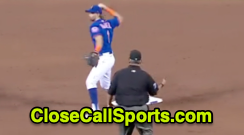
Play: With one out and two on (R1, R2), Nationals batter Luis Garcia hit a first pitch-changeup from Mets pitcher Max Scherzer in the air, whereupon Mets shortstop Lindor let the ball drop to the dirt before fielding it and throwing to second baseman Jeff McNeil, who threw to third baseman Eduardo Escobar, who tagged advancing Nats baserunner R2 CJ Abrams.

Call: Although umpires did not signal "infield fly" on the play, and although 2B Umpire Manny Gonzalez clearly signaled Mets baserunner R1 Lane Thomas out on second based on a force play, the game score's play-by-play account has this as "[batter] Luis Garcia pops into a double play" before concluding with, "Luis Garcia out at 1st."

Conflict of Calls and Scoring Decision via Stats Stringer: Since the Mets never threw the ball to first base, the only explanation for Garcia being out would be if this play was declared an infield fly, despite replays indicating evidence to the contrary (such as no signal, and U2 Gonzalez's force out call).

Rule: The infield fly rule is defined as: "a fair fly ball (not including a line drive nor an attempted bunt) which can be caught by an infielder with ordinary effort, when first and second, or first, second and third bases are occupied, before two are out. The pitcher, catcher and any outfielder who stations himself in the infield on the play shall be considered infielders for the purpose of this rule."

The batter is out, and the ball remains live (runners can advance at their own peril, with liability to be put out).

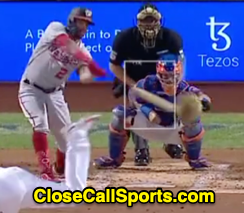
Analysis: With the less-than-two-out and runners-on-first-and-second criteria clearly satisfied, we turn to the "attempted bunt" portion of the rule. Replays indicate the batter appeared to contact the ball during a check swing—this is not a bunt and thus the bunt exemption does not apply.

Furthermore, this is not a line drive ("a batted ball that goes sharp and direct from the bat to a fielder without touching the ground").

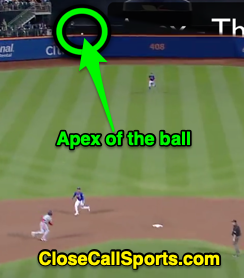
With replays indicating fielder Lindor could have caught this ball with ordinary effort, we turn to whether it satisfies the "fly ball" criterion or not. The definition for FLY BALL is of little help: "batted ball that goes high in the air in flight."

Thus, we are left with a subjective judgment call on whether this particular batted ball traveled "high" enough in the air. Judging by the ball's apex, one could certainly make an argument in favor of declaring this an infield fly. Note that the rule does not make any reference to amount of time the ball is airborne: the only criteria are whether a fair fly ball could be caught by an infielder with ordinary effort.

As for the intentional drop rule, OBR 5.09(a)(12) requires the infielder to have physically touched the baseball in order to merit a call; additionally, it is superseded by the infield fly rule: "In this situation, the batter is not out if the infielder permits the ball to drop untouched to the ground, except when the Infield Fly rule applies."

This is therefore not an intentional drop and may or may not be an infield fly, depending on your subjective interpretation of the word "high".

Video as follows:

Thursday, June 2, 2022

Ask UEFL - Angel in the Infield Fly & Intentional Drop?

Tmac
 answers two questions for the price of one in this Ask the UEFL infield fly and intentional drop rule double feature in a game between the Orioles and Cardinals with umpire Angel Hernandez behind the plate in St Louis. With none out and two on (R1, R2), Orioles batter Chris Owings' sacrifice bunt attempt goes horribly awry as the pitch from Nick Wittgren is bunted high into the air in front of the pitcher's mound.

Baltimore Pitcher Wittgren permits the batted ball to fall to the ground untouched before picking up the fair ball and throwing to third base to force out the lead runner, with third baseman Nolan Arenado throwing on to second base to force out R1 Robinson Chirinos.

The two-pronged question—why isn't this an infield fly and why isn't this an intentional drop—rely on two sections of the Official Baseball Rules. First, the Definition of Terms states, "An infield fly is a fair fly ball (not including a line drive nor an attempted bunt) which can be caught by an infielder with ordinary effort, when first and second, or first, second and third bases are occupied, before two are out."

OBR 5.09(a)(12) discusses intentional drops and states that the batter is out when "An infielder intentionally drops a fair fly ball or line drive, with first, first and second, first and third, or first, second and third base occupied before two are out. The ball is dead and runner or runners shall return to their original base or bases."

However, the pertinent part for this particular play is the following APPROVED RULING: "In this situation, the batter is not out if the infielder permits the ball to drop untouched to the ground, except when the Infield Fly rule applies."

When HP Umpire Hernandez signals "safe," Angel is thus communicating two different, but related, no-calls: It is not an infield fly because it is an attempted bunt, and it is not an intentional drop because the fielder permitted the ball to drop untouched and the infield fly does not apply.

Video as follows:

Monday, August 31, 2020

Case 20-3 - Twin Out, Triple Play, Or Intentional Drop

"Triple play!" squealed the Minnesota Twins broadcast as a bases-loaded dropped line drive dissipated into a one out sequence as called by 2B Umpire Umpire Ryan Blakney, upheld after crew consultation with Chief Laz Diaz, and confirmed after Replay Review challenge by Twins Manager Rocco Baldelli. What magic trick turned three outs into one?

The Play: With none out and the bases loaded, White Sox batter Danny Mendick hit a 1-2 curveball from Twins pitcher Rich Hill on a line drive to second baseman Luis Arraez, who dropped the batted ball before fielding and flipping to shortstop Jorge Polanco, who stepped on second base and threw onward to first baseman Miguel Sano, who tagged White Sox baserunner R1 Luis Robert, before throwing back to Twins shortstop Polanco, who tagged White Sox baserunner R2 James McCann, who was standing on second base at the time of the tag. R3 Edwin Encarnacion remained on third base and batter-runner Mendick stood at first base.

UIC DJ Reyburn and CC Laz Diaz explain.
The Call: In the middle of the action, 2B Umpire Ryan Blakney ruled F4 Arraez failed to catch the batted ball ("safe" call) before ruling baserunner R1 Robert out at second base on the force out by F6 Polanco. 1B Umpire and Crew Chief Laz Diaz made no call on F3 Sano's tag of R1 Robert (no need for a call, as Blakney had already called Robert out on the force play), before 2B Umpire Blakney ruled R2 McCann safe at second base for McCann was standing on the base at the time he was tagged.

F4 doesn't tag R2, meaning R2 is safe.
Analysis: This play was officiated correctly—as long as Arraez's drop of the batted ball is deemed unintentional. Chicago's R1 Robert was forced out at second base, making the subsequent tag of Robert at first redundant, while the defense failed to make a play on R2 McCann until the force was removed and he was allowed to return safely to second base without being forced to advance. No play was ever made on R3 nor the batter-runner; thus, only one out was recorded on this play (BR = Safe, R1 = Out, R2 = Safe, R3 = Safe).

Only one Q: Is this an intentional drop?
Case Play Question: As stated, the only way this play could have turned out differently is if the umpires deemed that F4 Arraez's drop of the baseball was intentional. The relevant rule is 5.09(a)(12), which puts a batter out when—"An infielder intentionally drops a fair fly ball or line drive, with first, first and second, first and third, or first, second and third base occupied before two are out. The ball is dead and runner or runners shall return to their original base or bases."

Had the umpires deemed the dropped ball an intentional act, all else equal (the same sequence having occurred, tags and all), what would the proper call have been?
Hint: It's in the rule itself, which makes this exercise rather rhetorical, perhaps.

Video as follows:

Tuesday, September 19, 2017

Phillips' DP Attempt Reversed by Intentional Drop Rule

Angels 2B Brandon Phillips tried a sneaky double play in Anaheim before umpires invoked the intentional drop rule to prevent the would-be inning ending maneuver, albeit only after a brief consultation between 2B Umpire Mark Ripperger and 1B Umpire and Crew Chief Tom Hallion.

Well, that's one way to try and stop a red-hot Cleveland Indians ball club.

Tom Hallion motions to halt Terry Francona.
The Play: With one out and one on (R1) in the top of the 2nd inning Tuesday night, Indians batter Yandy Diaz hit a 1-2 fastball from Angels pitcher Tyler Skaggs on a weak line drive to second baseman Phillips, who knocked the ball down to the ground with his glove—ruled "safe" or "no catch" by 2B Umpire Ripperger—and proceeded to execute the twin killing.

Aftermath: Nearly immediately after 1B Umpire Hallion signaled Diaz out at first base, he called "Time" to consult with Ripperger, who ultimately changed his initial call to that of an air out on Diaz, baserunner R1 Jay Bruce remaining at first base with batter Diaz declared out.

The Ruling: Ripperger's final ruling invoked Official Baseball Rule 5.09(a)(12)—otherwise known as the intentional drop rule—which states that the batter is out when, "An infielder intentionally drops a fair fly ball or line drive, with first, first and second, first and third, or first, second and third base occupied before two are out. The ball is dead and runner or runners shall return to their original base or bases."

Phillips, who in 2013 demonstrated his exceptional rules knowledge by allowing an infield fly to drop to the ground untouched in Cincinnati and subsequently doubled off a less informed Giants baserunner, smiled as Hallion's crew reversed course and ruled Diaz out for Phillips' intentional drop.
Related PostInfield Fly Rule Knowledge Costs Giants as Reds Turn Two (7/4/2013).

Phillips grins as the umpires enforce the rule.
Phillips had likely attempted a similar version of the untouched fallen ball trick Tuesday in Anaheim, but Diaz's soft line drive simply was hit too hard to allow it to fall untouched.

Legality: The intentional drop is a completely legal play insofar as there is no penalty or base award for an intentional drop because it is not a violation of any rule (recall that the definition of "Illegal" is "contrary to these rules"); if the intentional drop was illegal, it would be listed under Rule 6.00, which is entitled, "Improper Play, Illegal Action, and Misconduct. Instead, an intentional drop, pursuant to Rule 5.09(a)(12) [Rule 5.00 is called "Playing the Game"], is simply one of a dozen circumstances under which a batter may be declared out, just as a standard air out or tag can retire the batter-runner. An intentional drop is a legal way of retiring the batter-runner, which also causes the ball to become dead. When the ball is dead, no bases may be run and no runners may be put out, so an intentional drop can never logically retire a non-batter. It is up to the umpire to enforce this rule correctly.

To be clear, the fielder is always allowed to keep play alive by permitting the ball to fall untouched, but deliberately causing a fair fly ball (or line drive in flight) to drop to the ground after making contact with it makes the play liable for an intentional drop call and resulting dead ball. Finally, the infield fly rule (runners on first and second or bases loaded with less than two out; fair fly ball that is not a line drive nor bunt; can be caught by an infielder with ordinary effort) supersedes the intentional drop rule, meaning that the intentional drop rule is not invoked and the ball remains live when the batter has already been declared out under the auspices of the infield fly rule.
Related PostInfield Fly and a Double Play - Back to Basics for Phillies (4/11/16)

For more about the intentional drop rule, see the following textbook application of 5.09(a)(12) by Triple-A All-Star Game umpire Billy Cunha of the Pacific Coast League from earlier this summer:
Related PostIntentional Drop Rule Stars in Triple-A Midsummer Classic (7/12/17).
Related PostBernier Burned by Baserunning on Pseudo Infield Fly (7/24/13).

Video as follows:

Wednesday, July 12, 2017

Intentional Drop Rule Stars in Triple-A Midsummer Classic

Baseball's intentional drop rule, third-cousin of the infield fly, found its way into Triple-A's All-Star Game Wednesday night as the Pacific Coast League attempted to turn a crafty double play, only to have "Time" called instead.

PCL Ump Cunha calls a drop on the PCL team.
The Play: With one out and two on (R1, R2) in the top of the 7th inning of the INTL-PCL affair, International League batter Chance Sisco hit a line drive to PCL second baseman Ildemaro Vargas, who momentarily caught the ball before it dropped to the infield dirt as IL baserunner R2 Rusney Castillo ran back to retouch second base.

2B Umpire Billy Cunha of the Pacific Coast League immediately called "Time," pointed toward first base, and signaled batter Sisco out on the caught line drive under the intentional drop rule.

The Rule: Official Baseball Rule 5.09(a)(12) states that the batter is out when—"An infielder intentionally drops a fair fly ball or line drive, with first, first and second, first and third, or first, second and third base occupied before two are out. The ball is dead and runner or runners shall return to their original base or bases."

The fielder is allowed to allow the ball to fall untouched, but is liable for an intentional drop if he makes contact with the fair fly ball or line drive before allowing it to fall.

This rule is superseded by the infield fly rule, meaning that had batter Sisco hit a fly ball high in the air instead, such that infielder Vargas could have caught it with ordinary effort, and Vargas intentionally dropped the fly after letting it fall into his glove, the infield fly rule would be invoked: Sisco would be out, but the ball would remain live.
Related PostBernier Burned by Baserunning on Pseudo Infield Fly [legally untouched drop] (7/24/13).
Related PostInfield Fly Rule Knowledge Costs Giants as Reds Turn Two [dropped infield fly] (7/4/13).

Video as follows (thanks to the invaluable jpg901c YouTube channel):