Showing posts with label Obstruction. Show all posts

Wednesday, September 3, 2025

Obstruction in Boston as Runner & Catcher Collide on Batted Ball

"Obstruction!" announced umpire Jordan Baker after Guardians batter-runner José Ramírez and Red Sox catcher Connor Wong collided on a batted ball up the first baseline. Instead of an out, Ramírez was awarded first base and Cleveland's Brayan Rocchio scored from third. What's the rule and did Baker's crew get the call right?

With one out and runners on second and third in the top of the 2nd inning of Wednesday's Guardians vs Red Sox game, batter Ramírez hit a check swing ground ball in front of home plate toward first base. Boston catcher Wong initially pursued the batted ball before stopping once he saw pitcher Steven Matz running to field it, turning around to head back to cover home plate as R3 Rocchio raced in.

But as Wong turned toward home, he collided with batter-runner Ramírez. Initially ruled interference on Ramírez, chief Baker called his crew into consultation, ultimately ruling that, because Wong was not entitled to protection under the rules for fielding a batted ball, he therefore obstructed the batter-runner. Accordingly, the batter-runner was awarded first base and all runners advanced one base.

In general, baseball's right-of-way rules give the fielder the right to field a batted ball (meaning the runners must avoid the fielder lest they be guilty of interference) while the runner has the right to run the bases at any other time (the fielder must get out of the runner's way). However, only one fielder is entitled to right-of-way protection on a batted ball and, in this case, that protected fielder was not the pitcher, not the catcher. As such, the unprotected catcher obstructed the runner's right to run the bases.

This is the correct call pursuant to the following rules:
Official Baseball Rule 6.01(a)(10): "It is interference by a batter or a runner when they fail to avoid a fielder who is attempting to field a batted ball, or intentionally interfere with a thrown ball, provided that if two or more fielders attempt to field a batted ball, and the runner comes in contact with one or more of them, the umpire shall determine which fielder is entitled to the benefit of this rule, and shall not declare the runner out for coming in contact with a fielder other than the one the umpire determines to be entitled to field such a ball."
OBR 6.01(h)(1): "If a play is being made on the obstructed runner, or if the batter-runner is obstructed before they touch first base, the ball is dead and all runners shall advance, without liability to be put out, to the bases they would have reached, in the umpire’s judgment, if there had been no obstruction. The obstructed runner shall be awarded at least one base beyond the base they had last legally touched before the obstruction."

Wrap: Cleveland Guardians vs Boston Red Sox, 9/3/25 | Video as follows:

Friday, August 15, 2025

MLB Ejection 127 - Tom Hanahan (2; Matt Quatraro)

2B Umpire Tom Hanahan ejected Royals manager Matt Quatraro (obstruction no-call on Colson Montgomery; QOCN) in the bottom of the 5th inning of the #WhiteSox-#Royals game. With none out and none on, during Mike Yastrzemski's at-bat, Royals baserunner R1 Kyle Isbel attempted to steal second base, thrown out by catcher Edgar Quero to shortstop Montgomery. Replays indicate that prior to receiving the throw, Montgomery obstructed baserunner Isbel, the call was incorrect.* At the time of the ejection, the Royals were leading, 2-1. The Royals ultimately won the contest, 3-1.

This is Tom Hanahan (69)'s 2nd ejection of 2025.
*Official Baseball Rules Definition: "OBSTRUCTION is the act of a fielder who, while not in possession of the ball and not in the act of fielding the ball, impedes the progress of any runner."

This is the 127th ejection report of the 2025 MLB regular season.
This is the 68th manager ejection of 2025. Ejection Tally: 68 Managers, 21 Coaches, 38 Players.
This is Kansas City's 3rd ejection of 2025, 2nd in the AL Central (MIN 6; CWS 4; KC 3; DET 2; CLE 0).
This is Matt Quatraro's 2nd ejection of 2025, 1st since May 19 (Jordan Baker; QOC = Y [Obstruction]).
This is Tom Hanahan's 2nd ejection of 2025, 1st since June 1 (Tyler Soderstrom; QOC = Y [Balls/Strikes]).

Sunday, July 13, 2025

Red Sox Score Tie-Breaking Run on Obstruction vs Rays

3B Umpire Scott Barry's obstruction call on Rays third baseman Junior Caminero for base blocking broke a 0-0 tie, giving Boston a lead when Red Sox runner Marcelo Mayer found himself seemingly picked off by Tampa Bay catcher Matt Thaiss, only for umpire Barry to quickly reverse course and rule that Caminero impeded baserunner Mayer's return to third base due to improper footing.

The Official Baseball Rules define obstruction as "the act of a fielder who, while not in possession of the ball and not in the act of fielding the ball, impedes the progress of any runner."

Although Rays fielder Caminero was indeed in the act of fielding at the time of obstruction (by virtue of preparing to receive the throw), umpires ruled that he did not need to block the base in order to do so. Because Caminero blocked the base voluntarily and outside the scope of simply fielding the ball/throw, obstruction was the proper call.

Official Baseball Rule 6.01(h)(1) prescribes the penalty for Type 1 (Type B) obstruction: "If a play is being made on the obstructed runner, or if the batter-runner is obstructed before they touch first base...the obstructed runner shall be awarded at least one base beyond the base they had last legally touched before the obstruction." This is why baserunner R3 Mayer scored, rather than remained at third base.

Umpire Barry initially stated "stay here" in regard to Mayer's slide back into third base, as HP Umpire Adam Beck walked up the line, the umpires ultimately applying the proper ruling in OBR 6.01(h)(1) to award the runner his next base.

Video as follows:

Monday, June 23, 2025

MLB Ejection 084 - Alan Porter (2; Alex Cora)

2B Umpire Alan Porter ejected Red Sox manager Alex Cora (obstruction no-call; QOCN) in the top of the 5th inning of the #RedSox-#Angels game. With none out and one on, Red Sox batter Abraham Toro hit a 2-2 fastball from Angels pitcher Jack Kochanowicz on the ground to shortstop Zach Neto, who threw to third baseman Luis Rengifo as a rundown transpired during which second baseman Christian Moore tagged out Red Sox baserunner R2 Jarren Duran before throwing to third baseman Rengifo, covering second base, who tagged out Red Sox batter-runner Toro. Replays indicate that prior to receiving the throw, fielder Rengifo blocked Toro's path to second base and in doing so impeded his progress as Toro began his slide into the base, and that the throw did not take Rengifo into the runner's path so the act-of-fielding exception does not apply, the call was incorrect.* At the time of the ejection, the Angels were leading, 5-4. The Angels ultimately won the contest, 9-5.
  
This is Alan Porter (64)'s 3rd ejection of 2025.
*Official Baseball Rule Definitions: "OBSTRUCTION is the act of a fielder who, while not in possession of the ball and not in the act of fielding the ball, impedes the progress of any runner."

This is the 84th ejection report of the 2025 MLB regular season.
This is the 44th manager ejection of 2025. Ejection Tally: 44 Managers, 14 Coaches, 26 Players.
This is Boston's 6th ejection of 2025, 1st in the AL East (BOS, NYY 6; BAL, TB, TOR 3).
This is Alex Cora's 4th ejection of 2025, 1st since June 22 (Doug Eddings; QOC = Y [Replay Review]).
This is Alan Porter's 3rd ejection of 2025, 1st since May 21 (Kevin Cash; QOC = Y [Replay Review]).

Saturday, May 24, 2025

Dodgers-Mets Obstruction, Tag-Up & Pirates Out of Base Path

Dodgers 3B Max Muncy's visual obstruction and Shohei Ohtani/Michael Conforto's timely tag-up in New York and Pirates runner Alexander Canario's out of the base path calls feature in this rules analysis trio. How did the umpires do?

Muncy's Obstruction: With one out and a runner on third, Mets batter Pete Alonso hit a fly ball to Dodgers right fielder Toescar Hernández, who threw home in time to retire baserunner R3 Starling Marte, with HP Umpire Ryan Blakney signaling the runner out on the tag. 3B Umpire Tripp Gibson, however, called "Time" and ruled obstruction on Dodgers 3B Muncy, awarding Marte home for a Mets run.

According to the MLB Umpire Manual pertaining to official rule interpretations, Muncy committed obstruction by intentionally positioning himself to block R3 Marte's view of the fielder catching the sacrifice fly: "This is obstruction under Official Baseball Rule 6.01(h)(2). The umpire should call the infraction when it occurs and award bases, if any, in the appropriate manner."

Ohtani & Conforto's Timely Tag-Ups: Also in this game, New York unsuccessfully challenged 2B Umpire Marvin Hudson's call that Dodgers baserunners R1 Ohtani and R2 Conforto did not leave early (fail to retouch) second base on an outfield fly ball that was caught. Mets outfielders Juan Soto and Tyron Taylor briefly juggled the fly ball before Taylor ultimately caught it. Replays indicate R2 Conforto left second base after Soto's first touch of the fly ball, but before Taylor's eventual catch.

According to the Official Baseball Rule's definition of a catch, "Runners may leave their bases the instant the first fielder touches the ball." This means Conforto timely retouched by leaving second base after fielder Soto's touch, even if he left before the bobbled ball was eventually caught.

Canario's Out of the Base Path Overslide: In Pittsburgh, HP Umpire Mark Wegner called Pirates baserunner Alexander Canario out at home for running more than three feet away to avoid a tag on a play at the plate. Runner Canario overslid home plate and, in doing so, Wegner ruled that Canario ran out of his base path, since the base path from the start of the tag attempt ends at the base to which the runner is trying.

OBR 5.09(b)(1) states, "Any runner is out when they run more than three feet away from their base path to avoid being tagged unless their action is to avoid interference with a fielder fielding a batted ball. A runner’s base path is established when the tag attempt occurs and is a straight line from the runner to the base they are attempting to reach safely."

Video as follows:

Monday, May 19, 2025

MLB Ejection 038 - Jordan Baker (2; Matt Quatraro)

2B Umpire Jordan Baker ejected Royals manager Matt Quatraro (out/non-obstruction call; QOCY) in the top of the 7th inning of the #Royals-#Giants game. With one out and one on and Michael Massey at bat, Giants pitcher Robbie Ray threw to first baseman Casey Schmitt, who threw to shortstop Willy Adames to pick off Royals baserunner R1 Dairon Blanco, attempting to steal second base. Replays indicate Adames tagged Blanco prior to the runner's arrival at second base and without illegally blocking the runner's access to the base (act of fielding exception), the call was correct.* At the time of the ejection, the game was tied, 0-0. The Royals ultimately won the contest, 3-1.
 
This is Jordan Baker (71)'s 2nd ejection of 2025.
*Official Baseball Rules Definition: "OBSTRUCTION is the act of a fielder who, while not in possession of the ball and not in the act of fielding the ball, impedes the progress of any runner."

This is the 38th ejection of the 2025 MLB regular season.
This is the 19th manager ejection of 2025. Ejection Tally: 19 Managers, 10 Coaches, 9 Players.
This is Kansas City's 2nd ejection of 2025, 1st in the AL Central (CWS, KC, MIN 2; CLE, DET 0).
This is Matt Quatraro's 1st ejection since June 27, 2024 (Tripp Gibson; QOC = Y [Base Path]).
This is Jordan Baker's 2nd ejection of 2025, 1st since May 17 (Jeff Banister; QOC = Y [Pitch Clock]).

Wednesday, May 14, 2025

MLB Ejection 034 - Mark Ripperger (1; Torey Lovullo)

1B Umpire Mark Ripperger ejected Diamondbacks manager Torey Lovullo (obstruction call; QOCY) in the bottom of the 8th inning of the #Diamondbacks-#Giants game. With two out and one on, Giants batter Heliot Ramos hit a 1-1 slider from Diamondbacks pitcher Ryne Nelson on the ground to third baseman Eugenio Suárez, who threw to first baseman Pavin Smith as Ramos arrived at first base, ruled safe by 1B Umpire Ripperger. Smith then threw to shortstop Geraldo Perdomo, who tagged Giants baserunner R1 Christian Koss off the base, ruled out by 2B Umpire Edwin Jimenez. After crew consultation, umpires called obstruction on Diamondbacks second baseman Jordan Lawlar and ruled Koss safe, awarding him second base pursuant to Type 2 obstruction (no play being made on the runner at the time of OBS). Replays indicate Koss, after rounding second base, collided with Lawlar, who was not in possession of the ball and not in the act of fielding it, the call was correct.* At the time of the ejection, the Diamondbacks were leading, 8-6. The Diamondbacks ultimately won the contest, 8-7.

This is Mark Ripperger (90)'s 1st ejection of 2025.
Official Baseball Rules Definition: "OBSTRUCTION is the act of a fielder who, while not in possession of the ball and not in the act of fielding the ball, impedes the progress of any runner."
OBR 6.01(h)(2): "If no play is being made on the obstructed runner, the play shall proceed until no further action is possible. The umpire shall then call “Time” and impose such penalties, if any, as in their judgment will nullify the act of obstruction."
OBR 8.02(c): "...No player, manager or coach shall be permitted to argue the exercise of the umpires’ discretion in resolving the play and any person so arguing shall be subject to ejection."

This is the 34th ejection of the 2025 MLB regular season.
This is the 16th manager ejection of 2025. Ejection Tally: 16 Managers, 9 Coaches, 9 Players.
This is Arizona's 3rd ejection of 2025, 1st in the NL West (ARI 3; SD 2; LAD, SF 1; COL 0).
This is Torey Lovullo's 2nd ejection of 2025, 1st since April 8 (Laz Diaz; QOC = U [Check Swing]).
This is Mark Ripperger's 1st ejection since July 3, 2024 (Willy Adames; QOC = Y [Balls/Strikes]).

Friday, May 9, 2025

MLB Ejection 023 - James Hoye (1; Pat Murphy)

3B Umpire James Hoye ejected Brewers manager Pat Murphy (obstruction call; QOCY) in the bottom of the 6th inning of the #Brewers-#Rays game. With two out and one on, Rays baserunner Junior Caminero attempted to steal second base, drawing a throw from Brewers catcher William Contreras as Rays baserunner R3 Christopher Morel ran far off third base, drawing a throw to third baseman Caleb Durbin, who was called for obstruction. Replays indicate Durbin blocked Morel's path to the base without possession of the ball and not in a legitimate attempt to field the throw, the call was correct. At the time of the ejection, the Rays were leading, 3-2. The Rays ultimately won the contest, 4-3.

This is James Hoye (92)'s 1st ejection of 2025.
The Official Baseball Rules define obstruction as "the act of a fielder who, while not in possession of the ball and not in the act of fielding the ball, impedes the progress of any runner.
OBR 6.01(h)(1): "If a play is being made on the obstructed runner...The obstructed runner shall be awarded at least one base beyond the base they had last legally touched before the obstruction."

This is the 23rd manager ejection of the 2025 MLB regular season.
This is the 10th manager ejection of 2025. Ejection Tally: 10 Managers, 6 Coaches, 7 Players.
This is Cincinnati's 1/2nd ejection of 2025, 1st in the NL Central (CIN, MIL, STL 2; CHC 1; PIT 0).
This is Pat Murphy's 1st ejection since Sept 21, 2024 (Chris Segal; QOC = N [Balls/Strikes]).
This is James Hoye's 1st ejection since Sept 10, 2024 (Edwin Uceta; QOC = U [Throwing At]).

Thursday, May 8, 2025

MLB Ejections 021-2 - Alex MacKay, Alan Porter (CIN x2)

2B Umpire Alex MacKay ejected Reds 1B Coach Collin Cowgill and 3B Umpire Alan Porter ejected Reds manager Terry Francona (Replay Review decision that upheld MacKay's out [tag] play at second base on Blake Dunn's stolen base attempt; QOCY) in the top of the 11th inning of the #Reds-#Braves game. With two out and one on, Reds baserunner R1 Dunn attempted to steal second base on a first-pitch fastball from Scott Blewett to Reds batter Rece Hinds, ruled a strike by HP Umpire Brian Walsh, as Reds catcher Drake Baldwin threw to second baseman Ozzie Albies as Dunn slid into second base, ruled out by 2B Umpire MacKay. After Replay Review as the result of a challenge by Reds manager Francona, the call was upheld. Replays indicate Albies did not obstruct Dunn by virtue of gaining possession of the baseball before blocking the runner's path to second base, the call was correct.* At the time of the ejection, the game was tied, 4-4. The Braves ultimately won the contest, 5-4, in 11 innings.

This is Alex MacKay (9)'s 1st ejection of 2025.
This is Alan Porter (64)'s 1st ejection of 2025.
*The Official Baseball Rules define obstruction as "the act of a fielder who, while not in possession of the ball and not in the act of fielding the ball, impedes the progress of any runner." Accordingly, while it remains illegal for a fielder not yet in possession of the ball to block the runner's path into a base by placing a leg/knee/foot in the runner's way, it is not illegal for a fielder who has already gained possession of the ball to block the runner in this way. 

These are the 21st and 22nd ejection reports of the 2025 MLB regular season.
This is the 6th coach & 9th manager ejection of 2025. Ejection Tally: 9 Managers, 6 Coaches, 7 Players.
This is Cincinnati's 1/2nd ejection of 2025, 1st in the NL Central (CIN, STL 2; CHC, MIL 1; PIT 0).
This is Collin Cowgill's 1st ejection since April 18, 2015 (Paul Nauert; QOC = Y [Balls/Strikes]).
This is Terry Francona's 1st ejection since August 5, 2023 (Mark Wegner; QOC = U [Fighting]).
This is Alex MacKay's 1st ejection since August 13, 2023 (Rob Thomson; QOC = Y [Balls/Strikes]).
This is Alan Porter's 1st ejection since September 22, 2024 (Alex Cora; QOC = Y-c [Obstruction]).

Wrap: Cincinnati Reds vs Atlanta Braves, 5/8/25 | Video as follows:

Thursday, April 10, 2025

Obstruction Should Have Negated Collision Tag Play in PIT

Pirates 3B Ke'Bryan Hayes' made a heads up play to tag out Cardinals runner Thomas Saggese after 1B Endy Rodriguez and catcher Joey Bart collided in Pittsburgh, but should HP Umpire Lance Barksdale have called obstruction on the fielders lying prostrate in the runner's base path?

In short, "yes" and in long form, here's why:

With two out and runners on first and second base, Cardinals batter Willson Contreras hit a high fly ball in front of home plate, whereupon Pirates fielders Rodriguez and Bart collided, dropping the baseball in the process. As the ball rolled loose, Cardinals baserunner R2 Saggese attempted to score, tagged out by 3B Hayes who picked up the ball and tagged the runner before he slid into home plate.

Barksdale called the runner out instead of ruling obstruction on Pittsburgh, even though Rodriguez and Bart, having misplayed the batted ball, lay strewn across the baseline and directly in the path of R2 Saggese. Had obstruction been called, Saggese would have been awarded home and the inning would have continued, likely with R1 Masyn Winn advancing to third base.

The Official Baseball Rules define obstruction as "the act of a fielder who, while not in possession of the ball and not in the act of fielding the ball, impedes the progress of any runner."

Standing in an advancing runner's path without the ball and not in the act of fielding, thus blocking their direct progress, is very likely obstruction.

As for the act of fielding exemption, this applies to only one fielder: "If two or more fielders attempt to field a batted ball...the umpire shall determine which fielder is entitled to the benefit of this rule" (OBR 6.01(a)(10)). Although this is found in the offensive interference rule, the point about only one fielder receiving act-of-fielding protection applies here, as well.

Furthermore, a fielder is not considered "in the act of fielding" after the fielder attempts to field the ball and misses, which occurred here as well. Thus, this is obstruction, and because the ball was loose at the time of obstruction, it is Type 2 / B: "If no play is being made on the obstructed runner, the play shall proceed until no further action is possible. The umpire shall then call “Time” and impose such penalties, if any, as in their judgment will nullify the act of obstruction" (OBR 6.01(h)(2)), as no play can be considered as being made on a runner (as in OBS Type 1/A) while the ball is loose (e.g., not in the fielder's possession or not being thrown between teammates).

Video as follows:

Sunday, September 22, 2024

MLB Ejection 180 - Alan Porter (5; Alex Cora)

3B Umpire Alan Porter ejected Red Sox manager Alex Cora (obstruction call by 2B Umpire Dan Merzel on 2B Vaughn Grissom; QOCY) in the top of the 1st inning of the #Twins-#RedSox game. With one out and one on (R2), Red Sox pitcher Nick Pivetta threw to second baseman Grissom in an attempt to pick off Twins baserunner R2 Byron Buxton at second base, ruled safe by 2B Umpire Merzel. Upon crew consultation, the call was changed to obstruction (Type 1) against infielder Grissom, with baserunner R2 Buxton award third base. Replays indicate fielder Grissom placed his leg and knee in the runner's base path without possession of the ball and not in the act of fielding the throw requiring occupation of that space, the call was correct.* At the time of the ejection, the game was tied, 0-0. The Red Sox ultimately won the contest, 8-1.

This is Alan Porter (64)'s 5th ejection of 2024.
*Official Baseball Rule 6.01(h)(1): "If a play is being made on the obstructed runner, or if the batter-runner is obstructed before he touches first base, the ball is dead and all runners shall advance, without liability to be put out, to the bases they would have reached, in the umpire’s judgment, if there had been no obstruction. The obstructed runner shall be awarded at least one base beyond the base they had last legally touched before the obstruction."

This is the 180th ejection report of the 2024 MLB regular season.
This is the 90th manager ejection of 2024. Ejection Tally: 90 Managers, 30 Coaches, 59 Players.
This is Boston's 5th ejection of 2024, 5th in the AL East (NYY 10; TOR 9; BAL, TB 6; BOS 5).
This is Alex Cora's 3rd ejection of 2024, 1st since July 22 (Mark Wegner; QOC = Y [Balls/Strikes]).
This is Alan Porter's 5th ejection of 2024, 1st since July 28 (Brandon Hyde; QOC = Y [Replay Review]).

Wednesday, August 7, 2024

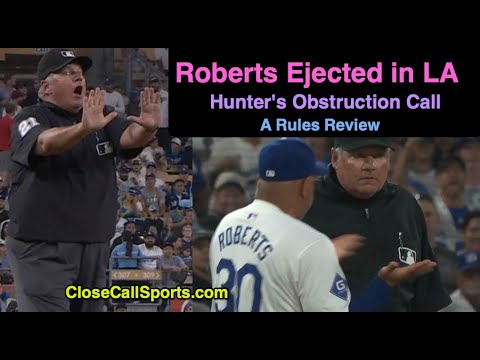
MLB Ejection 139 - Hunter Wendelstedt (4; Dave Roberts)

3B Umpire Hunter Wendelstedt ejected Dodgers manager Dave Roberts (obstruction call on Miguel Rojas; QOCY) in the top of the 6th inning of the #Phillies-#Dodgers game. With none out and one on, Phillies batter Brandon Marsh bunted a 0-0 fastball from Dodgers pitcher Alex Vesia on the ground to third baseman Enrique Hernández, who threw to shortstop Miguel Rojas as Phillies baserunner R2 Alec Bohm slid into third base, ruled obstruction on Rojas by 3B Umpire Wendelstedt. Replays indicate Rojas impeded Bohm's progress prior to fielding or possessing the ball, the call was correct.* At the time of the ejection, the Dodgers were leading, 4-3. The Phillies ultimately won the contest, 9-4.

This is Hunter Wendelstedt (21)'s 4th ejection of 2024.
*Official Baseball Rules Definition of Terms: "OBSTRUCTION is the act of a fielder who, while not in possession of the ball and not in the act of fielding the ball, impedes the progress of any runner."
OBR 6.01(h)(1): "If a play is being made on the obstructed runner, or if the batter-runner is obstructed before they touch first base, the ball is dead and all runners shall advance, without liability to be put out, to the bases they would have reached, in the umpire’s judgment, if there had been no obstruction."

This is the 139th ejection report of the 2024 MLB regular season.
This is the 68th manager ejection of 2024. Ejection Tally: 68 Managers, 22 Coaches, 49 Players.
This is Los Angeles' 1st ejection of 2024, 5th in the NL West (SF 7; ARI, SD 6; COL 3; LAD 1).
This is Dave Roberts' 1st ejection since August 26, 2023 (Jordan Baker; QOC = Y [Balls/Strikes]).3
This is Hunter Wendelstedt's 4th ejection of 2024, 1st since June 22 (Jesse Winker; QOC = Y [Balls/Strikes]).

Thursday, June 13, 2024

MLB Ejection 077 - Paul Clemons (2; Matt Quatraro)

2B Umpire Paul Clemons ejected Royals manager Matt Quatraro (obstruction no-call/out; QOCY) in the bottom of the 6th inning of the #Yankees-#Royals game. With two out and one on, Royals baserunner Bobby Witt Jr was picked off and caught stealing by Yankees pitcher Nestor Cortes, who threw to shortstop Anthony Volpe as Witt arrived at second base, called out by 2B Umpire Clemons, who ruled fielder Volpe did not obstruct the runner Witt. Replays indicate Volpe gained possession of the baseball prior to placing his foot in Witt's path, blocking the runner's access to second base; this is not obstruction due to possession, the call was correct. At the time of the ejection, the Royals were leading, 2-0. The Royals ultimately won the contest, 4-3.

This is Paul Clemons (104)'s 2nd ejection of 2024.
Official Baseball Rules Definition of Terms: "Obstruction is the act of a fielder who, while not in possession of the ball and not in the act of fielding the ball, impedes the progress of any runner."

This is the 77th ejection of the 2024 MLB regular season.
This is the 36th manager ejection of 2024. Ejection Tally: 35 Managers, 12 Coaches, 29 Players.
This is Kansas City's 1st ejection of 2024, 3rd in the AL Central (CWS 5; MIN 2; KC 1; CLE, DET 0).
This is Matt Quatraro's 1st ejection since August 7, 2023 (Vic Carapazza; QOC = U [Check Swing]).
This is Paul Clemons' 2nd ejection of 2024, 1st since June 7 (Derek Shomon; QOC = N [Balls/Strikes]).

Friday, May 31, 2024

Super Fast Center Fielder Tags Out Runner at Home Analysis

In a viral video, a lightning-quick center fielder sprints to tag a batter-runner out at the plate on a play in which the defense left third base and home uncovered. Although most attention focuses on the fast outfielder, umpires noticed a key yet ignored aspect of this play that, if called, would have resulted in the batter-runner being declared safe.

As the batter-runner's fly ball falls in shallow center field, it draws both the shortstop and second baseman to the outfield, which entices the third baseman to cover second base as the batter-runner tries to stretch his blooper into a double. As this in turn leaves third base uncovered, the batter-runner continues onto third, drawing the catcher to third base as the batter-runner arrives. This in turn leaves home plate uncovered, and the batter-runner soon sprints for home, only to be run down by the pursuing center fielder for an out.

But as we rewind the tape to the batter-runner rounding third base, we notice a very distinct interaction between him and the catcher. As the runner approaches third base, he looks up and sees the catcher charging up the foul line. The batter-runner then stutter-steps to get around the catcher and runs home, tagged out by fractions of a second.

This stutter-step at third base slowed the batter down just enough to enable the center fielder to timely tag him at home, and because that slowdown was caused by the catcher standing in the runner's way, we must consider obstruction: "OBSTRUCTION is the act of a fielder who, while not in possession of the ball and not in the act of fielding the ball, impedes the progress of any runner."

Because a play was being made on the batter-runner at the time of the obstruction (the center fielder was running with the ball toward him), this is OBR Rule 6.01(h)(1) Type 1 obstruction in professional and college baseball, the penalty for which is to award the obstructed runner "at least one base beyond the base they had last legally touched." The at least one part of this rule allows the plate award, even if the batter-runner may not have technically touched third base yet when obstruction occurred (it's really close). NCAA college is similar to the pro rule in this regard.

In high school's NFHS 8-3-1-2, obstruction is treated a little differently but results in the same outcome on this specific play: "the umpire shall award the obstructed runner a minimum of one base beyond the runner's position on base when the obstruction occurred." All levels allow additional base awards to nullify the act of obstruction.

Had obstruction been called, the batter-runner would have scored...and perhaps the internet deprived of its opportunity to praise a speedy fielder who covered more than 100 feet to make an impressive play.

Video as follows:

Thursday, May 30, 2024

Was Cody Bellinger Out of the Base Path or Did Arenado Obstruct?

When Cardinals pitcher Sonny Gray's pickoff throw behind Cubs baserunner Cody Bellinger caught the Chicago runner in a rundown, Bellinger lunged to his right to avoid St Louis 3B Nolan Arenado's tag. 3B Umpire Cory Blaser called Bellinger out for running more than three feet away from his base path to avoid the tag, but was he? Or did Arenado obstruct Belli instead?

Official Baseball Rule 5.09(b)(1) states that a runner is out when "they run more than three feet away from their base path to avoid being tagged unless their action is to avoid interference with a fielder fielding a batted ball. A runner’s base path is established when the tag attempt occurs and is a straight line from the runner to the base they are attempting to reach safely."

Remember, the base path is established only when the tag attempt begins, meaning that while the ball is still in flight, no such line can be drawn.

Meanwhile, we have the issue of potential obstruction. OBR's Definition of Terms states, "OBSTRUCTION is the act of a fielder who, while not in possession of the ball and not in the act of fielding the ball, impedes the progress of any runner" while OBR 6.01(h)(1) pertaining to Type 1 Obstruction specifies that when obstruction occurs while a play is being made on the obstructed runner, the runner is awarded the next base ("The obstructed runner shall be awarded at least one base beyond the base they had last legally touched before the obstruction").

In a similar token to when to begin a base path, we need to address when to begin considering a fielder to be "in the act of fielding," while noting the pre-season point of emphasis declaring that a fielder who blocks the runner's path should be called for obstruction if they do not legitimately need to occupy that space to field the baseball.

By virtue of fielder Arenado running at Bellinger—and into his path to third base—prior to teammate Masyn Winn even releasing the baseball, we know Arenado cannot be considered in the act of fielding when he initially impedes Bellinger and this play, thus, becomes a candidate for Obstruction Type 1 (Type A), effectively cancelling the later base path issue since play is dead at the moment of Obstruction 1 (had it been OBS 2, then "nullify the act" would get involved after the play's natural conclusion).

Video as follows:

Wednesday, May 15, 2024

TOR-BAL Obstruction & 'Late' Check Swing Appeal

When Toronto's Daulton Varsho collided with Orioles 2B Jorge Mateo during a stolen base attempt as he attempted to advance to third base on an overthrow, 2B Umpire Brian O'Nora called Obstruction Type 2(B), but didn't award Varsho third base. Later, Blue Jays batter Vlad Guerrero attempted to check his swing on a 3-1 pitch with George Springer stealing second, ruled a ball by HP Umpire Chad Fairchild, but reversed to a strike after a 'late' check swing appeal to 1B Umpire Brennan Miller by Baltimore.

Obstruction: The first decision making business regarding the Varsho play is to determine whether this is Type 1 (A) or Type 2 (B) obstruction. Type 1 applies to a play being made on the runner at the time of the obstruction OR the batter-runner being obstructed prior to reaching first base while Type 2 applies in every other situation in which obstruction occurs. With the ball rolling free in the outfield at the time of obstruction, this is an example of Type 2.

Type 1 (A) kills play immediately, with umpires automatically awarding the obstructed runner at least one base beyond the last legally touched base at the time of obstruction. All other runners are placed where they would have ended up had obstruction not occurred.

Type 2 (B), however, keeps play alive until no further action is possible. After this, pursuant to Official Baseball Rule 6.01(h)(2), "The umpire shall then call “Time” and impose such penalties, if any, as in their judgment will nullify the act of obstruction."

Because Varsho, after being obstructed, retreated to second base, 2B Umpire Brian O'Nora determined he could only protect the runner back to second. Because no further attempt was made to run to third—and perhaps of greater importance, the center fielder backed up the play and retrieved the ball quickly—O'Nora could not deem that runner Varsho would have made it to third had obstruction not occurred.

'Late' Check Swing Appeal: With a runner on first running on a 3-1 pitch to Vlad Guerrero, HP Umpire Chad Fairchild called ball four as Orioles catcher James McCann threw to try and retire the runner. After baserunner George Springer slid safely into second base, Baltimore, after a few seconds of delay, appealed the check swing (no swing) call to 1B Umpire Miller, who ruled Guerrero had swung for strike two.

Other than pitch clock timer-related restrictions, a check swing appeal is treated the same as any other appeal such as a base touch appeal—it may be made at any time until the next pitch, play, or attempted play (that is not part of the continuous action [e.g., the stolen base try] of the original play).

OBR allows both catchers or managers to request such an appeal: "The manager or the catcher may request the plate umpire to ask his partner for help on a half swing when the plate umpire calls the pitch a ball, but not when the pitch is called a strike.... Appeals on a half swing must be made before the next pitch, or any play or attempted play."

As such, even though the umpires conferred afterward, no pitch, play or attempted play had occurred, meaning this was a valid appeal, even if it was a tad 'late'—but not too late.

No, "fielder interference" and "he's in the baseline" don't apply (or make any sense here).

Video as follows:

Monday, April 22, 2024

Obstruction Enforcement Has Dropped - What's Going On?

After MLB made base blocking obstruction a point of emphasis prior to the 2024 season, we saw several instances of enforcement during Spring Training. But as the season progresses, obstruction calls have decreased, leaving some otherwise-obstruction calls going unanswered.

This video features a Yankees-Guardian obstruction play at first base wherein the first baseman appears to block the runner's path with a leg while fielding to the opposite side of the base.

To be clear, Official Baseball Rule 6.01(h)(1) has not changed and obstruction is still "the act of a fielder who, while not in possession of the ball and not in the act of fielding the ball, impedes the progress of any runner."

Instead, the point-of-emphasis instructs umpires to call obstruction when fielders illegally block runners at the base (mainly on pickoffs and steals). When a fielder has the ball, they are protected and can block a runner, but the POE concerns the "in the act of fielding" exception to obstruction liability, with a specific focus on fielders who use this exception as a loophole to block a runner's access when their act of fielding has nothing to do with needing to occupy space in the runner's path to catch the ball.

Seeking to close this loophole, MLB has now clarified that it is still obstruction when a fielder who is in the act of fielding blocks a runner's path to the base by placing a leg or foot in their way, when the fielder did not need to occupy that space (and did not need to block the runner) in order to field the ball.

Ejection 017 (Cory Blaser tosses Dave Martinez) was all about an obstruction no-call on a stolen base attempt by 2B Umpire Nate Tomlinson, who initially ruled Washington baserunner Ildemaro Vargas out at second base, a call affirmed by Replay Review after Martinez's challenge.

Because obstruction is not a reviewable play (go figure, home plate collision/plate blocking and sliding into a base to break up a double play are reviewable, but 'ordinary' obstruction and interference are not), Replay couldn't look at the obstruction aspect of the play, which left its sole task as determining whether or not the runner was tagged off-base with the ball, which he was, so he was called out.

Hence, Replay Review due to its reviewable vs not reviewable dichotomy highlights even more how an on-field obstruction call is vital, and also, how these on-field calls are dropping like fly balls to Fred Snodgrass.

Video as follows:

Friday, April 19, 2024

MLB Ejection 017 - Cory Blaser (1; Dave Martinez)

HP Umpire Cory Blaser ejected Nationals manager Dave Martinez (obstruction no-call [out call] by 2B Umpire Nate Tomlinson; QOCN) in the bottom of the 8th inning of the #Astros-Nationals game. With two out and one on, Nationals baserunner Ildemaro Vargas attempted to steal second base on a 2-2 fastball from Astros pitcher Ryan Pressly to Nationals batter CJ Abrams, Astros catcher Yainer Diaz to shortstop Jeremy Peña, ruled out by 2B Umpire Tomlinson and affirmed following Replay Review as a result of a challenge by Nationals manager Martinez. Replays indicate the runner appeared to be tagged prior to touching second base, but that he was obstructed by virtue of fielder Peña illegally placing his leg in the path of the runner without the ball and without needing to occupy that space to field the ball, the call was incorrect. Obstruction is not a reviewable play. At the time of the ejection, the Astros were leading, 5-2. The Astros ultimately won the contest, 5-3.

This is Cory Blaser (89)'s 1st ejection of 2024.

This is the 17th ejection report of the 2024 MLB regular season.
This is the 7th manager ejection of 2024.Ejection Tally: 7 Managers, 3 Coaches, 7 Players.
This is Nationals' 2nd ejection of 2023, 1st in the NL East (WAS 2; MIA, NYM 1; ATL, PHI 0).
This is Dave Martinez's 1st ejection since June 28, 2023 (Derek Thomas; QOC = Y [Base Path]).
This is Cory Blaser's 1st ejection since August 24, 2023 (David Popkins; QOC = Y [Balls/Strikes]).

Friday, March 29, 2024

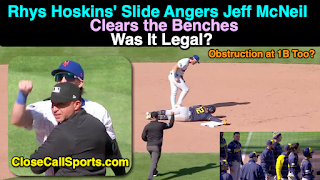
Hoskins' Slide Into McNeil & Obstruction Play at 1B

Following a look at whether Brewers 1B Rhys Hoskins' block of Mets runner DJ Stewart was obstruction or not, we determine whether Hoskins' slide into Mets 2B Jeff McNeil satisfied the bona flide slide rule criteria relative to breaking up double play attempts. Of note, 2B Umpire Jonathan Parra made his MLB debut and was working his first major league game when the benches cleared as a result of Hoskins' slide and McNeil's reaction.

Obstruction: In the bottom of the 2nd inning, Brewers catcher William Contreras threw to first base in an attempt to pickoff Mets baserunner R1 Stewart, with Milwaukee 1B Hoskins receiving the throw and appearing to place his left leg into runner Stewart's path, effectively blocking his access to first base. 1B Umpire Lance Barrett called the runner out, effectively no-calling potential obstruction as the retired runner complained that Hoskins was blocking the bag.

Defined as "the act of a fielder who, while not in possession of the ball and not in the act of fielding the ball, impedes the progress of any runner," the new obstruction point of emphasis instructs umpires to call obstruction as in Official Baseball Rule 6.01(h)(1) or Type A when a fielder blocks the runner's path without possession of the ball unnecessarily, even if the fielder is in the act of fielding at the time.

The goal is to crack down on fielders using the "act of fielding" defense to blatantly block runners' base paths when they distinctly do not need to occupy that space to receive the throw.

Bona Fide Slide: In the top of the 8th inning, Brewers baserunner R1 Hoskins slid into second base on an infield ground ball and potential double play attempt. Hoskins slid through the base, but was able to keep his hand in contact with the second base bag, making contact with Mets 2B McNeil in the process, who took exception and whose reaction spurred both benches to briefly clear.

After Replay Review, the Mets' challenge that Hoskins' slide was illegal was denied and the original call by 2B Umpire Parra of out and no slide violation was confirmed.

The four criteria of a bona fide slide, as in OBR 6.01(j), are 1) begins the slide before reaching the base, 2) able and attempts to reach the base, 3) able and attempts to remain on the base, and 4) slides within reach of the base without changing pathway for the purpose of initiating contact with a fielder.

Replay conclusively determined that R1 Hoskins satisfied all four criteria and, thus, engaged in a legal, bona fide slide.

Note that in college and high school, Hoskins' slide may have violated the force play slide rule (FPSR doesn't exist in pro ball), given that Hoskins' failed to slide in a direct line between the two bases. NCAA Rule 8-4 governs FPSR cases and holds that "the runner’s entire body (feet, legs, trunk and arms) must stay in a straight line between the bases."


Video as follows:

Friday, March 22, 2024

Lindor Called for Obstruction After Base Blocking

As Mets shortstop Francisco Lindor appeared to tag out Tigers baserunner Carson Kelly on a stolen base attempt, 2B Umpire Brennan Miller called the New York fielder for obstruction pursuant to MLB's new point of emphasis concerning base blocking, declaring Kelly safe at second due to the violation.

Official Baseball Rule 6.01(h)(1) itself has not changed and obstruction is still defined as "the act of a fielder who, while not in possession of the ball and not in the act of fielding the ball, impedes the progress of any runner."

However, the primary focus of the new emphasis appears to be fielders blocking runners on pickoffs and steals (or any time a play is being made at a base).

Major League Baseball seems concerned that infielders have used the "in the act of fielding the ball" exemption to the obstruction rule as an excuse to illegally block the offense from reaching a base, by sticking a leg, knee, or foot in the runner's way, and has adopted a stance on OBR 6.01(h)(1) similar in theory to the existing standard for home plate collisions in OBR 6.01(i)(2), which prohibit a catcher from blocking the pathway of the runner—even when in the act of fielding—unless the catcher is blocking the runner's path "in a legitimate attempt to field the throw."

Video as follows: