Showing posts with label Stadium Boundary. Show all posts

Friday, March 3, 2023

Orioles Runner, Awarded 3rd, Called Out at 2nd on Appeal

Despite Orioles runner Maverick Handley being awarded third base on a ball out of play, Pittsburgh nonetheless retired him at second for an inning-ending Spring Training double play. How can an umpire call a runner out despite a base award? Article:

With one out and one on (R2 Handley), Orioles batter Robert Neustrom hits a fly ball into foul territory, near the first base dugout. Pirates catcher Jason Delay catches the ball before stepping into the dugout (the second step [step below dugout lip] is considered “into the dugout”). HP Umpire Derek Thomas declares Neustrom out on the catch and calls “Time” to award R2 Handley third base on the catch-and-carry into dead ball territory.

This is a legal catch pursuant to Official Baseball Rule 5.09(a)(1) Comment: "A fielder may reach into, but not step into, a dugout to make a catch, and if they hold the ball, the catch shall be allowed. A fielder, in order to make a catch on a foul ball nearing a dugout or other out-of-play area (such as the stands), must have one or both feet on or over the playing surface (including the lip of the dugout) and neither foot on the ground inside the dugout or in any other out-of-play area."

When the ball is put back into play, Pirates pitcher Kyle Nicolas throws to second baseman Nick Gonzalez, who steps on second base to appeal that R2 Handley failed to retouch second base after catcher Delay’s catch. 2B Umpire and Crew Chief Chad Fairchild affirms the appeal and calls Handley out to end the inning.

The Official Baseball Rules state that a runner must fulfill their base running responsibilities—including base touches [and retouches]—even when they are awarded bases and the ball has become dead…otherwise they may be appealed on and declared out for failing to touch a base.

For reference, OBR 5.06(b)(3) states, "Each runner, other than the batter, may without liability to be put out, advance one base when—A fielder, after catching a fly ball, steps or falls into any out-of-play area" while 5.06(b)(3)(C) Comment states, "If a fielder, after having made a legal catch, should step or fall into any out-of-play area, the ball is dead and each runner shall advance one base, without liability to be put out, from their last legally touched base at the time the fielder entered such out-of-play area."

(Think, for instance, about a home run hit out of the playing field. This is technically a four-base award, but the batter and any runners must touch all bases in order before scoring, even though the ball has become dead and they have been awarded bases.)

Tuesday, December 27, 2022

Correcting Broadcast Blasphemy in Runner Placement Play

When Dodgers broadcasters Joe Davis and Orel Hershiser incorrectly stated that the base award for a thrown ball bouncing out of play is based on the batter-runner's location at the time of the ball leaving the field (in this case, bouncing into and out of the Dodger Stadium camera well), Tmac decided to correct the record.

Official Baseball Rule 5.06(b)(4)(G) states that a runner advances two bases from their position *at the time the wild throw is made."* In turn, because R1 Kris Bryant was located between second and third base (having passed second base) at the time of the wild throw, his two-base award takes him to third base and to home plate, scoring a run.

The umpires initially ruled that Rockies batter-runner Brendan Rodgers had not yet arrived at first base when center fielder Cody Bellinger released his throw, resulting in a Rockies challenge for runner placement, a call that was confirmed as the Replay Official conclusively determined that batter-runner Rodgers was indeed somewhere between home plate and first base at the time of the throw, confirming the on-field umpires' ruling and making Rodgers' two-base award first base and second base.

*Please note there are limited exceptions to this rule, but none of them award bases based upon the runner's position at the time the ball left the playing field. The main exception pertains to a ball thrown out of play by an infielder on the fielder's first play (usually on a ground ball). In such a case, the runners are awarded two bases based on their positions at the time of the pitch.

Video as follows:

Saturday, October 15, 2022

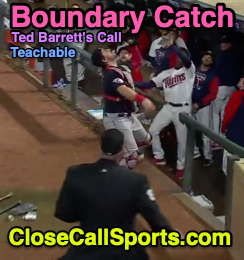
Teachable - A Boundary for Barrett - Catch Considerations

For this Teachable Moment, tmac highlights HP Umpire Ted Barrett officiating a catch play near the dugout boundary on a foul fly ball to Cleveland catcher Austin Hedges during a game vs Minnesota. There are a few considerations for a pop fly hit back to the screen, and tmac reviews them here.

Upon Twins batter Max Kepler making contact with the baseball, Barrett's first move is to watch catcher Hedges—Barrett needs to clear the catcher, or move out of the catcher's way as Hedges is glancing skyward for the ball; thus, Barrett keeps an eye on the catcher before looking for the ball since the catcher's eyes will communicate where the ball might be.

After clearing the catcher, Hedges runs toward the first-base dugout and Barrett pursues, ready to open the gate by matching Hedges' movements with corresponding position adjustments in order to attain a keyhole angle to see a potential catch or boundary issue. Speaking of this boundary issue, HP Umpire Barrett must find a position near the fence-line to rule on various aspects of this play such as: did the fielder catch the ball before or after stepping or falling into dead ball territory (also see Rule 5.06(b)(3)(C) for "Catch & Carry"), did the ball scrape the protective netting behind home plate, etc.

This play was reviewed and upheld as a legal catch | Video as follows:

Monday, September 19, 2022

Field of Dreams HR or Corn Catch? Rules Analysis

The Field of Dreams college baseball game between Luther College and Briar Cliff featured a 1st inning home run into the corn field by Cam Reimer, although outfielder Cullen Stamp dove/tripped/fell into the corn trying to catch the fly ball. Rules regarding ballpark design help us in our quest to answer the question of what umpires would have called had Stamp successfully caught the baseball.

Official Baseball Rule 2.01 is called Layout of the Field and specifies that "the distance from home base to the nearest fence, stand, or other obstruction on fair territory shall be 250 feet or more." Although the distance provision of this rule didn't always exist (it was put into the book primarily to account for some bizarre dimensions the Dodgers encountered when playing at the Los Angeles Memorial Coliseum their first few years in California), the general gist is expanded upon in Rule 5.06(b)(4) regarding base awards and baseballs leaving the playing field in flight.

Although no solid fence-line exists at the Field of Dreams ballpark in Iowa, the manicured corn-line serves as an adequate boundary to mark in and out of play territory. Accordingly, had the fielder caught the ball while in the air, having last touched in-play territory, this would be a catch, and if the fielder then fell into the corn, it would be a catch-and-carry situation (dead ball, out stands, runners advance one base, if there are runners). However, if the fielder were to catch the ball only after stepping into the corn field, this would not be a valid catch. We also discuss the issue of a stadium lighting pole in live ball territory, akin (in a sense) to the flagpole formerly of Tal's Hill in Houston (MLB).

Video as follows:

Thursday, August 4, 2022

MLB Ejection 119 - Bill Welke (3; Alex Cora)

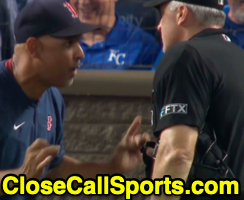
HP Umpire Bill Welke ejected Red Sox manager Alex Cora (Replay Review decision that upheld HR [out of play fair ball] call by 3B Umpire Gabe Morales; QOCN) in the bottom of the 7th inning of the #RedSox-#Royals game. With none out and two on, Royals batter Salvador Perez hit a 0-0 fastball from Red Sox pitcher Darwinzon Hernandez on a line drive to left field, ruled a home run by 3B umpire Gabe Morales and upheld as such following a challenge by Red Sox manager Cora. Replays indicate the batted ball struck the top corner of the outfield wall/padding adjacent to the foul pole but did not make contact with the foul pole above the fence-line before rebounding into the field of play, the call was incorrect.* At the time of the ejection, the Royals were leading, 7-3. The Royals ultimately won the contest, 7-3.

This is Bill Welke (3)'s 3rd ejection of 2022.
Bill Welke now has -2 points in the UEFL Standings (0 Previous + 2 MLB - 4 Incorrect Call = -2).
Crew Chief Bill Welke now has 1 point in Crew Division (1 Previous + 0 Incorrect Call = 1).
*The Kauffman Stadium Ground Rules provide that a "batted ball in flight that strikes any portion of the seating area safety fencing, including the railings," shall be considered in play similar to a ball striking the top of an outfield wall. If the ball then bounds over the outfield wall and out of play, it is a home run. If it bounds back onto the playing field, it is considered in play. A ball striking a foul pole below the fence-line shall be considered in play, similar to a ball hitting off the outfield wall.
Pursuant to the universal ground rules, "all yellow lines are in play."

This is the 119th ejection report of the 2022 MLB regular season.
This is the 64th manager ejection of 2022.
This is Boston's 4th ejection of 2022, 3rd in the AL East (NYY, TOR 8; BOS 4; BAL, TB 3).
This is Alex Cora's 3rd ejection of 2022, 1st since May 11 (Adam Beck; QOC = N [Balls/Strikes]).
This is Bill Welke's 3rd ejection of 2022, 1st since May 22 (Kevin Cash; QOC = Y [Balls/Strikes]).

Wrap: Boston Red Sox vs. Kansas City Royals, 8/4/22 | Video as follows:

Sunday, July 31, 2022

MLB Ejection 113 - Jerry Layne (2; Bob Melvin)

1B Umpire Jerry Layne ejected Padres manager Bob Melvin (Replay Review decision that overturned Layne's out [catch] call to safe [foul ball]) in the top of the 5th inning of the #Twins-#Padres game. With two out and two on, Twins batter Byron Buxton hit a 0-0 sinker from Padres pitcher Sean Manaea in the air along the right field fence-line in foul territory, where it was gloved by Padres first baseman Eric Hosmer, ruled a catch and air out by 1B Umpire Layne. Upon Replay Review as the result of a challenge by Twins manager Rocco Baldelli, the call was overturned to a foul ball, with the Replay Official ruling that the batted ball made contact with the protective netting prior to settling into Hosmer's glove. Replays indicate the ball appeared to change direction during its descent, indicative of contact with the net, the call was correct. At the time of the ejection, the game was tied, 1-1. The Padres ultimately won the contest, 3-2.

This is Jerry Layne (24)'s 2nd ejection of 2022.
Jerry Layne now has 9 points in the UEFL Standings (5 Previous + 2 MLB + 2 Correct Call = 9).
Crew Chief Jerry Layne now has 5 points in Crew Division (4 Previous + 1 Correct Call = 5).

This is the 113th ejection report of the 2022 MLB regular season.
This is the 60th manager ejection of 2022.
This is San Diego's 4th ejection of 2022, 1st in the NL West (SD 4; ARI 3; SF 2; COL, LAD 1).
This is Bob Melvin's 3rd ejection of 2022, 1st since May 31 (Chris Segal; QOC = Y [Balls/Strikes]).
This is Jerry Layne's 2nd ejection of 2022, 1st since July 14 (Dillon Lawson; QOC = Y [Balls/Strikes]).

Wrap: Minnesota Twins vs. San Diego Padres, 7/31/22 | Video as follows:

Saturday, June 5, 2021

Canada Protests HR vs 2B Runner Placement vs USA After Batted Ball Sticks to Top of Wall

Team Canada filed a protest with WBSC officials after USA batter Triston Casas' fly ball to right field, originally ruled a home run and reversed to a double on replay, resulted in baserunner R1 Logan Forsythe being allowed to score from first base despite Casas' two-base award.

Play: With one out and one on (R1), batter Casas hit a fly ball to deep right center, ruled a home run by 1B Umpire Ramiro Alfaro. Upon Replay Review, the call was overturned to a double, but the Replay Official placed Forsythe at home plate, ruling he would have achieved three bases had the original call been a live ball.

Team Canada protested the game, resulting in a significant delay as WBSC officials and three umpires left the field and returned, denying Canada's protest and ruling that Forsythe would be allowed to score.

Rule
: The relevant rule is OBR 5.06(b)(4)(F) which grants runners two bases if a ball "sticks in such fence, scoreboard, shrubbery or vines." The question of what "sticks" means is valid, as is the correct observation that no ball stuck in a fence: it was on top of the wall. For this, we consult the relevant MLB Umpire Manual interpretation, which states, "A fair fly ball striking the top of the outfield wall and remaining on the top of the wall shall be deemed a ground-rule double."

In other words, a ball that comes to rest on top of the wall is deemed a ground-rule double. As long as the ball continues moving, it is live and in play, but when it stops, untouched, it results in two bases.

Analysis: In the 9th inning, the English-language broadcast communicated a statement purportedly offered by the WBSC regarding the play in which officials purportedly claimed that the ball was still alive by virtue of Canada right fielder Jesse Hodges playing it; had Hodges put his hands up or otherwise not retrieved the ball, the argument goes, it would have resulted in a dead ball, two-base award for all runners.

The broadcast continued, reasoning that the Replay Official awarded R1 Forsythe home plate because had the correct call been made and play not declared dead, Forsythe would not have remained at third base, as replays indicate he did.

Gil's Call
: First and foremost, as we'll discuss momentarily in the following section, Replay Review's availability has changed the way stuck/lodged/coming to rest plays are officiated. In Replay games, it does not matter whether the fielder plays the ball or not: the Replay Official can and has determined the ball is dead by virtue of being "stuck" regardless of the fielder's actions after the ball has come to rest.

Second, the logic with USA R1 Forsythe vs Canada F9 Hodges is inconsistent. How come Forsythe gets the benefit of the doubt regarding the dead ball call yet Hodges does not (simply because Hodges' back is turned?)? Forsythe's actions after the umpire declares the ball dead—remaining at third base—are disregarded by the Replay Official, but Hodges' actions in playing the ball (which, again, does not matter in a Replay game when determining whether the ball has come to rest atop the outfield wall) are key to the Replay Official's determination that the ball is live.

Either we disregard everything that happens after the ball became dead—Forsythe's baserunning and Hodges' fielding—or we account for all of it.

Past Practice and Precedent: One additional clue is how MLB began handling the issue of balls sticking in or under outfield fences in the wake of replay's expansion. Umpire Mike DiMuro, in 2016, summed up MLB's historical way of treating potential stuck balls: "Ultimately, the proper ruling must be made by the base umpire who is responsible for the flight of the ball – and it is only possible to do so by running out to the fence to visually discern and confirm that the ball is indeed lodged or stuck. If the fielder dislodges the ball by grabbing it and removing it, then it can no longer be considered lodged or stuck."

In games without replay, this logic still prevails: if an umpire cannot discern whether or not a ball is stuck prior to a fielder playing it, the umpire has little choice but to keep play alive.

However, when MLB adopted expanded replay and made stadium boundary calls reviewable, it changed how this play was officiated via video: the Replay Official was now able to determine that a ball was stuck the moment it came to rest in or under a wall, whether or not the fielder raised their arms or played the ball. For instance, in 2016, we saw a slew of stuck/lodged ball calls via Replay Review, even when the fielder played the ball—or the ball didn't appear "stuck-stuck," but just "at rest" or immobile. Thus, we were treated to MLB's new standard: a ball at the wall that comes to rest in or under (or on top of) said wall is now deemed "stuck."
Related PostCause You're Stuck in the Wall - Batted Ball Out of Play (9/20/16).

Video as follows:

Wednesday, April 7, 2021

A Pesky Corner at Fenway Park & Fan Interference

Rays right fielder Randy Arozarena's apparent catch of Red Sox batter JD Martinez' fly ball at Fenway Park turned into a simple foul ball as umpires ruled a fan, without interfering, had touched the ball near Pesky's Pole before Arozarena was able to secure it.

Originally ruled an out by 1B Umpire Jeremie Rehak, Replay Review overturned the call based on video evidence suggesting that the fan had touched the ball, which descended along the fence-line in the right field corner.

Thus, when Red Sox Manager Alex Cora challenged the call, umpires at Replay Review HQ in New York looked at two elements: First, did the fan actually touch the ball, and, second, did this touching constitute spectator interference or not?

With replays suggesting the fan did touch the ball, Replay turned to the question of where the fan touched the ball. Pursuant to the Official Baseball Rules' definition, "Spectator interference occurs when a spectator (or an object thrown by the spectator) hinders a player’s attempt to make a play on a live ball, by going onto the playing field, or reaching out of the stands and over the playing field."

Thus, because replays showed the fan/ball interaction likely occurred above the top of the wall or fully within the stands, the spectator interference criteria were not fulfilled and Crew Chief Dan Iassogna conveyed the proper ruling upon review: foul ball, considered dead once it touched a spectator in dead ball territory.

As for the top of the wall—a neutral zone of sorts which we know can be considered as part of live ball territory or dead ball territory (see the case of a batted fair ball that strikes the top of the wall and bounds back onto the playing field = live ball vs. a similar batted fair ball striking the top of the wall and bounding into the stands = home run)—the Definition of Terms for Foul [and Fair] Territory helps us by delineating how far, exactly, the playing field reaches to: "extended to the fence and perpendicularly upwards."

Accordingly, the fan either remaining fully within the stands or touching the ball on top of the wall has not interfered and, by virtue of touching the ball before Arozarena caught it, has caused the ball to become dead, resulting in the proper call of a foul ball and legal play.

Video as follows:

Sunday, August 16, 2020

MLB Ejections 19-20 - Timmons, Reyburn (2, 1; DET)

1B Umpire Tim Timmons ejected Tigers Manager Ron Gardenhire (stadium boundary/base award for ball stuck in wall; QOCY) in the bottom of the 3rd and HP Umpire DJ Reyburn ejected Tigers batter Cameron Maybin in the bottom of the 5th inning of the #Indians-#Tigers game. With two out and one on (R1), Tigers batter Jeimer Candelario hit a 2-2 fastball from Indians pitcher Adam Plutko on a line drive to right field, where the ball bounced stuck to the base of the outfield wall, ruled a stuck ball pursuant to Official Baseball Rule 5.06(b)(4)(F) by Timmons. Replays indicate the ball rolled to the wall and became stationary by the obstruction caused by the padding protruding from the wall and gap left between the base of the padding and dirt warning track, the call was correct.* Play was reviewed and affirmed by the UEFL Appeals Board, the call was correct. At the time of Gardenhire's ejection, the game was tied, 3-3.

In the 5th, with one out and two on (R1, R2), Maybin took a 0-1 slider from Indians pitcher Oliver Perez for a called first strike before grounding into an inning-ending double play. Replays indicate the pitch was located over the outer edge of home plate and below the hollow of the knee (px 0.88, pz 1.45 [sz_bot 1.68 / RAD 1.56 / MOE 1.48]), the call was incorrect.* At the time of Maybin's ejection, the game was tied, 4-4. The Indians ultimately won the contest, 8-5.

This is Tim Timmons (95)'s second ejection of 2020.
This is DJ Reyburn (17)'s first ejection of 2020.
Tim Timmons now has 8 points in the UEFL Standings (4 Prev + 2 MLB + 2 Correct Call = 8).
DJ Reyburn now has -2 points in the UEFL Standings (0 Prev + 2 MLB - 4 Incorrect Call = -2).
Crew Chief Laz Diaz now has 1 point in Crew Division (0 Previous + 1 QOCY + 0 QOCN = 1).
*Rule 5.06(b)(4)(F) states, "Each runner including the batter-runner may, without liability to be put out, advance—two bases, if a fair ball bounces or is deflected into the stands outside the first or third base foul lines; or if it goes through or under a field fence, or through or under a scoreboard, or through or under shrubbery or vines in the fence; or if it sticks in such fence, scoreboard, shrubbery or vines."
RelatedMLB Ejection 085 - Fieldin Culbreth (3; Bryan Price) (6/29/17).
RelatedCause You're Stuck in the Wall - Batted Ball Out of Play (9/20/16).

These are the 19th and 20th ejection reports of the 2020 MLB regular season.
This is the eighth Manager ejection of 2020.
This is the ninth player ejection of 2020. Prior to ejection, Maybin was 0-1 in the contest.
This is Detroit's 1/2nd ejection of 2020, 1st in the AL Central (DET 2; CLE, CWS, KC, MIN 0).
This is Ron Gardenhire's 1st ejection since August 19, 2019 (Alfonso Marquez; QOC = U [NEC]).
This is Tim Timmons' 2nd ejection of 2020, 1st since Aug 12 (Willson Contreras; QOC = Y [Check Swing]).

Wrap: Cleveland Indians vs. Detroit Tigers, 8/16/20 | Video as follows:

Monday, April 16, 2018

Replay Rewind - Arizona's Lost HR & CIN's Bunt for Two

Welcome to Replay Rewind, a look back at some notable video reviews in baseball. In this inaugural edition, Arizona loses a home run due to a base-running blunder and Cincinnati earns a two-base bunt.

Marrero briefly runs past the entirety of Avila.
R-111 (Passing Runners; Overturned): Saturday night at Dodger Stadium, Diamondbacks batter Deven Marrero blasted Dodgers starter Rich Hill's 75th pitch of the ballgame over the left-center field wall for a three-run home run, scoring runners from first and second base. With baserunner R1 Alex Avila retreating toward first base for a potential tag-up play with one out as batter-runner Marrero rounded the bag, Dodgers Manager Dave Roberts elected to challenge the umpires' ruling that Marrero did not pass Avila.

Replay HQ cited the accompanying image, captured from the center field camera, as its Definitive Angle in opting to overturn the umpires' ruling that the BR Marrero did not pass R1 Avila. Thus, Marrero was declared out and his run nullified, for a two-RBI single. No matter, Arizona still won the game in blowout fashion.

Gibson sees the ball, but not the baserunners.
What's odd about this play is Arizona broadcaster Steve Berthiume's observation that 2B Umpire Brian Gorman (and not the first base umpire) signaled the BR/R1 interaction as legal, that 1B Umpire Tripp Gibson appeared to be the only umpire to significantly move during this play (3B Umpire Dan Iassogna appeared to have never left the infield dirt), and that no umpire saw the interaction around first base (replays indicate Gibson, for instance, was looking in the opposite direction as Marrero rounded first base).

In the end, R-111 reads "Passing, 73 Gibson, R-QOCN."

See the following Case Play for more about the rule regarding a trailing runner passing a predecessor.
Related PostCase Play 2016-11 - Time to Pass a Runner [Solved] (9/16/16).

A poor throw leads to a boundary replay.
R-127 (In Play/Out of Play; Overturned): Sunday in Cincinnati, Reds batter Tucker Barnhart bunted to Cardinals third baseman Greg Garcia, who threw to first baseman Jose Martinez as Barnhart arrived at first base. Garcia's throw was into the batter-runner, bounced off Barnhart, and caromed toward the end of the first-base dugout. Replays indicate BR Barnhart prematurely exited the 45-foot runner's lane, and was on the grass when he was struck by the throw, appearing to block first baseman Martinez from his attempted catch; however, HP Umpire Alan Porter declined to rule interference because Garcia's throw was of poor quality. As the Wendelstedt manual would put it, Garcia's throw could not reasonably retire Barnhart, and for that reason, runner's lane interference was not called.

With RLI out of the picture, offensive manager Bryan Price challenged HP Umpire Porter's ruling that the ball was in play. This is a difficult get for the plate umpire if for no other reason than Porter was on the foul line ruling on Barnart's legality at the time of the potential stadium boundary issue. The Replay Official thus overturned Porter based on the finding that the ball hit an object inside the camera well before bounding back onto the playing field; RLI, obviously, is not reviewable.

Mike Scioscia tried protesting a game based on an RLI no-call in 2016; naturally, MLB denied it.
Related PostAngels Protest Cuzzi RLI No-Call in Kansas City [Denied] (7/27/16).

See the following analyses regarding batter-runner positioning and potential RLI interference.
Related PostRunning Lane Interference and Advancing to 1st Base (9/6/15).
Related PostRunner's Lane Interference Plagues Chicago's Heyward (5/24/17).

Videos as follows:

Saturday, April 14, 2018

The Tarp Lodge - A Ball Still Moving Cannot Be Stuck

A Boston blooper turned into a Baltimore blunder Friday at Fenway Park when Orioles batter Adam Jones' pop-fly in shallow right field fell onto the field's tarp, setting up a challenge to determine whether the ball was stuck, lodged, or free, as Red Sox RF Mookie Betts threw out a jogging Jones, who had eased up, assuming the ball was out of play.

Replay Review: O's Manager Buck Showalter challenged 1B Umpire Stu Scheurwater's ruling that the baseball was live and in play along the right field wall.

Analysis: When Jones' batted ball bounced from fair territory to the LL Bean tarp along the right field fence-line, many of those on the playing field—including Jones—likely lost sight of the ball as it dropped behind the apex of the tarp. Official Baseball Rule 5.05(a)(7) states that the batter becomes a runner when, among others:
Any fair ball which, either before or after touching the ground, passes through or under a fence, or through or under a scoreboard, or through any opening in the fence or scoreboard, or through or under shrubbery, or vines on the fence, or which sticks in a fence or scoreboard, in which case the batter and the runners shall be entitled to two bases.
Rule 5.06(b)(4)(F) is the equivalent for runners ("...Two bases, if a fair ball bounces or is deflected into the stands outside the first or third base foul lines; or if it goes through or under a field fence, or through or under a scoreboard, or through or under shrubbery or vines on the fence; or if it sticks in such fence, scoreboard, shrubbery or vines").

Is this ball stuck behind the tarp?
When it comes to tarps, the Universal Ground Rules simply states, "A catch may be made on the field tarp." Fortunately the MLB Umpire Manual helps further establish that Rule 5.06(b)(4)(F) applies to tarps: "A ball that goes behind a field tarp or wall padding without leaving the playing field should also be considered to be lodged and the same two base award applies. The determination of whether a ball is lodged is subject to Replay Review."

We usually see this with batted balls that roll to the outfield wall, when the question becomes whether or not the ball has become stuck in the small space formed by warning track, base of the wall, and bottom of the wall's padding, which generally protrudes several inches onto the playing field. Colloquially, as long as the ball indeed sticks underneath the padding, it is considered out of play. If the ball remains in motion or appears loose, it is considered in play simply because the ball has not yet proven itself to be "stuck" or otherwise out of play. For instance, a ball that rolls underneath wall padding, only to carom back onto the naked warning track is in play.
Related PostCause You're Stuck in the Wall - Batted Ball Out of Play (9/20/16).

Cederstrom & Scheurwater await a decision.
Back to Fenway, the potential lodge location is created by the curved tarp and vertical padded wall: as long as the ball is moving and accessible to the fielder, it is live and in play; when it comes to rest, it may be deemed "stuck" and out of play.

Here is some support from MLBUM, regarding its interpretation of batted balls that land on top of outfield walls—not directly applicable, but the interp gives an idea of how motion influences a ball's status: "A fair fly ball striking the top of the outfield wall and remaining on the top of the wall shall be deemed a ground-rule double...A fair fly ball that strikes the top of the outfield wall and is picked up by a spectator while still in motion shall be ruled a home run. A fair fly ball that lands on top of the outfield wall and is picked up by a spectator after coming to a stop shall be deemed a ground-rule double."
Related Post: Replay Review, Ground Rules, and Levi's Landing (9/1/17).

Hidden from view, this ball is not dead yet.
Conclusion: As long as the ball is still in motion and accessible to a fielder, it is alive and in play, if for no other reason than it is not yet dead; once the ball stops moving, it is subject to remedial action, such as Rule 5.06(b)(4)(F), and a two-base award from time-of-pitch would be appropriate.

As umpire Mike DiMuro once said, "Ultimately, the proper ruling must be made by the base umpire who is responsible for the flight of the ball – and it is only possible to do so by running out to the fence to visually discern and confirm that the ball is indeed lodged or stuck. If the fielder dislodges the ball by grabbing it and removing it, then it can no longer be considered lodged or stuck."

Because of Betts' speed in retrieving the baseball, however, it is difficult even with instant replay to determine whether the ball came to rest—whether it was truly stuck behind the tarp. The Replay Official, faced with this inconclusive evidence, ruled that the call should stand: Jones is credited with a single and Betts with a 9-6 putout.

That said, if Betts' arrival to the ball is a split second later, perhaps the evidence would then be clear and convincing that the ball, indeed, was "stuck." | Video as follows:

Friday, March 16, 2018

Going Out - When a Wall is Potentially Trouble

A seemingly standard Spring Training play turned troublesome when Boston baserunner Hanley Ramirez returned to third base after appearing to score a run against Toronto on JD Martinez's double to the wall at JetBlue Park (aka Fenway South). With replays indicating the ball appeared to bounce off the base of the wall before being scooped up by Blue Jays left fielder Teoscar Hernandez, as opposed to becoming stuck in the wall, what happened to send Hanley back to third?

The Play: With none out and Hanley Ramirez at first base (R1), Martinez hit a line drive down the left-field line, bounding to and off the wall for a double, where it was fielded by Hernandez as Ramirez touched home plate. After the play, Ramirez returned to third base. According to BoSox official scorer Justin Long's report, Martinez was credited with a ground-rule double to left.

The Rule: To clarify, there are no stadium-specific ground rules that would cause a ball to become dead if it caroms off an in-play wall and bounces or rolls back onto the playing field, so the "ground rule double" label is a misnomer.

Instead, consider Official Baseball Rule 5.06(b)(4)(F): "Each runner including the batter-runner may, without liability to be put out [the ball is dead], advance—Two bases, if a fair ball bounces or is deflected into the stands outside the first or third base foul lines; or if it goes through or under a field fence, or through or under a scoreboard, or through or under shrubbery or vines on the fence; or if it sticks in such fence, scoreboard, shrubbery or vines."

For more on this rule, seeCause You're Stuck in the Wall - Batted Ball Out of Play (9/20/16).

Is this uncatchable line drive trouble or not?
Analysis: Replays indicate the ball did not fall out of play nor stick in the fence, but if any rule were to justify bringing R1 back to third base, it would be 5.06(b)(4)(F).

The bigger officiating question, naturally—and assuming that Ramirez didn't return to third base on his own volition—is why 3B Umpire Tim Timmons did not go out with the ball if it could potentially cause trouble by virtue of the stuck vs. loose debate. Does that qualify as "trouble" or is this non-catchable line drive a run-of-the-mill batted ball that merits no special attention; when should a field umpire go out?

Officiating Mechanics for the Four-Umpire System: With a runner on first base only and the second base umpire positioned inside, the first and third base umpires share responsibility for the entire outfield area. For a ball hit to left field, the third base umpire assumes primary responsibility.

When the third base umpire goes out, the home plate umpire rotates to third base and the first base umpire goes home upon observing baserunner R1 commit to third. The second base umpire then assumes responsibility for R1 back into second, and for the batter-runner into second or back into first. The idea is that just about every permutation and base is covered, even with only three umpires in the infield. See the following video for a visual depiction of this.

Diagram of umpire rotation when U3 goes out.
According to MLBUM, "one umpire will go out on ALL fly balls and line drives to the outfield, as well as on all batted balls that have potential for trouble (out-of-play areas, spectator interference, etc.). Outfield coverage is not required on line drives in the gap that are immediately read as non-catchable and are not susceptible to trouble such as spectator interference or a ground-rule double."

For this play, Martinez's batted ball to left clearly was non-catchable, but was potentially susceptible to trouble, due to stadium boundary issue caused by the gap between the dirt warning track and base of padding along the left-field wall, and possibility that the baseball could become stuck in that area.

Colloquially, however, most umpires would read this as a non-trouble ball—especially in a two-person crew—and stay in the infield so as to ensure maximum coverage on the bases (or, a higher likelihood of a play being made on a runner at a base than whether a ball is or is not stuck in the outfield fence). Unfortunately, in this situation, and barring a supposition that Hanley returned to third on his own, staying in may have made the ball more troublesome than it actually was.

As we wrote in 2016, regarding the issue of stuck balls (Cause You're Stuck in the Wall):
To stick is "to remain persistently or permanently," or "to become fastened, hindered, checked, or stationary by some obstruction."
The only question to answer here, then, is whether the ball's motion or position completely stopped upon bouncing or rolling into the wall. Because it appears the ball bounced back onto the warning track after touching the wall, I would surmise the ball did not get stuck and play should be kept alive.

Video as follows:

Thursday, June 29, 2017

MLB Ejection 085 - Fieldin Culbreth (3; Bryan Price)

HP Umpire Fieldin Culbreth ejected Reds Manager Bryan Price (Replay Review, confirmed stadium boundary call; QOCY) in the top of the 3rd inning of the Brewers-Reds game. With two out and one on (R1), Brewers batter Jesus Aguilar hit a 0-0 fastball from Reds pitcher Homer Bailey on a fly ball to the base of the right field wall, where it was fielded by right fielder Arismendy Alcantara, ruled in play by 1B Umpire Mark Carlson, baserunner R1 Domingo Santana scoring. Upon Replay Review as the result of a Manager's Challenge by Price, Carlson's ruling was affirmed, replays indicate the ball first made contact with the outfield wall's padding before dropping to the ground; it did not stick nor pass through or under the fence and the outfield wall did not cause the ball to come to rest (see Related Post), the call was correct.* At the time of the ejection, the Brewers were leading, 4-0.

This is Fieldin Culbreth (25)'s first, second ejection of the 2017 MLB regular season.
Fieldin Culbreth now has 14 points in the UEFL Standings (10 Prev + 2 MLB + 2 Correct Call = 14).
Crew Chief Fieldin Culbreth now has 6 points in Crew Division (5 Previous + 1 Correct Call = 6).
*OBR 5.05(a)(7) states the batter becomes a runner when—"Any fair ball which, either before or after touching the ground, passes through or under a fence, or through or under a scoreboard, or through any opening in the fence or scoreboard, or through or under shrubbery, or vines on the fence, or which sticks in a fence or scoreboard, in which case the batter and the runners shall be entitled to two bases."
*OBR 5.06(b)(4)(F): "Each runner including the batter-runner may, without liability to be put out [the ball is dead], advance—Two bases, if a fair ball bounces or is deflected into the stands outside the first or third base foul lines; or if it goes through or under a field fence, or through or under a scoreboard, or through or under shrubbery or vines on the fence; or if it sticks in such fence, scoreboard, shrubbery or vines."
The MLB Umpire Manual uses the phrase "goes behind...wall padding" in regards to a lodged ball.
Related Post: Cause You're Stuck in a Wall - Batted Ball Out of Play (9/20/16).

This is the 85th ejection report of 2017.
This is the 45th Manager ejection of 2017.
This is Cincinnati's 2nd ejection of 2017, 4th in the NL Central (MIL, PIT, STL 3; CIN 2; CHC 1).
This is Bryan Price's 2nd ejection of 2017, 1st since June 17 (Stu Scheurwater; QOC = Y [Balls/Strikes]).
This is Fieldin Culbreth's 3rd ejection of 2017, 1st since June 3 (Brad Ausmus; QOC = Y [Replay Review]).

Wrap: Milwaukee Brewers vs. Cincinnati Reds, 6/29/17 | Video via "Read More"

Wednesday, May 17, 2017

Boundary Call - Spectator Interference vs Out of Play

A fielder reached into the stands to catch a foul fly ball, and ended up with a fan's hat in his glove alongside it. Today's lesson from the UEFL University concerns boundaries: specifically, what constitutes a legal catch, spectator interference, and a ball deemed out of play.

UEFL University
About the UEFL University: In conjunction with the UEFL Video Rulebook, the UEFL University is a perpetual work-in-progress educational program that discusses various Official Baseball Rules. Eventually, the various "Rules Reviews," "Video Analyses," and "Tmac's Teachable Moments" will be catalogued and organized by topic. For now, though, refer to the Labels system to browse for a specific rule or concept (e.g., the label "Umpire Interference" corresponds to all archived discussions concerning that concept).

The Play: With none out and none on, Indians batter Edwin Encarnacion hit a fly ball toward the boundary wall in foul territory beyond first base. Rays first baseman Logan Morrison prepared to field the descending fly ball, and reached into the stands in order to do so, ultimately catching both the baseball and a wayward Cleveland fan's hat in his glove as 1B Umpire Gabe Morales declared Encarnacion out on the catch.

Topic of Discussion: On such a boundary call, when is a ball considered live vs dead—in play vs out of play—a catch vs a foul ball—spectator (aka "fan") interference vs a no-call?

Fan interference only exists on/over the field.
Analysis: In order for spectator interference to occur, the following definition of spectator interference must be satisfied: "a spectator reaches out of the stands, or goes on the playing field, and (1) touches a live ball or (2) touches a player and hinders and attempt to make a play on a live ball." Furthermore, the spectator must reach beyond the plane of the field-facing front of the padded wall for interference to exist.

For ballpark security administrators considering whether or not to eject the fan pursuant to MLB and stadium regulations, note that a ball that sits atop a wall, or is touched by a spectator while over the flat portion of any boundary wall, is not spectator interference for the spectator is required to reach out of the stands and over the playing field's airspace for interference to exist. This type of a top-of-the-wall-touch is simply considered "out of play" (not interference). Think: tie goes to the fan.
Diagram of potential fan interference.

In other words, imagine that the field-facing plane of the wall extends infinitely to the sky. Fans are allowed to do nearly anything on their side of the extended plane, as long as they don't cross over into restricted airspace (see accompanying diagram from Game 2 of the 2013 Detroit-Boston ALCS).

The penalty for spectator interference is: "the ball shall be dead at the moment of interference and the umpire shall impose such penalties as in his opinion will nullify the act of interference. APPROVED RULING: If spectator interference clearly prevents a fielder from catching a fly ball, the umpire shall declare the batter out" (Rule 6.01(e)).

Bartman did not interfere, either.
Replays indicate fielder Morrison reached into the stands to attempt his catch (his arm, thus, left the airspace over the playing field), meaning that spectator interference does not apply: "No interference shall be allowed when a fielder reaches over a fence, railing, rope or into a stand to catch a ball. He does so at his own risk. However, should a spectator reach out on the playing field side of such fence, railing or rope, and plainly prevent the fielder from catching the ball, then the batsman should be called out for the spectator’s interference."

With the interference question solved, we turn to the definition of in- vs out-of-play: in this situation, what else could cause the ball to become dead?

Specifically, we're looking to answer the question of whether the ball simply touching a fan's person, clothing, or accessories over dead-ball-territory (aka out of play, the stands, etc.) is enough to kill the play.

The answer is "yes," and comes from Rule 6.01(e) Comment: "There is a difference between a ball which has been thrown or batted into the stands, touching a spectator thereby being out of play even though it rebounds onto the field and a spectator going onto the field or reaching over, under or through a barrier and touching a ball in play or touching or otherwise interfering with a player."

We're specifically isolating the portion of the rule that states, "...touching a spectator thereby being out of play..."As soon as a spectator or any other object (a chair, a bird, or even a fan's hat) touches or is touched by a ball on the dead-ball side of the demarcation or boundary line, the play is dead.

Morrison's glove catches two objects.
That said, it appears fielder Morrison was able to pocket the baseball on one side of his glove while gathering the fan's hat on the opposite side. But did the hat help Morrison hang onto the ball—what if it did?

Rule 5.09(a) specifies that a batter is out when: "his fair or foul fly ball (other than a foul tip) is legally caught by a fielder." The rule continues, "A catch is the act of a fielder in getting secure possession in his hand or glove of a ball in flight and firmly holding it; providing he does not use his cap, protector, pocket or any other part of his uniform in getting possession... In establishing the validity of the catch, the fielder shall hold the ball long enough to prove that he has complete control of the ball and that his release of the ball is voluntary and intentional."

Conclusion: As long as the fly ball did not touch the hat prior to the ball's entry into the glove, and, in the umpire's opinion, Morrison did not use the hat to gain possession of the ball, this is a legal catch. Naturally, if the ball touched the foreign cap prior to entering the glove—or assisted Morrison in getting possession after entry—this is not a legal catch, and, based on the preceding analysis, is not fan interference, either (it is simply "out of play"). That said, had this entire sequence occurred on the playing field side of the boundary wall, it would be subject to consideration of spectator interference and the corresponding penalty.

Video via "Read More"

Thursday, September 29, 2016

The Price is Wrong as Reds Fail to Replay Walk-Off 2B

A Cardinals' walk-off double stood when Cincinnati failed to timely challenge the game-ending play in St. Louis.

Diagram of Busch Stadium's left field wall.
With two outs and a runner on first base in the bottom of the 9th inning of a tied ballgame in St. Louis Thursday evening, Cardinals batter Yadier Molina hit a line drive to left field that bounced on the warning track before caroming up and off of the wall or recessed advertising panel in left field, ruled alive and in play by 3B Umpire Scott Barry, as baserunner R1 Matt Carpenter hustled around the from first base to score the game-winning run.

Busch Stadium ground rules address the top of the wall situation in left field, specifying that a batted ball in flight striking the top of the wall above the padding and rebounding onto the playing field shall be ruled in play. A ball in flight or otherwise that strikes beyond the top of the wall shall be ruled out of play.

St. Louis celebrates its walk-off win.
Thus, with regard to Molina's game-ending hit Thursday night, the bounding ball hitting the recessed advertising panel atop the padded wall, which is depicted on the right side of the above diagram, is to be considered out of play, whereas a ball that merely hits the top of the padded wall (as indicated by the teardrop marked "2") before rebounding onto the playing field is to be considered in play.

If the batted ball bounced out of play, pursuant to Rule 5.05(a), the proper award is two bases to both batter Molina and runner Carpenter, meaning he would be placed at third base. If the ball remained in play, the run obviously would count.

In other words, this was a crucial game-ending call that Cincinnati had nothing to lose by challenging.

Yet they failed to challenge the play. By the time Reds Manager Bryan Price sought out HP Umpire and Crew Chief Bill Miller to request a Replay Review, the umpires had already left the playing field.

Pursuant to Replay Regulation II.D.1 (Timing of Manager Challenges and Crew Chief Reviews), "A challenge to a play that ends the game must be invoked immediately upon the conclusion of the play, and both Clubs shall remain in their dugouts until the Replay Official issues his decision."

Replays indicate that nearly 30 seconds transpired from the conclusion of the game-ending play and Price's departure from the dugout to seek out an umpire. In other words, he was too late: the umpires had already left the field, and were under no obligation to entertain the manager's delay (furthermore, entertaining Price's challenge after such a delay would run afoul of II.D.1).

Price blamed MLB's rule for his non-challenge.
In post-game comments to the press, Price explained that his team was allotted 10 seconds to decide whether or not to challenge the play, and that he felt 10 seconds was insufficient to make such a determination: Price stated that his team did not have a real-time view of the play and, thus, didn't see it fall into dead ball territory. [NOTE: 10 seconds refers to a Manager's Challenge of a third-out play. As pertains to a game-ending "walk-off" situation, as well as a third-out Crew Chief Review, the Replay Regulation states the manager must leave the dugout to seek a challenge or request for review immediately after the conclusion of the play. "Immediately" may reasonably be interpreted as "10 seconds."]

Price also stated that a game with playoff implications should be treated more leniently in regards to the rule. While St. Louis has a chance to make the Wild Card, Price's Reds have been eliminated from playoff contention since earlier this season. Cincinnati's record as of Thursday night is 67-92.

In what may come as a shock to no one, Price in his comments displayed a lack of rules knowledge.

Unlike a potential Manager's Challenge that may occur at any other point during the game, wherein a manager might "hold" up play while he consults with his video coordinator, a challenge on the game's final play must be filed immediately, which leaves no time to internally review the play. Because Price failed to timely challenge Barry's "in play" call, the game was considered final the moment the final umpire exited the field and deemed Cincinnati had failed to immediately challenge the call.

In other words, the moment Price referenced a need to have more time to review the play and/or receive a phone call from the video room, his argument ran contrary to the spirit of immediately.

Managers have previously been ejected (Walt Weiss, by Jerry Layne, 6/17/15) and have even protested games (Joe Maddon, of Bob Davidson, 8/26/14) over complaints that the opposing manager took too long to request a Replay Review, suggesting there are at least a few skippers out there that have read the Replay Regulations well enough to at least have an inkling as to Replay Review timing. Perhaps had Miller honored Price's untimely challenge, Mike Matheny would have joined Weiss and Maddon in being ejected for or protesting the cause (in his own post-game presser, Matheny referenced the timely requirement in filing a challenge "immediately" after a game-ending play, indicating he knew of the rule). After all, the desire to win has always trumped fair play.

Tuesday, September 20, 2016

Cause You're Stuck in the Wall - Batted Ball Out of Play

When Replay Review overturned Joe West's ruling of a ball in play, Jeff Banister's ejection seemed a fairly expected outcome: it was a potentially game-altering sequence, after all.

This is a rules recap of the ball-in-a-wall play, like the one that got Banister tossed.

To begin, the relevant rule is OBR 5.06(b)(4)(F), which states, "Each runner including the batter-runner may, without liability to be put out [the ball is dead], advance—Two bases, if a fair ball bounces or is deflected into the stands outside the first or third base foul lines; or if it goes through or under a field fence, or through or under a scoreboard, or through or under shrubbery or vines on the fence; or if it sticks in such fence, scoreboard, shrubbery or vines."

The relevant action verbs or phrases are deflected, goes through or under, or sticks.

This fair ball has stuck in the fence.
In Texas, for instance, there was no deflection into foul territory, the ball didn't go through or under a fence per se, so the only question is whether or not it stuck in the outfield fence.

On-Field Ruling: 2B Umpire West, in accordance with umpiring philosophy when the action area is about 150-200 feet away from the umpire's position, kept the play alive, simply because he was not in a spot to definitively rule a dead ball (e.g., with a home run or foul ball into the stands, the umpire can call the ball out of play from 200 feet away since, in most cases it is obvious the ball is out of play).

In these types of situations, where the ball bounces or rolls underneath the padding along the outfield wall, answering whether the ball engaged in sticking there is not easily answered from such a distance. Thus, the play is properly kept alive until such time that the umpire can conclusively investigate the situation.

However, with baserunners continuing to run the bases, it can be hazardous for a fielder to stop playing and leave the defensive team's fate in the umpire's hands: thus, the outfielder may opt to retrieve the ball prior to the umpire's arrival, in order to make a play on the batter or runner. For instance, Braves LF Justin Upton opted to stop playing when a ball rolled and stuck underneath a fence's padding in 2014, resulting in an apparent inside-the-park home run when the offense kept running the bases. After the play, the Braves successfully challenged that the ball stuck in the fence, and the runners were sent back to their two-base awards.

MLB Umpire Mike DiMuro previously opined on the ball-sticks-in-wall rule and the complications that arise from an umpire being 200 feet away from the play: "Ultimately, the proper ruling must be made by the base umpire who is responsible for the flight of the ball – and it is only possible to do so by running out to the fence to visually discern and confirm that the ball is indeed lodged or stuck. If the fielder dislodges the ball by grabbing it and removing it, then it can no longer be considered lodged or stuck." Thus, the advent of Replay Review quite literally changed the game insofar as the stuck ball is concerned: the post-play ruling can be made instantaneously upon the ball coming to rest, whether or not the fielder plays the ball.

For instance, Greg Gibson in 2013 (prior to Replay) ruled a live ball (non-stuck) on a ball that rolled beneath a fence's padding, and was ultimately fielded by LF Dayan Viciedo. This was the proper call, as the ball appeared to follow a tract underneath the padding while remaining loose: the wall did not, for instance, cause it to immediately come to rest; it did not stick at the wall's base.

Myth & Fact: Though popular baseball folklore implies that the fielder's actions—in throwing his hands up to communicate his belief that the ball is out of play, or in attempting to play the resting baseball—dictate whether the ball is alive or dead, the fact of the matter is that these actions do not determine whether or not the ball has become "stuck." DiMuro's explanation, above, however, helps explain why this belief persists, but at the end of the day, it's simply a myth, especially in this world of Replay Review.

This ball is ruled "stuck" by New York
The umpire's only consideration is whether the ball has deflected (into the stands), gone through or under a boundary, or stuck in such boundary. While the fielder's conduct may help the umpire determine whether one of these acts has occurred, it is simply one piece of evidence in the umpire's checklist in determining the baseball's status: It is the ball, not the fielder, that determines if Rule 5.06(b)(4)(F) is to be invoked.

To stick is "to remain persistently or permanently," or "to become fastened, hindered, checked, or stationary by some obstruction." In Texas, the ball became stationary by the obstruction caused by the padding protruding from the fence, where it remained persistently until the fielder played it. Of note is that, after rolling into the wall, the ball appeared to spin on end, but was prevented from leaving the wall by the bottom of the padding (~:45 in the below video): this is the definition of a ball which is "stuck."

This ball is not stuck: it remains loose.
By contrast, Yoenis Cespedes opted not to play a ball that he felt was stuck in a wall during a Spring Training game, resulting in an inside-the-park home run after field umpire CB Bucknor confirmed that the ball was not stuck in the wall. Replays clearly indicated that the ball, similar to Greg Gibson's play in Chicago, had ample overhead clearance and was not being held in place by the combination of the ground and padding: it was loose and, therefore, not stuck.

Thus, when New York/Replay Review looks at such a play and observes the ball roll to the wall, where it "remains persistently" and "becomes hindered" or held in place by the ball-sized gap formed between the ground, fence, and padding (but NOT if the gap provides the ball with ample overhead clearance such that it remains loose), NY will rule the ball legally out of play pursuant to 5.06(b)(4)(F): A ruling that an on-field umpire 150+ feet away from the play does not have the timely luxury of comprehensively seeing.

Two solutions to resolve the confusion: (1) Extend the padding to the base of the wall or to another dimension the ball cannot roll underneath, or (2) Raise the padding to provide ample overhead clearance.

Monday, September 19, 2016

MLB Ejections 169-170 - Danley, West (1|6; TEX)

HP Umpire Kerwin Danley ejected Rangers 1B Mitch Moreland for arguing a strike three call in the bottom of the 4th and 2B Umpire Joe West ejected Rangers Manager Jeff Banister for arguing a Replay Review decision that overturned West's in play ruling in the top of the 6th inning of the Angels-Rangers game. In the 4th, with two out and one on, Moreland took a 0-2 slider from Angels pitcher Jhoulys Chacin for a called third strike. Replays indicate the pitch was located off the outer edge of home plate and thigh high (px -1.272, pz 2.871), the call was incorrect. In the 6th, with one out and none on, Angels batter Yunel Escobar hit a line drive to right-center field, that stuck into the bottom of the right-center outfield wall, before being played by the Rangers for a putout at third base, overturned as the result of a Replay Review and challenge by Angels Manager Mike Scioscia. Replays indicate the ball stuck underneath the outfield wall and that the outfielder was unable to free it cleanly as a result, the call was correct.* At the time of Moreland's ejection, the game was tied, 0-0. At the time of Banister's ejection, the Rangers were leading, 1-0. The Rangers ultimately won the contest, 3-2.

This is Kerwin Danley (44)'s first ejection of the 2016 MLB regular season.
This is Joe West (22)'s sixth ejection of the 2016 MLB regular season.
Kerwin Danley now has 0 points in UEFL Standings (2 Previous + 2 MLB - 4 Incorrect Call = 0).
Joe West now has 13 points in the UEFL Standings (9 Previous + 2 MLB + 2 Correct Call = 4).
Crew Chief Joe West now has 8 points in Crew Division (7 Previous + 0 Incorrect + 1 Correct = 8).
*Rule 5.06(b)(4)(F): "Each runner including the batter-runner may, without liability to be put out (the ball is dead), advance—Two bases, if a fair ball bounces or is deflected into the stands outside the first or third base foul lines; or if it goes through or under a field fence, or through or under a scoreboard, or through or under shrubbery or vines on the fence; or if it sticks in such fence, scoreboard, shrubbery or vines."
*Relevant Replay Review (Precedent): MLB Instant Replay Review 025: Marvin Hudson (01) [2014]

This is the 169th, 170th ejection report of the 2016 regular season.
This is the 79th player ejection of 2016. Prior to ejection, Moreland was 0-2 (SO) in the contest.
This is the 68th Manager ejection of 2016.
This is Texas' 5/6th ejection of 2016, T-2nd in the AL West (HOU 7; LAA, TEX 6; OAK 5; SEA 2).
This is Mitch Moreland's first career MLB ejection.
This is Jeff Banister's 2nd ejection of 2016, 1st since May 9 (Laz Diaz; QOC = N [Balls/Strikes]).
This is Kerwin Danley's first ejection since June 22, 2015 (Asdrubal Cabrera; QOC = Y [Balls/Strikes]).
This is Joe West's first ejection since September 12, 2016 (Joe Maddon; QOC = U [USC-NEC]).

Wrap: Los Angeles Angels of Anaheim vs. Texas Rangers, 9/19/16 | Video available via "read more."

Friday, July 4, 2014

MLB Instant Replay Review 650: Alan Porter (07)

Instant Replay Review overturned 3B Umpire Alan Porter's out (catch/in play [stadium boundary]) call in the bottom of the 9th inning of the Yankees-Twins game. With none out and none on, Twins batter Sam Fuld hit a 1-2 knuckle curve from Yankees pitcher David Robertson on a fly ball near the third base (visitor's) dugout, where third baseman Zelous Wheeler attempted to field the fly. Upon Replay Review as the result of a challenge by Twins Manager Ron Gardenhire, Porter's ruling was reversed, the call was incorrect. At the time of the review, the Yankees were leading, 6-5. The Yankees ultimately won the contest, 6-5.

This is Alan Porter (64)'s seventh Replay Review of the 2014 MLB Regular Season.
This is Crew Chief Joe West's 29th supervised Replay Review of the 2014 Season.

This is the 650th Instant Replay Review of the 2014 MLB Regular Season.
This is the Minnesota Twins' 21st Replay Review of 2014.
Umpires are now 336/650 (.517 Affirmation Rate) in Replay Reviews during the 2014 MLB season.

Wrap: New York Yankees vs. Minnesota Twins, 7/2/14
Video: Play overturned; Wheeler jumps to the dugout step below lip level, causing a dead ball (MIN)