You can't get much more Little League than this. Team Venezuela batter Deivis OrdoƱez, nickname Chicken Little, deployed a unique batting stance, crouching down so low that his knee-hollow and upper midpoint are just inches apart vertically.
So what is an umpire to do when such tomfoolery takes place at home plate?
Question: This Case Play has two parts. The first posits that the batter stands this way only for the first pitch of his at-bat and then reverts to a more traditional batting stance for the remainder of the game. How should an umpire officiate the first pitch of the plate appearance?
The second scenario is a bit more tricky. If the batter assumes this batting stance throughout the game, consistently entering a crouch this low for every pitch and remaining in this stance through swings and takes alike, how should an umpire call this batsman's strike zone? What would a computer K-Zone even look like here?
Answer: For part one, this is not the batter's usual stance for the batter is not prepared to swing at a pitched ball. As a result, the plate umpire shall best estimate where the batter's vertical strike zone would be if the batter were standing in a more natural manner. A more liberal interpretation of the zone may be appropriate.
For the second case, if the batter truly swings and hits from this severe crouching position, then this is indeed the batter's strike zone; perhaps a rules loophole, a batter may legally assume such a severe stance and have a strike zone adjudged based on this stance as long as it is in consistent use for every pitch and the batter legitimately swings and hits from this position. Don't punish an individual batter because that one person doesn't conform to the league average stance, but by the same token, that hitting stance best be consistent.
Gil's Call: I've never seen a batter successfully hit from this position (much less use that stance), but if someone comes along who can do it on a consistent basis, more power to that player. That said, if a plate umpire has ever seen this hypothetical batter swing or hit before, that'll make it quite simple to know whether the batter is attempting to manipulate the strike zone. Other opportunities to observe the batter's "true" strike zone include: batting practice, the on-deck circle, practice swings as the batter prepares to enter the box.
In Little League, if an umpire says in jest to a batter during a dead ball, "show me your home run swing," more than likely, the batter will revert to their "actual" hitting stance, at which point it will be evident whether the severe crouch is legitimate or not.
Official Baseball Rules Library
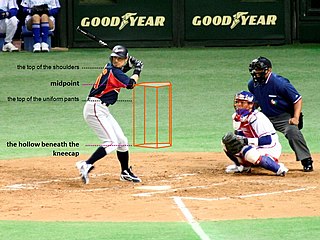
Definition of Terms: "The STRIKE ZONE is that area over home plate the upper limit of which is a horizontal line at the midpoint between the top of the shoulders and the top of the uniform pants, and the lower level is a line at the hollow beneath the kneecap. The Strike Zone shall be determined from the batter’s stance as the batter is prepared to swing at a pitched ball."
Video as follows:
Showing posts with label Rule 2.00 [Strike Zone]. Show all posts
Thursday, August 22, 2019
Friday, July 26, 2019
ALPB's Strike Zone Change & 1st ABS Call
The Atlantic League rolled out its Automated Ball-Strike System (ABS) to all teams on a full-time basis Thursday, marking the first day the electronic K-zone pitch calling tool will be used on a consistent basis in the ALPB. The league also changed the definition of the strike zone (well, the computer definition of the strike zone, anyway) and full-time ABS' first-ever pitch call on the first pitch of the first ABS game at High Point had an interesting visual translation.
Ball one indicated by the attached graphic ushered in a new era in professional baseball (I surmise the Atlantic League's prior ABS use was deemed irregular or somewhat of a beta test, whereas the league put out a press release announcing Thursday, July 25 as a "landmark day for the Atlantic League and professional baseball," according to ALPB President Rick White.
ALPB also apparently changed the strike zone, or at least its computer definition. According to a local reporter covering Lancaster, PA's team, under ABS, "vertically, a pitch has to be completely within the strikezone [sic] to be called a strike. Horizontally, a pitch only needs to be partially in the zone."
Ball one indicated by the attached graphic ushered in a new era in professional baseball (I surmise the Atlantic League's prior ABS use was deemed irregular or somewhat of a beta test, whereas the league put out a press release announcing Thursday, July 25 as a "landmark day for the Atlantic League and professional baseball," according to ALPB President Rick White.
ALPB also apparently changed the strike zone, or at least its computer definition. According to a local reporter covering Lancaster, PA's team, under ABS, "vertically, a pitch has to be completely within the strikezone [sic] to be called a strike. Horizontally, a pitch only needs to be partially in the zone."
Labels:
Articles
,
Atlantic League
,
Computer Strike Zone
,
Gil's Call
,
News
,
Rule 2.00 [Strike Zone]
,
UEFL
,
Umpire Odds/Ends
Thursday, July 11, 2019
Reviewing Atlantic League's Automated Strike Zone
The Atlantic League's official automated ball/strike system debut turned in a highlight reel performance when TrackMan's electronic umpire ruled a series of pitches depicted within the graphic K-zone as balls, despite the circular baseball graphics clearly appearing in the virtual box.
Officially a debut (though MLB/ALPB tested the electronic pitch tracker throughout the season's first half), Wednesday evening's Freedom-Liberty All-Star Game in York, PA made for a slightly different type of baseball game, with HP Umpire Brian deBrauwere's ball/strike calls a little more delayed than usual, generating some gems from the broadcast booth, such as, "First pitch to Ryan Dent is a little bit...not low."
According to one account, pitcher Daryl Thompson—who walked opposing batter Will Kengor on seven pitches, only one of which was outside of the computer-generated strike zone—actually began yelling at deBrauwere before he was informed (or reminded) that the robot umpire was to blame (Thompson then gave up a home run to ensuing batter Mike Ohlman on a 2-0 count after "ball two" was called on a pitch that the graphics indicated had half of the plate).
That means TrackMan disagreed with the computer's visual zone on four pitches over the course of two batters during Thompson's second-inning appearance, or on 4-of-6 pitches [an error/discrepancy rate of 67%].
Stats/Error Rate: Over the course of the entire game, 38 out of 101 callable pitches—nearly all of which were called balls—conflicted with the graphic depiction (37.6% error/discrepancy rate). Every inning had at least two such discrepancies, and there were several at-bats in which every pitch called during the at-bat disagreed with the graphic (visit the ALPB scoreboard page here if you'd like to verify for yourself).
The ALPB All-Star Game implementation of the automated ball/strike system (ABS) thus pitted public-facing gameday-style graphics that portrayed a series of pitches within the confines of the virtual strike zone against a robotic voice in deBrauwere's ear that continually uttered, "ball."
In short, red circles indicate strikes, green circles are called balls, and blue circles are balls put into play (batted balls). On more than a handful of occasions Wednesday night, a called ball appeared within or touching the virtual strike zone (recall that a strike is to be called " if any part of the ball passes through any part of the strike zone," such that a green circle that barely nicks the edge of the box is to be considered a strike).
This leads us to one of two possible conclusions: Either the graphics are incorrect or the computer has malfunctioned and failed to apply a proper algorithm or API.
Gil's Call: My wager would be on the former: the graphics don't agree with the ABS observed values, which suggests the graphic itself is incorrect. At the ALPB level, I can't say I'm surprised. Whether it's a deficient stat stringer or some other human operator error, a computer glitch, bug, or otherwise, suffice it to say, this is not what MLB wants to see.
The league's goal is to have the computer always agree with the graphic representation given to the public, so I am somewhat surprised that of all that could go wrong, this is the problem that appeared most prominently on Wednesday in York.
Then again, as Cardiff University Professor Harry Collins stated, "technology shouldn’t be presented as showing reality, when really it’s creating reality." Collins used the tennis match replay product Hawk-Eye as an example, pointing out that Hawk-Eye simply simulates an event rather than demonstrating reality: "it’s important for the public to know the difference between what they see on their screens and what’s constructed."
To fix the problem of visual discrepancy, MLBAM will have to tweak how the sport visually represents ABS; I have full confidence they can rectify the visual complication. My concern, however, is that in order to fix the graphics problem, the engineers in manipulating the graphics and/or data might get dangerously close to actually falsifying something (data, graphics, or both).
MLB Commissioner Rob Manfred has played both sides of the fence on the issue, admitting that, "that technology has a larger margin of error than we see with human umpires," while likewise acquiescing to a baseball audience hungry for a computerized strike zone: "We try to be responsive to those sorts of expressions of concern."
Related Post: Podcast - Truth About Baseball's Electronic Strike Zone (6/5/19).
Manfred also discussed the technology's development, and in doing so, revealed professional baseball's motivation for pressing on and why, as we alluded to in our Truth About Baseball's Electronic Strike Zone podcast, MLB can't afford to admit the true faulty nature of electronic pitch tracking: "We have spent a lot of time and money on the technology."
On a related note, I also wouldn't expect many complaints about TrackMan ABS for a solid year or so: fans and some players have been so passionate about getting an electronic strike zone that much like MLB, they can ill afford to complain about the tech once it debuts lest it turn into a "boy who cried wolf" scenario, especially after investing so many resources into campaigning for and implementing the computerized umpire concept.
The following video is a compilation of close/controversial ball/strike calls from 7/10/19:
Officially a debut (though MLB/ALPB tested the electronic pitch tracker throughout the season's first half), Wednesday evening's Freedom-Liberty All-Star Game in York, PA made for a slightly different type of baseball game, with HP Umpire Brian deBrauwere's ball/strike calls a little more delayed than usual, generating some gems from the broadcast booth, such as, "First pitch to Ryan Dent is a little bit...not low."
![]() |
| Thompson didn't like ball two. |
That means TrackMan disagreed with the computer's visual zone on four pitches over the course of two batters during Thompson's second-inning appearance, or on 4-of-6 pitches [an error/discrepancy rate of 67%].
Stats/Error Rate: Over the course of the entire game, 38 out of 101 callable pitches—nearly all of which were called balls—conflicted with the graphic depiction (37.6% error/discrepancy rate). Every inning had at least two such discrepancies, and there were several at-bats in which every pitch called during the at-bat disagreed with the graphic (visit the ALPB scoreboard page here if you'd like to verify for yourself).
The ALPB All-Star Game implementation of the automated ball/strike system (ABS) thus pitted public-facing gameday-style graphics that portrayed a series of pitches within the confines of the virtual strike zone against a robotic voice in deBrauwere's ear that continually uttered, "ball."
![]() |
| Visual depiction of a ball call within K-zone. |
This leads us to one of two possible conclusions: Either the graphics are incorrect or the computer has malfunctioned and failed to apply a proper algorithm or API.
![]() |
| HP umpire waiting to call as F2 throws to F1. |
The league's goal is to have the computer always agree with the graphic representation given to the public, so I am somewhat surprised that of all that could go wrong, this is the problem that appeared most prominently on Wednesday in York.
Then again, as Cardiff University Professor Harry Collins stated, "technology shouldn’t be presented as showing reality, when really it’s creating reality." Collins used the tennis match replay product Hawk-Eye as an example, pointing out that Hawk-Eye simply simulates an event rather than demonstrating reality: "it’s important for the public to know the difference between what they see on their screens and what’s constructed."
![]() |
| The pic-error issue is fixable, but is it honest? |
MLB Commissioner Rob Manfred has played both sides of the fence on the issue, admitting that, "that technology has a larger margin of error than we see with human umpires," while likewise acquiescing to a baseball audience hungry for a computerized strike zone: "We try to be responsive to those sorts of expressions of concern."
Related Post: Podcast - Truth About Baseball's Electronic Strike Zone (6/5/19).
![]() |
| Strike three call after ball returned to pitcher. |
On a related note, I also wouldn't expect many complaints about TrackMan ABS for a solid year or so: fans and some players have been so passionate about getting an electronic strike zone that much like MLB, they can ill afford to complain about the tech once it debuts lest it turn into a "boy who cried wolf" scenario, especially after investing so many resources into campaigning for and implementing the computerized umpire concept.
The following video is a compilation of close/controversial ball/strike calls from 7/10/19:
Labels:
Articles
,
Computer Strike Zone
,
Gil's Call
,
News
,
Rule 2.00 [Strike Zone]
,
UEFL
,
Umpire Odds/Ends
,
Video Analysis
Tuesday, January 29, 2019
Latin Ejection Lesson - Stay with the Pitch
A Serie Latinoamericana ejection that preceded Los Caimanes de Barranquilla (Colombia)'s comeback victory over Argentina's Falcones de Cordoba reminds us all to stick with the pitch and batter's strike zone as well. With one out and none on in the bottom of the 8th inning, Colombia batter Robinson Cabrera took a 1-2 pitch from Argentina pitcher Carlos Parra for a called third strike, Cabrera tagged out by catcher Omar Prieto after the uncaught third strike while arguing the call, having been ejected for spiking his helmet in protest. Shortly thereafter, Cabrera was joined by his manager and two base coaches in arguing with the home plate umpire. At the time of the ejection, Argentina was leading, 4-3. Colombia ultimately won the contest, 5-4.
With replays indicating Cabrera greatly reduced his stance height as the pitch crossed the plate (the pitch was above the hollow of the knee as it traversed the strike zone [see accompanying image with superimposed pitch trajectory]), let this Latin America ejection be a simple reminder to all: a batter dropping down to meet a perceivably low pitch increases the risk that the baseball will wind up at or above the knees, while an umpire must remain vigilant throughout the entire pitch in order to judge its location relative to the batter.
In the major leagues, HP Umpire Tim Timmons' 2013 ejection of Red Sox DH David Ortiz illustrates a similar principle (and another problem with the computerized zone on the vertical axis, but I digress). As Orioles pitcher Jairo Asencio delivered a 3-0 pitch to Ortiz, Big Papi gave up on the pitch, stood upright, and backed away from home plate as the baseball passed through. By maneuvering in this manner, Ortiz effectively increased the height of his strike zone, such that Asencio's pitch, which may have otherwise been too high had Ortiz remained in his stance, crossed home plate at the height of the standing Ortiz's belt (indicated by the graphic's red line). Timmons thus ruled the pitch a strike, Ortiz argued, ultimately struck out, and destroyed a Camden Yards dugout phone in anger, culminating in a most predictable ejection from MLB's then-biggest hothead player.
Related Post: MLB Ejection 105: Tim Timmons (5; David Ortiz) (7/28/13).
Related Post: Determining The League's Biggest Hothead (It's Big Papi) (6/11/15).
We recall that the vertical strike zone falls between "a horizontal line at the midpoint between the top of the shoulders and the top of the uniform pants, and the lower level is a line at the hollow beneath the kneecap."
It is determined from "the batter’s stance as the batter is prepared to swing at a pitched ball."
There is debate as to what this actually means, as in when exactly *the moment* occurs when the stance height shall be taken—or if it remains variable throughout the entire pitch sequence up until the pitch's arrival at home plate.
As far as the spirit and history of the rule is concerned, consider that in 1963, the strike zone's time-of-capture was changed from the preceding, "when [the batter] assumes his natural stance" to "The umpire shall determine the Strike Zone according to the batter's usual stance when he swings at a pitch." In 1988, we arrived at the modern "prepared to swing at a pitched ball" phrasing (1988 also changed the upper boundary of the zone, or as NL umpire supervisor Ed Vargo once said, "the nipple line, but they didn't want to put 'nipple line' in the rule book"). In 1996, the zone's lower limit moved from the top of the knees to the bottom (hollow) of the knees.
The effective natural-stance to prepared-to-swing change is rather rudimentary.
Natural Stance (Obsolete/Old Rule): A batter's "natural stance" is generally a consistent crouch regardless of the pitch and requires the umpire to calculate where this "natural stance" exists for each pitch, regardless of where the batter physically stands when the baseball gets to home plate. For example, a batter squaring to bunt rarely is in "his natural stance," which could theoretically make pitch-calling complicated (and somewhat nonsensical). The "natural stance" principle is used in most modern computerized pitch tracking applications (which is another reason why the computers are deficient). Finally, 1969's "as he swings"—which serves as the basis for capture (implicitly, this means the umpire should judge the zone as the pitch is actually crossing home plate)—has one glaring error: the batter can't possibly swing at any callable pitches, for by swinging, the pitches are no longer callable (e.g., a swing takes away the ball vs. called strike judgment call).
Prepared to Swing (Modern Rule): By removing the "natural stance" and "as he swings" terminology, the umpire is now free to call the strike zone relative to the batter's actual physical position as the pitch arrives, with no implication of an actual swing (though, again, this complicates bunt attempts and situations, like Ortiz's, when the batter gives up on the pitch). Both "natural stance" and "prepared to swing" are designed to prevent batters from doing things like deliberately ducking to the ground in order to minimize their strike zone height, but only "prepared to swing" allows the umpire to make modifications on the fly that may deviate from the static image conjured up by a "natural stance."
Conclusion: Umpires should bear in mind that a strike zone's lower and upper limits are never truly finalized until the pitch arrives at home plate. Common sense and fair play principles should dictate how to adjudicate the strike zone when the batter is on the move, with greater consideration reserved for ensuring the batter isn't trying to "game" the system by deliberately ducking or jumping away from a pitch that would otherwise be ruled a strike.
Wrap: Argentina vs. Colombia (Serie Latinoamericana), 1/28/19 | Video as follows:
With replays indicating Cabrera greatly reduced his stance height as the pitch crossed the plate (the pitch was above the hollow of the knee as it traversed the strike zone [see accompanying image with superimposed pitch trajectory]), let this Latin America ejection be a simple reminder to all: a batter dropping down to meet a perceivably low pitch increases the risk that the baseball will wind up at or above the knees, while an umpire must remain vigilant throughout the entire pitch in order to judge its location relative to the batter.
In the major leagues, HP Umpire Tim Timmons' 2013 ejection of Red Sox DH David Ortiz illustrates a similar principle (and another problem with the computerized zone on the vertical axis, but I digress). As Orioles pitcher Jairo Asencio delivered a 3-0 pitch to Ortiz, Big Papi gave up on the pitch, stood upright, and backed away from home plate as the baseball passed through. By maneuvering in this manner, Ortiz effectively increased the height of his strike zone, such that Asencio's pitch, which may have otherwise been too high had Ortiz remained in his stance, crossed home plate at the height of the standing Ortiz's belt (indicated by the graphic's red line). Timmons thus ruled the pitch a strike, Ortiz argued, ultimately struck out, and destroyed a Camden Yards dugout phone in anger, culminating in a most predictable ejection from MLB's then-biggest hothead player.
Related Post: MLB Ejection 105: Tim Timmons (5; David Ortiz) (7/28/13).
Related Post: Determining The League's Biggest Hothead (It's Big Papi) (6/11/15).
We recall that the vertical strike zone falls between "a horizontal line at the midpoint between the top of the shoulders and the top of the uniform pants, and the lower level is a line at the hollow beneath the kneecap."
It is determined from "the batter’s stance as the batter is prepared to swing at a pitched ball."
There is debate as to what this actually means, as in when exactly *the moment* occurs when the stance height shall be taken—or if it remains variable throughout the entire pitch sequence up until the pitch's arrival at home plate.
As far as the spirit and history of the rule is concerned, consider that in 1963, the strike zone's time-of-capture was changed from the preceding, "when [the batter] assumes his natural stance" to "The umpire shall determine the Strike Zone according to the batter's usual stance when he swings at a pitch." In 1988, we arrived at the modern "prepared to swing at a pitched ball" phrasing (1988 also changed the upper boundary of the zone, or as NL umpire supervisor Ed Vargo once said, "the nipple line, but they didn't want to put 'nipple line' in the rule book"). In 1996, the zone's lower limit moved from the top of the knees to the bottom (hollow) of the knees.
The effective natural-stance to prepared-to-swing change is rather rudimentary.
Natural Stance (Obsolete/Old Rule): A batter's "natural stance" is generally a consistent crouch regardless of the pitch and requires the umpire to calculate where this "natural stance" exists for each pitch, regardless of where the batter physically stands when the baseball gets to home plate. For example, a batter squaring to bunt rarely is in "his natural stance," which could theoretically make pitch-calling complicated (and somewhat nonsensical). The "natural stance" principle is used in most modern computerized pitch tracking applications (which is another reason why the computers are deficient). Finally, 1969's "as he swings"—which serves as the basis for capture (implicitly, this means the umpire should judge the zone as the pitch is actually crossing home plate)—has one glaring error: the batter can't possibly swing at any callable pitches, for by swinging, the pitches are no longer callable (e.g., a swing takes away the ball vs. called strike judgment call).
Prepared to Swing (Modern Rule): By removing the "natural stance" and "as he swings" terminology, the umpire is now free to call the strike zone relative to the batter's actual physical position as the pitch arrives, with no implication of an actual swing (though, again, this complicates bunt attempts and situations, like Ortiz's, when the batter gives up on the pitch). Both "natural stance" and "prepared to swing" are designed to prevent batters from doing things like deliberately ducking to the ground in order to minimize their strike zone height, but only "prepared to swing" allows the umpire to make modifications on the fly that may deviate from the static image conjured up by a "natural stance."
Conclusion: Umpires should bear in mind that a strike zone's lower and upper limits are never truly finalized until the pitch arrives at home plate. Common sense and fair play principles should dictate how to adjudicate the strike zone when the batter is on the move, with greater consideration reserved for ensuring the batter isn't trying to "game" the system by deliberately ducking or jumping away from a pitch that would otherwise be ruled a strike.
Wrap: Argentina vs. Colombia (Serie Latinoamericana), 1/28/19 | Video as follows:
Labels:
Articles
,
Ejections (MiLB)
,
Rule 2.00 [Strike Zone]
,
UEFL
,
Umpire Odds/Ends
Thursday, May 10, 2018
Case Play 2018-3 - No Strike, No Balk, No Steal [Solved]
Prior to his ejection of John Gibbons Sunday in Tampa Bay, HP Umpire Jeremie Rehak officiated a deceptively complicated stolen base attempt of home plate, as Blue Jays catcher Luke Maile caught Rays baserunner R3 Mallex Smith stealing in front of batter CJ Cron to end the Rays' 3rd inning.
The Play: With two outs and one on (R3), Rays baserunner R3 Smith attempts to steal home plate on a 0-2 count as Jays pitcher Estrada delivers a pitch to catcher Maile, who jumps up from his squat and forward toward the plate in an attempt to prepare himself for the impending play on baserunner Smith. Batter Cron, sensing that Smith is stealing home, briefly begins to back out of the right-handed batter's box before quickly returning to bat as Estrada releases his 0-2 offering.
The pitch appears to be a strike—but is called a ball—which catcher Maile catches at some point as it arrives toward or beyond the front edge of home plate (and likely still over the plate itself, if it did get there) as Cron does not offer at the pitch, and backs away from the baseline between home and third. With Cron nearly out of the right-handed batter's box, Maile tags out Smith, resulting in a third out call to end the inning.
NOTE: For the purposes of this Case Play, we are stipulating that Estrada's delivery was legal from first motion through release: The actions of the pitcher on the mound are not in question. The actions of the catcher, batter, and runner...that's for you to decide.
Case Play 2018-3 Question: First, determine whether this pitch is a strike or not—what would be the call had the ball arrived at the front edge of home plate and was caught while still over a portion of home plate? And what would the call be if the catcher caught the ball before it arrived at the front edge of home plate? Second, is this catcher's interference and/or a balk? Third, is the batter guilty of interference himself (if so, who is out)? Finally, does the home plate collision/blocking rule have any bearing on this play? For the second and third parts of this question, if "strike three" would have ended the inning, assume the count on the batter prior to this pitch was 0-1.
Case Play Answer (Click for Video Solution):By location alone, the pitch appears to be a strike...but it's not. Here's why. Thanks to StatCast, we have evidence that the ball arrived at the front of home plate, since the pitch tracking technology captures the ball's location as it arrives at the front edge. Since the pitch showed up on the tracker, we can surmise that the pitch arrived at the front of home plate and at least some part of the baseball touched some part of the strike zone, which would otherwise satisfy the definition of "STRIKE," except for a clue provided by Rule 6.02(b) Comment, which specifies what happens when a pitch that slips out of a pitcher's hand rolls toward home plate.
6.02(b) Comment states the pitch is a to be deemed legal (since it's rolling on the ground, it's a ball) if it crosses the foul line, but no pitch (and a balk with runners) if it fails to cross the foul line. By rule, home plate is entirely in fair territory and the intersection of the two foul lines occurs at the back point of home plate. Thus, if the ball never crosses the two intersecting sides of home plate (or the point of plate itself), it has never crossed the foul line...but this isn't the principal reason this play is a balk.
Answer, 1) This pitch isn't a strike.
The most common type of catcher's interference occurs when a batter's bat makes contact with the catcher's mitt during a full swing. The fact that this type of contact comprises nearly all instances of catcher's interference exclusively obfuscates the entirety of the rule. A pitch, being a ball delivered by a pitcher to the batter, must actually arrive at the batter so that the batter has the opportunity to choose to swing or not swing at it. If the catcher jumps the delivery and deprives the batter of this free choice, then the catcher has interfered with the batter's ability to hit the pitch.
Although it would sell the call and send a message, given baseball's recent history of bench-clearing incidents over relatively tame instances of contact, interference doesn't require the batter to club the catcher upside the head and potentially cause serious injury in order for this call to be made.
Related Post: Little Home Plate Collision Begets Wrigley Bench Clearing (5/8/18).
Another clue resides in the Official Baseball Rules' appendices, specifically the Layout at Home Base diagram. Note that the distance from the outmost points of the intersecting sides of home plate (that which signify where the foul lines separate from home plate itself) to the mouth of the catcher's box is exactly three feet. Recall that after Hunter Wendelstedt declared Andrew Benintendi out for running out of his base path to avoid a tag during Sean Manaea's no-hitter in April, Crew Chief Brian Gorman explained to reporters that the crew figured the average length of an outstretched arm is about three feet.
Related Post: No No-No? Out of Base Path Call Voids Potential Sox Hit (4/22/18).
By this same token, the logic would dictate that a catcher positioned at the mouth of his box with a fully outstretched arm would reach roughly to the aforementioned base of the plate's upper rectangle. It is simply not within the spirit of the rules for the catcher to reach all the way to the front edge of home plate. Yes, the catcher may leave the box to catch a pitch, but the catcher mustn't interfere with the batter or obstruct another offensive player in doing so.
Due to the angle of the video, we cannot definitively discern whether the catcher has stepped "on or in front of home base"—though we do know the ball was not permitted to traverse the entirety of the hitting area, so we can deduce that at least some part of the catcher was on or over home plate. That on its own isn't enough (not entirely definitive on video, in any case) to satisfy 6.01(g), but it is another clue.
The batter need not swing here for an interference call to be made, but the batter must remain in the box (he does) and show he is interested in choosing between a swing and taking the pitch. Though the batter appears to briefly back away during the pitcher's delivery, he hurriedly returns to a hitting stance as the pitch is thrown and seems engaged. Because the batter does back away initially, there may be some doubt as to whether the batter was truly ready to hit. In this situation with the catcher jumping across the back edge of home plate to catch a pitch while it is still in the hitting zone, since the batter never exits the batter's box (his legal position), the benefit of the doubt must go to the batter.
Answer, 2) This is catcher's interference and a balk.
To think, John Gibbons could have been ejected earlier in this game had this call been made...
Related Post: MLB Ejection 033 - Jeremie Rehak (1; John Gibbons) (5/6/18).
The home plate collision rule has nothing to do with this play, as the catcher gains possession of the ball well in advance of the runner's arrival (and also, technically, since the balk penalty would render this point moot).
Answer, 3) There is no violation for blocking the plate.
Official Baseball Rules Library
OBR 5.02(a): "The catcher shall station himself directly back of the plate. He may leave his position at any time to catch a pitch or make a play." [Gil's Note: There is an obsolete reference to IBB here.]
OBR 5.04(b)(5): "The batter’s legal position shall be with both feet within the batter’s box. APPROVED RULING: The lines defining the box are within the batter’s box."
OBR 5.05(b)(3): "The batter becomes a runner and is entitled to first base without liability to be put out (provided he advances to and touches first base) when—the catcher or any fielder interferes with him...Comment: If a runner is trying to score by a steal or squeeze from third base, note the additional penalty set forth in Rule 6.01(g)."
OBR 6.01(g) [Interference With Squeeze Play or Steal of Home]: "If, with a runner on third base and trying to score by means of a squeeze play or a steal, the catcher or any other fielder steps on, or in front of home base without possession of the ball, or touches the batter or his bat, the pitcher shall be charged with a balk, the batter shall be awarded first base on the interference and the ball is dead."
OBR 6.02(b) Comment: "A ball which slips out of a pitcher’s hand and crosses the foul line shall be called a ball; otherwise it will be called no pitch. This would be a balk with men on base."
OBR 6.03(a)(3): "A batter is out for illegal action when—he interferes with the catcher’s fielding or throwing by stepping out of the batter’s box or making any other movement that hinders the catcher’s play at home base."
OBR 6.03(a)(3) EXCEPTION: "Batter is not out if any runner attempting to advance is put out, or if runner trying to score is called out for batter’s interference."
OBR [Definitions]: "Offensive interference is an act by the team at bat which interferes with, obstructs, impedes, hinders or confuses any fielder attempting to make a play."
OBR [Definitions]: "Defensive interference is an act by a fielder that hinders or prevents a batter from hitting a pitch."
OBR [Definitions]: "The CATCHER’S BOX is that area within which the catcher shall stand until the pitcher delivers the ball."
OBR [Definitions]: "A PITCH is a ball delivered to the batter by the pitcher."
OBR [Definitions]: "A STRIKE is a legal pitch when so called by the umpire, which...is not struck at, if any part of the ball passes through any part of the strike zone."
OBR [Definitions]: "The STRIKE ZONE is that area over home plate the upper limit of which is a horizontal line at the midpoint between the top of the shoulders and the top of the uniform pants, and the lower level is a line at the hollow beneath the kneecap. The Strike Zone shall be determined from the batter’s stance as the batter is prepared to swing at a pitched ball."
Videos as follows:
![]() |
| Which of these many possible calls is correct? |
The pitch appears to be a strike—but is called a ball—which catcher Maile catches at some point as it arrives toward or beyond the front edge of home plate (and likely still over the plate itself, if it did get there) as Cron does not offer at the pitch, and backs away from the baseline between home and third. With Cron nearly out of the right-handed batter's box, Maile tags out Smith, resulting in a third out call to end the inning.
NOTE: For the purposes of this Case Play, we are stipulating that Estrada's delivery was legal from first motion through release: The actions of the pitcher on the mound are not in question. The actions of the catcher, batter, and runner...that's for you to decide.
Case Play 2018-3 Question: First, determine whether this pitch is a strike or not—what would be the call had the ball arrived at the front edge of home plate and was caught while still over a portion of home plate? And what would the call be if the catcher caught the ball before it arrived at the front edge of home plate? Second, is this catcher's interference and/or a balk? Third, is the batter guilty of interference himself (if so, who is out)? Finally, does the home plate collision/blocking rule have any bearing on this play? For the second and third parts of this question, if "strike three" would have ended the inning, assume the count on the batter prior to this pitch was 0-1.
![]() |
| Click here for a video solution to this play. |
![]() |
| Official layout and diagram at home plate. |
Answer, 1) This pitch isn't a strike.
The most common type of catcher's interference occurs when a batter's bat makes contact with the catcher's mitt during a full swing. The fact that this type of contact comprises nearly all instances of catcher's interference exclusively obfuscates the entirety of the rule. A pitch, being a ball delivered by a pitcher to the batter, must actually arrive at the batter so that the batter has the opportunity to choose to swing or not swing at it. If the catcher jumps the delivery and deprives the batter of this free choice, then the catcher has interfered with the batter's ability to hit the pitch.
Although it would sell the call and send a message, given baseball's recent history of bench-clearing incidents over relatively tame instances of contact, interference doesn't require the batter to club the catcher upside the head and potentially cause serious injury in order for this call to be made.
Related Post: Little Home Plate Collision Begets Wrigley Bench Clearing (5/8/18).
Another clue resides in the Official Baseball Rules' appendices, specifically the Layout at Home Base diagram. Note that the distance from the outmost points of the intersecting sides of home plate (that which signify where the foul lines separate from home plate itself) to the mouth of the catcher's box is exactly three feet. Recall that after Hunter Wendelstedt declared Andrew Benintendi out for running out of his base path to avoid a tag during Sean Manaea's no-hitter in April, Crew Chief Brian Gorman explained to reporters that the crew figured the average length of an outstretched arm is about three feet.
Related Post: No No-No? Out of Base Path Call Voids Potential Sox Hit (4/22/18).
![]() |
| F2 appears in front of home without the ball. |
Due to the angle of the video, we cannot definitively discern whether the catcher has stepped "on or in front of home base"—though we do know the ball was not permitted to traverse the entirety of the hitting area, so we can deduce that at least some part of the catcher was on or over home plate. That on its own isn't enough (not entirely definitive on video, in any case) to satisfy 6.01(g), but it is another clue.
The batter need not swing here for an interference call to be made, but the batter must remain in the box (he does) and show he is interested in choosing between a swing and taking the pitch. Though the batter appears to briefly back away during the pitcher's delivery, he hurriedly returns to a hitting stance as the pitch is thrown and seems engaged. Because the batter does back away initially, there may be some doubt as to whether the batter was truly ready to hit. In this situation with the catcher jumping across the back edge of home plate to catch a pitch while it is still in the hitting zone, since the batter never exits the batter's box (his legal position), the benefit of the doubt must go to the batter.
Answer, 2) This is catcher's interference and a balk.
To think, John Gibbons could have been ejected earlier in this game had this call been made...
Related Post: MLB Ejection 033 - Jeremie Rehak (1; John Gibbons) (5/6/18).
The home plate collision rule has nothing to do with this play, as the catcher gains possession of the ball well in advance of the runner's arrival (and also, technically, since the balk penalty would render this point moot).
Answer, 3) There is no violation for blocking the plate.
Official Baseball Rules Library
OBR 5.02(a): "The catcher shall station himself directly back of the plate. He may leave his position at any time to catch a pitch or make a play." [Gil's Note: There is an obsolete reference to IBB here.]
OBR 5.04(b)(5): "The batter’s legal position shall be with both feet within the batter’s box. APPROVED RULING: The lines defining the box are within the batter’s box."
OBR 5.05(b)(3): "The batter becomes a runner and is entitled to first base without liability to be put out (provided he advances to and touches first base) when—the catcher or any fielder interferes with him...Comment: If a runner is trying to score by a steal or squeeze from third base, note the additional penalty set forth in Rule 6.01(g)."
OBR 6.01(g) [Interference With Squeeze Play or Steal of Home]: "If, with a runner on third base and trying to score by means of a squeeze play or a steal, the catcher or any other fielder steps on, or in front of home base without possession of the ball, or touches the batter or his bat, the pitcher shall be charged with a balk, the batter shall be awarded first base on the interference and the ball is dead."
OBR 6.02(b) Comment: "A ball which slips out of a pitcher’s hand and crosses the foul line shall be called a ball; otherwise it will be called no pitch. This would be a balk with men on base."
OBR 6.03(a)(3): "A batter is out for illegal action when—he interferes with the catcher’s fielding or throwing by stepping out of the batter’s box or making any other movement that hinders the catcher’s play at home base."
OBR 6.03(a)(3) EXCEPTION: "Batter is not out if any runner attempting to advance is put out, or if runner trying to score is called out for batter’s interference."
OBR [Definitions]: "Offensive interference is an act by the team at bat which interferes with, obstructs, impedes, hinders or confuses any fielder attempting to make a play."
OBR [Definitions]: "Defensive interference is an act by a fielder that hinders or prevents a batter from hitting a pitch."
OBR [Definitions]: "The CATCHER’S BOX is that area within which the catcher shall stand until the pitcher delivers the ball."
OBR [Definitions]: "A PITCH is a ball delivered to the batter by the pitcher."
OBR [Definitions]: "A STRIKE is a legal pitch when so called by the umpire, which...is not struck at, if any part of the ball passes through any part of the strike zone."
OBR [Definitions]: "The STRIKE ZONE is that area over home plate the upper limit of which is a horizontal line at the midpoint between the top of the shoulders and the top of the uniform pants, and the lower level is a line at the hollow beneath the kneecap. The Strike Zone shall be determined from the batter’s stance as the batter is prepared to swing at a pitched ball."
Videos as follows:
Labels:
Case Plays
,
Rule 2.00 [Interference]
,
Rule 2.00 [Strike Zone]
,
Rule 2.00 [Strike]
,
Rule 5.02
,
Rule 5.04
,
Rule 5.05
,
Rule 6.01
,
Rule 6.03
,
UEFL
,
Umpire Odds/Ends
Tuesday, August 15, 2017
Zobrist - Computer Ump Would Have Called Strike 3, Too
After striking out to end a Cubs game, Ben Zobrist called for a computer strike zone. The problem? A robo-ump would have ruled the decisive pitch a strike, just as plate umpire Mark Wegner did.
The Play: With two out and two on with the Cubs looking to tie their game against Arizona in the top of the 9th inning, Ben Zobrist took a 2-2 pitch from Diamondbacks reliever David Hernandez for a called third strike.
Quality of Correctness: Replays indicate the pitch was located over the heart of home plate and at the hollow of the knee (px .264, pz 1.439 [sz_bot 1.504 / BOZ 1.380]), the call was correct.
Mathematic Analysis: With the horizontal coordinate (px value) presenting itself in the "always a strike" (all else equal) range, we turn our attention to the vertical pz value and the question of whether the ball passed through the bottom of the strike zone.
According to the computer Zobrist wishes would have replaced Wegner's pitch calling, the 2-2 pitch was vertically centered 1.439 feet above ground level while the bottom of Zobrist's strike zone (the hollow of the knee) was located 1.504 feet AGL. 1.439 feet corresponds to 17.27 inches and 1.504 corresponds to 18.05 inches. Thus, the center of the baseball was located .065 feet (or .78 inches) below the bottom of the strike zone.
However, as we previously discussed in "Analyzing Strike Zone Analysis - Not So Easy Or Simple," a baseball is not a singular point, but a three-dimensional sphere with an average radius of just under 1.5-inches in length. Because a radius is measured from the center of a circle to its edge, we know that the 2-2 pitch to Zobrist, centered at 17.27 inches AGL, extended from approximately 15.77 inches AGL at the lowest edge of the baseball to 18.77 inches AGL at the highest point of the baseball (mathematically, this is 17.27"+1.5").
Recall that the measured bottom of Zobrist's strike zone was 18.05" AGL. Because the highest point of the baseball was located at 18.77" AGL, and 18.77" is greater than sz_bot's 18.05", we know that a portion of the baseball passed through the strike zone (specifically, we know that precisely 0.72" of the baseball traveled through the lower portion of the strike zone).
The Rule: What does the rule book say about a pitch wherein only part of the baseball travels through the strike zone?
![]() |
| Zobrist & Maddon question Wegner as he leaves the field. |
Quality of Correctness: Replays indicate the pitch was located over the heart of home plate and at the hollow of the knee (px .264, pz 1.439 [sz_bot 1.504 / BOZ 1.380]), the call was correct.
Mathematic Analysis: With the horizontal coordinate (px value) presenting itself in the "always a strike" (all else equal) range, we turn our attention to the vertical pz value and the question of whether the ball passed through the bottom of the strike zone.
According to the computer Zobrist wishes would have replaced Wegner's pitch calling, the 2-2 pitch was vertically centered 1.439 feet above ground level while the bottom of Zobrist's strike zone (the hollow of the knee) was located 1.504 feet AGL. 1.439 feet corresponds to 17.27 inches and 1.504 corresponds to 18.05 inches. Thus, the center of the baseball was located .065 feet (or .78 inches) below the bottom of the strike zone.
![]() |
| Brooks' representation of Pitch #5 (Called K3) to Zobrist. |
Recall that the measured bottom of Zobrist's strike zone was 18.05" AGL. Because the highest point of the baseball was located at 18.77" AGL, and 18.77" is greater than sz_bot's 18.05", we know that a portion of the baseball passed through the strike zone (specifically, we know that precisely 0.72" of the baseball traveled through the lower portion of the strike zone).
The Rule: What does the rule book say about a pitch wherein only part of the baseball travels through the strike zone?
A STRIKE is a legal pitch when so called by the umpire, which...(b) Is not struck at, if any part of the ball passes through any part of the strike zone.Conclusion: Sorry Zobrist, it wasn't a faux pas on Wegner's part that led to that game-ending called third strike: the pitch was actually in the strike zone, and would have been called as such by the very computerized umpire being advocated. Video as follows:
Labels:
Articles
,
Ask the UEFL
,
Computer Strike Zone
,
Mark Wegner
,
Rule 2.00 [Strike Zone]
,
Rule 2.00 [Strike]
,
UEFL
,
Video Analysis
Wednesday, February 8, 2017
MLB Considering Intentional Walk, Strike Zone Changes
MLB has proposed changing the strike zone and intentional walk procedures, according to a source. Major League Baseball's purported proposal to the players' union is an echo of concepts from years gone by, as baseball tried the same thing with its strike zone in February 2015, sending the matter to the Playing Rules Committee in an attempt to interject more offense into a game that has recently favored pitchers.
The strike zone currently is defined as:
1887: Batsman's knee - shoulders;
1907: Batsman's knee - shoulders (Adopted by both National and American Leagues)
1950: Top of the knee when batter assumes a natural stance - armpits;
*NOTE: 1957 was the Adoption of Rule 2.00 [Strike] referencing Rule 2.00 [Strike Zone]*
1963: Top of knees when batter assumes a natural stance - top of shoulders;
1969: Top of knees when batter assumes a natural stance - armpits;
1988: Top of knees when prepared to swing - midpoint between top of shoulders and top of pants;
1996: Hollow of the knees when prepared to swing at pitch - midpoint b/w top of shoulders/pants.
*NOTE: 2014 renumbered Rule 2.00 [Strike Zone] to Definition of Terms [Strike Zone]*
Key: Green = Strike Zone Expansion; Red = Strike Zone Shrinkage; Yellow = Stayed the same.
The 2016 strike zone proposal would favor the offense by raising the lower bound of the strike zone to the top of the knees while keeping the upper limit at the midpoint.
Meanwhile, the no-pitch intentional walk previously made an appearance during the 2014 Arizona Fall League, when the League tested several pace of game proposals, including the since-adopted batter's box rule (except without the penalty of a dead ball strike) and inning/pitching change intermission clocks.
Needless to say, elimination of the four thrown balls requirement would eliminate: increased pitch counts; the potential for a wild pitch or passed ball, a pitcher or catcher's balk, a batter swinging at a poorly placed intentional ball, a stolen base; and the 30-seconds to one minute it takes to intentionally walk a batter.
The two proposals now stand for a players' union vote and, if they pass in a timely manner, could realistically be implemented in 2017. If they don't pass in time for Spring Training or the season, there likely would be no change made for the beginning of the 2017 season.
The strike zone currently is defined as:
The STRIKE ZONE is that area over home plate the upper limit of which is a horizontal line at the midpoint between the top of the shoulders and the top of the uniform pants, and the lower level is a line at the hollow beneath the kneecap. The Strike Zone shall be determined from the batter’s stance as the batter is prepared to swing at a pitched ball.And it previously looked like:
1887: Batsman's knee - shoulders;
1907: Batsman's knee - shoulders (Adopted by both National and American Leagues)
1950: Top of the knee when batter assumes a natural stance - armpits;
*NOTE: 1957 was the Adoption of Rule 2.00 [Strike] referencing Rule 2.00 [Strike Zone]*
1963: Top of knees when batter assumes a natural stance - top of shoulders;
1969: Top of knees when batter assumes a natural stance - armpits;
1988: Top of knees when prepared to swing - midpoint between top of shoulders and top of pants;
1996: Hollow of the knees when prepared to swing at pitch - midpoint b/w top of shoulders/pants.
*NOTE: 2014 renumbered Rule 2.00 [Strike Zone] to Definition of Terms [Strike Zone]*
Key: Green = Strike Zone Expansion; Red = Strike Zone Shrinkage; Yellow = Stayed the same.
The 2016 strike zone proposal would favor the offense by raising the lower bound of the strike zone to the top of the knees while keeping the upper limit at the midpoint.
Meanwhile, the no-pitch intentional walk previously made an appearance during the 2014 Arizona Fall League, when the League tested several pace of game proposals, including the since-adopted batter's box rule (except without the penalty of a dead ball strike) and inning/pitching change intermission clocks.
Needless to say, elimination of the four thrown balls requirement would eliminate: increased pitch counts; the potential for a wild pitch or passed ball, a pitcher or catcher's balk, a batter swinging at a poorly placed intentional ball, a stolen base; and the 30-seconds to one minute it takes to intentionally walk a batter.
The two proposals now stand for a players' union vote and, if they pass in a timely manner, could realistically be implemented in 2017. If they don't pass in time for Spring Training or the season, there likely would be no change made for the beginning of the 2017 season.
Labels:
News
,
Pace of Play
,
Rule 2.00 [Strike Zone]
,
UEFL
,
Umpire Odds/Ends
Thursday, October 27, 2016
Analyzing Strike Zone Analysis - Not So Easy or Simple
Warning: Strike zone analysis is not as easy or simple as it may appear. Today we take a look at the process of analyzing an umpire or collection of umpires' strike zones over the course of a series, season, or postseason.
Analyzing and critiquing umpires' strike zones is especially en vogue these days, what with the #RoboUmp movement and conventional thought that "mass data" = "good science." We have pitch trackers, so why not use them to call balls and strikes?
Why? Because borderline pitches present huge problems that even the computers don't know how to solve.
In August, we wrote about Pitch f/x error and made the point, albeit a passing one, that, "pitch f/x provides a px value and a pz value, both of which are exact data points; however, the baseball is a sphere with a certain volume and a diameter of approximately 2.9 to three inches." For the sake of this analysis, we'll place the baseball at a 9.25" circumference, or 2.94 inch diameter, which is the maximum afforded by Rule 3.01 The Ball. (Math: 9.25 divided by pi is ~2.94; we used C / Ļ = d = 2r).
Actually, this turns out to be a huge issue with pitchers painting corners and nibbling on the edges and borders of the plate and strike zone. Get ready for some science, math, and statistics.
To expand on this concept, per the laws of physics, a baseball takes up more space than a singular coordinate. Its radius is approximately 1.47 inches, which converts to .123 feet (1.47" divided by 12" is .123'). Today's analysis uses three significant digits where available; .1225 rounds to .123.
Taking this into account, here's one example from Game 2 of the 2016 World Series where sites such as MLB's Baseball Savant and the independent FanGraphs pegged a pitch as incorrectly called when, pursuant to the physical reality that a baseball occupies more than a singular point in space, the call was actually correct.
In other words, this is an example of #RoboUmp getting it wrong.
In the bottom of the 4th inning of Game 2, Cubs Pitcher Jake Arrieta threw a pitch measured at px -.275 and pz 3.34 to Indians batter Francisco Lindor, whose top of the strike zone sz_top was 3.29. (All of these variables are measured in feet by the Pitch f/x system.)
As seen in the corresponding annotated graphic based on the Brooks Baseball strike zone plot, Brooks presents a static strike zone on which it places all callable pitches for the entire game: the solid black line represents a "league average" strike zone and assumes every batter is the same height. The dashed "Fast Map" line represents the strike zone the average umpire typically would call to a league-average batter. For obvious reasons (e.g., multiple batters' variable heights and stances), the so-called black box is not particularly useful for strike zone analysis.
A site such as Baseball Savant and program such as StatCast would calculate that the Arrieta-Lindor pz of 3.34 is greater than sz_top 3.29, compare that to the fact that the pitch was called a strike, and deem it an incorrect call; after all, according to the computer's formula, when pz > sz_top, the call should be "ball". StatCast's method actually places such a pitch into a "Zone" number that corresponds to "Ball." It's such an easy and simple algorithm that anyone can be an analyst.
Well, isn't that cute...but it's wrong.
If pz 3.34 represents the center of the baseball, then we must add/subtract the ball's radius of .123 to create an interval that represents the true physical property of the baseball, we'll call it "pz_True": 3.340 +/- .123 => pz_True = (3.217, 3.463).
Thus, we see that Lindor's measured sz_top of 3.29 falls within the pz_True interval, meaning the baseball straddled the top of the strike zone: a portion of the baseball traveled through the strike zone—0.876 inches of the baseball to be exact—meaning the strike call was correct, even though conventional zone algorithms from Baseball Savant and the like would indicate it was incorrect.
Recall the following Official Baseball Rules definition: "A STRIKE is a legal pitch when so called by the umpire, which...Is not struck at, if any part of the ball passes through any part of the strike zone." The Strike Zone ("determined from the batter’s stance as the batter is prepared to swing at a pitched ball") is even more confounding.
Thus, even with only .876 inches of the 2.94'-diameter baseball—or 29.8% of the ball—traversing the strike zone, the proper call, by rule, is "Strike." And this doesn't even begin to address the other types of error we previously discussed, nor manufacturer-reported margin-of-error which is another can of worms entirely.
Now, multiply this ONE case study by tens of pitches per game, hundreds per regular season day, thousands per week, etc., and you'll see why using mass data sites like Baseball Savant to evaluate strike zone accuracy can be misleading at best, if not largely and significantly inaccurate.
All this hopefully will give you an idea as to why we take our time in providing strike zone analysis, relative to QOC. There are many variables that play a role, and quality work in that regard requires time and care.
![]() |
| Analyzing the strike zone is not so simple. |
Why? Because borderline pitches present huge problems that even the computers don't know how to solve.
In August, we wrote about Pitch f/x error and made the point, albeit a passing one, that, "pitch f/x provides a px value and a pz value, both of which are exact data points; however, the baseball is a sphere with a certain volume and a diameter of approximately 2.9 to three inches." For the sake of this analysis, we'll place the baseball at a 9.25" circumference, or 2.94 inch diameter, which is the maximum afforded by Rule 3.01 The Ball. (Math: 9.25 divided by pi is ~2.94; we used C / Ļ = d = 2r).
![]() |
| The dimensional properties of a baseball. |
To expand on this concept, per the laws of physics, a baseball takes up more space than a singular coordinate. Its radius is approximately 1.47 inches, which converts to .123 feet (1.47" divided by 12" is .123'). Today's analysis uses three significant digits where available; .1225 rounds to .123.
Taking this into account, here's one example from Game 2 of the 2016 World Series where sites such as MLB's Baseball Savant and the independent FanGraphs pegged a pitch as incorrectly called when, pursuant to the physical reality that a baseball occupies more than a singular point in space, the call was actually correct.
In other words, this is an example of #RoboUmp getting it wrong.
![]() |
| Brooks Baseball plot of 10/26's WS Game 2. |
As seen in the corresponding annotated graphic based on the Brooks Baseball strike zone plot, Brooks presents a static strike zone on which it places all callable pitches for the entire game: the solid black line represents a "league average" strike zone and assumes every batter is the same height. The dashed "Fast Map" line represents the strike zone the average umpire typically would call to a league-average batter. For obvious reasons (e.g., multiple batters' variable heights and stances), the so-called black box is not particularly useful for strike zone analysis.
A site such as Baseball Savant and program such as StatCast would calculate that the Arrieta-Lindor pz of 3.34 is greater than sz_top 3.29, compare that to the fact that the pitch was called a strike, and deem it an incorrect call; after all, according to the computer's formula, when pz > sz_top, the call should be "ball". StatCast's method actually places such a pitch into a "Zone" number that corresponds to "Ball." It's such an easy and simple algorithm that anyone can be an analyst.
Well, isn't that cute...but it's wrong.
If pz 3.34 represents the center of the baseball, then we must add/subtract the ball's radius of .123 to create an interval that represents the true physical property of the baseball, we'll call it "pz_True": 3.340 +/- .123 => pz_True = (3.217, 3.463).
Thus, we see that Lindor's measured sz_top of 3.29 falls within the pz_True interval, meaning the baseball straddled the top of the strike zone: a portion of the baseball traveled through the strike zone—0.876 inches of the baseball to be exact—meaning the strike call was correct, even though conventional zone algorithms from Baseball Savant and the like would indicate it was incorrect.
Recall the following Official Baseball Rules definition: "A STRIKE is a legal pitch when so called by the umpire, which...Is not struck at, if any part of the ball passes through any part of the strike zone." The Strike Zone ("determined from the batter’s stance as the batter is prepared to swing at a pitched ball") is even more confounding.
Thus, even with only .876 inches of the 2.94'-diameter baseball—or 29.8% of the ball—traversing the strike zone, the proper call, by rule, is "Strike." And this doesn't even begin to address the other types of error we previously discussed, nor manufacturer-reported margin-of-error which is another can of worms entirely.
Now, multiply this ONE case study by tens of pitches per game, hundreds per regular season day, thousands per week, etc., and you'll see why using mass data sites like Baseball Savant to evaluate strike zone accuracy can be misleading at best, if not largely and significantly inaccurate.
All this hopefully will give you an idea as to why we take our time in providing strike zone analysis, relative to QOC. There are many variables that play a role, and quality work in that regard requires time and care.
Labels:
Articles
,
Ask the UEFL
,
Computer Strike Zone
,
Rule 2.00 [Strike Zone]
,
Rule 2.00 [Strike]
,
Rule 3.01
,
UEFL
,
Umpire Odds/Ends
Friday, February 13, 2015
MLB Considering Changing Strike Zone Definition
MLB may change the definition of its strike zone in 2016, according to league sources. According to the report, the Major League Baseball Playing Rules Committee—whose umpires have been represented by crew chief Brian Gorman since 2011, and Charlie Reliford before him—has put the strike zone on its agenda for the 2015-16 offseason and may tweak Rule 2.00 [Strike Zone] as early as that time. The rule presently reads:
Mets GM and Playing Rules Committee chairman Sandy Alderson referred to the last time the Committee changed the definition of its strike zone, which occurred in 1996: "I don’t think the Playing Rules Committee at the time of the last change ever expected that the umpires would call strikes at the hollow of the knee."
Thanks to that committee and reinforced by the numbers and evaluation of PFX and ZE, they are.
A 2014 Hardball Times story concluded that the strike zone expanded down the knee, to its hollow, by 46 square inches between 2009 and 2014.
The following is a history of Major League Baseball's strike zone, in the form of [lower-upper limit]:
Key: Green = Lower or Upper Bound same as preceding rules change. Yellow = Changed rule.
1887: Batsman's knee - shoulders;
1907: Batsman's knee - shoulders (Adopted by both National and American Leagues)
1950: Top of the knee when batter assumes a natural stance - armpits;
*NOTE: 1957 was the Adoption of Rule 2.00 [Strike] referencing Rule 2.00 [Strike Zone]*
1963: Top of knees when batter assumes a natural stance - top of shoulders;
1969: Top of knees when batter assumes a natural stance - armpits;
1988: Top of knees when prepared to swing - midpoint between top of shoulders and top of pants;
1996: Hollow of the knees when prepared to swing at pitch - midpoint b/w top of shoulders/pants.
H/T: Yahoo Sports' Jeff Passan | Follow my blog with Bloglovin
| The 1996-present (2015) strike zone in professional baseball. |
The STRIKE ZONE is that area over home plate the upper limit of which is a horizontal line at the midpoint between the top of the shoulders and the top of the uniform pants, and the lower level is a line at the hollow beneath the kneecap. The Strike Zone shall be determined from the batter’s stance as the batter is prepared to swing at a pitched ball.The reason for the review may be tied to decreased offense and run production: the league sources cited technology, including Questec and the now-employed Zone Evaluation system tied to Pitch f/x, and the unintended consequence of a larger, more consistent strike zone, that has led to a recent trend towards pitcher domination.
Mets GM and Playing Rules Committee chairman Sandy Alderson referred to the last time the Committee changed the definition of its strike zone, which occurred in 1996: "I don’t think the Playing Rules Committee at the time of the last change ever expected that the umpires would call strikes at the hollow of the knee."
Thanks to that committee and reinforced by the numbers and evaluation of PFX and ZE, they are.
A 2014 Hardball Times story concluded that the strike zone expanded down the knee, to its hollow, by 46 square inches between 2009 and 2014.
The following is a history of Major League Baseball's strike zone, in the form of [lower-upper limit]:
Key: Green = Lower or Upper Bound same as preceding rules change. Yellow = Changed rule.
1887: Batsman's knee - shoulders;
1907: Batsman's knee - shoulders (Adopted by both National and American Leagues)
1950: Top of the knee when batter assumes a natural stance - armpits;
*NOTE: 1957 was the Adoption of Rule 2.00 [Strike] referencing Rule 2.00 [Strike Zone]*
1963: Top of knees when batter assumes a natural stance - top of shoulders;
1969: Top of knees when batter assumes a natural stance - armpits;
1988: Top of knees when prepared to swing - midpoint between top of shoulders and top of pants;
1996: Hollow of the knees when prepared to swing at pitch - midpoint b/w top of shoulders/pants.
H/T: Yahoo Sports' Jeff Passan | Follow my blog with Bloglovin
Labels:
Rule 2.00 [Strike Zone]
,
Rule 2.00 [Strike]
,
UEFL
,
Umpire Odds/Ends
Subscribe to:
Posts
(
Atom
)