Showing posts with label Umpire Abuse. Show all posts

Wednesday, April 26, 2023

NJ Little League's New Method to Combat Parent Misbehavior - Make Them Be Umpires

It seems as if the subject of umpire and referee abuse enters the national media cycle every few months—after all, the national shortage of officials still affects all sports and has led to cancelled games—and one New Jersey Little League decided to combat the problem of parents behaving badly with an interesting remedy: make them work three games as an umpire.

In the past, sportsmanship pledges amongst parents and other preventative approaches have had mixed success, but nonetheless, abuse of officials remains a worldwide problem, sometimes resulting in violent crime, physical injuries, or even death.

The trouble with sports is the same reason athletics appeal so universally: the artificial competition creates a tight-knit community through the vehicle of a team whose objective is, simply, to win a game. When that goal, or intermediate steps to attain that goal (such as ball and safe calls on defense or strikes and out calls on offense), falls short, that egoistic conflict sometimes ignites powerful emotions that can lead to poor behavior.

The cycle of abuse largely follows a circular pattern of four stages: there is the unsporting incident, followed by an attempt at reconciliation. This usually results in a time of calm with parties gaining a newfound perspective akin to a honeymoon period of sorts. But, eventually, tension builds as calls don't go a team's way or other similar conflicts resurface, until the cycle comes full circle and another incident transpires.

Will Deptford Township, NJ Little League's approach work on parents by activating empathy or an understanding of what it's like to be stuck in the middle? Or will that attempt at reconciliation and respect just prove futile? Only time will tell.

Video as follows:

Thursday, March 30, 2023

Reggie Drummer, Umpire of Infamous Game-Ending Strike Three Call in Mississippi Valley State vs New Orleans, Tells His Story

Umpire Reggie Drummer's game-ending strike three call in the top of the 9th inning of a recent Mississippi Valley State vs New Orleans college game took on internet infamy and drew widespread condemnation ever since the game on March 10.

Sensing there may have been more behind this viral moment than first met the eye, Close Call Sports launched an investigation, reaching out to both schools involved, and uncovering a trail of ejections—including that of a fan—that precipitated the last pitch of the game.

In this Plate Meeting Podcast, we speak with Reggie Drummer, home plate umpire whose game-ending strike call took on an internet life of its own, who tells his side of the story and what led up to this fateful moment. It's a story of umpire abuse, an apparently uncooperative coach, racial slurs, and a hostile environment that pushed things too far.
Related (Original) PostCalled Third Strike Ends NCAA Game - About Umpire Power (3/11/23).

Video as follows:

Friday, March 17, 2023

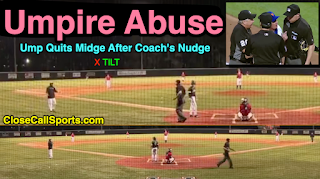
Umpire Walks Off Field Midgame - About Ump Abuse

Tmac reviews a viral video showing an umpire appearing to empty his ball bags and walk off the field mid-game following a coach's "get help" nudge regarding a non-appealable check swing strike call.

This is a review of umpire abuse's less over form: continued complaining and the straw that broke the camel's back: when second-guessing and nitpicking instances add up and contribute to a breaking point, or as Lin calls it, the officiating version of pinball's tilt shutdown as a result of too much table nudging.

Video as follows:

Monday, May 3, 2021

Critique - Cone Off the Ump Name Calling from the Booth

In this Commentary Critique, tmac reviews Yankees broadcaster David Cone's criticism of 2B Umpire Junior Valentine's start-stop balk in New York, a correct call in accordance with the Official Baseball Rules. Cone called Valentine a name, with a backdrop of a nationwide phenomenon of umpire abuse that has caused officiating shortages across multiple sports, mainly at the youth level.

After Valentine called Yankees pitcher Darren O'Day for a start-stop balk, Cone warned "I want to go off on a rant," before stating, "Barney Fife on second base is going to call it."

In complaining about the call, Cone described the pitcher's actions: "He started his motion a little bit and then stepped off the rubber," still perplexed at the balk call.

As a quick Rules Review, Cone's description is precisely why the balk was called. The two start-stop pitching rules in Set Position relate to going from the stretch to the set and for actions from set to delivery. This is an example of the former, as elucidated in OBR 5.07(a)(2): "Preparatory to coming to a set position, the pitcher shall have one hand on his side [the stretch]; from this position he shall go to his set position as defined in Rule 5.07(a)(2) without interruption and in one continuous motion." The accompanying latter balk rule is OBR 6.02(a)(1): "It is a balk when—the pitcher, while touching his plate, makes any motion naturally associated with his pitch and fails to make such delivery."

Replays indicate that, while in the stretch, O'Day started to moving his hands together, but stopped and then disengaged the rubber by stepping off with his pivot foot. This is an illegal disengagement because he had already started his transition from stretch to set, as in OBR 5.07(a)(2).

As for Cone's name-calling, despite admitting the call was correct and later offering an apology, for the casual fan that sees a simple 10-second video clip, the damage is done.

And with a nationwide referee and umpire shortage generating national headlines and citing abusive fan/coach/player conduct and poor sportsmanship as a top reason for officials opting not to participate in youth sports, the example of umpire abuse at baseball's highest level does no favors.

Video as follows:

Sunday, February 28, 2021

Angel Hernandez Trends on Day 1 of Spring as Sports Toxicity Returns to 2021 Season

Umpire Angel Hernandez trended on Twitter on Day 1 of Spring Training, receiving a flurry of vitriol and criticism after St. Louis Cardinals broadcaster Dan McLaughlin took issue with a ball/strike call that turned out to be correct, according to the computerized graphical strike zone the media generally enjoys referring to when an umpire's call is at odds with a team's preference.

The controversial call occurred during the top of the 1st inning of St. Louis' game against the Washington Nationals when Hernandez ruled a 1-1 pitch from Jack Flaherty low for ball two, a call that appeared to be supported by computerized graphics in use by MLB's own website.

AH called Pitch #3 a ball.
Nonetheless, Hernandez's correct call elicited a barrage of personal tweets from baseball fandom attacking the veteran umpire—in the top of the first inning, of the first game of spring.

As we have noted time and time again using the article label "Umpire Abuse," the sports world suffers from severe issues, including a harmful cultural attitude toward its officials.

In Hernandez's case, the existence of a lawsuit filed against Major League Baseball alleging discrimination based on race and national origin complicates matters in a way that compounds the abuse he, as an umpire, receives.

For instance, the consequence and character of Hernandez's pitch call in the first inning Sunday—very likely his first borderline call of 2021—in no way corresponded to the level of backlash he received (online...in the stadium, there was no such negative reaction). In other words, Hernandez's history influenced what occurred virtually, and largely for reasons previously discussed.

Hernandez, through his audacity in attempting to challenge a potentially oppressive system that sees a tremendous underrepresentation of Latino umpires relative to players (27% Latino players / 5% Latino umpires at the time of Hernandez's 2017 filing), or Crew Chiefs outright (0% Latino crew chiefs at the time of his filing), has drawn the scorn of a sports world not ready to reconcile a potentially uncomfortable reality that marginalization exists.

And for the crime of standing up for himself, it hardly comes as a surprise that Hernandez remains a favorite target of online bullying, personal attacks, and unmeritorious insults.

Oddly enough, McLaughin's quip that Hernandez was in "midseason form" actually was correct after all: the umpire correctly ruled a borderline pitch out of the strike zone and it is statistically true that umpires tend to get most calls right.

Video as follows:

Tuesday, February 2, 2021

Gil's Call - Callaway's Conduct Symptom of Larger Problem

When recent allegations surfaced alleging inappropriate behavior by former Mets Manager and Angels Pitching Coach Mickey Callaway, some of the remarks from alleged victims resembled comments made by umpire recipients of on-field abuse.

In this Gil's Call, we explore the relationship between abuse of officials by certain coaches, managers, or players that occurs on the field and allegations of misconduct that surfaces off the field.

The large difference, naturally, is that, by and large, an abusive person's misconduct during a game occurs on the field, directed at people who wear a certain uniform, while the abuse off the field is largely directed at people who share a certain personal characteristic.

In order to weed out the latter—which society at large seems to have formed a consensus as a largely unacceptable act—could, perchance, addressing the former—which society at large seems to somehow be okay with—prove an effective countermeasure?

When stories like Callaway break, many in the media or fandom decry how this could have happened, said coach is one bad apple, etc...yet those same newsmakers readily rack b-roll footage of said manager having an explosive temper tantrum directed at an umpire during a previous year's ejection to accompany the "shocking" story, as if the two aren't even remotely related.

Similar misconduct, even if different in form, is still abuse, whether it occurs on or off the field. Society seems to think the fence line separating the playing surface from the spectator area—or even the stadium gates—somehow holds a magical property that keeps things "between the lines" and suspends the principles of transitivity.

Here at CloseCallSports, we have long chronicled the perils of umpire/referee abuse and its detrimental effect on the sports officiating community.
Related Label: Umpire Abuse.

Yet for some reason, leagues have remained reluctant to substantially address bad behavior, which in 2017 led to a World Umpires Association-wide white wristband protest, followed not even one year later by the rebranded union, MLBUA, publicly calling for MLB to take action after yet another instance of umpire abuse from ejected personnel: whatever the league negotiated in the wristband protest finale clearly wasn't strong enough to hold for more than one season.

The on-field abuse issue remains so pervasive that our mental health sponsor, Outstanding Sportsmanship is Paramount (OSIP Foundation), runs a hotline called Officials Anonymous for officials experiencing issues related to abuse. After all, the same b-roll footage used to support a potentially abusive manager's indictment could very well be used to supplement a sport's officials disclosure of trauma.

When we are inconsistent in enforcing boundaries—by permitting abuse to continue on the field while decrying it off the field—the end result is covert abuse and gaslighting behavior off the field an a pervasive sense of entitlement. Callaway's alleged misconduct is, extremely likely, just the tip of the iceberg: not for Callaway personally, but in terms of abusive conduct by others which to this point remains unpublicized.

Disagreements are okay, arguments are okay, even yelling may be acceptable under certain circumstances. But abuse—whether through manipulative gaslighting, bullying, or overt illicit activity—is never okay and when it's time for the dispute to conclude, the afflicted teammate must be able to acknowledge and accept the umpire's stern edict of "no": the umpire must be shown that respect for autonomy.

And, thus, in order for "no means no" to work off the field, it must also work on the field and be backed up by those in charge. If the powers-that-be continue to be unable to do so, this systemic abuse—in whatever form it might take—will undoubtedly continue.

It shouldn't have to take covert abuse transmogrifying into a PR nightmare for a suspension to occur, at least not with all this prior evidence, and b-roll footage, sitting plainly in the public eye.

Video as follows:

Saturday, December 5, 2020

Referee Attacked, Killed During Soccer Game in Kenya

Nary hours after a high school football player charged at a referee in Texas, an elderly referee has been killed during a soccer game in Kenya. Mwalimu John Chang'aa aka Okwoyo succumbed to injuries sustained when a group of players and fans attacked the officials at half time in Kisii County.

According to local reports, retired teacher John Okwoyo was officiating a contest at Gesabakwa Green Stadium between teams Apire and Ichuni Youth when the crew encountered a play during which the ball wound up in the back of one of the team's goals. However, the assistant referee had raised his flag into the air prior to the goal to signal an infraction, and the crew ultimately cancelled the score and awarded a penalty to the defending team.

The report states that at halftime shortly thereafter, the offending team surrounded the referee before fans rushed off the sidelines to join in and a group attack occurred, resulting in the referee's death as he sought medical attention.

It was unclear if a fan or a player murdered the referee, but reports indicate that one fan who kicked the elderly referee in his chest was identified and arrested by local police.

News of the referee's death comes one just over one day after Texas high school football player Emmanuel Duron attacked TASO referee Fred Garcia during a playoff game. Hours later, the Edinburg Consolidated Independent School District announced it had decided to remove the team from the postseason and noted "appropriate disciplinary action" would follow an investigation into the incident, while the local police department arrested Duron, who now faces at least one criminal charge.

The District wrote, "We extend a sincere apology to the referee and his family" while the Texas Association of Sports Officials wrote, "Unfortunately, this type of blind-sided assault on an official while working on the field is not new to Texas football.

In 2008, Euless Trinity HS player Eric Fieilo tackled an official during a game, but evaded criminal charges. Fieilo later became a police officer at Euless PD.

Video as follows:

Thursday, December 3, 2020

COVID Criminal? Texas Football Player Attacks Referee

Our series on abuse-of-officials continues in Texas, when Edinburg High School Football defensive end Emmanuel Duron became an alleged criminal after attacking a referee following his disqualification/ejection from Thursday's game, leading to police involvement.

After a late hit on the quarterback penalty and an additional unsportsmanlike conduct penalty, Edinburg High School senior and DE Emmanuel Duron appeared to forcefully shove referee Fred Garcia during Edinburgh's Thursday's playoff play-in game against Pharr-San Juan-Alamo following the white hat's penalty announcement.

Note: The technical officiating jargon here is disqualification, but for all intents and purposes (e.g., when comparing the action to something seen in professional baseball), the decision to remove the offending player from the game is on par with an ejection.

Following the alleged criminal act, local reporter Andrew McCulloch reported that a card had been brought on the field to assist the victim. Several minutes later, the referee stood up and walked off the field under his own power.

Law enforcement identifies Duron.
Although local reports indicated that police officers escorted Duron from the field, he was not handcuffed, no arrest was reported, the officers who escorted Duron from the stadium stated "No comment, we're not at liberty to talk about that," and after a delay, the game continued with Edinburg ultimately winning the contest, 35-21.

According to the National Association of Sports Officials (NASO)'s 2020 Legislative Scorecard, Texas is one of 22 states that have passed officiating assault and/or harassment laws, though Texas' law is not exclusive to officials and rather pertains to any person who participates in a sporting event (such as players).

It states that such intentional physical contact against someone who is a sports participant shall constitute a Class B misdemeanor; however, if the victimized referee is an elderly individual, the classification would increase to Class A.

In 2008, Euless Trinity High School player Eric Fieilo attacked an official in a similar manner—blindside hit during a playoff game, his last of senior year—and, as a result, was sent to an alternative school and lost scholarship offers. Fieilo, however, was not charged with a crime.

Does crime pay? After graduating from Sam Houston State, which opted to give Fieilo a football scholarship after all, Fieilo—having not been charged for his high school alleged assault—joined the Euless Police Department, which apparently had no issue with Fieilo's purported violent battery on a fellow citizen.

13% of officials have been assaulted.
After the potential purported criminal became a police officer, Fieilo had two human interest stories written about him: one by Dallas Morning News reporter Naheed Rajwani and a second by Fort Worth Star-Telegram's Bill Hanna. Both articles portrayed Fieilo's story as redemption, with Rajwani deeming him a "revered cop" who recovered from "his most embarrassing moment" and Hanna writing of Fieilo's "horrible decision."

Neither Rajwani nor Hanna mentioned Fieilo's victim and in lieu of apologizing to the man he admittedly attacked, Fieilo instead praised God for giving him a second chance and called the incident and its aftermath a "blessing."

Unfortunately, the official Fieilo hit wasn't asked to comment on how much of a "blessing" it was to have been the victim of a purportedly injurious violent crime.

Assaults on officials have resulted in several deaths over the years, including 2013's death of Utah soccer referee Ricardo Portillo at the hands of an unnamed player who he had issued a yellow card to moments earlier. In 2014, referee John Bieniewicz died after ejected player Baseel Abdul-Amir Saad allegedly punched him in the head.

So if you're ever debating about the importance of pressing charges when attacked, remember the name Elikena "Eric" Fieilo, the player who allegedly assaulted an official and instead of being charged with a crime, became a police officer in the very same town.

Saturday, August 8, 2020

Texas to Tomlinson - Pep Talk for Tough Times

Baseball can be an unforgiving sport, but after umpire Nate Tomlinson had three overturned calls in his MLB debut, Rangers broadcasters Tom Grieve and Dave Raymond responded with compassion, telling their viewing audience about umpiring's difficulties, their families, and most importantly, their humanity.

Grieve, Texas' television color analyst, led with the bulk of the story, drawing on his experience as a major league player with the Washington Senators, Rangers, New York Mets, and St. Louis Cardinals from 1970-79. He was never ejected during his nine-year career, and neither was his son Ben Grieve who played in the bigs from 1997-2005.

Said Grieve, choosing a message of sportsmanship and kindness for umpires, other media figures, and fans alike, "It's easy to sit back and second guess an umpire, to yell at an umpire. They've got a family, his wife is probably watching the game. And to sit up here and take pot shots at the umpire isn't right."

And to 10-year professional umpire Tomlinson: "He wouldn't be here if he hadn't done a great job for 10 years." Added Raymond, "He was the plate umpire at the Futures Game. Those are honors they hand out to guys who are exemplary."

Video as follows:

Thursday, August 6, 2020

CPBL Demotes Umpire After Infield Fly Call

A controversial bases-loaded infield fly rule call overseas resulted in a 10-minute delay and, after the game, the calling umpire's demotion from the CPBL to Taiwan baseball's minor leagues. Was the call correct and why or why not? We dive into the rules to answer this question.

Starting with the definition of Infield Fly Rule would be most helpful: "An INFIELD FLY is a fair fly ball (not including a line drive nor an attempted bunt) which can be caught by an infielder with ordinary effort, when first and second, or first, second and third bases are occupied, before two are out. The pitcher, catcher and any outfielder who stations himself in the infield on the play shall be considered infielders for the purpose of this rule."

According to Official Baseball Rule 5.09(a)(2)(5), "A batter is out when—An Infield Fly is declared." and an umpire shall declare an infield fly when "it seems apparent that a batted ball will be an Infield Fly."

To summarize, an umpire has three key checkmarks to dole out in determining whether the infield fly criteria has been satisfied and should only declare an infield fly after all three boxes are marked.
(1) First & second base must be occupied with less than two out (third may or may not be occupied).
(2) The batter must hit a fair fly ball (a ball hit into the air), which is not a line drive nor a bunt, that;
(3) In the umpire's judgment, can be caught by an infielder (F1 - F6) employing ordinary effort.

Compare to Sam Holbrook's 2012 INF Fly.
Gil's Call: Back to the August 6 CPBL game between the Fubon Guardians and Rakuten Monkeys, I've color-coded the three criteria above as to my personal judgment as to their satisfaction. Yes, this is clearly a potential infield fly situation: runners are at first and second base with one out. Criteria number two is where I start to lose my willingness to call an infield fly: The batter definitely hits the ball into the air, but its trajectory and low arc suggests it may not quite fit the fly ball mold.

Even with room for interpretation as to this rule's second point, the third criterion—can be caught by an infielder employing ordinary effort—should seal the deal. Recall that "ordinary effort" is defined as, "the effort that a fielder of average skill at a position in [CPBL in this case] should exhibit on a play, with due consideration given to the condition of the field and weather conditions."

An extended argument from the home team.
Based on this definition, I do not believe the second baseman could have caught this ball with ordinary effort. Accordingly, even if we were to have deemed fair fly ball criterion two as satisfied, we would be prohibited by rule from calling 'infield fly' due to failure to satisfy the rule's ordinary effort clause.

The second part of the analysis pertains to game management. When 2B Umpire Qiu Jingyan made the infield fly call, 1B Umpire Ji Huawen, after observing his partner call infield fly, mirrored the point mechanic. That's fine.

This bump-the-ump produced a warning.
When the crew conferred to discuss the call, this would have been the prime opportunity to reverse the call and load the bases...IF any of the other umpires A) saw that it wasn't an infield fly and B) the calling umpire were to have allowed such an overturn [remember, umpires by rule cannot unilaterally overturn another umpire's judgment call...see OBR 8.02(c)'s "no umpire shall criticize, seek to reverse or interfere with another umpire's decision unless asked to do so by the umpire making it"].

When HP Umpire Luo Junhong, who appeared to be our crew chief, made the crew's final call, the crew entertained Rakuten's manager—fine. But once the manager began walking back toward his dugout, only to turn around and physically push through multiple umpires enroute to physically bumping the calling umpire, that should have been addressed.

Umpire Odo in Star Trek cites the USC rule.
Physical contact with an umpire in the course of an argument is not a warning, it's grounds for immediate ejection. The rule is 6.04(a)(4) Unsportsmanlike Conduct and reads, "No manager, player, substitute, coach, trainer or batboy shall at any time, whether from the bench, the coach’s box or on the playing field, or elsewhere make intentional contact with the umpire in any manner...PENALTY: The offender shall be removed from the game and shall leave the playing field, and, if a balk is made, it shall be nullified."

The following article from 2019 provides more insight on the infield fly rule and its implications for both the offense and defense.
Related PostYankees Doubled Up on Infield Fly - Learn the Rule! (3/28/19).

In 2018, we discussed the issue of reversing calls made during a potential infield fly situation.
Related PostForgetful Infield Fly - Reversing Calls Across Levels (3/21/18).

And in 2017, we discussed IFR situations and how to judge a batted ball as an infield fly or not.
Related PostKnowing the Situation - Infield Flies and Time Plays (9/15/17).

And there's a lot more where that came from.
Related PostOrioles Turn Triple Play on Contested Infield Fly No-Call (5/3/17).
Related PostInfield Fly and a Double Play - Back to Basics for Phillies (4/11/16).

Video as follows:

Wednesday, February 12, 2020

Manager Osuna Punished for Spitting on Umpire Leal

Following an ejection in the Venezuelan League, Tiburones (Sharks) Manager Renny Osuna spit on umpire Carlos Leal before taking his tantrum into the dugout. Named the LVBP's 2019-20 Manager of the Year, Osuna now faces a 10-game suspension and fine to be imposed next season, as the winter league has already named a champion.

Osuna argued with Leal during a Sharks at-bat against Los Caribes de Anzoátegui (La Guaira was ultimately swept by Anzoátegui in the semifinal round of the playoffs), netting himself an ejection. During the post-ejection dispute, Osuna appeared to spit in Leal's face before being ushered off the field.

Once back inside his dugout, Osuna appeared to enter into a physical confrontation with a member of the Sharks before finally leaving the confines. The LVBP's 10-game suspension is codified in the league's Code of Ethics and Discipline, as is its monetary fine.

Approximately 10 days following the spitting incident, Osuna received the LVBP's Alfonso "Chico" Carrasquel Award for 2019-2020 Manager of the Year.

Video as follows:

Monday, February 3, 2020

ABL Players Bash Umpire Thomas After Ejection

After HP Umpire Trent Thomas denied Canberra batter Kelvin Melean's late request for 'Time' during the Australian Baseball League Semifinals, the Cavalry shortstop struck out and was ejected, but the unsportsmanlike conduct spilled over to Facebook, where other players joined in to personally insult the umpire as social media continues to carve a pathway to prolong such temper tantrums.

Ejection Report: HP Umpire Trent Thomas ejected Cavalry SS Kelvin Melean in the top of the 7th inning of the Cavalry-Giants game. With one out and none on, Melean attempted to request 'Time' prior to the 0-1 pitch from Giants pitcher Ryan Chaffee. Thomas denied Melean's request pursuant to Official Baseball Rule 5.04(b)(2) Comment* as Melean requested time after pitcher Chaffee had already begun his delivery, generating an argument from Melean. When Melean subsequently struck out looking to conclude the at-bat, he was summarily ejected after further dissent. At the time of the ejection, the Giants were leading, 4-3. The Giants ultimately won the contest, 6-3.

IF Zach Wilson airs grievance on Facebook.
*OBR 5.04(b)(2) Comment states, "Umpires will not call 'Time' at the request of the batter or any member of his team once the pitcher has started his windup or has come to a set position even though the batter claims 'dust in his eyes,' 'steamed glasses,' 'didn’t get the sign' or for any other cause." Todd Tichenor ejected Red Sox LF Jonny Gomes over a similar complaint in 2013, which exemplifies proper enforcement of this rule. Yet the call's quality of correctness—denial of "Time" vs quick-return pitch—isn't where this play ends.

Cyber Bullying: After the game, several players from around baseball, including the ABL, CanAm, and former MLB, took to social media to complain about umpire Thomas: For instance, Zach Wilson (2018-19 with Canberra, 2018 York of the Atlantic League, and 2018-19 Quebec of the CanAm) posted on Facebook, "That ump is absolute trash...not just one game. It's every game. He's terrible," with former York, Lancaster, and ABL-Sydney Blue Sox player Ty'Relle Lee Harris posting a reply in support.

On Twitter, former ABL and MLB player Travis Blackley wrote, "Can't Robson just call every game. He's the only one capable," with players Luke Hughes and Todd Van Steensel also jumping into the conversation. Added former Canberra/Brisbane/Auckland player Nathan Crawford, "Dude's f*ing trash."

In a welcome break from some of our past stories on player use of internet media to personally insult or attack umpires, it appears that in this case, ejectee Melean left his dissent on the field and did not join in on the cadre of angry Facebook and Twitter rants.

In the States, the umpires' union (MLBUA) previously took umbrage with MLB's purported failure to adequately respond to instances of umpire abuse from active players as recently as 2019; see our previous article and video concerning the MLB-MLBUA workplace violence saga for more context. For instance, even if a league does have a social media policy for players or coaches, its penalties can be fairly inconsequential, such as MLB's 0.1%-of-salary fines for postgame umpire insults that are little more than a veiled instruction to draft a tax-deductible donation to charity.
Related PostMLB Rejects MLBUA's Workplace Violence Tweet (6/19/19).

Wrap: Canberra Cavalry vs. Adelaide Giants (ABL), 2/1/20 | Video as follows:

Tuesday, January 21, 2020

Postgame Encroachment - The Locker Room Invader

When a losing coach burst into the officials' room to berate the crew following a game in California, one of the referees hit "record" on his smart phone, capturing the incident on camera. We recap the action with "Postgame Abuse: What to do," a video pregame discussion for an unsportsmanlike event that hopefully will never befall you.

Despite umpire and referee locker rooms serving as safe havens for officials after a charged contest, there nonetheless exists the rare occasion upon which a frustrated person will invade the officials' space with the express intention of conveying some semblance of unsportsmanlike conduct.

Disclaimer: If the locker room invader is a coach or other team personnel fresh off the floor or field, these following guidelines will apply. If the intruder, however, is an unruly fan or other non-sports person, proceed straight to Step 4.

Technicals and ejections only go so far.
Step 1: Record video. The proliferation of smart phones and video technology has made documentation so much simpler. After all, video is extensively used in the stands, so take a page from this playbook and have accessible your video recording device, just in case.

Step 2: Tell the intruder, in no uncertain terms, to leave. It probably won't help much in the moment, but upon video review after the fact, your instruction will go a far way in establishing the malcontent's failure to comply.

Step 3: Don't argue. Because jurisdiction has ended, don't try and serve a technical foul or ejection; either would be non-binding. Although the defensive mechanism inherent within umpire scapegoating remains a psychologically logical outcome, its real-world manifestation of projection and blaming remains rather irrational. In other words, the intruder—having already broken rules and crossed lines—isn't up for measured discourse, and argument or discipline can only serve to inflame a negative situation.
Related PostGil's Call: The Blame Game (Umpire Scapegoating) (8/8/14).

On-field, it's a bump. Off-field, it's a crime.
Step 4: Call for help (security). If a crime is committed, call the police. For the most part, it is illegal for a person to touch another person without the victim's consent. During a game, implied consent exists when participants voluntarily elect to enter the playing surface, but afterward, there is little doubt that anyone other than an official (or official's invited guests) in an officials' room is unwanted and, thus, any potential touching would be unwanted. If unwanted touching follows Step 2, that only serves to further drive home the point.

Step 4a: File your report. If the police were involved, you'll have a police report. If not, you'll still have a report with the person who assigned the game, the league, conference, governing body, etc. The report should be factual as to what occurred and video evidence can prove quite beneficial as a supplement.

Not just acts, but VIDEO hurt Dusty Rhodes.
Step 5: Share the video if necessary. The reason Step 3 exists is because an official, despite having concluded the game and jurisdiction surrounding the game, is held to a high "always on duty" standard, and because a reasonable person would expect that the governing body will judiciously resolve the situation (e.g., by punishing the offender). By adhering to "silence cannot be misquoted," an official also can avoid charges or accusations that he or she aggravated the situation by talking or shouting.

However, sometimes supervisory staff can fail to respond adequately to a situation. Furthermore, as media coverage has demonstrated, sportsmanship deficiency remains a societal problem. In order to effect change, it sometimes is necessary to publicize instances of poor sportsmanship so as to decree its unacceptability.
Related LabelCCS - Umpire Abuse.

Video as follows:

Monday, January 13, 2020

Umpire Scapegoating - The Case of AJ Hinch

When MLB announced then-Astros manager AJ Hinch's 2020-season suspension for video sign stealing, it brought full circle an umpire scapegoating mystery we discussed in 2019, proving the point that when a manager, player, or coach gets personal and throws a tantrum during a game, it tends to be disproportionate to whatever call that participant is at odds with.

When I wrote the first MLB ejection report of 2019 on March 15 that year, I—and many commenters—found it very notable that Hinch was ejected for arguing a strike one call to the first batter in the bottom of the first inning. To be that worked up over the very first strike call to go against one's team in Spring Training was quite unusual, as were Hinch's postgame comments targeting the umpires.
Related PostMLB Ejection S-1 - Angel Hernandez (1; AJ Hinch) (3/15/19).

During a subsequent podcast, Tmac remarked on how obscenely disproportionate Hinch's on-field tantrum was to the surrounding an situation around him, including the officiating crew's calm demeanor.
Related PostPodcast - Episode 11 - Angel, AJ, and Umpire Futures (3/18/19).

This motif carried through to Hinch's ejection on April 3, 2019, after a strike one call by Ron Kulpa in the top of the 2nd inning—another mid-AB, early-inning dismissal. It was in the podcast following this game that Tmac alluded to potential off-the-field problems for Hinch, for his erratic behavior in habitually attacking umpires over what could best be described as perceptually minor offenses, simply didn't fit into the logic of a baseball game.
Related PostMLB Ejections 007-08 - Ron Kulpa (1-2; Cintron, Hinch) (4/3/19).
Related PostPodcast Minisode 13M - AJ Hinch's Mea Ron Kulpa (4/4/19).

With news of MLB's discipline of Hinch for cheating, our story now comes full circle: in his ejections with Hernandez and Kulpa, Hinch employed one of our oldest talking points—umpire scapegoating—that had little to do with either umpire, and as is the case many times, Hinch's personal comments had little to do with facts.
Related PostGil's Call: The Blame Game (Umpire Scapegoating) (8/8/14).
Related PostEjected Duffy Makes it Personal in KC vs Tumpane Claim (6/18/18).

The following video reminds officials across all sports that the more irate, personal, and vitriolic a player, coach, or manager's response to an official's call is, the less likely the participant's actions have anything to do with the umpire or referee who is the target of abuse.

Quite often, as appears to have been the case with Hinch's Houston Astros, it's a guilty-minded manager who projects personally unacceptable feelings onto a third party, if only to avoid having to confront unpleasant emotions—in this case, a severely dishonest scheme that cost Hinch his job...once he got caught.

Video as follows:

Tuesday, August 27, 2019

Justin Turner Bumps Umpire Rob Drake at Game's End

A non-ejection incident occurred following the final out of San Diego's victory over Los Angeles as Dodgers 3B Justin Turner bumped HP Umpire Rob Drake while arguing a strike three call to end the game; Turner was not ejected, but a report for the incident is indicated here pursuant to UEFL Rule 8-2 governing Odds & Ends, unofficial ejections, and similar unsportsmanlike incidents.

Gil's Call: Turner's contact with Drake appeared to occur as he leaned in as one would to hear what another person is saying in a loud environment. It doesn't look to follow the pattern of a player who deliberately charges into an umpire, but contact nonetheless does occur during a balls/strikes dispute situation, which by its definition makes it unsporting, whether intentional or not. Turner's pursuit of Drake following the shoulder/chest contact serves as an aggravating circumstance.

Turner pursues Drake after the initial contact.
Turner took a 1-2 fastball from Padres pitcher Kirby Yates for a called third strike to seal San Diego's win over LA. Replays indicate the final pitch of the game was located over the outer half of home plate and above the hollow of the knee (px 0.57, pz 1.79 [sz_bot 1.73]).

Apparently unaware he had struck out to end the game, Turner pursued Drake and appeared to make contact with the umpire as he argued the call, with Crew Chief Tim Timmons briefly stepping in front of Turner and Dodgers Manager Dave Roberts, which slowed but did not stop Turner's advance as Drake exited the field. The Padres won the contest, 4-3.

Video as follows:

Monday, August 26, 2019

MLB Ejection 173 - Manny Gonzalez (2; Keon Broxton)

HP Umpire Manny Gonzalez ejected Mariners RF Keon Broxton (strike three call; QOCY) in the bottom of the 2nd inning of the #Yankees-#Mariners game. With two out and none on, Broxton took a 3-2 fastball from Yankees pitcher J.A. Happ. Replays indicate the pitch was located over the outer edge of home plate and thigh-high (px 0.81, pz 3.11[sz_top 3.52]) and that all other pitches during the at-bat were properly officiated, the call was correct.* At the time of the ejection, the Yankees were leading, 4-3. The Yankees ultimately won the contest, 5-4.

After the strike three call, Broxton threw his batting gloves in Gonzalez's direction; this equipment appeared to make contact with umpire Gonzalez's face. Precedent: In June, Asdrubal Cabrera received a four-game suspension for throwing his batting gloves at the feet of Bill Miller in Texas.
Related PostMLB Suspends Cabrera - Too Harsh or Just Right? (6/21/19).

This is Manny Gonzalez (79)'s second ejection of 2019.
Manny Gonzalez now has 11points in the UEFL Standings (7 Prev + 2 MLB + 2 Correct Call = 11).
Crew Chief Sam Holbrook now has 18 points in Crew Division (17 Previous + 1 QOCY = 18).
*UEFL Rule 6-2-b-1 (Kulpa Rule): |0| < STRIKE < |.748| < BORDERLINE < |.914| < BALL.
This pitch was located 1.25 horizontal inches from being deemed an incorrect call.

This is the 173rd ejection report of the 2019 MLB regular season.
This is the 84th player ejection of 2019. Prior to ejection, Broxton was 0-1 (SO) in the contest.
This is Seattle's 5th ejection of 2019, 2nd in the AL West (OAK 6; SEA 5; TEX 4; HOU, LAA 3).
This is Keon Broxton's first career MLB ejection.
This is Manny Gonzalez's 2nd ejection of 2019, 1st since June 15 (Ron Gardenhire; QOC = Y [Balls/Strikes]).

Wrap: New York Yankees vs. Seattle Mariners, 8/26/19 | Video as follows:

Thursday, August 15, 2019

Officiating Positives - The Kids Who Inspire Umpires

Umpires and referees know that officiating can be a thankless and mentally fatiguing job. When hurtful grownups try to tear officials down, think of the child who loves nothing more than to see a dedicated referee or umpire at work. To help in that regard, we've put together a video featuring children of all ages who are fans of the officiating team. Consider it an anecdotal response to the tired phrase, "nobody buys a ticket to watch the umpire."

In this modern maelstrom of malicious mockery, recall that, "Personal insults of an official generally have nothing to do with the official personally...The act often concerns some underlying issue within the person committing the abuse and may represent a personal struggle that person has with authority, lack of control, or accepting a result in conflict with one's own desires."
Related PostLet's Talk - Mental Health in an Abusive Environment (10/10/17).

For instance, when an angry Danny Duffy accused umpire John Tumpane of personal animus—Tumpane, the umpire best known for saving a life—Duffy spoke from a place of personal hurt: Kansas City had lost six in a row and Duffy hadn't been playing well. When Todd Frazier said, "these umpires have got to get better," it followed a series of poor offensive output and ignored statistics showing that umpires had performed quite well as Frazier himself had struggled in the batter's box.
Related PostEjected Duffy Makes it Personal in KC vs Tumpane Claim (6/18/18).
Related PostTodd Frazier - "These Umpires Have Got to Get Better" (5/3/18).

As Jim Joyce once wrote, Nobody's Perfect, and sports officials will miss calls here and there. Even the Official Baseball Rules accepts this fate and includes this phrase in its General Instructions to Umpires: "You no doubt are going to make mistakes." It happens and it's okay to acknowledge this...but it's not okay to harass and berate. When unhappy grownups fail to stop when no means no, remember the kids, including those who come to the stadium specifically to watch the umpires—those young and young-at-heart referee fans who want nothing more than to see the most responsible adults on the field succeed at the task of calling a kid's game.
Related PostPodcast - Episode 12 - The Jim Joyce Jubilee (4/2/19).

Video as follows:

Monday, June 24, 2019

Workplace Violence - Ulrich Arrested for Battering Umpire

Continuing in our series about umpire abuse following the MLB Umpires Association's infamous workplace violence tweet, we report Sunday's arrest of a softball player in Des Moines on charges of assault causing bodily injury after allegedly violent and illegal contact with an umpire.

The Des Moines Police Department described the purported crime to WHO-TV as stemming from a foul ball call during a Sunday softball game at the Greater Des Moines Softball Complex. 29-year-old Lance Raymond Ulrich, the suspect in this case, purportedly was a player who was upset at the umpire over the call and used profanity in the furtherance of his argument.

Alleged criminal Ulrich.
According to police, the umpire ejected Ulrich after which Ulrich purportedly pushed the umpire to the ground in a moment partially captured on video, resulting in injury. Another player in the game told WHO-TV that the umpire terminated the game following the incident, likely forfeiting the contest in favor of Ulrich's opponent.

The video shows the result of a man in a black jersey—presumably Ulrich—appearing to shove the umpire to the ground, upon which this person appears to stand over the fallen umpire while saying something in his direction before players wearing red jerseys tend to the umpire, who remains on the ground as the alleged suspect walks away. A person in camera range then says, "call the police."

Suspected assaulter Lance Ulrich on film.
After his arrest and booking at Polk County Jail for the violent crime of assault causing bodily injury, alleged criminal Lance Ulrich was purportedly released on bond.

The National Association of Sports Officials (NASO) Legislative Scorecard indicates the state of Iowa has not passed laws related to assaults on officials.

According to Gosoftball.com, Ulrich of Saint Marys, Iowa, is a member of the Des Moines-based Clutch softball team. Arrest records indicate inmate Ulrich is associated with the nearby city of Norwalk, Iowa.

According to Iowa Courts public records, two cases have previously been brought against Lance Raymond Ulrich, aged 29 (DOB 6/21/1990): one for a registration violation in 2017 and another a civil suit filed by Home Point Financial Corp in 2018. Court records indicate the Home Point Financial case was recently resolved, with a satisfaction of judgment filing having been entered into the record on June 3, 2019. The initial petition filed in that case pertained to a foreclosure.

Other reports indicate Ulrich formerly served in the military (US Army). Video as follows:

Wednesday, June 19, 2019

MLB Rejects MLBUA's Workplace Violence Tweet

MLB Umpires Association (MLBUA)'s feud with Major League Baseball took a nasty turn as the sides traded barbs over Joe Torre's handling of 6/15's Manny Machado ejection, with MLB admonishing the umpire union for invoking "workplace violence," claiming it was an "inappropriate" comparison.

This video analysis illustrates the recent MLBUA vs MLB episode, why the two sides appear to be placing chess as the umpires' contract with the league is set to expire at the end of 2019, and why MLB might take such strong offense to the union's illusion to "workplace violence," which is a specific federal legal term that itself invokes the General Duty Clause of the Occupational Safety and Health Act (OSHA) of 1970.

In general, a claim of workplace violence piques US Department of Labor's interest; a 2011 directive, for instance, instructs OSHA on how to enforce the investigation or inspection of workplace violence incidents. If MLB acknowledged Saturday's incident as "workplace violence," it may have resulted in unwanted government interest, which could put MLB's coveted antitrust exemption status on the line—something the league likely would like to avoid.

So what is workplace violence and how does it relate to Saturday's ejection? Video as follows:

Wednesday, May 1, 2019

MLB Disciplines Springer for Anti-Gay Slur at Ump

MLB disciplined Houston's George Springer for directing a vulgar anti-gar slur at Angel Hernandez after the umpire called the Astros batter out on strikes April 23, but declined to specify what, if any, fine had been imposed.

Baseball issued an undisclosed penalty.
Springer was caught on camera calling Hernandez a "f*ing c*cker" several minutes after striking out looking during the eighth inning of the April 23 Twins-Astros game.

In responding to an inquiry from Outsports, MLB wrote, "This inappropriate behavior was addressed with Mr. Springer and the Houston Astros and he has been disciplined." MLB did not provide Outsports with clarification to a follow-up query as to the specific punishment.

After returning to the dugout and witnessing a subsequent Jose Altuve home run, Springer directed his slur at Hernandez in a moment captured on the Astros broadcast.

We didn't expect a real-world example so soon.
MLB's statement contained no mention of a specific fine and we can surmise that Springer was not suspended by virtue of his not having missed a game since the incident. Other than Outsports' inquiry, MLB has not publicly acknowledged the incident.

In Episode 14, of The Plate Meeting Podcast, we discussed the issue of umpire abuse and a sports culture that fosters unchecked vitriol to such a degree as to tacitly encourage misbehavior. We even anticipated that fans would latch onto personal insults because their distaste for officials might overpower any sense of decorum, decency, and ability to accept an unfavorable outcome.

We just didn't expect to point to another example of this sad state the same day that we released the episode.

If you haven't yet listened to our podcast on sportsmanship, visit the following link.
Related PostPodcast - Abuse & Sports with OSIP's Jack Furlong (5/1/19).

Outsports located several examples of fans applauding Springer for his vulgar comment, writing: "As upsetting as those two words can be to the LGBTQ community and its allies, it’s even sadder that Springer, saying them on camera, delighted so many straight fans."

Sidebar, What's the Problem? The issue is a slur used in the derogatory insult of "you are 'less than' because of this." For more, visit Slurs as the Shortcut of Discrimination from the Rivista di estetica journal.

Moral and right clashes with what's profitable.
Break with Precedent: By failing to publicly announce or specify Springer's penalty, MLB has broken with precedent it established in 2017, when it summarily suspended two players very shortly after their respective anti-gay slur incidents. In May 2017, the Blue Jays suspended CF Kevin Pillar two games for yelling an anti-gay slur at a Braves pitcher, while in August, MLB suspended A's outfielder Matt Joyce for two games for his homophobic slur directed at a fan in Anaheim.

Yet a player tosses such language at Hernandez, the one umpire whose very lawsuit initially alleged racial discrimination—and whose scope of allegations has since expanded to include ethnic- and gender-based discrimination in baseball—and we are left with, well, confirmation that biases still appear to exist in baseball, as if to spite Hernandez, MLB is willing to marginalize LGBTQ by appearing to depart from precedent or parity.
Related PostAngel Hernandez Petitions Court for Permission to Speak Publicly About MLB's Alleged Discrimination (3/21/19).

History, Umpire Abuse: It's no secret that discipline for abuse of officials remains fairly insignificant. The latest public Union-League dispute occurred in September 2018, while in 2017, we catalogued the 2011-17 history of MLB-WUA discord, including the league's increased reluctance to discipline players and coaches for umpire abuse.
Related PostMLBUA Calls for BOC Action After Latest Umpire Abuse (9/23/18).
Related PostWUA-MLB Relations Deteriorate with New Umpire Protest (8/19/17).
Related PostPsychology & Marketing - Why MLB Discipline is Weak (5/19/16).

A picture of a bunch of dollar signs over LA.
Footnote...Fines Can Be Tax Deductible: According to the MLBPA Basic Agreement, most fines for on-field conduct allow the player to choose whether to pay the fine to the Baseball Assistance Team (BAT) or the MLB-MLBPA Youth Development Foundation, which are both charitable organizations with 501(c)(3) non-profit status.

This essentially means that a player, such as Springer, who is fined, could deduct the fines as contributions or donations to a charitable organization. The so-called penalty thus is a tax-deductible charitable contribution.

Footnote...QOC: So...was Springer right about the call itself? According to the StatCast numbers for the strike three call in question, the pitch was located over the inner half of home plate and at the hollow of the knee (px -0.28, pz 1.36 [sz_bot 1.56 / RAD 1.437 / MOE 1.354]). Pursuant to UEFL Miller Rule 6-2-b-2, the pitch falls within the acceptable margin-of-error-aided borderline range by just 0.072 inches; however, ball three immediately preceding the strikeout was located higher and in the strike zone without any consideration for margin-of-error (pz 1.55, sz_bot 1.65 / RAD 1.527]).

Which means Springer could have been called out on strikes when he took the 2-2 pitch and that would have been a correct call. Had RoboUmp officiated this at-bat, Springer would have struck out on 2-2.

Would he still have reacted if he struck out one pitch earlier as he did after the 3-2 strike three call? Just like MLB's precise punishment for Springer, we may never know.

Video as follows: