Showing posts with label Rule 2.00 [Tag]. Show all posts

Saturday, May 18, 2024

Pirates & Cubs Ends on Confirmed Safe Call at Plate When Runner Knocks Ball Out of Catcher's Hand

Saturday's Pirates-Cubs game ended on a walk-off slide by Cody Bellinger into home plate despite Pittsburgh catcher Joey Bart appearing to tag the runner...only to drop the ball when Bellinger knocked the ball out of Bart's hand. Replay Review confirmed HP Umpire Chris Conroy's safe call, leaving some Yinzers to wonder how replay could confirm a safe call only made because of a dropped ball...which only was dropped because the runner knocked it out of the catcher's hand.

With one out and one on (R2), Cubs batter Christopher Morel hit a 3-2 splitter from Pirates pitcher David Bednar on a line drive to center fielder Michael A Taylor, who threw home to catcher Joey Bart as Cubs baserunner R2 Bellinger slid into home plate. HP Umpire Conroy called Bellinger safe, a call challenged by Pirates manager Derek Shelton and ultimately affirmed via Replay Review.

Replay Review relied on the definition of tag, which includes this passage: "It is not a tag, however, if simultaneously or immediately following his touching a base or touching a runner, the fielder drops the ball. In establishing the validity of the tag, the fielder shall hold the ball long enough to prove that they have complete control of the ball." The phrase "holding the ball securely and firmly in their hand or glove" is also used. With the ball on the ground, Replay would determine the full process of "tag" was not completed and, thus, the tag was not valid.

The Official Baseball Rules, regarding offensive interference, specify in OBR 5.09(b)(3) that a runner is out when "they intentionally interfere with a thrown ball; or hinder a fielder attempting to make a play on a batted ball." OBR 6.01(a)(10) agrees ("fails to avoid a fielder who is attempting to field a batted ball, or intentionally interferes with a thrown ball"), and this establishes a right-of-way hierarchy we've been over several times before.

During a batted ball, a fielder has the right to field it; however, the runner has the right to run the bases at any other time.

The standard for a non-batted ball situation is intentional interference, or, the runner must commit an intentional act to be called for an interference violation. Unintentional interference only applies to batted balls (and potentially bona fide slides on force plays, collisions at home plate, runner's lane, and batter's interference), but your garden variety tag play on the bases falls under the so-called intentional or "willful and deliberate" standard.

HP Umpire Conroy did not rule interference initially, just that the runner was safe because the catcher dropped the ball.

Because non-slide rule or HP collision interference is not reviewable, the Replay Official was unable to consider the element of Bellinger's swipe knocking the ball out of Bart's hand. Even so, it would have to be an intentional act to be interference.

Accordingly, Replay Review ruled that because Bart failed to complete the process of the tag with full control and possession of the ball, the runner was safe: call confirmed.

Did Replay get this questionable Cubs catcher caper (confirmed) right? | Video as follows:

Thursday, August 10, 2023

Little League Runner Knocks Fielder's Glove Off on Tag

A batter-runner knocked a first baseman's glove off his hand during a tag attempt at first base during the North Dakota-Iowa Midwest Region Little League World Series game. We review and answer your question as to whether the proper call here is "safe" due to the fielder's glove falling off or "out" due to the fielder's prior tag of first base.

The Official Baseball Rules definitions provides us with two tagging scenarios: "A TAG is the action of a fielder in touching a base with their body while holding the ball securely and firmly in their hand or glove; or touching a runner with the ball, or with their hand or glove holding the ball."

A fielder may thus tag 1) a base or 2) a runner. In this LLWS play, the fielder attempts to tag the base. Breaking this play down into phases, we see that the fielder received the throw, possessed the ball, and touched first base prior to the runner's arrival. The runner then stepped (assumedly unintentionally) on the fielder's glove, causing the glove to come off the fielder's hand.

The on-field umpire ruled the batter-runner safe, but Replay Review overturned this call based on the type of tag this was — a base tag, not a runner tag — and that the base tag had been satisfactorily completed prior to the runner, an outside influence at this point, coming and disrupting the attempted play with a foot to the glove.

Video as follows:

Tuesday, July 26, 2022

Quickie - A Pocket Full of Nothing and the Hanging Tag

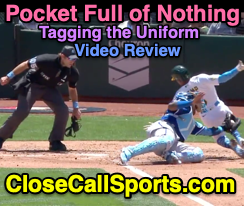
When Replay Review overturned a close play at the plate from safe-to-out, HQ's umpire relied on the slimmest of margin's—catcher Salvador Perez's tag of runner Tony Kemp's hanging pocket—to rule an out.

For this particular play, HP Umpire Alex MacKay works the wedge, staying on the catcher's foul-facing hip to see Perez's tag attempt, initially calling baserunner Kemp safe.

However, Replay upon review determined that Perez's mitt tagged the lining of Kemp's back pocket, which was turned inside out as he ran the bases.

To do so, Replay relied on the definitions of TAG and TOUCH which specify that a tag shall be considered legal if any part of the uniform is touched by the fielder's glove (not including its laces). Furthermore, Official Baseball Rule 5.05(b)(2) states a touch has not occurred if the ball (or, in this case, glove/mitt) "only touches any jewelry being worn by a player," similar in vein to the TAG definition stating "not including hanging laces alone" and "For purposes of this definition any jewelry being worn by a player (e.g., necklaces, bracelets, etc.) shall not constitute a part of the player’s body."

Finally, TOUCH is defined as follows: "To touch a player or umpire is to touch any part of their body, or any uniform or equipment worn by them (but not any jewelry (e.g., necklaces, bracelets, etc.) worn by a player)."

Video as follows:

Thursday, July 14, 2022

MLB Ejection 099 - Malachi Moore (1; Bud Black)

HP Umpire Malachi Moore ejected Rockies manager Bud Black (out of the base path call; QOCN) in the bottom of the 6th inning of the #Padres-#Rockies game. With none out and two on (R2, R3), Rockies batter Garrett Hampson hit a 2-1 changeup from Padres pitcher Nabil Crismatt on the ground to first baseman Eric Hosmer, who threw to catcher Austin Nola as Rockies baserunner R3 Sam Hilliard attempted to score, ruled out by HP Umpire Moore for running more than three feet to avoid a tag. Replays indicate that Padres catcher Nola failed to catch the baseball; because Nola never possessed the ball, runner Hilliard's base path was never established (no legal tag attempt was ever made because a tag requires possession of the baseball), the call was incorrect.* At the time of the ejection, the Padres were leading, 6-3. The Rockies ultimately won the contest, 10-6.

This is Malachi Moore (108)'s 1st ejection of 2022.
Malachi Moore now has -3 points in the UEFL Standings (1 Prev + 2 AAA - 4 Incorrect Call = -3).
Crew Chief Jerry Meals now has 2 points in Crew Division (2 Previous + 0 QOCN = 2).
*Official Baseball Rule 5.09(b)(2): "Any runner is out when—they run more than three feet away from their base path to avoid being tagged unless their action is to avoid interference with a fielder fielding a batted ball. A runner’s base path is established when the tag attempt occurs and is a straight line from the runner to the base he is attempting to reach safely."
*OBR's Definition of Terms: "A TAG is the action of a fielder in touching a base with their body while holding the ball securely and firmly in their hand or glove; or touching a runner with the ball, or with their hand or glove holding the ball (not including hanging laces alone), while holding the ball securely and firmly in their hand or glove. It is not a tag, however, if simultaneously or immediately following their touching a base or touching a runner, the fielder drops the ball. In establishing the validity of the tag, the fielder shall hold the ball long enough to prove that they have complete control of the ball."

This is the 99th ejection report of the 2022 MLB regular season.
This is the 51st manager ejection of 2022.
This is Colorado's 1st ejection of 2022, T-4th in the NL West (ARI, SD 3; SF 2; COL, LAD 1).
This is Malachi Moore's first career MLB ejection.
This is Bud Black's 1st ejection since April 14, 2021 (Phil Cuzzi; QOC = Y [Balls/Strikes]).

Wrap: San Diego Padres vs. Colorado Rockies, 7/13/22 | Video as follows:

Saturday, September 18, 2021

MLB Ejection 175 - James Hoye (3; Bob Melvin)

HP Umpire James Hoye ejected Athletics manager Bob Melvin (Replay Review decision that overturned 1B Umpire Erich Bacchus' out call at first base) in the bottom of the 7th inning of the #Athletics-#Angels game. With one out and two on (R1, R2), Angels batter Luis Rengifo hit 2-2 changeup from A's pitcher Deolis Guerra on the ground to first baseman Matt Olson, who threw to shortstop Elvis Andrus to retire Angels baserunner R1 Jared Walsh, and onto first base as Rengifo arrived, originally ruled out. Upon Replay Review as the result of a manager's challenge by Angels manager Joe Maddon, Bacchus' out call was overturned to safe. Replays indicate A's pitcher Guerra did not maintain possession of the ball as necessary to establish a catch for the required tag of first base, the call was correct. At the time of the ejection, the A's were leading, 3-0. The A's ultimately won the contest, 3-1.

This is James Hoye (92)'s 3rd ejection of 2021.
James Hoye now has 5 points in the UEFL Standings (2 Prev + 2 MLB + 1 Correct-Crewmate = 5).
Crew Chief Mark Carlson now has 4 points in Crew Division (3 Previous + 1 Correct Call = 4).

This is the 175th ejection report of the 2021 MLB regular season.
This is the 80th manager ejection of 2021.
This is Oakland's 6th ejection of 2021, 1st in the AL West (OAK 6; SEA 5; HOU, TEX 4; LAA 3).
This is Bob Melvin's 5th ejection of 2021, 1st since Aug 28 (Tony Randazzo; QOC = N [Replay Review]).
This is James Hoye's 3rd ejection of 2021, 1st since July 9 (Terry Francona; QOC = N [Out/Safe]).

Wrap: Oakland Athletics vs. Los Angeles Angels of Wasting Trout's Contract, 9/18/21 | Video as follows:

Thursday, June 3, 2021

Catcher's Mask Knocks Ball Out of Mitt - What's the Call?

In this Ask the UEFL, we consider a college catcher whose mask appeared to knock the baseball out of his mitt during a tag attempt at home plate. Ruled safe by HP Umpire Jeff Wright during the Georgia Southern vs Louisiana SBC Semifinal game, and affirmed by replay review, what is the rule?

Play: With none out and two on (R1, R3) in the bottom of the 9th inning, Louisiana batter hit a ground ball to Georgia Southern third baseman Jarrett Brown, who threw to catcher Matt Anderson as Louisiana baserunner R3 Tyler Robertson attempted to score. During the play at the plate, Robertson slid head-first and made contact with Anderson, the force of the collision appearing to knock Anderson's mask off his head, resulting in his mask making contact with his mitt, causing the baseball to fall to the ground.

Call: Upon seeing the ball on the ground, HP Umpire Wright ruled the runner safe, a call upheld after replay review.

A Legal Collision: Before we discuss the mask and mitt, we first establish that the runner's slide into home plate was legal and not a violation of any collision rule. The catcher's initial positioning gave the runner the entirety of foul territory as a pathway to home plate, and, upon receiving the ball, the catcher moved to tag the runner as the runner slid head-first in the direction of home plate. This is a legal collision.

Tag Rule
: With collision legality established, we move onto NCAA Rule 2-78, the definition of a tag: "The action of a fielder in touching a base with any part of the body while holding the ball securely and firmly in the hand or glove or touching a runner with the ball or with the glove while holding the ball securely and firmly in that hand or glove...The fielder shall maintain or regain control of his body and if he drops the ball due to his lack of body control or control of the ball, it is not a tag. A voluntary and intentional release is substantive proof of complete control." NCAA 8-5-i states that a runner is out when "the individual is touched by the ball (when not dead) securely held in the hand or glove of a fielder while the runner is not touching the base."

NCAA's Appendix E-2-g states that "force and tag play calls at any base" are reviewable.

The MLB/MiLB/pro equivalent under the Definition of Terms provides further clarify for that level of play: "It is not a tag, however, if simultaneously or immediately following his touching a base or touching a runner, the fielder drops the ball. In establishing the validity of the tag, the fielder shall hold the ball long enough to prove that they have complete control of the ball. If the fielder has made a tag and drops the ball while in the act of making a throw following the tag, the tag shall be adjudged to have been made." A runner is out when tagged while off a base (5.09(b)(4)).

The NFHS/high school rule 2-24-4 states "the ball is not considered as having been securely held if it is juggled or dropped after the touching, unless the runner deliberately knocks the ball from the hand of the fielder."

Analysis: The relevant phrase in college baseball is "voluntary and intentional release." In pro, the phrase "long enough to prove that they have complete control" is added. In real-time, less than five-tenths of a second transpires from the moment the fielder touches the runner until the ball falls out of the catcher's mitt. Because the catcher's own equipment (mask) caused the ball to come loose in a way that did not appear to be voluntary nor intentional, it would follow that the fielder did not complete the tag action pursuant to rule and, therefore, according to NCAA's complete control language, "it is not a tag."

Video as follows:

Tuesday, May 21, 2019

MLB Ejection 059 - Todd Tichenor (2; Clint Hurdle)

HP Umpire Todd Tichenor ejected Pirates Manager Clint Hurdle (Replay Review decision that upheld 1B Umpire Tom Hallion's out call; QOCN-c) in the bottom of the 8th inning of the Rockies-Pirates game. With one out and none on, Pirates batter Jake Elmore hit a 3-1 fastball from Rockies pitcher German Marquez on the ground to Marquez, who attempted to tag Elmore as he ran toward first base, ruled an out by 1B Umpire Hallion and upheld via Replay Review as the result of a Pirates Challenge by Manager Hurdle. Replays indicate that while possessing the ball in his glove, Marquez touched Elmore with his bare hand while failing to tag him with the glove, the call was incorrect. At the time of the ejection, the Rockies were leading, 5-0. The Rockies ultimately won the contest, 5-0.

This is Todd Tichenor (13)'s second ejection of 2019.
Todd Tichenor now has 4 points in the UEFL Standings (4 Prev + 2 MLB - 2 Incorrect-Crewmate = 4).
Crew Chief Tom Hallion now has 0 points in Crew Division (0 Previous + 0 Incorrect Call = 0).

This is the 59th ejection report of the 2019 MLB regular season.
This is the 29th Manager ejection of 2019.
This is Pittsburgh's 3rd ejection of 2019, 2nd in the NL Central (CIN 7; PIT 3; CHC, MIL, STL 2).
This is Clint Hurdle's first ejection since Sept 15, 2018 (Tripp Gibson; QOC = Y [Balls/Strikes]).
This is Todd Tichenor's 2nd ejection of 2019, 1st since April 19 (Ron Gardenhire; QOC = Y [Balls/Strikes]).

Wrap: Colorado Rockies vs. Pittsburgh Pirates, 5/21/19 | Video as follows:

Wednesday, July 11, 2018

Wild Walk-Off - Analysis of 6 Rules for 1 Play in Houston

The final play of Houston's walk-off victory over Oakland Tuesday featured an overcharged bouncing ball and at least six rules situations for HP Umpire David Rackley to quickly consider as A's catcher Jonathan Lucroy and Astros batter Alex Bregman danced around home plate before Lucroy finally threw the baseball wildly into right field, plating Houston's game-winning run. This article and video analyzes each individual phase of Tuesday's final play in Houston, as well as the plate umpire's responsibilities and reactions.

Rackley's Rapid Response™ passed the test.
The Play: With one out and two on (R1, R2), Astros batter Alex Bregman hit a ground ball softly to the right of home plate, where A's catcher Jonathan Lucroy fielded the ball in fair territory, attempted to tag batter-runner Bregman while fumbling and dropping the ball, which bounced off of HP Umpire David Rackley, before Lucroy retrieved the loose ball and threw it off of batter-runner Bregman's helmet, past first baseman Mark Canha, and down the right field line, allowing Astros baserunner R2 Kyle Tucker to score the game-winning run, affirmed following an A's challenge for Lucroy's attempted tag of Bregman.

Analysis: There is a lot to unpack here, so let's go step by step, rule by rule, and solve this wild play.

Call #1: Fair or Foul: This complex play begins, simply, when batter Bregman hits A's pitcher Blake Treinen's 1-2 pitch, which bounces in foul territory before rolling back into fair territory, whereupon catcher Lucroy makes initial contact with the baseball.

This ball was fielded in fair territory.
Rule #1: Amongst other criteria, and relevant to the play at hand, "A FOUL BALL is a batted ball that settles on foul territory between home and first base" while "A FAIR BALL is a batted ball that, while on or over fair territory touches the person of an umpire or player."

Analysis, Call #1: Because Lucroy makes first contact with the baseball while it is over fair territory, this is a fair ball.

Call #2: Interference or Incidental: As Lucroy attempts to field the ball, batter Bregman considers running to first base, and moves from his position in the right-handed batter's box toward first base. Seeing that Lucroy is about to field the ball, Bregman stops to avoid the imminent tag.

The batter did not interfere with the fielder.
Rule #2: The relevant portion of interference rule 6.01(a)(10) states the batter or runner is out when—"He fails to avoid a fielder who is attempting to field a batted ball," whereas, "Offensive interference is an act by the team at bat which interferes with, obstructs, impedes, hinders or confuses any fielder attempting to make a play."

QOC, Call #2: Bregman does not impede Lucroy's ability to field the batted ball, which means he has not interfered with the fielder's attempt to field a batted ball.

Call #3: Out of Base Path or Legal: As Lucroy attempts to tag Bregman, Bregman jumps backward, toward home plate, in an effort to avoid the tag.
The runner did not illegally exit his path.
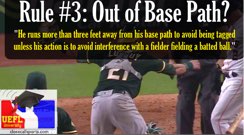
Rule #3: According to retiring-a-runner rule 5.09(b)(1), a runner is out when—"He runs more than three feet away from his base path to avoid being tagged unless his action is to avoid interference with a fielder fielding a batted ball."

QOC, Call #3: The batted ball exemption doesn't apply here, as Lucroy has already fielded the ball, leaving us to consider whether Bregman is three+ feet out of his path, established at the time of the tag attempt. It appears Bregman never quite arrived at (returned to) home plate, which also renders moot an MLB Umpire Manual interpretation regarding a batter-runner who retreats to home ("In situations where the batter-runner gets in a rundown between first and home, if the batter-runner retreats and reaches home plate, the batter-runner shall be declared out").

Call #4: Umpire Interference or Play On: As Lucroy fumbled the ball and HP Umpire Rackley stepped in for a closer look, the ball bounced off Rackley and settled in the dirt.

HP Umpire Rackley did not interfere.
Rule #4: Umpire interference occurs under very specific circumstances, which are presented in 6.01(f) [5.06(c)(2), delineating when the ball is dead, also describes that which is depicted by 6.01(f)(1)]: "Umpire’s interference occurs (1) when a plate umpire hinders, impedes or prevents a catcher’s throw attempting to prevent a stolen base or retire a runner on a pick-off play; or (2) when a fair ball touches an umpire on fair territory before passing a fielder. Umpire interference may also occur when an umpire interferes with a catcher returning the ball to the pitcher." To put it even more bluntly, "If a thrown ball accidentally touches a base coach, or a pitched or thrown ball touches an umpire, the ball is alive and in play."

QOC, Call #4: There is no call to make here, as a fumbled ball bouncing off of an umpire's chest is not one of the scenarios depicted nor covered by the umpire interference rule.

Call #5: Obstruction or Legal: As catcher Lucroy fumbles the ball into the left-handed batter's box, batter-runner Bregman reverses his retreat and sprints toward first base, avoiding the catcher in the process.

The runner did not obstruct the fielder.
Rule #5: The definition of terms holds that "OBSTRUCTION is the act of a fielder who, while not in possession of the ball and not in the act of fielding the ball, impedes the progress of any runner."

QOC, Call #5: It appears batter-runner Bregman was not impeded by catcher Lucroy, so no obstruction occurred. Had this been obstruction, it would be an instance of OBS Type 2 (Type B), as in rule 6.01(h)(2), because Lucroy had already fumbled the ball away after fielding it and making a play on the runner: "If no play is being made on the obstructed runner, the play shall proceed until no further action is possible."

Call #6: Runner's Lane Interference or Nothing: Lest we give up too quickly, the final aspect of this play concerns whether Bregman legally ran to first base as catcher Lucroy threw to first baseman Canha.

The runner did not commit RLI (INT).
Rule #6: Rule 5.09(a)(11) allows the batter-runner to be declared out if, "In running the last half of the distance from home base to first base, while the ball is being fielded to first base, he runs outside (to the right of) the three-foot line, or inside (to the left of) the foul line, and in the umpire’s judgment in so doing interferes with the fielder taking the throw at first base."

QOC, Call #6: Replays indicate Bregman's running lane adventure was entirely legal; he entered the lane on or between the two chalk lines and remained in the lane until the ball was already up the right field line, well past the infield.

At least six rules were involved in just one play Tuesday.
BONUS Call #7: Obstruction (on F3) or Nothing: Once Lucroy's throw eluded first baseman Canha, we were left with a first baseman standing in front of the base and a batter-runner who had to change his path in order to avoid the first baseman and touch first base. As Call #5 states above, if first baseman Canha impeded batter-runner Bregman from timely touching his base, the umpires would be within their rights to allow play to proceed through its conclusion and (let's assume Bregman was thrown out at second base prior to the winning run scoring...with two outs) make whatever call or runner placement that, in their judgment, would nullify the act of obstruction.

Mechanically Speaking: Rackley employs two "safe" mechanics here. The first signifies "no tag," "no interference," "not out of the base path," and "no obstruction"—essentially saying "everything that just happened is legal"—and the final safe call pertains to the runner's lane interference no-call, all of it the proper decision. Hunter Wendelstedt is on this crew and you sure hope he'll add Rackley's play to his curriculum at Umpire School for what to do when a crazy play finds you.

Postscript: Perhaps the most obvious call isn't even included in the aforementioned analysis—whether or not the catcher tagged the runner! As Replay Review confirmed, following an A's challenge, Lucroy did not tag Bregman—that is to say, Lucroy did not "touch a runner with the ball, or with his hand or glove holding the ball (not including hanging laces alone), while holding the ball securely and firmly in his hand or glove" [Definition of Terms: TAG]—but it just goes to show you what type of a call an umpire analyst can take for granted when confronted with no less than six additional considerations, all within a mere matter of seconds. As for HP Umpire Rackley, score that a QOC of Correct, multiplied by at least six.

Video as follows:

Monday, June 4, 2018

Commentary Critique - Glove Laces Not Part of Tag

Welcome to the inaugural episode of Commentary Critique, where we take a broadcaster's statement and analyze the announcer's rules- or umpire-centric accuracy. Today, we see if Toronto's "the laces are part of the glove...that is the rule" is a correct statement or not. Just as we determine Quality of Correctness for an umpire who ejects a player, we will attribute a Broadcaster QOC for this corner of criticism.

Question: Are laces part of the glove?
The Play: With two out and a runner on third, Blue Jays pitcher Sam Gaviglio's 2-2 slider to Red Sox batter Xander Bogaerts bounced in the dirt and eluded Jays catcher Luke Maile, who threw to Gaviglio covering home as Red Sox baserunner R3 Jackie Bradley attempted to score.

The Call & Challenge: Initially ruled safe by HP Umpire Jerry Layne, the ruling was overturned to an out after John Gibbons challenged the call.

Commentary Critique, Statement: During the Replay Review, Blue Jays broadcasters Buck Martinez and Dan Shulman stated that because the laces of Gaviglio's glove made contact with Bradley's hand, the runner was out. According to Shulman, "the laces are part of the glove...that is the rule."

Commentary Critique, QOC: This statement is inaccurate (QOCN). While the laces are physically attached to the glove, loose/hanging laces alone tagging a runner is not sufficient for an out call.

The Rule: The relevant rule may be found in the Definition of Terms, and states:
A TAG is the action of a fielder in touching a base with his body while holding the ball securely and firmly in his hand or glove; or touching a runner with the ball, or with his hand or glove holding the ball (not including hanging laces alone), while holding the ball securely and firmly in his hand or glove. 
OBR Appendix 4: Laces are not part of a glove.
Analysis: Accordingly, laces alone are not sufficient for a tag and the broadcasters' statement otherwise ("that is the rule") is incorrect. This phrase—"not including hanging laces alone"—was added to the Official Baseball Rules ahead of the 2016 season, as the Rules Committee was concerned with expanded replay and potential confusion of whether a hanging lace incidentally contacting a runner should be enough to oblige the Replay Official to overturn a safe call or confirm an out call.

This is also supported by OBR Diagram 4, in Appendix 4, which pictures a regulation glove featuring many items of interest, none of which happen to be hanging laces.

Instead, the call in Boston was overturned to "out" because the fielder tagged the runner, not with hanging laces, but with the glove's web, as indicated by Diagram 4's letter "E" (and C, and D).

Video as follows:

Tuesday, September 6, 2016

Case Play 2016-10 - Watch Your Step [Solved]

Tagging out a runner can be hazardous when glove and foot collide. Watch Your Step is our 10th Case Play of the 2016 season and concerns a Replay Review decision flagged for discussion by tmac.

Wainwright's glove is possessed...by the ball.
The Play: With one out and one on (R1), Mets batter James Loney hit a first-pitch fastball from Cardinals pitcher Adam Wainwright to shallow left field, where it was scooped up on a bounce (or few) by left fielder Brandon Moss, who threw to third base as baserunner R1 Cespedes tried to advance, pitcher Wainwright covering for his third baseman. Replays indicate that after Wainwright received the throw and staged his glove to apply the tag ahead of Cespedes' arrival, ensuing contact resulted in Wainwright's glove becoming detached from his hand as Cespedes appeared to step on Wainwright's gloved hand during the course of his pop-up slide (wherein the baserunner essentially kicks off of the base in order to "pop-up" or get back to a standing position). Ruled "safe" by HP Umpire Marty Foster (who Mets broadcaster Ron Darling nearly-obsessively criticized for not getting "in proper position to make the call," and then for calling it "late"), the call was confirmed following a Replay Review and Manager's Challenge by Cards skipper Mike Matheny.

Question: Given the aforementioned play, what is the proper call for each of the following scenarios?
(A) As occurred, is Foster's (and the Replay Official)'s call correct?
(B) B1 Loney runs to second base as the glove comes off.
(C) All else equal, the third baseman standing next to the play throws his own glove off and puts his hand inside Wainwright's glove, so as to securely hold it, as Cespedes remains standing with his foot in contact with the ball-possessing glove (e.g., Cespedes is not touching the base).
(D) All else equal to [C], except the third baseman retains his glove and simply grabs Wainwright's glove from under Cespedes using his free hand. When he pulls the glove up, it is apparent that the baseball is securely lodged within the closed glove.

Answer: (A) Foster's ruling is correct. The runner is safe. The fielder is not considered as "holding the ball securely and firmly in his hand or glove" if he is not wearing his glove, in a similar vein as dropping the ball immediately following his touching a runner.
(B) The play is live—there is no interference on the runner's part—and B1's advance will stand.
(C) & (D) The definition of "tag" simply requires that the ball be held securely and firmly in hand or glove. If the fielder demonstrates secure and firm possession of the ball (or of the glove, which in turn, securely holds the ball) and tags the runner off his base, the runner is out.

In regards to the lodged ball in glove issue, we had a question on whether this (that the ball remains live and in play) is true for all codes. The answer is NO. This is a rule exclusive to NCAA (college) and professional ball, allowing fielders to play a glove with a ball stuck in it. Under NFHS (high school/FED), the ball is immediately dead and the award is one base from time-of-dead-ball.

Official Baseball Rules Library
OBR 5.09(b)(4): "Any runner is out when—He is tagged, when the ball is alive, while off his base."
Definition of Terms (Tag): "A TAG is the action of a fielder in touching a base with his body while holding the ball securely and firmly in his hand or glove; or touching a runner with the ball, or with his hand or glove holding the ball (not including hanging laces alone), while holding the ball securely and firmly in his hand or glove. It is not a tag, however, if simultaneously or immediately following his touching a base or touching a runner, the fielder drops the ball. In establishing the validity of the tag, the fielder shall hold the ball long enough to prove that he has complete control of the ball. If the fielder has made a tag and drops the ball while in the act of making a throw following the tag, the tag shall be adjudged to have been made."

Video available via "Read more"

Tuesday, June 14, 2016

Marlins File Doomed Protest Over Out of Base Path Call

The Marlins filed a protest over Umpire Cory Blaser's out of the base path call that drew the ire of Miami Manager Don Mattingly. With none out, two on (R1, R2), and fans barely in their seats in the top of the first inning of the Marlins-Padres game, Marlins batter Christian Yelich hit a ground ball to Marlins first baseman Wil Myers, who attempted to tag out Yelich as Yelich slid to his right trying to avoid Myers' tag. After 1B Umpire Cory Blaser immediately ruled Yelich out for running more than three feet away from his base path, Mattingly ran out to argue with Blaser.

Upon crew consultation, Blaser upheld his out call, prompting Don Mattingly to file a protest with Crew Chief Jeff Nelson, alleging that Blaser misapplied Rule 5.09(b)(1) regarding a runner being deemed out of the base path.

Here is why Don Mattingly's protest will be unsuccessful (or would have failed had SD won the game):

Diagram of the play: Is Yelich out of sorts?
Since the Marlins won the game (as the non-protesting team usually does), the protest was automatically dropped, but Mattingly's protest of Blaser's OBR 5.09(b)(1) rules application was invalid from the beginning since it concerned a question of judgment and not of application (Rule 8.02(a): "Any umpire's decision which involves judgment...is final"). The following section addresses why Mattingly's protest was of an ineligible judgment call, as opposed to a rules misapplication.

Rule 5.09(b)(1) states that a runner is out when, in the umpire's judgment, "He runs more than three feet away from his base path to avoid being tagged unless his action is to avoid interference with a fielder fielding a batted ball. A runner’s base path is established when the tag attempt occurs and is a straight line from the runner to the base he is attempting to reach safely."

Mattingly's protest concerned Blaser's ruling of when "the tag attempt [occurred]" and B1 Yelich's position at the time of said occurrence. However, the official baseball rules do not specifically delineate such a tag attempt's timing. OBR's Definition of Terms specifies that, "a tag is a touch of the base/runner with the ball/glove," so a tag attempt, logically, is an attempt to touch the runner in this fashion ("attempt" is not defined).

Because there is no specific rule that specifies when, precisely, a "tag attempt" begins (much less what a "tag attempt" actually is), there is no rule which Blaser could have misapplied. As such, Mattingly's protest could not have possibly concerned a rules application, and instead, concerned a judgment call, which, by rule, is not eligible for protest. (Unless, of course, Blaser for some reason had called the runner out for being out of the runner's lane [the lane is irrelevant for this play since interference is not in question], though field microphone audio indicates Blaser used the out-of-the-base-path umpire's shorthand of, "he's out of the base line!" confirming this as an OOB call and not an RLI one: again, no interference = no RLI.)

Perhaps Mattingly played the role of magician and used the classic guise of misdirection to distract Blaser and Nelson from his otherwise-potentially ejectable conduct, drawing their attention away through any umpire's favorite pastime: a rules discussion.

Now that we've established the inadmissibility of Mattingly's protest, we can turn our attention to Blaser's judgment call and consider whether or not his call was correct. Replays appear to indicate that at the moment F3 Myers executed a tag attempt for the first time, B1 Yelich appeared to be running in the absolute center of the runner's lane (which, again, has no bearing on this play other than to provide a physical landmark or reference point as to the three-feet specified in 5.09(b)(1), though good on Yelich for running fully within the lane, given our recent spate of RLI controversy). Yelich's furthest deviation from the established base path appears to have been somewhere in the realm of three feet, though replays are ultimately inconclusive as to whether he ran and dove over three feet out of his way.
(For more on this sort of play, see: Baez Out of Base Path, 5/23/16 [1B Umpire Dana DeMuth])

BONUS: Replays do indicate that Myers appeared to actually tag Yelich, meaning that had Blaser reversed his call to "safe," and Padres Manager Andy Green subsequently challenged the play, it likely would have been overturned to an out due to Myers' tag.

Thursday, July 3, 2014

MLB Instant Replay Review 649: Vic Carapazza (07)

Instant Replay Review overturned 1B Umpire Vic Carapazza's safe (missed tag) call in the top of the 2nd inning of the Blue Jays-Athletics game. With one out and three on, Blue Jays batter Anthony Gose hit a 0-0 fastball from Athletics pitcher Sonny Gray on the ground to first baseman Nate Freiman, who attempted to tag Blue Jays baserunner R1 Munenori Kawasaki before throwing to A's catcher Stephen Vogt, who tagged home plate as Blue Jays baserunner R3 Edwin Encarnacion attempted to score. Upon Replay Review as the result of a challenge by Blue Jays Manager John Gibbons, Carapazza's ruling was reversed, the call was incorrect. At the time of the review, the game was tied, 0-0. The Athletics ultimately won the contest, 4-1.

This is Vic Carapazza (19)'s seventh Replay Review of the 2014 MLB Regular Season.
This is Crew Chief Bill Miller's 37th supervised Replay Review of the 2014 Season.
*Athletics Manager Bob Melvin elected to play the remainder of the game under formal protest, alleging that had the call at first base been out (removed the force), Vogt would have tagged Encarnacion, resulting in a double play. Instead, Replay Review determined that Encarnacion's run scored for lack of a tag to his person. The protest was dropped after the game as the result of Oakland's 4-1 victory.
Regarding Protests: Replay Regulation II.K.4 states, "Official Baseball Rule 4.19 shall have no applicability to these Replay Regulations. No protest shall ever be permitted on judgment decisions by the Replay Official. Moreover, a violation of any rule or procedure set forth herein shall not constitute a basis for protesting a game."

This is the 649th Instant Replay Review of the 2014 MLB Regular Season.
This is the Toronto Blue Jays' 31st Replay Review of 2014.
Umpires are now 336/649 (.518 Affirmation Rate) in Replay Reviews during the 2014 MLB season.

Friday, April 25, 2014

MLB Changes Catch/Transfer Rule Interpretation

MLB revised the new catch/transfer rule interpretation that came about in 2014, declaring a return to the standard used in 2013, prior to the expansion of instant replay review. Although the interpretation clearly changed in 2014, Major League Baseball announced the revision as its "official view" of how umpires should call Rule 2.00 [Catch] or [Tag]. The Playing Rules Committee (Brian Gorman, umpire representative) decreed the review. Enforcement of this clarification was set to begin immediately.

At the heart of the matter is when a ball is ruled caught or a tag (force out) made and, accordingly, when release is voluntary and intentional. Prior to 2014, attempted voluntary release qualified as acceptable for an out call (e.g., a flip or drop "on the transfer"). With the advent of replay review and the new catch/transfer rule interpretation in 2014, this phrase was eliminated from HW and replaced with an interpretation that the fielder must retain possession of the ball in the transfer. For Replay Officials, this meant less gray, more black & white.

The Rule 2.00 Catch interpretation has changed.
Rule 2.00 [Catch] has always provided that, "In establishing the validity of the catch, the fielder shall hold the ball long enough to prove that he has complete control of the ball and that his release of the ball is voluntary and intentional. If the fielder has made the catch and drops the ball while in the act of making a throw following the catch, the ball shall be adjudged to have been caught."

Prior to the 2014 season, umpires interpreted Rule 2.00 [Legal Catch], as pertains to a transfer, using the following criterion: "A ball will be ruled caught when the momentum of the catch is completed and the player voluntarily releases the ball" (MLBUM).

In 2014, the interpretation for a legal catch or tag received the following addition:
In determining whether a fielder drops the ball “while in the act of making a throw following the catch” in accordance with Rule 2.00, the umpires will determine whether the fielder obtained possession of a ball in flight but dropped the ball while in the act of making a throw during the momentum of the catch. For example, if the shortstop, in an effort to turn a double play, throws to the second baseman, who drops the ball while in the act of drawing back his arm to make a throw to first base, the second baseman shall be adjudged to have had secure control of the ball and thus the ball shall be adjudged to have been caught by the second baseman. However, it shall not be adjudged to be a catch if, while in the act of making a throw during the momentum of the catch, the fielder loses possession of the ball in the transfer (e.g., flip from the glove) before he secures the ball with his throwing hand.
The Harry Wendelstedt Umpire School added the following:
The "flip" itself is not deemed a voluntary release, even though it may be a voluntary action. This is an update you will find in the 2014 Rules and Interpretations Manual. We have removed the exclusive interpretation offered for a number of year providing that it only be an attempted voluntary release. This is no longer the case. The release must be voluntary. Additionally, this interpretation has been merged with a tag of a base as well on the front end of a double play attempt. He must secure the ball in his throwing hand before it will be deemed secure possession was made.
No more, said MLB. Securing the ball with the throwing hand has been eliminated from interpretational jargon. Going back to the future, baseball will again allow a drop during the transfer to be considered a catch as long as the fielder has made the catch and dropped the ball while in the act of making a throw following the catch.

Press Release: Playing Rules Committee reviews interpretation of transfer play (MLB)
Related Post: New 2014 Rule Interpretation: Catch/Transfer Explained

Thursday, March 28, 2013

Case Play Solution 2013-01: Ball Comes Apart During Play

Case Play 2013-01 (ball comes apart during play) is now complete. Refer to the solution below.
Original post: Case Play: Hockey Pucks Splits in Two in Swiss Game

To recap, with two outs and bases loaded in the bottom of the ninth inning of a 3-0 game, B1 hits a fly to deep center field with such force that the ball comes at least partially, if not fully, apart during play (Video);

Qa) Was our umpire correct in keeping this play alive... Aa) Yes. As many UEFL'ers alluded to, Rule 5.02 Comment specifies that if a ball shall come partially apart during play, the play remains live. Though Rule 5.10(e) authorizes an umpire to call "Time" for the purposes of examining the ball or equipment, 5.10(h) prescribes an umpire shall not call "Time" while a play is in progress, as is the case with, amongst others, Rule 5.02. The video clearly indicates a play is in progress while the ball is apart.

Qb) Is B1 out or does his run count; how does play proceed... Ab: B1 is out. Also acceptable: B1 is safe. Rule 2.00 [Tag] decrees an out shall be recorded if a fielder touches a runner with a baseball that is held securely and firmly in his hand; secure possession is of tantamount importance. Depending on your interpretation of the video, the game either goes into extra innings or offensive Team A wins {see 9.01(c) below, in part (c)}.

Qc) If the ball completely severs in two, with half landing in F8's glove and half landing over the fair outfield wall, what happens... Ac) Though Rules 6.09(d) and 7.05(a) specify that all runners and the batter may advance to home plate, scoring a run, if a fair ball goes out of the playing field in flight, Rule 6.05(a) ordains a batter is out when his fair or foul fly ball (other than a foul tip) is legally caught by a fielder. Rule 2.00 [Catch] defines the act as a fielder gaining secure possession of a ball in flight and holding it. No rule or official interpretation specifically addresses a ball coming completely apart during play. Therefore, Rule 9.01(c)—the elastic clause—applies. The "larger part of the ball" theory is not an official interpretation, though Rule 9.01(c) authorizes an umpire employing this or another principle to help adjudicate this play.

Thank you to all participants—each and every league member who participated answered at least one (generally more than one) scenario correctly, thereby earning one Case Play point in the UEFL standings.

+1 point to: BigCatch22, clawdad, CricketChapman, cyclone14, Drjjulius, gkiewitt, heyblue17, JeremyJ, Kevin Nichols, kickersrule, Oakgrove1, pamarlowe, titandude25, toss 'em, Turducken, TXWrangler, wwjd220.

Monday, September 10, 2012

Ejection 160: Angel Campos (7)

2B Umpire Angel Campos ejected Rockies Manager Jim Tracy for arguing an out call in the bottom of the 7th inning of the Giants-Rockies game. With one out and one on, Rockies batter Carlos Gonzalez hit a 2-2 fastball from Giants pitcher Jeremy Affeldt on the ground to second baseman Marco Scutaro, who attempted to tag baserunner R1 Josh Rutledge enroute to completing the double play by throwing to first baseman Brandon Belt. Replays indicate Scutaro's glove failed to make contact with Rutledge as he ran by while evidence suggests Rutledge's path of travel did take him out of the baseline pursuant to Rule 7.08(a)(1), the call was correct (see also: UEFL Rule 6-2-b-6-a). The call is now incorrect.* At the time of the ejection, the Rockies were leading, 6-4. The Rockies ultimately won the contest, 6-5.

This is Angel Campos (84)'s seventh ejection of 2012.
Angel Campos now has 21 points in the UEFL (23 Previous + 3 AAA + -1 Penalty + -4 Incorrect Call = 21) and remains the UEFL points leader.
Crew Chief Tim McClelland now has 3 points in the UEFL's Crew Division (3 Previous + 0 Incorrect Call = 3).
*QOC has been reversed by the UEFL Appeals Board (3-2).

UEFL Standings Update

This is the 160th ejection of 2012.
This is the 74th Manager ejection of 2012.
This is the Rockies' 3rd ejection of 2012, 4th in the NL West (LAD 11; SD, SF 4; COL 3; AZ 2).
This is Jim Tracy's first ejection since August 6 (Mike Everitt; QOC = Correct).
This is Angel Campos' first ejection since August 22 (Ozzie Guillen; QOC = Correct).

Wrap: San Francisco Giants at Colorado Rockies, 9/10/12
Video: Tracy argues close out call at second base as Giants escape 7th inning jam (COL)

Sunday, July 1, 2012

Ejection 081: James Hoye (2)

HP Umpire James Hoye ejected Angels Manager Mike Scioscia for arguing a safe call in the bottom of the 6th inning of the Angels-Blue Jays game. With none out and three on, Blue Jays batter Jose Bautista reached on a force attempt, fielding error by Angels second baseman Howard Kendrick. Blue Jays R3 Omar Vizquel scored. R2 Brett Lawrie scored. R1 Colby Rasmus to 3rd. Jose Bautista to 2nd. Replays indicate that as Lawrie went into the plate he collided with Angels catcher John Hester. Lawrie collided into Hester's forearm at the plate, but while in continued contact, Hester contacted Lawrie's shoulder with his bottom portion and base of the glove with the ball inside prior to Lawrie touching home plate (Hoye signaled safe, and then safe again when Lawrie retouched home plate prior to once again being tagged by Hester), the call was incorrect. After review, QOC has been reversed. The call is now correct.* At the time of the ejection, the Angels were leading, 3-2. The Angels ultimately won the contest, 10-6.

This is James Hoye (92)'s second ejection of 2012.
James Hoye now has 6 points in the UEFL (2 Previous + 2 MLB + 2 Correct Call = 6).
Crew Chief Tom Hallion now has 2 points in the UEFL's Crew Division (1 Previous + 1 Correct Call = 2).
*After review, Quality of Correctness has been reversed by the UEFL Appeals Board (4-2).
*Historical Appeals Board decisions may be consulted via the UEFL Portal.*

UEFL Standings Update

This is the 81st ejection of 2012.
This is the 41st Manager ejection of 2012.
This is Mike Scioscia's third ejection of 2012.
This is Mike Scioscia's first ejection since June 24 (Dan Iassogna; QOC = Correct).
This is James Hoye's first ejection since  May 19 (Bob Melvin; QOC = Irrecusable).
This is the Angels' third ejection of 2012, tied for second in the AL West (OAK 4; TEX 3; SEA 0).

Wrap: Angels at Blue Jays 7/1/12 (Canada Day)
Video: Error leads to collision at the plate between Lawrie, Hester; Scioscia tossed by Hoye
Video: Angels broadcasters determine Hoye has had "atrocious afternoon" after close call at plate
Related: Changed strike three call by Eric Cooper negates double play, results in Bobby Cox's ejection (2009)