Showing posts with label Rule 2.00 [Interference]. Show all posts

Tuesday, June 23, 2026

Interference Ends Rockies-Pirates Game as Runner Clips Fielder

An umpire crew's interference call ended a one-run Rockies-Pirates game when Pittsburgh runner R2 Billy Cook ran in front of Colorado 3B Kyle Karros and, in doing so, interfered with the fielder's ability to field the batted ball. Let's take a look.

With two out and the bases loaded in the top of the 9th inning of a game Colorado led 2-1, Pirates batter Jake Mangum hit a 1-2 changeup from Rockies pitcher Jaden Hill on the ground toward 3B Karros, who prepared to field the ball as Pittsburgh baserunner R2 Cook ran by.

Although neither 2B Umpire Tyler Jones nor 3B Umpire Clint Vondrak called interference in real-time, Crew Chief Todd Tichenor convened his crew and, alongside HP Umpire Adam Hamari, exited the brief consultation by ruling baserunner Cook out for interference, resulting in the third and final out of the inning and of the ballgame itself.

Official Baseball Rule 6.01(a)(10) states "it is interference by a batter or a runner when they fail to avoid a fielder who is attempting to field a batted ball." Meanwhile, "obstruction is the act of a fielder who, while not in possession of the ball and not in the act of fielding the ball, impedes the progress of any runner."

Interference on the other hand is defined as follows: "Offensive interference is an act by the team at bat which interferes with, obstructs, impedes, hinders or confuses any fielder attempting to make a play." Note that contact between runner and fielder is not required for interference to be called. All that is needed is an act by the runner that simply impedes or hinders the fielder in their attempt to, in this case, field a batted ball.

From these rules and definitions, we are able to assemble a general baseball axiom.
During a batted ball, the fielder has the right of way to field the ball.
At any other time, the runner has the right of way to run the bases.

In other words, because 3B Karros was attempting to field a batted ball, that means he as the fielder has the right of way. Therefore, illegal interaction with the runner results in an interference call, even if there was no actual contact between the players, although in this case, the runner's left foot appeared to contact the fielder's glove prior to the ball's arrival.

Video as follows:

Wednesday, October 8, 2025

Catcher's Interference No-Call in TOR-NYY ALDS

Blue Jays catcher Alejandro Kirk did not interfere with Yankees batter Trent Grisham in Game 3 of the Toronto-New York ALDS, following a Replay Review that upheld HP Umpire Jordan Baker's interference no-call as Grisham's bat came awfully close to making contact with catcher Kirk's mitt.

With none out and none on in the bottom of the 3rd inning of Game 3, batter Grisham attempted to check his swing on a 2-2 knuckle curve from Blue Jays pitcher Shane Bieber, ruled ball three. 

Upon Replay Review as the result of a manager's challenge by Yankees manager Aaron Boone, HP Umpire Baker's call was upheld, with Replay HQ ruling "call stands" as to the question of catcher's interference. 

Specifically, clear and convincing evidence did not exist to indicate whether or not catcher Kirk interfered. Because of the "call stands" ruling, we know the Replay Official judged the play solely on the merits of whether or not Grisham's bat made contact with Kirk's mitt.

The Official Baseball Rules defines catcher's interference as defensive interference: "an act by a fielder that hinders or prevents a batter from hitting a pitch."

Because replay only concerned itself with potential batt-glove contact, the judgment call as to whether hinderance actually existed (beyond the question of whether contact occurred) was not on the table.

In high school (NFHS), catcher's interference is called catcher's obstruction, as NFHS defensive interference is specifically an act that occurs prior to the pitch.

OBR 6.01(c) specifies the penalty for catcher's interference: "The batter becomes a runner and is entitled to first base without liability to be put out (provided they advance to and touches first base) when the catcher or any fielder interferes with them."

Video as follows:

Wednesday, September 17, 2025

Fan Interference AND HR? Blue Jays-Rays Replay Rewind

Rays batter Brandon Lowe's home run stood on review as umpires called both fan interference and a home run on the same play. Blue Jays manager John Schneider met with 3B Umpire Laz Diaz afterward to discuss the unusual ruling, which we now analyze.

With one out and two on in the bottom of the 3rd inning, Rays batter Lowe hit a 2-2 changeup from Blue Jays pitcher José Berríos on a fly ball to deep right-center field. Blue Jays right fielder Nathan Lukes jumped in an attempt to catch the ball, but a fan reached out of the stands and caught the descending fly ball, ruled a home run by 1B Umpire Brian O'Nora.

Upon Replay Review as the result of a Crew Chief initiated-second look (potential home runs are chief reviews), Replay determined that while the fan did definitively commit spectator interference, the home run would ultimately stand because, absent the fan's interference, the ball would have left the yard anyway.

In crafting this ruling, the Replay Official relied on two different rules concerning spectator interference. The analysis thus relies on two different parts.

First, the Official Baseball Rules definition of terms delineates what spectator interference actually is: "Spectator interference occurs when a spectator (or an object thrown by the spectator) hinders a player’s attempt to make a play on a live ball, by going onto the playing field, or reaching out of the stands and over the playing field."

Upon review, Replay HQ in New York determined clear and convincing evidence did exist to declare that spectator interference did occur. To that end, the call on the field of no interference was overturned.

Second, OBR 6.01(e) is triggered only if the spectator interference definition's criteria are satisfied. OBR 6.01(e) states, "When there is spectator interference with any thrown or batted ball, the ball shall be dead at the moment of interference and the umpire shall impose such penalties as in their opinion will nullify the act of interference." An approved ruling allows the umpire to award an out if the fielder would have caught the ball if not for the interference.

This second part of the equation is where Replay Review encountered more difficulty. Because the video angles available were all from press box/behind the home plate area, and no side angle (e.g., parallel to the fence-line) existed, Replay HQ could not definitely determine what would have happened had interference not occurred. In other words, Replay had trouble with the "nullify the act" portion of the rule.

With a lack of clear and convincing evidence to determine how to nullify the act of interference, that leaves with a peculiar ruling of overturn for the interference part of the equation, but call stands for the nullification portion.

Accordingly, the technically correct language and outcome for this play is that the call on the field of no interference was overturned. It was spectator interference, but because of a lack of clear and convincing evidence to suggest what would have occurred absent the fan's illegal involvement, the home run ultimately stands as called.

Video as follows:

Wednesday, September 3, 2025

Obstruction in Boston as Runner & Catcher Collide on Batted Ball

"Obstruction!" announced umpire Jordan Baker after Guardians batter-runner José Ramírez and Red Sox catcher Connor Wong collided on a batted ball up the first baseline. Instead of an out, Ramírez was awarded first base and Cleveland's Brayan Rocchio scored from third. What's the rule and did Baker's crew get the call right?

With one out and runners on second and third in the top of the 2nd inning of Wednesday's Guardians vs Red Sox game, batter Ramírez hit a check swing ground ball in front of home plate toward first base. Boston catcher Wong initially pursued the batted ball before stopping once he saw pitcher Steven Matz running to field it, turning around to head back to cover home plate as R3 Rocchio raced in.

But as Wong turned toward home, he collided with batter-runner Ramírez. Initially ruled interference on Ramírez, chief Baker called his crew into consultation, ultimately ruling that, because Wong was not entitled to protection under the rules for fielding a batted ball, he therefore obstructed the batter-runner. Accordingly, the batter-runner was awarded first base and all runners advanced one base.

In general, baseball's right-of-way rules give the fielder the right to field a batted ball (meaning the runners must avoid the fielder lest they be guilty of interference) while the runner has the right to run the bases at any other time (the fielder must get out of the runner's way). However, only one fielder is entitled to right-of-way protection on a batted ball and, in this case, that protected fielder was not the pitcher, not the catcher. As such, the unprotected catcher obstructed the runner's right to run the bases.

This is the correct call pursuant to the following rules:
Official Baseball Rule 6.01(a)(10): "It is interference by a batter or a runner when they fail to avoid a fielder who is attempting to field a batted ball, or intentionally interfere with a thrown ball, provided that if two or more fielders attempt to field a batted ball, and the runner comes in contact with one or more of them, the umpire shall determine which fielder is entitled to the benefit of this rule, and shall not declare the runner out for coming in contact with a fielder other than the one the umpire determines to be entitled to field such a ball."
OBR 6.01(h)(1): "If a play is being made on the obstructed runner, or if the batter-runner is obstructed before they touch first base, the ball is dead and all runners shall advance, without liability to be put out, to the bases they would have reached, in the umpire’s judgment, if there had been no obstruction. The obstructed runner shall be awarded at least one base beyond the base they had last legally touched before the obstruction."

Wrap: Cleveland Guardians vs Boston Red Sox, 9/3/25 | Video as follows:

Monday, August 18, 2025

MLB Ejection 132 - James Hoye (5; Mike Shildt)

HP Umpire James Hoye ejected Padres manager Mike Shildt (Replay Review decision that overturned Xander Bogaert's HR to fan interference/out; QOCN) in the bottom of the 2nd inning of the #Giants-#Padres game. With none out and none on, Padres batter Xander Bogaerts hit a 3-1 fastball from Giants pitcher Robbie Ray on a fly ball to left field, whereupon outfield Heliot Ramos attempted to catch the fly ball as a fan did as well, ruled a home run by 2B Umpire DJ Reyburn and overturned to fan interference/out upon Replay Review as the result of a Crew Chief Review. Replays do not clearly and convincingly suggest whether or not the spectator reached out of the stands and over the playing field (and in doing so hindered the fielder), the call was incorrect.* At the time of the ejection, the Giants were leading, 4-0. The Giants ultimately won the contest, 4-3.

This is James Hoye (92)'s 5th ejection of 2025.
*The initial call's QOC may very well be Correct; however, the decision to overturn the original ruling was incorrect, for lack of clear and convincing evidence with which to overturn or confirm it.
Official Baseball Rules Definition: "Spectator interference occurs when a spectator (or an object thrown by the spectator) hinders a player’s attempt to make a play on a live ball, by going onto the playing field, or reaching out of the stands and over the playing field."

This is the 132nd ejection of the 2025 MLB regular season.
This is the 71st manager ejection of 2025. Ejection Tally: 71 Managers, 23 Coaches, 38 Players.
This is San Diego's 8th ejection of 2025, 1st in the NL West (SD 8; ARI 5; SF 4; LAD 3; COL 2).
This is Mike Shildt's 2nd ejection of 2025, 1st since July 8 (Brian Walsh; QOC = Y [Balls/Strikes]).
This is James Hoye's 5th ejection of 2025, 1st since July 20 (Tom Mansolino; QOC = U-c [Check Swing]).

Wrap: San Francisco Giants vs San Diego Padres, 8/18/25 | Video as follows:

Tuesday, July 22, 2025

Phillies Win on Walk-Off Catcher's Interference

A walk-off win due to catcher's interference in Philadelphia left some Boston fans perplexed as Phillies batter Edmundo Sosa's bat made contact with Red Sox catcher Carlos Narváez during a 2-2 pitch, HP Umpire Quinn Wolcott announcing Replay Review's verdict over the stadium PA much to the delight of the home crowd. Because the bases were loaded at the time of the interference, all runners advanced and the tied game ended in the 10th inning.

Catcher's interference is defined more broadly as defensive interference in the Official Baseball Rules: "an act by a fielder that hinders or prevents a batter from hitting a pitch." In high school (NFHS), catcher's interference is called catcher's obstruction, as NFHS defensive interference is specifically an act that occurs prior to the pitch.

OBR 6.01(c) specifies the penalty for catcher's interference: "The batter becomes a runner and is entitled to first base without liability to be put out (provided they advance to and touches first base) when the catcher or any fielder interferes with them."

It is a rules myth that the batter must actually legitimately swing for catcher's interference to be called. For instance, catcher's interference also occurs when a catcher steps on or across home plate prior to the pitch's arrival, whether or not the batter actually swings at the pitch. Instead, catcher's interference occurs when the catcher's physical positioning (of body and/or glove/mitt) deprives the batter of the opportunity to choose whether to swing or not.

Because batter Sosa is said to have been deprived of this freedom of choice by virtue of the bat-mitt contact, the Replay Official overturned the on-field no-call and awarded the interference penalty, resulting in a walk-off win.

Video as follows:

Saturday, July 5, 2025

Runner Prevents Double Play by Fielding Ground Ball - Is That Legal?

Have you ever seen a baserunner field a ground ball? During July 1's La Crosse Loggers vs Duluth Huskies game in the Northwoods League, runner R2 Ethan Surowiec sought to prevent a double play on a bases loaded ground ball, opting to field the batted ball in front of La Crosse's waiting shortstop, resulting in a dead ball, with umpires ruling R2 Surowiec out and awarding batter-runner Reagan Reeder first base (the official scoring put this as a fielder's choice, but by rule this application would be credited as a single for the batter).

But was this the correct call?

This precise scenario is covered by Official Baseball Rule 6.01(a)(6): "If, in the judgment of the umpire, a base runner willfully and deliberately interferes with a batted ball or a fielder in the act of fielding a batted ball with the obvious intent to break up a double play, the ball is dead. The umpire shall call the runner out for interference and also call out the batter-runner because of the action of their teammate. In no event may bases be run or runs scored because of such action by a runner."

College's rule is even stricter, not requiring "obvious intent" but simply intentional interference: "If a double play is likely, and the runner intentionally interferes with the fielder who is attempting to field or throw the ball, both the runner and batter-runner shall be declared out" (NCAA 8-5-d).

High school returns to OBR's "obvious" standard: "The batter-runner is out when any runner or retired runner interferes (2-21-1, 2-30-3) in a way which obviously hinders an obvious double play" (NFHS 8-4-1h).

In sum, this very likely should have been ruled a double play. | Video as follows:

Wednesday, March 19, 2025

Shohei Ohtani's Home Run or Fan Interference in Tokyo?

Dodgers DH Shohei Ohtani hit a home run in Game 2 of LA's Tokyo Series sweep over Chicago, but not after umpires reviewed the play for spectator interference. Let's take another look at this call stands decision, made due to lack of clear and convincing evidence.

With one out and none on in the top of the 5th inning, Ohtani hit a 2-2 fastball from Cubs pitcher Nate Pearson to deep right-center field, whereupon a fan reached for and touched the baseball, ruled a home run by 2B Umpire John Libka.

Crew Chief Bill Miller initiated a review for spectator interference, defined by the Official Baseball Rules as occurring "when a spectator (or an object thrown by the spectator) hinders a player’s attempt to make a play on a live ball, by going onto the playing field, or reaching out of the stands and over the playing field."

OBR 6.01(e) specifies what to do when spectator interference occurs: "When there is spectator interference with any thrown or batted ball, the ball shall be dead at the moment of interference and the umpire shall impose such penalties as in their opinion will nullify the act of interference."

Replay determined that available camera angles (which themselves suffered from varying degrees of parallax) did not provide clear/convincing evidence to confirm or overturn the call, and thus ruled the original on-field ruling of home run should stand.

Video as follows:

Wednesday, March 12, 2025

Is Jumping into a Thrown Ball Interference? The Báez Case

Tigers baserunner Javier Báez jumped into a thrown ball following a diving catch by Rays shortstop Carson Williams, resulting in a double play at Grapefruit League Spring Training. With umpires not ruling this interference, instead signaling Báez out only when Tampa retrieved the loose ball and tagged first base, we review baseball's rules to determine whether the runner interfered with the play or not.

Pursuant to Official Baseball Rule 5.09(b)(3), "any runner is out when they intentionally interfere with a thrown ball; or hinder a fielder attempting to make a play on a batted ball."

Replays indicate Báez jumped after Williams began his throw toward first base in an attempt to double up Báez for failing to tag up on the air out, which is indeed interference, as long as the umpire deems the runner's actions were an intentional attempt to hinder or impede the defense from making a play (in this case, completing the throw to first base). Replays indicate 2B Umpire Diaz did not signal interference, which by rule, suggests he did not deem Báez's act as intentional in accordance with OBR 5.09(b)(3).

The definition of offensive interference is "an act by the team at bat which interferes with, obstructs, impedes, hinders or confuses any fielder attempting to make a play."

Video as follows:

Tuesday, July 9, 2024

Home Run Stands Even With Fan Interference Optics

Rockies batter Michael Toglia's home run survived Replay Review in Colorado despite video definitively indicating a fan's glove made contact with Royals left fielder Dairon Blanco's glove while the ball was still in flight. Why did umpires in New York return a "call stands"? It's baseball's parallax.

The Official Baseball Rules Definitions of Terms state, "Spectator interference occurs when a spectator (or an object thrown by the spectator) hinders a player’s attempt to make a play on a live ball, by going onto the playing field, or reaching out of the stands and over the playing field."

The definition of playing field is further explained with OBR 2.01 and the definition of fair territory, which state, "that part of the playing field within, and including the first base and third base lines, from home base to the bottom of the playing field" (foul is similar [yet different]). Thus, the vertical plane along the warning track side of the outfield wall/fence serves as the playing field's diving line.

This means the top of the fence is fair game for the fan to attempt a catch or even to interfere with the fielder—effectively, there is no interference to consider unless the fan reaches out over the warning track, not above the wall itself.

OBR 6.01(e) states that if fan interference occurs, "the ball shall be dead at the moment of interference and the umpire shall impose such penalties as in their opinion will nullify the act of interference," including the potential of awarding the defensive team an out.

Upon Crew Chief Larry Vanover shipping this to Replay HQ, the standard to confirm or overturn a call is "clear and convincing" video evidence, the absence of which results in a call stands outcome.

The issue with reviewing this play at Coors Field is a similar issue at other parks, too, in that the replay camera angles all suffer from a degree of parallax illusion, which creates uncertainty and fails to meet the clear and convincing standard.

Parallax is a displacement or difference in the apparent position of an object viewed along two different lines of sight, measured by angle of inclination between two lines. Parallax effect occurs when viewing from a certain angle creates an illusion that something has occurred (such as, in hockey, a puck crossing a goal line) that upon viewing the play from a more definitive angle—namely top-down—conclusively demonstrates the initial impression was incorrect.

Because the fan's hands were in the air, parallax effect made it difficult to judge the fan's position relative to the playing field boundary. Accordingly, even though it might look at first glance as if the fan definitively reached over the playing field and contacted the fielder and ball at that point, the Replay Official could not be certain that this view was free from parallax illusion, and returned a call stands verdict due to this uncertainty.

Thus, to Royals manager Matt Quatraro's statement, "I don't know what the explanation was, and whatever it was, it's going to be a bad explanation," there you are—through science.

Video as follows:

Thursday, May 23, 2024

White Sox Lose After Infield Fly Interference Double Play

Chicago's comeback against Baltimore came up short when 3B Umpire Junior Valentine called White Sox baserunner Andrew Vaughn for interference during batter Andrew Benintendi's pop up for a rare INT-infield fly rule double play to end the game. Pedro Grifol argued, as did Chicago's broadcasters, but to no avail...although unpleasant to end the game, Valentine's call was correct.

With one out and runners on first and second base in the bottom of the 9th inning of an 8-6 (Orioles) ballgame, Chicago batter Benintendi hit a 0-1 fastball from Orioles pitcher Craig Kimbrel high on the infield, resulting in umpires declaring an infield fly. As Orioles shortstop Gunnar Henderson jogged in to make a play on the fly ball, White Sox runner R2 Vaughn casually backed toward the fielder, creating a situation in which Henderson was forced to go around Vaughn to field the batted ball.

By rule, this is interference, which is what 3B Umpire Valentine called. Recall that during a batted ball, the fielder has the right to field it (one protected fielder per play), but at any other time, the runner has the right to run unencumbered (unless the fielder possesses the baseball or must occupy the space while in the act of fielding).

The rules citation is Official Baseball Rule 6.01(a)(10) ("Any runner is out when—they fail to avoid a fielder who is attempting to field a batted ball, or intentionally interfere with a thrown ball").

Interference during an infield fly throws a peculiar wrench into the affairs, which creates a dead ball that results in a double play, as long as the infield fly is fair. OBR's definition for Infield Fly specifies that: "If interference is called during an Infield Fly, the ball remains alive until it is determined whether the ball is fair or foul. If fair, both the runner who interfered with the fielder and the batter are out. If foul, even if caught, the runner is out and the batter returns to bat."

Accordingly, umpires declared runner Vaughn out for interfering with Henderson (remember, interference's standard is hinder or impede; there is NO contact requirement) and, as the ball became dead at the moment of interference relative to everything except determining fair/foul, there is no question of "wasn't Henderson going to catch it anyway?" When a dead ball occurs, no further action—including fielders recording outs—can take place.

The penalty for interference is to declare the runner out and the batter is also declared out, due to the infield fly (fair ball).

Video as follows:

Saturday, May 18, 2024

Pirates & Cubs Ends on Confirmed Safe Call at Plate When Runner Knocks Ball Out of Catcher's Hand

Saturday's Pirates-Cubs game ended on a walk-off slide by Cody Bellinger into home plate despite Pittsburgh catcher Joey Bart appearing to tag the runner...only to drop the ball when Bellinger knocked the ball out of Bart's hand. Replay Review confirmed HP Umpire Chris Conroy's safe call, leaving some Yinzers to wonder how replay could confirm a safe call only made because of a dropped ball...which only was dropped because the runner knocked it out of the catcher's hand.

With one out and one on (R2), Cubs batter Christopher Morel hit a 3-2 splitter from Pirates pitcher David Bednar on a line drive to center fielder Michael A Taylor, who threw home to catcher Joey Bart as Cubs baserunner R2 Bellinger slid into home plate. HP Umpire Conroy called Bellinger safe, a call challenged by Pirates manager Derek Shelton and ultimately affirmed via Replay Review.

Replay Review relied on the definition of tag, which includes this passage: "It is not a tag, however, if simultaneously or immediately following his touching a base or touching a runner, the fielder drops the ball. In establishing the validity of the tag, the fielder shall hold the ball long enough to prove that they have complete control of the ball." The phrase "holding the ball securely and firmly in their hand or glove" is also used. With the ball on the ground, Replay would determine the full process of "tag" was not completed and, thus, the tag was not valid.

The Official Baseball Rules, regarding offensive interference, specify in OBR 5.09(b)(3) that a runner is out when "they intentionally interfere with a thrown ball; or hinder a fielder attempting to make a play on a batted ball." OBR 6.01(a)(10) agrees ("fails to avoid a fielder who is attempting to field a batted ball, or intentionally interferes with a thrown ball"), and this establishes a right-of-way hierarchy we've been over several times before.

During a batted ball, a fielder has the right to field it; however, the runner has the right to run the bases at any other time.

The standard for a non-batted ball situation is intentional interference, or, the runner must commit an intentional act to be called for an interference violation. Unintentional interference only applies to batted balls (and potentially bona fide slides on force plays, collisions at home plate, runner's lane, and batter's interference), but your garden variety tag play on the bases falls under the so-called intentional or "willful and deliberate" standard.

HP Umpire Conroy did not rule interference initially, just that the runner was safe because the catcher dropped the ball.

Because non-slide rule or HP collision interference is not reviewable, the Replay Official was unable to consider the element of Bellinger's swipe knocking the ball out of Bart's hand. Even so, it would have to be an intentional act to be interference.

Accordingly, Replay Review ruled that because Bart failed to complete the process of the tag with full control and possession of the ball, the runner was safe: call confirmed.

Did Replay get this questionable Cubs catcher caper (confirmed) right? | Video as follows:

Monday, April 29, 2024

MLB Ejection 029 - Ryan Additon (1; Pat Murphy)

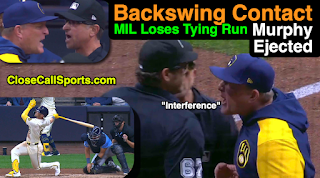
HP Umpire Ryan Additon ejected Brewers manager Pat Murphy (backswing contact [not interference]; QOCY) in the bottom of the 9th inning of the #Rays-#Brewers game. With one out and two on, Brewers batter Jake Bauers attempted to strike a 1-2 slider from Rays pitcher Jason Adam for a swinging third strike. As the pitch passed home plate, it eluded catcher René Pinto before batter Bauers' bat made contact with Pinto's head on the backswing, resulting in "Time" and dead ball call from HP Umpire Additon, who called Bauers for inadvertent backswing contact (colloquially known as "backswing interference" although this type of contact is not interference). As a result, Brewers baserunner Sal Frelick, who had slid across home plate on the wild pitch, was returned to third base and Bauers was declared out (since the dead ball strike on a 1-2 count resulted in strike three). Replays indicate Bauers' bat made contact with Pinto's head on the backswing, the call was correct.* At the time of the ejection, the Rays were leading, 1-0. The Rays ultimately won the contest, 1-0.

This is Ryan Additon (67)'s 1st ejection of 2024.
*Official Baseball Rule 6.03(a)(3) Comment states, "If a batter strikes at a ball and misses and swings so hard they carry the bat all the way around and, in the umpire’s judgment, unintentionally hit the catcher or the ball in back of them on the backswing, it shall be called a strike only (not interference). The ball will be dead, however, and no runner shall advance on the play."
In OBR/NCAA, this is inadvertent backswing contact (not actual interference).
In NFHS, this is follow-through interference (which is actual interference).

This is the 29th ejection report of the 2024 MLB regular season.
This is the 14th manager ejection of 2024. Ejection Tally: 14 Managers, 4 Coaches, 11 Players.
This is Milwaukee's 1st ejection of 2024, 2nd in the NL Central (PIT 3; MIL 1; CHC, CIN, STL 0).
This is Pat Murphy's 1st ejection since August 4, 2023 (Edwin Moscoso; QOC = Y [Balls/Strikes]).
This is Ryan Additon's 1st ejection since July 27, 2023 (Miles Mikolas; QOC = U [Throwing At]).

Sunday, April 28, 2024

Aaron Judge's Slide Into 2B - Was it Interference?

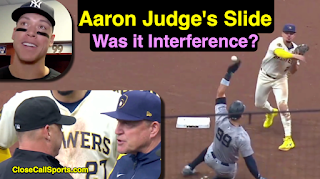
After Brewers shortstop Willy Adames' throw hit Yankees baserunner Aaron Judge's raised arm during a slide into second base, umpires opted against calling interference ruling the New York runner did not intentionally act to break up a double play in contravention of the rules. After the game, Crew Chief Andy Fletcher released a statement saying it was interference after all and that the call had been missed on the field. Here's what the rule says.

Official Baseball Rule 6.01(a)(10) pertains to interference and states it is interference when "[the offensive player] fails to avoid a fielder who is attempting to field a batted ball, or intentionally interferes with a thrown ball," while OBR 6.01(a)(5) which directly applies to this play states, "Any batter or runner who has just been put out, or any runner who has just scored, hinders or impedes any following play being made on a runner. Such runner shall be declared out for the interference of their teammate."

This language mirrors the definition of terms: "Offensive interference is an act by the team at bat which interferes with, obstructs, impedes, hinders or confuses any fielder attempting to make a play."

The intentionally interferes with a thrown ball phrasing appears elsewhere in the book as well (OBR 5.09(a)(13) explicitly puts the following runner out if a preceding runner interferes; while OBR 5.09(b)(3) puts a runner out for intentionally interfering with a thrown ball), but notably not in OBR 6.01(a)(5). Instead, the standard is lower—"simple" interference, whether or not it is actually intentional.

Obviously, intentional interference is always illegal and the intent of the retired runner can provide a clue as to whether said runner has violated the rule.

As for Judge, his action in deliberately raising his arm (one might even say willful and deliberate) and then dropping it into the path of the throw as the fielder threw the ball appears to constitute interference by a retired runner, an observation echoed by the acting Crew Chief for this game after the final out.

Video as follows:

Thursday, December 22, 2022

MLB Ejection 177 - Chad Fairchild (2; Austin Romine)

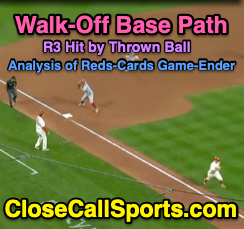
The following ejection occurred on September 17, 2022: HP Umpire Chad Fairchild ejected Reds catcher Austin Romine (runner's interference no-call; QOCY) in the bottom of the 11th inning of the #Reds-#Cardinals game. With none out and the bases loaded, Cardinals batter Paul Goldschmidt hit a 1-2 splitter from Reds pitcher Fernando Cruz on the ground to center fielder Nick Senzel (playing in on the shift), who threw to home plate as Cardinals baserunner R3 Andrew Knizner attempted to score. Replays indicate the throw hit Knizner's left arm before bouncing away from catcher Romine; because the runner establishes their own base path and no tag attempt was being attempted at the time of the ball contacting the runner, who did not intentionally interfere with the thrown ball, the no-call was correct.* At the time of the ejection, the Cardinals had won the contest, 1-0, in 11 innings.

This is Chad Fairchild (4)'s 2nd ejection of 2022.
For scorekeeping purposes, this is logged as Ejection 177 despite occurring between Ejections 164 & 166.

*There is no base path violation pursuant to Official Baseball Rule 5.09(b)(1) governing base paths and out-of-the-base-path (three-foot) calls. There is no runner's lane violation because the runner's lane only applies at first base. This leaves the question as to whether or not the runner intentionally interfered with a thrown ball, as in OBR 5.09(b)(3), which is unlikely given that the throw did not yet exist as the runner established his running motion in fair territory between third base and home plate.

Refer to our September 18 analysis for further explanation.
Related PostCardinals Win When Reds' Throw Hits Runner - Legal? (9/18/22).

This is the 177th ejection report of the 2022 MLB regular season.
This is the 62nd player ejection of 2022. Prior to ejection, Romine was 0-4 (2 SO) in the contest.
This is Cincinnati's 5th ejection of 2022, 4th in the NL Central (CHC 10; PIT, STL 6; CIN 5; MIL 4).
This is Austin Romine's 1st ejection since August 24, 2017 (Dana DeMuth; QOC = U [Fighting]).
This is Chad Fairchild's 2nd ejection of 2022, 1st since Sept 11 (Max Scherzer; QOC = Y [Replay Review]).

Saturday, October 15, 2022

France & Maldonado Tangle on Double Play in Seattle

Mariners first baseman Ty France turned a blazingly quick double play, catching Astros batter Jose Altuve's infield fly ball before quickly tagging baserunner Martin Maldonado in the 5th inning of Game 3 of the American League Division Series in Seattle. 1B Umpire Cory Blaser officiated the play several feet away while HP Umpire and Crew Chief Marvin Hudson explained the sequence to Houston manager Dusty Baker shortly thereafter.

The broadcasters mentioned that Baker may have sought to solicit an interference call, while also claiming that perhaps France had pushed Maldonado off the base ala the Kent Hrbek-Ron Gant force off play in Game 7 of the 1991 World Series, but replays confirm that fielder France tagged Maldonado off the base, and that Maldonado never made it back to first base to tag up until after the tag was applied.

There is some confusion about the entanglement issue, so perhaps the Official Baseball Rules' definitions for interference and obstruction will help explain.
Interference is an act ordinarily committed by the offense against the defense. It is defined as an infraction by the team at bat which "interferes with, obstructs, impedes, hinders, or confuses any fielder attempting to make a play." There is a special case for catcher's interference, which must be committed against a batter during a pitched ball (in NFHS/high school, this is ordinarily called catcher's obstruction).
Obstruction is an act ordinarily committed by the defense against the offense and is defined as, "the act of a fielder who, while not in possession of the ball and not in the act of fielding the ball, impedes the progress of any runner."

However, replays clearly indicate fielder France was either in the act of fielding the ball (the fielder ordinarily has the right of way to field a batted ball) or in possession of the ball at all times during the fielder-runner interaction, so it can be said that no defensive infraction occurred during this fast double play sequence. If anything, one could argue that baserunner Maldonado interfered with France, had France dropped the ball as a result of Maldonado standing off the base and in the way of the catch of a batted ball.

Video as follows:

Thursday, September 8, 2022

Reds-Cubs Batter Interference - Benefit of Doubt to Defense

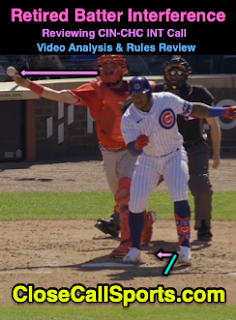
After HP Umpire Lew Williams ruled Cubs baserunner R1 Alfonso Rivas out for teammate and retired batter Nelson Velazquez's interference at home plate by stepping out of the batter's box and hindering Reds catcher Austin Romine's throw to second base, we were asked to review the batter interference rule.

An important distinction to note is that the Official Baseball Rules contain two potentially relevant provisions—one which applies to a batter who has not been retired or become a runner, and another which applies to a batter or runner who has been retired and nonetheless impedes a fielder attempting to play on a teammate.

OBR 6.03(a)(3) pertains to a still-active batter (e.g., batter has not struck out): "A batter is out for illegal action when—they interfere with the catcher’s fielding or throwing by stepping out of the batter’s box or making any other movement that hinders the catcher’s play at home base."

OBR 6.01(a)(5) pertains to a batter or runner who has been put out (including a batter that just struck out): "Any batter or runner who has just been put out, or any runner who has just scored, hinders or impedes any following play being made on a runner. Such runner shall be declared out for the interference of their teammate."

Thus, with Velazquez swinging and missing at a 3-2 pitch, we have a recently retired batter.

Because Velazquez seemed to step in front of Cincinnati catcher Romine after swinging and missing for a strikeout, the benefit of the doubt goes to the defense. Thus, it is logical to conclude that Velazquez, by stumbling to his right and in front of catcher Romine's left side, hindered or impeded Romine by causing the catcher to adjust by veering or throwing to his right more than he otherwise would have had Velazquez not stepped onto home plate. Because the throw was wild and to the right of its intended destination as well, we can conclude that interference—which does NOT require contact—likely occurred.

Video as follows:

Saturday, August 20, 2022

Rules Review - LLWS Flashy Triple Play Turned Foul Ball

The Little League World Series' Italy vs Australia elimination game produced an absolutely wild and wacky sequence that began as a bases-loaded, none-out triple play before umpires corrected it to, and Replay Review confirmed, the ultimate call of a foul ball. From the infield fly rule to fair/foul to interference, we review the Official Baseball Rules to determine what happened and what could have transpired had things turned out differently.

Play: With none out and the bases loaded in the top of the 3rd inning, a batter Team Italy, trailing Australia 5-0, hit a high fly ball along the first baseline, on the infield between home plate and first base. The ball fell untouched and was fielded by Australia's first baseman, who threw to the catcher ahead of Italy's runner. The catcher stepped on home plate before throwing to the third baseman, who tagged Italy's lead runner R3 as he ran back toward third base. Having tagged R3, Australia's third baseman then threw to the second baseman, who stepped on second base and then tagged Italy's trailing runner R1 as R1 ran toward second base. Following this, Italy's middle runner R2 took off for third base and Australia's second baseman threw to the third baseman, who tagged R2 as he slid into third base.

Call: The HP Umpire declared an Infield Fly and a fair ball, the 3B Umpire declared R3 out at third base, the 2B Umpire declared R1 out at second base, and then the 3B Umpire declared R2 out at third base.

Correcting the Fourth Out...and More: After the apparent triple play, the umpires conferred and determined that the batted ball had become foul, thus negating all subsequent action. The play was ruled a foul ball, which was confirmed after manager's challenge by Australia, and Italy's batter returned to bat.

Remember, even with all other criteria satisfied (runners on first and second [or bases loaded] with less than two out, batted ball is a fly ball which is not a line drive  nor bunt that can be caught be an infielder with ordinary effort), it is only an infield fly if the batted ball is fair [it is not an infield fly if the ball is foul], and the umpire's mechanic should be "Infield Fly, if Fair."

What if (Case Play): Although the ball was foul, let us assume for the purpose of discussion it was fair instead. In that case, the batter would be out for the Infield Fly, R3 would be out on the tag while off-base, and R1 would be out on the tag while off-base (R2's apparent out would be irrelevant and superfluous).

In that sense, the umpires officiated the infield fly portion of this play properly in real-time...the portion of the play that occurred after the first baseman fielded the baseball.

A Confounding Variable, Regardless of Fair/Foul: Replays indicate that while the batted ball was in flight, Australia's first baseman and Italy's baserunner R1 made contact while R1 was not touching first base. In this sense, presuming the umpires would have identified the first baseman F3 as the fielder entitled to field the batted ball pursuant to Official Baseball Rule 6.01(a)(10), R1 should be declared out for interference ("Fails to avoid a fielder who is attempting to field a batted ball...if two or more fielders attempt to field a batted ball and the runner comes in contact with one or more of them, the umpire shall determine which fielder is entitled to the benefit of this rule"). The fielder has the right of way in this situation.

This would then activate the Infield Fly Interference rule (from the definition of terms): "If interference is called during an Infield Fly, the ball remains alive until it is determined whether the ball is fair or foul. If fair, both the runner who interfered with the fielder and the batter are out. If foul, even if caught, the runner is out and the batter returns to bat."

Recap: If the umpires protect the pitcher as the fielder entitled to field the ball, foul ball is the correct call.

However, if the umpires identified the first baseman as the fielder entitled to field the ball, the proper call would have been a foul ball, but with the additional declaration that the runner from first base R1 is out for interference.

Under the Case Play scenario wherein the batted ball is fielded in fair territory and the pitcher is the protected fielder, this is a triple play (batter-runner out on the infield fly, R3 out on tag, R1 out on tag).

Under the Case Play scenario wherein the batted ball is fielded in fair territory and the first baseman is the protected fielder, this is a double play (R1 out on interference & batter-runner out on the infield fly).

Video as follows:

Friday, June 10, 2022

MLB Ejection 065 - Ramon De Jesus (1; Craig Counsell)

HP Umpire Ramon De Jesus ejected Brewers manager Craig Counsell (backswing [no interference] call; QOCY) in the bottom of the 5th inning of the #Brewers-#Nationals game. With two out and one on (R1), Nationals batter Victor Robles swung and missed at a 1-0 changeup from Brewers pitcher Aaron Ashby for a strike, appearing to direct his bat at the blocked ball as Brewers catcher Omar Narvaez moved to retrieve it. One pitch later, Robles swung and missed at a 1-1 slider from Ashby as baserunner R1 Luis Garcia attempted to steal second base, ruled backswing contact (no interference) by HP Umpire De Jesus, resulting in Garcia being returned to first base and the count resuming with a 1-2 count. Replays indicate Robles did not interfere with Narvaez on the 1-0 pitch because there was nothing to interfere with (e.g., the runner was not attempting to advance) and that Robles' bat made contact with Narvaez on the backswing for which the penalty is a dead ball and runners return (no outs are declared for it is not interference), the call was correct. At the time of the ejection, the Nationals were leading, 6-3. The Nationals ultimately won the contest, 11-5.

This is Ramon De Jesus (18)'s 2nd ejection of 2022.
Ramon De Jesus now has 4 points in the UEFL Standings (0 Previous + 2 MLB + 2 Correct Call = 4).
Crew Chief Alfonso Marquez now has 5 points in Crew Division (4 Prev + 1 Correct Call = 5).
OBR 6.03(a)(3): "A batter is out for illegal action when—They interfere with the catcher’s fielding or throwing by stepping out of the batter’s box or making any other movement that hinders the catcher’s play at home base."
OBR 6.03(a)(3) Comment: "If a batter strikes at a ball and misses and swings so hard he carries the bat all the way around and, in the umpire’s judgment, unintentionally hits the catcher or the ball in back of him on the backswing, it shall be called a strike only (not interference). The ball will be dead, however, and no runner shall advance on the play."

This is the 65th ejection report of the 2022 MLB regular season.
This is the 34th manager ejection of 2022.
This is Milwaukee's 1st ejection of 2022, 4th in the NL Central (CHC 4; STL 3; PIT 2; MIL 1; CIN 0).
This is Craig Counsell's 1st ejection since Sept 2, 2021 (Ted Barrett; QOC = Y-c [Fair/Foul]).
This is Ramon De Jesus' 2nd ejection of 2022, 1st since May 19 (Amir Garrett; QOC = N-c [Balk]).

Sunday, May 29, 2022

Ask UEFL - Base Award Breakdown (On Second Glance)

In this Ask the UEFL, we take a play from the Double-A Mississippi Braves vs Pensacola Blue Wahoos game in which umpires awarded bases on an overthrown ball that became unplayable, a call that might not be as obvious as one might have thought on first glance.

Discussion Play: With two out and one on (R1), Mississippi Braves batter Trey Harris hit a soft ground ball to Pensacola Blue Wahoos catcher Paul McIntosh, who threw wildly to first base and down the right field line, where the ball became unplayable as it rolled into the on-field bullpen.

The Call: 1B Umpire Raul Moreno called "Time" to signal the ball was out of play and after conferring with crewmates James Jean (3B Umpire & Crew Chief) and Macon Hammond (HP Umpire), the crew awarded the batter-runner Harris second base and awarded baserunner R1 Andrew Moritz home plate.

The Rule: Official Baseball Rule 5.06(b)(4)(G) is what first comes to mind and states that the batter and runners shall advance "Two bases when, with no spectators on the playing field, a thrown ball goes into the stands, or into a bench (whether or not the ball rebounds into the field), or over or under or through a field fence, or on a slanting part of the screen above the backstop, or remains in the meshes of a wire screen protecting spectators. The ball is dead. When such wild throw is the first play by an infielder, the umpire, in awarding such bases, shall be governed by the position of the runners at the time the ball was pitched; in all other cases the umpire shall be governed by the position of the runners at the time the wild throw was made."

QOC: Thus, BR should get second base (which is what happened) and R1 should get third base (which is not what happened, right? Wrong. Upon closer examination, we see that either a bullpen player/coach or ball attendant fielded the live ball in foul territory, meaning we now have to refer to a different rule to determine base awards, which is precisely what this crew did by conferring.

The Unintentional Intentional Interference Rule
: OBR 6.01(d) states that in the case of unintentional interference with a person on the playing field, the ball remains alive and in play, but in the case of intentional interference, the ball is dead and penalties are imposed to nullify the act of interference. The rule also spells out what is meant by the word intentional: "The question of intentional or unintentional interference shall be decided on the basis of the person’s action. For example: a bat boy, ball attendant, policeman, etc., who tries to avoid being touched by a thrown or batted ball but still is touched by the ball would be involved in unintentional interference. If, however, he kicks the ball or picks it up or pushes it, that is considered intentional interference, regardless of what his thought may have been."

If the interference is unintentional, the ball remains alive and in play.
If the interference is intentional, the ball is dead & penalties imposed to nullify the act of interference.

Thus, because the person in the bullpen picked the ball up, 1B Umpire Moreno ruled not a dead ball due to thrown-out-of-play, but instead called intentional interference (no mind-reading necessary here as it would be for "intentionally throwing at the batter"), the penalty for which is as follows: "If the interference is intentional, the ball shall be dead at the moment of the interference and the umpire shall impose such penalties as in his opinion will nullify the act of interference."

This allowed the umpires to place the batter-runner at second base, ruling he would have achieved that base had interference not occurred, and to award lead runner R1 home plate, ruling he would have advanced and scored had interference not occurred.

Video as follows: