Showing posts with label Rule 2.00 [Fair Ball]. Show all posts

Wednesday, April 29, 2026

About Cubs LF Matt Shaw's Fair Infield Single in San Diego

What is a fair ball? Cubs batter Matt Shaw hit an infield single in San Diego when Padres 3B Ty France picked up a batted ball as it rolled along the foul line, HP Umpire Dan Merzel explaining to manager Craig Stammen what he saw as Padres fans expressed outrage at the call.

So what happened?

This play comes up every few years, so we refer to the 2023 season's case of a fair infield single in New York, when HP Umpire Lance Barrett ruled Royals batter Bobby Witt Jr's bunt a fair ball after Yankees 3B DJ LeMahieu swiped his glove at the ball in fair territory.

To begin, we review the Official Baseball Rules' definition: "A FAIR BALL is a batted ball that settles on fair ground between home and first base, or between home and third base, or that is on or over fair territory when bounding to the outfield past first or third base, or that touches first, second or third base, or that first falls on fair territory on or beyond first base or third base, or that, while on or over fair territory touches the person of an umpire or player, or that, while over fair territory, passes out of the playing field in flight."

There are two main standards for judging fair/foul: situations that consider whether a ball is on fair territory and situations that consider whether a ball is over fair territory.

A ball must be on fair territory to be considered fair in the case of: a batted ball settling between home and first/third base or first falling on fair territory beyond first/third base (e.g., in the outfield).

A ball must be over fair territory to be considered fair (whether or not it also touches [or is on] fair territory) for: a batted ball bounding to the outfield past first/third base, a batted ball that touches an umpire or player, or passes out of the playing field in flight (home run).

And, finally, a batted ball that touches first/second/third base is a fair ball.

Eagle-eyed viewers might also notice the rulebook's definition of foul ball is extremely similar, just substituting the phrase "foul territory" for "fair territory."

Thus we must also consider the following definitions: "FAIR TERRITORY is that part of the playing field within, and including the first base and third base lines, from home base to the bottom of the playing field fence and perpendicularly upwards. All foul lines are in fair territory"; "FOUL TERRITORY is that part of the playing field outside the first and third base lines extended to the fence and perpendicularly upwards."

Finally, the MLB Umpire Manual interprets FAIR BALL as, "When in contact with the ground, a ball must be in contact with fair territory and not merely over fair territory in order to be adjudged to be fair."

MLBUM added this interpretation following the introduction of Replay Review ahead of the 2014 season, and it works well for outfield fair/foul decisions on reviewable plays in which the ball may or may not fall on the foul line, generally observed from a parallax-prone camera angle.

For the infield fair/foul decision regarding a batted ball that contacts a person, however, a few key differences arise. First, this is the infield not the outfield. Second, this is not presently a reviewable play. Third, the rulebook criteria for this infield play remains on or over fair territory, as opposed to the outfield play's on foul territory criterion. Fourth, the umpire's angle in calling this play generally positions their head above the foul line, not entirely "top-down" but at an angle greater than 45-degrees and, thus, closer to top-down than ground level.

And herein lies the problem: The umpire, looking from above the height of the ball (unless they were to place their head directly on the dirt), generally will see a baseball over fair territory, all else equal, if any part of the baseball is over the foul line, even if the baseball itself is not in contact with the line (it's a sphere, after all). Pursuant to the Official Baseball Rules, the umpire calls this a fair ball when touched by the fielder, which conflicts with the MLBUM interpretation, which itself conflicts with OBR. Lovely.

Video as follows:

Friday, September 22, 2023

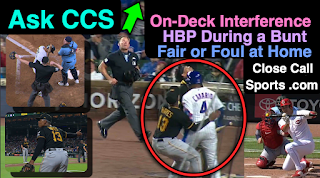
On-Deck Interference, A Bunt HBP & Fair-Foul at Home

An on-deck batter interference in Chicago, batter hit by a pitch while attempting a bunt in Cincinnati and catcher pouncing on a fair ball over home plate in New York comprise a trio of umpire Ask CCS questions over the past week.

On-Deck Interference: Cubs batter Patrick Wisdom's foul fly ball near Chicago's third base dugout drew two Pirates, including third baseman Ke'Bryan Hayes, who collided with Cubs on-deck batter Alexander Canario, who was trying to get out of the catcher's way but accidentally backed into the oncoming third baseman. After consultation, Crew Chief Alan Porter signaled batter Wisdom out for interference of his teammate Canario (who then came up to bat).

Official Baseball Rule 6.01(b), known as Fielder Right of Way, prescribes that, "The players, coaches or any member of a team at bat shall vacate any space (including both dugouts or bullpens) needed by a fielder who is attempting to field a batted or thrown ball." Whether intentional or not, an on-deck batter, dugout coach, etc. who hinders a fielder attempting to field a batted ball is guilty of interference, and the at-bat batter shall be called out for the interference of their teammate.

HBP During Bunt: Reds batter Luke Maile's attempted bunt ended unsuccessfully, as the pitched ball made contact with his hand coiled around the bat, either instead of or (more importantly) before contacting the bat. Play continued and Minnesota retired Maile at first base. Umpires went to Replay Review as the result of a Reds challenge and Replay HQ overturned the call, Crew Chief Marvin Hudson announcing that a dead ball strike would be charged to Maile for the ball hitting his hands first.

Fair or Foul at Home: Yankees batter-runner Gleyber Torres remained in the right-handed batter's box on a chopper at home plate as Blue Jays catcher Alejandro Kirk waited for the batted ball to spin back toward home plate and into fair territory before fielding the ball and tagging Torres out.

OBR's diagram of home plate confirms that the base itself is entirely in fair territory, with the intersection of the two foul lines (which themselves are within fair territory too) located at the point of home plate.

Video as follows:

Sunday, July 23, 2023

Why Was This Ball Called Fair in New York?

After HP Umpire Lance Barrett signaled fair when Yankees third baseman DJ LeMahieu swiped his glove at Royals batter Bobby Witt Jr's bunt, New York seemed perplexed by the lack of a foul ball call. 

To solve this riddle, we must first consult the rulebook definition for "Fair Ball"—

"A FAIR BALL is a batted ball that settles on fair ground between home and first base, or between home and third base, or that is on or over fair territory when bounding to the outfield past first or third base, or that touches first, second or third base, or that first falls on fair territory on or beyond first base or third base, or that, while on or over fair territory touches the person of an umpire or player, or that, while over fair territory, passes out of the playing field in flight."

Within this wordy definition appear two criteria for determining whether a ball is fair or foul: in some cases, the ball must be on fair territory/ground in order to be considered fair whereas, in others, the ball may be either on or over fair territory/ground.

For example, a fly ball to left field must first fall on fair territory. But notice that for the Royals-Yankees play—fielder LeMahieu physically touching the ball prior to first or third base—the ball may be either on or over fair territory when touched in order to be deemed fair.

Thus, even though the ball itself was in contact (or on) with foul territory, part of the baseball's sphere was positioned over fair territory when first touched by LeMahieu, and, thus, the ball was ruled fair.

Video as follows:

Saturday, August 20, 2022

Rules Review - LLWS Flashy Triple Play Turned Foul Ball

The Little League World Series' Italy vs Australia elimination game produced an absolutely wild and wacky sequence that began as a bases-loaded, none-out triple play before umpires corrected it to, and Replay Review confirmed, the ultimate call of a foul ball. From the infield fly rule to fair/foul to interference, we review the Official Baseball Rules to determine what happened and what could have transpired had things turned out differently.

Play: With none out and the bases loaded in the top of the 3rd inning, a batter Team Italy, trailing Australia 5-0, hit a high fly ball along the first baseline, on the infield between home plate and first base. The ball fell untouched and was fielded by Australia's first baseman, who threw to the catcher ahead of Italy's runner. The catcher stepped on home plate before throwing to the third baseman, who tagged Italy's lead runner R3 as he ran back toward third base. Having tagged R3, Australia's third baseman then threw to the second baseman, who stepped on second base and then tagged Italy's trailing runner R1 as R1 ran toward second base. Following this, Italy's middle runner R2 took off for third base and Australia's second baseman threw to the third baseman, who tagged R2 as he slid into third base.

Call: The HP Umpire declared an Infield Fly and a fair ball, the 3B Umpire declared R3 out at third base, the 2B Umpire declared R1 out at second base, and then the 3B Umpire declared R2 out at third base.

Correcting the Fourth Out...and More: After the apparent triple play, the umpires conferred and determined that the batted ball had become foul, thus negating all subsequent action. The play was ruled a foul ball, which was confirmed after manager's challenge by Australia, and Italy's batter returned to bat.

Remember, even with all other criteria satisfied (runners on first and second [or bases loaded] with less than two out, batted ball is a fly ball which is not a line drive  nor bunt that can be caught be an infielder with ordinary effort), it is only an infield fly if the batted ball is fair [it is not an infield fly if the ball is foul], and the umpire's mechanic should be "Infield Fly, if Fair."

What if (Case Play): Although the ball was foul, let us assume for the purpose of discussion it was fair instead. In that case, the batter would be out for the Infield Fly, R3 would be out on the tag while off-base, and R1 would be out on the tag while off-base (R2's apparent out would be irrelevant and superfluous).

In that sense, the umpires officiated the infield fly portion of this play properly in real-time...the portion of the play that occurred after the first baseman fielded the baseball.

A Confounding Variable, Regardless of Fair/Foul: Replays indicate that while the batted ball was in flight, Australia's first baseman and Italy's baserunner R1 made contact while R1 was not touching first base. In this sense, presuming the umpires would have identified the first baseman F3 as the fielder entitled to field the batted ball pursuant to Official Baseball Rule 6.01(a)(10), R1 should be declared out for interference ("Fails to avoid a fielder who is attempting to field a batted ball...if two or more fielders attempt to field a batted ball and the runner comes in contact with one or more of them, the umpire shall determine which fielder is entitled to the benefit of this rule"). The fielder has the right of way in this situation.

This would then activate the Infield Fly Interference rule (from the definition of terms): "If interference is called during an Infield Fly, the ball remains alive until it is determined whether the ball is fair or foul. If fair, both the runner who interfered with the fielder and the batter are out. If foul, even if caught, the runner is out and the batter returns to bat."

Recap: If the umpires protect the pitcher as the fielder entitled to field the ball, foul ball is the correct call.

However, if the umpires identified the first baseman as the fielder entitled to field the ball, the proper call would have been a foul ball, but with the additional declaration that the runner from first base R1 is out for interference.

Under the Case Play scenario wherein the batted ball is fielded in fair territory and the pitcher is the protected fielder, this is a triple play (batter-runner out on the infield fly, R3 out on tag, R1 out on tag).

Under the Case Play scenario wherein the batted ball is fielded in fair territory and the first baseman is the protected fielder, this is a double play (R1 out on interference & batter-runner out on the infield fly).

Video as follows:

Saturday, May 22, 2021

Game of Millimeters & Cuzzi's Cubs-Cardinals Fair Ball

When Cardinals third baseman Nolan Arenado picked up Cubs batter Nico Hoerner's slowly hit ground ball near the foul line in St Louis Saturday, HP Umpire Phil Cuzzi's subsequent fair ball call drew strong reactions from both rivalry fanbases with Chicago convinced the umpire had gotten the call correct and St Louis just as adamant that the umpire had erred by not calling the ball foul. What truly did happen?

Play: With two out in the top of the 9th of a game which St Louis led 2-1, Cubs batter Nico Hoerner hit a 1-1 curveball from Cardinals pitcher Alex Reyes on the ground toward third base. Cardinals third baseman Nolan Arenado picked up the baseball as it rolled along the foul line, believing he had retrieved the ball in foul territory.

Call: HP Umpire Phil Cuzzi, however, ruled the ball fair, deeming that Arenado touched the ball as it was on or over fair territory.

Rules Review: As is critical to objective analysis, we again begin with the relevant Official Baseball Rules, namely the definition of terms: "A FAIR BALL is a batted ball that...while on or over fair territory touches the person of an umpire or player" while "FAIR TERRITORY is that part of the playing field within, and including the first base and third base lines, from home base to the bottom of the playing field fence and perpendicularly upwards. All foul lines are in fair territory."

Analysis
: Next up is a discussion of the orbital nature of a baseball: it is a sphere and, given the aforementioned definitions for fair ball and fair territory, a ball need not actually contact the ground in fair territory while being touched by a fielder in front of first or third base for it to be deemed fair ("on or over"). 

Sidebar: Had this been a first contact by the batted ball in the outfield, it would need to make contact with the left/right field foul line or within those lines to be deemed fair [a recent MLB Umpire Manual interpretation add-on regarding batted balls in the outfield clarifies this to be the case for outfield hits, but not for infield hits]).

Accordingly, we have a parallax problem because this does not necessarily involve a ball touching painted line on the ground, but a portion of the ball breaking a plane nary inches off of the ground.

In our 2018 video regarding parallax in baseball and hockey, we simulated the difficulty in accurately assessing a ball (or puck)'s location when said object was not entirely flush with the ground and the camera angle provided was not positioned directly down the line used for fair/foul consideration.

The age-old question, then, of whether Cuzzi's call was correct or not may never be known: Cubs fans on Twitter think Cuzzi got it right, Cardinals fans think Cuzzi got it wrong, and neither side has definitive video proof to support their conjecture—especially with pitcher Reyes' leg blocking out the moment of truth on a key replay angle. In other words, this ruling truly is the "call stands" of fair/foul decisions.

(Note: The Cardinals won the game on a fly out several pitches later) | Video as follows:

Friday, July 13, 2018

Ask UEFL - Judging a Fly Ball as Fair or Foul (Video)

In the wake of umpire Paul Nauert's fair-to-foul call in Pittsburgh, Jim asked about a rules interpretation in the MLB Umpire Manual concerning the definition of a fair ball. Due to Replay Review and the parallax angle effect, clarity was needed for video that could deceptively indicate a fair ball when the spherical baseball may or may not have actually touched fair territory (e.g., the foul line) when the ball first fell to the ground. No rule was changed in the making of this interpretation.

3D video illustrates the fair/foul parallax issue.
The new MLBUM interp states, "When in contact with the ground, a ball must be in contact with fair territory and not merely over fair territory in order to be adjudged to be fair," whereas the Definition of Terms (which hasn't changed) states, "A FAIR BALL is a batted ball that...first falls on fair territory on or beyond first base or third base."

Important: This analysis refers to a batted ball, in flight, that first touches the ground at or past first or third base. In the case of a bounding ball (e.g., a ground ball) that passes first or third base after first touching the ground in front of the base, any part of the ball that breaks any part of the "fair territory" plane extending upward from the foul territory-facing side of the base, at the point where the ball passes the front edge of the base, is a fair ball. This also applies to batted balls leaving the playing field in flight (any portion of the ball that breaks the fair territory plane as the ball leaves the field signifies a fair ball. This plane is usually signified by the existence of a metal foul pole).

Because Replay Review is all about camera angles and video playback, the interpretation cited above clarifies for the Replay Official that the camera angle alone should not be used to approximate where the ball landed: the Replay Official must obtain clear and convincing evidence to suggest that the ball actually made physical contact with the ground in fair territory (e.g., the chalk or painted white line) in order to confirm or overturn a fair/foul in the outfield-type review.

Hockey's parallax effect also affects baseball.
In other words, an aerial or angular view that merely suggests that the ball was over the line at the time of ground contact is not sufficient due to the possibility that the ball failed to make physical contact with the portion of the ground that is in fair territory.

In relation to the important disclaimer above, an overhead or top-down angle would be sufficient for a bounding ball or batted ball leaving the playing field in flight (fair/foul HR review) because both of those fair/foul judgments are made in relation to the ball's location when it passes a plane or boundary: no physical contact required (e.g., a potential HR hit over the height of the foul pole...a top-down look would indicate whether it was fair or foul, without requiring any physical contact with the pole itself).

This is similar to the parallax angle effect we previously discussed that can make a pitched ball appear to be a strike from one angle, but not another, or how a check swing can look different from two competing camera angles.
Related PostDeceptive Angle - Woodring's Parallax Check Swing (6/6/18).

The following video thus illustrates the parallax effect for fair and foul balls in the outfield:

Wednesday, July 11, 2018

Wild Walk-Off - Analysis of 6 Rules for 1 Play in Houston

The final play of Houston's walk-off victory over Oakland Tuesday featured an overcharged bouncing ball and at least six rules situations for HP Umpire David Rackley to quickly consider as A's catcher Jonathan Lucroy and Astros batter Alex Bregman danced around home plate before Lucroy finally threw the baseball wildly into right field, plating Houston's game-winning run. This article and video analyzes each individual phase of Tuesday's final play in Houston, as well as the plate umpire's responsibilities and reactions.

Rackley's Rapid Response™ passed the test.
The Play: With one out and two on (R1, R2), Astros batter Alex Bregman hit a ground ball softly to the right of home plate, where A's catcher Jonathan Lucroy fielded the ball in fair territory, attempted to tag batter-runner Bregman while fumbling and dropping the ball, which bounced off of HP Umpire David Rackley, before Lucroy retrieved the loose ball and threw it off of batter-runner Bregman's helmet, past first baseman Mark Canha, and down the right field line, allowing Astros baserunner R2 Kyle Tucker to score the game-winning run, affirmed following an A's challenge for Lucroy's attempted tag of Bregman.

Analysis: There is a lot to unpack here, so let's go step by step, rule by rule, and solve this wild play.

Call #1: Fair or Foul: This complex play begins, simply, when batter Bregman hits A's pitcher Blake Treinen's 1-2 pitch, which bounces in foul territory before rolling back into fair territory, whereupon catcher Lucroy makes initial contact with the baseball.

This ball was fielded in fair territory.
Rule #1: Amongst other criteria, and relevant to the play at hand, "A FOUL BALL is a batted ball that settles on foul territory between home and first base" while "A FAIR BALL is a batted ball that, while on or over fair territory touches the person of an umpire or player."

Analysis, Call #1: Because Lucroy makes first contact with the baseball while it is over fair territory, this is a fair ball.

Call #2: Interference or Incidental: As Lucroy attempts to field the ball, batter Bregman considers running to first base, and moves from his position in the right-handed batter's box toward first base. Seeing that Lucroy is about to field the ball, Bregman stops to avoid the imminent tag.

The batter did not interfere with the fielder.
Rule #2: The relevant portion of interference rule 6.01(a)(10) states the batter or runner is out when—"He fails to avoid a fielder who is attempting to field a batted ball," whereas, "Offensive interference is an act by the team at bat which interferes with, obstructs, impedes, hinders or confuses any fielder attempting to make a play."

QOC, Call #2: Bregman does not impede Lucroy's ability to field the batted ball, which means he has not interfered with the fielder's attempt to field a batted ball.

Call #3: Out of Base Path or Legal: As Lucroy attempts to tag Bregman, Bregman jumps backward, toward home plate, in an effort to avoid the tag.
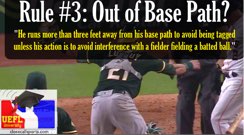
The runner did not illegally exit his path.
Rule #3: According to retiring-a-runner rule 5.09(b)(1), a runner is out when—"He runs more than three feet away from his base path to avoid being tagged unless his action is to avoid interference with a fielder fielding a batted ball."

QOC, Call #3: The batted ball exemption doesn't apply here, as Lucroy has already fielded the ball, leaving us to consider whether Bregman is three+ feet out of his path, established at the time of the tag attempt. It appears Bregman never quite arrived at (returned to) home plate, which also renders moot an MLB Umpire Manual interpretation regarding a batter-runner who retreats to home ("In situations where the batter-runner gets in a rundown between first and home, if the batter-runner retreats and reaches home plate, the batter-runner shall be declared out").

Call #4: Umpire Interference or Play On: As Lucroy fumbled the ball and HP Umpire Rackley stepped in for a closer look, the ball bounced off Rackley and settled in the dirt.

HP Umpire Rackley did not interfere.
Rule #4: Umpire interference occurs under very specific circumstances, which are presented in 6.01(f) [5.06(c)(2), delineating when the ball is dead, also describes that which is depicted by 6.01(f)(1)]: "Umpire’s interference occurs (1) when a plate umpire hinders, impedes or prevents a catcher’s throw attempting to prevent a stolen base or retire a runner on a pick-off play; or (2) when a fair ball touches an umpire on fair territory before passing a fielder. Umpire interference may also occur when an umpire interferes with a catcher returning the ball to the pitcher." To put it even more bluntly, "If a thrown ball accidentally touches a base coach, or a pitched or thrown ball touches an umpire, the ball is alive and in play."

QOC, Call #4: There is no call to make here, as a fumbled ball bouncing off of an umpire's chest is not one of the scenarios depicted nor covered by the umpire interference rule.

Call #5: Obstruction or Legal: As catcher Lucroy fumbles the ball into the left-handed batter's box, batter-runner Bregman reverses his retreat and sprints toward first base, avoiding the catcher in the process.

The runner did not obstruct the fielder.
Rule #5: The definition of terms holds that "OBSTRUCTION is the act of a fielder who, while not in possession of the ball and not in the act of fielding the ball, impedes the progress of any runner."

QOC, Call #5: It appears batter-runner Bregman was not impeded by catcher Lucroy, so no obstruction occurred. Had this been obstruction, it would be an instance of OBS Type 2 (Type B), as in rule 6.01(h)(2), because Lucroy had already fumbled the ball away after fielding it and making a play on the runner: "If no play is being made on the obstructed runner, the play shall proceed until no further action is possible."

Call #6: Runner's Lane Interference or Nothing: Lest we give up too quickly, the final aspect of this play concerns whether Bregman legally ran to first base as catcher Lucroy threw to first baseman Canha.

The runner did not commit RLI (INT).
Rule #6: Rule 5.09(a)(11) allows the batter-runner to be declared out if, "In running the last half of the distance from home base to first base, while the ball is being fielded to first base, he runs outside (to the right of) the three-foot line, or inside (to the left of) the foul line, and in the umpire’s judgment in so doing interferes with the fielder taking the throw at first base."

QOC, Call #6: Replays indicate Bregman's running lane adventure was entirely legal; he entered the lane on or between the two chalk lines and remained in the lane until the ball was already up the right field line, well past the infield.

At least six rules were involved in just one play Tuesday.
BONUS Call #7: Obstruction (on F3) or Nothing: Once Lucroy's throw eluded first baseman Canha, we were left with a first baseman standing in front of the base and a batter-runner who had to change his path in order to avoid the first baseman and touch first base. As Call #5 states above, if first baseman Canha impeded batter-runner Bregman from timely touching his base, the umpires would be within their rights to allow play to proceed through its conclusion and (let's assume Bregman was thrown out at second base prior to the winning run scoring...with two outs) make whatever call or runner placement that, in their judgment, would nullify the act of obstruction.

Mechanically Speaking: Rackley employs two "safe" mechanics here. The first signifies "no tag," "no interference," "not out of the base path," and "no obstruction"—essentially saying "everything that just happened is legal"—and the final safe call pertains to the runner's lane interference no-call, all of it the proper decision. Hunter Wendelstedt is on this crew and you sure hope he'll add Rackley's play to his curriculum at Umpire School for what to do when a crazy play finds you.

Postscript: Perhaps the most obvious call isn't even included in the aforementioned analysis—whether or not the catcher tagged the runner! As Replay Review confirmed, following an A's challenge, Lucroy did not tag Bregman—that is to say, Lucroy did not "touch a runner with the ball, or with his hand or glove holding the ball (not including hanging laces alone), while holding the ball securely and firmly in his hand or glove" [Definition of Terms: TAG]—but it just goes to show you what type of a call an umpire analyst can take for granted when confronted with no less than six additional considerations, all within a mere matter of seconds. As for HP Umpire Rackley, score that a QOC of Correct, multiplied by at least six.

Video as follows:

Saturday, May 17, 2014

MLB Ejection 049: Ron Kulpa (1; Fredi Gonzalez)

HP Umpire Ron Kulpa ejected Braves Manager Fredi Gonzalez for arguing a fair ball (bunt/out) call in the top of the 5th inning of the Braves-Cardinals game. With none out and one on, Braves batter Aaron Harang bunted a 1-1 fastball from Cardinals pitcher Shelby Miller near home plate, where it was fielded by catcher Yadier Molina to third baseman Matt Carpenter to first baseman Matt Adams, Braves baserunner R2 Andrelton Simmons out at third base and Harang out at first base. Replays indicate that after first bouncing off the ground in foul territory and gaining top spin, Molina first contacted the baseball while it was located over foul territory, the call was incorrect. At the time of the ejection, the contest was tied, 1-1. The Cardinals ultimately won the contest, 4-1.

This is Ron Kulpa's first ejection of the 2014 season.
Ron Kulpa now has -1 points in the UEFL Standings (1 Previous + 2 MLB + -4 Incorrect Call = -1).
Crew Chief Eric Cooper now has 1 point in the UEFL's Crew Division (1 Previous + 0 Incorrect = 1).
*The game was delayed one pitch later because Gonzalez refused to exit the third base dugout.*

This is the 49th ejection of the 2014 MLB Regular Season.
This is the 19th Manager ejection of 2014.
This is the Braves' 2nd ejection of 2014, 2nd in the NL East (NYM 3; ATL 2; MIA, PHI, WAS 0).
This is Fredi Gonzalez's first ejection since Sept 23, 2013 (Angel Hernandez; QOC = Y [HBP NCC]).
This is Ron Kulpa's first ejection since Sept 15, 2013 (Mike Napoli; QOC = Y [Balls/Strikes]).

Wrap: Atlanta Braves vs. St. Louis Cardinals, 5/17/14
Video: Failed bunt and double play leads to Gonzalez's ejection as Kulpa doesn't honor appeal (ATL)

Thursday, October 25, 2012

Squibbers: How a Batted Ball Becomes Fair or Foul at Home

All ground batted balls that result in an out are, by rule, fair—at least in today's game. In 1864's National Association of Base-Ball Players rules, also known as the first rules of base ball, foul balls caught on the first bound (bounce) resulted in an out (Sections 12, 14). In 1883, the National League specified that only balls caught on the fly were to be considered outs, while the American Association kept the 1865 ruling.
Fair territory includes a triangular
portion of the batter's boxes

Another product of the 1863 New York conference that became the '64 rules book was Section 9, which stated, "If the ball, from a stroke of the bat, first touches the ground ... behind the range of home and first base, or home and third base, it shall be termed foul and must be so declared by the umpire, unasked."

Still, Rule IV-27 of the 1880s American Association rules book defined a fair hit as a batted ball and as a ground ball that, among other possibilities, "(whether it first touches Foul or Fair Ground) bounds or rolls within the Foul Lines, between Home and First or Home and Third Bases, without first touching the person of a player."

In the modern, 21st century OBR book, caught one-hoppers do not result in a "hand out" while fair/foul ball status in front of first and third base is not determined until the ball settles or is touched by a player or object.
A FAIR BALL is a batted ball that settles on fair ground between home and first/third base ... or that while on or over fair territory touches the person of an umpire or player... (Rule 2.00 [FAIR BALL])
Be advised that in the event of a batted ball, the batter's box may protect a batter from being put out under the auspices of Rule 6.05 (Rule 6.03 exemption). Though a baseball field does not generally draw foul lines through the batter's box (for clarity), these lines do exist and, invisible as they may be, are used to determine fair/foul status (see 6.05 exemption). For a diagram, see Umpire Odds & Ends: Batter's Box Bafflement.

To learn more about batted balls hitting batters at home, please see Rule 6.05(g)(h): Batted Ball Interference.

Nonetheless, this seemingly simple concept of fair/foul status has resulted in conflict and even ejection. In a twist of the UEFL's standard "Test Yourself" section, see below for a list of play scenarios and apply a ruling—using 1864 rules and comparing those to the MLB rules in use today. To this end, home plate is a pentagon.

Batted Ball Striking Foul Territory Behind Home, Rolling into & Being First Touched/Settling on Fair Territory
Ejections: James Hoye (1)/Ozzie Guillen, B1 hits a slider into the dirt behind home plate. As the ball spins directly onto home plate, F2 picks it up and tags B1. Video features Guillen's kick of Soto's catchers' mask.
Ejection 006: Dale Scott (1)/Bud Black, B1 bunts a fastball into the dirt behind home plate. The ball spins into the LHH box and within the foul lines where F2 fields it. Disregard the mechanics demonstrated.
Ejection 089: Dan Bellino (4)/Miguel Cairo, B1 hits a sinker into the dirt behind home plate; the ball spins onto home plate and begins its roll back off the dish. F2 picks up the ball as it is no longer in contact with home plate, but the planar edge of the baseball is located graphically above the pentagon.
2012 World Series, Gm 1, B1 hits a ball into the dirt behind home plate; the ball spins into the right-handed batter's box where B1 is standing. F2 fields the ball in the fair territory triangle of the batter's box, tags B1 and throws to F6. The force removed, F6 must apply the tag on R1, which he does for a double play.