Wednesday, July 12, 2017

Intentional Drop Rule Stars in Triple-A Midsummer Classic

Baseball's intentional drop rule, third-cousin of the infield fly, found its way into Triple-A's All-Star Game Wednesday night as the Pacific Coast League attempted to turn a crafty double play, only to have "Time" called instead.

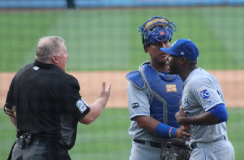
PCL Ump Cunha calls a drop on the PCL team.
The Play: With one out and two on (R1, R2) in the top of the 7th inning of the INTL-PCL affair, International League batter Chance Sisco hit a line drive to PCL second baseman Ildemaro Vargas, who momentarily caught the ball before it dropped to the infield dirt as IL baserunner R2 Rusney Castillo ran back to retouch second base.

2B Umpire Billy Cunha of the Pacific Coast League immediately called "Time," pointed toward first base, and signaled batter Sisco out on the caught line drive under the intentional drop rule.

The Rule: Official Baseball Rule 5.09(a)(12) states that the batter is out when—"An infielder intentionally drops a fair fly ball or line drive, with first, first and second, first and third, or first, second and third base occupied before two are out. The ball is dead and runner or runners shall return to their original base or bases."

The fielder is allowed to allow the ball to fall untouched, but is liable for an intentional drop if he makes contact with the fair fly ball or line drive before allowing it to fall.

This rule is superseded by the infield fly rule, meaning that had batter Sisco hit a fly ball high in the air instead, such that infielder Vargas could have caught it with ordinary effort, and Vargas intentionally dropped the fly after letting it fall into his glove, the infield fly rule would be invoked: Sisco would be out, but the ball would remain live.
Related Post: Bernier Burned by Baserunning on Pseudo Infield Fly [legally untouched drop] (7/24/13).
Related Post: Infield Fly Rule Knowledge Costs Giants as Reds Turn Two [dropped infield fly] (7/4/13).

Video as follows (thanks to the invaluable jpg901c YouTube channel):

Angel Hernandez, MLB, and Discrimination (Part 1)

With Angel Hernandez's MLB All-Star Game over, it's time to analyze his lawsuit against Major League Baseball. This lengthy discussion is split into two parts, the first of which touches on Hernandez' allegations of racial discrimination, while the second will discuss historical examples alleging religious and sex discrimination in professional baseball, along with factors that contribute to a near-universal underrepresentation of protected classes (non-caucasians, non-whites, non-USA-born persons, non-Christians, and women) in the professional umpiring ranks.

UEFL Analysis of the Hernandez v MLB suit.
Introduction (and Recap): To summarize the main points of this litigation, Hernandez sued MLB alleging racial discrimination and seeking renumeration in the form of back pay (the amount of which was not disclosed in the Complaint), compensatory and punitive damages, and employment benefits to remedy the discrimination (similar to an obstruction type B's "nullify the act" clause).

Hernandez also asked the court to place an injunction against MLB (from, say, retaliation for statements made related to these proceedings), and to grant a jury trial.

Read the full narrative of Hernandez's July 3 complaint here: Angel Hernandez Sues MLB for Racial Discrimination (7/3/17).

Disclosure: The following analysis is theoretical, opinionated, and contains no findings of fact relative to any specific cases. It is based on hypothetical situations of how proceedings might play out, and in no way attributes any statements, characteristics, or findings to the individuals mentioned. The themes, topics, and theories discussed may be uncomfortable for some readers.

Analysis: Hernandez's complaint makes strong and repeated claims against MLB Chief Baseball Officer Joe Torre, stating that before Torre's arrival in the Commissioner's Office, Hernandez's evaluations were positive and trending upward, but after Torre's arrival in 2011, the evaluations took a downturn into less-than-satisfactory territory.

The reason this is so important to note is that, ordinarily, an employee does not have a strong cause of action against his/her employer, simply because of a belief that the boss is acting unfairly. Similarly, a lawsuit will not be successful if the claim simply states that one manager or, perhaps, bad boss, is responsible for negatively evaluating an employee.

Paul Emmel ejects Joe Torre.
As Hernandez's supervising Officer at MLB's corporate office, Torre has the right and responsibility to critically evaluate Hernandez's performance, and, if Torre believes Hernandez's performance is substandard for whatever behavioral reason, he is well within his rights to notate that. Even if he repeats claims from 2001 all the way into 2011, Torre as Hernandez's boss has the right to do so unless, for some reason, Torre were to admit that he made those 2011-era evaluations without bothering to see or consider Hernandez's 2011-era job performance.

It is difficult to believe that any boss under suit would admit to such meddling without even bothering to observe their employee. Simply put, if Torre says Hernandez hasn't changed since 2001, that's all there is to his defense: As Hernandez's boss, he's allowed to say it.

Timeline of Hernandez's pre-suit actions.
Even Hernandez admitted that a perceived feud with Torre isn't legally tenable, in Paragraph 66 of the Complaint, stating, "Though it may seem as if Major League Baseball’s problems with Hernandez begin and end with some personal animus Torre and some other individuals in the Office of the Commissioner may have towards Hernandez, an overview of how Major League Baseball has treated minorities such as Hernandez shows a much deeper and more troubling trend."

As an aside, it probably helps support Torre's "put yourself in the spotlight" comment that Hernandez's first game since filing his lawsuit was the 2017 All-Star Game. Both sides knew well in advance of the filing of the lawsuit that Hernandez had been selected to officiate the All-Star Game, and both sides knew of Hernandez's scheduled week off the field from July 3 through the All-Star Break (umpire schedules are generally predetermined).

Thus, Hernandez must consider a different strategy that is legally actionable. There are two ways to go here. Both relate to discrimination, the first of which is covered under Title I of the Americans with Disability Act (ADA) and the second under Title VII of the Civil Rights Act of 1964.

Oddly enough, tantrum behavior is...fun?
ADA: Since Torre's "routinely attempting to put yourself in the spotlight" comments appear to be a theme in Hernandez's lawsuit, an ADA-related claim to counter would rely on the argument that such comments are discriminatory based on a disability. The one that most closely responds to such comments is narcissistic personality disorder, whose symptoms of exaggerated feelings of self-importance would address Torre's critical comments; However, there is no evidence (nor admission) to suggest Hernandez suffers from NPD. He has never invoked NPD, and no organization has alleged it (it is just being mentioned here as an example of a legal response to Torre's comments that could support a charge of discrimination). Hypothetically, even if a diagnosed plaintiff were to allege ADA discrimination, this would call for doctors as expert witnesses, intense scrutiny relative to diagnosing the disability, and, even if the disability were severe, consideration of what a "reasonable accommodation" from the employer would look like. Furthermore, an NPD claim wouldn't as easily address Torre's comments regarding Hernandez's alleged lack of rules knowledge, as in the March 2017 letter.
...Heaven forbid an umpire ever fights back.

Civ Rights: Because Hernandez identifies as Latino in his Complaint, discrimination based on a protected characteristic is a much more suitable course of action: no diagnoses, no doctors, no third-degree: Hernandez has a Cuban heritage and that's it. The Civil Rights Act prohibits employers from discriminating against employees based on race, color, national origin, sex, and religion. Hernandez's protected characteristic is "Latino."

Perhaps it is easier to define what is not protected under Title VII than that which is:
Race: Caucasian;
Color: White;
National Origin: United States of America;
Religion: Christian;
Sex: Male.

The race/color/nat origin route also allows Hernandez to cite statistics that go beyond Torre's critical evaluations and into MLB's overall hiring and promotion history (as alluded to by Paragraph 66, as above).

Not all foreign-born umps go full-time.
Based on legal precedent, a discrimination claim puts the employer in the unenviable position of proving its promotions were based on criteria unrelated to race. If it has ample paperwork and the "math adds up," MLB could successfully refute this claim.

Objective measures would prove most helpful for MLB, as such standard evaluative practices would demonstrate MLB's business operation and personnel movement is not based on subjective conjecture, but rather substantive and logical calculation. As long as the methods are consistently applied to all of its employees—and, moreover, MLB is able to convincingly demonstrate this—then proving unlawful discrimination will be difficult.

Race Composition of Umpires and Supervisors: Hernandez makes some pretty incredible observations about umpires and race statistics, notably that a permanent minority crew chief hasn't existed in the major leagues since the days of AL and NL staffs, with Crew Chief Rich Garcia, who led an American League crew from 1985 through his final game in 1999, when MLB accepted his resignation. Instead of returning to the playing field thereafter, Garcia joined the Commissioner's Office and served as an Umpire Supervisor from 2002 to 2010, when he, Marty Springstead, and Jim McKean were ousted as the result of events that occurred during the 2009 postseason.

Chuck Meriwether has Sup'd since 2011.
Presently, two minority Supervisors serve in the BOC (Cris Jones and Chuck Meriwether), while the current full-time MLB staff features ten minority umpires (Kerwin Danley, CB Bucknor, Laz Diaz, Manny Gonzalez, Hernandez, Adrian Johnson, Alfonso Marquez, Gabe Morales, Alan Porter, Carlos Torres), or 13.2% of the staff.

Four (Gonzalez [2013], Morales [2017], Porter [2013], and Torres [2017]) were hired since Torre took office, and all four filled spots previously held by caucasian umpires.

Carlos Torres was hired to the staff in 2017.
In January 2017, four umpires were hired to the staff. The most experienced had 461 of Major League experience, the second had 389 games, the third had 354 games and the fourth had 160 games. Torres of Venezuela was the 160-game umpire, and leapt over seven non-hired (white) Triple-A call-ups with more experience to get the full-time MLB gig. Torres, at 38-years-old, however, was also the oldest.

To prove Major League Baseball engaged in a pattern of racially-motivated discrimination, Hernandez would need to find evidence that deserving minority umpires were denied justly deserved promotions and assignments at the expense of their non-protected colleagues. Again, this goes back to the existence of objective criteria and evaluations mentioned above, and the quality of MLB's paperwork will determine whether these claims are supported or refuted.

If we are to believe, as we are told, that postseason assignments are an award for exceptional in-season performance, we can surmise that those umpires with routine postseason assignments in the later rounds (e.g., League Championship Series and World Series) are those that MLB has routinely rated the highest on staff. These are surely not the only objective measures MLB has to offer, but they are amongst the only ones that are public knowledge. In his complaint, Hernandez makes specific reference to the World Series, so we'll discuss Fall Classic assignments.

Sampling 'Bubble' White and Latino Umpires for Promotion: Take the case of Alfonso Marquez (Latino), who had officiated three World Series (2006, 11, 15) before his newly-promoted crew chief, Larry Vanover (white), had officiated even one (2016); Fonzie still has more postseason experience than other newer white crew chiefs, such as Fieldin Culbreth (two WS), Sam Holbrook (two WS, 2010 & '16) Paul Emmel (one WS, '13) and Jerry Meals (one WS, '14), yet Marquez himself is not a crew chief. The experience advantage extends to earlier postseason play (e.g., the League Championship Series) as well.

By contrast, Hernandez has officiated two World Series (2002, 05) [beats Vanover, and ties all others, except Marquez, who outpaces Hernandez by one].

Marquez's #s sure look promotion-worthy...
As for Replay Reviews and Review Affirmation Percentage (RAP), Marquez again comes out a winner. His 2016 RAP of .667 ranked seventh in the League (compared to Holbrook [20th], Vanover [25th], Culbreth [29th], Emmel [46th], and Meals [81st]). In 2015, Marquez again beat out his colleagues, finished second in the entire League with a .750 RAP (Holbrook [5th], Culbreth [11th], Emmel [18th] Vanover [42nd], Meals [64th]). In 2014, Marquez' .700 RAP [11th] again beat the other recent crew chiefs (Culbreth [15th], Vanover [32nd], Meals [34th], Emmel [78th], Holbrook [BL]).

By contrast, Hernandez's .389 RAP ranked 65th in 2016 (beats only Meals), .579 RAP ranked 26th in 2015 (beats Vanover and Meals), and .450 RAP ranked 58th in 2014 (beats only Emmel).

Why Marquez was not promoted at the expense of less-experienced and less-accurate white umpires is a conundrum, but one that MLB as a private entity has the right to keep secret (perhaps, until Hernandez's suit goes to trial [if it gets that far]; if Marquez never actually sought promotion, that'll be disclosed at discovery). As for Hernandez, personally, he doesn't stand above-and-beyond as Marquez does—on these specific metrics. Still, Marquez's non-promotion bolsters Hernandez's claim, especially when Fieldin Culbreth, as Crew Chief, in 2013 was suspended for incorrectly applying baseball rules during a pitching change sequence in Houston...yet Hernandez received comments from Torre criticizing his own rules knowledge.

General Discrimination (Race/Religion/Sex): Finally, the underlying message is one of systematic discrimination that begins all the way at the bottom of professional baseball, at PBUC/MiLBUD's hiring program for the Rookie Leagues, and for every promotional step along the way. To get into those statistics would surely take weeks to discuss, suffice it to say, but I have a theory—and it doesn't seem too absurd—that the composition of students at the two Umpiring Schools (Wendelstedt's HWS, and MiLB's TUS) are still majority-white, Christian, and male.

It's a historical perspective: In the past, I'd surmise that the racial makeup of each class was less diverse (thus, more white), and that in recent times, that composition has trended toward more equitable representation. It's a slippery slope argument to extract the precise reason for underrepresentation at school, and there are likely many causes.

First, the schools' cost can prove prohibitive to poorer students, who may trend toward racial minority status. To address the cost, MLB, MiLB and similar entities have instituted scholarships.

Second, there may exist an "ambition gap" wherein certain underrepresented groups (e.g., women [*administrative note* women aren't minorities]) remain underrepresented due to a lack of interest in the profession. Emerge America: Women Leaders for a Democratic Future, for instance, found that "the greatest hurdle for women in achieving gender parity in politics is not in the number of votes they get or their level of fundraising. It's overcoming the political ambition gap and convincing more women to run for office."

Third, and this is related to the ambition gap, if a potential umpire doesn't feel like (s)he will be successful in professional baseball, that person will likely not seek to attend school.

SABR demonstration of MLB's ethnic makeup.
We know that it routinely takes up to a decade's time for the chosen ones to reach the MLB level, which means that in Hernandez's class, there's an even greater chance Latinos were underrepresented at school, and thus, were underrepresented every step of the way up to and including in Major League Baseball.

Bear in mind that when Hernandez debuted in 1991, just 16% of players were Latino. Considering the amount of time it takes the average umpire to break into the Majors, even with the league's racial composition on the rise, umpiring's distribution, by necessity, will likely always be behind the curve, unless intervention causes the balance to skew by promoting umpires too quickly or keeping them in the minor league game too long.

Comparison, Racial Makeup of MLB Players vs Racial Makeup of MLB [Full-Time] Umpires:
Players: In 2007 ("10 years ago"), 26.1% of players were Latino. In 2016, it was 27.4%.
Umpires: In 2007, 5% of umpires were Latino. In 2016, it was 5.4%. In 2017, it's 7.9%.
*Non-Hispanic Black Players, 2007: 8.5%; 2016: 6.7%.
*Non-Hispanic Black Umpires, 2007: 4.4%; 2016: 4.0%.
*Asian Players, 2007: 2.2%; 2016: 2.1%. Asian Umpires, Both Years: 0.0%.

Putting it another way, 86.8% of 2017's umpires are white. By contrast, the last time 86.8% of MLB players were white was 1958. The last time only 7.9% of the league's players were Latino was 1961, and the last time 4.0% were black was 1953.

The natural question here is whether these percentages correspond to the umpires coming out of school (~10 years prior to the respective marks). If the statistics are comparable, we go back to the school attendance and ambition gap, and posit a theory as to why minorities are underrepresented at school. If not, we need to dig deeper.

We'll have more on this tomorrow...

Tuesday, July 11, 2017

Discussion of the 2017 MLB All-Star Game

Crew Chief/HP Umpire Joe West and All-Star Game umpires Angel Hernandez (1B), Mark Carlson (2B), Chris Conroy (3B), Manny Gonzalez (LF), and Mike Estabrook (RF) take the field in Miami with Replay Official Doug Eddings stationed at MLBAM headquarters in New York as we open the floor for 2017 All-Star Game discussion. Notes include home plate umpire performance according to pitch f/x and UEFL Rules 6-2-b-a (horizontal bound, "Kulpa Rule") and 6-2-b-b (vertical strike zone, "Miller Rule"). Plays include significant plays, if such plays occur.

- 7/11/17, AL@NL: HP Umpire Joe West: pfx. 107/110 Balls + 45/47 Strikes = 152/157 = 96.8%. +3 NL.

Close or Notable Plays (Green = QOC Correct / Red = QOC Incorrect / Yellow = QOC Irrecusable).
- Nelson Cruz brings cell phone to at-bat, asks Yadier Molina to take a photo with Joe West.

Replay Review Records (2017 Season, Opening Day through All-Star Break) - RAP
UIC Joe West: 10th, .750 RAP (9 Affirmed / 12 Total).
U1 Angel Hernandez: 60th (.400), 4/10.
U2 Mark Carlson: 34th (.583), 7/12.
U3 Chris Conroy: 65th (.333), 4/12.
U4 Manny Gonzalez: 73rd (.300), 3/10.
U5 Mike Estabrook: 35th (.571), 4/7.

Overall Team Success Percentage (TSP) and Manager's Challenge Success Percentage (CSP):
AL Manager Brad Mills (CLE): TSP = . 522 (12/23) - T-15th. CSP = N/A (No Challenges Filed).
NL Manager Joe Maddon (CHC): TSP = .559 (19/34) - 3rd. CSP = .594 (19/32) - 3rd.

Video as follows:

Monday, July 10, 2017

Tell it to the Judge - Ground Rule Prevents Derby HR

Thanks to Ground Rules of Marlins Park—or lack thereof—All-Star Aaron Judge's Home Run Derby nearly ended disastrously after he prematurely celebrated a Round One victory one home run too early, thanks to a batted ball hitting the stadium's ceiling in flight.

HR Derby Ground Rules (or lack thereof).
Unlike intrastate rival Tampa Bay's Tropicana Field and its intricate series of Ground Rules pertaining to the domed stadium's "Catwalks, Lights and Suspended Objects" overhangs, Marlins Park states that a batted ball striking a ceiling, support beam, or its retractable roof during flight, over fair territory, is a live ball and in play.
Tidbit: Miami's only Ground Rule prior to 2016 was, "Ball striking facing of roof over dugouts: Out of Play."

Let's assume we were in Miami prior to the adoption of the roof ground rule, leaving us to the Universal Ground Rules, which state nothing of a ball striking a ceiling during play.

As for the Official Baseball Rules, the point is not specifically addressed, which means that a ball striking the ceiling is subject to Rules 5.05(a)(5) and 8.01(c) ("Each umpire has authority to rule on any point not specifically covered in these rules").

Rule 5.05(a)(5) specifies when the batter becomes a runner: "A fair ball passes over a fence or into the stands at a distance from home base of 250 feet or more. Such hit entitles the batter to a home run when he shall have touched all bases legally. A fair fly ball that passes out of the playing field at a point less than 250 feet from home base shall entitle the batter to advance to second base only."

Rule 5.06(b)(4)(A) is similar: "[Runners advance] To home base, scoring a run, if a fair ball goes out of the playing field in flight and he touched all bases legally; or if a fair ball which, in the umpire’s judgment, would have gone out of the playing field in flight, is deflected by the act of a fielder in throwing his glove, cap, or any article of his apparel."

Common conception for a ball that hits a ceiling and drops down onto the field of play is that the ball is alive and in play, if for no other reason than the ball never left the field of play and there is no foolproof way to determine what would have happened had the ball not touched the ceiling, beam, or roof.

Credit Futures Game Umpires Nate Tomlinson, Eric Bacchus, Jason Starkovich, and Skyler Shown for knowing Miami Park's Ground Rules to address this play, and for applying the Official Baseball Rules to ensure a fair and even playing field for all HR Derby participants.

In sum, it is important to know the ground rules whenever baseball is played—even during a home run derby. Video as follows:

Standings Snapshot at the 2017 All-Star Break

Through 1,326 games at the All-Star Break, MLB has seen 95 ejections and 745 Replay Reviews.

Key Stats, Umpire Ejection Category (51 QOCY + 29 QOCN + 15 QOCU = 95 Total; .638 Acc):
Most EJ: Sam Holbrook (6); Bill Welke (5); Phil Cuzzi, Paul Emmel, Carlos Torres (4).
Perfect QOC (# Ejections): Culbreth (3); Wolf, Scheurwater, Porter, Lentz, Carapazza, Barry (2).

Key Stats, Replay Review Category (378 Upheld + 367 Overturned = 745 Total; .507 RAP):
Most Replays:  Doug Eddings (16); Holbrook, Fagan (15); Timmons, Morales, Layne (14).
Perfect RAP (# Replays): Fairchild (4/4); Blakney, Scott (2/2); Hoberg (1/1).

UEFL Points, Umpires (Primary Division):
1. Alan Porter - 14 (3 Ejections, 13 Replays).
2. Vic Carapazza - 13 (2 Ejections, 7 Replays).
2. Fieldin Culbreth - 13 (3 Ejections, 10 Replays).
2. Sam Holbrook - 13 (6 Ejections, 15 Replays).
5. Joe West - 11 (1 Ejection, 12 Replays).

UEFL Points, Umpires (Crew Division):
1. Sam Holbrook - 14.
2. Joe West - 12.
3. Jim Reynolds - 11.
3. Mike Everitt - 11.
5. Alfonso Marquez - 8.
5. Larry Vanover - 8.

UEFL Points, Members' Leaderboard:
1. sonderweg74 - 44 (Reynolds -cc, West, Guccione, T Barrett, Porter).
2. cyclone14 - 43 (Holbrook -cc, Bellino, T Gibson, T Barrett, West).
3. BkSl14812 - 38 (Holbrook -cc, Hoberg, Reyburn, Porter, Guccione).
4. skippyINC - 35 (West -cc, Iassogna, Baker, Carapazza, G Gibson).
5. tjskip21 - 34 (West -cc, Little, Porter, Wolcott, Tumpane).
6. Burtrh3 - 33 (Everitt -cc, Layne, Carapazza, West, Wendelstedt).
7. Duke82 - 32 (Reynolds -cc, Everitt, T Barrett, Marquez, T Gibson).
8. KTurner14 - 32 (Reynolds -cc, Hernandez, West, Guccione, Wolcott).
9. L'Ump - 31 (West -cc, Scott, Carapazza, Winters, Kellogg).
10. Mortonkc - 31 (Miller -cc, Culbreth, Segal, Meals, Everitt).

UEFL Points, Express Division:
1. sonderweg74 - 44.
2. skippyINC - 35.
3. cyclone14 - 34.
4. tjskip21 - 34.
5. Burtrh3 - 33.
6. Duke82 - 32.
7. KTurner14 - 32.
8. L'Ump - 31.
9. Bob Abouy - 29.
10. Mortonkc - 29.

Sunday, July 9, 2017

MLB Ejection 095 - Brian O'Nora (1; Eugenio Suarez)

HP Umpire Brian O'Nora ejected Reds 3B Eugenio Suarez (strike three call; QOCY) in the top of the 6th inning of the Reds-Diamondbacks game. With one out and one on (R2), Suarez took a 2-2 fastball from Diamondbacks pitcher Patrick Corbin for a called third strike. Replays indicate the pitch was located over the inner half of home plate and below the upper midpoint (px -.590, pz 2.806 [sz_top 3.319], this was the only callable strike of the at-bat), the call was correct. At the time of the ejection, the game was tied, 1-1. The Reds ultimately won the contest, 2-1.

This is Brian O'Nora (7)'s first ejection of the 2017 MLB regular season.
Brian O'Nora now has 0 points in the UEFL Standings (-4 Prev + 2 MLB + 2 Correct Call = 0).
Crew Chief Paul Emmel now has 8 points in Crew Division (7 Previous + 1 Correct Call = 8).

This is the 95th ejection report of 2017.
This is the 40th player ejection of 2017. Prior to ejection, Suarez was 0-3 (2 SO) in the contest.
This is Cincinnati's 3rd ejection of 2017, T-1st in the NL Central (CIN, MIL, PIT, STL 3; CHC 1).
This is Eugenio Suarez's first career MLB ejection.
This is Brian O'Nora's first ejection since August 29, 2016 (Joe Girardi; QOC = Y [Balls/Strikes]).

Wrap: Cincinnati Reds vs. Arizona Diamondbacks, 7/9/17 | Video as follows:

Injury Scout - Another Kerwin Danley Head Shot in LA

Kerwin Danley left Sunday's Royals-Dodgers game in the 2nd inning after a foul ball head injury at Dodger Stadium. It is Danley's second significant game-ending head injury suffered as plate umpire in Los Angeles, including a 2008 episode that required an ambulance and ended with a concussion diagnosis.

Kerwin Danley is assisted at Dodger Stadium.
With two out and none in the bottom of the 1st inning, Dodgers batter Cody Bellinger fouled off a 94.3-mph fastball from Royals pitcher Danny Duffy into the central forehead portion of Danley's hockey-style mask (HSM), causing him to lose his balance and be helped to the ground behind home plate by Royals catcher Drew Butera, Belinger, and several Dodgers staffers.

After remaining in the game through completion of the inning, as well as the top of the 2nd while crew mate and 1B Umpire Adam Hamari put on the plate umpire's equipment, Danley was replaced behind home plate by Hamari, while base umpires Todd Tichenor (2B => 1B) and Crew Chief Bill Miller (3B) officiated the field for the remainder of the contest.

Relevant Injury History: Danley has a significant history of traumatic head injuries as plate umpire.
> On April 7, 2016, Danley remained in a game after a 98-mph fastball to the head.
> On May 12, 2015, Danley exited a game in Arizona as the result of a 94-mph pitch fouled into his HSM.
> On June 3, 2013, Danley exited in Cincinnati after a bouncing ball deflected and struck his mask.
> On April 21, 2009, Danley was carted off the field after a broken bat struck the side of his head.
> On April 26, 2008, Danley was knocked unconscious in LA by a 96-mph pitch directly to the mask.

Last Game: July 9, 2017 | Return to Play: July 14, 2017 | Total Time Absent: 0 Games [All-Star Break]
Video as follows:

Saturday, July 8, 2017

MLB Ejections 093-94 - Sam Holbrook (5-6; COL x2)

HP Umpire Sam Holbrook ejected Rockies CF Charlie Blackmon and Manager Bud Black (strike three call; QOCY) in the bottom of the 9th inning of the White Sox-Rockies game. With one out and none on, Blackmon took a 3-2 cutter from White Sox pitcher David Robertson for a called third strike. Replays indicate the pitch was located over the inner half of home plate and at the hollow of the knee (px -.401, pz 1.554 [sz_bot 1.601 / MOE 1.518]), the call was correct. At the time of the ejections, the White Sox were leading, 5-4. The White Sox ultimately won the contest, 5-4.

This is Sam Holbrook (34)'s fifth, sixth ejection of the 2017 MLB regular season.
Sam Holbrook now has 12 points in the UEFL Standings (4 Prev + 2*[2 MLB + 2 QOCY] = 12).
Crew Chief Sam Holbrook now has 9 points in Crew Division (7 Previous + 2 Correct Call = 9).

This is the 93rd, 94th ejection report of 2017.
This is the 39th player ejection of 2017. Prior to ejection, Blackmon was 2-5 (3 SO) in the contest.
This is the 50th Manager ejection of 2017.
This is Colorado's 3rd/4th ejection of 2017, 2nd in the NL West (LAD 6; COL 4; ARI, SD, SF 2).
This is Charlie Blackmon's first ejection since May 17, 2015 (Marty Foster; QOC = N [Balls/Strikes]).
This is Bud Black's 2nd ejection of 2017, 1st since April 14 (Mike Everitt; QOC = Y [Balk]).
This is Sam Holbrook's 5/6th ejection of 2017, 1st since June 24 (Rick Renteria; QOC = Y [Replay Review]).

Wrap: Chicago White Sox vs. Colorado Rockies, 7/8/17 | Video as follows:

MLB Ejection 092 - Bill Miller (2; Lorenzo Cain)

HP Umpire Bill Miller ejected Royals CF Lorenzo Cain (strike three call) in the top of the 7th inning of the Royals-Dodgers game. With one out and the bases loaded, Cain took a 2-2 fastball from Dodgers pitcher Pedro Baez for a called third strike. Replays indicate the pitch was located off the outer edge of home plate and thigh-high (px 1.108, pz 2.903), the call was incorrect. At the time of the ejection, the game was tied, 3-3. The Dodgers ultimately won the contest, 5-4, in 10 innings.

This is Bill Miller (26)'s second ejection of the 2017 MLB regular season.
Bill Miller now has -2 points in the UEFL Standings (0 Prev + 2 MLB - 4 Incorrect Call = -2).
Crew Chief Bill Miller now has 2 points in Crew Division (2 Previous + 0 Incorrect Call = 2).
*UEFL Rule 6-2-b-1 (Kulpa Rule): |0| < STRIKE < |.748| < BORDERLINE < |.914| < BALL.

This is the 92nd ejection report of 2017.
This is the 38th player ejection of 2017. Prior to ejection, Cain was 1-3 (SO) in the contest.
This is Kansas City's 4th ejection of 2017, 2nd in the AL Central (CWS 10; KC 4; DET 3; MIN 2; CLE 0).
This is Lorenzo Cain's first ejection since July 9, 2015 (Chris Segal; QOC = Y [Balls/Strikes]).
This is Bill Miller's 2nd ejection of 2017, 1st since June 24 (John Farrell; QOC = N [Balk]).

Wrap: Kansas City Royals vs. Los Angeles Dodgers of LA, 7/8/17 | Video as follows:

Dead Ball - Stroman's Start-Stop and Contested Time Call

Blue Jays pitcher Marcus Stroman's odd delivery and HP Umpire Paul Nauert's "Time" call produced an argument from Stroman when he felt the umpire improperly called "Time" after Stroman had come set.

Stroman questions Nauert's call.
The Play: With one out and none on in the top of the 4th inning of Saturday's Astros-Blue Jays game, Astros batter Brian McCann prepared to face Stroman's 0-1 pitch. As Stroman prepared to deliver the ball toward home plate, McCann requested "Time" from plate umpire Nauert, which was granted, resulting in Stroman's passionate objection as he walked off the mound to address Nauert, who took up the discussion with Manager John Gibbons.

Was this the correct call?

The Rules: Official Baseball Rule 5.04(b)(2) Comment states, "Umpires will not call 'Time' at the request of the batter or any member of his team once the pitcher has started his windup or has come to a set position even though the batter claims 'dust in his eyes,' 'steamed glasses,' 'didn’t get the sign' or for any other cause."
For an example of an umpire properly refusing to grant "Time" after a pitcher has started his windup, see Todd Tichenor - Jonny Gomes (time out request refusal), 7/14/13.
For one of the reasons this rule exists, see "Cueto Injury and Why Ump Did Not Grant Time."

"Time" is denied after the pitcher winds up.
OBR 5.07(a) specifies two legal pitching positions, the Windup Position and Set Position. As Stroman selected the Set Position, we shall cite Set Position Rule 5.07(a)(2): "Set Position shall be indicated by the pitcher when he stands facing the batter with his pivot foot in contact with, and his other foot in front of, the pitcher’s plate, holding the ball in both hands in front of his body and coming to a complete stop...After assuming Set Position, any natural motion associated with his delivery of the ball to the batter commits him to the pitch without alteration or interruption."

Analysis: Replays indicate that after assuming Set Position, with both hands in front of his body while in contact with the pitcher's plate, the following sequence of events occurred:

(1) Stroman raises his left leg (lead leg), which is a natural motion associated with his delivery.
(2) Stroman returns his left leg to the ground, but fails to pitch the ball.
(3) Batter McCann requests, and is granted, "Time."
(4) Stroman again raises his left leg, but this time, attempts to deliver a pitch as Nauert signals "Time."

Stroman tried to double-dip before "Time."
Had there been baserunners, Stroman's actions would have constituted a balk, specifically a Rule 6.02(a)(1) violation, also known as a Start-Stop balk: "If there is a runner, or runners, it is a balk when—The pitcher, while touching his plate, makes any motion naturally associated with his pitch and fails to make such delivery."

As it were, Stroman's start-stop action (numbers (1) and (2)), on its own, carries a "no harm, no foul" connotation with the bases empty: the pitcher can simply step off, reset, and re-engage with no additional penalty.

However, and depending on your evaluation of Stroman's first step (as specified by sequential numbers (1) and (2), above), Stroman might have even been guilty of an illegal pitch when he attempted to fast-track his interrupted delivery via phase (4), and pursuant to Rule 5.07(a) Comment, which states, "The pitcher may not take a second step toward home plate with either foot or otherwise reset his pivot foot in his delivery of the pitch. If there is a runner, or runners, on base it is a balk under Rule 6.02(a); if the bases are unoccupied it is an illegal pitch under Rule 6.02(b)."

Graphic of Rule 5.04(b)(2) Comment.
Although a batter may not request "Time" after a pitcher begins his windup or enters Set Position, the pitcher in this play violated Set Position Rule 5.07(a)(2) by failing to pitch to the batter when committed: he improperly started his delivery, only to stop it prematurely.

To take a spirit-of-the-rule glance at this play, consider another portion of Rule 5.04(b)(2) Comment: "If after the pitcher starts his windup or comes to a 'set position' with a runner on, he does not go through with his pitch because the batter has inadvertently caused the pitcher to interrupt his delivery, it shall not be called a balk. Both the pitcher and batter have violated a rule and the umpire shall call time and both the batter and pitcher start over from 'scratch.'"
Related Post: Starting From Scratch - Batter Disrupts Pitcher's Delivery (6/29/17)

Although this is a bases-empty situation, the sentence that translates is, "Both the pitcher and batter have violated a rule and the umpire shall call time and both the batter and pitcher start over from 'scratch.'" Thus, if Stroman violated by failing to pitch without alteration or interruption and McCann violated by requesting "Time" after Stroman came set, we have a reset/start over from scratch situation. Even though failing to pitch when committed is not a balk with the bases empty, it nonetheless is a violation of the Set Position rule.

The fact that Stroman attempted to save his delivery faux pas—as specified by number (4) in the sequence—does not rectify the fact that he attempted to make an illegal pitch, and the batter was well within his right to request, and receive, "Time" due to the pitcher's illegal action based on the aforementioned rules.

Video as follows: