Saturday, March 30, 2024

MLB Ejection 002 - Todd Tichenor (1; Genesis Cabrera)

2B Umpire Todd Tichenor ejected Blue Jays pitcher Génesis Cabrera (fighting) in the bottom of the 7th inning of the #BlueJays-#Rays game. With two out and one on, Rays batter José Caballero bunted a 0-1 fastball from Cabrera, resulting in a throwing error by 3B Justin Turner. Caballero attempted to advance to third base on the error and was tagged out by shortstop Bo Bichette. After the out, Caballero and Cabrera engaged in a physical confrontation beyond third base with Cabrera appearing to shove Caballero in the face resulting in warnings and Cabrera's ejection, the call was irrecusable. At the time of the ejection, the Rays were leading, 4-1. The Rays ulimately won the contest, 5-1.

This is Todd Tichenor (13)'s 1st ejection of 2024.

This is the 2nd ejection report of the 2024 MLB regular season.
This is the 2nd player ejection of 2024. Prior to ejection, Cabrera's line was 1.0 IP, ER.
This is Toronto's 1st ejection of 2023, 1st in the AL East (TOR 1; BAL, BOS, NYY, TB 0).
This is Génesis Cabrera's 1st ejection since July 25, 2021 (Chad Fairchild; QOC = N [Balls/Strikes]).
This is Todd Tichenor's 1st ejection since August 23, 2023 (Robert Suarez; QOC = U [Illegal Substance]).

MLB Ejection 001 - Alfonso Marquez (1; Yohan Ramirez)

3B Umpire Alfonso Márquez ejected Mets pitcher Yohan Ramírez (throwing at Brewers DH Rhys Hoskins) in the top of the 7th inning of the #Brewers-#Mets game. With one out and one on, Brewers batter Hoskins took a first-pitch sinker from Mets pitcher Ramírez for ball one. Replays indicate the pitch was thrown behind Hoskins, approximately torso-high. Warnings had not previously been issued, the call was irrecusable. At the time of the ejection, the Brewers were leading, 6-2. The Brewers ultimately won the contest, 7-6.

This is Alfonso Márquez (72)'s 1st ejection of 2024.*
*This box score credits the ejection to HP Umpire Lance Barrett; however, available video replay suggests this ejection came from Crew Chief Márquez.
Official Baseball Rule 6.02(c)(9) entitled Intentionally Pitch at the Batter states, "If, in the umpire’s judgment, such a violation occurs, the umpire may elect either to: (A) Expel the pitcher, on the manager and pitcher from the game, or (B) may warn the pitcher and manager of both teams that another such pitch will result in the immediate expulsion of that pitcher (or replacement) and the manager."
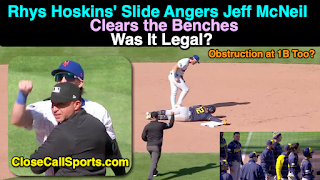
Related Post: Hoskins' Slide Into McNeil & Obstruction Play at 1B (Opening Day, 3/29/24).

This is the 1st ejection report of the 2024 MLB regular season.
This is the 1st player ejection of 2024. Prior to ejection, Ramírez's line was 0.1 IP, K.
This is New York's 1st ejection of 2023, 1st in the NL East (NYM 1; ATL, MIA, PHI, WAS 0).
This is Yohan Ramírez's first career MLB ejection.
This is Alfonso Márquez's 1st ejection since July 7, 2023 (Seby Zavala; QOC = N [Out/Safe]).

Friday, March 29, 2024

Hoskins' Slide Into McNeil & Obstruction Play at 1B

Following a look at whether Brewers 1B Rhys Hoskins' block of Mets runner DJ Stewart was obstruction or not, we determine whether Hoskins' slide into Mets 2B Jeff McNeil satisfied the bona flide slide rule criteria relative to breaking up double play attempts. Of note, 2B Umpire Jonathan Parra made his MLB debut and was working his first major league game when the benches cleared as a result of Hoskins' slide and McNeil's reaction.

Obstruction: In the bottom of the 2nd inning, Brewers catcher William Contreras threw to first base in an attempt to pickoff Mets baserunner R1 Stewart, with Milwaukee 1B Hoskins receiving the throw and appearing to place his left leg into runner Stewart's path, effectively blocking his access to first base. 1B Umpire Lance Barrett called the runner out, effectively no-calling potential obstruction as the retired runner complained that Hoskins was blocking the bag.

Defined as "the act of a fielder who, while not in possession of the ball and not in the act of fielding the ball, impedes the progress of any runner," the new obstruction point of emphasis instructs umpires to call obstruction as in Official Baseball Rule 6.01(h)(1) or Type A when a fielder blocks the runner's path without possession of the ball unnecessarily, even if the fielder is in the act of fielding at the time.

The goal is to crack down on fielders using the "act of fielding" defense to blatantly block runners' base paths when they distinctly do not need to occupy that space to receive the throw.

Bona Fide Slide: In the top of the 8th inning, Brewers baserunner R1 Hoskins slid into second base on an infield ground ball and potential double play attempt. Hoskins slid through the base, but was able to keep his hand in contact with the second base bag, making contact with Mets 2B McNeil in the process, who took exception and whose reaction spurred both benches to briefly clear.

After Replay Review, the Mets' challenge that Hoskins' slide was illegal was denied and the original call by 2B Umpire Parra of out and no slide violation was confirmed.

The four criteria of a bona fide slide, as in OBR 6.01(j), are 1) begins the slide before reaching the base, 2) able and attempts to reach the base, 3) able and attempts to remain on the base, and 4) slides within reach of the base without changing pathway for the purpose of initiating contact with a fielder.

Replay conclusively determined that R1 Hoskins satisfied all four criteria and, thus, engaged in a legal, bona fide slide.

Note that in college and high school, Hoskins' slide may have violated the force play slide rule (FPSR doesn't exist in pro ball), given that Hoskins' failed to slide in a direct line between the two bases. NCAA Rule 8-4 governs FPSR cases and holds that "the runner’s entire body (feet, legs, trunk and arms) must stay in a straight line between the bases."


Video as follows:

Plate Blocking Replay & Missed Foul Ball Leads to Run

A pair of Opening Day plate blocking replays at home in Houston and Miami brought out some fiery opinions from the Marlins broadcasters while a missed foul ball call led to Chicago's 9th-inning go-ahead run as the Rangers catcher argued with the umpire during play rather than pursuing the loose baseball, allowing a heads-up Cubs baserunner to score all the way from second base.

We begin with an Astros challenge of HP Umpire James Hoye's out and home plate collision rule no-call in Houston as Yankees outfielder Juan Soto threw out baserunner Mauricio Dubón on a close play at home plate.

Official Baseball Rule 6.01(i)(2) pertaining to home plate collisions states, "Unless the catcher is in possession of the ball, the catcher cannot block the pathway of the runner as he is attempting to score. If, in the judgment of the umpire, the catcher without possession of the ball blocks the pathway of the runner, the umpire shall call or signal the runner safe."

A catcher's legal position for this play, through which the defensive player gives the runner a path home, for better or worse often can be illustrated using the foul line—if the catcher is positioned to the right of the line (or at least in fair territory), blocking is unlikely, but if the catcher initially positions in foul territory (or straddling the line), blocking becomes a possibility. Replays indicate New York catcher Jose Trevino initially set up entirely to the infield-side of the foul line and at no point—even after catching the ball—appeared to actually block the runner. Accordingly, the out call was upheld.

In Miami, Marlins TV took exception to a Pirates challenge of the home plate collision rule and HP Umpire Chris Guccione's out call when catcher Nick Fortes tagged Pittsburgh baserunner Michael Taylor out at home on a throw from first baseman Josh Bell. In this situation, replays indicate the catcher initially set up straddling the foul line, which could theoretically lend itself to a blocking call.

However, OBR 6.01(i)(2) continues, "Notwithstanding the above, it shall not be considered a violation of this Rule 6.01(i)(2) if the catcher blocks the pathway of the runner in a legitimate attempt to field the throw (e.g., in reaction to the direction, trajectory or the hop of the incoming throw, or in reaction to a throw that originates from a pitcher or drawn-in infielder)."

Replays indicate first baseman Bell was on the infield grass when he threw home and from this drawn-in position, catcher Fortes' potentially blocking occupation is exempted as legal by rule.

Finally, Chicago took a 9th-inning lead over the Rangers when HP Umpire Chad Fairchild did not notice a foul ball off the bat of Cubs batter Miles Mastrobuoni. As the ball bounced away from Rangers catcher Jonah Heim, Cubs baserunner R2 Michael Busch took off from second base and, as Heim continued to argue the call during live action, took two bases, scoring a run, on the passed ball-turned-wild pitch (scoring decision).

To our chagrin (we've been asking for this for years but it still hasn't happened), this play is not reviewable.

Video as follows:

Monday, March 25, 2024

NCAA Ejection for Helmet Toss During Walk-Off HR

Georgia batter Kolby Branch found himself ejected and suspended after tossing his helmet while celebrating a walk-off grand slam, umpires opting to enforce NCAA baseball's unsportsmanlike conduct rule after the game had ended, meaning that pursuant to the post-participation ejection rules, Branch was effectively "ejected" (or suspended) for the team's next game, which was Game 2 of a doubleheader vs Alabama.

To be clear, NCAA Rule 5-17, Unsportsmanlike Conduct, states that "Game personnel shall not use language that will, in any manner, refer to or reflect negatively upon opposing players, coaches, umpires or spectators. Any orchestrated activities by any player or dugout personnel designed to distract, intimidate or disconcert the opposing team or reflect poor sportsmanship shall not be allowed."

We knew that bat flips during a game were grounds for ejection, but a celebratory helmet toss after a game-ending four-run home run?

The roots of college's decision to adopt 5-17 and emphasize its enforcement stems from a benches-clearing incident that occurred after a bat flap mid-game, but in this case, the game was already over and indeed, the plate umpire had already started walking off the field with his back turned to home plate—the first base umpire was the only official who appeared to witness the throw, convening the crew shortly thereafter to impose the ejection penalty for a violation of NCAA 5-17.

Are we going too far in legislating celebrations or is this a correct application of rule within its spirit to head off a potential game management situation in Game 2 of the Alabama-Georgia doubleheader?

Video as follows:

Saturday, March 23, 2024

Shohei's Blunder & Bogaerts Strikes Out on Pitch Clock Violation in Seoul

After Dodgers acquisition Shohei Ohtani's baserunning blunder during MLB's Seoul Series, Padres batter Xander Bogaerts struck out on a pitch timer violation when HP Umpire Andy Fletcher called an automatic strike on the San Diego slugger, leading to an argument over who said what and when.

In Game 1 of the LA vs San Diego season opening series in Korea, baserunner R1 Ohtani ran toward second base on a deep fly ball off Freddie Freeman's bat that was eventually caught for a fly-out. When retreating to first base, Ohtani—who had rounded second base—failed to retouch on his last time by the bag. San Diego successfully appealed the base-running error for the inning-ending double play. Official Baseball Rule 5.06(b)(1) requires all runners forced to return to "retouch all bases in reverse order."

With two out and none on in the top of the 8th inning of Game 2, Bogaerts took a 1-0 changeup from Dodgers pitcher JP Feyereisen for a called first strike. Bogaerts, who appeared to disagree with HP Umpire Fletcher's strike call (pitch QOC for those curious: px 0.68, pz 1.54 [sz_bot 1.58 / RAD 1.46]...the call was correct), stepped toward the umpire and said something, to which HP Umpire Fletcher signaled "Time" and pointed at the batter to indicate Bogaerts had taken his offensive timeout.

After a later strike two call (px 0.31, pz 1.64 [sz_bot 1.58]—call was correct), Bogaerts again said something to Fletcher, who then signaled Bogaerts out for a clock/time violation, resulting in an argument during which it became clear the disagreement concerned how many times Bogaerts had requested time out. Bogaerts maintained it was his first time out request of the at-bat while Fletcher had it as the batter's second.

With a 15-second bases-empty pitch clock (18-seconds with runners on base [down from 20-seconds in 2023]), the timer can work very quickly, leaving little time to argue about an umpire's call between pitches. The pace of play procedure states that each batter is allowed one time out request per at-bat, meaning that Fletcher's determination that Bogaerts had requested two time outs also meant that Bogaerts had violated the pitch timer rules by requesting an excessive timeout, the penalty for which is an automatic strike.

With a two-strike count, the auto-K resulted in a strikeout. | Video as follows:

Friday, March 22, 2024

Lindor Called for Obstruction After Base Blocking

As Mets shortstop Francisco Lindor appeared to tag out Tigers baserunner Carson Kelly on a stolen base attempt, 2B Umpire Brennan Miller called the New York fielder for obstruction pursuant to MLB's new point of emphasis concerning base blocking, declaring Kelly safe at second due to the violation.

Official Baseball Rule 6.01(h)(1) itself has not changed and obstruction is still defined as "the act of a fielder who, while not in possession of the ball and not in the act of fielding the ball, impedes the progress of any runner."

However, the primary focus of the new emphasis appears to be fielders blocking runners on pickoffs and steals (or any time a play is being made at a base).

Major League Baseball seems concerned that infielders have used the "in the act of fielding the ball" exemption to the obstruction rule as an excuse to illegally block the offense from reaching a base, by sticking a leg, knee, or foot in the runner's way, and has adopted a stance on OBR 6.01(h)(1) similar in theory to the existing standard for home plate collisions in OBR 6.01(i)(2), which prohibit a catcher from blocking the pathway of the runner—even when in the act of fielding—unless the catcher is blocking the runner's path "in a legitimate attempt to field the throw."

Video as follows:

Wednesday, March 20, 2024

Interference Ends Tigers' 8th vs Phillies - Whose Protection is it Anyway?

After Phillies 3B Esteban Quiroz failed to catch a two-out fly ball vs Detroit, 2B Umpire Matt Brown called Tigers baserunner Eddys Leonard out for interference, ruling that the runner illegally hindered the fielder attempting to field a batted ball. But with three Philadelphia infielders in close proximity appearing to track the fly ball, was 3B Quiroz the correctly protected fielder or was this another player's ball?

Official Baseball Rule 6.01(a)(10), which puts a batter or runner out for interference if they "fail to avoid a fielder who is attempting to field a batted ball," also states, "if two or more fielders attempt to field a batted ball, and the runner comes in contact with one or more of them, the umpire shall determine which fielder is entitled to the benefit of this rule."

Although the "comes in contact with" portion of this rule might suggest contact is required for such a call, this is another instance of a misleadingly-worded rule. The definition of interference states, "Offensive interference is an act by the team at bat which interferes with, obstructs, impedes, hinders or confuses any fielder attempting to make a play." Body contact is not required (though it often helps toward getting this called).

Replays indicate 3B Quiroz was joined by two teammates in the immediate vicinity of the falling fly ball and 2B Umpire Brown determined that this fielder was the one protected—do you agree?

Had the umpire not protected 3B Quiroz, we theoretically could have seen an Obstruction 2/B call out of this, presuming the umpire also determined that the fielder hindered the runner's attempted advancement.

But in the end, with 3B Quiroz protected, the interference call ended the inning. Credit Tigers batter Parker Meadows with an infield single.

Video as follows:

Monday, March 18, 2024

Bat Flip Ejections - How Not to Be Ejected for Flipping?

After umpires ejected UConn's Matt Malcolm and Penn State's Kyle Hannon, both for bat flips after hitting a home run, you asked us how a college player can avoid ejection for celebrating a big hit, and why bat flips have seemingly been deemed illegal by NCAA Baseball. Perhaps of equal importance is to consider why college baseball adopted the bat flip ejection rule in the first place.

Prior to the 2023 season, NCAA adopted rule 5-17: Unsportsmanlike Conduct, which states
Game personnel shall not use language that will, in any manner, refer to or reflect negatively upon opposing players, coaches, umpires or spectators. Any orchestrated activities by any player or dugout personnel designed to distract, intimidate or disconcert the opposing team or reflect poor sportsmanship shall not be allowed. This includes activities such as:
> Negative comments directed at an opponent, umpire or spectator.
> Bench jockeying.
> Bat flips near or toward an opponent or umpire.
> Use of props or signs directed at an opponent or umpiring decision.
The instruction to umpires appears to be one of strict scrutiny: interpret most bat flips as qualifying under this new sportsmanship rule 5-17. After all, an opponent (including the opposing dugout) or umpire is bound to be near a bat flipping player.

During a college baseball playoff game in 2016, a Miami player flipped his bat after a grand slam, resulting in a benches-clearing incident when defensive team Boston College responded with objection. Eight years later, the NCAA rules committee stepped in to address the bat flip issue, effectively finding that its member schools had been unable to address the problem on their own, requiring a sportsmanship intervention.

*An earlier version of this article's title contained the phrase, "How to not be ejected for flipping?" The author sincerely apologizes for exposing the reader to this reckless split infinitive. This careless error has been corrected.

Video as follows:

Saturday, March 16, 2024

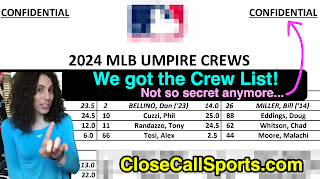
2024 MLB Umpire Crew List & Roster

MLB quietly posted its 2024 umpire crew list on its website, albeit marked "CONFIDENTIAL"... though the crews are posted publicly via Official Information => Umpires = > Crews. In any case, crew chief Jerry Layne returns as baseball's most experienced umpire in the major leagues, with a new crew for recently-promoted chief Chris Guccione and new-hires Clint Vondrak and Ryan Wills slotted into the mix. Here are the 2024 crews:

2024 MLB Umpire Crews

#Crew ChiefUmpire 2Umpire 3Umpire 4
A50 Emmel, Paul49 Fletcher, Andy76 Muchlinski, Mike52 Visconti, Jansen
B2 Bellino, Dan10 Cuzzi, Phil11 Randazzo, Tony66 Tosi, Alex
C26 Miller, Bill88 Eddings, Doug62 Whitson, Chad44 Moore, Malachi
D64 Porter, Alan28 Wolf, Jim36 Blakney, Ryan29 Barber, Sean
E13 Tichenor, Todd89 Blaser, Cory79 Gonzalez, Manny33 Ceja, Nestor
F80 Johnson, Adrian81 Wolcott, Quinn18 De Jesus, Ramon25 Valentine, Junior
G72 Marquez, Alfonso16 Barrett, Lance90 Ripperger, Mark40 Ortiz, Roberto
H63 Diaz, Laz73 Gibson, Tripp83 Estabrook, Mike12 Bacchus, Erich
I51 Hudson, Marvin21 Wendelstedt, Hunter74 Tumpane, John48 Mahrley, Nick
J14 Wegner, Mark1 Dreckman, Bruce35 Rehak, Jeremie15 Vondrak, Clint
K46 Kulpa, Ron4 Fairchild, Chad37 Torres, Carlos20 Wills, Ryan
L24 Layne, Jerry19 Carapazza, Vic78 Hamari, Adam32 Moscoso, Edwin
M27 Vanover, Larry86 Rackley, David96 Segal, ChrisTBD*
N98 Conroy, Chris7 O'Nora, Brian31 Hoberg, Pat55 Miller, Brennan
O58 Iassogna, Dan54 Bucknor, CB97 May, Ben38 Beck, Adam
P6 Carlson, Mark71 Baker, Jordan85 Scheurwater, StuTBD*
Q23 Barksdale, Lance5 Hernandez, Angel93 Little, Will59 Lentz, Nic
R92 Hoye, James8 Drake, Rob17 Reyburn, DJ84 Libka, John
S68 Guccione, Chris91 Knight, Brian47 Morales, Gabe67 Additon, Ryan
UUnassigned: 87 Barry, Scott43 Livensparger, ShaneCloseCallSports.com

Transactions:
Crew A (Emmel) added Fletcher for Fairchild, Muchlinski for Lentz, and Visconti for Rehak.
Crew B (Bellino) added Randazzo for Ripperger and Tosi for Livensparger (unassigned).
Crew C (Miller) added Eddings for Drake and Moore for Ortiz.
Crew D (Porter) added Blakney for Muchlinski. Blakney is now a #3.
Crew E (Tichenor) added Blaser for Knight, Gonzalez for Randazzo, and Ceja for Tosi.
Crew F (Johnson) added De Jesus for Gonzalez. Wolcott is now a #2. De Jesus is now a #3.
Crew G (Marquez) added Barrett for Eddings. Barrett is now a #2.
Crew H (Diaz) added Gibson for Fletcher. Gibson is now a #2.
Crew I (Hudson) added Mahrley for Blakney.
Crew J (Wegner) added Vondrak (new-hire) for Scheurwater. Rehak is now a #3.
Crew K (Kulpa) added Fairchild and Wills (new-hire) for Blaser and Visconti.
Crew L (Layne) added Moscoso for Mahrley.
Crew M (Vanover) added Segal (from Nelson) for Guccione (new crew chief). Rackley is now a #2.
Crew N Conroy added Miller, Br for Ceja.
Crew O (Iassogna) added Bucknor and May (from Nelson), for Barry (unassigned) and Morales. 
Crew P (Carlson) added Scheurwater for Gibson and TBD for Br Miller.
Crew Q (Barksdale) added Hernandez for Hickox (retired) and Lentz for Additon.
Crew R (Hoye) added Drake for Hernandez.
Crew S (Guccione) replaced 2023 Crew B (Nelson; retired) and has four different umpires.
Unassigned umpires are Barry and Livensparger. Crews M & P have TBD slots.

Supervisor Jim Reynolds oversees Crews A (Emmel), F (Johnson), N (Conroy), and P (Carlson).
Supervisor Larry Young oversees Crews B (Bellino), D (Porter), and J (Wegner).
Supervisor Mike Everitt oversees Crews C (Miller), G (Marquez), H (Diaz), and Q (Barksdale).
Supervisor Charlie Reliford oversees Crews E (Tichenor), L (Layne), and S (Guccione).
Supervisor Jeff Kellogg oversees Crews I (Hudson), O (Iassogna), and R (Hoye).

Video as follows: