Showing posts with label Ejections (MiLB). Show all posts

Tuesday, July 21, 2026

MiLB Ejection on Non-Interference with 2 Outs in 9th

An interference no-call when a runner collided with a fielder attempting to field a batted ball with 2 outs in the 9th allowed Double-A's Senators to tie its game with the Eerie SeaWolves, resulting in ejection and extending the minor league game that was ultimately decided in the 10th inning.

3B Umpire Brandon Spevak ejected SeaWolves manager Tony Cappuccilli for arguing the non-interference call when Senators batter Johnathon Thomas singled on a ground ball past third base. Senators baserunner R2 Maxwell Romero Jr, running into third base, collided with SeaWolves third baseman EJ Exposito, allowing the ball to trickle by while Romero scored and Thomas advanced to second base. At the time of the ejection, the Senators had just tied the game at 2-2. The SeaWolves ultimately won the contest, 3-2, in 10 innings.

The relevant rule is Official Baseball Rule 6.01(a)(10): "Any runner is out when—they fail to avoid a fielder who is attempting to field a batted ball, or intentionally interfere with a thrown ball."

Is there an exception, however, to this rule when a runner is either in contact with or running toward a base?

The answer is no. On a batted ball, the fielder has the right to field it.
At any other time, the runner has the right to run the bases.
Bear in mind, only one fielder is deemed 'protected' during a batted ball, which is an umpire's determination as to which fielder is entitled to field the ball. A non-protected fielder may be guilty of obstruction if they impede the runner.

There is one exception during which the base is a safe space when it comes to questions of batted ball interference: "If a runner is touching their base when touched by an Infield Fly, they are not out, although the batter is out" (OBR 5.07(b)(7)).

Other than that, however, the base is not a safe space and this is interference. Video as follows:

Saturday, August 23, 2025

Umpire Ejects Batboy (Ballboy?) After Controversial Call

Umpire Richy Arrendondo ejected a ball boy for arguing a series of calls during a Loons vs River Bandits game in MiLB's Midwest League. Having already tossed Quad Cities catcher Canyon Brown and manager Jesus Azuaje, the umpire mouthed "What are you doing?" toward the ball boy, who used the delivery of replacement baseballs as an opportunity to argue with the umpire, a no-no for auxiliary personnel.

HP Umpire Richy Arredondo ejected River Bandits catcher Canyon Brown, manager Jesus Azuaje, and the ball boy for arguing a ball four call, foul ball no-call, and balk call in the top of the 7th inning of the Loons-River Bandits game of MiLB's High-A Midwest League. With one out and one on, Loons batter Logan Wagner took a 3-1 pitch from River Bandits pitcher Mauricio Veliz for a called fourth ball, resulting in the ejection of catcher Brown. Following a two-RBI double by Jake Gelof, batter Joe Vetrano swung at a pitch for strike two, ruled a wild pitch that allowed Gelof to advance to third base, resulting in an argument from manager Azuaje that batter Vetrano actually fouled the pitch off (Azuaje was ejected here). Shortly thereafter, Gelof scored on a balk, resulting in the ejection of the ball boy for arguing while he delivered replacement baseballs.

Although we don't often encounter it, ball or bat attendant ejections fall under a lower category on officiating's tolerance hierarchy than managers, players, assistant coaches, and bench personnel. Attendants (in this case, a ball boy) are considered auxiliary personnel, are supposed to be impartial (e.g., not to argue or have a competing interest in the game and not to favour one team over the other), and are to be dismissed if they fail to maintain neutrality, as the ball boy did during this game.

Wrap: Great Lakes Loons vs Quad Cities River Bandits (Midwest Lg), 8/21/25 | Video as follows:

Friday, August 1, 2025

MANAGER Hit by Pitch During Ejection Tantrum

Quebec Capitales' manager was hit by a pitch thrown by his pitcher, on purpose, after being ejected by HP Umpire Jordan Alfonso of the Frontier League. Patrick Scalabrini's antics followed Ottawa Titans batter Jackie Urbaez's hit-by-pitch in the 9th inning, Urbaez's fourth HBP of the game.

Scalabrini's lively demonstration suggests an argument concerning whether Urbaez should have really had four HBPs, or whether he failed to follow the rule that would require he attempt to avoid the pitch.

Official Baseball Rule 5.05(b)(2) states, "The batter becomes a runner and is entitled to first base without liability to be put out (provided he advances to and touches first base) when they are touched by a pitched ball which they are not attempting to hit unless (A) The ball is in the strike zone when it touches the batter, or (B) The batter makes no attempt to avoid being touched by the ball."

If the pitch is in the strike zone when it touches the batter, it is a dead ball strike, and if the pitch is out of the zone and touches the batter who makes no attempt to avoid being touched, it is a ball (no award of first base). The batter only gets the base award if they make an attempt to avoid a ball.

Meanwhile, in college, NCAA Rule 7-4-i awards a strike if the batter "is judged to intentionally make a movement to be hit by a pitch, regardless of where the pitch is located; or allows themself to be intentionally hit by a pitch that is not thrown within the boundaries of the batter’s box unless it was not possible to avoid being hit."

High School (NFHS 8-1-d) is similar to professional ball: "If the batter permits the pitched ball to touch oneself (7-3-4), or if the umpire calls the pitched ball a strike, the hitting of the batter is disregarded except that the ball is dead. It is a strike or ball depending on location of the pitch."

Video as follows:

Tuesday, June 24, 2025

Angel Campos' College World Series Ejections of Coastal Carolina

Sunday's College World Series championship finale featured two ejections: Coastal Carolina head coach Kevin Schnall and 1B coach Matt Schilling by HP Umpire Angel Campos (formerly MLB, now NCAA Division 1). Were the ejections justified or overly aggressive, as the broadcast (and Schnall in a post-game press conference) suggested? Let's break it down.

In the first inning, 1B coach Schilling left the first base coach's box and walked toward home plate to argue balls and strikes after HP Umpire Campos called a strike during a stolen base attempt. Campos then issued a balls/strikes warning to Coastal Carolina (which is how it's done in NCAA baseball).

Chanticleer head coach Schnall (yes, that's their school mascot) then exited the dugout, in his words, to seek clarification on the warning. But when Campos responded it was a balls/strikes warning, Schnall responded by gesturing a number three with his hand while exclaiming, "you missed three pitches."

Because Schnall left his position (leaving the dugout) to argue balls and strikes after directly being warned not to continue arguing balls and strikes, he was ejected from the game.

Interesting note: NCAA Rule 3-6-f states, "If a coach leaves the dugout or their position to argue a ball or strike call (including a half swing or hit-by-pitch), the coach may be ejected without warning."

Schnall then continued arguing while walking toward home plate, eventually engaging with other umpires who had arrived to assist. One umpire fell and upon standing issued Schnall a two-game suspension (which, again, is a college-specific procedure) pursuant to NCAA Rule 2-26 regarding excessive arguing after being ejected: "No team personnel may continue to argue or to continue to excessively express themselves with prolonged actions or offensive language after an ejection. Penalty: An additional two-game suspension."

To conclude, the ejection followed a warning pursuant to the book—my only gripe is Campos' "shoo fly" gesture, which the head coach took offence to (as did I). The shooing gesture is not just an unapproved mechanic, it rarely if ever actually works to diffuse a situation. Instead, a firm stop sign might have done the trick, but considering this coach's aggressive posture regarding "you missed three pitches," I would surmise the ejection would likely have occurred either way.

Saturday, May 3, 2025

MiLB Ejections - Three Bench Clearings and a HBP

Benches cleared several times between MiLB's Brooklyn Cyclones and Jersey Shore BlueClaws, resulting in three ejections for umpires Dominic Romero and Tatum Littleton, as a violent-but-legal infield collision, home run celebration, and retaliatory intentional hit-by-pitch riled the Single-A series, leaving the two umpires to manage a number of upset players, managers, and coaches.

It all started with a hard infield collision between Cyclones baserunner R2 Eli Serrano, picked off and caught stealing 3rd base, that resulted in rundown, which ended when Serrano ran into BlueClaws right fielder Jordan Viars, the collision knocking Serrano to the ground and bringing Brooklyn out of its dugout. Umpires opted to warn both teams following this bench-clearing incident pursuant to Official Baseball Rule 6.02(c)(9)'s warnings provision: "If, in the umpire’s judgment, circumstances warrant, both teams may be officially “warned” prior to the game or at any time during the game."

Two innings later, Serrano homered and celebrated during his trip around the bases, drawing further BlueClaws ire and an argument from manager Greg Brodzinski, who left the dugout to argue with the umpires several times over the course of this series.

The next day, BlueClaws pitcher Aaron Combs hit Cyclones batter Chris Suero with a pitch immediately after Suero shouted out toward the mound, resulting in yet another benches-clearing event as the bullpens got involved, going back and forth with Suero at first base.

Umpires Romero and Littleton had huddled up to confer after the intentional HBP, as is protocol, and the benches emptied during this discussion that had taken both umpires away from their game management responsibilities...thanks, of course, to pro ball protocol for intent HBP situations which mandate a full-crew conference. The umpires then had another conference before opting to eject BlueClaws pitcher Combs for violation of OBR 6.02(c)(9) ("If, in the umpire’s judgment, such a violation occurs, the umpire may elect either to expel the pitcher, or manager and pitcher, from the game, or [issue warnings]") and batter Suero for his unsporting conduct with the pitcher and bullpen.

BlueClaws manager Brodzinski got the boot for refusing to stop arguing after more than five minutes of discussion with the umpires following the umpires' own conference.

Video as follows:

Thursday, April 24, 2025

MiLB Manager Ejected After Odd Double Play

Umpire Chandler Durham ejected Lookouts manager Jose Moreno after an unusual double play when an already-out runner dove back into first base, confusing the batter-runner, who walked off the base even though he was safe. We take a look at the umpire mechanics of this play and discuss whether anything could have been done differently or whether the offensive team simply ran into an extra out.

With none out and one on (R1) in the top of the 7th inning of the Chattanooga Lookouts' game against the Knoxville Smokies, Lookouts batter-runner Héctor Rodríguez hit a ground ball/line drive to first base, fielded by Smokies first baseman BJ Murray, who threw to shortstop Ed Howard to force out Lookouts baserunner R1 Sal Stewart, who retreated and dove back into first base as Howard's return throw arrived late on batter-runner Rodríguez.

Despite 1B Umpire Spencer Kim signaling BR Rodríguez safe at first base, Rodríguez decided, seemingly on his own volition, to jog back to the dugout, leaving the base, whereupon first baseman Murray, now in possession of the ball, tagged him out for a double play.

We first establish that R1 Stewart's actions in returning to first base despite already being forced out at second does not constitute interference pursuant to Official Baseball Rule 6.01(a)(5): "If the batter or a runner continues to advance or returns or attempts to return to their last legally touched base after they have been put out, they shall not by that act alone be considered as confusing, hindering or impeding the fielders."

Second, noticing that during his argument Moreno animatedly motioned an "out" mechanic, alluding that perhaps the batter-runner was confused because the umpire signaled "out" prematurely, we observe that U1 Kim's only gestured mechanics during the initial action and before BR Rodríguez left first base on his way back to the dugout were "fair ball" and "safe"...U1 Kim did eventually signal "out" but only after the initial action concluded, only after the batter-runner started jogging back to his dugout, and only while also pointing to R1 Stewart to clarify that R1 Stewart was the one who was out.

In sum, the mechanics here did not contain an improper "out" signal as argued by the Lookouts. Instead, perhaps the confusion resulted from Chattanooga mistakenly thinking the batted ball was caught on the fly when it was not. Thus the only mechanic that could have been different here would have been the umpire signaling "safe" after the fair ball mechanic, to signify that the batted ball was indeed not caught in the air.

Video as follows:

Saturday, April 12, 2025

An Ump Bump Ejection in Korea After "Time" Call

A manager bumped an umpire during a KBO League ejection as LG Twins skipper Kyung-Yeop Yeom  charged at 1B Umpire Young-Jae Lee following a force out at second on an uncaught line drive to third base, ruled fair by 3B Umpire Gap-Soo Kim.

After U3 Kim ruled the uncaught batted ball fair, Doosan Bears third baseman Seung-Ho Kang threw the ball to second base to force out Twins baserunner R1 Seong-Joo Moon, as batter-runner Joo-Heon Lee arrived at first base.

As confusion reigned at first base, U1 Lee called "Time" after a request from the Bears first baseman.

Twins manager Yeom exited the dugout to argue that the third base umpire called "Time" during the initial play, but replays indicate none of the umpires did such a thing until U1's "Time" call well after the force out at second base.

During the argument, umpire Lee and manager Yeom continued their heated exchange, culminating in Yeom bumping Lee moments after being ejected by HP Umpire Byeong-du Bae.

The MLB Umpire Manual's situation handling guidelines, for illustration, state, "MLB Umpires should remain calm, confident, and non-confrontational in order to maintain an appearance of fairness and impartiality," while Official Baseball Rule 6.04(d), pertaining to unsportsmanlike conduct, states, "When a manager, player, coach or trainer is ejected from a game, they shall leave the field immediately and take no further part in that game. They shall remain in the clubhouse or change to street clothes and either leave the park or take a seat in the grandstand well removed from the vicinity of their team’s bench or bullpen."

Video as follows:

Tuesday, August 20, 2024

Minor League Crew Consultation Ejection

Minor league umpires Isabella Robb and Stone Garver tag teamed a silent treatment ejection in High-A after Peoria Chiefs manager Patrick Anderson refused to stop arguing over a backswing contact strikeout call made after consultation.

With none out and none on in the top of the 9th inning of Sunday's Chiefs-Timber Rattlers game, Chiefs batter Tre Richardson swung at a 2-2 pitch from Timber Rattlers pitcher Tyler Wehrle, initially ruled a dead ball by HP Umpire Robb before resulting in an unintentional contact backswing strikeout upon crew consultation with 1B Umpire Garver.

Official Baseball Rule 6.03(a) specifies the case of backswing contact: "If a batter strikes at a ball and misses and swings so hard they carry the bat all the way around and, in the umpire’s judgment, unintentionally hit the catcher or the ball in back of them on the backswing, it shall be called a strike only (not interference). The ball will be dead, however, and no runner shall advance on the play."
Note: In high school, NFHS deems this follow-through interference.

After umpires concluded that Richardson's bat knocked the ball out of Wisconsin catcher Matthew Wood's mitt, Robb signaled the batter out, leading to Anderson's extended argument, culminating in a post-ejection silent treatment method of situation handling as the skipper tired himself out.

OBR 8.02(c) prohibits arguing a call changed after crew consultation: "No player, manager or coach shall be permitted to argue the exercise of the umpires’ discretion in resolving the play and any person so arguing shall be subject to ejection."

Video as follows:

Wednesday, June 12, 2024

Ejections Aplenty from Pitch Clock Strikeout to Game-Losing Missed Base Appeal

In just one minor league game, we had ejections for arguing a pitch clock violation strikeout, a missed base touch appeal resulting in a loss, a water cooler thrown from the dugout onto the field (oh and a "simple" balls/strikes argument too). HP Umpire Kyle Stutz ejected both managers—Midland's Gregorio Petit and San Antonio's Luke Montz—in a 4-3 ballgame that ended with a base touch appeal that RockHounds runner Denzel Clarke missed third on what initially was a game-winning 3-RBI home run by Cooper Bowman that instead turned into a game-ending double when umpires affirmed San Antonio's appeal.

The ejections began early when HP Umpire Stutz ejected RockHounds manager Petit for arguing a strike call in the 2nd inning. In the 4th, HP Umpire Stutz also ran Missions manager Luke Montz after batter Brandon Valenzuela struck out due to a pitch clock violation with a two-strike count. Valenzuela had stepped out of the box after strike two, but didn't appear to request "Time" from the umpire, meaning the pitch clock continued to run until Stutz called Valenzuela for failing to be in the batter's box and alert to the pitcher by the eight-second mark.

Finally, the game ended with fanfare as with San Antonio holding a 4-2 lead with two outs in the bottom of the 9th inning, with runners at the corners, Midland batter Cooper Bowman appeared to hit a game-winning three-RBI home run to left field to seal a 5-4 final in favor of the RockHounds. However, after the play, San Antonio appealed that Midland baserunner R1 Denzel Clarke failed to touch third base, a ruling affirmed for the third out of the inning, meaning that both Clarke and batter-runner Bowman's runs did not count.

Official Baseball Rule 5.08(a) states, "A run is not scored if the runner advances to home base during a play in which the third out is made (1) by the batter-runner before he touches first base; (2) by any runner being forced out; or (3) by a preceding runner who is declared out because they failed to touch one of the bases."

To get the out, OBR 5.09(c)(2)'s appeal process was invoked: "Any runner shall be called out, on appeal, when with the ball in play, while advancing or returning to a base, they fail to touch each base in order before they, or a missed base, are tagged."

Accordingly, the final score reverted to a 4-3 tally favoring San Antonio (lead runner Brennan Milone's run counted, as he preceded Clark on the bases), with several ejections following, including one for throwing a water cooler onto the field from the now-losing Midland dugout.

Video as follows:

Wednesday, June 5, 2024

Four MiLB El Paso Ejections Over Tag Plays

Four El Paso Chihuahuas were ejected by MiLB umpires Kelvis Velez and Jen Pawol during a series vs Round Rock after a pair of contested tag plays that, by minor league rule, aren't reviewable because nothing is at that level (typically). What does game management say about all this?

In Velez' case, El Paso catcher Kevin Plawecki, 2B Nate Mondou, and manager Pete Zamora were ejected arguing after an RBI single which itself followed a safe call on a stolen base attempt at second base. Mondou and Zamora, specifically, argued the safe call when it occurred, Zamora returning to the dugout and Mondou to his position. Thus, those two ejections were for continuing to argue a previous play, while Plawecki charged up the third base line to confront the umpire to earn his dismissal.

For Pawol, 3B Eguy Rosario made a beeline toward the crew chief after a safe call at third base, making a finger pointing gesture just feet from Pawol's face.

Video as follows:

Sunday, May 26, 2024

LSU Catcher's Interference During Steal vs South Carolina

South Carolina scored its 11th run vs LSU on a 10th inning catcher's interference and balk call, umpires ruling that the catcher illegally interfered with the batter by prematurely jumping on home plate prior to a pitch arriving during which a runner attempted to steal home. 

NCAA Rule 8-3-p states, "If, on an attempted squeeze play or steal of home plate, the catcher steps on or in front of home plate without possession of the ball or touches the batter or the bat, the pitcher shall be charged with a balk and the catcher with interference." The equivalent rules throughout the levels are OBR 6.01(g) and NFHS 8-1-1e.1.

Throughout the 15-minute delay as a result of the umpire's call and subsequent LSU protest (yes, college still has protests, no protesting a judgment call still should result in denial), the broadcast focused on the catcher's positioning at home, claiming he was not "on or in front" of home plate.

Rather than engage too much with this argument, we instead turn to a different rule that brings us to the same conclusion. NCAA 8-2-e-2 discusses catcher's interference that occurs when any runner is attempting to steal a base: "[A stealing runner at any base] shall be awarded the base the runner is attempting to reach."

As for the balk component, R3 is awarded home plate either via balk or because of attempting to steal the base when catcher's interference occurs while R1 gets second base because the batter becoming a runner on the catcher's interference award forces R1 to advance.

For reference, defensive interference is defined as "an act by a fielder (usually the catcher) that hinders or prevents a batter from hitting a pitch" and replays indicate this catcher jumped in front of the batter, blocking his access to home plate (and the pitch) prior to the pitch's arrival. The batter had no free choice at this point to swing or not swing (and before arguing the batter must swing, think about it...requiring the batter swing here means catchers will get seriously injured...).

After the play as LSU set up to appeal R3's missed base touch of home plate (ruled "safe"/no miss by the umpire), R2 ran toward third base in an attempt to draw a throw, since all appeals must occur during a live ball (in OBR/NCAA) and be made before any subsequent pitch, play, attempted play.

Drawing a throw to third would thus be a play or attempted play and close the window on the appeal on old R3 at home. Nonetheless, the umpire ruled R3 safe because even though the runner didn't touch home plate during the initial play, the interference and obstruction rules allow umpires to award base touches in order to nullify the act of interference or obstruction.

Video as follows:

Thursday, May 16, 2024

MiLB Manager Ejected Arguing a Call That Helped Him

Columbus Clippers manager Andy Tracy passionately argued himself through an ejection from HP Umpire Macon Hammond, even though the play Tracy was arguing actually benefited his own team. With one out and the bases loaded, Clippers batter Myles Straw hit a line drive to Mud Hens 2B Jace Jung, ruled an out on the catch by 3B Umpire Kelvis Velez. Both Velez and 1B Umpire Jen Pawol then signaled "safe" when Toledo unsuccessfully tried to double up the Columbus baserunners at second and first, before Toledo threw to third base to appeal Clippers baserunner R3 Micah Pries, who took off for home plate and scored for leaving early.

HP Umpire Hammond, however, ruled the runner safe—that he left timely—and the inning appeared poised to continue with two out and runners at first and second...until the runner on second, Dom Nuñez took off for third and was easily tagged out by Toledo third baseman Buddy Kennedy, who still held the baseball from the appeal executed moments earlier.

Although replays do not conclusively indicate whether or not R3 Pries timely tagged at third, the runner's speed in touching home plate suggests he may have not. If any manager were to be upset with the umpires about the outcome of this play, it would be Toledo's Tim Federowicz, because Columbus scored a run it may not have been entitled to.

Instead, Federowicz's discussion with the umpires was fairly brief and it was Tracy who approached Hammond as the umpire and catcher Nuñez discussed the play at home plate prior to the next inning.

Hammond quickly ejected Tracy, who appeared to be unaware that umpire Velez had signaled the batter out on the catch.

In this case, Tracy's ignorance was not bliss. | Video as follows:

Sunday, May 12, 2024

Umpire Calls Runner Out for Missing Home Plate on HR, Coach Ejected

Sergio Guerra thought he hit his first home run of the season, only to be called out by HP Umpire Asa Howard for failing to physically touch home plate when Utah Valley appealed the Tarleton State batter's baserunning infraction. Head Coach Fuller Smith was ejected arguing the umpire's ruling.

In calling Guerra out on the defense's successful appeal, umpires enforced NCAA Rule 8-6-3, which states that a runner may be called out on appeal for missing a base when "The runner fails to touch each base in order when advancing or returning to a base. Either the runner or the missed base may be tagged."

College isn't the only level to require base touches; all codes agree on this matter. The equivalent rule for professional baseball is OBR 5.06(b)(1) Advancing Bases and for high school is NFHS 8-2-1.

So next time you spy an umpire running alongside a home run hitter in the infield like 1B Umpire Clayton Hamm did alongside Guerra here, or see a plate umpire lean in to look at home plate as the runner approaches, this is precisely what they are looking for: a required base touch, in case there is an appeal play afterward.

Video as follows:

Monday, April 29, 2024

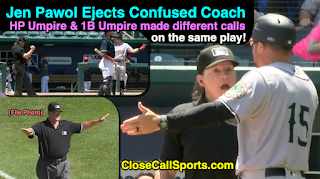
Jen Pawol Ejects Confused Coach After Conflicting Calls

Triple-A umpire Jen Pawol ejected Norfolk's manager and right fielder after she and 1B Umpire Kelvis Velez made conflicting calls on the same check swing play—Pawol as the home plate umpire ruling "swing" and Velez, mistaking her point at the batter as a point to him for an appeal, signaling the batter did not swing at the pitch.

With one out and a runner on second base, Norfolk Tides batter Peyton Burdick attempted to check his swing on a 2-2 fastball from Jacksonville pitcher Eli Villalobos. 

The circumstance of R2 and less than two out is important to note for this Triple-A game operating with a three-person umpire crew. In this situation, the 1B Umpire shall position themself within the infield, in front of second base (well, not directly in front of 2B, but still in the vicinity of Deep B/C), meaning there is no field umpire down the right field line anymore.

While the plate umpire assigning fair/foul responsibilities to right field in this crew configuation, the 1B Umpire retains check swing appeal responsibility for right-handed batters.

Accordingly, when Burdick tried checking his swing, HP Umpire Pawol pointed to the batter as part of a two-part "yes he did" mechanic to call the batter for a swinging strike.

1B Umpire Velez, however, saw Pawol pointing beyond the batter and near second base, where he was standing, and assumed Pawol had appealed the matter of Burdick's check swing to him (after all, the catcher requested an appeal by gesturing toward U1).

Thus, as Pawol completed her two-part mechanic ending with a fist, Velez signaled safe with outstretched arms, leading to confusion as two umpires had different calls for the same play.

Although the Official Baseball Rules do clearly state that the plate umpire has primary responsibility for all decisions on the batter—including half swings—which makes this Pawol's primary call, a more apropos response is found in OBR 8.03(c) pertaining to conflicting calls by multiple umpires: "If different decisions should be made on one play by different umpires, the umpire-in-chief shall call all the umpires into consultation, with no manager or player present. After consultation, the umpire-in-chief (unless another umpire may have been designated by the Office of the Commissioner) shall determine which decision shall prevail, based on which umpire was in best position and which decision was most likely correct. Play shall proceed as if only the final decision had been made."

With little doubt that the plate umpire's call of swinging strikeout would prevail (it was Pawol's call to begin with), that left one confused coach arguing to the point of ejection.

How to Avoid This Situation: The best way for a base umpire to avoid a situation where they might signal "safe" on a check swing where the plate umpire signals "out" is for the base umpire to pause momentarily. By waiting a beat, U1 would have been able to see the totality of UIC's swinging strike mechanic, and avoided ruling on a check swing appeal that was never indicated.

Exception: The one exception to this is an MLBUM interpretation known as "Voluntary Strike" in which the base umpire does signal on their own, with or without appeal, on an uncaught third strike, and only if they are going to rule the play a swinging strike.

Video as follows:

Monday, February 26, 2024

College Player Ejected for Bat Flip - Unraveling Nebraska vs Grand Canyon U

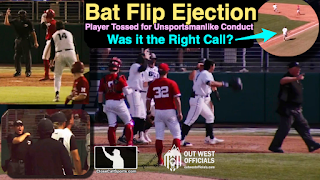
Grand Canyon University batter Tyler Wilson hit a grand slam to tie the Nebraska-GCU game, but was ejected by the HP Umpire during his home run trot for a bat flip near first base. What are college baseball's sportsmanship rules and was an ejection all over flipping a bat during a big moment in a game necessary?

We begin the night before Sunday's game in question, with both Nebraska and GCU trading celebrations after executing plays that benefited their respective teams. On their own, these celebrations are, effectively, unremarkable—players are allowed to celebrate success on the field.

The issue came to a head, however, in the 7th inning, with GCU pitcher Nathan Ward's exuberant celebration after a check swing strikeout to end Nebraska's top half. That attracted the attention not just of Nebraska, but the plate umpire who ordered Ward back to the dugout. Nebraska's head coach was seen speaking with umpires during the inning break.

After the game, the two teams met in the outfield and exchange unsporting words, indicating held over resentment, all leading to Sunday's game when Wilson hit his game-tying grand slam and flipped his bat, having held onto it until passing the halfway point down the first baseline.

As for why umpires ejected Wilson for his bat flip, we refer to the NCAA Baseball rulebook.

In addition to the Coaching/Players' Code of Ethics prohibiting unsportmanlike behavior, NCAA 5-17, newly amended for 2023-24, prohibits actions that "reflect poor sportsmanship," specifically including, "Bat flips near or toward an opponent or umpire." The penalty in college is a warning after the first offense and an ejection for any further unsportsmanlike conduct after the warning.

NCAA 3-6-b obliges umpires to enforce these rules: "[Each umpire] is obliged to conduct the game under conditions conducive to the highest standards of good sportsmanship."

The Official Baseball Rule (professional/MLB/MiLB) version of the sportsmanship rule is OBR 6.04, with ejections mandated by umpires' rule OBR 8.01(d).

NFHS 3-3-1f prohibits "any unsportsmanlike act" including taunting (3-3-1c: "carelessly throw a bat") while high school rule 10-1-6 authorizes umpires to eject for these violations.

Video as follows:

Friday, August 11, 2023

ABS Stops Calling Strikes, Manager Ejected in 20-4 Romp

HP Umpire Takahito Matsuda ejected Charlotte Knights manager Justin Jirschele in the 9th inning of a 20-4 blowout game designed as a full Automated Ball/Strike System (ABS) affair, meaning that computers rather than the umpire called all balls and strikes for the game...except that in the 9th, ABS seemed to stop calling strikes and Gwinnett tacked on four more runs thanks to six walks (there was also a hit-by-pitch).

Indeed, even the Gameday computer readout seemed to be missing a few pitches during multiple at-bats in the 9th inning as catcher-turned-position player pitching Xavier Fernández threw 33 pitches (just five of them strikes) as the three-plus hour game slowly trudged to a lopsided conclusion.

The final score was Gwinnett Stripers 20, Charlotte Knights 4.

Video as follows:

Wednesday, August 9, 2023

What if Runner's Lane Interference was Reviewable - CPBL

What if runner's lane interference was a reviewable play? It might not be in MLB, but it is in the Chinese Professional Baseball League and we take a look at one such CPBL review that resulted in ejection of the offensive team manager when RLI, which was not called on the field, was awarded by the Replay Official.

Official Baseball Rule 5.09(a)(11) states, "The batter is out when in running the last half of the distance from home base to first base, while the ball is being fielded to first base, they run outside (to the right of) the three-foot line, or inside (to the left of) the foul line, and in the umpire’s judgment in so doing interfere with the fielder taking the throw at first base, in which case the ball is dead."

Given this language, do you believe this was RLI? Could the throw have reasonable retired the runner, given the runner's foot was already on first base as the thrown ball was still well in front of first base?

Video as follows:

Wednesday, July 5, 2023

Ghani Ejects LeCroy After Computer Ball/Strike Call

HP Umpire Darius Ghani ejected Rochester Red Wings manager Matthew LeCroy after IronPigs batter Weston Wilson's successful challenge on an apparent inning-ending strike three call, reversed by computer to ball three instead, extending the frame as Rochester was on its way to the dugout.

With two out and one on, Wilson took a 2-2 pitch from Red Wings pitcher Wily Peralta for a called third strike. After the call, Wilson animatedly tapped his helmet to signify a challenge request, which HP Umpire Ghani acknowledged with a head-tap of his own, resulting in an overturned ruling as the computer deemed the pitch low for ball three.

LeCroy was then ejected for arguing a combination of the replay result and Ghani's acceptance of Wilson's challenge. By rule, a pitch location challenge filed by the batter, pitcher, or catcher shall occur immediately after the call in question and replays indicate that although Wilson did react to the initial call, he fairly quickly signaled a challenge via the hand-to-head gesture.

LeCroy was previously ejected by Taka Matsuda in May, during a game in which both teams combined for six unsuccessful challenges as the quasi-Automated Ball Strike System (challenge) computer upheld all six Matsuda pitch calls.
Related PostChallenge Checkup - Umpire Matsuda 6-for-6 w Ejections (5/22/23).

Video as follows:

Tuesday, July 4, 2023

Umpire Isabella Robb's Ejection of Tarpons Manager Rachel Balkovec is 1st All-Woman MiLB Ejection

Minor League umpire Isabella Robb's ejection of Tampa Tarpons (Single-A Yankees) manager Rachel Balkovec is the first all-woman ejection in affiliated baseball and also features a key play concerning a pulled foot at first base, as well as crew consultation to help with this call. Let's review.

With a runner on first, Tarpons batter Anthony Hall hit a ground ball to Tortugas second baseman Johnny Ascanio, who threw to shortstop Victor Acosta to force out baserunner R1 Brenny Escanio at second, whose throw to pitcher Zach Maxwell covering first base arrived just as batter-runner Hall's foot came down at first base. Thus, the two elements of this play are the timing of safe/out, and also the potential pulled foot by the pitcher covering first base.

In a crew of two, although the first base umpire often can take a pulled foot on their own, the home plate umpire just so happens to be in an ideal position to provide information about a potential pulled foot by the fielder on a close play at first base. This is because the plate umpire is generally on the foul line with a perfect view of the side of the base, due to the plate umpire's positioning for officiating a potential runner's lane interference infraction on the batter-runner's part.

Here, 1B Umpire Robb initially calls the Tarpons batter-runner out at first base. Upon request from at-bat manager Balkovec, she confers with her partner at home plate, and the crew sticks with the out call after the help. Balkovec dissents and is ultimately ejected for arguing the crew's post-consultation ruling that the runner was out at first base.

Video as follows:

Friday, June 30, 2023

MiLB Ejection - Chris Marco Runs Casey Lawrence for Balk Complaints in Both Games of Doubleheader

Minor League scheduling contributed to a Triple-A ejection in Buffalo as umpire Chris Marco ejected Bisons pitcher Casey Lawrence for an extended balk complaint that started in Game 1 when Lawrence was called for a balk, culminating in a complaint that Worcester Red Sox pitcher Chase Shugart was not called for a similar balk in Game 2.

As 1B Umpire in Game 1, Marco called Lawrence for a no step balk during a pickoff play at first base, ruling a violation of Official Baseball Rule 6.02(a)(3), which states it is a balk when "The pitcher, while touching their plate, fails to step directly toward a base before throwing to that base."

The MLBUM interpretation of this OBR 6.02(a)(3) called Stepping to a Base states, "If a pitcher turns or spins off their free foot without actually stepping, it is a balk."

The interp further requires the pitcher to "lift their entire non-pivot foot off the ground and bring it down in a location different from where it started and toward the base. The entire non-pivot foot must move in a direction and distance to the base. This will constitute a step. The pitcher is not allowed to lift their non-pivot foot up and bring it back down in the same spot where it started. In stepping, the heel of the pitcher’s free foot may not end up in the same spot it started."

When Marco, now the HP Umpire in Game 2, did not call a balk on Shugart, Lawrence (who had lost the first game and was a bench player for Game 2) was ejected from the dugout.

Video as follows: