Showing posts with label Runner's Lane Interference. Show all posts

Sunday, August 30, 2026

MLB Ejections 108-9 - Visconti, Fletcher (Tatis, Stammen)

3B Umpire Jansen Visconti ejected Padres RF Fernando Tatis and 2B Umpire Andy Fletcher ejected manager Craig Stammen (runner's lane interference out call by HP Umpire Tyler Jones; QOCY) in the top of the 7th inning of the #Padres-#Rays game. With two out and none on, Padres batter Tatis bunted a 0-0 cutter from Rays pitcher Cam Booser on the ground to pitcher Booser, who threw to 1B Jonathan Aranda as Padres batter-runner Tatis ran to first base, ruled runner's lane interference by HP Umpire Jones. Replays indicate batter-runner Tatis ran on the infield grass and not within the runner's lane during the last half of his run to first base and in doing so interfered with 1B Aranda's ability to field Booser's throw, the call was correct.* At the time of the ejection, the Padres were leading, 3-1. The Rays ultimately won the contest, 5-4, in 11 innings.

This is Jansen Visconti (52)'s 2nd ejection of 2026.
This is Andy Fletcher (49)'s 1st ejection of 2026.

*Official Baseball Rule 5.09(a): "A batter is out when in running the last half of the distance from home base to first base, while the ball is being fielded to first base, they run outside (to the right of) the three-foot line, or inside (to the left of) the foul line and on the infield grass, and in the umpire’s judgment in so doing interfere with the fielder taking the throw at first base, in which case the ball is dead."

These are the 108th and 109th ejection reports of the 2026 MLB regular season.
This is the 61st manager ejection of 2026.
This is the 27th player ejection of 2026. Ejection Tally: 61 Managers, 21 Coaches, 27 Players.
This is San Diego's 9/10th ejection of 2026, 1st in the NL West (SD 10; SF 9; ARI 1; COL, LAD 0).
This is Fernando Tatis' 1st ejection since May 5, 2025 (Adrian Johnson; QOC = Y [Balls/Strikes]).
This is Craig Stammen's 5th ejection of 2026, 1st since July 28 (Jeremie Rehak; QOC = N [ABS Denial]).
This is Andy Fletcher's 1st ejection since August 8, 2025 (Mike Tauchman; QOC = U [Check Swing]).
This is Jansen Visconti's 2nd ejection of 2026, 1st since June 8 (David Popkins; QOC = Y [Balls/Strikes]).

Saturday, April 11, 2026

MLB Ejection 011 - Adam Beck (1; Kurt Suzuki)

HP Umpire Adam Beck ejected Angels manager Kurt Suzuki (runner's lane interference call; QOCY) in the top of the 8th inning of the #Angels-#Reds game. With none out and none on, Angels batter Logan O'Hoppe struck out swinging on a 2-2 slurve from Reds pitcher Tony Santillan, which went uncaught by catcher Tyler Stephenson, who retrieved the baseball and threw to 1B Sal Stewart, ruled interference by HP Umpire Beck. Replays indicate batter-runner O'Hoppe failed to run within the three-foot runner's lane and in doing so interfered with 1B Stewart's ability to receive the throw, the call was correct.* At the time of the ejection, the Reds were leading, 5-3. The Reds ultimately won the contest, 7-3.

This is Adam Beck (38)'s 1st ejection of 2026.
Official Baseball Rule 5.09(a)(11): "A batter is out when, in running the last half of the distance from home base to first base, while the ball is being fielded to first base, they run outside (to the right of) the three-foot line, or inside (to the left of) the foul line and on the infield grass, and in the umpire’s judgment in so doing interfere with the fielder taking the throw at first base, in which case the ball is dead."

This is the 11th ejection report of the 2026 MLB regular season.
This is the 8th manager ejection of 2026. Ejection Tally: 8 Managers, 1 Coaches, 2 Players.
This is Los Angeles' 2nd ejection of 2026, 1st in the AL West (LAA 2; HOU, OAK?, SEA, TEX 0).
This is Kurt Suzuki's 1st ejection since May 12, 2013 (John Tumpane; QOC = N [Balls/Strikes]).
This is Adam Beck's 1st ejection since April 20, 2025 (Aaron Boone; QOC = Y [Replay Review]).

Sunday, April 5, 2026

MLB Ejection 006 - David Rackley (1; Tony Vitello)

3B Umpire David Rackley ejected Giants manager Tony Vitello (runner's lane interference out call by HP Umpire Edwin Jimenez; QOCY) in the bottom of the 7th inning of the #Mets-#Giants game. With one out and none on, Giants batter Jerar Encarnacion hit a 0-0 sinker from Mets pitcher Huascar Brazobán on the ground to Brazobán, who threw to first base, resulting in a runner's lane interference call as Jimenez ruled Encarnacion's running on the infield grass interfered with the first baseman receiving the throw. Replays indicate Encarnacion did not run within the runner's lane and, in doing so, interfered with fielder Mark Vientos' ability to field the throw, the call was correct.* At time of the ejection, the Giants were leading, 2-1. The Mets ultimately won the contest, 5-2.

This is David Rackley (86)'s 1st ejection of 2026.
Official Baseball Rule 5.09(a)(11): "A batter is out when, in running the last half of the distance from home base to first base, while the ball is being fielded to first base, they run outside (to the right of) the three-foot line, or inside (to the left of) the foul line and on the infield grass, and in the umpire’s judgment in so doing interfere with the fielder taking the throw at first base, in which case the ball is dead."

This is the 6th ejection report of the 2026 MLB regular season.
This is the 6th manager ejection of 2026. Ejection Tally: 6 Managers, 0 Coaches, 0 Players.
This is San Francisco's 1st ejection of 2026, 1st in the NL West (SF 1; ARI, COL, LAD, SD 0).
This is Tony Vitello's 1st career MLB ejection.
This is David Rackley's 1st ejection since August 28, 2025 (Craig Counsell; QOC = Y [Balls/Strikes]).

Monday, June 9, 2025

MLB Ejection 067 - Stu Scheurwater (1; Craig Counsell)

HP Umpire Stu Scheurwater ejected Cubs manager Craig Counsell (runner's lane interference no-call on Otto Kemp; QOCY) in the bottom of the 9th inning of the #Cubs-#Phillies game. With none out and none on, Phillies batter Kemp hit a 0-0 fastball from Cubs pitcher Brad Keller on the ground to catcher Carson Kelly, who threw to first baseman Michael Busch after Kemp arrived at first base, ruled safe by 1B Umpire Vic Carapazza and non-runner's lane interference by HP Umpire Scheurwater. Replays indicate that although batter-runner Kemp failed to run within the running lane (plus fair territory dirt extension adopted by MLB in 2024) by virtue of running on the grass, his doing so did not interfere with fielder Busch receiving the throw at first base, as the throw could not have reasonably retired the runner. At the time of the ejection, the game was tied, 2-2. The Phillies ultimately won the contest, 4-3, in 11 innings.
  
This is Stu Scheurwater (85)'s 1st ejection of 2025.
*Official Baseball Rule 5.09(a)(11): "The batter is out when in running the last half of the distance from home base to first base, while the ball is being fielded to first base, they run outside (to the right of) the three-foot line, or inside (to the left of) the foul line, and in the umpire’s judgment in so doing interfere with the fielder taking the throw at first base, in which case the ball is dead."

This is the 67th ejection report of the 2025 MLB regular season.
This is the 34th manager ejection of 2025. Ejection Tally: 34 Managers, 13 Coaches, 20 Players.
This is Chicago's 4th ejection of 2025, 1st in the NL Central (CHC, PIT 4; CIN, STL 3; MIL 2).
This is Craig Counsell's 2nd ejection of 2025, 1st since June 8 (Derek Thomas; QOC = Y [Balls/Strikes]).
This is Stu Scheurwater's 1st ejection since August 12, 2024 (Oliver Marmol; QOC = Y [Balls/Strikes]).

Friday, June 6, 2025

MLB Ejections 060-1 - Chad Fairchild (1-2; MIA x2)

HP Umpire Chad Fairchild ejected Marlins 2B Xavier Edwards and manager Clayton McCullough (runner's lane interference call; QOCN) in the top of the 3rd inning of the #Marlins-#Rays game. With none out and one on, Marlins batter Edwards bunted a 0-0 fastball from Rays pitcher Zack Littell on the ground to Littell, who threw to first baseman Jonathan Aranda as batter-runner Edwards arrived at first base, resulting in a collision between Edwards and Aranda as the ball caromed into right field, ruled runner's lane interference by HP Umpire Fairchild. Replays indicate the batter-runner may have run outside of the expanded runner's lane (e.g., on the infield grass), but that the pitcher's low throw could not have reasonably retired the runner, the call was incorrect.* At the time of the ejection, the Rays were leading, 1-0. The Rays ultimately won the contest, 4-3.
 
These are Chad Fairchild (4)'s 1st and 2nd ejections of 2025.
*Official Baseball Rule 5.09(a)(11): "The batter is out when in running the last half of the distance from home base to first base, while the ball is being fielded to first base, they run outside (to the right of) the three-foot line, or inside (to the left of) the foul line, and in the umpire’s judgment in so doing interfere with the fielder taking the throw at first base, in which case the ball is dead."
2024 MLB Rules Change: The runner's lane has been expanded to include the dirt in fair territory.
Wendelstedt Umpire Manual Interpretation: "The determination is not whether the throw is true, but whether it could still reasonably retire the runner."

These are the 60th and 61st ejection reports of the 2025 MLB regular season.
This is the 18th player & 31st manager ejection of 2025. Ejection Tally: 31 Managers, 12 Coaches, 18 Players.
This is Miami's 1/2nd ejection of 2025, 1st in the NL East (MIA, WAS 2; PHI 1; ATL, NYM 0).
This is Xavier Edwards' 1st career MLB ejection.
This is Clayton McCullough's 1st career MLB ejection.
This is Chad Fairchild's 1st ejection since July 11, 2024 (Miguel Cairo; QOC = Y [Balls/Strikes]).

Box: Miami Marlins vs Tampa Bay Rays, 6/6/25 | Video as follows:

Friday, June 14, 2024

MLB Ejection 078 - Vic Carapazza (5; Bruce Bochy)

HP Umpire Vic Carapazza ejected Rangers manager Bruce Bochy (runner's lane interference no-call; QOCY) in the bottom of the 4th inning of the #Rangers-#Mariners game. With one out and one on, Mariners batter Victor Robles bunted a first-pitch changeup from Rangers pitcher Andrew Heaney back to the pitcher, whose throw to first base failed to retire Robles, resulting a bunt single. Replays indicate Robles failed to run within the expanded runner's lane (traditional lane + extension of the dirt in fair territory), but in doing so did not interfere with the fielder taking the throw at first base (1B Nathaniel Lowe), the call was correct.* At the time of the ejection, the Mariners were leading, 3-2. The Mariners ultimately won the contest, 3-2.

This is Vic Carapazza (19)'s 5th ejection of 2024.
Official Baseball Rule 5.09(a)(11): "A batter is out when in running the last half of the distance from home base to first base, while the ball is being fielded to first base, they run outside (to the right of) the three-foot line, or inside (to the left of) the foul line and on the infield grass, and in the umpire’s judgment in so doing interfere with the fielder taking the throw at first base, in which case the ball is dead."
^Baseball Rules Difference: NCAA & NFHS both would have RLI here if the umpire deems that the runner's illegal position interfered with the fielder making the throw (OBR only relates to the fielder taking the throw).

This is the 78th ejection of the 2024 MLB regular season.
This is the 37th manager ejection of 2024. Ejection Tally: 37 Managers, 12 Coaches, 29 Players.
This is Texas' 4th ejection of 2024, T-1st in the AL West (OAK, TEX 4; HOU, SEA 3; LAA 1).
This is Bruce Bochy's 3rd ejection of 2024, 1st since May 25 (Laz Diaz; QOC = N-c [Fair/Foul]).
This is Vic Carapazza's 5th ejection of 2024, 1st since June 5 (Nico Hoerner; QOC = N [Balls/Strikes]).

Wrap: Texas Rangers vs Seattle Mariners, 6/14/24 | Video as follows:

Sunday, April 28, 2024

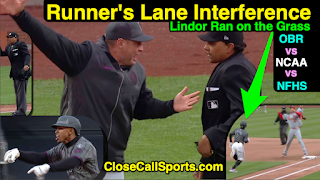
Lindor's Runner's Lane Interference - Taking the Throw

Called out for runner's lane interference, Mets batter-runner Francisco Lindor and manager Carlos Mendoza argued with HP Umpire Eric Bacchus to no avail that New York's SS didn't actually interfere with St Louis on the almost-wild pitch strikeout that led to Lindor running to first base.

We review professional baseball's runner's lane interference rule and compare this call across baseball's different levels, namely college (NCAA) and high school (NFHS). Is Lindor out for RLI at each level?

Contrary to Lindor's claim that he ran legally within the running lane—including the extended-for-2024 dirt area in fair territory—replays indicate Lindor ran entirely on the infield grass and well out of the runner's lane or "inside the line" during his jaunt to first base.

Cardinals catcher Willson Contreras' throw to first baseman Paul Goldschmidt, however, was high and Goldy was unable to catch the ball upon jumping for it. HP Umpire Bacchus' RLI call thus put an out on the board even with the overthrow.

Official Baseball Rule 5.09(a)(11) states, "A batter is out when in running the last half of the distance from home base to first base, while the ball is being fielded to first base, he runs outside (to the right of) the three-foot line, or inside (to the left of) the foul line and on the infield grass, and in the umpire’s judgment in so doing interferes with the fielder taking the throw at first base."

College has a similar rule on its face, but unlike OBR, NCAA 7-11-p has a note that states, "If the batter-runner is running illegally to first base and their being outside the lane alters the throw of a fielder, hinders or alters a fielder’s opportunity to field the throw, or the batter-runner is hit by the throw that has been made in an attempt to make a play, it shall be called interference and the batter-runner is to be called out."

This means the primary difference between college and pro is with whom the batter-runner, by virtue of running out of the lane, is interfering with. Under OBR, the only consideration is "the fielder taking the throw" while NCAA RLI provides for either the fielder taking the throw or the fielder making the throw, provided the batter-runner's illegal positioning "alter[ed] the throw of a fielder."

Accordingly, we must determine whether 1B Goldschmidt, as the fielder taking the throw, was actually interfered with by Lindor's running out of the running lane. Because of the high throw and the jump that couldn't reel it in, I'm inclined to say the throw could not have "reasonably retired the runner", which is the standard interpretation for RLI when considering questionable throw quality.

Meanwhile, high school's rule is probably the easiest as NFHS 8-4-1g states, succinctly, that a batter-runner is out when they run "outside the three-foot running lane (last half of the distance from home plate to first base), while the ball is being fielded or thrown to first base." In other words, NFHS is strict: fail to run within the lane, if there's any question of whether there was interference, you're out, period.

Also the broadcaster incorrectly stated Lindor was out for running "out of the baseline." Sigh.

Wrap: Houston Astros vs Chicago Cubs, 4/25/24 | Video as follows:

Friday, December 22, 2023

2024 Major MLB Rules Changes - A CCS Review

Major League Baseball announced several rules changes approved by MLB's Competition Committee for the 2024 season, including reductions in the pitch clock timer and mound visit limit, new pitcher minimums, and an expansion of the runner's lane to a wider space.

Pitch Clock
Although the 15-second bases-empty pitch clock and 30-second between-batters pitch clock will remain the same in 2024, MLB will reduce the runners-on-base limit by two seconds, from 2023's mark of 20-seconds to 18 seconds in 2024. Furthermore, the pitch timer following foul balls or other dead ball situations will now begin upon the pitcher receiving the new baseball as opposed to 2023's start of the pitcher entering the dirt circle or mound area.

Mound Visit Limit
In 2023, teams were permitted five mound visits per game before being compelled to remove a pitcher for any subsequent visit exceeding this allotment. Umpires had discretion late in games to allow a mound visit without requiring the pitcher's removal. In 2024, teams will be allowed four mound visits until the 9th inning, when umpires may afford teams an additional visit without the must-remove-pitcher penalty.

Pitcher Minimum
In addition to the existing three-batter minimum rule for pitchers, 2024 will now require any pitcher who warms up on the field prior to an inning to face at least one batter (three for any pitcher newly into the game). This will prevent managers from executing pitching changes after warmups but before the first batter of the new inning.

Runner's Lane
Due to a flurry of runner's interference incidents, MLB will expand the runner's lane in 2024 to include the entirety of the dirt path between home plate and first base in fair territory, in addition to the existing three-foot wide lane in foul territory during the latter half of the distance to first base. This expansion effectively means runners may run to first base without penalty in fair territory, provided that both feet remain on or touching the dirt. A runner will be deemed legal if half of their foot is on the dirt and half on the infield grass in fair territory.

Video as follows:

Wednesday, August 9, 2023

What if Runner's Lane Interference was Reviewable - CPBL

What if runner's lane interference was a reviewable play? It might not be in MLB, but it is in the Chinese Professional Baseball League and we take a look at one such CPBL review that resulted in ejection of the offensive team manager when RLI, which was not called on the field, was awarded by the Replay Official.

Official Baseball Rule 5.09(a)(11) states, "The batter is out when in running the last half of the distance from home base to first base, while the ball is being fielded to first base, they run outside (to the right of) the three-foot line, or inside (to the left of) the foul line, and in the umpire’s judgment in so doing interfere with the fielder taking the throw at first base, in which case the ball is dead."

Given this language, do you believe this was RLI? Could the throw have reasonable retired the runner, given the runner's foot was already on first base as the thrown ball was still well in front of first base?

Video as follows:

Tuesday, July 4, 2023

MLB Ejections 132-3 - Fletcher, Bacchus (Ross, Napoli)

1B Umpire Andy Fletcher ejected Cubs 1B Coach Mike Napoli and HP Umpire Erich Bacchus ejected Cubs manager David Ross (strike two call; QOCY) in the top of the 11th inning of the #Cubs-#Brewers game. With two out and one on, Cubs batter Dansby Swanson took a 2-1 fastball from Brewers pitcher Clayton Andrews for a called second strike. Replays indicate the pitch was located over the inner half of home plate and above the hollow of the knee (px -0.37, pz 1.63 [sz_bot 1.59 / RAD 1.47]), the call was correct.* At the time of the ejections, the Cubs were leading, 7-6. The Cubs ultimately won the contest, 7-6, in 11 innings.

Prior, Ross argued with Bacchus in the bottom of the 6th inning (but was not ejected) after Brewers batter William Contreras' soft ground ball fielded by Cubs catcher Miguel Amaya resulted in a single and throwing error when Amaya's throw to first base sailed down the foul line into right field. Bacchus ruled that runner's lane interference did not occur because Amaya's throw could not have reasonably retired the runner (presumably due to inaccuracy).

This is Andy Fletcher (49)'s 1st ejection of 2023.
This is Erich Bacchus (12)'s 4th ejection of 2023.
*This pitch was located 2.92 vertical inches from being deemed incorrect.
Official Baseball Rule 5.09(a)(11): "In running the last half of the distance from home base to first base, while the ball is being fielded to first base, he runs outside (to the right of) the three-foot line, or inside (to the left of) the foul line, and in the umpire’s judgment in so doing interferes with the fielder taking the throw at first base, in which case the ball is dead."
Wendelstedt interpretation of OBR 5.09(a)(11) and RLI: "The determination is not whether the throw is true, but whether it could still reasonably retire the runner."

These are the 132nd and 133rd ejection reports of the 2023 MLB regular season.
This is the 16th coach ejection of 2023.
This is the 64th manager ejection of 2023. Ejection Tally: 64 Managers, 53 Players, 16 Coaches.
This is Chicago's 4/5th ejection of 2023, T-2nd in the NL Central (STL 6; CHC, CIN, MIL 5; PIT 4).
This is Mike Napoli's 1st ejection since August 27, 2022 (Manny Gonzalez; QOC = N [Balls/Strikes]).
This is David Ross' 3rd ejection of 2023, 1st since May 13 (Emil Jimenez; QOC = Y [Balls/Strikes]).
This is Andy Fletcher's 1st ejection since Sept 22, 2022 (Kevin Long; QOC = N [Balls/Strikes]).
This is Erich Bacchus' 4th ejection of 2023, 1st since June 25 (Buck Showalter; QOC = U [Check Swing]).

Wrap: Chicago Cubs vs Milwaukee Brewers, 7/4/23 | Video as follows:

Wednesday, June 14, 2023

Dave Martinez's Nats Lose on Walk Off RLI No-Call

In a flashback to the 2019 World Series Nationals manager Dave Martinez argued with a plate umpire in Houston, this time as the Astros walked off Washington on a throwing error and runner's lane interference no-call at first base. So, was the call correct or not?

With one out and the bases loaded, Astros batter Jake Meyers grounded to Nats shortstop CJ Abrams, who threw to catcher Keibert Ruiz to force out Astros R3 Kyle Tucker at home. Nationals catcher Ruiz's throw to first base to attempt an inning-ending double play got away from first baseman Michael Chavis, no-called by HP Umpire Jeremy Riggs...but was this no-call correct?

Official Baseball Rule 5.09(a)(11) states, "A batter is out when, in running the last half of the distance from home base to first base, while the ball is being fielded to first base, they run outside (to the right of) the three-foot line, or inside (to the left of) the foul line, and in the umpire’s judgment in so doing interfere with the fielder taking the throw at first base, in which case the ball is dead."

Replays indicate batter-runner Meyers failed to run within the runner's lane and—by virtue of the fielder's mitt making contact with Meyers' helmet as the the fielder attempted to field the catcher's throw—likely interfered pursuant to OBR 5.09(a)(11). Therefore, this appeared to be an incorrect runner's lane interference no-call.

Video as follows:

Sunday, June 4, 2023

Aaron Judge's Bullpen Crashing Catch & Carry

After Dodgers batter Max Muncy demonstrated how to legally run within the runner's lane and was therefore safe when hit in the back by Yankees catcher Jose Trevino's throw, New York outfielder Aaron Judge crashed through the bullpen fence and gate in right field while catching JD Martinez's fly ball.

Yankees manager Aaron Boone soon left the dugout to argue as the umpires awarded R1 Muncy second base on the play, and Crew Chief Marvin Hudson had to explain baseball's catch-and-carry rule to the New York skipper, who had originally sought to challenge the boundary and runner placement call. Dodgers manager Dave Roberts chuckled when told Boone was not challenging the play after all.

Official Baseball Rule 5.09(a)(1) states that a batter is out when their "fair or foul fly ball (other than a foul tip) is legally caught by a fielder." In order for the catch to be legal, the fielder "must have one or both feet on or over the playing surface and neither foot inside the dugout or in any other out-of-play area."

OBR 5.06(b)(3)(C) states that each runner (other than the batter) may advance one base when "A fielder, after catching a fly ball, steps or falls into any out-of-play area." The one base award is made from the runner's "last legally touched base at the time the fielder entered such out of play area."

Accordingly, fielder Judge legally caught the fly ball while still on the playing surface, but then stepped into the bullpen and out of play, resulting in a dead ball. Pursuant to the rules, that meant R1 Muncy—obliged to remain on or go back to first base to tag up on the caught fly ball—was awarded second base on Judge's catch and carry.

Video as follows:

Monday, May 29, 2023

Twofer - RLI and Jeff Nelson's Hot Mic Moment in Anaheim

We begin this CCS Twofer with a runner's lane interference call by HP Umpire Charlie Ramos in Detroit and end with Crew Chief Jeff Nelson's hot mic moment in Anaheim as the umpire had to compete with in-stadium music to speak on a Marlins challenge in extra innings.

The runner's lane interference (RLI) play proved rather run of the mill, as all tend to do when you know what to look for: Rangers batter Bubba Thompson failed to run within the runner's lane in the last half of the distance to first base and was called for RLI by the plate umpire as a result. Replays indicate that Thompson, in at least a few strides, was entirely inside (to the left of) the foul line and on the infield grass.

In Anaheim, HP Umpire CB Bucknor ruled an out at home plate on a double play attempt, but Miami sought to challenge it because LA's catcher failed to touch home plate with his foot. Nelson tried three times to inform the stadium the play was under review, but aborted his first two attempts when the music continued to blare.

After Nelson finally got his announcement in, his still-hot mic captured "they've got their heads up their asses." While most commenters believe he was annoyed with the Marlins for challenging the play, I think it had to do with the level of auditory competition at the stadium.

Video as follows:

Sunday, April 9, 2023

Ejection 005 - Mark Carlson (1; Kyle Tucker)

HP Umpire Mark Carlson ejected Astros RF Kyle Tucker (runner's lane interference call; QOCY) in the top of the 8th inning of the #Astros-#Twins game. With none out and the bases loaded, Astros batter Tucker hit a 2-2 fastball from Twins pitcher Jorge Alcala on the ground to second baseman Nick Gordon, who threw to catcher Ryan Jeffers to retire Astros baserunner R3 Alex Bregman at home, and onto first base to attempt to retire Tucker. Astros catcher Jeffers' throw to first baseman Donovan Solano was not caught, but Tucker was called out for runner's lane interference, resulting in a dead ball and baserunners R2 Yordan Alvarez and R1 Jose Abreu returned to second and first base, respectively. Replays indicate Tucker failed to run within the runner's lane pursuant to rule, and in doing so interfered with the fielder taking the throw at first base (Solano), the call was correct.* At the time of the ejection, the Astros were leading, 4-1. The Astros ultimately won the contest, 5-1.

This is Mark Carlson (6)'s 1st ejection of 2023.
*Official Baseball Rule 5.09(a)(11) concerning runner's lane interference states: "A batter is out when, in running the last half of the distance from home base to first base, while the ball is being fielded to first base, they run outside (to the right of) the three-foot line, or inside (to the left of) the foul line, and in the umpire's judgment in doing so interfere with the fielder taking the throw at first base, in which case the ball is dead."

This is the 5th ejection report of the 2023 MLB regular season.
This is the 4th player ejection of 2023. Prior to ejection, Tucker was 0-3 (SO) in the contest.
This is Houston's 1st ejection of 2023, 1st in the AL West (HOU 1; LAA, OAK, SEA, TEX 0).
This is Kyle Tucker's first career MLB ejection.
This is Mark Carlson's 1st ejection since April 8, 2022 (Gary Disarcina; QOC = U [Fighting]).

Wrap: Houston Astros vs Minnesota Twins, 4/9/23 | Video as follows:

Tuesday, April 4, 2023

More Runner's Lane Interference in Chicago & DC

After our first RLI play of the season in Seattle, you asked us to take a look at two (potentially three) other runner's lane interference no-calls in Chicago and Washington. In Chicago, we follow the umpire positioned well on the line to call the play, but was the call proper? In DC, we scout Rays batter-runner Manuel Margot's footwork as Nationals pitcher Trevor Williams' throw arrives as Margot's knee knocks the first baseman's mitt off of his hand.

To review, Official Baseball Rule 5.09(a)(11) governs RLI plays: "A batter is out when, in running the last half of the distance from home base to first base, while the ball is being fielded to first base, they run outside (to the right of) the three-foot line, or inside (to the left of) the foul line, and in the umpire’s judgment in so doing interfere with the fielder taking the throw at first base, in which case the ball is dead." A runner who is legally within the lane the entire way to first base is allowed to exit the lane in the immediate vicinity of first base in order to touch the bag.

We also discuss the history of the runner's lane in baseball: why does it exist, anyway?

In the 1850s, baseball began its life with first and third bases centered over the foul lines.
In 1882 (NL) and 1884 (AA), a runner's lane was added in foul territory. 1B remained half fair & half foul.
By 1893, both leagues had moved first and third base to be entirely in fair territory.
The runner's lane remained and an exception was added to the rule allowing a runner to exit at first base.

Finally, we provide a request commentary critique on Milwaukee TV's broadcast remarks, which appeared to confuse the three-foot tag avoidance rule (out of the base path rule) with the runner's lane rule. Although the runner's lane is also three feet wide, these are different rules. Because this situation involved a thrown ball, the three-foot out of the base path rule does not apply.

Runner's Lane Interference, OBR 5.09(a)(11), applies on thrown balls to first base.
Out of the Base Path, OBR 5.09(b)(1), applies on tag attempts at any base (or between bases).

Video as follows:

Monday, April 3, 2023

Cleveland Scores Game-Winning Run on Runner's Lane Interference No-Call

Before Cleveland secured a 6-5 win over Seattle in extra innings on Sunday, the Guardians scored the eventual winning run on a throwing error and runner's lane interference no-call by HP Umpire Brennan Miller. Was this the correct ruling?

With one out and the bases loaded in the top of the 10th inning of a tied game, Guardians batter Josh Naylor hit a ground ball to Mariners pitcher Gabe Speier, who threw to catcher Cal Raleigh to retire Guardians R3 Steven Kwan. Raleigh then turned to throw to first baseman Ty France, but his throw bounced on the dirt in front of the base, and France was unable to field it, resulting in a throwing error that allowed Guardians runner R2 Jose Ramirez—hustling from second base—to score the eventual winning run.

Replays clearly indicate that batter-runner Naylor failed to run within the 45-foot runner's lane on his way to first base, but does that mean HP Umpire Miller should have called him out for runner's lane interference, which would have resulted in an inning-ending double play?

Official Baseball Rule 5.09(a)(11) puts the batter out for runner's lane interference if the following occurs: "A batter is out when, in running the last half of the distance from home base to first base, while the ball is being fielded to first base, they run outside (to the right of) the three-foot line, or inside (to the left of) the foul line, and in the umpire’s judgment in so doing interfere with the fielder taking the throw at first base, in which case the ball is dead." (an exception allows a runner who has been legally within the lane the allotment to exit the lane by a stride within the immediate vicinity of first base).

In addition to the simple question of batter-runner Naylor's positioning (inside the foul line), OBR 5.09(a)(11) requires the batter-runner's position inside or outside the line to interfere with the fielder taking the throw, whom in the case was first baseman France. Whether or not Naylor's running interfered with catcher Raleigh's throw is irrelevant: it only matters whether or not Naylor's running inside the line interfered with France taking the throw, and in order for that to be the case, the throw must have had a chance of reasonably retiring the runner had the runner not been inside (or outside) the line.

As Miller—who was in perfect position to see the play on first baseline extended—ruled that the throw would not have reasonably retired the runner, Naylor was not declared out for RLI.

Video as follows:

Tuesday, February 7, 2023

Runner's Lane Interference - A Mechanics Review

HP Umpire Nathan Hall did not hesitate to call runner's lane interference after deeming that a batter veered out of the running lane on a play to first base, a definitive decision from the very beginning that features in our Play Breakdown, sponsored by Umpire Placement Course (umpcourse.com), gateway to job placement across several professional leagues, including the Northwoods League, where this play took place.

With two out and two on (R1, R2) in the top of the 8th inning of the Wausau Woodchucks vs Traverse City Pit Splitters, a ground ball back to the pitcher's mound turned into an eventful few seconds for HP Umpire Hall as he first cleared the catcher to signal the batted ball fair before setting up along the foul line between home plate and first base.

Having observed that the Woodchucks batter-runner appeared to run inside (to the left of) the runner's lane (sidebar: both "inside" and "outside" the lane are illegal; within the lane is legal), Hall called "Time" to indicate runner's lane interference, ruling that the runner's illegal positioning constituted interference when the Pit Splitters pitcher's throw to first base hit the runner's helmet before bouncing into right field.

Hall then discusses the play with Wausau's manager before the game resumes.

Video as follows:

Tuesday, September 6, 2022

Tracking Umpires During Runner's Lane Interference Play

Thanks to Staten Island (Atlantic League)'s press box wide camera angle and field overview, we were able to keep tabs on all three umpires during a recent runner's lane interference sequence vs Lancaster.

Play: With a runner on first base and less than two out, the umpiring crew of three is configured such that the third base umpire is working inside, on the infield grass. The batter bunts a ball in front of home plate, where it is fielded by the catcher and thrown to the first baseman. The thrown ball hits the batter-runner in the back and bounces away from first base.

Rule: A brief reminder is that RLI is listed in Official Baseball Rule 5.09(a)(11): The batter is out if—"in running the last half of the distance from home base to first base, while the ball is being fielded to first base, they run outside (to the right of) the three-foot line, or inside (to the left of) the foul line, and in the umpire’s judgment in so doing interfere with the fielder taking the throw at first base, in which case the ball is dead." There are further provisions and exceptions, but none apply here.

HP Umpire
: After the batter bunts the ball, the plate umpire signals the ball fair while stepping onto the foul line between home plate and first base. Upon observing the thrown ball strike the runner, the plate umpire calls "Time" and rules the batter-runner out for runner's lane interference.
Analysis: This is a textbook case of runner's lane interference and the mechanics for such a play.

1B Umpire
: After the ball is bunted, the first base umpire moves into position to officiate a potential out/safe play at first base—on the tag, the throw, etc. When the plate umpire signals "Time", the first base umpire mirrors the "Time" mechanic in order to amplify the plate umpire's declaration of a dead ball. 
Analysis: The first base umpire properly signals "Time" to mirror his crew-mate while withholding any "out" call, as runner's lane interference is the plate umpire's call to make, given that the plate umpire was in position and called "Time" to make it.

3B Umpire
: Starting inside, this third base umpire has opted to work in Deep B position—a few meters to the first base side of second base, and physically closer to home plate, on the edge of the infield grass.
Analysis: The peril of starting in the Deep B position in a crew of three is that the third base umpire has responsibility for the existing baserunner R1's potential advancement to third base, in addition to a play at second. Thus, starting on the right field side of second base, as opposed to the left field side as in Deep C position, could potentially threaten the umpire's ability to attain an optimal angle to officiate a potential play at third base. This is a personal preference, as even prior to the batted ball, U3 working inside will take all stolen base attempts/tags at second.

Other than this, the primary responsibility for this call lies with the home plate umpire, who puts on a clinic for how to officiate this type of a play.

Video as follows:

Tuesday, August 30, 2022

MiLB Ejection - Umpire's Safe Call Sparks Dispute

A Minor League ejection in Jersey Shore led to the ejection of BlueClaws manager Keith Werman, courtesy 1B Umpire Jacob McConnell after a safe call during Brooklyn Cyclones batter JT Schwartz's infield single.

Play: With one out and one on (R3), batter Schwartz hit a 1-2 pitch on the ground back to BlueClaws pitcher Dominic Pipkin, who lunged in an attempt to tag a diving Schwartz, ruled safe by 1B Umpire McConnell, who was positioned inside, toward the middle infield, which is where the field umpire ordinarily will stand in a two-person umpire crew with a runner on third base and one out.

Questions: After speaking with Werman, McConnell met with HP Umpire Trevor Mathews to discuss the play, as Mathews by virtue of his position at home plate may have possessed new information relative to Schwartz's baserunning.

Consideration 1, Runner's Lane Interference: The first by rule question to ask is whether batter-runner Schwartz could have been guilty of a runner's lane interference violation, as replays indicate a foot may have exited the lane prematurely. However, seeing as no throw was made to first base, and Official Baseball Rule 5.09(a)(11) [RLI] requires as a prerequisite, a "throw at first base," we have no RLI simply because there was no throw to make RLI a possibility for this play.

Consideration 2, Out of Base Path
: The second question is whether batter-runner Schwartz ran/slid more than three feet away from his base path to avoid being tagged. OBR 5.09(b)(1) states "a runner's base path is established when the tag attempt occurs and is a straight line from the runner to the base they are attempting to reach safely," so under this criterion, it would appear Schwartz did not violate the three-foot out of the base path rule. This part of the play, for what it's worth, is where HP Umpire Mathews' input is most valid, as Mathews' angle up the line provides a wonderful view for a potential deviation (had this play been eligible for RLI, Mathews would have responsibility for that call, as well).

Consideration 3, Tag Attempt: That leaves us with the question of whether the fielder actually tagged the runner. Replays suggest this did not occur, leaving the umpires to keep their original ruling of "safe" which led to the ejection of BlueClaws skipper Werman.

Video as follows:

Sunday, October 10, 2021

Sorry, Stros - RLI Doesn't Apply on Plays FROM First Base

When Astros first baseman Yuli Gurriel's thrown ball toward home plate hit White Sox batter-runner Yasmani Grandal on the infield grass, Houston sought a runner's lane interference call, but HP Umpire Tom Hallion said the 45-foot line didn't matter for this play. Why is that?

With none out and runners at the corners in the 4th inning of Sunday's Houston-Chicago ALDS Game 3, White Sox batter Grandal hit a 0-1 changeup from Astros pitcher Zack Greinke on the ground to first baseman Gurriel, who threw home to make a play on White Sox baserunner R3 Luis Robert. Gurriel's throw hit Grandal and deflected past catcher Martin Maldonado, allowing Robert to score and runner R1 Jose Abreu to advance to third base.

After the play, Houston campaigned for a call, but after conference, the umpires opted not to rule Grandal out for interference. There are two kinds of interference that came up in Hallion's subsequent discussion with Houston manager Dusty Baker.

The first is runner's lane interference, or Official Baseball Rule 5.09(a)(11), which states, in part, "In running the last half of the distance from home base to first base, while the ball is being fielded to first base," the runner isn't within the lane, etc. I stopped after the first phrase because we already have our answer as to why RLI doesn't apply: the ball was not "being field TO first base": it was being thrown FROM first base. That's how simple it is to explain why RLI, and thus the runner's lane itself, doesn't matter here. You'll recall every time we've discussed RLI, it's been on a play TO first base, and now you know why.

As for interference with a thrown ball, OBR 6.01(a)(10) states that a runner can be declared out for two reasons: "fails to avoid a fielder who is attempting to field a batted ball, or intentionally interferes with a thrown ball." Just like RLI, the rule gives us our answer. This is not a batted ball, but a thrown ball, which means the interference must be intentional. Simply running on the grass or otherwise is not on its own sufficient to establish this level of intent—Hallion gave an elbow/chicken wing gesture while talking with Baker to demonstrate what would signify intent—and for that reason, umpires declined to call interference.

Finally, as we have stated many times over the years, the baseline is irrelevant here and the base path three-foot rule also does not apply because the base path rule only applies when a fielder is attempting to tag the runner.

Video as follows: