Wednesday, November 2, 2022

2022 No-Hitter 4, Tripp Gibson (1; HOU Combined)

HP Umpire Tripp Gibson called the Houston #Astros' combined no-hitter vs the #Phillies in Philadelphia in Game 4 of the 2022 #WorldSeries, joined by 1B Umpire Lance Barksdale, 2B Umpire Alan Porter, 3B Umpire James Hoye, LF Umpire Pat Hoberg, and RF Umpire and Crew Chief Dan Iassogna.

Gibson officiated Cristian Javier, Bryan Abreu, Rafael Montero, and Ryan Pressly's combined no-hitter with a net accuracy of 96.0%.

This is Tripp Gibson's first career MLB no-hitter and the first postseason no-hitter since October 6, 2010, when HP Umpire John Hirschbeck called Roy Halladay's no-hitter.

This is the first Major League no-hitter since June 25, 2022 (Alex Tosi; Houston Combined).

The UEFL f/x look:
Balls: 83 called balls outside strike zone / 5 called balls within strike zone = 83/88 = 94.3% accuracy.
Strikes: 36 called strikes within strike zone / 0 called strike outside strike zone = 36/36 = 100% accuracy.
Total Raw Accuracy Score: 119/124 = 96.0% accuracy (+3 PHI [Favored Philadelphia by 3 pitches]).

Video as follows:

Sunday, October 30, 2022

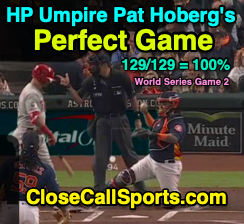
Pat Hoberg Calls Perfect Game in World Series Gm 2

Home Plate Umpire Pat Hoberg called a perfect game during Houston's victory over Philadelphia in Game 2 of the 2022 #WorldSeries between the Phillies and Astros. He saw 129 callable pitches—which includes balls and called strikes but excludes all swings—and officiated all of them correctly.

The reason Fox Sports' FoxTrax on-screen TV graphic zone may have differed from Hoberg's pitch calling is a tale as old as PitchCast, StatCast, Pitch f/x, and QuesTec, combined. Television visualizations still have trouble with vertical strike zones (computers have problems drawing these zones too), while PitchCast sacrifices accuracy for expediency, leading to errors in broadcast TV depictions.

The UEFL f/x look:
Balls: 89 called balls outside strike zone / 0 called balls within strike zone = 89/89 = 100% accuracy.
Strikes: 40 called strikes within strike zone / 0 called strikes outside strike zone = 40/40 = 100% accuracy.
Total Raw Accuracy Score: 129/129 = 100% accuracy (+0 Nu [Neutral Skew, favored neither team]).

Video as follows:

Saturday, October 29, 2022

Diaz Called Back to Bat After Umpire Rules He Leaned In

Aledmys Diaz grounded out to complete Houston's extra-inning loss to Philadelphia in Game 1 of the 2022 #Phillies-#Astros #WorldSeries, but not after he tried to get on base another way. Two pitches before the game-ending groundout, HP Umpire James Hoye denied Diaz free passage to first base on a hit-by-pitch from Phillies pitcher David Robertson, ruling that Diaz failed to make an attempt to avoid being touched by the ball, which by rule excludes the customary first base award on a standard HBP. 

Official Baseball Rule 5.05(b)(2) states, "The batter becomes a runner and is entitled to first base without liability to be put out when—

They are touched by a pitched ball which they are not attempting to hit unless (A) The ball is in the strike zone when it touches the batter, or (B) The batter makes no attempt to avoid being touched by the ball; If the ball is in the strike zone when it touches the batter, it shall be called a strike, whether or not the batter tries to avoid the ball. If the ball is outside the strike zone when it touches the batter, it shall be called a ball if they make no attempt to avoid being touched."

Accordingly, as leaning into a pitch most certainly doesn't meet the criteria for attempting to avoid it, Diaz was called back to bat.

Interestingly college posits a unique penalty for this violation that is different than OBR (and NHFS), per NCAA Rule 8-2-d-1a: "If the ball is in the strike zone when it touches the batter, or if the batter moves to intentionally get hit or freezes to allow a pitch that is not within the batter's box to hit them, the ball is dead, it shall be called a strike and the batter is not awarded first base."

Video as follows:

Wednesday, October 26, 2022

Roster - 2022 World Series Umpires

Major League Baseball assigned seven umpires to officiate the 2022 Fall Classic between the Houston Astros and Philadelphia Phillies. Led by Crew Chief Dan Iassogna, MLB's #WorldSeries umpire crew features three first-timers (Tripp Gibson, Jordan Baker, Pat Hoberg), and three umpires calling their second World Series (James Hoye, Lance Barksdale, Alan Porter). It is Iassogna's third Fall Classic.

Umpires will rotate such that one person will be in reserve/off-field for the game prior to their plate job. Rotations thus will follow a RF-LF-3B-2B-1B-Reserve-HP scheme; Game 1's configuration is listed below. Replay Officials will remain in New York for the entirety of the Series. James Hoye (denoted by *) will serve as acting crew chief when Iassogna is off the field.

2022 World Series (Houston Astros vs Philadelphia Phillies) Umpires:
HP: James Hoye* [Game 1 Plate]                         [4 WC, 4 DS, 3 LCS, 2nd World Series]
1B: Dan Iassogna -cc [Game 3 Plate]                [3 WC, 7 DS, 6 LCS, 3rd World Series]
2B: Tripp Gibson ^1st WS^ [Game 4 Plate]        [3 WC, 3 DS, 1 LCS, 1st World Series]
3B: Jordan Baker ^1st WS^ [Game 5 Plate]        [3 WC, 2 DS, 1 LCS, 1st World Series]
LF: Lance Barksdale [Game 6 Plate]                  [3 WC, 6 DS, 3 LCS, 2nd World Series]
RF: Alan Porter [Game 7 Plate]                          [3 WC, 6 DS, 3 LCS, 2nd World Series]
Reserve: Pat Hoberg ^1st WS^ [Game 2 Plate]   [2 WC, 3 DS, 1 LCS, 1st World Series]

World Series Replay Officials: Chad Fairchild and Carlos Torres.

Video as follows:

Sunday, October 23, 2022

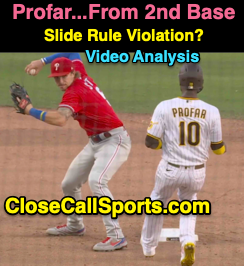
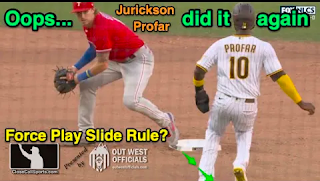
Did Profar Commit a Slide Rule Violation by Not Sliding?

Did San Diego's Jurickson Profar violate baseball's bona fide slide rule by jogging upright into second base instead of sliding—Phillies infielder Bryson Stott threw wide to first base thus preventing a double play during Philadelphia's NLCS against the Padres, but 2B Umpire Quinn Wolcott no-called the potential violation and Phillies manager Rob Thomson opted not to challenge the no-call, despite slide rule violations being eligible for Replay Review.

In the 8th inning of NLCS Game 2, Padres baserunner R1 Profar strolled in front of Stott on a ground ball double play attempt as the Phillies shortstop threw widely to first base. We review whether Profar violated the bona fide slide rule by remaining bipedal throughout the sequence.

Official Baseball Rule 6.01(j) pertains to slide rule violations and outlines four basic criteria for a runner to satisfy to meet the bona fide slide standards:
1) Begin their slide (by making contact with the ground) before reaching the base;
2) Be able and attempt to reach the base with their hand or foot;
3) Be able and attempt to remain on the base with their hand or foot;
4) Slide within reach of the base without changing direction to initiate contact with a fielder.

However, Profar didn't slide so he obviously didn't meet the bona fide slide criteria. The question is whether this is an automatic rules violation for failing to slide and whether it is not interference.

The answer is...for professional baseball, OBR does not require a slide into bases on force plays. The bona fide slide criteria exist for cases in which the runner chooses to slide, but there is no mandatory slide rule. Accordingly, Profar appears to run straight into second base from his base path on the grass (which he is allowed to choose, as all runners are); thus, unless the base path is illegal (which it is not), there is no out on this play, and because the base path rule allows for a runner to choose their own path, this play is legal under OBR.

In NFHS (high school) and NCAA (college), however, the force play slide rule (FPSR) would deem Profar's actions illegal; NCAA requires runners to slide on all force plays (Profar is out for not sliding between the bases on a force play) and in NFHS, although a slide is not required, the FPSR would put Profar out for failing to slide or run between the two bases—Profar's base path may be rules-legal, but when it comes to approaching a base on a force play, the FPSR in NFHS, Profar fails to remain in a straight/direct line between the bases as the middle infielder tags the base and then attempts to throw onto the following base. So under NCAA and NFHS, this is interference due to a FPSR violation.

Video as follows:

Saturday, October 22, 2022

Analysis as Replay Overturns Eddings' Transfer Call at 2B

Tmac
 provides instant analysis of a Replay Review decision during Game 3 of the Padres-Phillies NLCS in which Replay Review overturned 2B Umpire Doug Eddings' out (transfer) call at second base.

Positioning proves key on a play in which Eddings elects to work from the outside and tmac argues for a return to more traditional, inside positioning for 2B Umpires when there is a runner on base, in order to see plays such as catch/no catch transfers in the middle infield.

Video as follows:

Friday, October 21, 2022

MLB Ejection P1 - Ted Barrett (1; Jurickson Profar)

HP Umpire Ted Barrett ejected Padres LF Jurickson Profar (check swing strike three call by 3B Umpire Todd Tichenor) in the top of the 9th inning of the #Padres-#Phillies game. With none out and one on, Profar attempted to check his swing on a 3-2 fastball from Phillies pitcher Seranthony Dominguez, ruled a ball by HP Umpire Barrett and called a swinging strike on appeal to 3B Umpire Tichenor. Play was reviewed and affirmed by the UEFL Appeals Board (7-0), the call was correct. At the time of the ejection, the Phillies were leading, 4-2. The Phillies ultimately won the contest, 4-2.

This is Ted Barrett (65)'s 1st ejection of 2022.

This is the 1st ejection report of the 2022 MLB postseason (177th overall).
This is the 61st player ejection of 2022. Prior to ejection, Profar was 1-4 (SO) in the contest.
This is San Diego's 7th ejection of 2022, 2nd in the NL West (ARI 9; SD 7; SF 5; COL 3; LAD 1).
This is Jurickson Profar's 1st ejection since June 5, 2021 (Hunter Wendelstedt; QOC = Y [Balls/Strikes]).

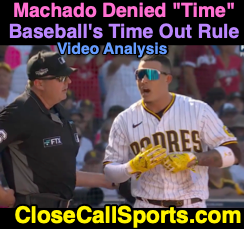
Why Umpire Barrett Denied Machado's Time Out Request

After striking out to end the 3rd inning in Game 2 of the Phillies-Padres NLCS, San Diego batter Manny Machado turned to argue with Lance Barrett about the HP Umpire's failure to grant Machado's "Time" request. Here's why the time out was denied.

Official Baseball Rule 5.04(b)(2) governs this situation and states, "Umpires will not call “Time” at the request of the batter or any member of their team once the pitcher has started their windup or has come to a set position even though the batter claims “dust in his eyes,” “steamed glasses,” “didn’t get the sign” or for any other cause."

Although replays do not conclusively indicate whether or not Machado timely requested "Time" or did so only after Phillies pitcher Aaron Nola began his windup delivery because the TV broadcast was busy concentrating on the health of broadcaster John Smoltz's Starbucks drink and thus cut to the pitch sequence too late, we see that Machado previously struck out during a playoff game in Los Angeles when, as a member of the Dodgers, a late time-out request was similarly denied by that game's plate umpire, Hunter Wendelstedt.

To deny a request, an umpire simply ignores it and calls the pitch as per usual | Video as follows:

Wednesday, October 19, 2022

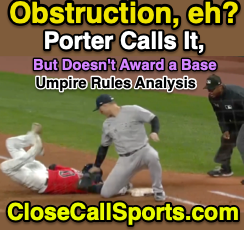
Obstruction Type 'Eh?' Porter Keeps Runner at Prior Base

When Yankees pitcher Gerrit Cole attempted to pick off Guardians runner Andres Gimenez in Game 4 of the New York-Cleveland ALDS, 1B Umpire Alan Porter called the runner safe, first baseman Anthony Rizzo appearing to obstruct the runner's return.

But with baseball's obstruction rule essentially requiring that all obstructed runners so obstructed while a play is being made on them to be awarded at least one base beyond their prior base, why did Porter simply return Gimenez to the first base bag, instead of awarding the runner second base?

Official Baseball Rule 6.01(h)(1) governs Obstruction Type 1/A, and states, "If a play is being made on the obstructed runner, or if the batter-runner is obstructed before they touch first base, the ball is dead and all runners shall advance, without liability to be put out, to the bases they would have reached, in the umpire’s judgment, if there had been no obstruction. The obstructed runner shall be awarded at least one base beyond the base they had last legally touched before the obstruction."

Accordingly, by rule, Gimenez—illegally blocked by Rizzo's leg while Rizzo didn't have possession of the ball and was not entitled to impede the runner's path—should have been granted safe passage to second base for Obstruction 1...but that's not what Porter did.

After the play, Porter signaled that an infraction had indeed occurred at first base—even telling the guilty fielder, "You can't do that"—but didn't enforce the penalty to its rulebook specification while the RF Umpire appeared to run toward New York's first base dugout, possibly to warn manager Aaron Boone against challenging the safe/out (tag) call, and that if Boone tried to challenge, the umpires might be obligated at that point to enforce the full effect of the obstruction penalty.

Sometimes, when you run your own league, your mechanics and expected calls can be tweaked, and this may be such a situation. The expected call here for both teams and most fans is to place the runner back on first base, not to award them second base...because the runner never tried to advance to second base.

Although the rules-correct call here is indeed to award the runner second base and no rulebook would disagree with that course of action, high-level leagues sometimes, well, play by their own set of rules.

Video as follows:

Tuesday, October 18, 2022

Rosters - 2022 AL & NL Lg Championship Series Umpires

Major League Baseball assigned 14 umpires to officiate the American and National League Championship Series round of the 2022 postseason. The NLCS between the Phillies and Padres will be led by Crew Chief Ted Barrett while the ALCS between the Guardians-Yankees winner and the Astros will be led by Chief Alfonso Marquez.

During the LCS and World Series rounds of the playoffs, umpires work in seven-person crews, with six on-field umpires and the seventh serving as an off-field standby or reserve official. Replay Review in New York is staffed by umpires who are entirely off-field. Plate rotations are listed below, such that the umpires will rotate as follows: RF-LF-3B-2B-1B-Reserve-HP. Umpires denoted by * will serve as acting crew chief when the LCS Chiefs are off the field in the Reserve position.

AL Championship Series (Cleveland Guardians or New York Yankees vs Houston Astros) Umpires:
HP: Mike Muchlisnki [Game 1 Plate]                     [2 WC, 3 DS, 2nd LCS, 1 WS]
1B: Alfonso Marquez -cc [Game 3 Plate]              [3 WC, 11 DS, 6th LCS, 4 WS]
2B: Adrian Johnson ^1st LCS^ [Game 4 Plate]       [2 WC, 4 DS, 1st LCS]
3B: Vic Carapazza [Game 5 Plate]                          [2 WC, 5 DS, 2nd LCS]
LF: Chris Guccione [Game 6 Plate]                        [6 WC, 7 DS, 5th LCS, 2 WS]
RF: Chris Conroy* [Game 7 Plate]                           [3 WC, 2 DS, 3rd LCS, 1 WS]
Reserve: DJ Reyburn ^1st LCS^ [Game 2 Plate]    [2 WC, 3 DS, 1st LCS]

NL Championship Series (Philadelphia Phillies vs San Diego Padres) Umpires:
HP: Brian Knight ^1st LCS^ [Game 1 Plate]           [3 WC, 4 DS, 1st LCS]
1B: Ted Barrett -cc [Game 3 Plate]                       [6 WC, 12 DS, 10th LCS, 5 WS]
2B: Adam Hamari ^1st LCS^ [Game 4 Plate]         [3 WC, 1 DS, 1st LCS]
3B: Quinn Wolcott ^1st LCS^ [Game 5 Plate]        [3 WC, 3 DS, 1st LCS]
LF: Doug Eddings [Game 6 Plate]                          [3 WC, 6 DS, 2nd LCS, 1 WS]
RF: Todd Tichenor* [Game 7 Plate]                         [3 WC, 5 DS, 3rd LCS, 1 WS]
Reserve: Lance Barrett ^1st LCS^ [Game 2 Plate]   [3 WC, 2 DS, 1st LCS]

Video as follows: