Saturday, October 22, 2022

Analysis as Replay Overturns Eddings' Transfer Call at 2B

Tmac
 provides instant analysis of a Replay Review decision during Game 3 of the Padres-Phillies NLCS in which Replay Review overturned 2B Umpire Doug Eddings' out (transfer) call at second base.

Positioning proves key on a play in which Eddings elects to work from the outside and tmac argues for a return to more traditional, inside positioning for 2B Umpires when there is a runner on base, in order to see plays such as catch/no catch transfers in the middle infield.

Video as follows:

Friday, October 21, 2022

MLB Ejection P1 - Ted Barrett (1; Jurickson Profar)

HP Umpire Ted Barrett ejected Padres LF Jurickson Profar (check swing strike three call by 3B Umpire Todd Tichenor) in the top of the 9th inning of the #Padres-#Phillies game. With none out and one on, Profar attempted to check his swing on a 3-2 fastball from Phillies pitcher Seranthony Dominguez, ruled a ball by HP Umpire Barrett and called a swinging strike on appeal to 3B Umpire Tichenor. Play was reviewed and affirmed by the UEFL Appeals Board (7-0), the call was correct. At the time of the ejection, the Phillies were leading, 4-2. The Phillies ultimately won the contest, 4-2.

This is Ted Barrett (65)'s 1st ejection of 2022.

This is the 1st ejection report of the 2022 MLB postseason (177th overall).
This is the 61st player ejection of 2022. Prior to ejection, Profar was 1-4 (SO) in the contest.
This is San Diego's 7th ejection of 2022, 2nd in the NL West (ARI 9; SD 7; SF 5; COL 3; LAD 1).
This is Jurickson Profar's 1st ejection since June 5, 2021 (Hunter Wendelstedt; QOC = Y [Balls/Strikes]).

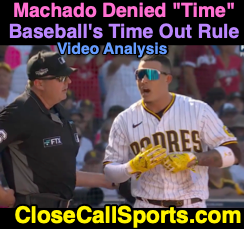
Why Umpire Barrett Denied Machado's Time Out Request

After striking out to end the 3rd inning in Game 2 of the Phillies-Padres NLCS, San Diego batter Manny Machado turned to argue with Lance Barrett about the HP Umpire's failure to grant Machado's "Time" request. Here's why the time out was denied.

Official Baseball Rule 5.04(b)(2) governs this situation and states, "Umpires will not call “Time” at the request of the batter or any member of their team once the pitcher has started their windup or has come to a set position even though the batter claims “dust in his eyes,” “steamed glasses,” “didn’t get the sign” or for any other cause."

Although replays do not conclusively indicate whether or not Machado timely requested "Time" or did so only after Phillies pitcher Aaron Nola began his windup delivery because the TV broadcast was busy concentrating on the health of broadcaster John Smoltz's Starbucks drink and thus cut to the pitch sequence too late, we see that Machado previously struck out during a playoff game in Los Angeles when, as a member of the Dodgers, a late time-out request was similarly denied by that game's plate umpire, Hunter Wendelstedt.

To deny a request, an umpire simply ignores it and calls the pitch as per usual | Video as follows:

Wednesday, October 19, 2022

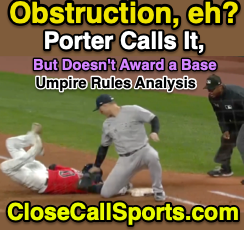
Obstruction Type 'Eh?' Porter Keeps Runner at Prior Base

When Yankees pitcher Gerrit Cole attempted to pick off Guardians runner Andres Gimenez in Game 4 of the New York-Cleveland ALDS, 1B Umpire Alan Porter called the runner safe, first baseman Anthony Rizzo appearing to obstruct the runner's return.

But with baseball's obstruction rule essentially requiring that all obstructed runners so obstructed while a play is being made on them to be awarded at least one base beyond their prior base, why did Porter simply return Gimenez to the first base bag, instead of awarding the runner second base?

Official Baseball Rule 6.01(h)(1) governs Obstruction Type 1/A, and states, "If a play is being made on the obstructed runner, or if the batter-runner is obstructed before they touch first base, the ball is dead and all runners shall advance, without liability to be put out, to the bases they would have reached, in the umpire’s judgment, if there had been no obstruction. The obstructed runner shall be awarded at least one base beyond the base they had last legally touched before the obstruction."

Accordingly, by rule, Gimenez—illegally blocked by Rizzo's leg while Rizzo didn't have possession of the ball and was not entitled to impede the runner's path—should have been granted safe passage to second base for Obstruction 1...but that's not what Porter did.

After the play, Porter signaled that an infraction had indeed occurred at first base—even telling the guilty fielder, "You can't do that"—but didn't enforce the penalty to its rulebook specification while the RF Umpire appeared to run toward New York's first base dugout, possibly to warn manager Aaron Boone against challenging the safe/out (tag) call, and that if Boone tried to challenge, the umpires might be obligated at that point to enforce the full effect of the obstruction penalty.

Sometimes, when you run your own league, your mechanics and expected calls can be tweaked, and this may be such a situation. The expected call here for both teams and most fans is to place the runner back on first base, not to award them second base...because the runner never tried to advance to second base.

Although the rules-correct call here is indeed to award the runner second base and no rulebook would disagree with that course of action, high-level leagues sometimes, well, play by their own set of rules.

Video as follows:

Tuesday, October 18, 2022

Rosters - 2022 AL & NL Lg Championship Series Umpires

Major League Baseball assigned 14 umpires to officiate the American and National League Championship Series round of the 2022 postseason. The NLCS between the Phillies and Padres will be led by Crew Chief Ted Barrett while the ALCS between the Guardians-Yankees winner and the Astros will be led by Chief Alfonso Marquez.

During the LCS and World Series rounds of the playoffs, umpires work in seven-person crews, with six on-field umpires and the seventh serving as an off-field standby or reserve official. Replay Review in New York is staffed by umpires who are entirely off-field. Plate rotations are listed below, such that the umpires will rotate as follows: RF-LF-3B-2B-1B-Reserve-HP. Umpires denoted by * will serve as acting crew chief when the LCS Chiefs are off the field in the Reserve position.

AL Championship Series (Cleveland Guardians or New York Yankees vs Houston Astros) Umpires:
HP: Mike Muchlisnki [Game 1 Plate]                     [2 WC, 3 DS, 2nd LCS, 1 WS]
1B: Alfonso Marquez -cc [Game 3 Plate]              [3 WC, 11 DS, 6th LCS, 4 WS]
2B: Adrian Johnson ^1st LCS^ [Game 4 Plate]       [2 WC, 4 DS, 1st LCS]
3B: Vic Carapazza [Game 5 Plate]                          [2 WC, 5 DS, 2nd LCS]
LF: Chris Guccione [Game 6 Plate]                        [6 WC, 7 DS, 5th LCS, 2 WS]
RF: Chris Conroy* [Game 7 Plate]                           [3 WC, 2 DS, 3rd LCS, 1 WS]
Reserve: DJ Reyburn ^1st LCS^ [Game 2 Plate]    [2 WC, 3 DS, 1st LCS]

NL Championship Series (Philadelphia Phillies vs San Diego Padres) Umpires:
HP: Brian Knight ^1st LCS^ [Game 1 Plate]           [3 WC, 4 DS, 1st LCS]
1B: Ted Barrett -cc [Game 3 Plate]                       [6 WC, 12 DS, 10th LCS, 5 WS]
2B: Adam Hamari ^1st LCS^ [Game 4 Plate]         [3 WC, 1 DS, 1st LCS]
3B: Quinn Wolcott ^1st LCS^ [Game 5 Plate]        [3 WC, 3 DS, 1st LCS]
LF: Doug Eddings [Game 6 Plate]                          [3 WC, 6 DS, 2nd LCS, 1 WS]
RF: Todd Tichenor* [Game 7 Plate]                         [3 WC, 5 DS, 3rd LCS, 1 WS]
Reserve: Lance Barrett ^1st LCS^ [Game 2 Plate]   [3 WC, 2 DS, 1st LCS]

Video as follows:

Monday, October 17, 2022

Pondering Playoff Porter's Perfectly Positioned Plays

Tmac
 noticed that 1B Umpire Alan Porter went 2-for-2 on Replay Review during Game 4 of the Yankees-Guardians ALDS in Cleveland, and we now review the two plays at first base, with a Teachable eye on Porter's positioning in making both of these calls.

For the first play, Cleveland batter Jose Ramirez hit a fly ball to shallow left field, which fell to the ground for a base hit. New York quickly recovered, however, and threw behind Ramirez at first base, leaving Porter to officiate a tag play on the batter-runner's shoulder, an out call confirmed via Replay Review.

For the second play, Porter ruled that Gabriel Arias' foot couldn't keep contact with first base while lunging to receive a thrown ball as Yankees batter-runner Aaron Judge arrived at first base, a call that stood on Replay Review to put Cleveland out of their two allotted challenges (one for regular season, two for postseason).

Video as follows:

Saturday, October 15, 2022

France & Maldonado Tangle on Double Play in Seattle

Mariners first baseman Ty France turned a blazingly quick double play, catching Astros batter Jose Altuve's infield fly ball before quickly tagging baserunner Martin Maldonado in the 5th inning of Game 3 of the American League Division Series in Seattle. 1B Umpire Cory Blaser officiated the play several feet away while HP Umpire and Crew Chief Marvin Hudson explained the sequence to Houston manager Dusty Baker shortly thereafter.

The broadcasters mentioned that Baker may have sought to solicit an interference call, while also claiming that perhaps France had pushed Maldonado off the base ala the Kent Hrbek-Ron Gant force off play in Game 7 of the 1991 World Series, but replays confirm that fielder France tagged Maldonado off the base, and that Maldonado never made it back to first base to tag up until after the tag was applied.

There is some confusion about the entanglement issue, so perhaps the Official Baseball Rules' definitions for interference and obstruction will help explain.
Interference is an act ordinarily committed by the offense against the defense. It is defined as an infraction by the team at bat which "interferes with, obstructs, impedes, hinders, or confuses any fielder attempting to make a play." There is a special case for catcher's interference, which must be committed against a batter during a pitched ball (in NFHS/high school, this is ordinarily called catcher's obstruction).
Obstruction is an act ordinarily committed by the defense against the offense and is defined as, "the act of a fielder who, while not in possession of the ball and not in the act of fielding the ball, impedes the progress of any runner."

However, replays clearly indicate fielder France was either in the act of fielding the ball (the fielder ordinarily has the right of way to field a batted ball) or in possession of the ball at all times during the fielder-runner interaction, so it can be said that no defensive infraction occurred during this fast double play sequence. If anything, one could argue that baserunner Maldonado interfered with France, had France dropped the ball as a result of Maldonado standing off the base and in the way of the catch of a batted ball.

Video as follows:

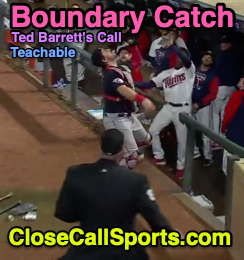
Teachable - A Boundary for Barrett - Catch Considerations

For this Teachable Moment, tmac highlights HP Umpire Ted Barrett officiating a catch play near the dugout boundary on a foul fly ball to Cleveland catcher Austin Hedges during a game vs Minnesota. There are a few considerations for a pop fly hit back to the screen, and tmac reviews them here.

Upon Twins batter Max Kepler making contact with the baseball, Barrett's first move is to watch catcher Hedges—Barrett needs to clear the catcher, or move out of the catcher's way as Hedges is glancing skyward for the ball; thus, Barrett keeps an eye on the catcher before looking for the ball since the catcher's eyes will communicate where the ball might be.

After clearing the catcher, Hedges runs toward the first-base dugout and Barrett pursues, ready to open the gate by matching Hedges' movements with corresponding position adjustments in order to attain a keyhole angle to see a potential catch or boundary issue. Speaking of this boundary issue, HP Umpire Barrett must find a position near the fence-line to rule on various aspects of this play such as: did the fielder catch the ball before or after stepping or falling into dead ball territory (also see Rule 5.06(b)(3)(C) for "Catch & Carry"), did the ball scrape the protective netting behind home plate, etc.

This play was reviewed and upheld as a legal catch | Video as follows:

Friday, October 14, 2022

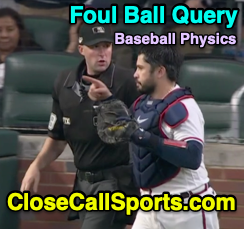
A Foul Ball off the Protective Netting - Wall Physics

Atlanta had to wait just a bit longer for Bryce Harper to make the third and final out of NLDS Game 2 vs Philadelphia after HP Umpire Nic Lentz ruled an earlier foul fly ball by the Phillies batter dead and out of play, with the baseball contacting the protective netting behind home plate before Braves catcher Travis d'Arnaud could catch it.

The primary clue of a ball having struck a wall or scraped a fence is whether the ball suddenly changes direction when coming back toward the playing surface. Physically speaking, as well, projectile dymanics as well as spin rate and wind speed + direction all play a role in officiating this play.

In this case, video doesn't appear to show where exactly the ball was relative to the boundary—Lentz's position along the fence-line is the optimal angle for officiating this play and better than any TV camera.

For that reason, Replay Review ultimately ruled "call stands" due to a lack of clear and convincing video evidence to prove either potentiality. A few pitches later, Kenley Jansen struck out batter Harper to end the game.

Video as follows:

Wednesday, October 12, 2022

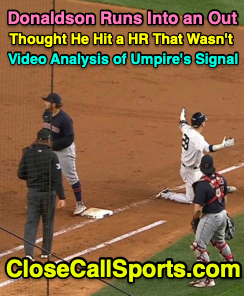
Josh Donaldson Thrown Out Assuming HR That Wasn't

You asked us to take a look at Yankees batter-runner Josh Donaldson getting thrown out at first base in Game 1 of the Cleveland-New York ALDS on a play in which Donaldson incorrectly thought he hit a home run that umpires instead ruled alive and in play due to the ball hitting the top of the outfield wall, so naturally we went overboard and pulled up prior instances of Josh Donaldson thinking he hit a home run to right field at Yankee Stadium that turned out to be in play.

As was the case Tuesday night in New York, Donaldson was thrown out in one of those other examples as well, this time by Yankees right fielder Ichiro Suzuki when Donaldson was playing for the Oakland Athletics.

During the American League Division Series Game 1 play, Donaldson hit a fly ball to the right field corner that caromed off the top of the outfield wall and bounced back into play, ruled fair and in play by RF Mark Ripperger, who mechanized his "in play" ruling by using a safe signal to indicate the ball had not left the ballpark.

Donaldson, however, trotted past first base with his head down and may not have seen this signal, ultimately finding himself thrown out at first base on a live ball that he thought was dead by virtue of leaving the playing field, which it had not done, a call confirmed via Replay Review.

Video as follows: