Thursday, July 12, 2018

Ask UEFL - Angel Fan's Non-Interference with Upton

Mariners batter Dee Gordon's fly ball in left field Tuesday night in Anaheim led to a peculiar scene, as Angels left fielder Justin Upton and a fan became entangled during Upton's successful catch as Seattle baserunner Chris Herrmann tagged up and advanced while Upton was distracted. Today's Ask the UEFL article concerns whether this play constitutes fan interference. Beware—the answer is not as straightforward as you might think.

Did a Trout fan hinder Upton in Anaheim?
The Play: With one out and one on (R2), Mariners batter Dee Gordon hit a fly ball into foul territory along the left field wall, where it was caught by Angels left fielder Justin Upton as he became entangled with a fan. While Upton and the fan were interacting, Mariners baserunner R2 Chris Herrmann tagged up at second and advanced to third base.

The Call: 3B Umpire Jim Wolf ruled the play an air out on Upton's catch and no-called the potential fan interference despite a post-play argument from Angels Manager Mike Scioscia.

The Rule - Definition: Major League Baseball changed the Official Baseball Rule pertaining to spectator interference in advance of the 2018 season (underlined text indicates the modification): "Spectator interference occurs when a spectator (or an object thrown by the spectator) hinders a player’s attempt to make a play on a live ball, by going onto the playing field, or reaching out of the stands and over the playing field."
Related Post: MLB Changes Rules for Retired Runner, Fan Interference (3/25/18).
Diagram of spectator interference.

Spectator interference previously required the fan to physically touch the player or ball; the rules change authorizes an interference call based on a "hinders a player's attempt" standard similar to existing offensive and defensive (catcher's) interference rules, as long as the fan (or object thrown by the fan) breaks the plane separating the stands from the playing field, which extends vertically from the base of the wall on the playing field side of the boundary.

The Rule - Penalty: Pursuant to OBR 6.01(e), "When there is spectator interference with any thrown or batted ball, the ball shall be dead at the moment of interference and the umpire shall impose such penalties as in his opinion will nullify the act of interference." This is the same penalty as Intentional Interference by a person authorized to be on the playing field (e.g., a security/police officer or "ball attendant"), 6.01(d).

Analysis: I think we can all agree that, as it pertains to the batted ball, there is no interference—Upton clearly catches the fly ball despite the fan's reaching out onto the playing field. The issue, then, is the entanglement after the catch, while the ball is live and the runner is tagging up.

The fan clearly distracts Upton from his responsibility with the runner, but recall that verbal or even visual distraction alone is not interference. What is potential interference is the fan's arm physically wrapped around Upton's upper body, but the question for 3B Umpire Wolf is whether this physical interaction hindered Upton's attempt to make a play on the runner.

This pat on the back, alone, is likely not INT.
If Upton never attempted to make a play on the runner, then there can be no interference: logically speaking, one cannot be impeded from attempting to do something that one was not attempting to do in the first place.

Gil's Call: In my estimation, had Upton shown an immediate concern as to R2 Herrmann's status upon catching the ball—had he turned toward the infield or tried checking the runner while still in contact with the fan—this would have been ruled interference. Because Upton failed to show concern as to R2 Herrmann until well after his catch, it suggests that he did not attempt to make a play on the runner until this time, which was well after the period of potential fan interference had already concluded.

There is no doubt in my mind that the fan disturbed Upton's thought process, but in order to rule interference, the umpire would have to rule that Upton's attempt on the runner was impeded. No attempt = no interference.

I suppose it comes down to the umpire's judgment of Upton's situational awareness, and how well the umpire can read Upton's mind.

Upton contended with not one, but two fans.
Rulebook Lawyer: The spectator interference rule 6.01(e) clearly discusses a "thrown or batted ball," but makes no mention of hindrance which occurs after the batted ball has already been caught and before it has the opportunity to become a thrown ball. This would otherwise appear to be a tremendous loophole in the rule—a fan appears to have legal authority to interfere after the catch, but before the throw—but it seems highly unlikely that the spirit of the rule intends to grant such an illogical exemption, given the aforementioned rules change to the Definition of Terms.

SIDEBAR: This is an excellent opportunity to point out how rulebooks deteriorate. The Rules Committee last offseason changed the Definition of Terms regarding spectator interference to refer to a "live ball," but left Rule 6.01(e), which refers to a "thrown or batted ball" in regard to spectator interference, untouched. Accordingly, the definition of spectator interference and rule/penalty for spectator interference no longer match—a microcosm of how these sort of rules inconsistencies occur. It would behoove the Rules Committee this offseason to make Rule 6.01(e)'s language consistent with the new spectator interference definition.

For that reason, under the principles of common sense and fair play, it would be reasonable to presume that spectator interference can occur at any time that a ball is live—not simply while the ball is loose on a hit or a throw.

Video as follows:

Wednesday, July 11, 2018

Will Little Leaves Twins Game in Labor Report

As the Kansas City Royals took a 3-0 lead over the Twins into the top of the 2nd inning at Target Field in Minnesota, 2B Umpire Will Little left Wednesday afternoon's game to be with his wife, who went into labor, according to local beat reporters.

Following Little's departure, Crew Chief Ted Barrett remained behind home plate, while corner umpires Lance Barksdale and Tom Woodring stayed at first and third base, respectively.

UEFL Injury Scout (Paternity Leave)
Last Game: July 11 | Return to Play: July 20 | Time Absent: 8 Days.

Wild Walk-Off - Analysis of 6 Rules for 1 Play in Houston

The final play of Houston's walk-off victory over Oakland Tuesday featured an overcharged bouncing ball and at least six rules situations for HP Umpire David Rackley to quickly consider as A's catcher Jonathan Lucroy and Astros batter Alex Bregman danced around home plate before Lucroy finally threw the baseball wildly into right field, plating Houston's game-winning run. This article and video analyzes each individual phase of Tuesday's final play in Houston, as well as the plate umpire's responsibilities and reactions.

Rackley's Rapid Response™ passed the test.
The Play: With one out and two on (R1, R2), Astros batter Alex Bregman hit a ground ball softly to the right of home plate, where A's catcher Jonathan Lucroy fielded the ball in fair territory, attempted to tag batter-runner Bregman while fumbling and dropping the ball, which bounced off of HP Umpire David Rackley, before Lucroy retrieved the loose ball and threw it off of batter-runner Bregman's helmet, past first baseman Mark Canha, and down the right field line, allowing Astros baserunner R2 Kyle Tucker to score the game-winning run, affirmed following an A's challenge for Lucroy's attempted tag of Bregman.

Analysis: There is a lot to unpack here, so let's go step by step, rule by rule, and solve this wild play.

Call #1: Fair or Foul: This complex play begins, simply, when batter Bregman hits A's pitcher Blake Treinen's 1-2 pitch, which bounces in foul territory before rolling back into fair territory, whereupon catcher Lucroy makes initial contact with the baseball.

This ball was fielded in fair territory.
Rule #1: Amongst other criteria, and relevant to the play at hand, "A FOUL BALL is a batted ball that settles on foul territory between home and first base" while "A FAIR BALL is a batted ball that, while on or over fair territory touches the person of an umpire or player."

Analysis, Call #1: Because Lucroy makes first contact with the baseball while it is over fair territory, this is a fair ball.

Call #2: Interference or Incidental: As Lucroy attempts to field the ball, batter Bregman considers running to first base, and moves from his position in the right-handed batter's box toward first base. Seeing that Lucroy is about to field the ball, Bregman stops to avoid the imminent tag.

The batter did not interfere with the fielder.
Rule #2: The relevant portion of interference rule 6.01(a)(10) states the batter or runner is out when—"He fails to avoid a fielder who is attempting to field a batted ball," whereas, "Offensive interference is an act by the team at bat which interferes with, obstructs, impedes, hinders or confuses any fielder attempting to make a play."

QOC, Call #2: Bregman does not impede Lucroy's ability to field the batted ball, which means he has not interfered with the fielder's attempt to field a batted ball.

Call #3: Out of Base Path or Legal: As Lucroy attempts to tag Bregman, Bregman jumps backward, toward home plate, in an effort to avoid the tag.
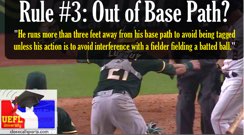
The runner did not illegally exit his path.
Rule #3: According to retiring-a-runner rule 5.09(b)(1), a runner is out when—"He runs more than three feet away from his base path to avoid being tagged unless his action is to avoid interference with a fielder fielding a batted ball."

QOC, Call #3: The batted ball exemption doesn't apply here, as Lucroy has already fielded the ball, leaving us to consider whether Bregman is three+ feet out of his path, established at the time of the tag attempt. It appears Bregman never quite arrived at (returned to) home plate, which also renders moot an MLB Umpire Manual interpretation regarding a batter-runner who retreats to home ("In situations where the batter-runner gets in a rundown between first and home, if the batter-runner retreats and reaches home plate, the batter-runner shall be declared out").

Call #4: Umpire Interference or Play On: As Lucroy fumbled the ball and HP Umpire Rackley stepped in for a closer look, the ball bounced off Rackley and settled in the dirt.

HP Umpire Rackley did not interfere.
Rule #4: Umpire interference occurs under very specific circumstances, which are presented in 6.01(f) [5.06(c)(2), delineating when the ball is dead, also describes that which is depicted by 6.01(f)(1)]: "Umpire’s interference occurs (1) when a plate umpire hinders, impedes or prevents a catcher’s throw attempting to prevent a stolen base or retire a runner on a pick-off play; or (2) when a fair ball touches an umpire on fair territory before passing a fielder. Umpire interference may also occur when an umpire interferes with a catcher returning the ball to the pitcher." To put it even more bluntly, "If a thrown ball accidentally touches a base coach, or a pitched or thrown ball touches an umpire, the ball is alive and in play."

QOC, Call #4: There is no call to make here, as a fumbled ball bouncing off of an umpire's chest is not one of the scenarios depicted nor covered by the umpire interference rule.

Call #5: Obstruction or Legal: As catcher Lucroy fumbles the ball into the left-handed batter's box, batter-runner Bregman reverses his retreat and sprints toward first base, avoiding the catcher in the process.

The runner did not obstruct the fielder.
Rule #5: The definition of terms holds that "OBSTRUCTION is the act of a fielder who, while not in possession of the ball and not in the act of fielding the ball, impedes the progress of any runner."

QOC, Call #5: It appears batter-runner Bregman was not impeded by catcher Lucroy, so no obstruction occurred. Had this been obstruction, it would be an instance of OBS Type 2 (Type B), as in rule 6.01(h)(2), because Lucroy had already fumbled the ball away after fielding it and making a play on the runner: "If no play is being made on the obstructed runner, the play shall proceed until no further action is possible."

Call #6: Runner's Lane Interference or Nothing: Lest we give up too quickly, the final aspect of this play concerns whether Bregman legally ran to first base as catcher Lucroy threw to first baseman Canha.

The runner did not commit RLI (INT).
Rule #6: Rule 5.09(a)(11) allows the batter-runner to be declared out if, "In running the last half of the distance from home base to first base, while the ball is being fielded to first base, he runs outside (to the right of) the three-foot line, or inside (to the left of) the foul line, and in the umpire’s judgment in so doing interferes with the fielder taking the throw at first base."

QOC, Call #6: Replays indicate Bregman's running lane adventure was entirely legal; he entered the lane on or between the two chalk lines and remained in the lane until the ball was already up the right field line, well past the infield.

At least six rules were involved in just one play Tuesday.
BONUS Call #7: Obstruction (on F3) or Nothing: Once Lucroy's throw eluded first baseman Canha, we were left with a first baseman standing in front of the base and a batter-runner who had to change his path in order to avoid the first baseman and touch first base. As Call #5 states above, if first baseman Canha impeded batter-runner Bregman from timely touching his base, the umpires would be within their rights to allow play to proceed through its conclusion and (let's assume Bregman was thrown out at second base prior to the winning run scoring...with two outs) make whatever call or runner placement that, in their judgment, would nullify the act of obstruction.

Mechanically Speaking: Rackley employs two "safe" mechanics here. The first signifies "no tag," "no interference," "not out of the base path," and "no obstruction"—essentially saying "everything that just happened is legal"—and the final safe call pertains to the runner's lane interference no-call, all of it the proper decision. Hunter Wendelstedt is on this crew and you sure hope he'll add Rackley's play to his curriculum at Umpire School for what to do when a crazy play finds you.

Postscript: Perhaps the most obvious call isn't even included in the aforementioned analysis—whether or not the catcher tagged the runner! As Replay Review confirmed, following an A's challenge, Lucroy did not tag Bregman—that is to say, Lucroy did not "touch a runner with the ball, or with his hand or glove holding the ball (not including hanging laces alone), while holding the ball securely and firmly in his hand or glove" [Definition of Terms: TAG]—but it just goes to show you what type of a call an umpire analyst can take for granted when confronted with no less than six additional considerations, all within a mere matter of seconds. As for HP Umpire Rackley, score that a QOC of Correct, multiplied by at least six.

Video as follows:

Tuesday, July 10, 2018

MLB Ejection 094 - David Rackley (2; Bob Melvin)

HP Umpire David Rackley ejected Athletics Manager Bob Melvin (check swing strike three call) in the top of the 4th inning of the Athletics-Astros game. With one out and one on (R1), A's batter Khris Davis attempted to check his swing on a 3-2 slider from Astros pitcher Justin Verlander, ruled a swinging third strike by HP Umpire Rackley. Play was reviewed and adjudicated by the UEFL Appeals Board (8-0-1), the call was correct. At the time of the ejection, the Astros were leading, 2-0. The Astros ultimately won the contest, 6-5, in 11 innings.

This is David Rackley (86)'s second ejection of 2018.
David Rackley now has 11 points in the UEFL Standings (7 Prev + 2 MLB + 2 Correct Call = 11).
Crew Chief Larry Vanover now has 14 points in Crew Division (13 Previous + 1 Correct Call = 14).

This is the 94th ejection report of the 2018 MLB regular season.
This is the 39th Manager ejection of 2018.
This is Oakland's 1st ejection of 2018, 5th in the AL West (TEX 5; LAA, HOU, SEA 3; OAK 1).
This is Bob Melvin's first ejection since May 27, 2017 (Will Little; QOC = N [Balls/Strikes]).
This is David Rackley's 2nd ejection of 2018, 1st since June 8 (Chris Prieto; QOC = Y [Balk No-Call]).

Wrap: Oakland Athletics vs. Houston Astros, 7/10/18 | Video as follows:

2018 MLB All-Star Game Umpires

Major League Baseball selected the following umpires to officiate the 2018 MLB All-Star Game at Washington's Nationals Park:

Ted Barrett & Jim Reynolds will umpire in DC.
HP Umpire Ted Barrett (crew chief)*: 2nd All-Star Gm.
1B Umpire Jim Reynolds: 2nd All-Star Game.
2B Umpire Alfonso Marquez: 2nd All-Star Game.
3B Umpire Andy Fletcher: 2nd All-Star Game.
LF Umpire Mike Muchlinski: 1st All-Star Game.
RF Umpire Cory Blaser: 1st All-Star Game.
Replay Official Marvin Hudson: 1st ASG Replay.

League Rank, Replay Review Affirmation Percentage (RAP):
Ted Barrett: 7th (.800 RAP, 8/10).
Jim Reynolds: 10th (.714 RAP, 5/7).
Alfonso Marquez: 62nd (.429 RAP, 3/7).
Andy Fletcher: 72nd (.333 RAP, 3/9).
Mike Muchlinski: 41st (.500 RAP, 2/2).
Cory Blaser: 41st (.500 RAP, 4/4).
Marvin Hudson: 67th (.400 RAP, 2/5).

Pursuant to UEFL Rule 2-2-a, all All-Star Game umpires will receive one League point for appearing in the contest (two for the crew chief). No points are awarded to the Replay Official (must "appear in that game").

MiLB Triple-A All-Star Game Umpires (Columbus, Ohio):
HP Umpire: Dan Merzel (International League).
1B Umpire: Bryan Fields (Pacific Coast League).
2B Umpire: Ryan Clark (International League).
3B Umpire: John Libka (Pacific Coast League).

MiLB All-Star Futures Game Umpires (Double-A Showcase at MLB All-Star Weekend):
HP Umpire: Malachi Moore (Texas League).
1B Umpire: Edwin Moscoso (Southern League).
2B Umpire: Kyle McCrady (Texas League).
3B Umpire: John Mang (Eastern League).

* A Family Affair
Like Father, like son: Father Ted Barrett is slated to work the plate for the 2018 MLB All-Star Game while son Andrew Barrett drew a home plate assignment for the 2018 California League (Class-A) All-Star Game, played June 19 in Lancaster, CA. Andrew's crew featured fellow Cal-League umpires Joe Gonzalez (1B), Darius Ghani (2B), and Luis Hernandez (3B).

Monday, July 9, 2018

MLB Ejection 093 - Will Little (3; Ned Yost)

HP Umpire Will Little ejected Royals Manager Ned Yost (strike three call; QOCN) in the top of the 4th inning of the Royals-Twins game. With none out and two on (R2, R3), Royals batter Lucas Duda took a 0-2 fastball from Twins pitcher Jose Berrios for a called third strike. Replays indicate the pitch was located over the outer half of home plate and above the midpoint (px -.337, pz 3.838 [sz_top 3.549 / RAD 3.672 / MOE 3.755]), the call was incorrect. At the time of the ejection, the Royals were leading, 1-0. The Twins ultimately won the contest, 3-1.

This is Will Little (93)'s third ejection of 2018.
Will Little now has -1 points in the UEFL Standings (1 Prev + 2 MLB - 4 Incorrect Call = -1).
Crew Chief Ted Barrett now has 10 points in Crew Division (10 Previous + 0 Incorrect Call = 10).

This is the 93rd ejection report of the 2018 MLB regular season.
This is the 38th Manager ejection of 2018.
This is Kansas City's 4th ejection of 2018, 1st in the AL Central (KC 4; CWS, DET 3; MIN 2; CLE 1).
This is Ned Yost's first ejection since August 3, 2017 (Larry Vanover; QOC = Y [Replay Review]).
This is Will Little's 3rd ejection of 2018, 1st since June 20 (Rick Renteria; QOC = N [Balls/Strikes]).

Wrap: Kansas City Royals vs. Minnesota Twins, 7/9/18 | Video as follows:

Sunday, July 8, 2018

Ted Barrett, Jeff Nelson Named to AFL Hall of Fame

As MLB's 2018 All-Star umpire selections await official announcement, crew chiefs Ted Barrett and Jeff Nelson have been selected as the first two umpires to enter the Arizona Fall League Hall of Fame. Both join the AFL HOF for their achievements at the major-league level following their participation in the offseason league.

Nelson and Barrett are AFL Hall of Famers.
Said AFL Director Steve Cobb after announcing Giants catcher Buster Posey as the third member of the AFL's Class of 2018, "We're also proud to induct our first two umpires into the Fall League Hall of Fame. Ted Barrett and Jeff Nelson are obvious choices for their long and meritorious service to baseball."

Barrett officiated in the Arizona Fall League from 1993 through 1995, debuting in the American League in 1994 and joining the Major League staff in 1999 before his appointment to crew chief prior to the 2013 season.

Nelson called AFL ball in 1996, made his big league debut in the National League in 1997, and similarly became a member of the full-time staff in 1999, promoting to crew chief in 2014.

They are the first-ever umpires inducted into the Arizona Fall League Hall of Fame, which was formed in 2001 to celebrate AFL alumni's performance at the Major League level.

MLB Ejection 092 - Jansen Visconti (1; AJ Pollock)

HP Umpire Jansen Visconti ejected Diamondbacks CF AJ Pollock (strike three call; QOCN) in the bottom of the 5th inning of the Padres-Diamondbacks game. With none out and one on (R1), Pollock took a 0-2 fastball from Padres pitcher Clayton Richard for a called third strike. Replays indicate the pitch was located off the inner edge of home plate and knee-high (px -1.047, pz 1.860 [sz_bot 1.565]), the call was incorrect. At the time of the ejection, the Diamondbacks were leading, 3-2. The Padres ultimately won hte contest, 4-3, in 16 innings.

This is Jansen Visconti (52)'s first ejection of 2018.
Jansen Visconti now has 0 points in the UEFL Standings (2 Prev + 2 AAA - 4 Incorrect Call = 0).
Crew Chief Jeff Nelson now has 2 points in Crew Division (2 Previous + 0 Incorrect Call = 2).
*UEFL Rule 6-2-b-1 (Kulpa Rule): |0| < STRIKE < |.748| < BORDERLINE < |.914| < BALL.

This is the 92nd ejection report of the 2018 MLB regular season.
This is the 46th player ejection of 2018. Prior to ejection, Pollock was 2-3 (SO) in the contest.
This is Arizona's 5th ejection of 2018, 3rd in the NL West (LAD, SD 6; ARI 5; COL, SF 4).
This is AJ Pollock's first ejection since July 30, 2017 (DJ Reyburn; QOC = N [Balls/Strikes]).
This is Jansen Visconti's first career MLB ejection.

Wrap: San Diego Padres vs. Arizona Diamondbacks, 7/8/18 | Video as follows:

MLB Ejection 091 - Bill Welke (3; Tim Leiper)

1B Umpire Bill Welke ejected Blue Jays 1B Coach Tim Leiper (pace of play/interpreter entering the playing field during mound visit rule; QOCY) in the top of the 8th inning of the Yankees-Blue Jays game. Following the conclusion of the 7th inning, Blue Jays relief pitcher Seunghwan Oh replaced starter Ryan Borucki. Replays indicate that Oh exited the bullpen and crossed the warning track onto the playing field with his interpreter, but without a coach or manager present, the call was correct.* At the time of the ejection, the game was tied, 1-1. The Yankees ultimately won the contest, 2-1, in 10 innings.

This is Bill Welke (3)'s third ejection of 2018.
Bill Welke now has 10 points in the UEFL Standings (6 Prev + 2 MLB + 2 Correct Call = 10).
Crew Chief Bill Welke now has 12 points in Crew Division (11 Previous + 1 Correct Call = 12).
*The MLB Umpire Manual states the following relative to Official Baseball Rule 5.10 (mound visits):
Note regarding translators: Standards and On-Field Operations Regulation 2-2 (Occupying the Bench) provides that a full-time interpreter is permitted to enter the playing field during a game to translate for a coach or manager on an official visit to the pitcher as well as for the evaluation of an injury of a player. Interpreters are not permitted onto the playing field under any other circumstances, including when a catcher and/or infielder(s) visit the mound without a coach or manager.
Accordingly, the umpires properly instructed the interpreter to exit the playing field, as no coach or manager was on the mound during an official visit to pitcher Oh (nor was there an injury to evaluate), meaning the interpreter—by rule—was not permitted on the field at that time.

This is the 91st ejection report of the 2018 MLB regular season.
This is Toronto's 5th ejection of 2018, 2nd in the AL East (NYY 6; TOR 5; BAL 3; BOS 2; TB 1).
This is Tim Leiper's first ejection since May 15, 2016 (Dale Scott; QOC = Y [Balk No-Call]).
This is Bill Welke's 3rd ejection of 2018, 1st since June 18 (Bud Black; QOC = Y [Out of Base Path]).

Wrap: New York Yankees vs. Toronto Blue Jays, 7/8/18 | Video as follows:

MLB Ejection 090 - Chris Segal (3; Jeff Banister)

HP Umpire Chris Segal ejected Rangers Manager Jeff Banister (runner's lane interference call; QOCY) in the top of the 2nd inning of the Rangers-Tigers game. With none out and two on (R1, R2), Rangers batter Carlos Tocci bunted a 0-0 fastball from Tigers pitcher Michael Fulmer on the ground to Fulmer, who threw toward first base, the thrown ball hitting Tocci in his upper back and preventing first baseman John Hicks from making a catch. Replays indicate batter-runner Tocci advanced the entire distance from home plate to first in fair territory, which, pursuant to the Jim Evans interpretation of Rule 5.09(a)(11) pertaining to a runner out of the lane interfering with a throw that could potentially reasonably retire him, indicates the runner's action was illegal, the call was correct.* At the time of the ejection, the Rangers were leading, 2-0. The Rangers ultimately won the contest, 3-0.

This is Chris Segal (96)'s third ejection of 2018.
Chris Segal now has 15 points in the UEFL Standings (11 Prev + 2 MLB + 2 Correct Call = 15).
Crew Chief Jerry Meals now has 4 points in Crew Division (3 Previous + 1 Correct Call = 4).
*Rule 5.09(a)(11) states the batter is out when—"In running the last half of the distance from home base to first base, while the ball is being fielded to first base, he runs outside (to the right of ) the three-foot line, or inside (to the left of ) the foul line, and in the umpire’s judgment in so doing interferes with the fielder taking the throw at first base..."
*Evans' interpretation of Rule 5.09(a)(11), relative to this play, states, "A runner who has advanced the entire distance from home plate to first in fair territory making no effort to run within the lane is not extended the same leniency as the runner who runs in the lane as required and then cuts into fair territory near the base to touch it."
Related Post: Running Lane Interference and Advancing to 1st Base (9/6/15).

This is the 90th ejection report of the 2018 MLB regular season.
This is the 37th Manager ejection of 2018.
This is Texas' 5th ejection of 2018, 1st in the AL West (TEX 5; LAA, HOU, SEA 3; OAK 0).
This is Jeff Banister's 3rd ejection of 2018, 1st since June 10 (Sam Holbrook; QOC = Y [Balk]).
This is Chris Segal's 3rd ejection of 2018, 1st since May 17 (Bruce Bochy; QOC = Y [Balls/Strikes]).

Wrap: Texas Rangers vs. Detroit Tigers, 7/8/18 | Video as follows: