Monday, March 13, 2023

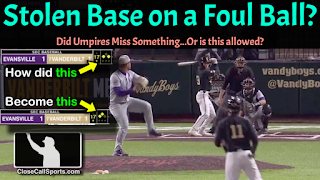
Stolen Base on a Foul Ball? Should Runner Have Gone Back?

In the 17th inning of Evansville and Vanderbilt's marathon game, Vandy baserunner R1 Davis Diaz tried to steal second base on a pitch ultimately fouled at the plate, but instead of returning to first base as foul balls generally prescribe, Diaz stayed at second with an umpire standing mere feet away. Was this a legal stolen base or did the fatigue of a 17 inning game factor into a misappropriated 90 feet for the home team?

The answer begins with the definition of a foul ball: "The ball becomes dead and runners advance one base, or return to their bases, without liability to be put out, when…a foul ball is not caught, in which case runners return to their bases" (Official Baseball Rule 5.06(c)(5)), or, because this was a college game, the relevant rule of NCAA 6-2-a: "The ball becomes dead and base runners return when…A foul is hit that is not caught. Runners return and the umpire shall not put the ball in play until all runners have retouched their bases."

No matter the level or how you phrase it, the theme is consistent: foul ball, runners return, right?

Well, there's a little more to it than meets the eye. Replays indicate that baserunner R1 Diaz arrived at and passed second base before Evansville pitcher Nate Hardman begin his motion, of out Set Position, toward home plate. This means that Diaz's advancement to second base was legal despite (ruled defensive indifference with the winning run on third base) the ensuing foul ball because he had already arrived at and occupied second base prior to the pitching motion to home plate: on foul balls, runners are to return to bases occupied at time of pitch.

As for the definition of when, exactly, a pitcher's actions constitute the exact time of pitch, NCAA 2-82 states, "The time of the pitch is (1) in the wind up position, when the pitcher makes any movement habitually connected with the delivery to the plate, or (2) in the set position, when the pitcher begins the natural movement associated with the pitcher's delivery of the ball after the pitcher has come set with both hands together in front of their body."

Accordingly, the runner R1 Diaz successfully advances to second base prior to time of pitch, and thus becomes R2 prior to the foul ball sequence; this means when he returns to his original base at time of pitch, he is returning to second base and not first base.

Video as follows:

Sunday, March 12, 2023

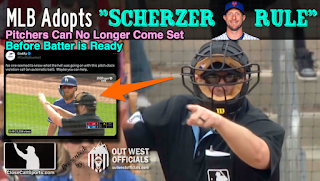
MLB's Max Scherzer Rule - Pitcher Can't Come Set Before Batter is Ready

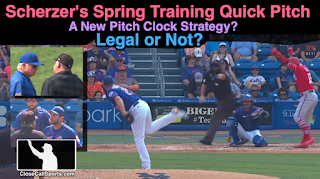
After Mets pitcher Max Scherzer spent New York's early Spring Training game against Washington playing with the pitch clock rules and throwing off batter timing, MLB has come in and shut him down: The new so-called "Scherzer Rule" or point of emphasis states that pitchers no longer may come set prior to the batter becoming alert in the box; umpires are to award a penalty of an automatic ball if the pitcher violates (after being warned or instructed to wait until the batter is alert before coming set).

HP Umpire John Bacon called the automatic ball infraction multiple times (after a warning the first time) during an Angels-Dodgers Spring Training game, with the last auto-ball penalty occurring during the very last at-bat of the game, which ended via a walk-off walk for the Dodgers.

To be clear, this is not a new Official Baseball Rule but instead a new point of emphasis or procedural/protocol change for umpires, stating that the Scherzer strategy of coming set before the batter is ready in the box, while legal just one week ago, is no longer to be permitted and, instead, will result in a pitch clock violation penalty for repeated infractions.

Video as follows:

Saturday, March 11, 2023

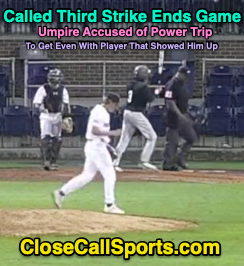
Called Third Strike Ends NCAA Game - About Umpire Power

After a called third strike wrapped up New Orleans' 7-3 win over Mississippi Valley State, questioned surfaced as to whether the NCAA umpire deliberately called a strike on a pitch that was a ball in order to get back at a player who may have shown the umpire up one pitch earlier. We review the play and discuss the issue of umpire and referee authority and abuse of power.

After the home plate umpire called strike two with two outs in the top of the 9th inning, the batter demonstratively jumped out of the batter's box before returning and gesturing with his bat to where he believed the pitch to have been thrown. The umpire did not discipline the batter and play resumed. The umpire did, however, call a third strike on the ensuing 1-2 pitch, ending the at-bat and the game.

The umpire measuredly walked off the field without addressing the player as the struck-out batter followed and attempted to argue, before the batter was restrained by the opposing catcher.

This has led to accusations that the umpire deliberately called strike three on a clear ball out of the strike zone, due to a grudge or way to get back at the player who behaved disrespectfully one pitch earlier.

To be clear, an umpire may discipline a player for unsporting conduct pursuant to the rules.

NCAA Rule 2-26 states, "the game officials have the authority to eject a player, coach, or team representative for misconduct or unsportsmanlike conduct. MLB's version is Official Baseball Rule 8.01(d): "Each umpire has the authority to disqualify any player, coach, manager, or substitute for objecting to decisions or for unsportsmanlike conduct or language, and to eject such disqualified person from the playing field."

However, when an umpire or referee instead deliberately disregards the rules of the game, for instance, by calling a strike on a pitch the umpire knows to be a ball and outside the strike zone, the official has abused their authority and violated the ethics of officiating.

In sum, discipline the player for misconduct—the rules and, depending on your game, video will support you—but the moment an official has deliberately called a play incorrectly in order to get even with a player or send a message, that official has abused their authority and committed a disservice to the game.

Video as follows:

Friday, March 10, 2023

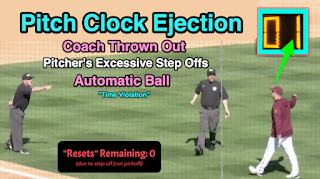
Pitch Clock Ejection - Time Violation Prompts Coach's Toss

A pitch clock-related time violation and automatic ball call led to ASU head coach Willie Bloomquist's ejection by 3B Umpire Darren Hyman, after Arizona State pitcher Owen Stevenson was called for a time violation due to excess step-off "reset" disengagements during a 6th inning plate appearance against UC Irvine.

With one out and one on in the top of the 6th, Anteaters batter Anthony Martinez stood in to face Stevenson. NCAA uses a 20-second "action clock" as opposed to MLB's variable pitch clock (30 seconds between batters, 20 seconds between pitches with runner(s) and 15 seconds between pitches with bases empty), and also has different rules about pickoffs and step-offs.

Whereas in professional baseball (MLB/MiLB), pitchers may disengage twice during any individual at-bat—including simply step-offs, fake throws, actual pickoff attempts, and other plays on the runner—the college rule limits pitchers to one step off per at-bat with the following exceptions: in college, disengagements due to pickoff attempts and plays on runners are unlimited and at both levels, the limit resets to two (MLB) or one (NCAA) if a runner advances.

In other words, the only real limit for college are the simple step off and fake throws. For the at-bat in question, pitcher Stevenson made several pickoff throws to first base (remember, pickoff attempts are unlimited under NCAA rules), and then briefly stepped off without making a play on the baserunner prior to delivering the 1-1 pitch. This step-off, known as a "reset", put the action clock back at 20 seconds (hence the term "reset") and counted as Stevenson one and only "reset" for the at-bat.

When Stevenson disengaged the rubber for a step-off again with a 2-1 count, this constituted a time violation of the "reset" limit rule, the penalty for which is an automatic ball, making the count 3-1. HP Umpire AJ Lostaglio enforced the rule by calling "Time" and signaling the count as 3-1. By rule, there are no warnings (NCAA Appendix F).

In NCAA, a so-called time violation of excessive resets results in a penalty of an automatic ball.
In MLB, a violation of excessive disengagements (without retiring a runner) results in a balk.

Head coach Bloomquist was ejected from foul line for continuing to argue the call following explanation.

We also talk about the scoreboard in use. Daktronics scoreboard / shot clock models not using tenths of a second result in a "zero" (or horn if there were to be automatic horn enabled, as is the case in basketball or hockey) when the clock display reads ":00" to fans. But internally, the scoreboard will actually read ":00.9" at the moment of the horn.

The nine-tenths of a second thus is also added to the start of the timer, making it look like the timer is delayed slightly when it is started. For a 20-second action clock, the timer thus begins at 20.9 seconds and expires at 0.9 seconds, reading as ":20" to ":00" for the fans.

Video as follows:

Thursday, March 9, 2023

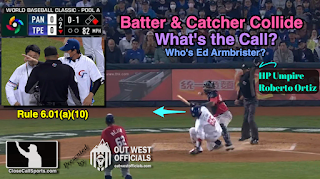
Panama Turns Double Play After WBC Armbrister Tangle

When a batter-runner and catcher became entangled on a bunt attempt in front of home plate during the World Baseball Classic's Panama vs Chinese Taipei game, HP Umpire Roberto Ortiz no-called the play, ruling the contact incidental and legal, before Panama catcher Christian Bethancourt threw to shortstop Ruben Tejada to force out baserunner Kun-Yu Chiang, before a second throw to first baseman Jahdiel Santamaria resulted in a second out.

In no-calling the sequence in front of home plate, HP Umpire Ortiz cited Official Baseball Rule 6.01(a)(10) Comment: "When a catcher and batter-runner going to first base have contact when the catcher is fielding the ball, there is generally no violation and nothing should be called." Although OBR 6.01(a)(10) itself puts the batter or runner out for interference if they fail to avoid a fielder attempting to field a batted ball, the exception posed by the rule's comment thus absolves batter Yu-Chieh Kao of any wrongdoing. Obstruction to the catcher is only to be called in "very flagrant and violent" cases here.

Longtime baseball followers might recall the original play that inspired the rule's comment that occurred during Game 3 of the 1975 World Series. That play was strikingly similar: with a runner on first base, Reds batter Ed Armbrister bunted the ball in front of home plate. As Red Sox catcher Carlton Fisk tried to field it, the two players collided, with HP Umpire Larry Barnett no-calling the play. This no-call rule interpretation, in today's books under OBR 6.01(a)(10) Comment, is called an Armbrister tangle (untangle).

A similar play occurred during Game 3 of the 2020 ALCS, when HP Umpire Jeff Nelson properly no-called a similar collision between Astros catcher Martin Maldonado and Rays batter-runner Manuel Margot. Two years earlier, however, HP Umpire Dan Iassogna declared Dodgers batter-runner Matt Kemp out for interference when Kemp failed to advance toward first base and thus didn't satisfy the Comment's "going to first base" criterion. 
Related PostMargot-Maldonado's ALCS Tangle Recalls Fisk-Armbrister (10/13/20).

Video as follows:

Wednesday, March 8, 2023

MLB Promotes 7 Crew Chiefs for 2023

After 10 umpires—including seven crew chiefs—retired to close out 2022, Major League Baseball promoted seven veteran umpires to fill the crew chief vacancies. Senior-most on MLB's list of new chiefs is Lance Barksdale, with Dan Bellino, Chris Conroy, James Hoye, Adrian Johnson, Alan Porter, and Todd Tichenor rounding out the new appointments.

In the table below, we have summarized data, including the umpire's age at time of promotion to crew chief, the year of their MLB debut (the era of NL and AL league-specific debuts is just about over), World Series postseason experience, and as we did last time for the 10 Triple-A call-ups hired to the full-time MLB staff, Replay Overturn Rate and Plate Score. The rankings for both Replay and Plate columns are scaled from one (best) to 19 (lowest), relative to other MLB crew chiefs.
NameAgeMLB DebutWorld Series?Replay Overturn RateReplay RankPlate ScorePlate Rank
Barksdale, Lance562000Yes (2)17.7493.41
Bellino, Dan442008Yes (1)15.3892.85
Conroy, Chris482010Yes (1)12.31792.94
Hoye, James522003Yes (2)13.61492.68
Johnson, Adrian472006No13.91391.715
Porter, Alan452010Yes (1)16.6593.32
Tichenor, Todd462007Yes (1)15.7792.76

Video as follows:

Tuesday, March 7, 2023

College Ejection - Brian DeBrauwere's Intentional HBP

HP Umpire Brian DeBrauwere ejected Gonzaga pitcher Ty Buckner for intentionally throwing at Tennessee batter Blake Burke after the former yelled at Buckner about an alleged quick pitch during the 3rd inning at-bat. Even more interesting, Brian had joined CCS years earlier to discuss game management about pitch cadence disputes between batter and pitcher, and how taking steps to slow things down—by calling "Time" or working with the catcher—could also diffuse potential problems.

Coincidentally, guess what game management tools NCAA and MLB's new-ish pitch clock eliminated?

Sunday, March 5, 2023

What if Batter Hits HR After Pitcher's Clock Violation?

The most common follow-up question we received after Saturday's Max Scherzer pitch clock violation video pertained to the batter: can the offense choose to decline this penalty? In the Scherzer video, the timer expires but HP Umpire Jeremy Riggs doesn't immediately call "Time" to kill play, instead simply pointing at the infraction as Scherzer delivers—late—to home plate. Had the batter hit a home run, for instance, could the offensive team opted to take the result of the play instead of have the pitch clock rule enforced?

The answer to this question is no. Pitch clock violations, at least to start 2023, are to be treated as immediate dead balls. Even if the umpire allows the pitcher to throw toward home plate in an untimely manner, only to call "Time" and enforce the rule after the pitch, MLB sought to eliminate discretion and any potential argument that an umpire wasn't "fast enough" in enforcing the rule by making all such violations an immediate dead ball, with no potential options to decline the penalty or choose an outcome.

This runs in stark contrast to the new infield shift restriction rule, which is treated as a delayed infraction or penalty. In this situation, the offense can choose to take the result of the play (e.g., a sacrifice fly) if the defensive team has violated the shift rule by placing three infielders on one side of second base, for instance. If the batter gets a hit, such as a home run, the shift infraction is simply ignored and the HR stands, similar to the catcher's interference rule in disregarding the infraction if the offense benefits via a hit.

Video as follows:

Saturday, March 4, 2023

Is Max Scherzer's Set Position Pitch Clock Strategy Legal?

Mets pitcher Max Scherzer labored into the third inning of New York's Spring Training game against Washington with a peculiar strategy to use the pitch clock to his advantage while throwing batters off their rhythm. But with HP Umpire Jeremy Riggs calling multiple infractions, is Scherzer's gamesmanship legal or a violation of the rules?

One week into Spring Training, Scherzer took the mound with a new approach to pitching to a clock. After surrendering a single to Nationals batter Ildemaro Vargas, Scherzer shifted tactics for ensuing batter Victor Robles, assuming Set Position as soon as possible in an effort to catch Vargas off guard for the ensuing delivery to home plate. HP Umpire Riggs, however, called Scherzer for a balk on his first attempt—the Mets ace had begun his delivery prior to the Nats batter becoming fully set and "alert" in the box.

Official Baseball Rule 6.02(a)(5) states that it is a balk when a pitcher makes an illegal pitch: "A quick pitch is an illegal pitch. Umpires will judge a quick pitch as one delivered before the batter is reasonably set in the batter’s box. With runners on base the penalty is a balk; with no runners on base, it is a ball. The quick pitch is dangerous and should not be permitted."

It is of little dispute that beginning one's delivery prior to the batter looking toward the mound constitutes a quick return pitch. With a runner on, this was called a balk.

As the inning progressed, it appeared Scherzer played more and more clock games, including the come-set-before-the-batter-gets-ready race and the make-the-batter-request-"Time"-and-exhaust-their-limit-of-one-"Time"-per-at-bat. If the batter did manage to assume alertness before Scherzer arrived at Set Position, Scherzer would simply hold the ball and wait until the pitch clock neared expiration prior to starting his delivery (Riggs called Scherzer for a time-expired violation once in the inning).

Insofar as a pitcher coming Set prior to the batter's readiness, the rules (namely 5.07(a)(2) regarding Set Position) do not outlaw the move: the rule simply requires the batter come set before delivering to the batter (we're assuming Set Position and not Windup is used). If there are runners, the pitcher must momentarily stop in Set prior to pitching (penalty: no-stop balk).

But there is no restriction in timing of when a pitch is first allowed to come set. Thus, Scherzer's strategy is legal, although the potential cost of messing with one's own timing and cadence (Scherzer's line was 2.2 IP, 7 R) may out-weight the potential benefits.

Video as follows:

Friday, March 3, 2023

Orioles Runner, Awarded 3rd, Called Out at 2nd on Appeal

Despite Orioles runner Maverick Handley being awarded third base on a ball out of play, Pittsburgh nonetheless retired him at second for an inning-ending Spring Training double play. How can an umpire call a runner out despite a base award? Article:

With one out and one on (R2 Handley), Orioles batter Robert Neustrom hits a fly ball into foul territory, near the first base dugout. Pirates catcher Jason Delay catches the ball before stepping into the dugout (the second step [step below dugout lip] is considered “into the dugout”). HP Umpire Derek Thomas declares Neustrom out on the catch and calls “Time” to award R2 Handley third base on the catch-and-carry into dead ball territory.

This is a legal catch pursuant to Official Baseball Rule 5.09(a)(1) Comment: "A fielder may reach into, but not step into, a dugout to make a catch, and if they hold the ball, the catch shall be allowed. A fielder, in order to make a catch on a foul ball nearing a dugout or other out-of-play area (such as the stands), must have one or both feet on or over the playing surface (including the lip of the dugout) and neither foot on the ground inside the dugout or in any other out-of-play area."

When the ball is put back into play, Pirates pitcher Kyle Nicolas throws to second baseman Nick Gonzalez, who steps on second base to appeal that R2 Handley failed to retouch second base after catcher Delay’s catch. 2B Umpire and Crew Chief Chad Fairchild affirms the appeal and calls Handley out to end the inning.

The Official Baseball Rules state that a runner must fulfill their base running responsibilities—including base touches [and retouches]—even when they are awarded bases and the ball has become dead…otherwise they may be appealed on and declared out for failing to touch a base.

For reference, OBR 5.06(b)(3) states, "Each runner, other than the batter, may without liability to be put out, advance one base when—A fielder, after catching a fly ball, steps or falls into any out-of-play area" while 5.06(b)(3)(C) Comment states, "If a fielder, after having made a legal catch, should step or fall into any out-of-play area, the ball is dead and each runner shall advance one base, without liability to be put out, from their last legally touched base at the time the fielder entered such out-of-play area."

(Think, for instance, about a home run hit out of the playing field. This is technically a four-base award, but the batter and any runners must touch all bases in order before scoring, even though the ball has become dead and they have been awarded bases.)