Friday, March 8, 2024

Spring Ejections 1-2 - Angel Hernandez (Lynn, Marmol)

HP Umpire Angel Hernandez ejected Cardinals pitcher Lance Lynn and manager Oliver Marmol (arguing balls/strikes) in the bottom of the 3rd inning of a #Cardinals-#Nationals Spring Training game. With one out and none on, Hernandez warned the St Louis dugout about arguing balls and strikes. Lynn was ejected after objecting to a ball call on a subsequent pitch; Marmol for arguing Lynn's ejection. This game was not televised and its stadium not equipped with pitch tracking data, the call was irrecusable. At the time of the ejections, the Cardinals were leading, 5-4. The Cardinals ultimately won the contest, 7-6.

These are Angel Hernandez (5)'s 1st and 2nd ejections of Spring Training.
*OBR 6.04(d) states, "When a manager, player, coach or trainer is ejected from a game, they shall leave the field immediately and take no further part in that game. They shall remain in the clubhouse or change to street clothes and either leave the park or take a seat in the grandstand well removed from the vicinity of their team’s bench or bullpen."

These are the 1st and 2nd ejection reports of 2024 MLB Spring Training.
This is the 1st player ejection of Spring 2024. Prior to ejection, Lynn's line was 2.0 IP, 4 ER.
This is the 1st manager ejection of Spring 2024. Ejection Tally: 1 Manager, 1 Player, 0 Coaches.
This is St Louis' 1-2nd ejection of S-2024, 1st in the Grapefruit League (STL 2; All Others 0).
This is Lance Lynn's 1st ejection since August 18, 2021 (Nic Lentz; QOC = U [Illegal Substance-USC]).
This is Oliver Marmol's 1st ejection since August 22, 2023 (Brennan Miller; QOC = N [Balls/Strikes]).
This is Angel Hernandez's 1st ejection since Sept 28, 2023 (Bryce Harper; QOC = U [Check Swing]).

Thursday, March 7, 2024

New Obstruction Emphasis Called for 1st Time in Spring Training

2024's new obstruction rule point of emphasis got its first call of Spring Training as 3B Umpire Nick Mahrley called Angels third baseman Luis Rengifo for illegally blocking Cubs baserunner Chrisopher Morel's return slide into third base before Rengifo fielded pitcher Reid Detmers' throw. The ensuing base award enabled Morel to score Chicago's first run of the afternoon, despite Morel having been obstructed while sliding back into third base and not trying for home.

As announced in February, MLB's obstruction point of emphasis instructs umpires to call violations of Official Baseball Rule 6.01(h)(1) when a fielder blocks the runner's base path without possession of the ball, or if fielding the ball (without possessing it), blocks the runner's path unnecessarily (e.g., the fielder did not need to occupy that space to receive the throw.

This allows the definition and rule to remain unchanged: "Obstruction is the act of a fielder who, while not in possession of the ball and not in the act of fielding the ball, impedes the progress of any runner," while deeming that a violation of OBR 6.01(h)(1) has occurred if the fielder, for instance, sticks a knee into the runner's path without the ball, or performs some other impeding action that isn't strictly necessary to field a thrown ball.

Finally, OBR 6.01(h)(1) states, "The obstructed runner shall be awarded at least one base beyond the base they had last legally touched before the obstruction," which is why baserunner R3 Morel, having reached third on the prior play, was awarded home plate. Note that this mandatory base award applies only to Obstruction Type 1 (Type A) and only to the obstructed runner. When no play is being made on an obstructed runner at the time of obstruction (Obstruction 2 / B), the base awards are made to "nullify the act of obstruction."

The scoring on this is an error charged to the fielder.

Video as follows:

Thursday, February 29, 2024

Swimmer Disqualified for Celebrating? Spirit of the Rule

NC State swimmer Kenneth "Owen" Lloyd finished first in his Men's 1650-yard freestyle Final in record time and climbed into teammate Ross Dant's lane to celebrate. After the race, however, referees announced Lloyd had been disqualified for switching lanes prior to the heat's end in violation of NCAA Swimming's interference rule. Let's talk spirit of the rule vs technical letter of the law.

NCAA Swimming & Diving Rule 2-5-1-b, a section called FOULS with the article titled INTERFERENCE, states, "A swimmer who changes lanes during a heat shall be disqualified."

There it is, black and white. A heat, event, or race effectively ends when the final competitor touches the wall to stop the clock. Replays indicate that Lloyd finished so quickly that other racers were still swimming—in the opposite direction—when Lloyd and opponent-but-also-teammate Dant touched up.

Lloyd then climbed atop the lane divider between himself and Dant's lane before dropping into his teammate's lane to celebrate a dominant victory.

Upon the race's conclusion, referees met (they are allowed to use video review) and determined that Lloyd was to be disqualified for changing lanes during the heat—e.g., while opponents were still swimming.

It didn't matter that Lloyd didn't appear to actually interfere with anyone (Dant had already finished when Lloyd breached the lane)—he was DQ'd based on the strict technicality of the interference rule.

This brings us to spirit vs letter of the rule—should this rulebook-supported decision been withheld due to Lloyd's obvious victory...or are the rules letter-tight for a reason in all situations?

Video as follows:

Monday, February 26, 2024

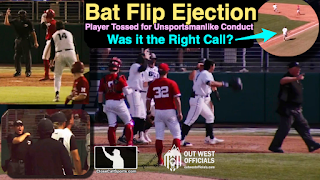
College Player Ejected for Bat Flip - Unraveling Nebraska vs Grand Canyon U

Grand Canyon University batter Tyler Wilson hit a grand slam to tie the Nebraska-GCU game, but was ejected by the HP Umpire during his home run trot for a bat flip near first base. What are college baseball's sportsmanship rules and was an ejection all over flipping a bat during a big moment in a game necessary?

We begin the night before Sunday's game in question, with both Nebraska and GCU trading celebrations after executing plays that benefited their respective teams. On their own, these celebrations are, effectively, unremarkable—players are allowed to celebrate success on the field.

The issue came to a head, however, in the 7th inning, with GCU pitcher Nathan Ward's exuberant celebration after a check swing strikeout to end Nebraska's top half. That attracted the attention not just of Nebraska, but the plate umpire who ordered Ward back to the dugout. Nebraska's head coach was seen speaking with umpires during the inning break.

After the game, the two teams met in the outfield and exchange unsporting words, indicating held over resentment, all leading to Sunday's game when Wilson hit his game-tying grand slam and flipped his bat, having held onto it until passing the halfway point down the first baseline.

As for why umpires ejected Wilson for his bat flip, we refer to the NCAA Baseball rulebook.

In addition to the Coaching/Players' Code of Ethics prohibiting unsportmanlike behavior, NCAA 5-17, newly amended for 2023-24, prohibits actions that "reflect poor sportsmanship," specifically including, "Bat flips near or toward an opponent or umpire." The penalty in college is a warning after the first offense and an ejection for any further unsportsmanlike conduct after the warning.

NCAA 3-6-b obliges umpires to enforce these rules: "[Each umpire] is obliged to conduct the game under conditions conducive to the highest standards of good sportsmanship."

The Official Baseball Rule (professional/MLB/MiLB) version of the sportsmanship rule is OBR 6.04, with ejections mandated by umpires' rule OBR 8.01(d).

NFHS 3-3-1f prohibits "any unsportsmanlike act" including taunting (3-3-1c: "carelessly throw a bat") while high school rule 10-1-6 authorizes umpires to eject for these violations.

Video as follows:

Thursday, February 22, 2024

Tagged Runner Returns to 1B - Placing the Ole Miss Call

With none out and a runner on first in the bottom of the 12th inning of Hawaii's home game against Ole Miss, Rainbow Warriors batter Matthew Miura flied out to right field as baserunner R1 Ben Zeigler-Namoa jogged into second base, with Rebels fielders both tagging R1 and appealing his failure to tag up at first base. Upon video review, Miura was returned—safely—to first base with batter-runner Miura out. Why?

Succinctly, replays indicate that as R1 held between first and second base and Ole Miss RF Treyson Hughes ranged over to catch the batted ball, the first base umpire, having run into the outfield to officiate the fly ball, signaled "safe" as in "no catch". Thus when R1 cruised into second base and stayed there, only to be tagged and appealed-on, Namoa responded by pointing to the umpire and indicating the erroneous "safe" mechanic.

NCAA/college's rulebook holds two outcomes for getting the call right in Appendix E—one for crew consultations without video review, and one for video review calls.

Both scenarios play out similarly in terms of correcting an erroneous initial call: "If the reversing of a call results in the need for decisions on the placement of base runners, the umpire crew shall use their best judgment to determine their locations as if the call had been made correctly."

OBR 8.02(c) is similar: "If the umpires consult after a play and change a call that had been made, then they have the authority to take all steps that they may deem necessary, in their discretion, to eliminate the results and consequences of the earlier call that they are reversing, including placing runners where they think those runners would have been after the play," while NFHS 10-2-l/high school grants umpires-in-chief the authority to "rectify any situation in which an umpire's decision that was reversed has placed either team at a disadvantage."

The general principle here is that no player shall be placed in jeopardy because they relied on an umpire's incorrect initial call. Accordingly, R1 was returned to first base and the batter declared out, the crew deeming via review that had U1 called the batter out initially, R1 would have most likely returned to first base safely.

As a footnote, what may have contributed to U1's error was the right fielder's glove, which was white or grey in color, similar to the baseball's hue. Although NCAA rules do not restrict non-pitcher fielders in their glove color, OBR 3.07(a) states that "no fielder regardless of position may use a fielding glove that falls within a PANTONE color set lighter than the current 14-series." This applies to most white and grey colored gloves and, had this occurred during a professional game, would likely apply here as well.

Video as follows:

Monday, February 19, 2024

Rain Ejections After Umpires Order Softball Team to Play Through Downpour; Pitcher Can't Find a Grip

A wild argument after umpires refused to call for a rain delay, instead ordering Cal softball to play through a downpour in Louisiana, resulted in multiple ejections when Cal's pitcher couldn't find a grip in the slippery conditions. What's the rule about rain delays and could anything have avoided this flashpoint?

The controversy started when multiple California Bears players knelt in protest during the pre-game National Anthem, prompting heckling from the home crowd and charged emotions before a pitch was even thrown (Friday).

Potential problems continued to brew Sunday as clouds ominously turned grey during a 7th inning Replay Review for a hit-by-pitch vs foul ball play, with the home plate umpire and Cal head coach taking turns exhibiting curt body language cues with each other, indicating the duo might not get along too well if controversy were to occur later on.

The rain ultimately picked up significantly and despite Cal's pitcher appearing wholly unable to get a grip on the softball, and despite her head coach's plea to temporarily stop playing, the umpires opted to continue playing, leading to back-to-back Cal wild pitches allowing Louisiana to tie the game and igniting a near-free for all ending with multiple Cal ejections.

NCAA Softball's Rule 6.11.2.1.2 pertains to suspension and the resumption of play and states, "Play should be suspended immediately without regard to timing within the inning when spectator or participant safety is compromised (for example, in the event of lightning detected within the danger zone, serious injury to a participant or if players’ footing or grip on the bat or ball is obviously compromised)."

The phrase "obviously compromised" proved controversial to coach and umpire who were already operating on different wavelengths, but it is tough to argue the pitcher's repeated inability to grip the ball in the heavier rain would not meet this threshold.

Instead, play continued until back-to-back wild pitches due to poor grip helped tie the game and ignite the multiple ejections. The multiple ejections that followed delayed the game by several minutes, allowing the heavier problematic rain to pass through the area before play resumed. In other words, when it comes to an issue of delaying the game, an umpire's attempt at getting in the final word to play through can be circumvented by team personnel who can call for their own delay simply by wasting time arguing the rain delay no-call.

With Cal's pitcher once again able to grip the baseball in less-downpourish conditions, the Bears recorded the third out and ultimately won the contest in extra innings.

Video as follows:

Sunday, February 18, 2024

Batter-Runner Interference at UCF? A College Question

A batter-runner ran into a catcher attempting to throw out a baserunner during Friday's Bryant vs UCF game, a no-call ruled legal by HP Umpire Daniel Jimenez who deemed UCF batter Mikey Kluska did not interfere with Bryant catcher Jackson Phinney during a bunt attempt.

With a runner on first and none out in the 7th inning of a close 11-10 game, Kluska dropped down a bunt on the first pitch he saw, presumably a sacrifice attempt. But as catcher Phinney fielded the ball and attempted a throw to second base, a hindering action occurred as batter-runner Kluska ran into the catcher.

To determine whether or not this is interference requires a visit to the rulebook.

NCAA Rule 8-5-d states that a runner is out when they commit interference, specifically when—"The runner interferes intentionally with a throw or thrown ball, or interferes with a fielder who is attempting to field a batted ball. If a double play is likely, and the runner intentionally interferes with the fielder who is attempting to field or throw the ball, both runner and batter-runner shall be declared out."

Had this play occurred in MLB/MiLB, the rule is somewhat similar. For instance, OBR 5.09(b)(3) puts the runner out when "they intentionally interfere with a thrown ball; or hinder a fielder attempting to make a play on a batted ball," while the rule dedicated to interference, OBR 6.01(a), in provision (10) puts a runner out for interference when "He fails to avoid a fielder who is attempting to field a
batted ball, or intentionally interferes with a thrown ball." We must return to 5.09(a)(13) to see this also applies to a fielder in the act of throwing: "...intentionally interfere with a fielder who is attempting to catch a thrown ball or to throw a ball in an attempt to complete any play."

High school treats this play similarly pursuant to NFHS 8-4-2g: "any runner is out when the runner intentionally interferes with a throw or a thrown ball."

With all rulesets roughly the same, we concentrate on our sequence. We notice the catcher appears to field the batted ball successfully, prior to the batter-runner/catcher collision. Thus, the catcher's right of way protection during a batted ball has expired, because the ball is no longer a batted ball, having been fielded.

Instead, the batter-runner/catcher interaction occurs during the attempted throwing phase of play, meaning the more stringent standard of intentionality applies. If the batter-runner's actions are deemed intentional, this is interference and, conceivably, the dead ball can result in a double play if the umpire deems circumstances are appropriate. But if the hindrance is deemed unintentional—an unfortunate tangle and nothing more—then the rules do not support an interference call in this case.

Video as follows:

Wednesday, February 14, 2024

Obstruction Calls Are 2024's Point of Emphasis

Obstruction calls are set to increase in 2024 thanks to a new MLB point of emphasis of Official Baseball Rule 6.01(h), according to an ESPN source. Succinctly, the league office will instruct umpires to rule a runner safe in the event a fielder blocks a runner's path to the base while preparing to receive a throw.

This point of emphasis brings OBR 6.01(h) into greater alignment with 6.01(i)(2), the Collisions at Home Plate rule for fielders that functionally employs a similar penalty to the existing obstruction rule, but only applies at home plate and is also much more strict in its standard for violation.

Home plate collision rule OBR 6.01(i)(2) states, in part, "Unless the catcher is in possession of the ball, the catcher cannot block the pathway of the runner as they are attempting to score...it shall not be considered a violation of this Rule 6.01(i)(2) if the catcher blocks the pathway of the runner in a legitimate attempt to field the throw."

Meanwhile, the existing definition for Obstruction (at any base), as found in the rulebook's Definition of Terms, states: "Obstruction is the act of a fielder who, while not in possession of the ball and not in the act of fielding the ball, impedes the progress of any runner."

The definition of obstruction predates the home plate collision rule by a number of decades and is plainly not as detailed. Although OBR and the MLB Umpire Manual both make reference to "the act of fielding" relative to obstruction, the phrase "legitimate attempt" is nowhere to be seen in this particular rule relative to a fielder preparing to receive a throw who might use their leg to block a runner's base path.

Over the past few years, runner's lane interferencea rule since changed prior to the 2024 season by expanding the width of the runner's lane—has received emphasis, which in turn resulted in a handful of additional arguments and ejections.

Will obstruction suffer this same fate? | Video as follows:

Monday, February 12, 2024

Clint Vondrak and Ryan Wills Hired to Umpire Staff, Guccione Promoted to Crew Chief; Pawol on List of 24 Spring Invitees

Now-former Triple-A umpires Clint Vondrak and Ryan Wills are MLB's two newest full-timers MLB also promoted Chris Guccione to full-time Crew Chief and invited Jen Pawol to Spring Training, the first woman set to umpire a major league exhibition game since Ria Cortesio in 2007, following Pam Postema in the 1980s.

Clinton "Clint" Vondrak joins MLBU at the age of 34 after 12 years in Minor League Baseball, joining MiLB in 2012 and officiating the Pioneer, Midwest, California, Southern, and Pacific Coast Leagues on his way to the majors. Vondrak officiated the 2016 Southern League All-Star Game and has had his MLB debut during during the COVID-shortened 2020 season, on August 10, 2020. He has 286 games of MLB experience.

Ryan Wills is 36 years old to begin the 2024 season and has been hired after 13 years in MiLB. Since starting his minor league career in 2011, Wills has officiated in the Gulf Coast, Appalachian, South Atlantic, California, Carolina, Texas, Eastern, Florida Instructional, and International Leagues prior to his August 22, 2020 debut. Wills might be one of the last MLB new-hires to have graduated from the Jim Evans Academy for Professional Umpiring, which closed in 2012. Wills has worked 402 MLB games.

Chris Guccione has been promoted to Crew Chief after 17 years of major league service (over the course of 24 seasons starting in 2000). He has 3,021 major league games of experience during the regular season, in addition to 9 Wild Card Rounds, 7 Division Series, 5 League Championship Series, and 2 World Series. Similar to Dan Bellino last offseason, Guccione did not work the 2023 postseason prior to his 2024 promotion.

2024 Spring Training Invitee Umpires: Returning sleeve-numbered umpires for Spring Training in 2024 are David Arrieta (100), John Bacon (70), Brock Ballou (119), Paul Clemons (104), Tom Hanahan (69), Edwin Jimenez (75), Emil Jimenez (82), Alex MacKay (105), Dan Merzel (107), Jacob Metz (94), Charlie Ramos (111), Jeremy Riggs (112), Derek Thomas (106), Nate Tomlinson (114), and Brian Walsh (120).

Rounding out the list of 24 Spring invitees are Matt Brown, Steven Jaschinski, James Jean, Austin Jones, Tyler Jones, Dexter Kelley, Chris Marco, Johnathan Parra, and Jen Pawol.

Video as follows:

Sunday, February 4, 2024

Basketball Line is Out - Responding to Fan Complaints

During Sunday's NCAA Men's Basketball game between Wisconsin and Purdue, some Badgers fans were upset with the officiating crew over a displacement related foul call and an out of vs in bounds no-call for an inbounder. Let's take a look.

The foul call pertains to an attempted trap defense near the end line. The Boilermakers ballcarrier picks up his dribble and is defended before appearing to either travel or step out of bounds, only for the center official to signal a foul.

What the referee saw was the defensive player move forward and into the offensive player, displacing the ballcarrier with a knee and causing the potential violation. Ergo, foul call.

But the focus of today's lines lesson pertains to a complaint about referees no-calling an inbounder who stepped on the line before inbounding the basketball. The purpose of this video and article is to reiterate that the end- and side lines are always out of bounds such that when an inbounder, standing out of bounds, steps on (but not across) one of these lines, that player is still considered out of bounds.

Video as follows: