Showing posts sorted by relevance for query perfect game. Sort by date Show all posts

Monday, October 12, 2020

Perfect Game for John Tumpane is First in UEFL History

When home plate umpire John Tumpane stepped off the field following Game 2 of the 2020 American League Championship Series between the Houston Astros and Tampa Bay Rays, he accomplished a UEFL first: Tumpane called a perfect game with 135 correct calls over 135 callable pitches thrown for a Preliminary UEFL f/x score of 100%.*

In all, the baseball world has seen some eagle-eyed umpiring over the past few postseasons, beginning with Joe West's 99.4% mark in a near-perfect Game 3 of the 2018 Red Sox-Astros ALCS, 99.3% score by James Hoye during Game 4 of the 2019 Houston-Tampa Bay ALDS, and, earlier in the 2020 postseason, Jordan Baker's 99.4% finalized score in Game 1 of the American League Wild Card Series between the New York Yankees and Cleveland Indians.

However, Tumpane's perfect game is a UEFL first. According to an article from The Ringer, no umpire has ever called a perfect game for both teams, though 25 umpires have called a perfect game for one team or the other.
As far as the ML Public score is concerned, Tumpane's preliminary number was 96.3% (130/135) with a matching 100% rating for ML Private, meaning that while the ML Public perfection problem persists, Tumpane not only beat the computer using the ZE estimate, but also, for the first time, put up a flawless performance using UEFL f/x criteria for day-of plate scores.

And just to prove that perfection isn't good enough for some people, career ejectee Josh Donaldson took to twitter to complain about Tumpane, tweeting, "Top 3 worst ump in the game" and "Trust me this guy has no idea what the zone is in the rule book. He's never wrong in his words."

So there you have it: the umpire who "has no idea what the zone is" just called a perfect game, preliminarily.

*Update: The post-game processed Final numbers brought Tumpane's plate score down from 135/135 to 134/135 = 99.3% (Skew: +1 HOU). For more information on UEFL f/x 3.0 and how Preliminary (same day) vs Final (overnight or postgame processing) numbers work, visit our introductory article:

PS: What was the pitch that took Tumpane's UEFL f/x perfect game away from Preliminary to Final (he's still perfect on ML Private)? A strike one call to Austin Meadows in the bottom of the 2nd inning with pz 3.63 / RAD 3.51 / MOE 3.42 and sz_top 3.41. That's right, Tumpane missed out on a post-game processed perfecto by 0.1 inches.

Video as follows:

Wednesday, June 13, 2012

Record Breaker: Another Perfecto, Umpiring History Made

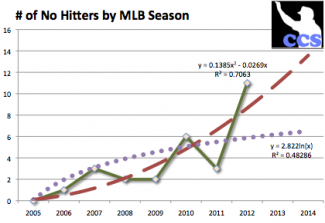
Yet again, for the fifth time this season the Umpire Ejection Fantasy League and Major League Baseball witnessed a no-hitter (the 277th in MLB history) and perfect game for the second time this season and 22nd in MLB history today, June 13, when Ted Barrett (65) umpired the plate for San Francisco Giants pitcher Matt Cain's first career no-hitter and perfect game (and the Giants franchise's first perfect game) against the Houston Astros. Tonight's no-hitter becomes the third such contest in less than two weeks. Cain struck out 14 Astros and threw 125 pitches, though only 68 were callable, with 39 balls and 29 called strikes.

MLB is on pace for a record 11 no-hitters in 2012
Brian Runge, who called the most recent both the most recent no-hitter and the most recent perfect game (and the last to work the plate for a Giants no-hitter, thrown by Johnathan Sanchez) worked third base, taking part in his third no-hitter of the year. Barrett also partook in his third no-hitter of the season tonight and his second no-hitter calling balls and strikes in as many seasons. He umpired Angels pitcher Ervin Santana's no-hitter of the Indians on July 27, 2011. Umpires Mike Muchlinski and Angel Campos (both AAA fill-ins) were not part of either previous no-hitter Runge & Barrett worked in 2012.

With this perfect game, Ted Barrett becomes the first umpire in Major League history to work the plate for two perfect games in a career. Barrett called balls and strikes for David Cone's perfect game in July of 1999.

With the increased frequency of the no-hitter, there very well may possibly be something to the idea that we will easily surpass the logarithmic trend prediction of six no-hitters in the 2012 season. Could it be thanks to the human element? The umpiring? Whatever is stirring the pot in 2012, there is no shortage of hair thin close calls.

With another no-hitter, we all of course saw yet another very close play that kept the perfect game and no-hitter intact, as in the previous four no-hitters. The previous four were: Brian Runge's inconclusive ruling of a swing made by Brendan Ryan, Angel Hernandez's correct call of a batted foul ball, Adrian Johnson's incorrect call of foul on a batted ball by Carlos Beltran, and Ted Barrett's inconclusive call of out on Dee Gordon at first base. This time, it was yet another fair/foul call. 1B Umpire Mike Muchlinski ruled a 1-2 batted ball by Astros batter Jordan Schafer foul on a bouncing ball that bounded near the bag at first. Astros Manager Brad Mills shortly questioned the call, as replays showed a very close play.

Saturday, April 21, 2012

Umpire Odds & Ends: Perfect Game 21

Baseball and the UEFL saw a perfect game for the first time this season and 21st in MLB history today, April 21, when Brian Runge (18) umpired the plate for White Sox pitcher Phil Humber's first career no-hitter and perfect game against the Seattle Mariners. Humber threw 95 pitches, though only 51 were callable, with 28 balls and 23 called strikes

Did Ryan swing?
Watch the following video to see Humber complete the perfect game and decide for yourself whether Brian Runge's game-ending swing call on Mariners batter Brendan Ryan's attempted check swing was the correct or incorrect call.

Video: Humber strikes out Ryan on close check swing call to secure the 21st perfect game in MLB history
Video: Final Out - Side angle of Ryan's attempted check swing (Thanks to TheGunsofHochuli for the link)


Here is a quick look at the statistics of how Brian Runge called Phil Humber's perfect game & no hitter:
Total Pitches: 95
Swinging Strikes: 14
Foul Balls: 12
In Play, Out: 18
Callable Pitches: 51
Balls: 28
Called Strikes: 23

Correct Called Balls: 25
Incorrect Called Balls (Called balls within the strike zone): 3 (1 additional was in the borderline range; correct)
Correct Ball %: <90.0%

Correct Called Strikes: 21
Incorrect Called Strikes (Called strikes outside the strike zone): 2 (3 others were in the borderline range; correct)
Correct Strike %: 91.3%

Correct % of Called Pitches: 90.2%

Pitch f/x courtesy Brooks Baseball

Tuesday, October 13, 2020

Postgame Computer Balances Tumpane, Hoberg Scores

Between umpires John Tumpane and Pat Hoberg, only two out of 276 callable pitches seen Monday were improperly officiated. When we introduced UEFL f/x 3.0's multi-stage plate score format for the 2020 MLB postseason, we explained that baseball's strike zone computer runs in phases, returning multiple scores because the technology is unable to reliably assess batter height during real-time gameplay.

For instance, during one such postseason game, the computer changed batter strike zone height values in 53% of the pitches it tracked during post-game processing.

Alternately, one could say the computer changed its original answer over half the time.

Put differently, for over half of the pitches thrown, a trigger activated during post-game analysis that compelled an adjustment to the batter strike zone height, such as a close pitch near the edge of the zone/boundary. 53% of all pitches were adjusted, and the 47% of the pitches not adjusted...may well have been adjusted had the post-game analysis stayed true to the process of adjustment (as it is, possibly to save computing power or other labor, the computer only adjusts certain pitches).

Sometimes these adjustments change umpire QOCs and sometimes they don't.

Preliminary: During each game, StatCast uses placeholder values for batter bottom/top strike zone boundaries known as sz_bot and sz_top, respectively, regardless of the batter's actual stance during the pitch subject to evaluation. Thus, the score returned after each game known as the Preliminary score is based on placeholder height values and is a best-guess expectation of what the batter zone heights should be.

Final: After each game, the computer gets to work replacing many of these placeholder sz_bot and sz_top values with actual/observed figures. Sometimes they might match the placeholders and sometimes they don't. In the end, a new plate score is generated known as the Final score, generally scraped the morning after the game but occasionally later on game-day.

Tumpane's Prelim score was perfect.
Oftentimes, an umpire's Preliminary score will improve in the Final calculation, while, other times, it will decrease, as the computer calculates whether a zone height adjustment affected Quality of Correctness for a given edge pitch call.

Monday's LCS Umpires: Between Tumpane and Hoberg, the umpires saw 276 pitches and officiated 274 properly during Monday's League Championship Series action for a combined UEFL f/x score of 99.3%. Both figures (274/276 and 99.3%) are true for Preliminary and for Final numbers.

But between Preliminary and Final, both individual umpires saw adjustments.

Tumpane: Tumpane famously earned the first perfect preliminary plate score in UEFL f/x postseason history Monday afternoon in San Diego, scoring 90/90 Balls + 45/45 Strikes = 135/135 = 100%.

Hoberg's final score increased by 1.
Which meant the only place for baseball's computer to adjust Tumpane would be downward, and the computer didn't fail to disappoint, dropping one of Tumpane's called strikes to the incorrect category based on actual vs placeholder (or expected) batter height, and changing his 135/135 to 134/135, or 99.3%.

Hoberg: On the other side of balance sheet, Hoberg originally scored 91/91 Balls + 48/50 Strikes = 139/141 = 98.6%, and his post-game processing adjustment changed an incorrect strike call to a correct strike call, bumping his score to 140/141 = 99.3%.

Combined: In the end, baseball maintained pitch calling equilibrium as the Preliminary full-day score for Tumpane + Hoberg of 181/181 Balls + 93/95 Strikes = 274/276 = 99.3% remained the same overnight, which is an effect that happens quite often with computer processing: over the whole, the adjustments tend to largely balance out, though during individual games, they might increase or decrease a specific umpire's score.

Conclusion: Unfortunately for the robot umpire concept, the macro view of averages isn't quite good enough: the technology must be perfected to call pitches to accurate, adjusted batter height in real-time, specific to the game in which the pitch occurs and, as the Tumpane/Hoberg flip-flop demonstrates, the computer has not yet proven itself consistently and accurately capable of this: not while a majority of pitches are routinely changed during post-game processing. As such, the computer's adjustment to reflect overall umpire accuracy while nonetheless altering individual scores suggests a proof of technology's shortcomings.

PS: What was the pitch that took Tumpane's UEFL f/x perfect game away (he's still perfect on ML Private)? A strike one call to Austin Meadows in the bottom of the 2nd inning with pz 3.63 / RAD 3.51 / MOE 3.42 and sz_top 3.41.

That's right, Tumpane missed out on a post-game processed perfecto by 0.1 inches.

Video as follows:

Wednesday, September 30, 2020

Umpire Jordan Baker Nearly Called a Perfect Game and the World Will Never Know

On Day 1 of UEFL f/x—in which we introduced preliminary/day-of vs final/day-after plate score reporting—we discovered that umpire Jordan Baker nearly called a perfect game in Cleveland (one pitch shy), but thanks to the MLB computer's vertical strike zone blind spot, the world may never know.

During Game 1 of the Yankees-Indians AL Wild Card Series, HP Umpire Baker saw 166 callable pitches and, according to baseball's real-time pitch tracking computer, officiated 163 of those 166 pitches correctly for a plate score of 98.2%.

As we discussed in our UEFL f/x 3.0 Plate Score primer, baseball's computer quietly changes its grading system overnight, after the computer essentially double-checks itself to account for errors caused by the computer's inability to see certain vertical strike zone attributes in real-time.

Baker's game in Cleveland was no exception: While the computer scored Baker as 163/166 = 98.2% on the day of his game, MLB's computer went to work overnight re-processing and re-grading Baker's work, ultimately returning a result we hypothesized would likely occur: it increased Baker's score from 163/166 = 98.2% to 165/166 = 99.4%, an increase of +2 pitches and +1.2% accuracy.
Jordan Baker's preliminary (pre-processed) plate score for NYY-CLE WC Game 1 was 98.2%.
Perhaps a more convincing way of putting it would be the inverse of accuracy, or what Mark Williams at Boston University would call, the "Bad Call Rate" (BCR). Thus, Baker's preliminary, day-of BCR was 100-98.2= 1.8%, a strong performance in its own right.

However, after post-game processing, MLB's morning-after BCR for Baker decreased from 1.8% to just 0.6%. And, thanks to the lack of fanfare surrounding the post-game processing procedure, fans who saw Baker's game in real-time will never know what he called a better game than what ESPN K-Zone initially showed.
Baker's final (post-game processed) plate score for NYY-CLE WC Game 1 was 99.4%.

Put differently, the computer preliminarily charged Baker with three incorrect calls (163/166), but after processing changed its grade to just one incorrect call (165/166). For the computer, to decrease its red marks on Baker's game by two-of-three pitches or 66.7%, constitutes an incredibly statistically significant adjustment.

And this adjustment rate of 66.7%—which would be known as a failure rate had the computer made these calls in real-time, as would be the case with a robot umpire or computerized strike zone proposal, such as Automated Ball/Strike System (ABS)—is a blatant Achilles heel in the ABS experiment and one reason why, despite sign-off from the umpires' union and Commissioner Rob Manfred's vow to put computers in baseball games, MLB has, as of yet, been unable to assign a RoboUmp to call balls and strikes.

Video as follows:

Tuesday, October 16, 2018

Joe West Sets % Record in Near-Perfect Game in ALCS

MLB's senior umpire, ALCS Crew Chief Joe West, fell one pitch shy of perfection in Game 3, correctly judging 159 of 160 callable pitches for a plate accuracy score of 99.4% as Boston's Red Sox defeated Houston's Astros. West's score sets a UEFL record, as this is the first time our system has ever tracked an umpire missing just one pitch during a postseason game.

West's 99.4% plate performance was tracked as part of the Close Call Sports & Umpire Ejection Fantasy League's usual postseason discussion and analysis and is the highest UEFL-f/x score ever recorded for the postseason, defeating previous record-holder Jim Wolf's 98.8%, set during the 2018 American League Wild Card Game, when Wolf called 160 of 162 pitches correctly during New York's victory over Oakland.
Related PostDiscussion of 2018 AL and NL Championship Series (10/16/18).
Related PostDiscussion of 2018 AL and NL Wild Card Games (10/2/18).

Sidebar: For more on UEFL f/x and how we calculate umpire plate performance statistics, refer to...
Related PostUEFL f/x vs K-Zone and the Player-Umpire Disconnect (10/4/18).

As has been discussed often since pitch tracking technology was introduced to assist the umpires in identifying trends and tendencies—ultimately as an educational tool—umpires have continually been getting better at calling balls and strikes. Prior to Wolf's 98.8% (160/162) in the AL Wild Card Game, the highest postseason score recorded here was Jeff Nelson's 98.7% (147/149) during Game 5 of the 2011 ALCS.

Similar scores include 98.6%, from Game 2 of the 2016 ALCS, also by Wolf. Before that, it was Paul Emmel's 98.5% NLCS Game 4 score in 2015, which eclipsed Dan Iassogna's 98.4% earlier in the day during Game 5 of the 2015 ALCS, which outranked Greg Gibson's 98.3% during Game 5 of the 2014 NLCS, and so forth.

During this 2018 postseason, through Game 3 of the ALCS, the following umpires have performed at at least the 98% level behind home plate:

2018 Wild Card Round
AL Wild Card Game - Jim Wolf - 160/162 = 98.8%.

2018 Division Series
ALDS Game 2 - Chad Fairchild - 122/124 = 98.4%.
NLDS Game 3 - Ted Barrett - 146/148 = 98.6%.
ALDS Game 4 - Angel Hernandez - 145/148 = 98.0%.

2018 League Championship Series
NLCS Game 2 - Alan Porter - 146/149 = 98.0%.
ALCS Game 3 - Joe West - 159/160 = 99.4%. *UEFL record.

Yes, I would say that umpires are indeed getting better and have the wherewith-all to ball and strike pitches as appropriate, within the confines of the rule book, with fair play first and foremost at hand.

BY THE WAY...What was the one call that West missed anyway? It was a seventh-inning 2-0 pitch from Red Sox pitcher Ryan Brasier to Astros batter Tony Kemp, ruled strike one, and located about 1.08 horizontal inches from, as they say, perfection. Kemp ultimately lined out to Andrew Benintendi to conclude his at-bat—West was perfect for the 113 pitches prior to and the 46 following "strike one." In general, 2-0 and 3-0 pitches located near the outside edge of home plate can be particularly dangerous for umpires, who statistically are more likely to call strikes during those counts. In West's case, it was just over an inch away. That's less than half of a baseball.

Wednesday, August 15, 2012

Perfect Game 23: 3rd in 2012, 2nd at Safeco Field

With Mariners pitcher Felix Hernandez hurling a perfect game, striking out the last batter he faced (looking), the baseball community has now seen the 23rd perfect game in MLB history, 1st in Mariners franchise history, third of the 2012 season and second at Safeco Field in Seattle, Washington.

In April, the Mariners were victimized by White Sox pitcher Phil Humber's first career no-no and perfect game.

As Hernandez's perfecto marks the sixth no-hitter of the 2012 season, MLB remains on pace to break the all-time record dating back to George Bradley's no-hitter in 1876; since that time, baseball has never seen more than seven no-hitters during any single season.

Discussed after the Matt Cain no-hitter, several 2012 no-nos have had at least one close call or other controversy that has resulted in nearly one third of voters in this poll liken an incorrect call in favor of the defense during a no-hitter to the Jim Joyce-Armando Galarraga saga—in reverse.

This is pertinent information, as for the first time this season, a manager was ejected from the no-hitter in progress for arguing a potential missed call: Rays skipper Joe Maddon was run by home plate umpire Rob Drake for arguing a strike call replays indicate was the wrong one.
Related Post: Ejection 119: Rob Drake (2).

So, does Maddon have merit? Was Drake's strike zone lopsided in favor of King Felix? As is UEFL tradition for perfect games and no-hitters, here is the statistical breakdown of Hernandez's effort as called by Drake:

Saturday, April 23, 2011

History: The New UEFL Banner

One of the UEFL followers recently commented on our new look:

Here's what I want to know...

There MUST be some significance to the UEFL banner on top of the page. No one just randomly puts in pics of Fred Brocklander and Dave Pallone...two guys who worked during the MLB strike way back in the day. And the clocks? I am racking my brain trying the figure what the time on each clock could stand for.

Those are great pics of Kaiser, Reilly and JJ...but Brocklander? Fred Freakin' Brocklander? At least Pallone, IMHO, proved he belonged and overcame two stigmas (scab and gay) to be in the bigs.

Of course, the bigger issue may be that I can even recognize a photo of Brocklander. Must. Get. A. Life.


To this, we say: Excellent observations. Indeed, the umpires who appear in the banner run the gamut of professional umpiring history. Here is a brief overview of the elements of the UEFL Banner at the top of the page.

Left Clock, Right Clock: The clock images come from atop the famous Wrigley Field scoreboard. Built in 1914 as Weegman park, Wrigley best represents all of Major League's ballparks. As the second oldest stadium in MLB (behind Fenway), Wrigley is full of baseball history. Featuring a hand turned scoreboard, an iconic main entry marquee, a stadium so dedicated to the tradition of the day game (only having installed lights in 1988), and its setting in the middle of the surrounding Lakeview neighborhood, The Friendly Confines is a clear choice for inclusion in our banner dedicated to professional umpiring history. The clocks themselves represent a progression of time.

Nicholas Young: Positioned next to the 3:55pm clock (perhaps a day game?) is baseball executive Nicholas Young. Truly representative of the turn of the century umpire (that would be the 1900 turn of the century), Young served in the Union Army during the Civil War. Like most umpires during the 1870s, Young was a right fielder by trade and was instrumental in forming the National Association of Professional Baseball Players, the first professional baseball league in the United States of America. Young managed the Washington team from 1871-1873 and also umpired in the league. Young served as secretary and treasurer of the newly formed National League, before becoming NL President from 1885-1902. He left the League later that year to return to his first job, with the US Treasury Department. He is not in the National Baseball Hall of Fame.

John Joseph "Rip" Egan: Next to young is Rip Egan, who was also a player by trade. From 1894-1900, Egan pitched professionally with the minor league Providence Clamdiggers, Omaha Omahogs, Detroit Tigers (a minor league team at the time), Kansas City Blues, and Cleveland Lake Shores, and the major league Washington Senators (he lasted one day in the bigs, giving up five runs in five innings, posting an ERA of 10.80... he didn't get the loss and finished with a 0-0 record). Egan began his American League umpiring career in 1907, which would last through the 1914 season. During his time as a professional umpire, Egan umpired two no-hitters (Frank Smith, Joe Benz) and umpired the 1913 World Series. Proving that baseball truly is a timeless sport, Egan, just like the umpires of today, was criticized by the press because of a close call he made during a Naps-Cardinals contest in 1908. Regardless, Egan was "highly regarded" as an umpire. He is not in the National Baseball Hall of Fame.

DISPUTED: Charles Moran: There is some controversy regarding the man next to Egan. First up is "Uncle Charley" Moran, a collegiate football player, professional baseball player, collegiate and professional football coach, collegiate baseball coach, and professional baseball umpire. After playing college football at the University of Tennessee and Bethel College, Moran was drafted by the St. Louis Cardinals. He lasted slightly longer than Egan, a grand total of three games in 1903, during which he posted an ERA of 5.25 in 24 innings of work, with a record of 0-1, and an offensive batting average of .429 (perhaps he should have been a position player). He then returned to the Cardinals in 1908, as a catcher (listened to my advice), playing in 21 games and batting just .175 on the last place Cardinals team. He bounced around several minor league teams after 1908, while moonlighting as a college football coach from 1909-1933. He was an NFL coach (Frankford Yellow Jackets) in 1927. While continuing to coach football and play minor league baseball, he picked up a baseball coaching job at Texas A&M, which he held from 1909-1914. In 1918, Moran became a National League umpire, beginning a career highlighted by four World Series (1927, 1929, 1933 -crew chief, 1938 -crew chief), and a 1929 Carl Hubbell no-hitter. He retired in 1939. He is not in the National Baseball Hall of Fame, but he is in the Texas A&M Athletic Hall of Fame.

DISPUTED: Tom Connolly: There is some controversy that the man next to Egan is actually Tom Connolly. Connolly officiated in the National League from 1898-1900, before joining the American League in 1901. During his umpiring and umpire supervising career, he established strict umpiring standards, solidifying the integrity associated with umpiring. Originally a cricket player (English, you see), Connolly quickly made the transition to baseball upon arriving in the United States of America in 1885. He became a rules expert (perhaps the ultimate inspiration for the UEFL's concept of rules knowledge) and began umpiring in the early 1890s. He switched from the NL to the AL in 1900, having resigned from the NL because the league's president (the aforementioned Nicholas Young) was reluctant to back up umpires' on field decisions, when pressured by owners. After being assured by AL president Ban Johnson that umpires' judgement was final, Connolly umpired the first American League game ever played on April 24, 1901 and would later umpire the first AL games ever played at Comiskey Park, Shibe Park, Fenway Park, and (the old) Yankee Stadium. The first ever winner of the UEFL (if there had been one back in 1901), Connolly led the AL with 10 ejections during its first season of existence. He ultimately earned great respect and restraint, once going 10 full seasons without an ejection. Connolly worked the first ever World Series in 1903, the only AL member of that crew. When he retired from field-work in 1931 to become the first ever AL umpire supervisor, a post he held until 1954, Connolly had worked a (then-) record 8 World Series (1903, 1908, 1910, 1911, 1913, 1916, 1920, 1924) and four no-hitters. On May 4, 1928, he participated in what has become known as the ultimate real-life Hall of Fame All-Star Game: During the New York Yankees-Philadelphia Athletics game that day, 17 future hall of famers took the field as players, managers, and umpires (Bill McGowan was the other HOF umpire who worked that contest). Connolly is in the National Baseball Hall of Fame, one of the first two umpires ever elected. Connolly and NL Umpire Bill Klem both were inducted in 1953.

Bruce Froemming: Next to Moran is Bruce Froemming, the longest tenured umpire in major league history, having umpired 37 full seasons upon his retirement after the 2007 season. Froemming umpired his first National League games in 1971, and in 2007, surpassed Bill Klem (who is in the Hall of Fame) for most seasons umpired. Only Froemming and Klem have umpired 5,000 games as of this post. Froemming also broke Klem's age record for oldest umpire to work a game; Froemming was 68 years and 2 days old on September 30, 2007, his final big league contest. Like the early umpires, Froemming too started out as a baseball player, but decided on umpiring early on in his adult life. He quickly rose to the rank of crew chief in 1988, and when all was said and done, Froemming had worked 5 World Series (1976, 1984, 1988, 1990, 1995), 10 National League Championship Series (1973, 1977, 1980, 1982, 1985, 1989, 1991, 1993, 1997, 2000), 9 Division Series (1981, 1995, 1996, 1998, 1999, 2001, 2002, 2003, 2007), and 3 All-Star Games (1975, 1986, 2007). He holds records for most NLCS worked (10, tied with Jerry Crawford), most DS worked (9), and most total postseason games worked (111; Klem = 103, Crawford = 108). He also worked a record 11 no-hitters, including one thrown by Cubs pitcher Milt Pappas in 1972, who had his perfect game ended when with two outs and a 3-2 count in the 9th inning, he walked pinch-hitter Larry Stahl on a close (but inside) pitch. Froemming has been the subject of controversy for this and similar on-the-field reasons, as well as several off-the-field incidents; he was suspended for offensive comments in 2003 (10-days, no pay), and was fined in 1996 for going into the Dodgers' clubhouse before a game in New York... he had wanted Dodgers catcher Mike Piazza's autograph. Froemming retired in 2007 and is not in the National Baseball Hall of Fame, though he gained election eligibility in 2010.

Fred Brocklander: Next to Froemming is Fred Brocklander, an NL Umpire from 1979-1992. He, too, started out as a player, joining the Kansas City Athletics organization as a minor leaguer in 1962. He also was a serious multi-sport official, and officiated amateur soccer as well as Division I College Basketball. After working in minor league baseball for 10 years, many major league umpires decided to strike in 1979 as part of an ill-conceived collective bargaining technique (sound familiar? It happened again - to a more extreme extent - 20 years later). Brocklander was one of those who then gained a National League spot as a result of the 1979 strike. He umpired the 1984 All-Star Game and the 1986 NLCS, where he was met with Houston-area controversy after ruling Astros batter-runner Craig Reynolds out at first base in the second inning. Fran Blinebury of the Houston Chronicles "eternally linked" Brocklander and Umpire Don Denkinger in Blinebury's very own Hall of Shame. Denkinger, of course, had clearly missed a call during the 9th inning in Game 6 1985 World Series. Brocklander was the NL Umpire who gave us the quote, umpiring is "one of the few professions in the world where you’re supposed to be perfect and get better." Having retired for health reasons in 1992, Brocklander returned to umpiring in 1998, opting for high school softball. Like Egan, Brocklander was described by former player Mark Grace as a "highly regarded major league umpire of twelve years." He is not in the National Baseball Hall of Fame.

Dave Pallone: Next to Brocklander is Dave Pallone. Like Brocklander, he too was hired by the NL in 1979 following the strike of that year. During his career, he umpired the 1983 All-Star Game and 1987 NLCS. He umpired one no-hitter (Mike Scott, 1986) and presided over Nolan Ryan's 4,000th career strikeout in 1985. Pallone, like many both before and after him, was involved in controversy when in 1988, he called Mets batter-runner Mookie Wilson safe on a close play. When Reds Manager Pete Rose came out to argue (click here for a YouTube video of this confrontation... what's your Quality of Correctness here?), gesturing between the two led to Rose shoving Pallone, fans littering the field with garbage (not that fans throwing things is unusual...), and ultimately the decision to be made that Pallone would be taken out of the ball game to ease tensions. Controversial (theme, huh?) Reds owner Marge Schott was referenced on the stadium's jumbo-tron, the message reading, "Please do not throw objects onto the field, or the game may be forfeited. Please 'cool it'. Thanks, Marge." Pallone would resign later that season, and later wrote a tell-all book, Behind the Mask, about his experiences as a gay man working as a professional baseball umpire. He is not in the National Baseball Hall of Fame.

Joe West (22): Next to Pallone (more accurately, over his left shoulder) is Joe West. Unlike Pallone and Brocklander, he was hired by the National League in 1976 and was not displaced by the 1979 strike. He would, however, lose his job in 1999, before being hired back by MLB in 2002. Crew chief "Cowboy Joe" was a starting quarterback at Elon College, winning the MVP award in 1973. A singer/songwriter as well as an umpire, West also designed and marketed the "West Vest" chest protector, marketed by Wilson Sporting Goods. He also made one film appearance, playing the Third Base Umpire during a Mariners-Angels game (at Dodger Stadium... featuring a pre-game shot of Wrigley Field) in 1988's The Naked Gun (wonder why Joe West is wearing an AL hat in the UEFL banner?). As of the beginning of the 2011 season, West has umpired 4 World Series (1992, 1997, 2005, 2009), 7 LCS (1981, 1986, 1988, 1993, 1996, 2003, 2004), and 4 DS (1995, 2002, 2005, 2009). Like many other umpires before and after him, West has been criticized by multiple outlets (White Sox?), and indeed fueled controversy himself in 2010 when he remarked that the Yankees and Red Sox play too slowly, that their pace of game relative to the Commissioner's edict on faster games is "pathetic and embarrassing." He was voted the 2nd worst umpire in Major League Baseball after the 2009 season. West was elected President of the World Umpires Association prior to the 2010 season. He has worked over 4,000 games. West is not in the National Baseball Hall of Fame and is currently part of the 2011 MLB staff, but he is in the Elon Sports Hall of Fame.

Ken Kaiser: Next to West is AL Umpire Ken Kaiser, who worked in the league from 1977-1999. Like many others, Kaiser was an athlete before he was an arbiter, but unlike some other umpires, he was a professional wrestler known as "The Hatchet Man." Like West, he also lost his job in 1999, but unlike West, was not hired back by MLB afterwards. Kaiser worked the 1991 All-Star Game, 2 World Series (1987, 1997), 4 ALCS (1980, 1988, 1993, 1995), and 3 ALDS (1981, 1996, 1997). Like several other umpires during his era, Kaiser was criticized for his weight (he was listed at 288 pounds, though some suspect he broke the 300 pound mark). After NL Umpire John McSherry suffered a fatal opening day, on-field heart attack in 1996, Kaiser reduced his listed weight to 270 by 1999. Unlike Egan and Brocklander, Kaiser was not "highly regarded." Instead, former pitcher Tom Candiotti claimed Kaiser "wouldn't move three steps to call a play"; fellow umpire Durwood Merrill noted Kaiser "marched to the beat of his own drummer." AL players voted him "worst umpire in the AL" in 1999. Like Pallone, Kaiser penned an autobiography, 2003's Planet of the Umps: A Baseball Life From Behind the Plate. Kaiser is not in the National Baseball Hall of Fame.

Mike Reilly: Next to Kaiser is former AL/MLB Umpire Mike Reilly. Reilly took to umpiring after a college class on the subject of sports officiating, and worked his way up to the American League in 1977, where he would remain until the leagues merged in 1999. He worked for MLB from 2000-2010 and was not affected by the 1999 bargaining fiasco. Reilly worked 4 All-Star Games (1982, 1993, 2000, 2010), 4 World Series (1984, 1992, 2002, 2007), 9 LCS (1983, 1987, 1991, 1996, 1997, 2001, 2003, 2006, 2008), and 6 DS (1981, 1995, 1999, 2000, 2002, 2007). Though he too missed an important call in Game 2 of the 1992 World Series, and was even featured on the cover of Sports Illustrated after the missed call, Reilly managed to avoid the controversy that has met other umpires after particularly large missed calls (Brocklander, Pallone). Reilly was the UEFL's Umpire of the Year in 2010. He is not the National Baseball Hall of Fame, but he is in the St. Philip Catholic Central Hall of Fame.

Jim Joyce (66): Next to Reilly is Jim Joyce. Like Joe West, he is also a 2011 MLB Umpire. He played baseball at Bowling Green State University in the 1970s, and ultimately joined the AL staff in 1987, where he remained until 1999, and like Reilly, was retained by MLB in 2000. Joyce has worked two All-Star Games (1994, 2001), 2 World Series (1999, 2001), 3 LCS (1997, 2004, 2006, 2007), and 6 DS (1995, 1998, 1999, 2001, 2002, 2003, 2008, 2009). Like many other umpires, he missed a high profile call on June 2, 2010, during the Indians-Tigers contest. Tigers pitcher Armando Galarraga had not allowed a baserunner and was working on a perfect game with two outs in the top of the ninth inning. Indians batter Jason Donald then softly hit a grounder to Tigers first baseman Miguel Cabrera, who threw to Galarraga covering first base, as Donald ran by. 1B Umpire Joyce ruled Donald safe, resulting in the first Indians hit. Though Galarraga still earned the complete game shutout, Joyce and his crew were met by an angry Tigers team as they left the field (see Unofficial Ejections: Derryl Cousins (1, 2)). Upon reviewing the play in the umpire's dressing room post-game, Joyce tearfully admitted "it was the biggest call of my career and I [blew] it," , and visited Galarraga to apologize for taking "a perfect game away from that kid over there who worked his # off all night." The incident resulted in tremendous praise for Galarraga, Tigers Manager Jim Leyland, and Joyce, for displaying incredible sportsmanship in the aftermath of the play. Less than two weeks later, Joyce was voted as the best umpire in Major League Baseball, 19% ahead of second-place Tim McClelland. Joyce was the UEFL's Umpire of the Year in 2009. He is not in the National Baseball Hall of Fame and is currently part of the 2011 MLB staff, but he is in the Irish American Baseball Hall of Fame.

Friday, April 11, 2025

Mark Ripperger Calls a Perfect Game in KC

MLB Umpire Mark Ripperger called a perfect game in Kansas City, officiating Thursday's #Twins-#Royals game with 136 correct ball/strike calls out of 136 callable pitches thrown for a 100% accuracy plate score.

These numbers reflect postgame adjustment figures and are normalized to both UmpScorecards' and CCS' measurement standards.

This is not Ripperger's first brush with perfection. When Ripperger called A's pitcher Mike Fiers' no-hitter in 2019 for an overall accuracy score of 97.2%, his accuracy for Fiers' pitching was 100% (73/73).

Stats for HP Umpire Mark Ripperger on 4/10/2025
Balls: 89 called balls outside of strike zone / 0 called balls within strike zone = 89/89 = 100% Accuracy.
Strikes: 47 called strikes inside strike zone / 0 called strikes outside strike zone = 47/47 = 100% Accuracy.
Overall Game Score: 89/89 Balls + 47/47 Strikes = 136/136 = 100.0%. +0 Neutral.

Video as follows:

Tuesday, July 12, 2011

Polls: All-Star Umpires

The UEFL wouldn't be a fantasy league if we didn't get to choose our own All-Stars. This poll will run for a shorter duration of time, but has many more options. What goes into choosing an All-Star Umpire? Is it simply on-field performance as defined by accuracy and correct calls? A superb handling of one specific situation that arises in a game? Is it demeanor? A significantly high or low number of ejections? Now, you decide.

Previous Poll (Best Broadcasters) Results: Our previous poll, Polls: Best Broadcasters, asked who, from an umpire's perspective, are the best broadcasters in Major League Baseball. Combining your votes on the blog and on our Facebook page, we see a strong trend favoring one specific west coaster. (Total Votes: 374):

  • 45% chose Vin Scully (Dodgers) as the best broadcaster in the game. Receiving almost half the vote, Scully wins in runaway and landslide fashion, his story telling and artful fashion clearly having a positive effect on many voters. Scully is also the only broadcaster on the list to routinely work games solo, handling both color commentary and analysis duties. He is also known for routinely offering narratives on umpires, in addition to players and coaches, effectively humanizing the men in blue and reminding the audience that baseball is a sport officiated by people. Scully is in the ASA Hall of Fame as a broadcaster, was named Sportscaster of the Century in 2000, and Top Sportscaster of All-Time in 2009. Scully also has a star on the Hollywood Walk of Fame. It was Scully who called Sandy Koufax's perfect game in 1965 ("Sandy into his wind-up, here's the pitch... swung on and missed, a perfect game!") Kirk Gibson's 1988 World Series walk off home run ("In a year that has been so improbable, the impossible has happened") & Bill Buckner's muffed ground ball in the 1986 World Series ("Behind the bag... it gets through Buckner! Here comes Knight and the Mets win it!"). In our quote matching game, it was Scully who said, "Well, you make the call. Imagine with the high powered equipment that we have and Tom Hallion only has one shot."
  • 12% chose Chip Caray and Joe Simpson (Braves). Like Brian Runge in umpiring, Chip Caray is a third generation broadcaster, having learned the trade from his grandfather, Harry Caray (Cubs), and father, "Skip" Caray (Braves). His brother, Josh Caray, also broadcasts for the Gwinett Braves. Joe Simpson recovered from being the 3000th strikeout victim of Gaylord Perry to receive "George Sports Broadcaster of the Year" in 1995. Both men have also worked for TBS, which is based in Atlanta, though we're still not sure Chip Caray can pronounce "Petco Park."
  • 12% chose Jon Miller / Duane Kuiper / Mike Krukow (Giants). Miller has been around baseball since the 1970s and is most famous for his work on ESPN's Sunday Night Baseball from 1990-2010. He has called historic moments, "Barry Bonds with 756 home runs," and absolute debacles, "that was the worst base running in the history of the game!" Kuiper is half of "Kruk and Kuip," and last played professionally for the Giants in 1985. Like Miller, he is an Emmy Award winner, having received that honor five times. Krukow is also a former Giant (1983-1989) and is one of the more colorful color analysts in the game. Miller, Kuiper, and Krukow can all be heard in baseball video games (Miller in 2k Sports' MLB Games, and Kruk and Kuip in EA's MVP Baseball 2003-2005). In our quote matching game, it was Krukow who said, "Umpires don't get applause and they get dinged like that, I think you need to point out that they're really special at what they do."
  • 11% chose Len Kasper and Bob Brenley (Cubs). Not one to hold back on jokes or cheers, Len Kasper joined the Cubs in 2005. A broadcaster by trade, Kasper joined former player and Manager Bob Brenley and the two have been a popular duo ever since. Though Brenley and Kasper are often brutally honest, they tend not to pile on the criticism when it comes to obviously missed calls... or maybe they do...
  • 10% ventured north of the border and chose Buck Martinez and Pat Tabler (Blue Jays). Martinez is also a former player/manager, and only recently joined the Blue Jays. Like many other broadcasters on this list, Martinez' style is fact based, as he often withholds judgement through conclusive replays, though he's been known to call 'em like he sees 'em. Tabler also played ball, and has been with Toronto since 1993. Like Martinez, Table is also known as an even keel broadcaster who stays away from "piling it on." Martinez is another broadcaster who lent his voice to the video game market, in EA Sport's Triple Play 99-2001 games.
  • 7% chose Michael Kay and Ken Singleton (Yankees). One of the more recognizable voices in the game, Kay began his career at WFUV, as did #1 vote getter Vin Scully. Another voice of a video game (Nintendo 64's All-Star Baseball [1999-2001]), Kay is known for his unique home run call and fast paced speech. Singleton is a former player, though he never played for the Yankees, though he did play across the street at Macombs Dam Park as part of the Bronx Federation League. Kay and Singleton gravitate more to the "homer" side of broadcasting, yet remain popular, especially amongst Yankee fans.
  • 6% chose Mario Impemba and Rod Allen (Tigers). Formerly with the Angels, Impemba began his broadcasting career in college and never looked back. He is a Michigan Emmy Award winner and runs the website, baseballbroadcasters.com. Allen, like many analysts, is a former player, last with the Hiroshima Carp in 1991. It was Allen who once charged the mound and somehow ended up in deep Center Field. Like Impemba, he is also a Michigan Emmy Award winner (2006 & 2007) and concentrates more on hitters' swings and stances than on umpiring, maintaining the stance that players need to manage their own shop before criticizing someone else's.
  • 4% chose Gary Cohen, Keith Hernandez and Ron Darling (Mets). The product of an ambitious Facebook write-in campaign, Cohen has been a broadcaster with the Mets organization since 1989. Cohen has also worked postseason games for ESPN and CBS Radio. Hernandez is a former Mets player, having won the "Mustache Madness" contest on newsday.com in 2007. Hernandez is a New York Emmy Award winner, as is Ron Darling. Darling is also a former Mets player. This broadcast crew is known for having fun and, yes, for falling asleep at work.
  • 4% chose Thom Brennaman and Chris Welsh (Reds). Brennaman, son of broadcaster Marty, is a play-by-play man by trade, and was the voice of Microsoft Baseball 2001 & All-Star Baseball 2002-2005. A multi-sport broadcaster, Brennaman has been active in football, routinely announcing BCS contests as well as NFL telecasts. Welsh is a former player, ending his career with the Reds in 1986. The crafty left-hander pokes fun at all parties, including himself, during broadcasts, which contributes to an "is he serious or not" perception when it comes to tricky plays and blown calls.
Also receiving votes were: McCarthy/Matthews (PHI, 3%), Brown/Deshaies (HOU, 2%), Uecker (MIL, 2%), McLaughling/Hrabosky (STL, 1%), Kuiper/Fosse (OAK, 1%), and Orsillo/Remy (BOS, 1 vote).

Current Poll: Who would be in our All-Star Umpiring Crew? From Barrett to Wolf, we've picked out a field of 35 umpires to choose from. These options are based on UEFL'er feedback, including comments made throughout the past few seasons. These umpires are therefore considered, by many UEFL'ers, to be in the top half of baseball. The only caveat, none of the umpires hired within the past few years (since and including Chris Guccione) are included in the poll; there isn't yet enough feedback regarding these newer umpires to place them ahead of others who were not selected to the list. You are encouraged to choose six umpires whom you'd like to see working together in an All-Star Game. The leading vote getter will be the UEFL HP Umpire, 2nd place receives 1B honors, etc. Don't see your choice? Vote on our Facebook page, where you may write-in your own choice.


Who would be in Your All-Star Umpiring Crew?

Saturday, October 20, 2018

Greg Gibson follows West with Near-Perfecto in NLCS

Greg Gibson capped off Game 7 of the Dodgers-Brewers National League Championship Series with a 99.3% score behind home plate, echoing umpire Joe West's similar near-perfect feat in the ALCS earlier in the week. Gibson saw 142 callable pitches and missed just one of them, making Gibson and West the only two umpires in UEFL postseason history to call games with just one pitch in error.

Had West not achieved his 159-of-160 (99.4%) game in Game 3 of the ALCS in Houston, Gibson's mark would have set a UEFL record; as it stands, Gibson finds himself in second place behind West, having seen 18 less pitches than West (141/142 = 99.3%).
Related PostJoe West Sets % Record in Near-Perfect Game in ALCS (10/16/18).

Gibson did set a new record, however, for longest consecutive innings of perfection; he took a perfect score into the bottom of the 9th inning Saturday night at Miller Park, where only a Clayton Kershaw 1-0 offering to Brewers batter Jesus Aguilar, who ultimately struck out swinging, stood in the way of numerical exactitude. Kershaw's 1-0 pitch, ruled a strike, was located just one tenth of an inch outside of the borderline range.

The NLCS has been the only series, other than the one-off Wild Card Games, to go the distance thus far in the 2018 postseason, and Gibson therefore has been the only umpire to officiate a winner-take-all game for a multi-game series (e.g., Division Series and League Championship Series rounds). In such a pivotal game, though the playing score may not have dictated its importance, it speaks well that the most statistically accurate umpiring plate performance of the series belonged to its Game 7 umpire.

Monday, January 16, 2017

Source - Jim Joyce Retires, Holbrook & Emmel Promoted

"Imperfect Game" umpire Jim Joyce has retired with crew chief promotions to Sam Holbrook and Paul Emmel, according to a source with knowledge of the situation. No official announcement has yet been made.

In 2014, Joyce granted an interview to the Portland Tribune in which he stated that he "could very easily have walked away from the game of baseball" after the infamous June 2, 2010 game in Detroit featuring Tigers pitcher Armando Galarraga and the so-called 28-out perfect game after Joyce's safe call with two outs in the ninth inning extended the game by one batter. At the time, Joyce said in postgame comments that he "blew the call" and eventually co-authored the book Nobody's Perfect with Galarraga concerning sportsmanship and lessons learned from that night.

Joyce was in the right place at the right time two years later when a Diamondbacks stadium employee entered cardiac arrest; Joyce performed CPR on Levy employee Jayne Powers and received praise by many who said that Joyce had saved Powers' life.

In the 2014 Tribune interview, Joyce also mentioned that he had "a couple of more [years]" left, "if my knees hold up." The 2015 and 2016 seasons make for a couple of years and, according to a source, Joyce is following through on that retirement projection. News of Joyce's retirement was also broadcast over the air via Portland, Oregon radio station AM 1080 The Fan.

Joyce, who entered the American League in 1987, officiated 3,268 regular season games during his three decades in the Majors, ejecting 73 people, and additionally called three All-Star Games, 10 Division Series, four League Championship Series, and three World Series.

His obstruction call to end Game 3 of the 2013 World Series constituted the first Fall Classic game-ending obstruction or interference play, and capped off a stretch run for Joyce during which he received two UEFL Honorable Umpire of the Year awards (2010 and 2012) and two UEFL Umpire of the Year awards (2009 and 2013).

Joyce is a member of the Central Catholic High School Sports Hall of Fame (2000) and Irish American Baseball Hall of Fame (2009).

Sam Holbrook, Paul Emmel Promoted to Crew Chief
Umpires Sam Holbrook and Paul Emmel have purportedly been tapped to replace retiring crew chiefs Joyce and John Hirschbeck, according to a source.

Holbrook is just shy of 2,000 games in his Major League career (AL debut: 1996, NL debut: 1997) while Emmel is over the 2,000-game mark (NL debut: 1999); both have officiated all levels of special events, with Holbrook most recently presiding over Game 7 of the 2016 World Series.

Mike Everitt, meanwhile, has served as fill-in crew chief since January 2016, in the stead of Tim Welke, who has since retired after spending one year on umpiring's Disabled List. Everitt has 2,388 games of regular season experience heading into 2017.

All three have served as acting or interim crew chief on several occasions throughout the past few seasons, including Holbrook's extended stint as crew chief in place of regular Joe West when West missed the first few months of 2013; Hawk Harrelson has the story.

Holbrook himself missed the 2014 season upon the death of his wife Laura "Susie" Glass, and worked the 2016 World Series with Hirschbeck, who himself spent time on bereavement after losing two sons.

Joyce's retirement comprises the fourth since September 2016 (Bob Davidson, Hirschbeck, T Welke), accounting for MLB's purported quadruple hire of umpires Adam Hamari, Pat Hoberg, Gabe Morales and Carlos Torres, while the Hirschbeck/Joyce/Welke retirements as crew chiefs account for the purported Holbrook/Emmel/Everitt promotions.

Saturday, February 23, 2019

All in the Family - Ted & Andrew Barrett Call Cubs Game

Father Ted and son Andrew Barrett (actually, it's "Reverend Doctor Ted") officiated together for the first time at the professional level during Saturday's Brewers-Cubs MLB Spring Training game in the Arizona Cactus League as umpire slots for both HP & 2B ended in "Barrett."

Andrew drew the plate assignment while Ted served as crew chief from the field, starting at second base (in Spring Training, the field umpires rotate every few innings between the three bases). The Barrett family was joined by Tony Randazzo and Pat Hoberg.

Ted and Andrew Barrett hope to join six other father-son umpires in MLB history (five full-time MLBU). They are (dates include time as MiLB fill-in umpires):
> Shag "Henry" & Jerry Crawford (1956-75 and 1976-2010);
> Lou & Mike DiMuro (1963-82 and 1997-present);
> Lou & Ray DiMuro (1963-82 and 1996-98);
> Tom & Brian Gorman (1951-77 and 1991-present);
> Ed, Paul & Brian Runge (1954-70, 1973-97, and 1999-2012);
> Harry & Hunter Wendelstedt (1966-1998 and 1998-present).

Harry and Hunter are the only father-son to have officiated a Major League contest together, which they did during Hunter's call-up season in 1998.

Taking it even a step further, Mike and Lou are the only father-son umpires to both have called an MLB no-hitter from behind the plate (Mike's was a perfect game). Ted Barrett has already called two perfect games from behind home plate.

For the Barretts, this isn't the first similar pro assignment, though it is the first time they've called the same game. Teddy served as home plate umpire and crew chief during the 2018 MLB All-Star Game in Washington, DC while Andrew had the plate for the 2018 California League (Class-A) All-Star Game in California.
Related Post2018 MLB All-Star Game Umpires (7/10/18).

Though Andrew is only in Double-A and thus did not receive a full-MLB Spring invitation, due to all the split squad, early schedule, and plethora of umpires all in the same city, he is one of a handful of young umpires to have the opportunity to call the one-off (or two, or three) MLB Spring Training game, some of which would otherwise have just two assigned umpires.

For instance, while Andrew called the Cubs game in Mesa, other non-invitee umpires who officiated MLB Spring Training games on Saturday included Derek Thomas (NYY-BOS), Sam Burch (STL-MIA), Adam Beck (ATL-NYM), Bryan Fields (CLE-CIN), Reid Gibbs (TEX-KC), Jason Starkovich (CHI-OAK), and Mark Stewart (HOU-WAS).
Wrap: Milwaukee Brewers vs. Chicago Cubs (Spring Training), 2/23/19

Sunday, October 30, 2022

Pat Hoberg Calls Perfect Game in World Series Gm 2

Home Plate Umpire Pat Hoberg called a perfect game during Houston's victory over Philadelphia in Game 2 of the 2022 #WorldSeries between the Phillies and Astros. He saw 129 callable pitches—which includes balls and called strikes but excludes all swings—and officiated all of them correctly.

The reason Fox Sports' FoxTrax on-screen TV graphic zone may have differed from Hoberg's pitch calling is a tale as old as PitchCast, StatCast, Pitch f/x, and QuesTec, combined. Television visualizations still have trouble with vertical strike zones (computers have problems drawing these zones too), while PitchCast sacrifices accuracy for expediency, leading to errors in broadcast TV depictions.

The UEFL f/x look:
Balls: 89 called balls outside strike zone / 0 called balls within strike zone = 89/89 = 100% accuracy.
Strikes: 40 called strikes within strike zone / 0 called strikes outside strike zone = 40/40 = 100% accuracy.
Total Raw Accuracy Score: 129/129 = 100% accuracy (+0 Nu [Neutral Skew, favored neither team]).

Video as follows:

Friday, June 2, 2017

Coach Filmed Allegedly Plotting Umpire Assault

Youth coach Jeremy Knox, accused of instructing a minor pitcher to intentionally pitch at an umpire, has been fired from his team, and the team has been banned from the sports complex where the incident occurred.

Screenshot from the incriminating video.
According to KHOU, former EvoShield Canes Texas coach Jeremy Knox allegedly told a player during a Memorial Day weekend tournament, "You hit the [f*ing] umpire right here in the [f*ing] mask. Right here. Hit him right here. Just throw it right here. If he gets outta the way, fine. If he doesn't, [f*] him."

Knox's alleged instruction was captured on video posted to an unidentified Snapchat account and anonymously forwarded to the opposing coach, who posted it on Facebook. KHOU identified the person on video issuing the command as Knox.

The report states that Knox, who was a first-year coach with EvoShield Canes Texas—and who, according to an administrator at the sports complex where the incident took place, had previously been banned from the property and shouldn't have even been on the field or in the dugout during the game—was dismissed following discovery of his conduct.

The EvoShield Canes TX organization released a statement addressing the incident:
EvoShield Canes TX terminated Coach Jeremy Knox Tuesday, May 30, 2017 immediately upon notification of the improper behavior displayed this past weekend during a tournament game.
Our organization's core values are to teach our players how to succeed on and off the field, develop their knowledge and understanding of the game, demonstrate respect towards others by practicing good sportsmanship, and most importantly establish the highest level of integrity at all times. Unfortunately, Coach Knox's actions did not represent or align with how we teach our players to play or act; this is absolutely unacceptable and will not be tolerated at any level of our organization. Accordingly, Coach Knox was terminated immediately.
On behalf of our organization (EvoShield Canes TX), we apologize to the tournament officials (Perfect Game), the tournament host (Premier Baseball of Texas Complex), the umpire involved, all players, parents, and spectators that witnessed this event. It is our responsibility to teach our players to uphold our core values. 
Perfect Game CEO Brad Clement stated, "There is no place in the game, at any level, for this type of accused behavior."

Two EvoShield Canes Texas assistant coaches and two players were ejected following the violative pitch. It wasn't apparent whether the pitch, like Knox allegedly instructed, was thrown at the umpire's head.

Nor has it been proven whether Knox actually engaged in the misconduct that allegedly appeared on the video posted to social media, though EvoShield Canes TX did terminate Knox for "inappropriate" and "absolutely unacceptable" behavior. KHOU reported that attempts to contact Knox were unsuccessful.

According to the report, Premier Baseball of Texas Sports Complex has since banned the EvoShield Canes TX team, while Knox "wasn't even supposed to be on the property, let alone in a dugout." The circumstances under which the Premier Baseball of Texas Complex originally banned Knox were unclear, as were the circumstances that led to a previously-banned coach being on the property in the first place.

Texas State photo of "Jeremy Knox."
Photo from TSU staff directory
A Houston, Texas LinkedIn profile with the name "Jeremy Knox" indicates its owner served as a coach at The Kinkaid School, and also listed experience as a scout for the San Diego Padres.

The Texas State University's baseball program lists Knox as a former volunteer assistant coach, and at one point, Knox was affiliated with Houston Heat Baseball, serving as a travel ball coach in Texas.

An archived page from The Fort Bend Texans Sports Association indicates that Knox is a former college baseball player, who played at Galveston College (2001-03) and Southern University (2003-05). The 2015 Texas State media guide listed Knox's alma mater as Southern '05.

Section 22.01(c) of the Texas Penal Code is called "Assaultive Offenses," and introduces enhanced penalties of a Class B misdemeanor for a non-sports participant who knowingly threatens—amongst others—umpires or referees "while the participant is performing duties or responsibilities in the participant's capacity as a sports participant [or] in retaliation for or on account of the participant's performance of a duty or responsibility within the participant's capacity as a sports participant." Intentionally, knowingly, or recklessly causing bodily injury to another is a Class A misdemeanor.

As we have seen time and again, home plate umpires can suffer devastating head injuries, including concussions, after being hit in the facemask. Of note, MLB umpires Dale Scott, hit in the head on April 14, and Tony Randazzo, hit in the head on May 12, have not returned to the field since their respective injuries.

The KHOU report did not indicate whether any injuries occurred during the Memorial Day weekend tournament, nor whether any criminal charges were being considered, and indicated the allegations against Knox purportedly captured on camera were yet to be proven one way or another.

Video via "Read More"

Wednesday, October 9, 2019

James Hoye Calls Within a Pitch of Perfection in ALDS

MLB Umpire James Hoye recorded the second-highest plate score in UEFL f/x postseason history during Game 4 of the Astros-Rays Division Series, registering a 99.3% rating on 137-of-138 correct pitch calls, second only to Joe West's 99.4% mark set during the 2018 ALCS.

This is the second time UEFL f/x has tracked an umpire coming within just one pitch of a perfect game in the postseason, and marks an umpire falling just one pitch shy of perfection for the second-straight year, and first in the Division Series...did Hoye just get himself a World Series assignment (Hoye worked the 2018 ALCS with West)?

Speaking of which, and for reference, Hoye matched his 2018 ALCS crew chief's accuracy mark in raw number of pitches missed (just one) in Tampa Bay on Tuesady, but Joe saw more pitches during Game 3 of the 2018 Red Sox-Astros American League Championship Series: 160 total, to Hoye's 138 total pitches seen...by the rules of math, that makes West's percentage one tenth higher than Hoye's (99.4 vs 99.3).
Related PostJoe West Sets % Record in Near-Perfect Game in ALCS (10/16/18).

SIDEBAR: For more information about UEFL f/x and how we calculate plate scores, see:
Related PostUEFL f/x vs K-Zone and the Player-Umpire Disconnect (10/4/18).

Hoye missed just one pitch on Tuesday.
Hoye's sole miss came early, in the bottom of the second inning, when he called a ball on the first pitch pitch thrown by Houston's Justin Verlander to Rays batter Tommy Pham (px -0.22, pz 1.59 [sz_bot 1.59]). Replays indicate the pitch appeared to have been received rather poorly by Astros catcher Robinson Chirinos, which likely contributed to the ball call.

FoxTrax appeared broken at the Trop.
You may have also noticed that Fox Sports' FoxTrax graphic malfunctioned in the second inning of the game; the pitches were still being tracked by the system, but the application that converts the raw numbers to balls and strikes via user-friendly image output (PitchCast) either failed or otherwise was not "show ready."

A certain balancing act exists when it comes to PitchCast—whether deemed Fox Trax (by FOX), PitchTrax (by TBS), or K-Zone (by ESPN)—wherein television production personnel must decide at which point a clearly inaccurate graphic should be removed from the broadcast, which competes with media's strong desire to have the strike zone box overlay appear on the screen on a consistent basis (e.g., for every pitch). In order for this second goal to occur, there usually is a sacrifice of the accuracy element, which occurred when FoxTrax was restored for the third inning of play, as evidenced by the accompanying still.

Gil's Call: Games are much more enjoyable to watch without an overlayed strike zone box. It feels more relaxed, and fans as a whole aren't subliminally cued to be on edge, ready to pounce anytime the umpire's call may conflict with the electronic-yet-erroneous graphic with the implied message that a viewer is expected to compare (and contrast) every umpire pitch call to the graphic's output. One reason I prefer MLB Network's coverage of baseball games is precisely because MLBN tends not to use the real-time box overlay. In my experience, it's a much easier and less stressful way to watch a baseball game.

Video as follows:

Friday, October 26, 2012

No Errors: World Series Umpires Perfect Through Game 2

Perfect game? How about two. The World Series umpires have officiated a total of six close calls (non-balls/strikes) through the first home-field portion of the Fall Classic and have come out with an accuracy of 1.000, a Pablo Sandoval in Game 1 performance times two, if you will.

Umpires Dan Iassogna and Gerry Davis flawlessly judged the two close calls from Game 1—a safe/out banger at first base and a chopper-turned-double play in front of home plate—while Iassogna, Fieldin Culbreth and Brian O'Nora combined to correctly arbitrate four more eyelid batters.

The elite artistry displayed by the men in black Thursday evening drew several instances of praise from FOX broadcasters Joe Buck and Tim McCarver—and another post-game from Tigers manager Jim Leyland, who said, "[Iassogna] made an absolute terrific call in a big, tough situation, a tough call and he made a great call."

Yet where does that leave the populace roaring for expanded replay? After all, this is the same media that railed Jim Joyce after a miss at first in the NLDS, Jeff Nelson after his postseason ejection and Bill Miller after a tag play in the NLCS, not to mention the garbage flinging, umpire bashing event known as Infield Fly-Gate.

Game 3 kicks off Saturday with Joe West—ranked as one of the best and one of the worst umpires in baseball simultaneously (huh?) and who himself is statistically the most consistent umpire in baseball—at third base, which has left some main stream journalists feeling absolutely giddy: "It's like they're just daring Cowboy Joe West to get involved somehow, no?" I suppose if a play is made at third, then yes?

Then again, this is the same fanatical world that worked itself into a frenzy when it realized that NL Wild Card umpire Sam Holbrook—he still got the call right—would be working the ALCS. How's the golf, Hawk?

Related Opinion: World Series: After Video Review, Umpire Crew Perfect in San Francisco Games [b/r]

Wednesday, July 5, 2023

No-Hitter (Perfect Game) - Edwin Moscoso (Germán)

HP Umpire Edwin Moscoso called #Yankees pitcher Domingo Germán's no-hitter (a perfect game) vs the #Athletics in Oakland, joined by 1B Umpire Nate Tomlinson, 2B Umpire Jordan Baker, and 3B Umpire and Crew Chief Chris Guccione.

Moscoso officiated Germán's perfect game with a net accuracy of 95.8%.

This is Edwin Moscoso's first career MLB no-hitter.

The UEFL f/x look:
Balls: 43 called balls outside strike zone / 3 called balls within strike zone = 43/46 = 93.5% accuracy.
Strikes: 95 called strikes within strike zone / 3 called strike outside strike zone = 95/98 = 96.9% accuracy.
Total Raw Accuracy Score: 138/144 = 95.8% accuracy (+2 NY [Favored New York by 2 pitches]).