Tuesday, November 5, 2019

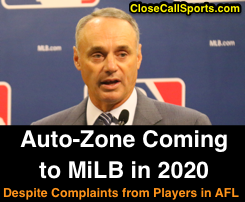
Manfred Vows Robo-Umps in 2020 MiLB as Players Complain About 2019 ABS

Despite negative reviews from Arizona Fall League players of baseball's Automated Ball/Strike System, MLB Commissioner Rob Manfred announced ABS will debut during the 2020 MiLB season...oh, a video with Manfred criticizing robot umpires has been on the internet for a few years now, but is largely unknown and unseen (137 views) and the Commissioner might not want you to watch it, since this same technology he spoke out against in 2017 is now on his priority list for 2020.

Players Object to Robo-Ump: Baseball America grabbed some exit interviews with players about the subject of ABS at the Arizona Fall League's Fall Stars Game with HP Umpire Eric Bacchus simply relaying ABS' balls/strikes messages as other AFL umpires did throughout the developmental minor league postseason...which collectively drew more than a few double-takes, including Jose Navas' ejection of Geraldo Perdomo after an ABS strikeout call at Salt River Fields at Talking Stick (there were other AFL ejections as well, but none on publicly available video).
Related PostComputer Strike Call Prompts Navas' AFL Ejection (10/16/19).

Angels OF Marsh "not a fan" of ABS.
Baseball America described life with ABS in the AFL: "By the end, two things were clear: Pitchers with arsenals geared toward working from the top to the bottom of the strike zone were at a stark advantage, and nobody—neither hitters nor pitchers—was happy with TrackMan."

The article quoted Angels outfielder Brandon Marsh: "Not a fan," and Mariners pitcher Penn Murfee: "Whether it benefits me or not, I'm just coming at it from a baseball purist standpoint. Umpires are back there and they have a job for a reason. It's to manage the calling of the game—why take out one of the biggest pieces of that?"

Said Rays outfielder Josh Lowe, "I think the weirdest part is just the pause from the pitch hitting the catcher’s glove and then the umpire calling it a strike" (see our video on ABS pitch calling delays in the Atlantic League), continuing, "I think I’d rather deal with a human error rather than a computer error. It’s still really tough to get this zone adjusted to everything."
Related VideoAutomated Ball/Strike System Postseason Highlights (9/30/19).

Josh Lowe "rather deal with a human umpire."
Mariners pitcher Raymond Kerr alluded to an oft-referenced Manfred buzzword, pace-of-play: "I don’t like that. It takes away the catcher’s ability to frame, and umpires are delayed on calls. I just think it slows down the game a little bit."

Torre & Manfred Were Against It, Too: 'Robot umpire' is a concept both MLB Chief Baseball Officer Joe Torre and Manfred himself previously criticized—with Manfred going so far as to point out the flaws of tennis' Hawk-eye system as a reason why technology is not better than human umpires.
Related PostTorre Doesn't Want Robot Umpires in MLB (7/26/19).
But something changed in 2019 for Manfred. In 2018, he said his changed position was due to the technology improving ("accuracy is way up"), despite the actual science suggesting the technology had not improved so dramatically...not to mention the 2019 ALPB and AFL experiments essentially confirming the technology's subpar performance.
Related PostManfred Talks Robot Umps - Tech is "Way Up" (5/30/18).

While Torre remained steadfast in his stance ("I'd like the game to stay human...I don't see the robotic strike zone happening"), Manfred jumped ship...seemingly contradicting not just the science, but himself in previous criticism—on video—of using technology to call balls and strikes, and creating a schism between MLB's #1 (Manfred) and #2 (Torre) executives.
Related PostCiting Atlantic Lg, Manfred Ready for Robo-Zone (8/19/19).

Manfred wasn't always a fan of computers.
Manfred told MLB Network, "We have the technology...we need to be ready to use an automated strike zone when the time is right." Considering baseball's plans to introduce said technology in the minor leagues in 2020—one report indicates the Class-A Advanced Florida State League could be a target, due to its stadium's use during MLB Spring Training—Manfred must think "the time is right."

The Umpire Accuracy Video You're Not Supposed to See: About a month before the Sports Illustrated article, "Commissioner Rob Manfred Not in Favor of Moving to Electronic Strike Zone," Manfred appeared on a panel with three other Commissioners—NHL's Gary Bettman, NFL's Roger Goodell, and NBA's Adam Silver—at The Paley Center for Media.

Manfred spoke at a panel of Commissioners.
New York Knicks owner James Dolan speaking from the audience asked Manfred about tennis' Hawk-eye and how baseball can incorporate technology to call balls and strikes ("Why do we have umpires?", generating laughter from the crowd).

Manfred replied, "First of all, let me say, our umpires are really really good at calling balls and strikes, they are...

Let me say something about the tennis technology and then I'll say why it's more difficult in baseball. You should always think about a technology where what they show you as part of the replay is a simulation as opposed to the actual stopped frame, so think about that as you watch tennis and see what conclusion you come to.

During his talk, Manfred said no to robots.
Our strike zone is not a single line on a fixed court. It's a plate, it's three dimensional. The ball passes through the strike zone at different points. We do have a system that we use in broadcast that measures balls and strikes. In all candor, that technology has a larger margin of error than we see with human umpires.

Someday, I think it will be up to the task of calling balls and strikes, but I actually believe that at that point you have to ask yourself a question as to whether you want to take that human element out of the game and replace it with a machine."

Conclusion: For whatever reason (e.g., pressure from teams/fans/owners), Manfred may well believe "that point" has come (despite the mountain of evidence indicating otherwise), and over the past two years, he and Torre (amongst others) have appeared to exhibit a clear disagreement as to the answer of his ultimate question as to the human element.

Will the MLB answer be full automation? A challenge system? Nothing at all? Read on for our Replay Review-inspired challenge system to correct obvious mistakes while acknowledging the computer zone's remaining inaccuracy on border/edge pitches.
Related PostFixing the Strike Zone - Pitch Challenge Proposal (10/28/19).

Video as follows:

2019 UEFL Award for Fill-In Umpire - Jansen Visconti

Jansen Visconti wins UEFL's 2019 Fill-In Umpire of the Year Award [2018 Winner: Jeremie Rehak].
Voting Results (10%+): Visconti (17%), Chris Segal (15%), Nic Lentz (13.7%), Rehak (11.1%).

Award Winner: Jansen Visconti (52).
Sophomore Visconti had no ejections in 2019 despite officiating the most games of any call-up umpire: Visconti worked 142 MLB games during the 2019 regular season, with 2018's Fill-In award winner Jeremie Rehak in second place with 130 games officiated. From there, it was Ryan Blakney (125), Nic Lentz (123), Chris Segal (123), Sean Barber (120), Ramon De Jesus (112), John Libka (106), and Roberto Ortiz (105).

Said Russ, who tracked games worked by all Triple-A call-ups throughout the season, "Working this many games shows how confident the MLB Office is with him...He improved tremendously behind the plate from 2018 to 2019. I also think he had a lot more confidence this season. There were times in 2018 where he looked like a deer in the headlights. Not this year."

Added baseballfollower, "Not flashy, not often noticed and that is meant in the most positive way possible. He is going to be full time soon."

Visconti concluded his season ranked 77th in Replay Review.

UEFL Awards History, Jeremie Rehak
None.

Jansen Visconti now has 3 points in the Umpire Ejection Fantasy League (1 Previous + 2 Award = 3).
The next postseason award, Crew Chief of the Year, will be released Wednesday.

2019 UEFL Award for Most Improved - Eddings & Cooper

Doug Eddings & Eric Cooper win the Most Improved Umpire Award for 2019 [2018 Winner: Andy Fletcher].
Voting Results: Eddings (24.3%), Cooper (10%), Angel Hernandez (5%), Bruce Dreckman (5%).

Doug Eddings and Eric Cooper are the Umpire Ejection Fantasy League's 2019 most improved umpires of the year.

Eddings officiated his first career World Series in 2019, completing a very long-term comeback through the postseason to do so. Back in 2005, Eddings officiated his first League Championship Series between the AL's White Sox and Angels, taking the plate for a fateful Game 2 in which a contested uncaught third strike led not only to a Chicago walk-off victory (Chicago won the series in five games), but a rare postgame press conference with plate umpire Eddings and a subsequent mechanics change for signaling an uncaught third strike.

After the 2005 ALCS controversy, Eddings didn't make it back to the postseason for a full nine years, getting a Wild Card Game in 2014. After that, it would be another four seasons before a trip to the 2018 Division Series and, finally, a call to the 2019 Division Series and World Series.

Eddings' Most Improved nod is truly a story of a long-term comeback, or, as baseballfollower wrote, "It is nice to see Doug back in the postseason and experiencing a career renaissance if you will." Added Sportsmania, "Wow the strides Doug has made has been tremendous. He even made the WS, something we did not expect at all would happen this year or ever. He went from a very poor #2 to a really good one and good for him."

If Eddings' story is characterized by a long-term redemption, Cooper's Most Improved selection could be deemed a quick turnaround. In 2018, Cooper was placed on the Disappointing Season slate for "a very rough season," which also saw his streak of seven consecutive postseason appearances come to a close.

Yet in 2019, Coop returned to form (and to the postseason) and put the 2018 season fully behind him. He started early with an assignment to the MLB Japan All-Star Series in November 2018, where he properly officiated a ground rule out (and possibly just as skillfully explained the call to Don Mattingly).

His journey back into October in 2019 marked his 10th Division Series and a true return to form, making Cooper's death less than a month ago all the more tragic: in the span of a season, he had bounced back—and then some—and regained his status as one of MLB's top umpires.

Said BkSl14812, succinctly, "He was really good this season. RIP."

UEFL Awards History, Doug Eddings
None.

UEFL Awards History, Eric Cooper
Disappointing Season: 2018.

Doug Eddings now has 15 points in the UEFL Standings (14 Previous + 1 Award = 15).
Eric Cooper now has 12 points in the UEFL Standings (11 Previous + 1 Award = 12).
The next postseason award, Fill-In Umpire of the Year, will be released later today.

Monday, November 4, 2019

2019 UEFL Award for Disappointing Season - Rob Drake

The Umpire Ejection Fantasy League's first Postseason Award is for Most Disappointing Season, which this year goes to Rob Drake (30) [2018 Winner: Eric Cooper].
Voting Results (Top 3): Rob Drake (22.7%), Mike Estabrook (20%), Angel Hernandez (14%).

Award Winner: Rob Drake (30).
Pursuant to UEFL Rule 4-4, the UEFL Postseason Awards begin distribution with Most Disappointing Season, below, and continue with Most Improved, Fill-In, Crew Chief, Honorable, Promising, Ejection(s) of the Year and concluding with Umpire of the Year. 171 total ballots were cast during this year's nominations process.

Rob Drake receives the UEFL's 2019 Most Disappointing Season Award.

Although Drake finished the season with 11 overturned calls via Replay Review (tied for fourth-most amongst MLB/MiLB call-up umpires), his two ejections didn't pertain to ball/strike matters (Shane Carle for intentional HBP on 3/31/19 and Mike Shildt for arguing a refusal to grant "time" on 7/4/19), and he encountered unsportsmanlike non-ejection incidents with the Texas Rangers on July 13 and Dodgers on August 27, these alone may not have contributed to Drake's section for this Award.
Related PostChavez Taunts Ump Drake with Glasses Gesture (7/13/19).
Related PostJustin Turner Bumps Umpire Rob Drake at Game's End (8/27/19).

The Most Disappointing Season lists amongst its criteria, "might have had a regrettable incident(s) occur in-season" and for Drake, although he was not selected to officiate the postseason, a social media post during the World Series may well have led to Drake earning a plurality of ballots for this category.

According to media reports, Drake on or about October 22 tweeted on his since-deleted @thedrake30 Twitter account, "I will be buying an AR-15 tomorrow, because if you impeach MY PRESIDENT this way, YOU WILL HAVE ANOTHER CIVAL WAR!!! #MAGA2020."
Related PostRob Drake's Twitter War, Umpires and Social Media (10/24/19).

Drake's October tweet provoked controversy.
Although Drake enjoys Freedom of Speech rights and the ability to practice politics freely as do all United States citizens, the appearance of potential bias posed by a statement from a should-be-neutral-in-public umpire, not to mention the allusion to, as Drake himself wrote in a subsequent apology, "gun violence" (again, those are Drake's words), prompted an ongoing MLB investigation and some impassioned opinions on the matter, including the rare incident that not only may harm one's own reputation, but also has the propensity to tarnish the entire profession.

For instance, Jim in choosing Drake for Most Disappointing Season wrote, "He had a down year, but what did him in was that tweet. I don't care what your politics are, but he really hurt the entire profession with that tweet and in reading the description of this award for 'regrettable incident,' I think this fits the bill. He made ALL umpires look bad."

Seakrait was more concise: "Drake went from consistently making the playoffs to being outside looking in, and that tweet is just a bad look."

UEFL Awards History, Rob Drake
Honorable Umpire of the Year: 2016.

Rob Drake now has 9 points in the UEFL Standings (10 Previous - 1 Award = 9).
The next postseason award, Most Improved Umpire of the Year, will be released Tuesday.

Thursday, October 31, 2019

2019 UEFL Year-End Awards Nominations Open

Nominations for the Umpire Ejection Fantasy League's Postseason Awards have begun—fill out the form to vote for eligible umpires* who, during the past season, have demonstrated significant performances to fit the terms of one of several awards (UEFL Rule 4-4).

Link to Postseason Awards Ballot (also appears below).
a. Umpire of the Year (min. 1 / max. 1 umpire) [+5 pts]
b. Promising Umpire of the Year (min. 1 / max. 2) [+3]
c. Honorable Umpire of the Year (min. 0 / max. 2) [+2]
d. Fill-In Umpire of the Year (min. 0 / max. 1) [+2]
e. Most Improved Umpire (min. 0 / max. 1) [+1]
f. Crew Chief of the Year (min. 0 / max. 1) [+1]
g. Best Ejection of the Year (min. 0 / max. 2) [Link: 2019 MLB Ejections (UEFL Portal)] [+1]
h. Most Disappointing Season (min. 0 / max. 1) [-1]

Click here for the complete history and list of UEFL Postseason Awards recipients

An eligible umpire may be selected for as many or as few awards as you wish; Ballots will be accepted until 11:50 PT on Sunday, November 3, with awards distribution beginning on Monday, November 4.

Triple-A Umpires with at least 115 MLB games officiated in 2019 are eligible to be written in (via comment) for any UEFL Award, in addition to the Fill-In Umpire of the Year award. In 2019, the following call-up umpires officiated at least 115 MLB games and are eligible for write-in: Jansen Visconti (142), Jeremie Rehak (130), Ryan Blakney (125), Nic Lentz (123), Chris Segal (123), Sean Barber (120). Chad Whitson was hired to the MLB staff mid-season and is eligible for all awards except d (Fill-In Umpire of the Year).

Definitions:
a. Umpire of the Year: This Umpire has been the best MLB Umpire the past year, bar none. This Umpire has been more dedicated, professional, and positive than all others. This award will be given to one umpire.
b. Promising Umpire of the Year: This Umpire has been dedicated, professional, and has worked hard. Perhaps a rising star, the Promising Umpire of the Year is an umpire to keep an eye on, for an expectation of great things down the line. Formerly known as Noteworthy Umpire of the Year, this award will be given to one or two umpires.
c. Honorable Umpire of the Year: This Umpire has been the most honorable Umpire during the past year. Perhaps through Community Service, or through struggling with and overcoming his own difficulties, this Umpire has been the most personally admirable of all. This award may or may not be given to either one or two umpires.
d. Fill-In Umpire of the Year: This Umpire has been the best AAA Call-Up Umpire the past year, bar none. This Umpire has been the most dedicated, professional, and positive AAA/Non-MLB Full Time Umpire of all non-MLB Full Time Umpires. This award may or may not be given to a maximum of one umpire.
e. Most Improved Umpire of the Year: This Umpire has improved his overall performance from the previous season more noticeably than any other Umpire. Generally, this umpire has developed into a solid arbiter within the past year. This award may or may not be given to a maximum of one umpire.
f. Crew Chief of the Year: This Umpire has been the best MLB Umpire Crew Chief, the past year, bar none. This Umpire has led his crew(s) better than all others. This award will be given to one umpire.
g. Best Ejection of the Year: In the form of "Ejection 123: Umpire (1)," this award recognizes the best ejection(s) of the year. Nominated and selected due to form, mechanics, entertainment value, reason for ejection, or overall quality, the Best Ejection of the Year is awarded to one or two umpires for one or two specific ejections. The award may be given to one umpire for two separate ejections, in which case, he receives one point for each ejection.
h. Most Disappointing Season: This Umpire has demonstrated a regression in ability, and might have had a regrettable incident(s) occur in-season. The Most Disappointing Season award may or may not be given to a maximum of one umpire.

Video & Ballot as follows:

Wednesday, October 30, 2019

Discussion of 2019 World Series

Welcome to the 2019 #WorldSeries discussion and liveblog at Close Call Sports. We'll list each game's home plate umpire and provide postgame scores, as well as analysis and other commentary pertaining to rules situations and other umpiring elements throughout the World Series.

Alan Porter takes Game 1 of the fall classic for World Series Crew Chief Gary Cederstrom's crew, the full list of which is available at the following link.
Related2019 MLB World Series Umpire Crew Roster.

- 10/22 WAS@HOU Gm 1: Alan Porter: 113/115 Balls + 48/49 Strikes = 161/164 = 98.2%. +3 HOU.
- 10/23 WAS@HOU Gm 2: Doug Eddings: 116/123 Balls + 52/56 Strikes = 168/179 = 93.9%. +5 HOU.

- 10/25 HOU@WAS Gm 3: Gary Cederstrom: 112/116 Balls + 53/56 Strikes = 165/172 = 95.9%. +5 HOU.
- 10/26 HOU@WAS Gm 4: James Hoye: 131/136 Balls + 45/48 Strikes = 176/184 = 95.7%. +0 Nu.
- 10/27 HOU@WAS Gm 5: Lance Barksdale: 96/97 Balls + 41/46 Strikes = 137/143 = 95.8%. +0 Nu.

- 10/29 WAS@HOU Gm 6: Sam Holbrook: 101/102 Balls + 51/56 Strikes = 152/158 = 96.2%. +0 Nu.
- 10/30 WAS@HOU Gm 7: Jim Wolf: 123/125 Balls + 46/52 Strikes = 169/177 = 95.5%. +2 WAS.
Series Complete (WAS Def HOU 4-3): 1128/1177 = 95.8%. +11 HOU.

Note: The highest plate score during the 2018 World Series was Jeff Nelson's 98.3% (WS Gm 5).
The highest plate score during the 2018 Postseason was Joe West's 99.4% (ALCS Gm 3).
The highest plate score during the 2019 Postseason, thus far, is James Hoye's 99.3% (ALDS 4).

Live Blog: Join the CCS Crew for live postseason discussion and analysis (Java required):

World Series Interference - Blame the Rule, not the Umpire

Nationals batter Trea Turner's runner's lane interference, Manager Dave Martinez's argument, and umpire Sam Holbrook's #WorldSeries ejection: here's a comprehensive analysis of the play, the history of baseball's RLI rule, and what Turner could have done differently to avoid this call.

Summary: We have a runner on first with none out. Turner hits a ground ball to Astros pitcher Brad Peacock, who throws toward first baseman Yuli Gurriel as Turner arrives at first base. Gurriel's glove collides with Turner's leg and the baseball winds up hitting Turner's thigh, resulting in HP Umpire Holbrook's call of interference. Martinez is furious and after the half-inning ends, he works himself into a tizzy and is ejected.
Related PostMLB Ejection P1 - Sam Holbrook (3; Dave Martinez) (10/29/19).

An example of RLI during the 2019 season.
Reaction: MLB Chief Baseball Officer Joe Torre says Holbrook got the call right, the media largely says otherwise, and here we are...trying to explain a controversial call to readers who probably have their own strong opinions on the matter and aren't looking to be swayed one way or the other.

Precedent: CloseCallSports.com is full of prior runner's lane interference plays. For instance, Bill Miller ejected Joe Maddon in August 2018 over a properly officiated interference call.
Related PostMLB Ejection 116 - Bill Miller (1; Joe Maddon) (8/10/18).

The Rule: It always helps to start with the rule. So many people fail right out of the box because they never cite the rule, so here it is, Official Baseball Rule 5.09(a)(11): "A batter is out when—In running the last half of the distance from home base to first base, while the ball is being fielded to first base, he runs outside (to the right of) the three-foot line, or inside (to the left of) the foul line, and in the umpire’s judgment in so doing interferes with the fielder taking the throw at first base, in which case the ball is dead."

Sidebar: OBR 5.09(a)(11) Comment states, "The batter-runner is permitted to exit the three-foot lane by means of a step, stride, reach or slide in the immediate vicinity of first base for the sole purpose of touching first base." Be advised that a runner must be within the lane in order to exit it. It is physically impossible to exit something that one has never been in.

Turner would be safe had he run legally.
You'll notice there's nothing about a "direct route" to the base (Joe Buck), or "center of the base" (John Smoltz), "grass" (Buck), or even "allowed to be inside the line for his last step" (Tom Verducci), etc. When talking about a rule, it's generally helpful to cite the rule, so that's what we have done here. Verducci was the closest to getting the rule right, but he forgot one key aspect: a runner is not protected if said runner ran the entire length to first base to the left of (or the right of) the runner's lane.

Translation: This means that Turner could have avoided being called out for interference by doing just one thing: running within the lane at some point during his journey to first base. Replays conclusively indicate he failed to run within the lane at any point, which subjects him to an interference call if the second criterion of the rule is met: "interferes with the fielder taking the throw at first base."


In the mid-1880s, the lane prevented collisions.
Brief History: The three-foot-wide runner's lane at the 45' mark was added to baseball fields in 1882 (National League) and 1884 (American Association), and its purpose was to prevent collisions between batter-runners and first basemen (sound familiar?). This is because in the 19th century, first base was located half in fair territory and half in foul territory. The prevailing logic was that the lane would guide the runner to the foul territory half of the bag, while the fielder would tag the fair territory side, thus preventing injury.

In 1887, first base moved, but the lane stayed.
In 1887, however, the NL and AA agreed to move first and third base 7.5 inches toward second base, so as to place both bases entirely within fair ground—which would make adjudicating fair/foul near the corner bases a whole lot easier.

Yet the runner's lane remained in its foul territory location, and a rule was subsequently adopted to give the batter-runner permission to exit the lane in the vicinity of first base in order to touch the base, which was now entirely in fair territory—to cross over, so to speak.

1B collisions in the present era are rare.
Fast forward to today, collisions between runners and first basemen are exceedingly rare (unless you're Manny Machado), yet the lane and interference rules remain. As former umpire Jim Evans once opined, "Going to first you have the runner's lane, which the runner is supposed to stay in, which I think is really antiquated. The runner's lane violation was to prevent the collisions at first base, not interference with the throw."

Sidebar: Softball solves this problem by having two bases sitting next to each other: one for the fielder and one for the runner.

Interference Analysis: The intriguing part about Turner's interaction with Gurriel is that a minor collision, of sorts, actually did occur in that Gurriel's hand/wrist/glove made contact with Turner in fair territory.

This video analysis is extremely detailed.
Yes, Turner had reason to be in fair territory in the immediate vicinity of first base (to touch it), but he got there illegally—by running to the left of the lane the entire way down the baseline.

To review, here's the first professional rules interpretation from Wendelstedt (Evans agrees, as do all codes): "A runner that is running the entire distance outside of the running lane will not be protected if he interferes with a play at first base, even if it is in his last stride or step to the base. In order to be protected, this last step must be when he first exits the running lane" (recall that in order to exit, one must first be within).

For illustration's sake, here's Evans: "A runner who has advanced the entire distance from home plate to first in fair territory making no effort to run within the lane is not extended the same leniency as the runner who runs in the lane as required and then cuts into fair territory near the base to touch it."

The second concerns the throw: "The determination is not whether the throw is true, but whether it could still reasonably retire the runner."

This throw could have retired the runner.
Because of the contact between Gurriel and Turner, which occurred a fraction of a second prior to the ball arriving at the point of contact, it is ultimately unclear whether the throw would have retired Turner. As such, it can be said that the throw could have reasonably retired him...not that it would have for it might not have, but it could have, and in this situation, the rulebook gives the benefit of the doubt to the fielder because of the runner's violation of the lane rule.

The throw may not have been great, but that isn't the rule...we're not looking for a "true" throw...we're just looking for whether it could have reasonably retired the runner.

In July, a similar play resulted in RLI.
While Gurriel's left arm stretched for the tailing throw, his glove ran into Turner's hip before the ball arrived at the plane even with Gurriel's glove at the point of contact with Turner, which means we'll never know if Gurriel would have caught the ball...but he could have, and that's what breaks the tie.

Similar RLI Call: Here's an example. In July 2019, Chris Segal ejected Jeff Banister for arguing a correctly officiated runner's lane interference call against Rangers batter Carlos Tocci. It was a similar circumstance: the runner advanced the entire distance from home plate to first base in fair territory and not within the lane, the throw was sailing into foul territory, the fielder at first base stretching to receive it, and the ball hit the runner. "Time. That's interference."
Related PostMLB Ejection 090 - Chris Segal (3; Jeff Banister) (7/8/18).

We'll never know if it would have been caught.
Possible Rules Absurdity: Had the exact same interaction between Turner and Gurriel occurred at first base, but instead, Turner had been running legally in the runner's lane the entire time, then Turner would not have been out for interference. In other words, the only difference between being safe and out here is not simply the interference that occurred that occurred at first base, but Turner failing to run in the lane AND also interfering with Gurriel at first base.

Finally, bear in mind that the fact that the runner may have beaten the ball to the base is irrelevant: we're looking for the fielder to catch the ball in front of the base, not waiting for the ball to get to the base itself. The image above illustrates the ball arriving at the point where the fielder's glove ended up while the batter's foot had not yet touched first base.

Whether the rule itself is fine or needs work is a legitimate debate, but this analysis pertains solely to Holbrook's enforcement of the rule and whether this was RLI. Blame the rule, not the umpire, for the umpire is tasked with calling the rule.

Verdict: This is runner's lane interference, Sam Holbrook's call was correct.

One more note: Crew Chief Gary Cederstrom and Holbrook put on the replay headsets to speak with Alan Porter and the MLBAM replay room in New York not for the purposes of reviewing the play (it's not reviewable), but in order to conduct a rules check to ensure the rule was properly enforced. Washington's attempted protest was rejected because a judgment call cannot be protested (the RLI rule clearly states "in the umpire's judgment" while OBR 7.04 states in part, "No protest shall ever be permitted on judgment decisions by the umpire").

Further Reading: For a more comprehensive overview of runner's lane interference and examples of similar plays, refer to the following play from the 2018 World Series in Los Angeles. For reference, both tmac and I had RLI on the 2018 Steve Pearce-Cody Bellinger play linked below and, to be consistent, it would follow that we have RLI here as well. Again, the key is that the runner was illegal the entire time to first base by virtue of failing to run within the runner's lane.
Related PostRunner's Lane Interference - 2018 World Series Edition (10/28/18).

Video as follows:

Tuesday, October 29, 2019

MLB Ejection P1 - Sam Holbrook (3; Dave Martinez)

HP Umpire Sam Holbrook ejected Nationals Manager Dave Martinez (runner's lane interference call; QOCY) in the top of the 7th inning of #Nationals-#Astros #WorldSeries Game 6. With none out and one on (R1), Nats batter Trea Turner hit a 0-0 fastball from Astros pitcher Brad Peacock on the ground to Peacock, who threw to first baseman Yuli Gurriel as Turner arrived, resulting in an interference call and extensive Replay Review as the result of an attempt to protest the game by the Nationals, officially classified as a rules check (RLI is not reviewable), which was disallowed as a result of baseball's longstanding prohibition on protesting judgment calls. Replays indicate Turner failed to run within the three-foot-wide runner's lane the entire distance from the 45-foot mark to first base, while Gurriel failed to catch Peacock's throw as a result of interference from Turner when Gurriel's hand and glove made contact with Turner prior to the ball's arrival at the contact plane, the call was correct.* At the time of the ejection, the Nationals were leading, 5-2. The Nationals ultimately won the contest, 7-2.

This is Sam Holbrook (34)'s third ejection of 2019.
Sam Holbrook now has 20 points in the UEFL Standings (15 Prev + 3 MLB-Post + 2 Correct Call = 20).
Crew Chief Gary Cederstrom now has 19 points in Crew Division (18 Previous + 1 QOCY = 19).
*Official Baseball Rule 5.09(a)(11) states, in part, that a batter is out when—"In running the last half of the distance from home base to first base, while the ball is being fielded to first base, he runs outside (to the right of) the three-foot line, or inside (to the left of) the foul line, and in the umpire’s judgment in so doing interferes with the fielder taking the throw at first base, in which case the ball is dead...The batter-runner is permitted to exit the three-foot lane by means of a step, stride, reach or slide in the immediate vicinity of first base for the sole purpose of touching first base."
^Official Baseball Rule 7.04 states, in part, "No protest shall ever be permitted on judgment decisions by the umpire."
There will be further analysis on this play in a subsequent article.

This is the 218th ejection report of 2019, first of the postseason.
This is the 99th Manager ejection of 2019.
This is the 1st World Series ejection since October 26, 1996 (Tim Welke/Bobby Cox [out call]).
This is Washington's 11th ejection of 2019, 1st in the NL East (WAS 11; PHI 10; ATL 8; MIA, NYM 5).
This is Dave Martinez's 5th ejection of 2019, 1st since Sept 8 (Mike Estabrook; QOC = Y [Balls/Strikes]).
This is Sam Holbrook's 3rd ejection of 2019, 1st since Sept 25 (Scott Servais; QOC = Y [Balls/Strikes]).

Wrap: Washington Nationals vs. Houston Astros (World Series Game 6), 10/29/19 | Video as follows:

Barksdale and Washington's Pitch Skew Problem

Umpire Lance Barksdale's #WorldSeries Game 5 was one of the few games in which pitch skew hasn't favored the Nationals' opponent this postseason (was neutral), but if Washington wants to beat Houston in the pitch skew department, best bench catcher Kurt Suzuki, whose framing quality seems to have declined dramatically as October has worn on. With a hip flexor strain possibly sidelining the Nats' backstop, Yan Gomes could again draw in for Game 6, which makes it more likely for Washington to take its first pitch skew advantage of the postseason...and it's not because the umpires are biased for or against any particular team.

Definition: Pitch skew takes all veritably incorrect ball/strike calls by a home plate umpire and attributes the call to favoring one team or another (e.g., a pitch thrown outside the strike zone called a strike favors the defensive team, etc.). At the end of the game, all favors are added up and a game skew reflects which team benefited from more errors throughout the game. A series skew simply adds up all game skews. Skews of +0 and +1 should be deemed statistically neutral and equivalent, as when an odd number of callable pitch errors exist, skew cannot be 0 and must at minimum be 1. Under this framework, every game caught by Gomes this postseason has been a statistically neutral game.

Washington, on the verge of losing three straight games at home in a best-of-four World Series, seemed rather upset with HP Umpire Lance Barksdale's strike zone during Game 5. Barksdale did indeed miss a crucial strike three call to Nats batter Victor Robles and another ball call with Houston at-bat, but his overall game score was remarkably average and his skew was +0 (neutral rating): the definition of when baseball "evens out."

Barksdale at one point purportedly told Washington catcher Yan Gomes, "you were taking off on me" after Gomes started to run off the field on a two-strike pitch that Barksdale balled. The media ran with it to suggest Barksdale called it a ball because he felt shown up or what have you when Barksdale's comment was rather elementary.

An umpire is taught to see the ball from the pitcher's hand into the catcher's glove/mitt—in basketball, referees call it Start-Develop-Finish. If the catcher jumps up and blocks the umpire before the "finish" stage, the umpire's call is made more difficult—that's why pitches in the strike zone on stolen base attempts are balled at a higher rate...because the umpire couldn't see the ball into the catcher's glove/mitt.

That's what happened here, but the public at large has not one whit of umpiring technique, much less rules knowledge, so the story was spun to one of untoward motives...and this is why umpires don't do postgame press conferences or often speak in public: the spin room isn't umpire-friendly and silence can't be misquoted, especially not after the ongoing Rob Drake debacle.
Related PostRob Drake's Twitter War, Umpires and Social Media (10/24/19).

Despite Barksdale's statistically-confirmed neutrality, fans already frustrated with dropping all three games at home decried a "biased" Game 5 performance (see umpire scapegoating). For a sport with a fanbase and populace so enamored with the concept of computerized umpires and zones, it seems rather ironic yet entirely predictable that these same fans would so quickly shun the computer—which indicates the umpire called an entirely even-handed game—in favor of emotional arguments.

History Repeats Itself: This is extremely similar to what happened when Royals pitcher Mike Montgomery accused Manny Gonzalez of personal bias in a September game against Minnesota. Montgomery, ejected for arguing balls and strikes, called for automated strike zones while claiming that HP Umpire Gonzalez was personally biased against him and gave him "that look like, 'I'm going to screw you.'"

Naturally, we fact checked the entire game and the computer returned a skew of +1...in favor of Montgomery's Kansas City Royals.

Why is it that fans and players who are so passionate about pursuing an electronic strike zone seem to suffer a case of technological illiteracy when the computer statistics don't support claims of bias and unfairness?
Related PostMontgomery Slams Ump Manny, Alleges Personal Bias (9/20/19).

DC's Pitch Skew Woes: I previously spoke of Washington's pitch skew struggles against the Los Angeles Dodgers in the Division Series such that Washington—which won the series—lost the pitch skew war in dramatic fashion to a team whose analytic-minded front office seems to take great pride in blowing out opponents on the pitch skew front, all while losing key postseason baseball games.
Related PostPostseason Pitch Skew - Dodgers Catcher Change (10/11/19).

The Nationals have two catchers: Kurt Suzuki and Yan Gomes. Suzuki's average pitch skew rating this postseason has been -2.9, or a skew of +2.9 pitches in favor of his opponent. Gomes' average pitch skew rating this postseason has been -0.4, or a skew of +0.4 pitches in favor of his opponent.

For instance, after suffering a cumulative pitch skew of -13 through three games of the 2019 World Series with Suzuki catching, Nats Manager Dave Martinez started Gomes for Games 4 and 5, earning a +0 (Neutral) skew for both games.

The following is a table indicating skews for Washington this postseason.

Game Opponent Skew Catcher Opp Catcher
WC Brewers +1 MIL Suzuki Grandal
NLDS 1 Dodgers +1 LA Gomes Smith
NLDS 2 Dodgers +0 Nu Suzuki Smith
NLDS 3 Dodgers +3 LA Suzuki Martin
NLDS 4 Dodgers +6 LA Suzuki Smith
NLDS 5 Dodgers +2 LA Suzuki Smith
NLCS 1 Cardinals +0 Nu Gomes Molina
NLCS 2 Cardinals +1 STL Suzuki Molina
NLCS 3 Cardinals +3 STL Suzuki Molina
NLCS 4 Cardinals +1 STL Gomes Molina
WS 1 Astros +3 HOU Suzuki Maldonado
WS 2 Astros +5 HOU Suzuki Chirinos
WS 3 Astros +5 HOU Suzuki Chirinos
WS 4 Astros +0 Nu Gomes Chirinos
WS 5 Astros +0 Nu Gomes Maldonado
As such, Washington's best bet for finally winning a pitch skew battle would be to start Gomes over Suzuki for the remainder of the World Series.

Video as follows:

Monday, October 28, 2019

Fixing the Strike Zone - Pitch Challenge Proposal

Today we unveil a responsible proposal for fixing the strike zone through technology: not full robot-umpire pitch calling, but a challenge system instead. Tech is coming to baseball and MLB has the opportunity to fix obvious errors while preserving umpire autonomy regarding most aspects of officiating behind home plate. You might think this rather out of left field for us, but we did call ourselves The Left Field Corner all those years ago for a reason.

As we've known for several years, baseball's attempts at incorporating technology for balls and strikes has proven rather frustrating for fans and umpires alike: mostly because teams and fans tend to zero-in on perceived missed ball/strike calls shown on television broadcasts and internet graphics while umpires lament that fans are exposed to a flawed computer system that is subject to a multitude of errors.

Publicly available pitch data exposes teams and fans to statistics suggesting umpires are 91% accurate behind home plate while MLB's evaluations show an average 97% Zone Evaluation score...that creates a disconnect of problems.
Related PostPodcast - Truth About Baseball's Electronic Strike Zone (6/5/19).
Related PostCall for Umpire Accountability & the 97% Plate Score (4/19/19).

On the one extreme are fans demanding fully automated pitch calling, similar to the Automated Ball/Strike System (ABS) attempted in the Atlantic and Arizona Fall Leagues (which resulted in several coach and player ejections for arguing the computer's ball/strike calls...there were additional ejections to those we've highlighted, but unfortunately, they did not feature video).
Related PostComputer Strike Call Prompts Navas' AFL Ejection (10/16/19).
Related PostAtlantic League ABS Robo-Ump Ejection Encore (9/28/19).
Related PostHistory - Baseball's First Ejection Due to TrackMan (7/12/19).

Robots? Torre said no, but Manfred said yes.
On the other are traditionalists seeking to preserve the human element, and somewhere in the middle is Close Call Sports, which acknowledges that technology can assist in the ball/strike call mission, while also acknowledging that the very system baseball presently uses on MLB Gameday, Baseball Savant, Brooks Baseball, PitchCast / Fox Trax / ESPN K-Zone is prone to error.

Umpiring can be an art, while ball/strike analysis is generally a science. Through our proposal, we'll try and strike a balance: preserve the art while incorporating some of the science.

Both sides have to face some facts: For fans, no, a fully-automated system may not be realistic at this time. For umpires, the tech might have reached a breaking point similar to Replay Review before its 2014 expansion. The NBA just adopted a challenge system for some foul calls, the NHL expanded its existing challenge system, and the NFL red flag is famous. Maybe not now, maybe not next year or two, but soon.

MLB Chief Baseball Officer Joe Torre said in 2019, "I don't see the robotic strike zone happening," while MLB Commissioner Rob Manfred stated his motive: "I think an automated strike zone puts you in a position to manage that strike zone. Where should it be exactly to produce the amount of offense that you want?" Theoretically, a computer could be tweaked to only calls strikes between the thighs and belt, for instance, if Manfred wanted to "manage" the zone that way...assuming, of course, a most accurate computer.
Related PostCiting Atlantic Lg, Manfred Ready for Robo-Zone (8/19/19).
Related PostTorre Doesn't Want Robot Umpires in MLB (7/26/19).

Vertical zone error remains an unanswered ?
Proposal: To mediate the discussion, it would follow that a compromise might be at hand: to the robo-ump crowd, there are some elements of the game that computers are unable—proven time and time again—to adjudicate, while to the traditionalist faction, technology exists to help guide us to the concept of correcting "the obvious miss."

As such, we propose a challenge system, which we further break down into one of two options depending on how optimistic you feel about TrackMan (Hawk-eye, going forward)'s ability to adjudicate pitches.

For instance, the Automated Ball/Strike System (ABS) was subject to the following errors:
> Standardization and Radial Error;
> Calibration Error;
> Vertical Strike Zone Error;
> 2D vs 3D Zone Measurement Error;
> Final Approach Error (e.g., pfx is measured at 40 feet [NOT 60 feet]);
> Tracking, Capture, and Margin of Error (1-2 inches per statistics);
> Computer failing to see pitches (fails to register that a pitch was thrown).

Delayed pitch calls remain an issue.
Trajectory Measured by Automated Caller (TMAC): The TMAC system is as black-and-white as you can get and assumes the computerized pitch tracker is 100% accurate at all times and never makes any mistakes. Margin of error is zero, for under TMAC, "error" does not exist. Another way to think of the TMAC system is a computer that after a brief delay calls the pitch on its own, similar to Hawk-Eye in tennis. NOTE: For TMAC to be incorporated at the present time means that baseball would BE REQUIRED to accept inaccuracy, which might be somewhat ironic since the whole idea stems from a fandom unhappy about perceived umpire inaccuracy.

Here are the basics:
> Each team receives 3 challenges per game. Like Replay, a won challenge is retained.
> > The system will declare each challenged pitch to be a Ball or Strike.
> Offense: Only a batter may challenge a call of "strike."
> Defense: Only the catcher or pitcher may challenge a call of "ball."
> For pace-of-play purposes, a challenge must be immediate upon the umpire's call.
> One additional challenge per team for each three extra innings (e.g., +1 in 10th, +1 in 13th, etc.).
> If Hawk-Eye malfunctions or fails to capture the pitch, no challenge is charged (call stands).
> There is no other method for Borderline/Call Stands because the system assumes that the computer is 100% accurate on all pitches that it sees (aka Zero-Error).

> The Atlantic League's ABS experiment turned up quite a number of malfunctions in that the system sometimes failed to capture as many as 50% (possibly even more) of pitches thrown during a given inning. On several occasions, ABS had to be shut off for the night due to poor performance.
Related PostABS Playoff Highlights - Delayed Calls & System Errors (10/1/19).
Related PostALPB - Inconsistent TrackMan Use Riles Coaches (7/22/19).

Robo-Umps: Bringing rivals together since '19.
Graphic Inaccuracy Logic (GIL): The GIL system acknowledges that the computer sometimes makes mistakes on close calls, are occasionally subject to errors, and affords the benefit-of-the-doubt to the umpire. Another way to think of the GIL system is one that operates under the framework of Replay Review in that all calls are Confirmed/Stands/Overturned, with Stands going to the original on-field ruling.

The basic structure of GIL is similar to TMAC, except that "Call Stands" is a realistic outcome if the pitch falls within the UEFL f/x's one-inch margin of error (could be expanded to ML Private/Zone Eval Equivalent's two-inch margin of error, depending on administrative preference). Like Replay Review, a challenge is considered lost if the call stands.

For instance, the GIL system would attempt to account for an error such as vertical zone error—see our work on postgame processing for example—while for the TMAC system to work effectively, no such error can exist.
Related PostPostgame Processing Changes Gibson's Strike EJ QOC (9/21/19).

The question is whether to nitpick or not.
Conclusion: That's our proposal to incorporate technology into the game while acknowledging its shortcomings and accounting for those close calls that the computer cannot decipher. The goal with the challenge proposal is to correct the "obvious miss," similar to what Tony La Russa once said was the original purpose of expanded Replay Review.

The idea with the GIL system is to avoid the level of pedanticism that plagues those out/safe reviews that overturn a safe call to an out call based on slow-motion replay that shows the runner—who clearly beat the throw—broke contact with the base for one-tenth of a second. I wrote about this level of technicality in 2018 (see related post)...but if you don't mind that, and assume the computer is always right, then choose the TMAC system.
Related PostReplay Rewind - Technically Correct or Spiritual Travesty? (6/9/18).

In either event, the goal should be to correct the "that strike was three inches outside" call. If the umpire's was truly an incorrect call by such an amount, as alleged, we'd like to help fix that.

Proposal video as follows: