Saturday, February 23, 2019

All in the Family - Ted & Andrew Barrett Call Cubs Game

Father Ted and son Andrew Barrett (actually, it's "Reverend Doctor Ted") officiated together for the first time at the professional level during Saturday's Brewers-Cubs MLB Spring Training game in the Arizona Cactus League as umpire slots for both HP & 2B ended in "Barrett."

Andrew drew the plate assignment while Ted served as crew chief from the field, starting at second base (in Spring Training, the field umpires rotate every few innings between the three bases). The Barrett family was joined by Tony Randazzo and Pat Hoberg.

Ted and Andrew Barrett hope to join six other father-son umpires in MLB history (five full-time MLBU). They are (dates include time as MiLB fill-in umpires):
> Shag "Henry" & Jerry Crawford (1956-75 and 1976-2010);
> Lou & Mike DiMuro (1963-82 and 1997-present);
> Lou & Ray DiMuro (1963-82 and 1996-98);
> Tom & Brian Gorman (1951-77 and 1991-present);
> Ed, Paul & Brian Runge (1954-70, 1973-97, and 1999-2012);
> Harry & Hunter Wendelstedt (1966-1998 and 1998-present).

Harry and Hunter are the only father-son to have officiated a Major League contest together, which they did during Hunter's call-up season in 1998.

Taking it even a step further, Mike and Lou are the only father-son umpires to both have called an MLB no-hitter from behind the plate (Mike's was a perfect game). Ted Barrett has already called two perfect games from behind home plate.

For the Barretts, this isn't the first similar pro assignment, though it is the first time they've called the same game. Teddy served as home plate umpire and crew chief during the 2018 MLB All-Star Game in Washington, DC while Andrew had the plate for the 2018 California League (Class-A) All-Star Game in California.
Related Post2018 MLB All-Star Game Umpires (7/10/18).

Though Andrew is only in Double-A and thus did not receive a full-MLB Spring invitation, due to all the split squad, early schedule, and plethora of umpires all in the same city, he is one of a handful of young umpires to have the opportunity to call the one-off (or two, or three) MLB Spring Training game, some of which would otherwise have just two assigned umpires.

For instance, while Andrew called the Cubs game in Mesa, other non-invitee umpires who officiated MLB Spring Training games on Saturday included Derek Thomas (NYY-BOS), Sam Burch (STL-MIA), Adam Beck (ATL-NYM), Bryan Fields (CLE-CIN), Reid Gibbs (TEX-KC), Jason Starkovich (CHI-OAK), and Mark Stewart (HOU-WAS).
Wrap: Milwaukee Brewers vs. Chicago Cubs (Spring Training), 2/23/19

Friday, February 22, 2019

Plate Meeting Podcast - Call for ?s - Jim Joyce

As Spring Training gets underway, we're pleased to announce our next guest for The Plate Meeting, a LF Umpire Podcast from CloseCallSports.com. A five-time UEFL Award winner, 30-year AL & MLB veteran Jim Joyce officiated three World Series to go alongside four League Championship and 10 Division Series appearances, in addition to 3,268 regular season games, 73 ejections, and countless signature strike calls, topping several player polls for "best umpire" along the way (and what's this about a Time Magazine Person of the Year nod in 2010?). Submit your questions for Jim here at CCS.

Joyce began his professional baseball career in the 1978 Midwest League, traveling through the Texas and Pacific Coast Leagues before his 1987 American League debut in Oakland. He also saw the Athletics in his final big league game on October 2, 2016.


The Plate Meeting, a Left Field Umpire Podcast is Close Call Sports & Umpire Ejection Fantasy League's official audio forum for umpiring-related issues, including analysis or other conversation pertaining to plays, ejections, rules, and more.

To subscribe to The Plate Meeting, visit our Anchor.fm page, or search for us on Apple Podcasts/iTunes, Spotify, Radio Public, and Google Podcasts.

Follow us on Twitter 🐦 (@UmpireEjections) and like us on Facebook 👍 (/UmpireEjections).

Thursday, February 21, 2019

2019 MLB Spring Training Umpire Roster

The 2019 Spring Training Umpire roster is comprised of 97 umpires, including 76 full-time MLB + 21 minor league call-ups and invitees spread across Arizona's Cactus and Florida's Grapefruit Leagues. This preseason's list features six more umpires than the 2018 Spring Training roster (91 umpires) and five less than the 2017 Spring Training list (102 umpires).

The following roster includes sleeve numbers for all applicable umpires; Minor League Baseball umpires with numbers are deemed Call-Ups and may fill in during the regular season at the Major League level, while MiLB umpires without numbers are the Spring Training invitees and are not yet on MLB's fill-in list.

MLB Spring Training Umpires' Roster - 2019 Pre-Season
MLB StaffMLB StaffMiLB Invitees & Call-Ups
Baker, Jordan 71
Barksdale, Lance 23
Barrett, Lance 94
Barrett, Ted 65
Barry, Scott 87
Bellino, Dan 2
Blaser, Cory 89
Bucknor, CB 54
Carapazza, Vic 19
Carlson, Mark 6
Cederstrom, Gary 38
Conroy, Chris 98
Cooper, Eric 56
Culbreth, Fieldin 25
Cuzzi, Phil 10
Danley, Kerwin 44
Davis, Gerry 12
DeMuth, Dana 32
Diaz, Laz 63
DiMuro, Mike 16
Drake, Rob 30
Dreckman, Bruce 1
Eddings, Doug 88
Emmel, Paul 50
Estabrook, Mike 83
Everitt, Mike 57
Fairchild, Chad 4
Fletcher, Andy 49
Foster, Marty 60
Gibson, Greg 53
Gibson, Tripp 73
Gonzalez, Manny 79
Gorman, Brian 9
Guccione, Chris 68
Hallion, Tom 20
Hamari, Adam 78
Hernandez, Angel 5
Hickox, Ed 15
Hoberg, Pat 31
Holbrook, Sam 34
Hoye, James 92
Hudson, Marvin 51
Iassogna, Dan 58
Johnson, Adrian 80
Kellogg, Jeff 8
Knight, Brian 91
Kulpa, Ron 46
Layne, Jerry 24
Little, Will 93
Marquez, Alfonso 72
Meals, Jerry 41
Miller, Bill 26
Morales, Gabe 47
Muchlinski, Mike 76
Nauert, Paul 39
Nelson, Jeff 45
O'Nora, Brian 7
Porter, Alan 64
Rackley, David 86
Randazzo, Tony 11
Reyburn, D.J. 17
Reynolds Jim 77
Ripperger, Mark 90
Scheurwater, Stu 85
Tichenor, Todd 13
Timmons, Tim 95
Torres, Carlos 37
Tumpane, John 74
Vanover, Larry 27
Wegner, Mark 14
Welke, Bill 3
Wendelstedt, Hunter 21
West, Joe 22
Winters, Mike 33
Wolcott, Quinn 81
Wolf, Jim 28
Additon, Ryan 67
Bacon, John -
Barber, Sean 29
Blakney, Ryan 36
De Jesus, Ramon 18
January, Javerro "JJ" -
Lentz, Nic 59
Libka, John 84
Livensparger, Shane 43
Mahrley, Nick 48
May, Ben 97
Merzel, Dan -
Miller, Brennan -
Ortiz, Roberto 40
Rehak, Jeremie 35
Riggs, Jeremy -
Segal, Chris 96
Tosi, Alex -
Visconti, Jansen 52
Whitson, Chad 62
Woodring, Tom 75

(21 MiLB Umpires)
(76 MLB Umpires)
(97 Total Umpires)

Information obtained by
UEFL on 2/21/2019.
www.closecallsports.com
Some observations, year-over-year:
  • > 2018's roster of 20 MiLBU is comprised of five invitees and 15 regular-season call-up umps.
  • Brennan Miller and Jeremy Riggs (in bold, above) are the only new invitees; JJ January was the only non-call-up to appear on the full-time 2017 Spring Training list.
  • > Umpires who appeared on the 2017 Spring Training MiLB invitee list, were absent from the full-time 2018 list, and are back again in 2019 are: John Bacon, Dan Merzel, and Alex Tosi.
  • > Many other MiLBU will have the opportunity to officiate a few MLB Spring games, but only those on this list are a part of the so-called full-time Spring staff.
  • > All 15 MiLB call-ups from the 2018 season are back again in 2019. No staff changes.

Wednesday, February 20, 2019

2019 UEFL Draft and Registration Now Open

Registration is now open for the 2019 Umpire Ejection Fantasy League season. Draft your UEFL crew today!
MLB Spring Training marks the start of the 2019 Umpire Ejection Fantasy League preseason. This year's registration and draft form is officially open and will be due prior to Opening Day in March (see below for this year's deadlines).

Pursuant to UEFL Rule 1 (Selection of Umpires), you may draft umpires all at once or in phases. After Spring Training has begun, we will release the 2019 UEFL Draft Prospectus, which includes scouting information regarding umpires eligible for selection. The Prospectus will be released at least two weeks prior to the registration deadline.

Relevant Links for the 2019 UEFL Season
2019 UEFL Registration and Draft Form | Free UEFL Digest E-mail Subscription
UEFL Rules Book | 2019 MLB Umpire Crew List | Sortable Umpire Roster & Profiles
Twitter 🐦: @UmpireEjections | Facebook 👍: /UmpireEjections.

Registration and Draft Process
If this is your first time here, welcome! And welcome back to those of you returning. As always, UEFL is a free-to-play league that is open to any person that submits the registration and draft form.

Step 1) To begin, access the 2019 UEFL Registration and Draft Form. You will indicate your desired username and e-mail address (or other unique identifier). In the event that you opt to draft in phases, this unique combination of username and e-mail will serve as verification that you are the same person (e.g., prevents against imposters or draft errors in the event of identical user IDs).

Step 2) Draft 1 Crew Chief, 2 Primary Umpires, and 2 Secondary Umpires, either all at once or in phases up until the deadline. This five-umpire crew will earn the bulk of your points during the upcoming season, though there may be other opportunities to earn points throughout the year via Case Play questions.

Important Note: Crew Chiefs earn points based on the performance of their crew while Primary and Secondary Umpires earn points based on individual performance. In general, an umpire earns points for every confirmed/stands replay review outcome and for every ejection as the result of a correct or irrecusable call, but loses points for every incorrect replay review outcome and for every ejection as the result of an incorrect call. See the accompanying graphics and UEFL Rules 3 and 4 for specific points information.

Step 3) Register for the DISQUS system in order to comment on posts (scroll down to the comments section for the appropriate link to DISQUS). Although guest commenting is enabled, UEFL Rules 4-7 and 6-1 state that only DISQUS-registered users may challenge UEFL rulings. Your DISQUS name must match your UEFL username indicated during registration.

Registration, Draft, and Roster Deadlines:
Tuesday, March 19, 2019: Last day to submit unrestricted umpire selections (CC, PRM & SEC).*
Wednesday, March 27, 2019: Last day to register for the 2019 UEFL (registration closed).
Thursday, March 28, 2019: Traditional Opening Day.

*Because the season's opening series in Japan kicks off on March 20, some umpires may be restricted (e.g., cannot be drafted) after this date. For instance, if an umpire officiating the March 20 game earns points in the league, that umpire will not be eligible for draft. By rule, no umpire may be drafted if that umpire has more than zero points at the time of the draft. Similarly, no umpire may be replaced with any other umpire that has more points than the umpire-to-be-replaced.

Any user who has not selected umpires by Traditional Opening Day will be subject to random assignment (if you wish to take the Quick Pick option voluntarily, simply leave your draft selections blank).

UEFL Appeals Board - UEFL Rule 6-4-a:
This season, there are no vacancies on the UEFL Appeals Board. The 2019 Board is as follows:
Executive Board (x4): Gil (Chair), tmac (Vice Chair), Jeremy (Deputy), RichMSN (Charter).
At Large (x5): Arik G, cyclone14, MarkCanada, jvick2017, MLBUmpireObserver.

Reply here with questions. Submit draft picks and register via the accompanying form:

Tuesday, February 19, 2019

2019 Season MLB Umpire Crews

The 2019 MLB umpire crew list features 76 umpires in 19 crews. The following table is arranged by Chief seniority and may be found on the UEFL Umpire Roster, Profiles & Crews page, which features MiLB call-up information as well as the MLB staff list. UEFL Umpire Profiles are also available for full-time MLBU.

New for this year, we've included a pronunciation guide for all MLB staff and minor league fill-in umpires. Our video trailer for this new feature is available at the conclusion of this article. Information regarding UEFL registration and the 2019 UEFL draft will be available on Wednesday.

2019 MLB Umpire Crews (by Umpiring Crew Chief Seniority)

Crew #Crew ChiefUmpire 2Umpire 3Umpire 4
Crew 112 Davis, Gerry53 Gibson, Greg91 Knight, Brian31 Hoberg, Pat
Crew 232 DeMuth, Dana5 Hernandez, Angel15 Hickox, Ed37 Torres, Carlos
Crew 322 West, Joe56 Cooper, Eric49 Fletcher, Andy93 Little, Will
Crew 438 Cederstrom, Gary51 Hudson, Marvin80 Johnson, Adrian81 Wolcott, Quinn
Crew 524 Layne, Jerry21 Wendelstedt, Hunter19 Carapazza, Vic71 Baker, Jordan
Crew 69 Gorman, Brian6 Carlson, Mark87 Barry, Scott73 Gibson, Tripp
Crew 78 Kellogg, Jeff7 O'Nora, Brian92 Hoye, James90 Ripperger, Mark
Crew 820 Hallion, Tom10 Cuzzi, Phil13 Tichenor, Todd78 Hamari, Adam
Crew 933 Winters, Mike95 Timmons, Tim30 Drake, Rob76 Muchlinski, Mike
Crew 1025 Culbreth, Fieldin39 Nauert, Paul54 Bucknor, CB17 Reyburn DJ
Crew 1165 Barrett, Ted44 Danley, Kerwin23 Barksdale, Lance74 Tumpane, John
Crew 1245 Nelson, Jeff63 Diaz, Laz11 Randazzo, Tony89 Blaser, Cory
Crew 1326 Miller, Bill88 Eddings, Doug16 DiMuro, Mike98 Conroy, Chris
Crew 1427 Vanover, Larry72 Marquez, Alfonso2 Bellino, Dan86 Rackley, David
Crew 1541 Meals, Jerry46 Kulpa, Ron60 Foster, Marty47 Morales, Gabe
Crew 16 57 Everitt, Mike3 Welke, Bill68 Guccione, Chris94 Barrett, Lance
Crew 1750 Emmel, Paul1 Dreckman, Bruce4 Fairchild, Chad83 Estabrook, Mike
Crew 1834 Holbrook, Sam58 Iassogna, Dan28 Wolf, Jim79 Gonzalez, Manny
Crew 1914 Wegner, Mark77 Reynolds, Jim64 Porter, Alan85 Scheurwater, Stu
DL/IR[None]


New MLB Umpires (New Hire MLBU) & Retirements: No staff changes.

Notes and Observations:
≫ Only two crews—#9 (Winters) and #17 (Emmel) are unchanged from 2018.
≫ As occurred in 2018, West swapped all three supporting umpires, reuniting with Fletcher ('17).
Wendelstedt rejoins Layne after a two-year absence (last together: 2016, also: Hickox/DeMuth).

Statistical Promotions or Leftward Lateral Movement:
≫ From Umpire 4 to Umpire 3: Alan Porter (from Miller to Wegner [#4: Scheurwater]).

Statistical Rightward Lateral Movement:
≫ From Umpire 3 to Umpire 4: Cory Blaser (from Cederstrom to Nelson [#3: Randazzo]).

Video as follows:

Monday, February 18, 2019

Manfred: Pitch Clock WILL Debut at Spring Training

When Spring Training begins on February 21, 2019, it will feature a 20-second pitch clock, MLB Commissioner Rob Manfred told reporters a week ahead of baseball's preseason.

Manfred responded to a pace-of-play query by saying, "I'm trying not to be that clear about the pitch clock...this is the point."

The Commissioner continued by explaining his plan for phasing in the use of a clock during live play, asking reporters to wait for an official press release from the league, though Manfred did state the pitch clock would be 20 seconds in duration.

Earlier this offseason, Manfred explained baseball's pace-of-play proposals and other potential rule changes. Those proposals went to the doorstep of Major League Baseball Players Association Executive Director Tony Clark, who as recently as Monday afternoon decried Manfred's negotiations—related to payroll issues—as "unconstructive and misleading at best." Manfred had previously criticized the MLBPA's "negativity."
Related Post2019 Rule Change Proposals - Pitch Clock & NL DH? (2/6/19)

League reaction to the impending pitch clock is mixed. While some managers have compared it to the mound visit limit that MLB'ers quickly adapted to, others, such as Dodgers starter Clayton Kershaw, dismissed the clock: "If I go over it then I go over. I'm not going to change anything I do. I'm not going to pay attention to it one bit, and if it becomes a problem I guess I'll have to deal with it then."

Kershaw then said something that just might make any umpire's skin crawl, regardless of one's stance on the clock: "I think there's ways to fake it...I'm sure there are ways around it."

Teammate Rich Hill was more blunt: "I don't really like it. It's ridiculous."

Video as follows:

Thursday, February 14, 2019

Plate Meeting Podcast - Episode 10 - Rich Garcia

The 10th Plate Meeting podcast episode features 25-year American League veteran umpire Rich Garcia, who joins the show to discuss his officiating career, a major league umpire strike and labor dispute, and his brief foray into the movie business as an umpire in the Kevin Costner-driven film, For Love of the Game.

Rich also had a stint as a broadcast analyst and was on-air for the Kent Hrbek/Ron Gant play in the 1991 World Series. We talk about some ejections—such as Tim Foli over a dispute regarding how the baseballs were rubbed before the game—and also ask Rich if he had any odd plays in right field during his postseason career, and if he ever heard of a guy named Vic Carapazza.

Click the below play (▶) button to listen to "Episode 10 - Rich Garcia Umpired for Love of the Game" or visit the show online at https://anchor.fm/the-plate-meeting. The Plate Meeting is also available on iTunes (Apple Podcasts), Google, Spotify, Stitcher, TuneIn, and several other podcast apps.

Alternate Link: Episode 10 - Rich Garcia Umpired for Love of the Game.

Additional Links, Videos, and Other Media:

The Plate Meeting is brought to you by OSIP, where Outstanding Sportsmanship Is Paramount.

Related Video #1: Hrbek and Gant meet at first base during the 1991 WS (54:00).
Related Video #2: Scene from For the Love of the Game with a cast of MLB umpires (57:00).
Related Video #3: The infamous Jeffrey Maier play and Derek Jeter home run in 1996 (1:11:00).

Donate/Store Buttons
Support the UEFL
Shop the CCS Store.
Follow us on Twitter 🐦 (@UmpireEjections) and like on Facebook 👍 (/UmpireEjections).

Tuesday, February 12, 2019

Tmac's Teachables - Snap Pickoff at First Base

It's time for another Tmac Teachable brought to you by the good folks at ProUmpireCamp.com! Today's retro moment features 1B Umpire Bill Kunkel's ejection of Twins runner Mike Cubbage and Manager Gene Mauch over a back-pickoff play that retired Cubbage at first base. What angle should umpires take to receive such a play and how should officials respond to a runner who acts as Cubbage did?

Before we dig in, Pro Umpire Camp is the only three-person camp that will have college assignors and supervisors from the Atlantic League, Can-Am League, and the American Association. Whether you're just trying to learn three-man or looking to be seen this camp is a great place to start!

It's important to remember a couple items as we dig into this edition, and this ejection. First, we are looking at this play from a 2019 prism. We're not focused on the judgement of the call, but rather how in today's world we can get this play right. Today's officials are: HP Umpire Al Clark; 1B Umpire Bill Kunkel; 2B Umpire Bill Deegen; and 3B Umpire Terry Cooney. This is the second game of a doubleheader.

1B Umpire Kunkel officiates the pickoff play.
On our upcoming podcast with American League veteran Rich Garcia, we talk about Kunkel and Cooney. In our situation today, we have runners on first and second and one out. The pitch is a swing and a miss and there is a back pick to first base. Our goal is to have the glove coming at us so we're going to want to be to the side Kunkel is on, but from an angle standpoint we want to be able to see the tag and the front of the bag that the runner is sliding into, so our best spot is probably a couple steps into foul territory toward the back edge of the bag.  If we are engaged with the moves of our first baseman this will be easy.

As fans of the Teachables know, I'm a proponent for getting your nose into a play like this, but we always suggest doing what makes your assignor happy. Most good assignors are happy when we get this play right in the three- and four-umpire system.

Cubbage and Mauch outnumber the umpire.
So now that we know where we should be (foul ground, not moving if possible), reading the first baseman's movement, what about the aftermath? Well, once Mike Cubbage, the player who was called out, is ejected for launching his helmet, the crew chief needs to get him out of there. It's a near certainty that the Manager (or head coach as the case may be) will be visiting shortly.  If the crew chief is involved in the call the "two" on the crew (aka backup crew chief) needs to get into the action and help lead Cubbage to the dugout. This is especially the case if no other coaches or players are helping.

Now it gets tricky. The manager of the Twins, Gene Mauch, immediately makes contact with Kunkel and is summarily ejected.

The tantrum continued in the Twins dugout.
Now, all umpires need to be engaged with the situation.  Once contact is made it's all hands on deck. Kunkel, a former MLB pitcher, whose son also played in MLB, handles himself well here. I could do without the wave off, but under the circumstances I understand. Also, while the announcers were mostly fair, did you head one of them say it was a delayed call? Didn't look delayed to me! At least not nearly as delayed as the time we had to wait to resume play after Minnesota littered the field with bats.

As we get ready to either watch baseball (if you're stuck in the cold), or head on the field, a few simple reminders: Read the rulebook—don't be the guy who doesn't know the rules! Second, be engaged! It's really hard, especially in rough weather to stay focused. Third, always think about the next possible play and be sure to be ready! Finally, have fun—you're umpiring a baseball game!  What's better than that?! Until next time, Happy Umpiring Everyone!

Monday, February 11, 2019

Pitcher Spins Away from Batter - Legal Delivery?

NOC Tonkawa junior college pitcher Trevin Michael's unique windup and delivery has spurred discussion as to its legality as, with his right foot in contact with the pitcher's plate, he spins 360° and away from the batter before throwing the pitch. Is this a balk or a legal maneuver?

The following discussion is broken down into three levels of baseball: we'll start with the professional level and OBR, move to NCAA—college, and conclude with NFHS—high school.

Michael's Move: First and foremost, before the rules discussion, let's begin by stipulating what, exactly, our pitcher is physically doing. He begins with his right foot (pivot foot) on the pitcher's plate and his left foot (free foot) in front of and to the left of the plate. He begins the delivery by taking a diagonal step back with his free foot, which lands behind the rubber, then rotates on his pivot foot, which may or may not break contact with the pitcher's plate as he spins on it. As he completes his 360-degree spin, his pivot foot parallels the front edge of the rubber while his left leg kicks out and he throws his pitch. The pitching hand stays in contact with the ball the entire time.

Immediate Disqualifier: If your interpretation is that the pitcher's pivot foot has broken contact with the pitcher's plate by virtue of the pitcher jumping in mid-air so as to assist his spinning action, this move is illegal under all codes. Your work is done. Otherwise, read on...

OBR: The Official Baseball Rules for the pros (and Little League) authorize Windup and Set positions, and we see a pitcher working out of Windup here: "The pitcher shall stand facing the batter, his pivot foot in contact with the pitcher’s plate and the other foot free...He shall not raise either foot from the ground, except that in his actual delivery of the ball to the batter, he may take one step backward, and one step forward with his free foot."

OBR 6.02(a)(5) is the "illegal pitch" balk, and Rule 5.07(a) Comment states, "The pitcher may not take a second step toward home plate with either foot or otherwise reset his pivot foot in his delivery of the pitch. If there is a runner, or runners, on base it is a balk under Rule 6.02(a); if the bases are unoccupied it is an illegal pitch under Rule 6.02(b)."
Related PostCarter Capps Throws Illegal Pitch, Ejected After Hitting Ump (6/26/17).

SIDEBAR: As for twirling around, even with his back to the batter, we know from the days of Hideo Nomo that this, on its own, is a legal move. Naturally, Nomo maintained a legal pivot foot during this motion. We also stipulate this is Michael's natural movement, which he is not interrupting nor altering. If this is coming out of the blue on his 50th pitch of the game, we can deem it unnatural, but if this is what we see as the first pitch of the game, it pretty much establishes this as a natural move.
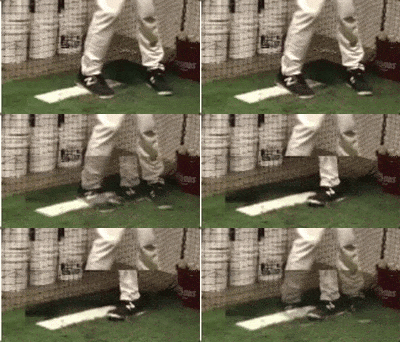
Does F1 "reset" his pivot foot?
Take a look at the accompanying animated GIF: Has Michael "reset" his pivot foot? If all the pitcher has done is rotated his pivot foot, or spun on the foot, then he is legal. If he has actually hopped on his foot or "reset" it, then we have a balk. This is no Carter Capps crow-hop, and it appears our pitcher is doing his best to maintain contact with his plate using the toe of his pivot foot. If he executes it correctly in this manner, his move is legal under OBR.

NCAA: Prepatory to the pitch, the college book wants the free foot "touching or behind (breaking) the plane of the front edge of the pitcher's plate." That suggests Michael's free foot, in front of the front edge, is illegal (penalty: illegal pitch if no runners are on base, or, a balk if runners). But let's assume Michael can easily correct this issue of pre-pitch free foot placement—let's talk about the delivery itself.

NCAA is better than MLB about the "reset" of the pivot foot rule. Unlike OBR, NCAA doesn't actually use "reset" language and instead states in 9-1-a-8, "The pitcher shall not take a forward step with the pivot foot in using the windup delivery. This is commonly known as 'running into the pitch' and is an illegal pitch."

NCAA also makes reference to "habitual" motion (e.g., 9-1-a-2's "the pitcher shall pitch to the batter immediately after making any motion with any part of the body such as the pitcher habitually uses during the delivery," which also appears in balk rule 9-3-g). This means that if he does it every windup, we're good. If he just brings this move out occasionally for shock value, then it's illegal.

NFHS: The National Federation rules committee just elected (for 2018-19) to eliminate the requirement that the pitcher's entire pivot foot be in contact with the pitcher's plate, as in 6-1; otherwise, this move would be highly illegal. THAT SAID, Wind-up Position Rule 6-1-2 requires that before starting delivery, "The pitcher’s non-pivot foot shall be in any position on or behind a line extending through the front edge of the pitcher’s plate" (similar to NCAA). The reason for this is that 6-1-3, pertaining to Set Position, requires that the non-pivot foot be placed in front of the front edge of the pitcher's plate (NFHS wants a clear difference between the two). These rules make Michael's move illegal at the high school level (penalty: ball is dead & a ball is added to the count if no runners are on base, or, a balk if runners).

Video as follows:

Wednesday, February 6, 2019

2019 Rule Change Proposals - Pitch Clock & NL DH?

MLB, led by Commissioner Rob Manfred, and the Players Association, have discussed various rules proposals and changes, including a handful of pace-of-play measures (the pitch clock idea is back, as is a batters-faced minimum) and a universal designated hitter for both National and American Leagues. The proposal sheet also features several hypothesized changes to rosters, draft, and trade procedures meant to reward winners and punish losers.

According to The Athletic, Baseball has proposed the following rules changes (I've arranged them by type of change):

Pace of Play
> 20-second pitch clock with no runners. At this point, the pitch clock is a pace-of-play broken record as Manfred seemingly proposes this every year and the MLBPA rejects it every time. In 2018, MLB implicitly and unofficially floated the possibility that Manfred could use a provision of the CBA with the union to override the players' veto. Naturally, this did not happen and no pitch clock was used in the majors. That said, the pitch clock remains a standard gameplay device in Minor League Baseball.
Related PostPlayers Reject Pace of Play Proposal, Override Probable (1/19/18).
Related PostMinor League Baseball Issues 2018 Pace of Play Rules (3/14/18).

MLB wants to further limit mound visits.
> Pitchers must face a minimum of three batters OR end an inning. The idea here is to prevent bullpen use of one-batter specialists and require pitchers to be worth their while through a three-batter (or end-of-inning) requirement. Succinctly, if a team brings in a new pitcher (or the starter throws a pitch to the first batter he faces), under this proposed rule, that pitcher will have to not only face that batter, but two additional batters as well, unless the team gets a third out and ends the inning before the third batter, in which case, the pitcher is relieved of the three-batter requirement. This rule would allow for very narrow exceptions, including injury.

> Reduction in Mound Visits from Six to Five. In 2018, MLB introduced a mound visit limit of six per game, designed to prevent habitual time-wasting by catchers who routinely would meet with their pitchers. The 2019 proposal thus further cracks down on mound visit limits by taking the number from six to five. Umpires would still be authorized to permit an excess visit under limited circumstances.
Related Post2018 Pace of Play Changes Limit Mound Visits, No Clock (2/19/18).

> Extra Inning Tie-Breaker Rule (Pre-Placed Runner at Second Base). After a 2017 test run in the Arizona and Gulf Coast Leagues, Minor League Baseball in 2018 adopted the extra inning tie-breaker rule throughout its Rookie-to-Triple-A leagues. Now, MLB wants to bring this overturn speed-up rule to the bigs—but not yet to the regular and post-season. MLB wants to adopt this rule specifically for Spring Training and the All-Star Game...for now.
Related PostMinor League Baseball Issues 2018 Pace of Play Rules (3/14/18).

P/DH Shohei Ohtani could get NL work.
Additional Gameplay Rules
> Universal DH. This rule would allow National League clubs to make use of the Designated Hitter in NL ballparks, essentially an attempt to inject more offense into a game that has been decried for its lack of excitement.

> Expansion of Rosters from 25 to 26 players, and maximum of 12 pitchers. This gives the MLPA something they'd like (expanded rosters), while giving MLB something it would like (limit on pitchers). If combined with the three-batters-per-pitcher-minimum requirement, the idea is that teams would have no reason to add more than 12 pitchers to the roster in the first place, making the 12-pitcher maximum a redundancy more than a rule.

MLB wants to punish perennially losing teams.
> Single Trade Deadline Before All-Star Break. Instead of a July 31 trade deadline and August 31 waiver-trade deadline, MLB wants to combine the transactions date into one overall trade deadline before the All-Star Game.

> Draft Penalty for Losing Teams, Reward for Winning Teams. This would change the draft order for the purpose of rewarding teams that win by offering them greater draft position, while punishing teams that habitually lose by penalizing them in the draft...this proposal is very much the opposite of what other sports, such as basketball or hockey, do with their drafts. MLB believes that by punishing teams that lose, the teams will respond by winning games.