Public Service Announcement time for umpires: MLB will host a free one-day Umpire Camp/clinic August 18 at Minute Maid Park in Texas, home of the Houston Astros.
The League has a registration form available for this MLBUC, at this link, but even if you don't pre-register, walk-ups are always welcome.
For aspiring professional umpires, the MLB Umpire Camps offer the potential for an invitation to the MLB Professional Mini-Camp in Florida, which in turn offers its highest prospects scholarships to umpire school—either Wendelstedt's or MiLB's Academy.
In 2017, 22 MLB Umpire Camp clinic participants received invites to Mini-Camp and 10 of the Mini-Camp attendees received scholarships to school. Over the course of the program, which dates back to 2006, MLB says that 130 Umpire Camp (clinic) attendees have advanced to work in professional baseball.
To register for the August 18, 2018 clinic in Houston, click here.
Tuesday, July 17, 2018
Monday, July 16, 2018
Future MLB Hiring Outlook at the 2018 Break
As in 2017, MLBUmpireObserver takes a look at the Triple-A call-up umpire slate at the 2018 All-Star Break and, alongside Russ's stats, puts together a scouting report from the up-and-down farm that is the Minor League fill-in roster. Umpires are ranked by how many games they have worked in 2018, Opening Day through the mid-July All-Star Break.
Tier 1 - Most Likely to Be Hired
Nic Lentz - (214 games in 2 years + 86 games in 2018)
MLUO: He has worked in the big leagues almost all year. I expect him to be either 3rd or 4th to be hired.
Chris Segal - (372 games in 4 years + 83 games in 2018)
MLUO: I believe he will be full time next year. The only thing I worry about is that he has been passed over a few times by the league.
Chad Whitson - (191 games in 4 years + 76 games in 2018)
MLUO: The league is high on him with almost a semi-permanent assignment on Gorman’s crew. I expect him to be 3rd in line to get hired this offseason but he and Lentz are really close to each other.
Ryan Blakney - (349 games in 3 years + 72 games in 2018)
MLUO: He has worked with Holbrook’s crew almost the entire season. He reminds me of Scheurwater last year with a semi-permanent crew assignment. I think he is the next umpire to be hired Full time.
Tier 2 - Waiting in the Wings
Tom Woodring - (299 games in 4 years + 61 games in 2018)
MLUO: He has been up most of the year which is a good sign for him.
Jeremie Rehak - (Rookie + 58 games in 2018)
MLUO: Look for him to keep getting more games, and possibly jump to the top of the list at this point next year. He has the look of a MLB umpire out on the field.
Ben May - (291 games in 4 years + 52 games in 2018)
MLUO: I expect him to not get hired this offseason but looking positive for 2020.
Tier 3 - Middle Ground
Sean Barber - (284 games in 4 years + 52 games in 2018)
MLUO: I feel the league could go either way on him. He has seen some action this year and he will be back next year but I think it will take a lot of turnover to get him a job.
Roberto Ortiz - (74 games in 2 years + 50 games in 2018)
MLUO: I still don’t know where the league will go with him. He could easily go either way.
Jansen Visconti - (Rookie + 50 games in 2018)
MLUO: I almost forgot about Jansen because he has had such a quiet year this year despite getting some very favorable assignments as a rookie. He has a bright outlook in the next few years.
Ramon De Jesus - (178 games in 2 years +29 games in 2018)
MLUO: I at one point thought he would be a front runner for this upcoming offseason but he has obviously falling from number one as he only has 20 some games at the all star break.
Nick Mahrley - (31 games in 1 year +24 games in 2018)
MLUO: I feel like we will need to see more of him next season to figure out how MLB will react to him.
Tier 4 - Caution
Ryan Additon - (55 games in 1 year +20 games in 2018)
MLUO: Very slow start to the year but has picked up. Hopefully he isn’t hurt by the Donnie Baseball curse but I fear he has been.
Shane Livensparger - (40 games in 1 year +18 games in 2018)
MLUO: I expected him to get more games as he was made a rover this season, but the league hasn’t used him very much but I think after this year and a few retirements he will get a look next season.
John Libka - (19 games in 1 year +17 games in 2018)
MLUO: I thought he was on the outside looking in after having 3 calls overturned in a game last year but has gotten some work lately.
Gil's Take: When MLUO put together this year's list, the names were tiered without regard to the number of games each umpire has worked thus far in 2018. Suffice it to say, MLUO's four tiers are accurately reflected in the number of games each call-up has received thus far this season: Segal as the most experienced umpire on the list appears to have the most promise, alongside Whitson, Blakney, and Lentz, followed by Tier 2, whose members have gotten a healthy dose of work thus far.
It is notable that both rookies (Rehak and Visconti) have gotten significant work this year, which bodes well for both as long as they continue to impress at the MLB level. Some of Rehak's situation handling, in particular, has been quite impressive for a newcomer to the big leagues.
On the flip side, we have Additon, Livensparger, and Libka in MLB's proverbial hot seat, with Libka perhaps the umpire who has the greatest opportunity for growth due to how few games he has officiated in the majors, compared to the others. Yes, he had three calls overturned in a game, but if that was the only criterion for MLB work, there might well be a few veteran full-timers out of a job right now.
In all, an umpire likely needs at least 50 games at the major league level before a more substantial opinion can form; the only question is with such talent waiting to surface, will there be enough time?
As far as "time's running out" is concerned, just Barber, May, Segal, Whitson, and Woodring are on call-up year #5 (Blakney's on year #4). In the end, it might very well depend on retirements at the full-time level: this year has produced many MiLB opportunities to work MLB games due to various injuries and surgeries, so it will be interesting to see how that carries over year-to-year. If it translates to retirements, that means more time for everyone and, obviously, a greater number of hires over the winter.
*Segal and May have both worked a suspended game not yet completed, which is not accounted for in the above number of games officiated thus far in 2018.
![]() |
| Nic Lentz has worked the most in 2018. |
Nic Lentz - (214 games in 2 years + 86 games in 2018)
MLUO: He has worked in the big leagues almost all year. I expect him to be either 3rd or 4th to be hired.
Chris Segal - (372 games in 4 years + 83 games in 2018)
MLUO: I believe he will be full time next year. The only thing I worry about is that he has been passed over a few times by the league.
Chad Whitson - (191 games in 4 years + 76 games in 2018)
MLUO: The league is high on him with almost a semi-permanent assignment on Gorman’s crew. I expect him to be 3rd in line to get hired this offseason but he and Lentz are really close to each other.
Ryan Blakney - (349 games in 3 years + 72 games in 2018)
MLUO: He has worked with Holbrook’s crew almost the entire season. He reminds me of Scheurwater last year with a semi-permanent crew assignment. I think he is the next umpire to be hired Full time.
Tier 2 - Waiting in the Wings
Tom Woodring - (299 games in 4 years + 61 games in 2018)
MLUO: He has been up most of the year which is a good sign for him.
Jeremie Rehak - (Rookie + 58 games in 2018)
MLUO: Look for him to keep getting more games, and possibly jump to the top of the list at this point next year. He has the look of a MLB umpire out on the field.
Ben May - (291 games in 4 years + 52 games in 2018)
MLUO: I expect him to not get hired this offseason but looking positive for 2020.
Tier 3 - Middle Ground
Sean Barber - (284 games in 4 years + 52 games in 2018)
MLUO: I feel the league could go either way on him. He has seen some action this year and he will be back next year but I think it will take a lot of turnover to get him a job.
Roberto Ortiz - (74 games in 2 years + 50 games in 2018)
MLUO: I still don’t know where the league will go with him. He could easily go either way.
Jansen Visconti - (Rookie + 50 games in 2018)
MLUO: I almost forgot about Jansen because he has had such a quiet year this year despite getting some very favorable assignments as a rookie. He has a bright outlook in the next few years.
Ramon De Jesus - (178 games in 2 years +29 games in 2018)
MLUO: I at one point thought he would be a front runner for this upcoming offseason but he has obviously falling from number one as he only has 20 some games at the all star break.
Nick Mahrley - (31 games in 1 year +24 games in 2018)
MLUO: I feel like we will need to see more of him next season to figure out how MLB will react to him.
Tier 4 - Caution
Ryan Additon - (55 games in 1 year +20 games in 2018)
MLUO: Very slow start to the year but has picked up. Hopefully he isn’t hurt by the Donnie Baseball curse but I fear he has been.
Shane Livensparger - (40 games in 1 year +18 games in 2018)
MLUO: I expected him to get more games as he was made a rover this season, but the league hasn’t used him very much but I think after this year and a few retirements he will get a look next season.
John Libka - (19 games in 1 year +17 games in 2018)
MLUO: I thought he was on the outside looking in after having 3 calls overturned in a game last year but has gotten some work lately.
Gil's Take: When MLUO put together this year's list, the names were tiered without regard to the number of games each umpire has worked thus far in 2018. Suffice it to say, MLUO's four tiers are accurately reflected in the number of games each call-up has received thus far this season: Segal as the most experienced umpire on the list appears to have the most promise, alongside Whitson, Blakney, and Lentz, followed by Tier 2, whose members have gotten a healthy dose of work thus far.
It is notable that both rookies (Rehak and Visconti) have gotten significant work this year, which bodes well for both as long as they continue to impress at the MLB level. Some of Rehak's situation handling, in particular, has been quite impressive for a newcomer to the big leagues.
On the flip side, we have Additon, Livensparger, and Libka in MLB's proverbial hot seat, with Libka perhaps the umpire who has the greatest opportunity for growth due to how few games he has officiated in the majors, compared to the others. Yes, he had three calls overturned in a game, but if that was the only criterion for MLB work, there might well be a few veteran full-timers out of a job right now.
In all, an umpire likely needs at least 50 games at the major league level before a more substantial opinion can form; the only question is with such talent waiting to surface, will there be enough time?
As far as "time's running out" is concerned, just Barber, May, Segal, Whitson, and Woodring are on call-up year #5 (Blakney's on year #4). In the end, it might very well depend on retirements at the full-time level: this year has produced many MiLB opportunities to work MLB games due to various injuries and surgeries, so it will be interesting to see how that carries over year-to-year. If it translates to retirements, that means more time for everyone and, obviously, a greater number of hires over the winter.
*Segal and May have both worked a suspended game not yet completed, which is not accounted for in the above number of games officiated thus far in 2018.
Labels:
Articles
,
UEFL
,
Umpire Odds/Ends
Sunday, July 15, 2018
MLB Ejection 098 - Ryan Additon (1; Eduardo Escobar)
HP Umpire Ryan Additon ejected Twins 3B Eduardo Escobar (inciting a bench-clearing incident after warnings; QOCU) in the bottom of the 7th inning of the Rays-Twins game. With two out and one on (R3), Rays pitcher Diego Castillo balked home Twins baserunner R3 Brian Dozier before throwing low and inside to batter Escobar, resulting in a bench-clearing incident, after which warnings were issued. Following a called third strike to end the inning, Escobar engaged with the Rays dugout, resulting in a second bench-clearing incident and Escobar's ejection from the game. At the time of the ejection, the Twins were leading, 5-4. The Twins ultimately won the contest, 11-7, in 10 innings.
This is Ryan Additon (67)'s first ejection of 2018.
Ryan Additon now has 1 point in the UEFL Standings (-1 Prev + 2 AAA + 0 Irrecusable Call = 1).
Crew Chief Jeff Kellogg now has -5 points in Crew Division (-6 Previous + 1 Irrecusable Call = -5).
This is the 98th ejection report of the 2018 MLB regular season.
This is the 48th player ejection of 2018. Prior to ejection, Escobar was 0-3 (2 SO) in the contest.
This is Minnesota's 3rd ejection of 2018, T-3rd in the AL Central (CWS, KC 4; DET, MIN 3; CLE 1).
This is Eduardo Escobar's first career MLB ejection.
This is Ryan Additon's first ejection since September 15, 2017 (Don Mattingly; QOC = Y [BOO]).
Wrap: Tampa Bay Rays vs. Minnesota Twins, 7/15/18 | Video as follows:
Labels:
Eduardo Escobar
,
Ejections
,
Fights
,
MIN
,
QOCU
,
Ryan Additon
,
UEFL
,
Unsportsmanlike-NEC
Hirschbeck Bobblehead Latest Minor League Ump Promo
Operating in smaller markets with shoestring budgets, MiLB teams have to be creative to survive. Enter the Class-A Short Mahoning Valley Scrappers, who held a John Hirschbeck Bobblehead Giveaway over the weekend, honoring an umpire from Poland, Ohio (Cleveland is Mahoning Valley's MLB parent team) who retired from the majors following the 2016 season.
The John Hirschbeck bobblehead, given to the first 1,000 fans that attended Saturday's Scrappers game at Eastwood Field, is hardly the first minor league promotion to honor umpires—last season, the Charleston RiverDogs held "Umpire Appreciation Night" during which the Class-A squad from South Carolina gave away 1,000 "bobble-wrists" of an umpire cleaning home plate—but it highlights a key aspect of baseball business, especially at lower levels.
Because minor and independent league teams operate with smaller fanbases and with smaller budgets (hence, only 1,000 items are given away), these clubs must reach out beyond the traditional baseball market to draw in customers.
What this means is while big league clubs can more-or-less afford to coast on the backs of big-market casual fans, big-name sponsors, and popular culture trends de jour, minor and independent league teams have to (1) seek out dedicated baseball folks and/or (2) create their own markets.
Thus, the idea of Umpire Appreciation Night—and the umpire honors go back decades, from Arlington's night honoring NL umpire Frank Walsh (1961-63) for his service, to Bill Haller's Joilet Jackhammers bobblehead, to Bob Motley's bobblehead at the Negro Leagues Museum, to Bruce Froemming's 2013 bobblehead from the Northwoods League's Lakeshore Chinooks, to this Orioles bird umpire bobblehead that must be modeled after Mike Estabrook (due to the plastic helmet atop the bird's head)—takes advantage of a very simple fact: umpires are dedicated to baseball and genuinely enjoy the game.
Related Post: MLB History: A Familiar Conflict of Interest (7/14/12).
Though many fans—especially at the popular-to-the-point-of-ignorance MLB level—might say otherwise, the underlying reason why Ump Night exists in the minors is because umpires comprise a key faction of baseball fans that support small-town ball at a level significant enough to merit acknowledgement and thanks.
Yet by the time the game grows to the level of a 40-to 50,000 seat stadium and high-priced regional sports network television deals, the proportion of these hardcore baseball fans—umpires and non-umpires alike—drops dramatically, replaced by the more casual fan that cares not for the intricacies of the game, but simply, whether one's preferred team has won or lost, or even, whether a gambling bet has proven lucrative or costly.
When small town sport is replaced by big market business, appreciation often is lost in translation. It's just a game, after all.
Related Post: Gambling Ban Reversal Has Joe West Scared "to Death" (5/17/18).
![]() |
| John Hirschbeck bobblehead in Single-A. |
Because minor and independent league teams operate with smaller fanbases and with smaller budgets (hence, only 1,000 items are given away), these clubs must reach out beyond the traditional baseball market to draw in customers.
What this means is while big league clubs can more-or-less afford to coast on the backs of big-market casual fans, big-name sponsors, and popular culture trends de jour, minor and independent league teams have to (1) seek out dedicated baseball folks and/or (2) create their own markets.
Related Post: MLB History: A Familiar Conflict of Interest (7/14/12).
![]() |
| Bruce Froemming at his bobblehead night. |
Yet by the time the game grows to the level of a 40-to 50,000 seat stadium and high-priced regional sports network television deals, the proportion of these hardcore baseball fans—umpires and non-umpires alike—drops dramatically, replaced by the more casual fan that cares not for the intricacies of the game, but simply, whether one's preferred team has won or lost, or even, whether a gambling bet has proven lucrative or costly.
When small town sport is replaced by big market business, appreciation often is lost in translation. It's just a game, after all.
Related Post: Gambling Ban Reversal Has Joe West Scared "to Death" (5/17/18).
Labels:
Articles
,
Gil's Call
,
John Hirschbeck
,
News
,
UEFL
,
Umpire Odds/Ends
Saturday, July 14, 2018
MLB Ejection 097 - Greg Gibson (2; Brandon Belt)
3B Umpire Greg Gibson ejected Giants 1B Brandon Belt (check swing strike three call) in the bottom of the 4th inning of the Athletics-Giants game. With one out and two on (R1, R2), Belt attempted to check his swing on a 2-2 curveball from A's pitcher Yusmeiro Petit, ruled a ball by HP Umpire Vic Carapazza and a swinging third strike on appeal by 3B Umpire Gibson. Play reviewed and adjudicated by the UEFL Appeals Board (5-4-0), the call was correct. At the time of the ejection, the Giants were leading, 3-2. The Athletics ultimately won the contest, 4-3.
This is Greg Gibson (53)'s second ejection of 2018.
Greg Gibson now has 2 points in the UEFL Standings (-2 Prev + 2 MLB + 2 Correct Call = 2).
Crew Chief Greg Gibson now has 6 points in Crew Division (5 Previous + 1 Correct Call = 6).
This is the 97th ejection report of the 2018 MLB regular season.
This is the 47th player ejection of 2018. Prior to ejection, Belt was 0-3 (SO) in the contest.
This is San Francisco's 5th ejection of 2018, T-3rd in the NL West (LAD, SD 6; ARI, SF 5; COL 4).
This is Brandon Belt's first ejection since July 15, 2016 (Mike Estabrook; QOC = Y [Balls/Strikes]).
This is Greg Gibson's 2nd ejection of 2018, 1st since June 23 (Brandon Hyde; QOC = U [USC-NEC]).
Wrap: Oakland Athletics vs. San Francisco Giants, 7/14/18 | Video as follows:
Labels:
Appeals Board
,
Brandon Belt
,
Check Swing
,
Ejections
,
Greg Gibson
,
QOCY
,
SF
,
UEFL
MLB Ejection 096 - Jerry Meals (2; Aaron Boone)
1B Umpire Jerry Meals ejected Yankees Manager Aaron Boone (dead ball strike three call by HP Umpire Ed Hickox) in the top of the 6th inning of the Yankees-Indians game. With none out and none on, Yankees batter Giancarlo Stanton swung at a 0-2 fastball from Indians pitcher Steve Clevinger, resulting in a dead ball third strike ruling by HP Umpire Hickox, who ruled that Stanton made contact with the pitched ball as he attempted to strike it. Replays indicate Stanton's hands made contact with the ball during his swing and that the bat did not make contact with the ball prior to this event; by rule, this is a strike, the call was correct.* At the time of the ejection, the Yankees were leading, 3-2. The Yankees ultimately won the contest, 5-4.
This is Jerry Meals (41)'s second ejection of 2018.
Jerry Meals now has 0 points in the UEFL Standings (-3 Prev + 2 MLB + 1 Correct Call-Crewmate = 0).
Crew Chief Jerry Meals now has 4 points in Crew Division (3 Previous + 1 Correct Call = 4).
*OBR Definition of Terms: "A STRIKE is a legal pitch when so called by the umpire, which: (e) Touches the batter as he strikes at it."
*OBR 5.09(a)(6): "A batter is out when—He attempts to hit a third strike and the ball touches him."
This is the 96th ejection report of the 2018 MLB regular season.
This is the 41st Manager ejection of 2018.
This is New York-AL's 7th ejection of 2018, 1st in the AL East (NYY 7; TOR 5; BAL 3; BOS 2; TB 1).
This is Aaron Boone's 2nd ejection of 2018, 1st since May 22 (Pat Hoberg; QOC = Y [Balls/Strikes]).
This is Jerry Meals' 2nd ejection of 2018, 1st since April 1 (Marwin Gonzalez; QOC = U [USC-NEC]).
Wrap: New York Yankees vs. Cleveland Indians, 7/14/18 | Video as follows:
Labels:
Aaron Boone
,
Ejections
,
Foul/HBP
,
Jerry Meals
,
NYY
,
QOCY
,
Rule 2.00 [Strike]
,
Rule 5.09
,
UEFL
MLB Ejection 095 - Adam Hamari (1; Rick Renteria)
HP Umpire Adam Hamari ejected White Sox Manager Rick Renteria (check swing ball two call by 1B Umpire Chad Whitson) in the top of the 5th inning of the Royals-White Sox game. With none out and one on (R2), Royals batter Alcides Escobar attempted to check his swing on a 1-2 slider from White Sox pitcher Reynaldo Lopez, ruled a ball by Hamari and affirmed as ball two by 1B Umpire Whitson. Replays indicate all pitches during the at-bat were correctly officiated per pitch location; Play was reviewed and adjudicated by the UEFL Appeals Board (4-2-3), the call was correct. At the time of the ejection, the Royals were leading, 2-0. The Royals ultimately won the contest, 5-0.
This is Adam Hamari (78)'s first ejection of 2018.
Adam Hamari now has -2 points in the UEFL Standings (-5 Prev + 2 MLB + 1 Correct-Crewmate = -2).
Crew Chief Mike Winters now has 1 point in Crew Division (0 Previous + 1 Correct Call = 1).
This is the 95th ejection report of the 2018 MLB regular season.
This is the 40th Manager ejection of 2018.
This is Chicago-AL's 4th ejection of 2018, T-1st in the AL Central (CWS, KC 4; DET 3; MIN 2; CLE 1).
This is Rick Renteria's 3rd ejection of 2018, 1st since June 20 (Will Little; QOC = N [Balls/Strikes]).
This is Adam Hamari's first ejection since May 25, 2017 (Scott Servais; QOC = Y [Balls/Strikes]).
Wrap: Kansas City Royals vs. Chicago White Sox, 7/14/18 | Video as follows:
Labels:
Adam Hamari
,
Appeals Board
,
Check Swing
,
CWS
,
Ejections
,
QOCY
,
Rick Renteria
,
UEFL
Even if Time Not Granted, Batter Cannot Cause a Balk
The first of two interesting plays we're going to highlight this weekend occurred in Colorado. Though a batter is permitted to ask for "Time" prior to delivery, once the pitcher starts his windup or comes to a Set Position, the plate umpire shall not grant the request: This is the gist of Rule 5.04(b)(2) Comment as it pertains to the batter's box allowance during a pitch. Rule 5.04(b)(2) prescribes the penalty for such a violation: "If the pitcher pitches, the umpire shall call
'Ball' or 'Strike,' as the case may be."
That said, it's of equal importance to know what to do if the pitcher stops his delivery or otherwise appears to balk as a result of the batter's illegal action in requesting "Time" or backing out of the box after the windup has commenced or Set Position has been achieved.
Rule 5.04(b)(2) Comment describes this result, as well: "If after the pitcher starts his windup or comes to a 'set position' with a runner on, he does not go through with his pitch because the batter has inadvertently caused the pitcher to interrupt his delivery, it shall not be called a balk. Both the pitcher and batter have violated a rule and the umpire shall call time and both the batter and pitcher start over from 'scratch.'"
Related Post: Starting From Scratch - Batter Disrupts Pitcher's Delivery (6/29/16).
Furthermore, in the Minor Leagues, Rule 5.04(b)(2) Comment states that if the batter backs out of the box after the pitcher starts his windup or comes set, it should be deemed a violation of the batter's box rule and a warning issued (if it's the batter's first violation of the game). If it's the batter's second or any subsequent batter's box violation, the ball shall be declared dead and a strike shall be awarded.
Case in Point: In the 2nd inning of Colorado's eventual 19-2 victory over Arizona, with a runner on first, Rockies batter Tony Wolters requested "Time" from HP Umpire Chad Whitson after Diamondbacks pitcher Jorge De La Rosa had come set and was mid-delivery. Seeing that Wolters was no longer in a hitting stance (and no longer looking at the pitch), De La Rosa terminated his delivery, resulting in a balk call as Diamondbacks skipper Torey Lovullo contested the ruling.
Analysis: There is only one reason a start-stop balk would be appropriate here and that would be if the umpire deemed that the pitcher terminated his delivery on his own, without any input from and independent of the batter's actions. If the umpire believes the pitcher was, in any way, influenced by the batter so as to cause interruption or premature termination to his delivery, then the proper ruling is a "start over from scratch" declaration.
Mechanics/Responsibility: As this is a balk call—the "shared responsibility" call amongst the crew—had any other umpire seen the batter's actions and deemed he caused the pitcher to interrupt his delivery, crew consultation could be effected. Realistically, there's a greater chance the corner umpires at first and third base were locked into the pitcher and, depending on the second base umpire's positioning, he might not have had a look at the batter, either.
Changing the Play: Let's say that the HP umpire did call time or knows that batter stepped back and caused the pitcher to stop and one of our base umpires, focused on the pitcher called the balk. Then it is the responsibility of our plate umpire to loudly and emphatically step up (while signaling time) and say something to the effect of, "I have time, batter asked for time." I'm not a big fan of yelling out-- "Batter can't cause a balk." That will just open a can of worms. One thing is for certain: When you reverse a balk the offended manager will be saying hello. That is when you can say, "By rule the offensive team can not cause a balk and the batter asked for time causing the pitcher to stop the delivery of the pitch."
Video as follows:
![]() |
| D'Backs Manager Torey Lovullo talks balks. |
Rule 5.04(b)(2) Comment describes this result, as well: "If after the pitcher starts his windup or comes to a 'set position' with a runner on, he does not go through with his pitch because the batter has inadvertently caused the pitcher to interrupt his delivery, it shall not be called a balk. Both the pitcher and batter have violated a rule and the umpire shall call time and both the batter and pitcher start over from 'scratch.'"
Related Post: Starting From Scratch - Batter Disrupts Pitcher's Delivery (6/29/16).
Furthermore, in the Minor Leagues, Rule 5.04(b)(2) Comment states that if the batter backs out of the box after the pitcher starts his windup or comes set, it should be deemed a violation of the batter's box rule and a warning issued (if it's the batter's first violation of the game). If it's the batter's second or any subsequent batter's box violation, the ball shall be declared dead and a strike shall be awarded.
Case in Point: In the 2nd inning of Colorado's eventual 19-2 victory over Arizona, with a runner on first, Rockies batter Tony Wolters requested "Time" from HP Umpire Chad Whitson after Diamondbacks pitcher Jorge De La Rosa had come set and was mid-delivery. Seeing that Wolters was no longer in a hitting stance (and no longer looking at the pitch), De La Rosa terminated his delivery, resulting in a balk call as Diamondbacks skipper Torey Lovullo contested the ruling.
Analysis: There is only one reason a start-stop balk would be appropriate here and that would be if the umpire deemed that the pitcher terminated his delivery on his own, without any input from and independent of the batter's actions. If the umpire believes the pitcher was, in any way, influenced by the batter so as to cause interruption or premature termination to his delivery, then the proper ruling is a "start over from scratch" declaration.
Mechanics/Responsibility: As this is a balk call—the "shared responsibility" call amongst the crew—had any other umpire seen the batter's actions and deemed he caused the pitcher to interrupt his delivery, crew consultation could be effected. Realistically, there's a greater chance the corner umpires at first and third base were locked into the pitcher and, depending on the second base umpire's positioning, he might not have had a look at the batter, either.
Changing the Play: Let's say that the HP umpire did call time or knows that batter stepped back and caused the pitcher to stop and one of our base umpires, focused on the pitcher called the balk. Then it is the responsibility of our plate umpire to loudly and emphatically step up (while signaling time) and say something to the effect of, "I have time, batter asked for time." I'm not a big fan of yelling out-- "Batter can't cause a balk." That will just open a can of worms. One thing is for certain: When you reverse a balk the offended manager will be saying hello. That is when you can say, "By rule the offensive team can not cause a balk and the batter asked for time causing the pitcher to stop the delivery of the pitch."
Video as follows:
Labels:
Balk
,
Chad Whitson
,
Rule 5.04
,
Rules Review
,
UEFL
,
Umpire Odds/Ends
Friday, July 13, 2018
Ask UEFL - Judging a Fly Ball as Fair or Foul (Video)
In the wake of umpire Paul Nauert's fair-to-foul call in Pittsburgh, Jim asked about a rules interpretation in the MLB Umpire Manual concerning the definition of a fair ball. Due to Replay Review and the parallax angle effect, clarity was needed for video that could deceptively indicate a fair ball when the spherical baseball may or may not have actually touched fair territory (e.g., the foul line) when the ball first fell to the ground. No rule was changed in the making of this interpretation.
The new MLBUM interp states, "When in contact with the ground, a ball must be in contact with fair territory and not merely over fair territory in order to be adjudged to be fair," whereas the Definition of Terms (which hasn't changed) states, "A FAIR BALL is a batted ball that...first falls on fair territory on or beyond first base or third base."
Important: This analysis refers to a batted ball, in flight, that first touches the ground at or past first or third base. In the case of a bounding ball (e.g., a ground ball) that passes first or third base after first touching the ground in front of the base, any part of the ball that breaks any part of the "fair territory" plane extending upward from the foul territory-facing side of the base, at the point where the ball passes the front edge of the base, is a fair ball. This also applies to batted balls leaving the playing field in flight (any portion of the ball that breaks the fair territory plane as the ball leaves the field signifies a fair ball. This plane is usually signified by the existence of a metal foul pole).
Because Replay Review is all about camera angles and video playback, the interpretation cited above clarifies for the Replay Official that the camera angle alone should not be used to approximate where the ball landed: the Replay Official must obtain clear and convincing evidence to suggest that the ball actually made physical contact with the ground in fair territory (e.g., the chalk or painted white line) in order to confirm or overturn a fair/foul in the outfield-type review.
In other words, an aerial or angular view that merely suggests that the ball was over the line at the time of ground contact is not sufficient due to the possibility that the ball failed to make physical contact with the portion of the ground that is in fair territory.
In relation to the important disclaimer above, an overhead or top-down angle would be sufficient for a bounding ball or batted ball leaving the playing field in flight (fair/foul HR review) because both of those fair/foul judgments are made in relation to the ball's location when it passes a plane or boundary: no physical contact required (e.g., a potential HR hit over the height of the foul pole...a top-down look would indicate whether it was fair or foul, without requiring any physical contact with the pole itself).
This is similar to the parallax angle effect we previously discussed that can make a pitched ball appear to be a strike from one angle, but not another, or how a check swing can look different from two competing camera angles.
Related Post: Deceptive Angle - Woodring's Parallax Check Swing (6/6/18).
The following video thus illustrates the parallax effect for fair and foul balls in the outfield:
![]() |
| 3D video illustrates the fair/foul parallax issue. |
Important: This analysis refers to a batted ball, in flight, that first touches the ground at or past first or third base. In the case of a bounding ball (e.g., a ground ball) that passes first or third base after first touching the ground in front of the base, any part of the ball that breaks any part of the "fair territory" plane extending upward from the foul territory-facing side of the base, at the point where the ball passes the front edge of the base, is a fair ball. This also applies to batted balls leaving the playing field in flight (any portion of the ball that breaks the fair territory plane as the ball leaves the field signifies a fair ball. This plane is usually signified by the existence of a metal foul pole).
Because Replay Review is all about camera angles and video playback, the interpretation cited above clarifies for the Replay Official that the camera angle alone should not be used to approximate where the ball landed: the Replay Official must obtain clear and convincing evidence to suggest that the ball actually made physical contact with the ground in fair territory (e.g., the chalk or painted white line) in order to confirm or overturn a fair/foul in the outfield-type review.
![]() |
| Hockey's parallax effect also affects baseball. |
In relation to the important disclaimer above, an overhead or top-down angle would be sufficient for a bounding ball or batted ball leaving the playing field in flight (fair/foul HR review) because both of those fair/foul judgments are made in relation to the ball's location when it passes a plane or boundary: no physical contact required (e.g., a potential HR hit over the height of the foul pole...a top-down look would indicate whether it was fair or foul, without requiring any physical contact with the pole itself).
This is similar to the parallax angle effect we previously discussed that can make a pitched ball appear to be a strike from one angle, but not another, or how a check swing can look different from two competing camera angles.
Related Post: Deceptive Angle - Woodring's Parallax Check Swing (6/6/18).
The following video thus illustrates the parallax effect for fair and foul balls in the outfield:
Labels:
Articles
,
Ask the UEFL
,
Rule 2.00 [Fair Ball]
,
Rules Review
,
UEFL
,
UEFL University
,
Umpire Odds/Ends
,
Video Analysis
Thursday, July 12, 2018
Nauert's False Start - Reversing a Foul Fair Call
With the bases loaded in Pittsburgh, Milwaukee Brewers batter Christian Yelich hit a sharp line drive directly toward 3B Umpire Paul Nauert, who ruled the batted ball fair before reversing course and changing his call to a foul ball, Manager Craig Counsell arguing the sequence of events before opting to request a Replay Review whose eligibility turned out to be a much closer call than the actual fair/foul decision being challenged.
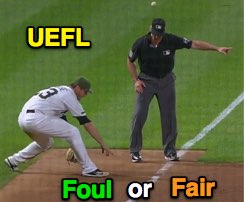
The Play: With one out and the bases loaded of a 6-2 ballgame, batter Yelich hit a line drive past third base, which bounced in front of 3B Umpire Nauert, who signaled the ball fair as Pirates third baseman David Freese pointed to the divot where the ball landed in the dirt, which was in foul territory. After a quick internal deliberation, Nauert reversed course and killed the play, stating the batted ball was a foul ball from the get-go.
Challenge: Unhappy with the call's reversal, Brewers Manager Counsell briefly argued with Nauert about his reversed call before requesting, and receiving, a Replay Review, which confirmed Nauert's final call of "foul ball."
Analysis: First of all, the batted ball is clearly foul. Every once in awhile, especially on a play that explodes right in front of an umpire (in Nauert's case, maybe a yard away—at most), it's easy to get turned around, which explains Nauert's initial fair call—he wants to make an immediate call and "fair" is the first thing that comes up. Once things settled down and Nauert had time to process the play, he realized the ball was foul and called "Time" to signify as much.
We can talk timing till the cows come home (and, elsewhere on the site—not even two weeks ago—we have talked about timing and patience, even as it relates to reversing a call in real-time), but it sure looks like Nauert got turned around here more than the usual "oh, the fielder dropped the ball" mistake we usually see. I'm not sure any amount of delay here would have helped, nor been appropriate for this particular call.
Related Post: Tmac's Teachable Moments - Little Roller Up Along First (6/28/18).
Related Post: Much Patience and Good Judgment - Reversing a Call (2/26/17).
Perception: By optics alone, it would appear to an offensive manager like Counsell that third baseman Freese's campaigning is what changed the umpire's mind when, in reality, Nauert was already staring at the ground when Freese entered the frame, likely second-guessing his initial call well before Freese showed up: maybe Freese put the cherry on top, but Nauert clearly had doubts. It's easy for a team to think the umpire is exhibiting bias or favor and to jump to accompanying conclusions, but at the end of the day, the umpire's task is to get the call right, and Nauert switching to "foul ball" after staring at the ground for a few seconds at the expense of watching the bounding ball down the left field line was an example of precisely that task.
If the third base umpire doesn't think he made a mistake, he'll follow the batted ball bounce along the wall. If the third base umpire thinks he failed to call a fair ball foul, he'll freeze his stare at its divot before realizing he can fix the erroneous call simply by calling "Time" and explaining that the ball was indeed foul.
Err on the Side of Fair: Generally speaking, a call of "fair" can be corrected to "foul" if necessary because no additional dominoes fall by reversing "fair" to "foul" other than bringing the batter and runners back and adding a strike to the count (or keeping it as a two-strike count). There are no other consequences (other than, perhaps, to the crew's pride), so this play is relatively easy to correct if the initial call is clearly erroneous, such as Nauert's was. If it happens more than roughly once per game, though, the crew's credibility will suffer.
Unring the Bell: On the other hand, a call of "foul" cannot as easily be corrected to "fair" because of the added implications of placing runners and trying to figure out what would have happened had the correct call of "fair" been made in the first place. Invariably, the offensive manager will want a baserunner from first to score and the defensive manager will want a blanket two-base award, if that (assuming the defensive manager hasn't already been ejected for losing his mind at the reversed call).
As is said, you can't unring the bell, and, in this case, the call of "foul ball" is the bell.
Replay Review is Complicated: Not all line drives to the corner umpires are eligible for replay.
Had Replay Review overturned Nauert's foul ball call (to that of a fair ball), defensive team (Pirates) Manager Clint Hurdle may have tried arguing that Nauert and Crew Chief Kerwin Danley permitted a review on a call ineligible for review.
As Nauert himself signals by tapping his foot to the dirt mark where the ball bounced in foul territory, the ball may have landed in front of Nauert, which would have disqualified the call from review: "Balls that first land in front of the set positions of the first or third base Umpire shall not be subject to review" (Replay Review Regulation V.C).
As it stands, replays indicate Nauert retreated as he sensed the ball squealing toward him, which would suggest that the batted ball indeed landed even with Nauert's "set position" (e.g., where he started the play), which would make the call eligible for review. Nonetheless, this close call pertaining to replay eligibility is yet another aspect of the play the umpire must consider, which brings us to somewhat of a Replay Review paradox.
Why Make a Big Deal of It? Answer: This is Replay Review, the technology that has made a name for itself in overturning safe calls when a runner slides half an inch off of a base, or overturning outs to safes when a middle infielder barely misses scraping a base with his foot.
The paradox, thus, is an amusing footnote that the umpire's judgment as to whether a ball has landed in front of his set position or not is, itself, not subject to replay review and cannot be challenged, all while his judgment as to whether the ball landed to the left or right of a foul line is subject to review.
In my tongue-in-cheek estimation, the foul ball call is confirmed (as it was per NY's ruling), while the determination that the ball landed even with U3 stands (again, not that this aspect of umpire judgment was even eligible for review in the first place).
As is said, in the Replay Review era, there are no neighborhood plays. If the Replay Review Regulation says that balls that land "in front" are not eligible for review, then they aren't. Not by 10 feet, and not by half-of-an-inch. Or at least until MLB rewrites the regulation.
Video as follows:
![]() |
| 3B Umpire Paul Nauert contemplates his call. |
Challenge: Unhappy with the call's reversal, Brewers Manager Counsell briefly argued with Nauert about his reversed call before requesting, and receiving, a Replay Review, which confirmed Nauert's final call of "foul ball."
Analysis: First of all, the batted ball is clearly foul. Every once in awhile, especially on a play that explodes right in front of an umpire (in Nauert's case, maybe a yard away—at most), it's easy to get turned around, which explains Nauert's initial fair call—he wants to make an immediate call and "fair" is the first thing that comes up. Once things settled down and Nauert had time to process the play, he realized the ball was foul and called "Time" to signify as much.
We can talk timing till the cows come home (and, elsewhere on the site—not even two weeks ago—we have talked about timing and patience, even as it relates to reversing a call in real-time), but it sure looks like Nauert got turned around here more than the usual "oh, the fielder dropped the ball" mistake we usually see. I'm not sure any amount of delay here would have helped, nor been appropriate for this particular call.
Related Post: Tmac's Teachable Moments - Little Roller Up Along First (6/28/18).
Related Post: Much Patience and Good Judgment - Reversing a Call (2/26/17).
![]() |
| Counsell is frustrated after losing 2 RBI. |
If the third base umpire doesn't think he made a mistake, he'll follow the batted ball bounce along the wall. If the third base umpire thinks he failed to call a fair ball foul, he'll freeze his stare at its divot before realizing he can fix the erroneous call simply by calling "Time" and explaining that the ball was indeed foul.
Err on the Side of Fair: Generally speaking, a call of "fair" can be corrected to "foul" if necessary because no additional dominoes fall by reversing "fair" to "foul" other than bringing the batter and runners back and adding a strike to the count (or keeping it as a two-strike count). There are no other consequences (other than, perhaps, to the crew's pride), so this play is relatively easy to correct if the initial call is clearly erroneous, such as Nauert's was. If it happens more than roughly once per game, though, the crew's credibility will suffer.
Unring the Bell: On the other hand, a call of "foul" cannot as easily be corrected to "fair" because of the added implications of placing runners and trying to figure out what would have happened had the correct call of "fair" been made in the first place. Invariably, the offensive manager will want a baserunner from first to score and the defensive manager will want a blanket two-base award, if that (assuming the defensive manager hasn't already been ejected for losing his mind at the reversed call).
As is said, you can't unring the bell, and, in this case, the call of "foul ball" is the bell.
Replay Review is Complicated: Not all line drives to the corner umpires are eligible for replay.
Had Replay Review overturned Nauert's foul ball call (to that of a fair ball), defensive team (Pirates) Manager Clint Hurdle may have tried arguing that Nauert and Crew Chief Kerwin Danley permitted a review on a call ineligible for review.
![]() |
| Replay: The one persisting error. |
As it stands, replays indicate Nauert retreated as he sensed the ball squealing toward him, which would suggest that the batted ball indeed landed even with Nauert's "set position" (e.g., where he started the play), which would make the call eligible for review. Nonetheless, this close call pertaining to replay eligibility is yet another aspect of the play the umpire must consider, which brings us to somewhat of a Replay Review paradox.
![]() |
| Does this ball land even with or in front of U3? |
The paradox, thus, is an amusing footnote that the umpire's judgment as to whether a ball has landed in front of his set position or not is, itself, not subject to replay review and cannot be challenged, all while his judgment as to whether the ball landed to the left or right of a foul line is subject to review.
In my tongue-in-cheek estimation, the foul ball call is confirmed (as it was per NY's ruling), while the determination that the ball landed even with U3 stands (again, not that this aspect of umpire judgment was even eligible for review in the first place).
As is said, in the Replay Review era, there are no neighborhood plays. If the Replay Review Regulation says that balls that land "in front" are not eligible for review, then they aren't. Not by 10 feet, and not by half-of-an-inch. Or at least until MLB rewrites the regulation.
Video as follows:
Labels:
Articles
,
Fair/Foul
,
Instant Replay
,
Paul Nauert
,
UEFL
,
Umpire Odds/Ends
,
Video Analysis
Subscribe to:
Posts
(
Atom
)