Thursday, October 4, 2018

Discussion of 2018 AL and NL Division Series

Join us for discussion of the 2018 American League and National League Division Series.

Umpires Mike Muchlinski (NL COL@MIL), Adrian Johnson (NL ATL@LAD), Chris Conroy (AL CLE@HOU), and Cory Blaser (AL NYY@BOS) are your game one plate umpires.

Also guaranteed plate games are Kerwin Danley and Ted Barrett (NL COL@MIL), Lance Barksdale and Gary Cederstrom (NL ATL@LAD), Chad Fairchild and Jerry Layne (AL CLE@HOU), and Dan Bellino and Mike Winters (AL NYY@BOS).
Related2018 Wild Card & Division Series Umpires (10/2/18).

Home plate umpire performance is listed following the completion of each contest according to UEFL f/x (Statcast/pitch f/x data and application of UEFL Rules 6-2-b-a [horizontal bound, "Kulpa Rule"] and 6-2-b-b [vertical strike zone, "Miller Rule"]). Non-callable pitches, such as fouls, swinging strikes, balls batted into play, pitchouts, and hit-by-pitches, are excluded from the analysis.

- 10/4, COL@MIL 1: Mike Muchlinski: pfx. 107/108 Balls + 40/44 Strikes = 147/152 = 96.7%. +1 COL.
- 10/4, ATL@LAD 1: Adrian Johnson: pfx. 111/112 Balls + 47/52 Strikes = 158/164 = 96.3%. +4 LAD.

- 10/5, CLE@HOU 1: Chris Conroy: pfx. 94/96 Balls + 44/49 Strikes = 138/145 = 95.2%. +2 CLE.
- 10/5, COL@MIL 2: Kerwin Danley: pfx. 96/96 Balls + 39/43 Strikes = 135/139 = 97.1%. +0 Nu.
- 10/5, NYY@BOS 1: Cory Blaser: pfx. 117/117 Balls + 41/51 Strikes = 158/168 = 94.0%. +0 Nu.
- 10/5, ATL@LAD 2: Lance Barksdale. pfx. 69/71 Balls + 30/32 Strikes = 99/103 = 96.1%. +2 LAD.

- 10/6, CLE@HOU 2: Chad Fairchild: pfx. 85/85 Balls + 37/39 Strikes = 122/124 = 98.4%. +0 Nu.
- 10/6, NYY@BOS 2: Dan Bellino: pfx. 109/109 Balls + 52/56 Strikes = 161/165 = 97.6%. +0 Nu.

- 10/7, MIL@COL 3: Ted Barrett: pfx. 92/92 Balls + 54/56 Strikes = 146/148 = 98.6%. +0 Nu.
Series Complete (NLDS MIL Over COL 3-0): 428/439 = 97.5%. Net Skew +1 COL.
- 10/7, LAD@ATL 3: Gary Cederstrom: pfx. 138/139 Balls + 37/40 Strikes = 175/179 = 97.8%. +0 Nu.

- 10/8, HOU@CLE 3: Jerry Layne: pfx. 122/124 Balls + 54/58 Strikes = 176/182 = 96.7%. +0 Nu.
Series Complete (ALDS HOU Over CLE 3-0): 436/451 = 96.7%. Net Skew +2 CLE.
- 10/8, LAD@ATL 4: Tom Hallion: pfx. 120/123 Balls + 35/38 Strikes = 155/161 = 96.3%. +2 LAD.
Series Complete (NLDS LAD Over ATL 3-1): 587/607 = 96.7%. Net Skew +8 LAD.
- 10/8, BOS@NYY 3: Mike Winters: pfx. 121/123 Balls + 46/51 Strikes = 167/174 = 96.0%. +1 BOS.

- 10/9, BOS@NYY 4: Angel Hernandez: pfx. 94/94 Balls + 51/54 Strikes = 145/148 = 98.0%. +1 NYY.
Series Complete (ALDS BOS Over NYY 3-1): 631/655 = 96.3%. Net Skew +0 Neutral.

The highest plate score during the 2017 Division Series was Fieldin Culbreth's 97.2% (NLDS Gm 3).
The highest plate score during the 2017 Postseason was Chad Fairchild's 97.4% (ALCS Gm 1).
The highest plate score during the 2018 Postseason, thus far, was Jim Wolf's 98.8% (AL WC Gm).

Live Blog: Join the CCS Crew LIVE for postseason discussion and analysis (requires Java):

UEFL f/x vs K-Zone and the Player-Umpire Disconnect

The postseason brings many newcomers to the website, often brought by curiosity about our home plate umpire pitch performance figures. Welcome! We’re thrilled that you are here. This article introduces UEFL f/x and how it stacks up against Statcast, Brooks Baseball graphics, Pitch f/x, K-Zone, etc.

Introducing UEFL f/x pitch tracking.
UEFL f/x is a tool that, like nearly every other pitch tracker out there, uses MLBAM's publicly available pitch location data and converts raw numbers into a determination as to whether an umpire's location-based call is correct or not. What you see on TV, on Baseball Savant, etc....it's all based on the same raw data from MLB in use here as well.

What do We Look at? UEFL f/x considers only callable pitches—that is, only pitches resulting in a call of "ball" or "strike," based on location. Swinging strikes, batted balls, foul/foul tips, hit-by-pitches, and pitchouts are excluded from the analysis.

When & Where is the Pitch Tracked? Pitches are tracked upon arrival at the front edge of home plate.

Variables: Four primary variables are considered. px is the horizontal coordinate of the baseball, as measured from the center of home plate. pz is the vertical coordinate of the baseball, as measured from the ground. sz_bot and sz_top are the bottom and top of the batter's strike zone.

Brooks thinks Altuve and Judge have identical
strike zones. UEFL f/x knows better.
Where UEFL f/x is Different: Unlike other pitch trackers, which tend to consider everything to the left of a line as a "ball" and everything to the right of the line as a "strike," UEFL f/x recognizes that error exists within the tracking computer itself (as specified by the hardware's manufacturer itself...it's as if there was a water resistant electronic measurement device with a warning not for use at a depth greater than 10 meters and most divers still tried to use it at 15 meters deep while we stayed at 10...the readings at 15 aren't as reliable as at 10, but it still technically functions) and accompanying human operator, and has instituted a procedure to address this.

Furthermore, while many trackers, such as Dylan Yep's UmpireAuditor, fail to acknowledge that baseballs possess physical properties, such as a diameter that is wider than just a singular data point, UEFL-f/x accounts for the radius of a baseball in its calculations.

Listen to our interview with Dylan in which he admits his method fails to account for the radius of a baseball, which in turn tends to exaggerate the distance he alleges umpires miss calls by, and his vow to change methodology after we brought this fundamental error to his attention. Yet several months after our interview, the methodology has yet to be corrected.
Related PostPodcast - Truth About Baseball's Electronic Strike Zone (6/5/19).

Kulpa and Miller Rules: Pursuant to UEFL Rules 6-2-b-1 and -2, the following boundaries are applied to px and pz relative to determining whether a pitch is to be considered "ball," "borderline," or "strike."
> Kulpa Rule (Rule 6-2-b-1) refers to the horizontal location (PFX value "px") and is as follows...
>> (Measures in feet, all else equal) |0| < STRIKE < |.748| < BORDERLINE < |.914| < BALL.
> Miller Rule (Rule 6-2-b-2) refers to the vertical location (PFX value "pz") and is as follows...
>> (all else equal) BALL < sz_bot + MOE < STRIKE < sz_top + MOE < BALL.

Decision Table for UEFL f/x.
Determining Quality of Correctness: When it comes to adjudicating QOC for a given pitch, a formula that resembles the accompanying UEFL f/x Parameters table is used. In sum, a pitch's px and pz variables must both be "strike" (e.g., the pitch must be located within the strike zone and not touching the borderline range) in order for a call of "ball" to be considered incorrect.

Conversely, either the px or pz must be "ball" (e.g., the pitch must be located outside of the strike zone and not touching the borderline range) in order for a call of "strike" to be considered incorrect.

Any other permutation of "ball"—"borderline"—"strike" amongst the px/pz variables will result in a ruling being deemed Correct.

Compare to: If you're looking for an analogy as to how UEFL f/x operates, look to Replay Review (the decision options, not the parts of Replay we've critiqued that need work). Correct  Confirmed, Borderline  Stands, Incorrect  Overturned.
Related PostTmac's Teachable Moments - Let's Fix Replay (1/19/17).

Philosophy Behind UEFL f/x QOC: Our mission here is to track and analyze close and controversial calls in sport, with great regard for the rules and spirit of the game. To that end, we make a determination as to Quality of Correctness on each and every pitch that produces an ejection, but also during the postseason on every callable pitch that is thrown.

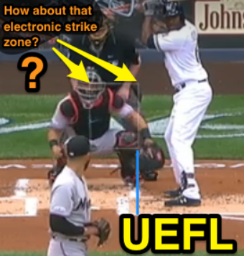
The Fox Trax/box has a significant fail rate.
PitchCast (which manifests on TV graphics as Fox Trax or ESPN K-Zone) has a statistically significant failure rate. Sometimes it fails to track pitches entirely, sometimes the ball track is incorrect, and sometimes the 'box' placement is inaccurate. The accompanying image indicates a situation in which FoxTrax's box graphic does not accurately represent the rules book strike zone.

Furthermore, Close Call Sports, and thus UEFL f/x, subscribes to the theory that an umpire’s call shall not be deemed incorrect unless evidence conclusively proves as much. Thus, a pitch ruled a “ball” with a horizontal px value in “ball” range and a vertical pz value in “borderline” range would be deemed “correct” on UEFL f/x for lack of conclusive evidence to indicate that the call was incorrect. The call would stand because we can't rely on the computer's accuracy to conclusively tell us otherwise.
Horizontal error is easier to measure.
Horizontal Error (Kulpa Rule): From the days of Pitch f/x, we know that manufacturer SportVision publicly claimed its product was accurate to within approximately one-inch. That means that, conversely, Pitch f/x was not guaranteed accuracy under that margin. Hence, we at Close Call Sports crafted two separate margin-of-error rules, one for the horizontal and one for the vertical. This value may change in the future—maybe even during this very offseason's Rules Summit—but that's what we have for now, per SMT SportVision's statement.

We'll get back to the SportVision vs MLBAM issue in a minute.

Anywho, horizontal error is pretty straightforward, as home plate is a static entity. That's how px values less than .748 feet are "always a strike," values greater than .914 feet are "always a ball," and everything in between is "borderline," subject to a vertical pz value within the appropriate range.

Another example of a subtle box malfunction.
Vertical Error (Miller Rule): Adjudicating pz QOC is a little more complicated. In addition to the aforementioned margin-of-error, pz relies on position relative to sz_bot and sz_top, as the strike zone changes for each individual batter and for each individual pitch.

What we’ve found is that baseball pitch operators will often use a player’s individualized average strike zone to set the sz_bot and sz_top boundaries, which is not a foolproof method for any one individual pitch, but likely is highly accurate when averaged out over the course of an entire season. Sometimes, the operators will manually adjust the zone to account for a player’s unique movement during a specific pitch, but let’s just say that the method of establishing the computerized tops and bottoms of the strike zone is a bit lacking.

Regardless, we took a best-fit approach to this problem and called the process that produces this corresponding borderline range the Miller Rule.

Takeaway Red Flag: Baseball doesn't know how to accurately establish sz_bot and sz_top.

UEFL vs Brooks Baseball comparison.
How This Stacks Up: UEFL f/x is unique in this approach—no other platform incorporates error, applies borderline ranges, and errs on the side of "the umpire isn't wrong unless there is ample clear and convincing evidence to prove it." Whether it's K-Zone, Brooks, Baseball Savant, etc., the ball vs strike determination takes the edge of home plate (e.g., about .831 ft for the horizontal |px|) and creates a hardline bound. If |px| is less than or equal to .831, it's deemed a strike. If greater than .831, it's a ball. No exceptions, no leeway. Brooks Baseball, to its credit, attempts to correct for calibration error in its under-the-hood numbers (but not its publicly-seen graphics), but margin-of-error is a whole other ballgame that seems to fall unaccounted for by most pitch trackers.

UEFL f/x Counterpoint: How is it fair to evaluate umpires based on computers that themselves may not have razor-sharp accuracy, could be off by a good-sized chunk of a baseball, and visualize strike zones using boxes that are 2D, not fitted for each pitch/batter, and often are calibrated incorrectly?

Example: Let’s go back to the National League Wild Card Game and HP Umpire Chris Guccione. Per UEFL f/x, using our methodology, Guccione graded out at 97.1% with a skew of +2 Chicago (a net of two more pitches favored Chicago than Colorado). Taking our involvement out of the equation and using only the raw Statcast figures, Guccione’s grade drops to 91% with a skew of +6 Chicago.

This difference helps explain one attribute as to why, as Brian Hertzog explained in Episode 3 of our Plate Meeting Podcast, players and teams see one thing while the umpire sees something entirely different.
RelatedPlate Mtg Podcast Ep 3 - Brian Hertzog (8/20/18).

Conflict Between Players and Umpires: You may recall several high-profile incidents between players such as Todd Frazier, Javier Baez, Ben Zobrist, and Carlos Gomez, over close pitches that didn’t go their way. Turning to the raw numbers of Statcast, some of these pitches appeared to have been missed.

On the other hand, the MLB Umpires Association, relative to the Carlos Gomez complaint, publicly stated that umpire Andy Fletcher didn’t miss a single pitch during the Gomez at bat.
Related PostFined - Carlos Gomez to Appeal Financial Penalty (9/25/18).

More recently, Dodgers rental Manny Machado voiced his complaint against NLDS Game 1 plate umpire Adrian Johnson over multiple strike calls. As MLBUA tweeted, the pitches were in the zone.
Gomez and Fletcher use different technologies.

This time, because it was a postseason game, we had UEFL f/x evaluate Machado's claims, and...Machado probably shouldn't have said much. Johnson's 96.3% performance actually favored Los Angeles by +4 pitches.

What we have here is a disconnect caused by multiple competing technologies and at least two different pitch calling languages. The players and teams are using one form of pitch tracking, with one set of boundaries and parameters, while the umpires are using something entirely different...and it's all based on the same raw data!

Teams and players subscribe to an absolute Brooks-style zone (which itself is misleading because the graphic doesn't account for the radius of a baseball, three-dimensional zone, and seems to think every player has the same sz_bot 1.5 / sz_top 3.5 strike zone), while the umpires subscribe to a more UEFL-like zone (though the precise technology they use is a trade secret and more generous than UEFL fx).

UEFL f/x on a Brooks Baseball plot.
No Plot Images: The accompanying "UEFL on Brooks" graphic depicts how this can be a problem. Brooks uses an algorithm to convert px and pz values to newer numbers it deems to be better fits. Invariably, this results in data points being moved about.

Brooks also doesn't show the true size of a baseball (e.g., a ball has a nearly three-inch diameter), and assumes that everyone's strike zone runs from 1.5 to 3.5 feet. This also is misleading if not wholly inaccurate (see the Jose Altuve vs Aaron Judge graphic earlier in the article).

The UEFL on Brooks graphic indicates a pitch shown by Brooks to be a called ball well within the strike zone (data point Brooks #2). The original, un-manipulated (raw) location of pitch #2 (indicated by Orig. #2) is actually located further from the center of home plate and slightly lower. The UEFL f/x Kulpa Rule's borderline range has been superimposed in blue highlight; Orig. #2 clearly falls within this borderline range, while Brooks #2 does not.

In large part because the vertical strike zone bottoms and tops change every at-bat, if not every pitch, no visual pitch plot can be accurate if it shows more than one pitch (much less more than one batter) using the same sz_bot/sz_top boundaries. For this and other similar reasons regarding the simple "busy" look of the borderline range, UEFL f/x presently uses no graphics or plots in its analysis.

In the end, conventional pitch trackers would deem Pitch #2 an incorrect ball call, fans that look at the visual pitch plots would deem Pitch #2 an incorrect ball call, but UEFL f/x would deem it a correct call in the sense of our borderline "stands" framework.

History: Once upon a time, Major League Baseball decided to invest in computerized camera tracking of pitches. We wrote about this history on Close Call Sports and encourage you to read it, from QuesTec to Pitch f/x and Zone Evaluation, Statcast, Pitchcast, and Trackman.
Related PostPitch f/x SMT Sportvision Sues MLBAM for StatCast 'Theft' (5/21/18).

SMT sued MLBAM over pitch tracking.
In 2017, MLB replaced the existing Pitch f/x technology with the inhouse Statcast equivalent. Statcast’s manufacturer, SMT Sportvision, sued MLB Advanced Media over BAM’s PitchCast component, but the important note here is that there is a public-facing product—PitchCast, served by Trackman, or what used to be Pitch f/x—and a second proprietary version, Zone Evaluation, which is both what the umpires use AND which is also not available to the public.

In other words, the players' pitch tracking system is available to the public, while the umpires' pitch tracking system is not. Thus, what system, realistically, can we expect fans at large to use—the publicly available one, or the shrouded-in-secrecy system that no one outside of one opaque department of professional baseball has access to?

UEFL f/x attempts to portray what the umpires' system might look like, but even so, UEFL f/x makes no account for poorly received pitches, catchers standing up to block out umpires, etc. UEFL f/x is solely concerned with pitch location numbers.

Referring back to the Guccione game, where UEFL f/x graded out at 97.1% while conventional trackers graded out at 91%. Take any one of those pitches that fall within that 91-97.1% differential and you’ll see that the umpire will consider the call correct, while the player—especially a Colorado player who sees a skew four pitches greater than what the umpire sees—will consider the call incorrect.

Compound this effect over the course of tens of thousands of pitches per year and the player-umpire disconnect becomes a little easier to understand.

Tuesday, October 2, 2018

Discussion of 2018 AL and NL Wild Card Games

Join us for discussion of the 2018 American League and National League Wild Card Games.

Chris Guccione (NL) and Jim Wolf (AL) are plate umpires for the two Wild Card Games (NL: Rockies @ Cubs ... AL: A's @ Yankees); Bill Miller (NL) and Gerry Davis (AL) are the crew chiefs.
Related2018 Wild Card & Division Series Umpires (10/2/18).

Home plate umpire performance is listed following the completion of each contest according to UEFL f/x (Statcast/pitch f/x data and application of UEFL Rules 6-2-b-a [horizontal bound, "Kulpa Rule"] and 6-2-b-b [vertical strike zone, "Miller Rule"]). Fouls, swinging strikes, balls batted into play, and hit-by-pitches are excluded from the analysis.

- 10/2 COL@CHC Gm 1: Chris Guccione: pfx. 123/123 Balls + 72/78 Strikes = 195/201 = 97.0%. +2 CHC.
- 10/3 OAK@NYY Gm 1: Jim Wolf: pfx. 112/112 Balls + 48/50 Strikes = 160/162 = 98.8%. +0 NU.

Note: The highest plate score during the 2017 Wild Card Games was Alfonso Marquez's 97.1% (ALWC).
The highest plate score overall during the 2017 Postseason was Chad Fairchild's 97.4% (ALCS Gm 1).

Live Blog: Join the CCS Crew LIVE for postseason discussion and analysis (requires Java):

2018 Wild Card & Division Series Umpires Roster

The 2018 American and National League (AL/NL) Wild Card Game and Division Series (ALDS/NLDS) umpire roster is as follows, sorted by round and crew assignment. The Replay Official does not join on-field umpires for MLB's first two postseason rounds.

UEFL Replay Review Ranking (Review Affirmation Percentage [RAP]) is indicated by the number in parentheses.

NL Wild Card (Colorado Rockies @ Chicago Cubs) Umpires
HP: Chris Guccione (25)
1B: Mark Wegner* (84)
2B: Bill Miller* -cc (79)
3B: James Hoye (21)
LF: Tripp Gibson (17)
RF: Gabe Morales ^1st^ (45)

AL Wild Card [WC 'B'] (Oakland Athletics @ New York Yankees) Umpires
HP: Jim Wolf (21)
1B: Greg Gibson (86)
2B: Gerry Davis* -cc (30)
3B: Alan Porter (64)
LF: Will Little (71)
RF: Pat Hoberg ^1st^ (12)

NL and AL Wild Card Game Replay Officials: Ed Hickox (8) and Sam Holbrook* (85).

NL Division Series A (Atlanta Braves @ Los Angeles Dodgers) Umpires
HP: Adrian Johnson (40)
1B: Lance Barksdale [Game 2 Plate] (45)
2B: Gary Cederstrom* -cc [Game 3 Plate] (65)
3B: Tom Hallion* [Game 4 Plate] (65)
LF: Jim Reynolds [Game 5 Plate] (45)
RF: Doug Eddings (65)

NL Division Series B (Wild Card [COL/CHC] @ Milwaukee Brewers) Umpires
HP: Mike Muchlinski (13)
1B: Kerwin Danley [Game 2 Plate] (35)
2B: Ted Barrett* -cc [Game 3 Plate] (17)
3B: Todd Tichenor [Game 4 Plate] (77)
LF: Alfonso Marquez [Game 5 Plate] (32)
RF: John Tumpane '1st DS' (1)

AL Division Series A (Cleveland Indians @ Houston Astros) Umpires
HP: Chris Conroy '1st DS' (55)
1B: Chad Fairchild [Game 2 Plate] (3)
2B: Jerry Layne* -cc [Game 3 Plate] (52)
3B: Tim Timmons [Game 4 Plate] (2)
LF: Jeff Nelson* [Game 5 Plate] (8)
RF: Andy Fletcher '1st DS' (52)

AL Division Series B (Wild Card [OAK/NYY] @ Boston Red Sox) Umpires
HP: Cory Blaser (27)
1B: Dan Bellino [Game 2 Plate] (71)
2B: Mike Winters* -cc [Game 3 Plate] (62)
3B: Angel Hernandez [Game 4 Plate] (52)
LF: Fieldin Culbreth* [Game 5 Plate] (4)
RF: DJ Reyburn ^1st^ (17)

ALDS/NLDS Replay Officials: Marvin Hudson (32), Brian Knight (6), David Rackley (32), and Bill Welke (8).

-cc denotes Game/Series Crew Chief, * denotes regular season crew chief, ^1st^ denotes first postseason assignment, '1st DS' denotes first Division Series assignment. Pursuant to UEFL Rule 4-3-c, umpires selected to appear in the Wild Card games receive one bonus point for this appearance, while umpiers assigned to the Division Series receive two points for an on-field appearance. Postseason crew chiefs receive an additional bonus point, but replay officials who do not appear on the field (e.g., Wild Card & Division Series replay personnel) do not receive points for this role.

Monday, October 1, 2018

2018 Arizona Fall League Umpire Roster

Specifically selected by supervisors to further their development in affiliated professional baseball, the following Minor League umpires will officiate the Arizona Fall League as selected from Triple-A's International (IL) and Pacific Coast League (PCL) umpiring staffs. Previous AFL experience (if applicable) and MLB call-up information is also listed.

2018 Arizona Fall League Umpire Roster:
> John Bacon. IL. 2017 Spring. 2018 MiLB Postseason.
> Adam Beck. IL.
> Blake Carnahan. IL.
> Nestor Ceja. PCL.
> Bryan Fields. PCL2017 AFL
> Dan Merzel. IL2017 Spring Training. 2018 MiLB Postseason.
> Brennan Miller. IL.
> Bryan Peterson. IL.
> Jeremie Rehak. IL2017 Spring Training2017 AFL. 2018 Spring Training RosterMLB Fill-In.*
> Jeremy Riggs. IL. 2018 MiLB Postseason.
> Alex Tosi. IL2017 Spring Training2017 AFL. 2018 MiLB Postseason.
> Junior Valentine. PCL2017 Spring Training.
> Jansen Visconti. IL2017 AFLMLB Fill-In.*

*Roster breakdown: 3 Pacific Coast League + 10 International League = 13 AFL Umpires.

Discussion and Umpires - 2018 Tiebreaker Games

Welcome to the UEFL's discussion and live blog for the 2018 NL Tiebreaker Games.

We'll begin with umpires for Milwaukee Brewers at Chicago Cubs:
HP: Fieldin Culbreth
1B: Jeff Nelson
2B: Jim Reynolds
3B: Chad Fairchild
LF: D.J. Reyburn
RF: Adam Hamari.

And Rockies-Dodgers in Los Angeles:
HP: Bill Welke, 1B: Brian Gorman, 2B: Jerry Meals, 3B: Marvin Hudson, LF: David Rackley, RF: Quinn Wolcott.

Home plate umpire performance is listed following the completion of each contest according to pitch f/x and UEFL Rules 6-2-b-a (horizontal bound, "Kulpa Rule") and 6-2-b-b (vertical strike zone, "Miller Rule").

Callable pitches (which excludes all swinging strikes, fair and foul balls, HBPs, and pitchouts) are organized by type: "ball" or "called strike."

For instance, if a line score reads "24/25 Strikes," that signifies that of 25 total pitches ruled "strike" 24 were officiated correctly, while one pitch called "strike" was located outside of the strike zone.

- 10/1 MIL@CHC Gm 1: Fieldin Culbreth: pfx. 94/96 Balls + 41/43 Strikes = 135/139 = 97.1%. +0 NU.
- 10/1 COL@LAD Gm 1: Bill Welke: px. 91/91 Balls + 35/38 Strikes = 126/129 = 97.7%. +1 LA.

Live Blog: Join the CCS Crew LIVE for the Tiebreaker Games (requires Java):

Saturday, September 29, 2018

Injury Scout - Brian Knight Works SF With Broken Foot

After a foul ball broke Brian Knight's left foot during the 6th inning of Friday's Dodgers-Giants game, the veteran home plate umpire remained in the contest until its completion, some 90 minutes and 110 pitches later.

Knight was struck by a foul in the foot.
In the top of the 6th, Dodgers batter Chris Taylor fouled several pitches from Giants starter Madison Bumgarner, one of which struck the toe portion of plate umpire Knight's left plate shoe, reportedly resulting in a fracture; Knight walked with a noticeable limp in the aftermath of the fateful foul.

Knight remained in the game, with 1B Umpire and Crew Chief Gerry Davis, 2B Umpire Todd Tichenor, and 3B Umpire Pat Hoberg maintaining their positions in the field.

In a coincidental turn of events, Knight was replaced at third base on Saturday by umpire Ed Hickox; it was Hickox in 2017 who suffered a season-ending foot injury as the result of a line drive in San Francisco.
Related PostInjury Scout - Hickox Out After Line Drive to Foot (7/26/17).

Last Game: September 28 | Return to Play: 2019 | Time Absent: Rest of Season | Video as follows:

Friday, September 28, 2018

Plate Meeting Podcast 5 - Chris Hubler & JEAPU Play

Welcome to the fifth episode of The Plate Meeting, a LF Umpire Podcast from Close Call Sports, where we talk umpiring with umpires. In episode 5, Tmac and Gil chat with MiLB veteran and Jim Evans Academy clinician Chris Hubler about his professional baseball career, JEAPU affiliation, and modern changes to the game.

We also take a phone call from the audience, a certain "Mike Gilbert" from "Fort Collins, Colorado" (29-year American League umpire Jim Evans), who asks a convoluted JEAPU-caliber quiz question about a play featuring a balk, base hit, and batting-out-of-order appeal. For extra credit, we open the Podcast up to a UEFL Case Play by adding catcher's interference to the equation (scroll down for more about this Podcast version of our UEFL Case Play series)

Click the below "play" button to hear Episode 5 - Chris Hubler's View and Jim Evans' Play, Too, or visit the show online at https://anchor.fm/the-plate-meeting to subscribe. The Plate Meeting is also available through the iTunes store's podcasts section (The Plate Meeting on iTunes), Google Podcasts, TuneIn, and other podcast providers listed on the Anchor.fm page.

Additional Links, Videos, and Other Media:
The following section contains relevant links, footnotes, or additional commentary relative to subjects discussed on the show. Click the following links for this episode to access the relevant videos.

The Plate Meeting is brought to you by OSIP, where Outstanding Sportsmanship Is Paramount.


Donate/Store Buttons
Support the UEFL
Shop the CCS Store.
Follow us on Twitter 🐦 (@UmpireEjections) and like on Facebook 👍 (/UmpireEjections).

Related Link: Jim Evans Academy of Professional Umpiring's 2018 California Classic (10/22-10/27).

Related Link: United Umpires Profile of Chris Hubler || Force 3 Pro Gear.

UEFL Case Play 2018-9 - The JEAPU Balk and Catcher's Interference Puzzler
Straight from the Podcast to a Case Play! With a runner on third and less than two out, the pitcher is called for a balk during his delivery. He nonetheless completes his pitch and the batter swings and hits a line drive to right field, easily jogging to first base safely, as the plate umpire calls catcher's interference because during his swing, the batter's bat touched the catcher's glove. Baserunner R3 remains on third base for the entirety of the play. After the umpires call "Time," the defensive manager appeals to the plate umpire that the offense has batted out of turn. The UIC confirms that the offense indeed sent the improper batter to the plate. What's the call?

Injury Scout - Fletcher Leaves on Lower Leg Limp

Andy Fletcher left Friday's Yankees-Red Sox game following a lower leg injury sustained while making a call on a ball hit off the Green Monster at Fenway Park.

In the top of the 4th inning, Yankees batter Miguel Andujar hit a fly ball to the left field wall, fielded by Red Sox outfielder Andrew Benintendi, who threw to second baseman Ian Kinsler as Andujar slid into second base, Fletcher ruling the runner safe as he hopped back to the infield, appearing to favor his right calf.

Fletcher subsequently left the game, as 1B Umpire Manny Gonzalez and 3B Umpire and crew chief Jeff Nelson managed the bases with HP Umpire Laz Diaz remaining behind the plate.

Relevant Injury History: N/A.

Last Game: September 28 | Return to Play: October 5  | Time Absent: 6 Days | Video as follows:

Thursday, September 27, 2018

MLB Ejections 178-179 - Vic Carapazza (2-3; NYY x2)

HP Umpire Vic Carapazza ejected Yankees pitcher CC Sabathia and Manager Aaron Boone (throwing at Rays batter Jesus Sucre after warnings; QOCU) in the bottom of the 6th inning of the Yankees-Rays game. With none out and none on, Rays batter Sucre took a first-pitch cutter from Sabathia for a hit-by-pitch. Replays indicate the pitch was located inside and struck Sucre in the left thigh; warnings had previously been issued after a prior inside pitch, the call was irrecusable. At the time of the ejections, the Yankees were leading, 11-0. The Yankees ultimately won the contest, 12-1.

These are Vic Carapazza (19)'s second and third ejections of 2018.
Vic Carapazza now has 13 points in the UEFL Standings (9 Prev + 2*[2 MLB + 0 Irrecusable] = 13).
Crew Chief Jerry Layne now has 7 points in Crew Division (5 Previous + 2*[1 Irrecusable Call] = 7).

This is the 178th and 179th ejection report of the 2018 MLB regular season.
This is the 87th player ejection of 2018. Prior to ejection, Sabathia's line was 5.0 IP, 0 ER.
This is the 73rd Manager ejection of 2018.
This is NY-AL's 10/11th ejection of 2018, 1st in the AL East (NYY 11; TOR 10; BOS 5; BAL, TB 3).
This is CC Sabathia's 2nd ejection of 2018, 1st since July 7 (Lance Barrett; QOC = Y [Balls/Strikes]).
This is Aaron Boone's 4th ejection of 2018, 1st since August 31 (Nic Lentz; QOC = Y [Balls/Strikes]).
This is Vic Carapazza's 2/3rd ejection of 2018, 1st since April 17 (Albert Pujols; QOC = Y [Balls/Strikes]).

Wrap: New York Yankees vs. Tampa Bay Rays, 9/27/18 | Video as follows: